Igor Evgenyevich Irodov

Perhaps the most commonly known book for Problems and Solutions in Physics preparing for all the competitive exams in India is Problems in General Physics by I. E. Irodov. This book is still in print from CBS Publishers in Delhi and hugely popular. It is supposed to the problem book in Physics. The book has the typical style of all books (listed here previously on this blog) of first topically giving problems and then in the later part of the book giving solutions. This is what the inside cover of the hardbound edition says about the book.

The book is intended for college undergraduates majoring in Physics. It contains about 2000 problem covering the major areas of Physical science: mechanics, thermodynamics, molecular physics, electrodynamics, oscillations and waves, optics, atomic and nuclear physics. Each section is preceded by a short summary of appropriate formulas whose total number exceeds 300. The answers to all of the problems are given at the end of volume. Most difficult problems are provided with explanations. Moreover, the author presents some general hints helping the undergraduate to tackle physical problems. Problems in General Physics is an excellent book which may serve as a valuable supplement to any college course on the subject.

This book, I think was one of the first Mir Books to be available as a scanned copy, perhaps due to the immense popularity of the book. There are also many solution sets to the book by different Indian authors.

You can download the book from here and here. (All credits to the Original Uploader)

This book was reprinted many times in the English edition. The first English edition appeared in 1981 was translated from Russian by Yuri Atanov. The link has the Third Reprinting of the book in 1988. This is also one of the last books published by Mir, which has an ISBN number (ISBN: 5030008004).

A little about the author from the backside cover of the book:

Igor Evgenyevich Irodov, Candidate of Science (Physics and Mathematics), Professor of General Physics, has published a number of scientific papers and books, among which are several manuals: Fundamental Laws of Mechanics, Problems in General Physics, A Laboratory Course in Optics. His Problem Book on Atomic and Nuclear Physics appeared in six Russian editions, and was published in Great Britain, USA, Romania and twice in Poland.

A Problem Book on General Physics (with I. V. Savelyev and O. I. Zamsha as co-authors) was printed three times in Russian and published in Poland. Mir Publishers have translated it into French; its publication in Arabic and Vietnamese is expected.

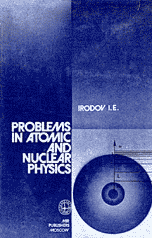
Apart from this popular book in India, Irodov has also written another problem book titled Problems and Solutions in Atomic and Nuclear Physics, which seems to be popular else where. This is most probably out of print and is a rare book to find and has over 1000 problems of varying difficulty. The Mir edition in English was first published in 1983 and was translated from Russian by Yuri Atanov.

You can download the book from here and here.

Two more books of Irodov which are still in print, thanks to CBS Publishers are Fundamental Laws of Mechanics and Basic Laws of Electromagnetism. Again both of these books were translated from the Russian by Yuri Atanov.

Fundamental Laws of Mechanics was first published in English by Mir in 1980. Currently there is 2002 reprint still in stock from CBS Publishers.
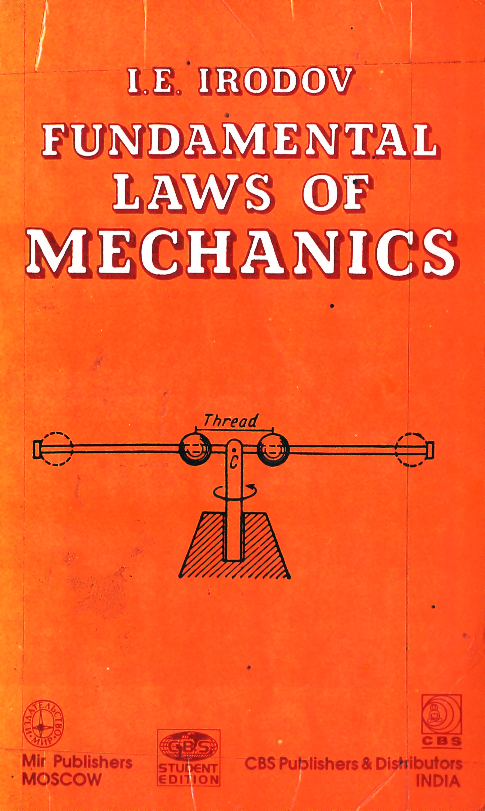
The objective of this book is to draw the readers’ attention to the basic laws of mechanics, that is, to the laws of motion and to laws of conservation of energy, momentum and angular momentum, as well as to show how these laws are to be applied in solving various scientific problems. At the same time author has excluded all things of minor importance in order to concentrate on questions which are hardest to comprehend.

The book consists of two parts: (1) classical mechanics and (2) relativistic mechanics. In the first part the laws of mechanics are treated in the Newtonian approximation i.e. when motion velocities are much less than the velocity of light, while in the second part of the book velocities comparable to that of light are considered.

Each chapter opens with a theoretical essay followed by a number of the most instructive and interesting examples and problems, with solutions provided. There are about 80 problems altogether; being closely associated with the introductory text, they develop and supplement it and therefore their examination is of equal inportance.

A few corrections and refinements have been made in the present edition to stress the physical essence of the problems studied. This holds true primarily for Newton’s second law and the conservation laws. Some new examples and problems have been provided.

The book is intended for first-year students of physics but can also be useful to senior students and lecturers.

You can download this book from here and here.

Another jewel is the book on electromagnetism and its title is Basic Laws of Electromagnetism.
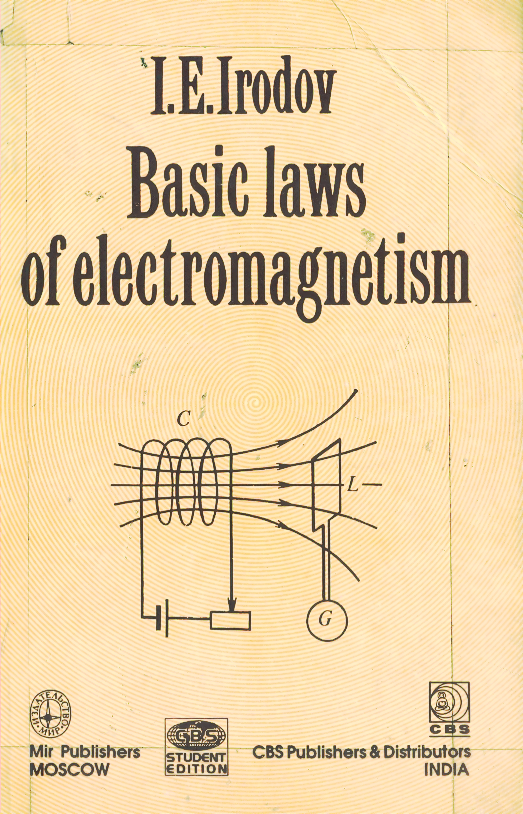
The main idea The main idea behind this book is to amalgamate the description of the basic concepts of the theory and the practical methods of solving problems in one book. Therefore, each chapter contains first a description of the theory of the subject being considered (illustrated by concrete examples) and then a set of selected problems with solutions. The problems are closely related to the text and often complement it. Hence they should be analYfed together with the text. In author’s opinion, the selected problems should enable the reader to attain a deeper understanding of many important topics and to visualize (even without solving the problems
but just by going through them) the wide range of applications of the ideas presented in this book.
In order to emphasize the most important laws of electromagnetism, and especially to clarify the most difficult topics, the author has endeavored to exclude the less important topics. In an attempt to describe the main ideas concisely, clearly and at the same time correctly, the text has been kept free from superfluous mathematical formulas, and the main stress has been laid on the physical aspects of the phenomena. With the same end in view, various model representations, simplifying factors, special cases, symmetry considerations, etc. have been employed wherever possible. SI units of measurements are used throughout the book. However, considering that the Gaussian system of units is still widely used, we have included in Appendices 3 and 4 the tables of conversion of the most important quantities and formulas from SI to Gaussian units.
The most important statements and terms are given in italics. More complicated material and problems involving cumbersome mathematical calculations are set in brevier type. This material can be omitted on first reading without any loss of continuity. The brevier type is also used for problems and examples.

The book is intended as a textbook for students specializing in physics for undergraduate students specializing in physics (in the framework of the course on general physics). It can also be used by university teachers.

This book can be downloaded from here and here.

In the books attributed to Irodov above, I could not find any data on the book mentioned on the side cover of Problems in General Physics namely, A Laboratory Course in Optics. I tried worldcat, but there seems to be no entry for this particular book in English. So, I do not know whether an English edition of this book was ever published. Also, I do not know whether there are any books of Irodov which were translated into Indian languages. So please let me know if this is the case.

So this was my humble tribute to the great teacher and instructor of physics, from whom generations of physicists and technical students have benefitted immensely.

Facing Problems: See FAQs

Please post alternative links in Comments!
Posted in books, mir books, mir publishers, soviet | Tagged , , , , | 74 Comments

Buy New Mir Books Now!

Yes!

This is a once in a lifetime chance!!

You can see the catalog of Mir books  that Rajan has on his website:

Some of the titles are quite rare and are reasonably priced.

I have recently purchased some books from there.

Hope you too!!

P.S. I know of the following site which has a lot of Mir Books. But they are priced in euros and are at times too high:

http://urss.ru

There are books in many European and Indian and Arabic languages as well.


Posted in books, foreign languages publishing, little mathematics library, mir books, mir publishers, progress publishers, raduga publishers, science for everyone, soviet | Tagged , , , , , , , | 33 Comments

Tarasov and Tarasova

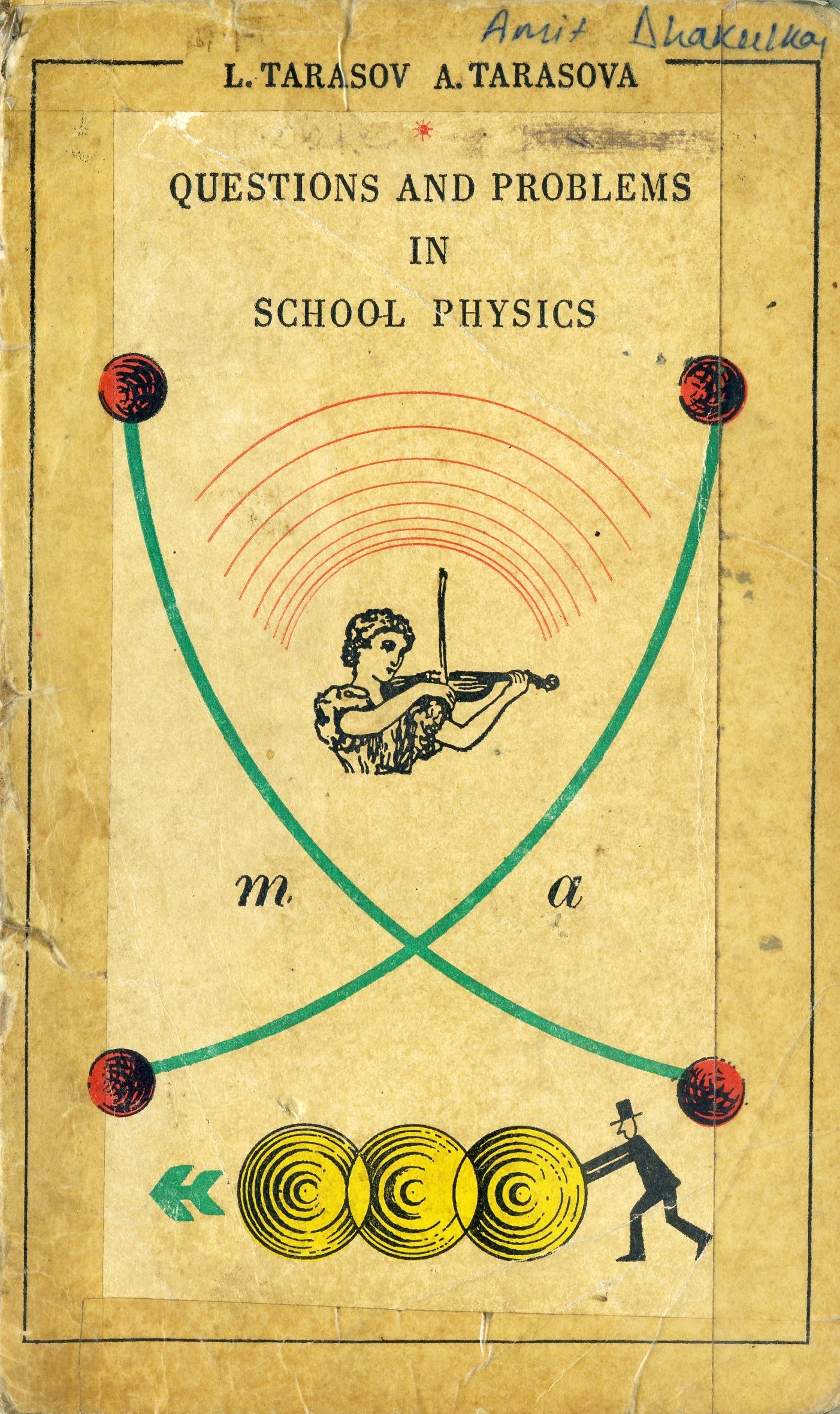
One of the very first physics books that I had purchased in Nagpur from the used book sellers which was not a story book was a book by Aldina Tarasova and Lev Tarasov. The title of the book was Questions and Answers in School Physics. The book was written in style of dialogue between a teacher and students, with misconceptions of the students explored in all branches of basic physics at the school level.

To put it in the words of the authors themselves:

(Reader) will find this text to be perhaps more like a freely told story or, rather a freely conducted discussion.

This is a book on physics education. But apart from this book there are other wonderful books by these authors. The English edition of this book was published in 1973 and was translated from the Russian by Nicholas Weinstein.

You can download this wonderful book from here and here.

Electronic copy typeset in LaTeX here and here.

I do not know if there are translations of this book in Indian languages, if you know of any please let me know.

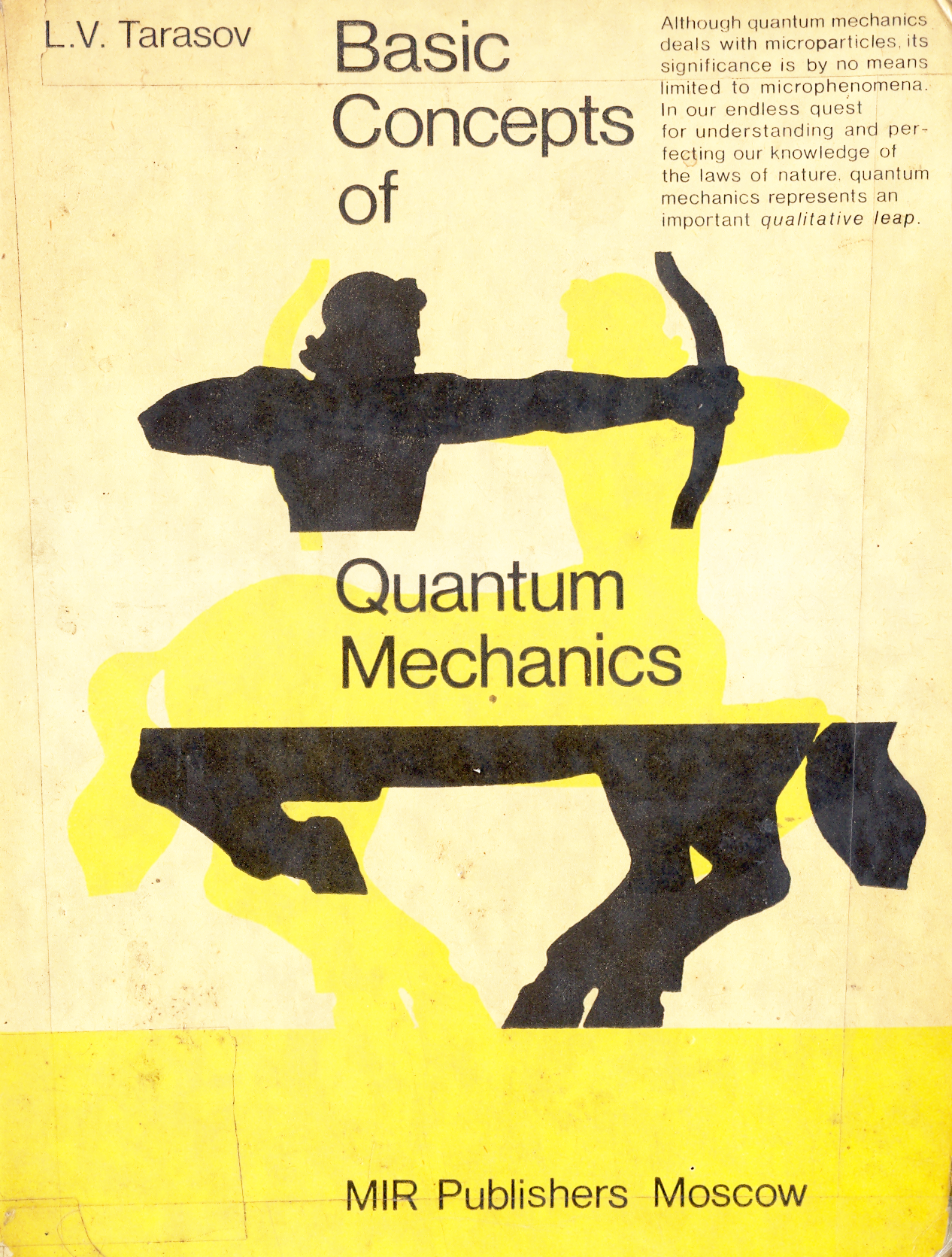
The second book that I got of Tarasov was Basic Concepts of Quantum Mechanics. This is again a gem of a book. Many of my misconceptions in Quantum Mechanics got cleared from this book. The book also has prelude and interlude where a classical physicist and a quantum physicist (the author) argue about many interesting physical and philosophical matters pertaining to physics.

The aim of this book is to acquaint the reader with the concepts and ideas of quantum mechanics and the physical properties of matter; to reveal the logic of its new ideas, to show how these ideas are  embodied in the mathematical apparatus of linear operators and to demonstrate the working of this apparatus using a number of examples and problems of interest to engineering students.

The English edition was published in 1980. I definitely know that there is a Bengali version of this book, but am unaware of any other translations in Indian languages. Please let me know any other Indian languages that you are aware of.

You can download this book from here and here.

Electronic copy typeset in LaTeX here and here.

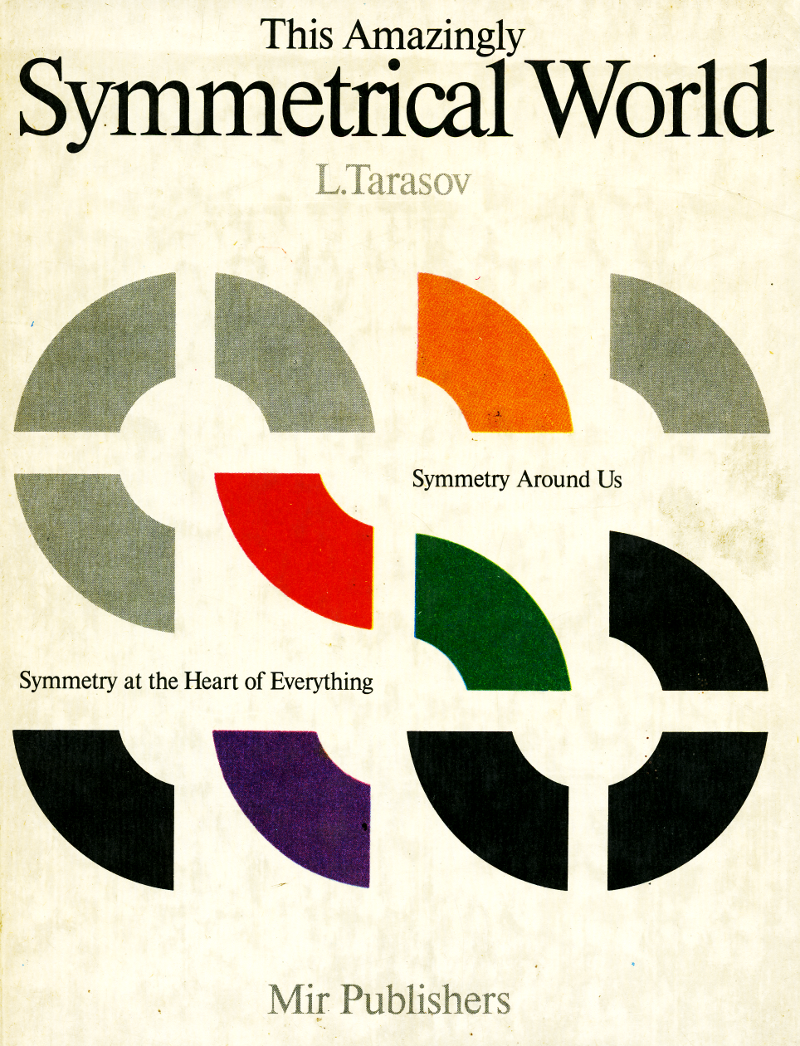
One more amazing book by Lev Tarasov is titled This Amazingly Symmetrical World. This book explores the concept of symmetry starting from everyday concepts and going all the way upto symmetry in Quantum Mechanics. This is one of the few Mir books which were technical and was printed completely in color. I know only of English hardbound edition of the book. I do not know if translations in other Indian languages exist.

You can get the book here and here.

Electronic copy typeset in LaTeX here and here.

Calculus by Tarasov is one of the most elusive books that I have been after. I was told by someone that this book exists, I did not see any advertisement of this book, in the back of any book. And I searched in vain in all the libraries and contacts that I have, but could not find it. Then a friend of mine located it through the wonderful internet resource called http://worldcat.org . This particular website has catalogs of books from the thousands of libraries of the world, and what is interesting is that, if your library is part of their network then you can get books from other libraries as inter-library service. So he got hold of the book (in a month’s time ) and send me a scanned copy.

Thanks to Anish.Dot for the scan.

You can download the book from here and here.

Electronic copy typeset in LaTeX here and here.

Another copy of the book can be obtained here. Thanks to Dr. Narayanan for this copy.

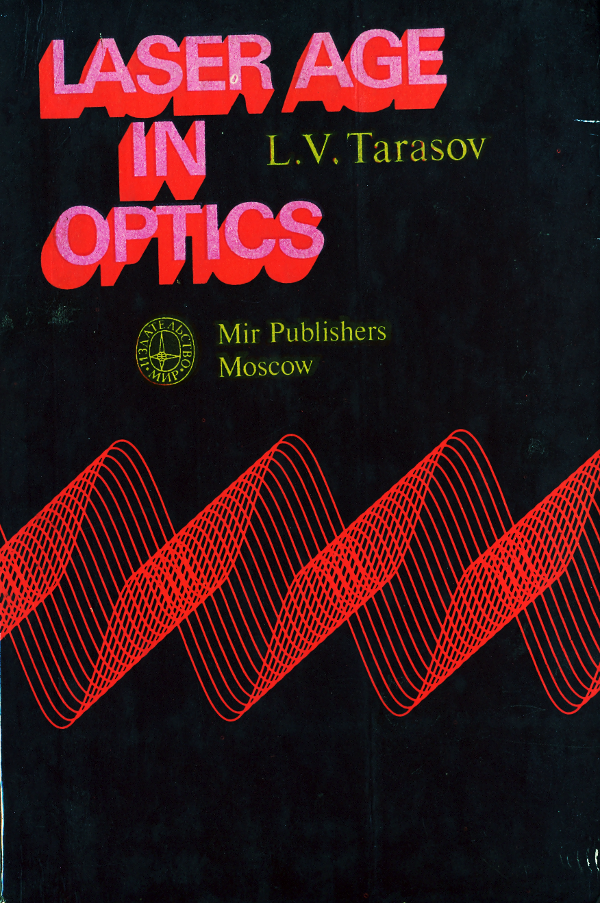
Lev Tarasov has also written 3 books on lasers. Their titles are Laser Age in Optics, Laser Physics and Applications and Laser Physics. In this I do not have the last one. Laser Age in Optics is a popular science book concerned with new trends in optics arising from development of the laser. The book has clear and concise description of many of the concepts in lasers and holograms and many things which are usually ignored are also talked about and is presented for a school level student.


Laser related books


The English edition was first published in 1981 by Mir Publishers. The book titled Laser Physics and Applications (English translation published in 1986) is a bit more technical and can be a good textbook for beginners of a laser course. I have not seen the contents of the book just titled Lasers, the English edition was published in . I do not know if there are translations of any of these 3 book in Indian languages.

Laser Age in Optics here and here

Laser Physics here and here

Laser Physics and Applications here and here

Discussions on Refraction of Light: I have given description of this book in the Science for Everyone series. But I am mentioning this book again with some details. The book is lively and written with lot of historical anecdotes and good problems at the end of each chapter.

Why does a beam of light change its direction when passing through the interface between two media? Why does the setting sun appear oblate on the horizon? What causes mirages? Why does a prism disperse sunlight into different colours? How can one calculate the angular dimensions of a rainbow? Why do distant objects appear close when we view them through a telescope? What is the structure of the human eye?  Why does a light ray get broken into two in a crystal? Can the plane of the polarization of a ray be turned?  Can light rays be bent at will?  Is the refractive index controllable?

This book will give the reader answers t o all these questions. He will get to know how the law of refraction was discovered, how Newton’s theory of the refraction of light in the atmosphere was nearly lost forever, how Newton’s experiments changed radically the old ideas concerning the origin of colours, how the telescope was
invented, how it took twenty centuries to understand the anatomy of  human vision, and how difficult it was t o discover the polarization of light.  To make the historical and the physical aspects of the book more convincing, the authors have introduced a number of problems and their detailed solutions, geometrical constructions, and optical diagrams of some instruments and devices. No doubt, the reader will get a better understanding of some excerpts from the classics of physical optics (for example, Newton’s “Optics” or Huygens’ “Treatise on Light”) after they have been illustrated with the help of diagrams, constructions and concrete problems.  Thus, as he explores the world of refracted rays, the reader will be able to familiarize himself not only with the physics of the topics being considered but also with the evolution of some of the concepts of physics and their practical applications to problems, constructions and optical schemes. It is the authors’ hope that this journey will be both instructive and enjoyable.

This book was first published in English in 1984 by Mir in the Science for Everyone series. This was found by using world cat mentioned above.

You can download the book from here and here.

I do not know if there are translations of these books in other Indian languages.

So these are some of the books by the wonderful authors to whom I am grateful for a lot of things that they have taught me from their books. And I think a lot many people who are out there who will have a resonating feeling inside them. If there are any other books by Lev Tarasov and Aldina Tarasova that are not mentioned here please let me know.

Update: Gordon has pointed out another book by Tarasov it is titled The World is Built on Probability  and was published by Mir in 1988. It was translated from the Russian by Michael Burov. I have not seen this book, so lets hope this one gets through to the electronic media soon. Okay we have the book.

The World is Built on Probability by Lev Tarasov here and here.

Completely Electronic edition here and here.

tarasov the world is built on probability

Want Magnet Links/ Torrents, go here.

Problems? See FAQs

Posted in books, mir books, mir publishers | Tagged , , , , , , | 78 Comments

Yakov Perelman

“to whet thirst for knowledge, to evoke the desire for further reading”.

Chances are that  one of the first book that actually interested you in mathematics and physics was that of the incredibly talented writer Yakov Perelman. There are numerous books by Perelman which have been published and translated in numerous languages. In India I have seen his works in Marathi, Hindi, Telugu, Tamil, Bengali, Kannada (thanks to Shashi for pointing this out. Still in print! check the comment by Shahsi) and Gujarati at least, (there may be many more of which I am not aware of). If you know of any other translations in Indian languages please let us know. The books also exist in a lot of other European languages.

The wikipedia page referred to above, lists the books by Perelman as below. Each one is a gem.

You can get the book here

here and here


In this the Physics for Entertainment, has been published as a two volume series, especially in the regional languages of India. Many of the books were published under different titles, as publishers, long after Perelman was gone, continued to print the books. This led to different editions of the books, with different graphics supporting them over the years.

The following foreword by the editor of the Physics Can Be Fun that I have describes it more aptly:

Perelman’s Physics for Entertainment owes its wide popularity to the rare talent of its author who was able to single out and present in an entertaining form ordinary facts and phenomena that have a deep physical meaning.

The aim of the book is not so much to give you some fresh  knowledge, as to help you “learn what you already know”. In other words, the idea is to brush up and enliven your basic knowledge of physics, and to teach you how to apply it in various ways. To achieve this purpose, conundrums, brain-teasers, entertaining anecdotes and stories, amusing experiments, paradoxes and unexpected comparisons – all dealing with physics and based on everyday experience and science fiction are included. The author quotes extensively from Jules Verne, H. G. Wells, Mark Twain and other writers, because besides providing entertainment, the fantastic experiments these writers describe may well serve as instructive illustrations at physics classes.

On the other hand, you will find very little in the way of parlor tricks or spectacular experiments. The book seeks to stimulate you thinking along scientific lines and to amass associations with a variety of things from everyday life. This English language edition is a translation from the 21st Russian edition of Physics for Entertainment, Book 1 and Book 2. Chapters from 11th to 20th are Book 2. Although the two halves of the book are essential independent and can be read in any sequence, the last ten chapters are, by and large, meant for the more advanced reader.

Perelman once noted that Physics for Entertainment has been written not to leave an inquisitive mind satisfied. On the contrary, its task is “to whet thirst for knowledge, to evoke the desire for further reading”.


I will be soon adding some more wonderful covers of the books and the art contained within those books.

I will reproduce here what one of the editors of Physics Can Be Fun wrote about Perelman in the opening pages of the book:

 In 1913 in Russian bookshops appeared a book by the outstanding educationalist Yakov Isidorovich Perelman entitled Physics for Entertainment. It stuck the fancy of the young who found in it the answers to many of the questions that interested them.

Physics for Entertainment not only had an interesting layout, it was also immensely interactive.

In the preface of the 11th edition Perelman wrote: “The main objective of Physics for Entertainment is to arouse the activity of scientific imagination, to teach the reader to think in the spirit of the science of physics and to create in his mind a wide variety of associations of physical knowledge with the widely differing facts of life, with all that he normally comes in contact with.”

Physics for Entertainment was a best seller.
Y. I. Perelman was born in 1882 in the town of Byelostok (now in Poland). In 1909 he obtained a diploma of forester from the St. Petersburg Forestery Institute. After the success of Physics for Entertainment Perelman set out to produce other books, in which he showed himself to be an imaginative popularizer of science. Especially popular were Arithmetics for Entertainment, Mechanics for Entertainment, Geometry for Entertainment, Astronomy for Entertainment, Figures for Fun, Physics Everywhere, and Tricks and Amusements. Today these books are known to every educated person in the Soviet Union.

He has also written several books on interplanetary travel (Interplanetary Journeys, On A Rocket to Stars, World Expanses,
etc.). The great scientist K. E. Tsiolkovsky thought highly of talent and the creative genius of Perelman. He wrote of him in the preface to Interplanetary Journeys: “The author has long been known by his popular, witty and quite scientific works on physics, astronomy, and mathematics, which are moreover written in a marvellous language and are very readable.”

Perelman has also authored a number of textbooks and articles in Soviet popular science magazines.

In addition to his educational, scientific and literary activities,
he has also devoted much tie to editing. So he was the editor of
the magazines Nature and People and In The Workshop of Nature.

Perelman died on March 16 1942, in Leningrad.

Many generations of readers have enjoyed Perelman’s fascinating
books, and they will undoubtedly be of interest for generations to
come.

Posted in mir books, mir publishers, soviet | Tagged , , , , , , , , | 32 Comments

Purchased mirtitles.org

After some deliberation I have purchased domain for this blog:

http://mirtitles.org

The old link at https://mirtitles.wordpress.com will redirect to the new domain.

Thanks for all the inputs and encouragements from all people who have visited this blog.


Posted in meta | 3 Comments

Popular Science Books – 1

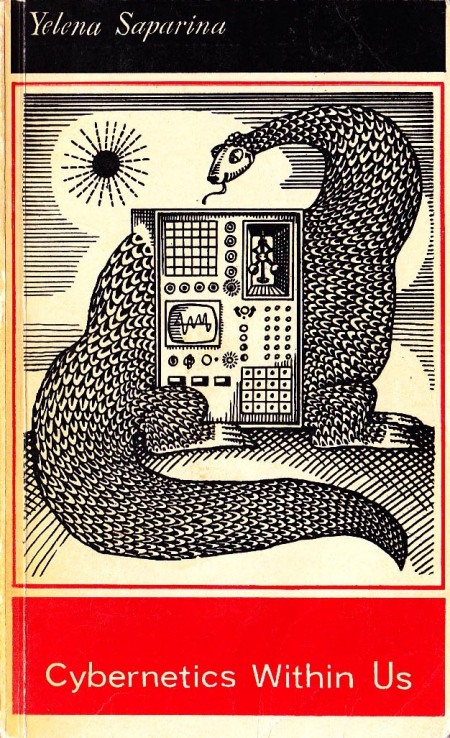
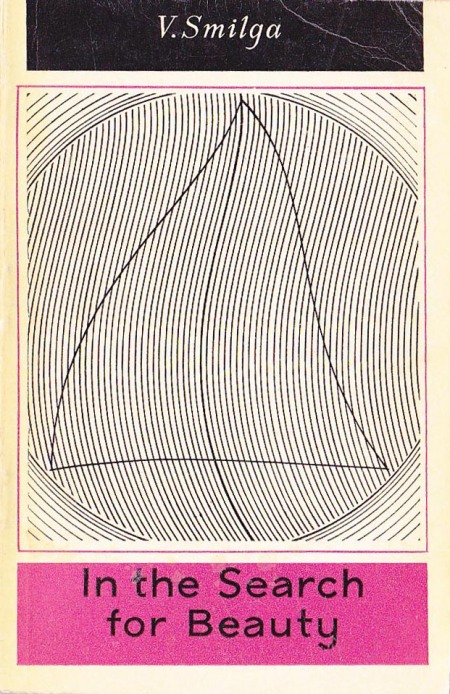
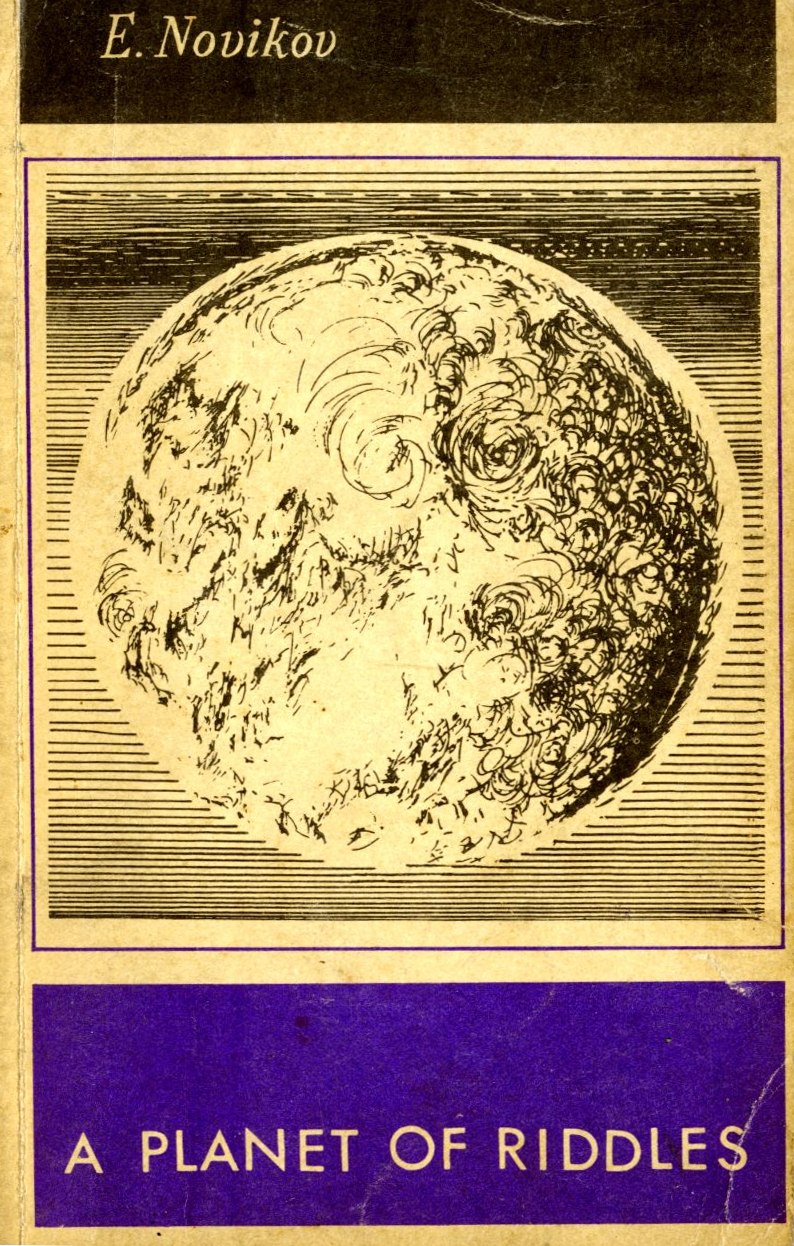
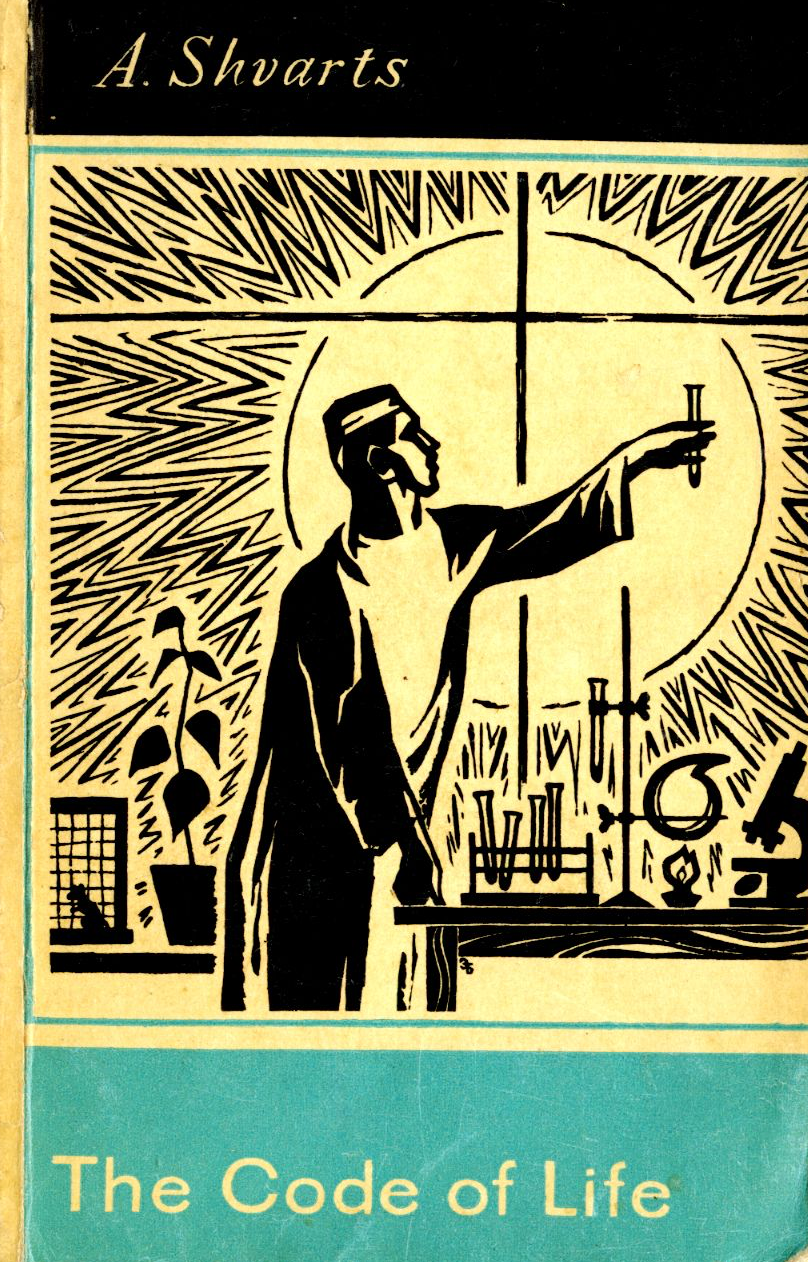
In this post I am highlighting some of the books in the popular science series published by Mir. The time of publication is from late 60s to early 70s. The books are in varied subjects and disciplines and the reason that I am posting them together is that their covers are in the same design style. A black band at top of the cover, with the authors name in white font. The title of the book is at the bottom with a colored band as the foreground. The color of the lower band depended on the overall design of the cover and the colors used there.

Title Author Year Pages
1 Sounds and signs A. Kondratov 1969 286
2 Planet of riddles E. Novikov 1972 255
3 The quiet sun N. V. Pushkov, B. I. Silkin 1968 242
4 The moon and man M. Rebrov, G. Khozin 1967 117
5 The code of life A. Shvarts 1966 267
6 How Reliable is the brain? E. Asratyan, B. Belitsky, P. Simonov 1966 179
7 The mystery of the earth’s mantle A. Malakhov 1966 246
8 Cybernetics within us Y. Saparina 1966 313
9 In the search for beauty, V. Smilga. 1970 343
Posted in books, mir books, soviet, Uncategorized, used books | Tagged , , , , , | 17 Comments

Problem books in Physics

Mir also published a number of Problem Books in Physics and Mathematics. In this post we will looking at problem books in Physics. The most famous of these in India is the one by Irodov. Problems in General Physics is an indepensible book for those who are trying to get through to touch exams. So popular is the book that many Solutions to the book have been publised, which discuss the problems when they are solved.

The typical format the books have two sections:

1. Questions and problems

2. Solutions to Problems

Sometimes the solutions are discussed, as how to arrive at them and what is the significance, but for simpler problems [simple according to the authors] only the numerical values are given.  Here is a list of the problem books that I know of [was helped by a friend in compiling this list]

S. P. Myasnikov, T. N. Osanova

Title Authors Year Pages
1 Problems in General Physics V. S. Wolkenstein, G. Leib, A. Troitsky 1975 349
2 Problems in Physics V. G. Zubov, V. P. Shalnov 1974 290
3 Problems in elementaty physics I.P. Gurskii. 1987 510
4 Problems in Physics A.A. Pinsky 1980 333
5 Problems in School Physics I.V. Savelyev 1984 302
6 Collected problems in physics S. Kozel, E. Rashda, S. Slavatinskii 1986 181
7 General Methods of Solving Physics Problems B.S. Belikov 1984 285
8 Problems in Theoretical Physics L. G. Grechko et al. 1977 447
9 Problems in Physics N.I. Goldfarb 1990 378
11 Physics problems for the technician R.A. Gladkova, L.S. Zhdanov. 1982 404
12 Selected questions and problems in physics R. Gladkova and N. Kutylovskaya 1989 357
13 Problems in General Physics I.E. Irodov 1981 386
14 A collection of questions and problems in Physics L.A. Sena. 1988 335
15 Questions and Problems in School Physics L V Tarasov; A N Tarasova 1987 238
16 Problems in Elementary Physics B. Bukhovtsev … [et al.] 1973 438
17 Problems in Atomic and Nuclear Physics I.E. Irodov 1983 283
18 A collection of problems on the equations of mathematical physics V. S. Vladimirov (Ed.) 1986 284
A Collection of Problems on The Equations of Mathematical Physics A.V. Bitsadze, D.F. Kalinichenko 1980 332
21 Key problems of physics and astrophysics

(Though not a problem book in the sense of this post, discusses lot of research problems which were unsolved, worthy of being researched)

V.L. Ginzburg 1978 167
22 Physical problems for Robinsons V. Lange 1976 134
23 Selected problems on physics S. P. Myasnikov, T. N. Osanova 1990 476
24 Problems of Crystal Physics with Solutions N. V.Perelomova, M. M. Tagieva. 1983 336
25 Collection of Problems on the Dynamics of a Point in a Central Force Field Ye. N. Polyakhova 1974 145
27 Collection of Problems in Theoretical Mechanics V. Meshchersky 1968 307
28 Problems In Mathematical Physics With Solutions I. V. Misyurkeyev 1966 168
29 Problems in Undergraduate Physics V. L. Ginzburg, L. M. Levin, M. S. Rabinovich and D. V. Sivukhin, E. S. Chetverikova,  S. P Streklov, I. A. El’stin and S. E. Khaikin,  I. A. Yakovlev 1965 Volume 1 – 208

Volume 2 – 220

Volume 3 – 296

Volume 4 – 260

30 Problems On The Equations Of Mathematical Physics M. M. Smirnov 1967 108
31 Problems in Physics P. L. Kapitza 19
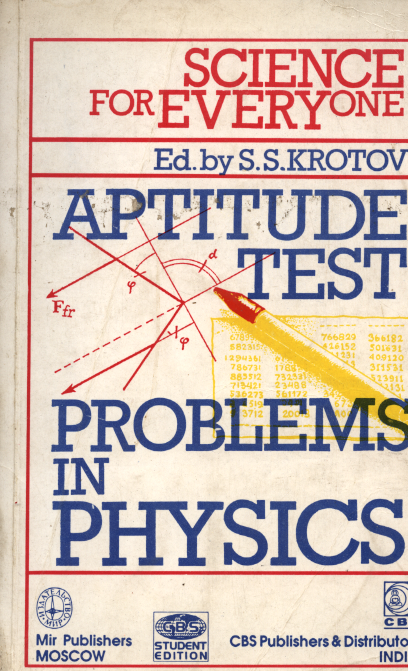
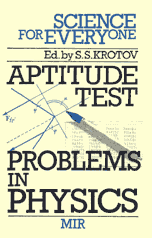
32 Aptitude Test Problems in Physics S. Krotov (Ed.) contributing authors A. I. Buzdin, V. A. Il’lin, I. V. Krivchenkov, N. A. Sveshnokov 1990 310
Collection Of Problems In Classical Mechanics G. L. Kotkin; V. G. Serbo 1971 288
A Collection Of Problems On Mathematical Physics B. M. Budak; A. A. Samarskii; A. N. Tikhonov 1964 733
Problems In Electrodynamics V.V. Batygin; I.N. Toptygin 1964 513
Problems In Quantum Mechanics I.I. Gol’dman, V.D. Krivchenkov, V.I. Kogan, V.M. Galitskii and edited by D. Ter Haar 1975 489
Posted in books, mir books, mir publishers, soviet, Uncategorized | Tagged , , | 45 Comments

Physics For Everyone

The great Lev Landau along with Alexander I. Kitaigorodsky published a volume on popular physics titled Physics for Everyone. This one volume was later expanded into 4 volumes by Kitaigorodosky.

Title Author Year Pages
Physics for Everyone: Motion, Heat L. D. Landau, A. I. Kitaigorodsky 1978 478
Physics for Everyone – Book 1 – Physical Bodies L. D. Landau, A. I. Kitaigorodsky 1980 248
Physics for Everyone – Book 2 – Molecules L. D. Landau, A. I. Kitaigorodsky 1980 244
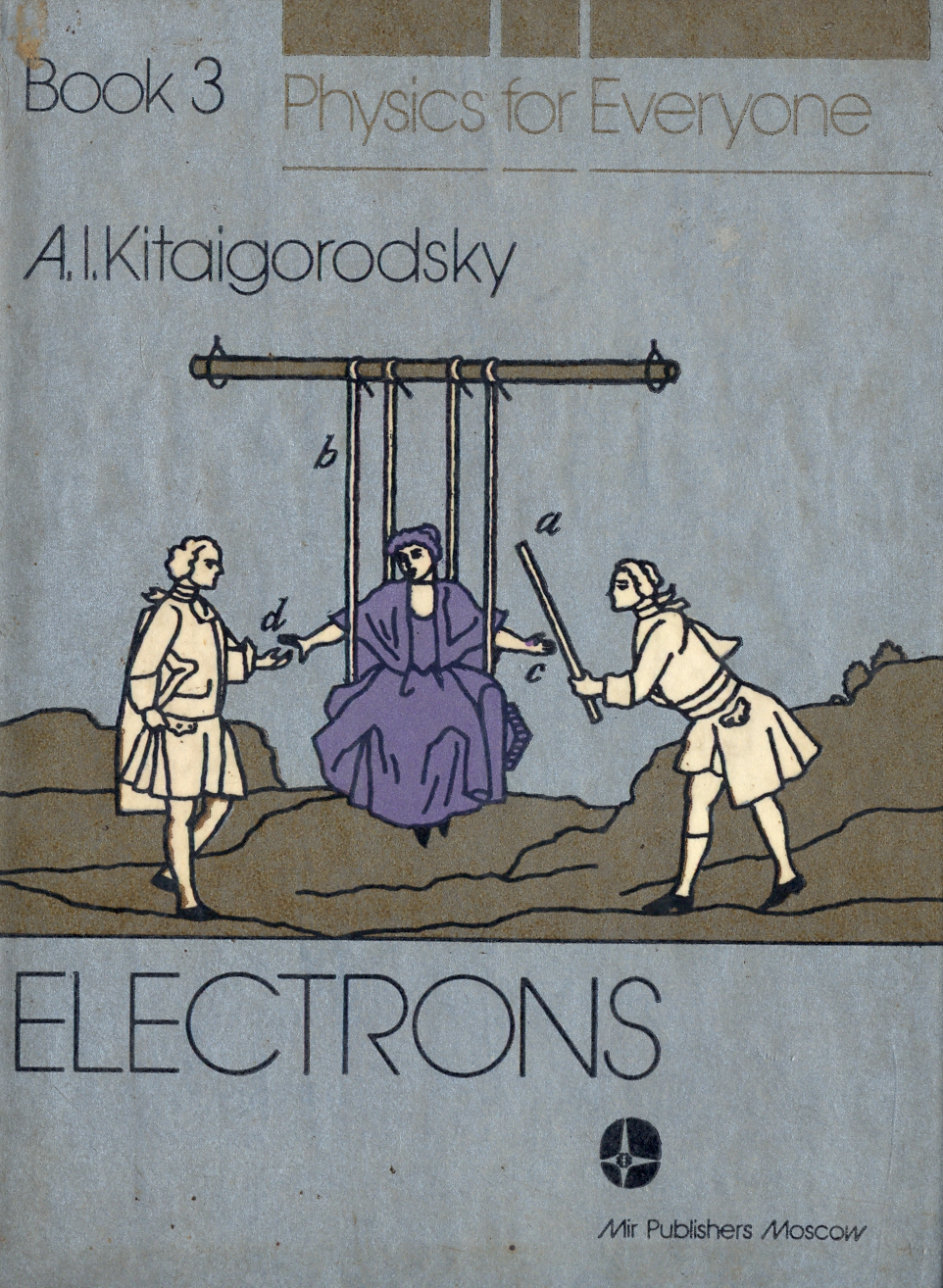
Physics for Everyone – Book 3 – Electrons A. I. Kitaigorodsky 1981 248
Physics for Everyone – Book 4 – Photon and Nuclei A. I. Kitaigorodsky 1981 235

Update: All the books in the Physics for Everyone series are now up:

Physics for Everyone – Motion and Heat. (All credits to the original uploader)

Book 1- Physical Bodies.

Book 2  – Molecules.

Book 3 – Electrons.

Book 4 – Photons and Nuclei.


Posted in books, mir books, soviet, Uncategorized | Tagged , , , , , | 41 Comments

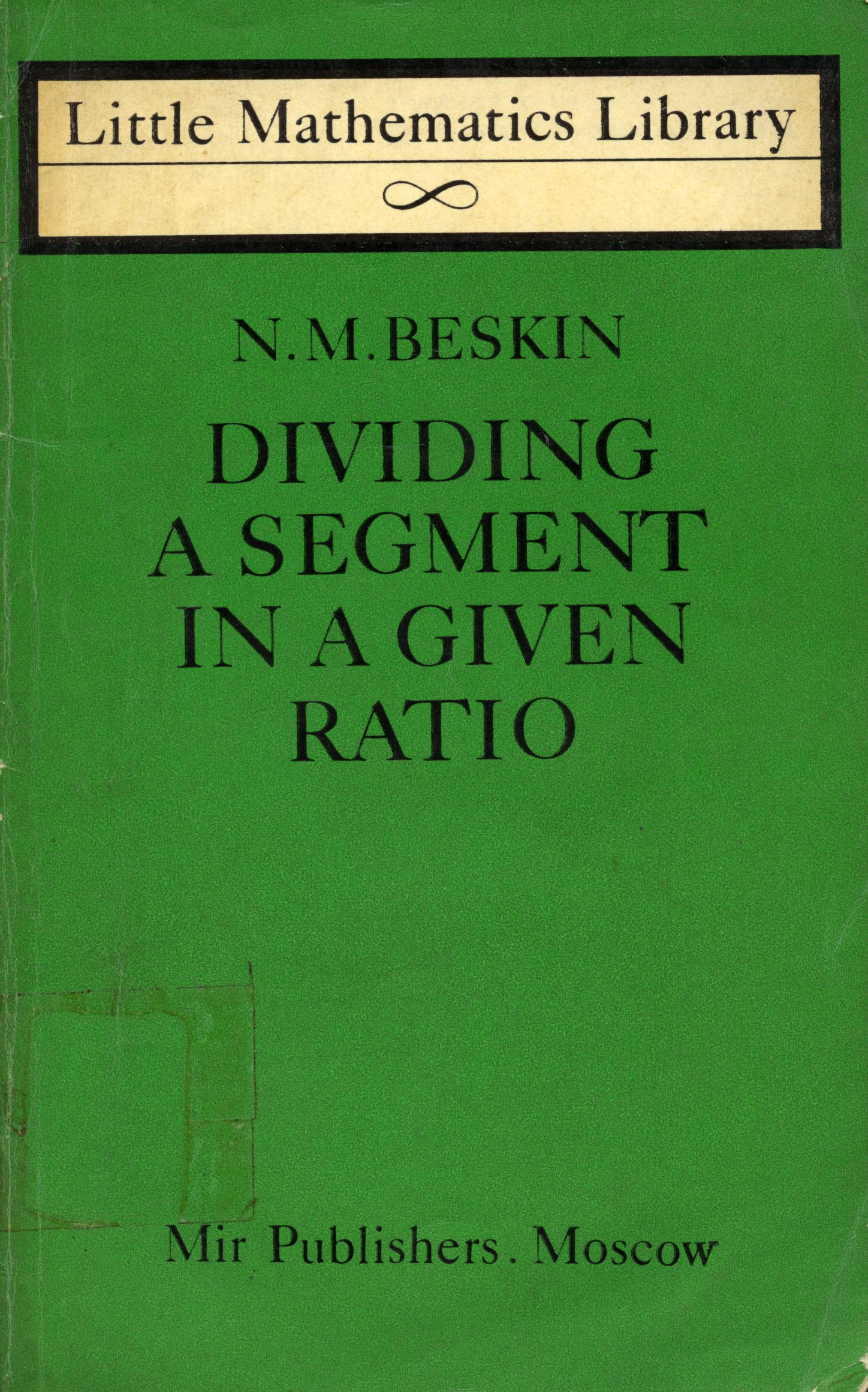
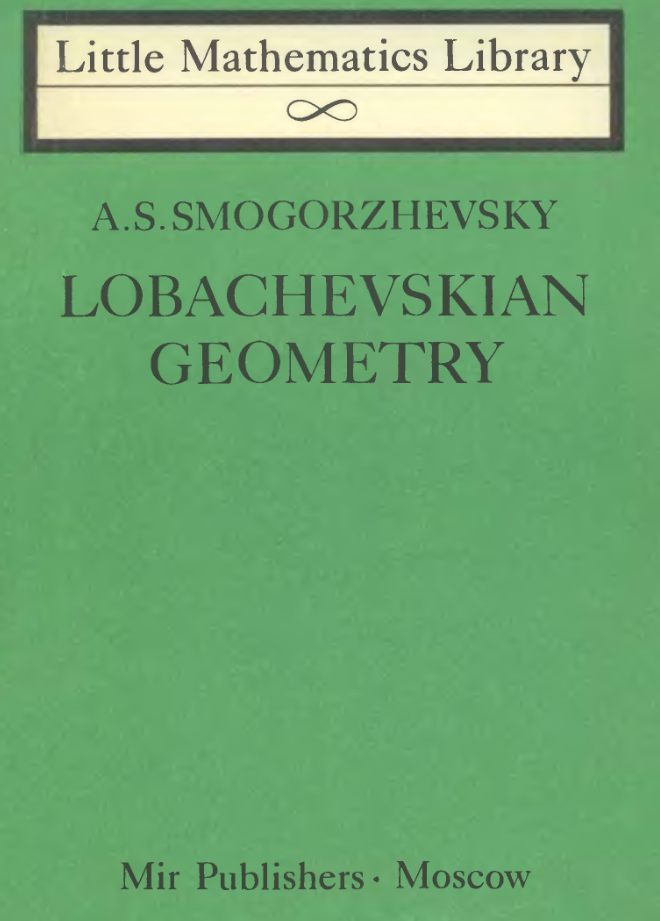
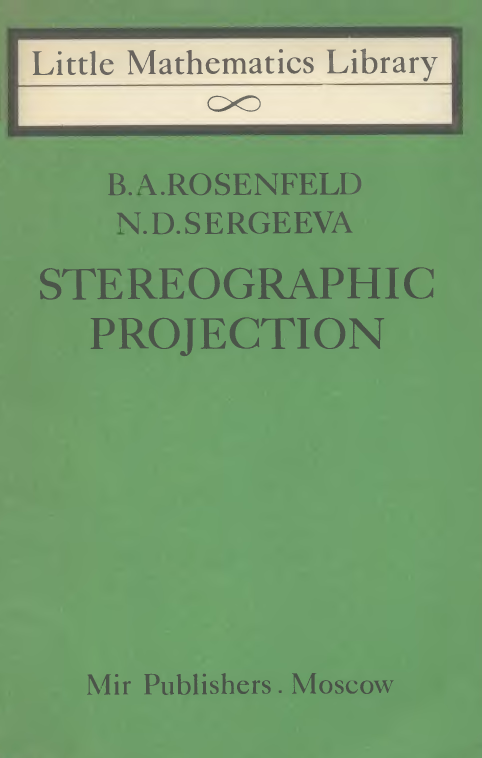
Little Mathematics Library

Just like the Science for Everyone series, Mir Publishers also ran a series in mathematics called the Little Mathematics Library. Here are some of the books from that series. Please add the books that are not listed here and are not known to me [there will be a lot for sure]
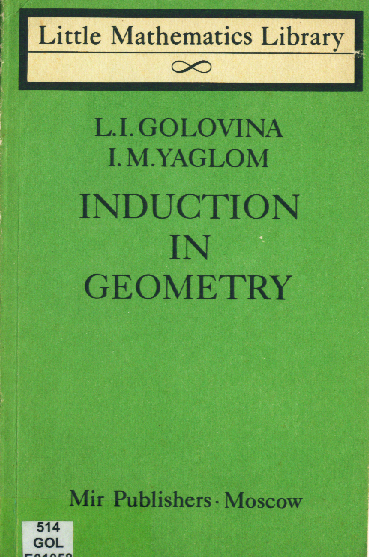
Some the titles are gems in mathematics and mathematical thinking, for example Induction in Geometry and Proof in Geometry are really well developed. The books though are small in size (typical size below 100 pages) are packed with a mathematical punch. Though small in size the contents are not diluted, as it happens in many small mathematics books. The books are quite rigorous in treating the material at hand.

Title Author Year Pages
Pascal’s triangle Vladimir A Uspenski 1973 86
Method of successive approximations N. Ya. Vilenkin 1979 109
The fundamental theorem of arithmetic L. A. Kaluzhnin 1979 35
The kinematic method in geometrical problems Yu. I. Lyubich, L. A. Shor 1980 55
Calculus of rational functions G.E. Shilov 1976 50
Complex numbers and conformal mappings A.I. Markushevich 1982 62
Geometrical constructions with compasses only A. Kostovskii 1986 77
Proof in geometry A I Fetisov 1982 64
Algebraic equations of arbitrary degrees A.G. Kurosh 1977 35
Gödel’s incompleteness theorem Vladimir A Uspenski 1987 102
The Euler Characteristic Yu A Shashkin 1989
Elements of Game Theory Ye Venttsel 1980
Method of coordinates A S Smogorzhevsky 1984 47
Plotting graphs G.E. Shilov, S Sosinsky 1978 29
Systems of linear equations L.A. Skorniakov. 1988 64
Differentiation explained V.G. Boltyansky 1977 62
Recursion sequences A I Markushevich 1975 48
Solving equations in integers A.O. Gelfond 1978 56
Shortest lines: variational problems L.A. Lyusternik 1973 103
Fascinating fractions N.M. Beskin 1986 86
An unusual algebra I.M. Yaglom 1978 127
The methods of mathematical induction. I S Sominsky 1975 63
Inequalities P P Korovkin. Sergei Vrubel 1986 71
Stereographic projection B. A. Rosenfeld; N. D. Sergeeva 1986 50
The Monte Carlo method I.M. Sobol. 1975 72
Dividing a segment in a given ratio N.M. Beskin. 1975
Lobachevskian geometry A S Smogorzhevsky 1982 69
Systems of linear inequalities A. S. Solodobnikov 1979 122
Induction in geometry L. I. Golovina and I. M. Yaglom 1979 132
Post’s machine V.A. Uspensky 1983 88
Areas and logarithms A.I. Markushevich 1981 69
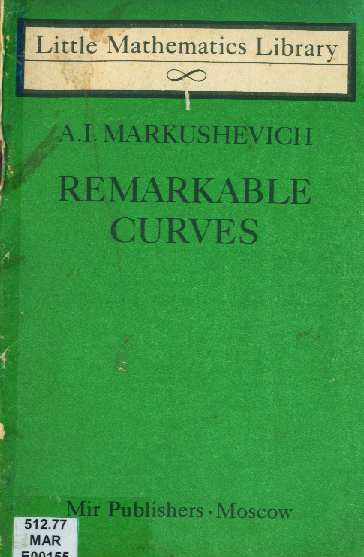
Remarkable curves A.I. Markushevich 1980 47
Posted in books, little mathematics library, mir books, Uncategorized | Tagged , , | 41 Comments

Science for Everyone

Science for Everyone is a long running series from Mir Publishers. Most of the titles that I have collected are from used book shops.

Some of the titles are by others and some from library and some of the titles I have only seen on the internet.

Some of the titles that I have are as follows:

Title Author Year Pages
Traces of Bygone Biospheres A. V. Lapo 1987 352
Physics and Geometry of Disorder: Percolation Theory A. L. Efros 1986 259
Differential Equations in Applications V. V. Amel’kinn 1990 279
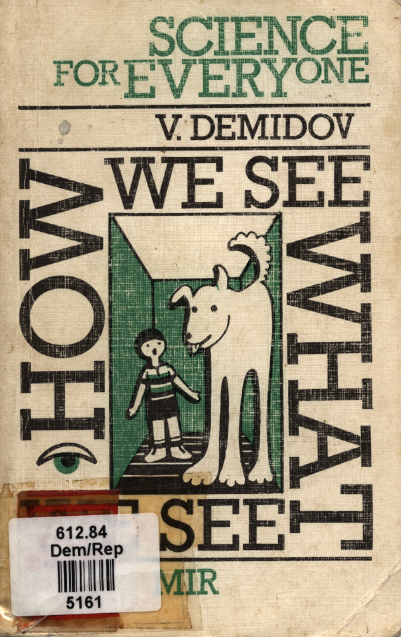
How We See What We See V. Demidov 1986 238
Aptitude Test Problems in Physics S. S. Krotov [Ed.] 1990 310
This Fascinating Astronomy V. N. Komarov 1985 303
Storming The Fortress of Fusion G. S. Voronov 1988 335
Electrons and Crystals Th. Wolkenstein 1985 174
Me or Not Me R. V. Petrov 1987 372
Elementary Kinematics of Elementary Particles G. I. Kopylov 1983 270
Flying Trains G. Zelkin 1986 151
Yes, No or Maybe Ya. I Khurgin 1985 219
Temperature Ya. A. Smorodisnky 1984 263
Physics In Your Kitchen Lab I. K. Kikoin (Ed.) 1985 189
Physical Paradoxes and Sophisms V. N. Lange 1987 232
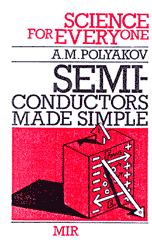
Semiconductors Made Simple A. M. Polyakov 1985 240
Luminescence in Public Health N. N Barashkov 1988 146
Problems in Plane Geometry I. F. Sharygin 1986 408
Problems in Solid Geometry I. F. Sharygin 1986 247
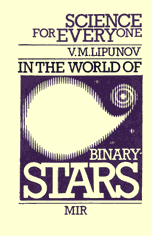
In The World of Binary Stars V. N. Lipunov 1989 324
Discussions on Refraction of Light L. V. Tarasov, A. N. Tarasova 1984 239
Silhouettes of Chemistry D. N. Trifonov, L. G. Vlasov 1987 296
Ethology What animals do and why Igorʹ Akimushkin 1988 294
Encounters with physicists and physics. I.K. Kikoin. 1989 198
The Greatest speed S.R. Filonovich 1986 285
The progeny of volcanoes P.N. Erofeev 1986 327
Puppets without strings V.I. Varshavsky, D.A. Pospelov 1988 294
Mystery of minerology B.I. Srebrodolsky 1989 239
Learning about chemistry G. B. Shul’pin. 1989 230
The grand biological clock V.M. Dilman 1989 424
The nature of magnetism M.I. Kaganov, V.M. Tsukernik 1985 283
Origin and development of life on earth G.V. Voitkevich 1988 232
Modern geology N.A. Yasamanov 1990 280
Origin and chemical evolution of the earth G.V. Voitkevich 1988 238
Our planet–the Earth A.V. Byalko. 1984 304
Earth, sweet Earth Ekaterina Radkevich 1990 371
Satellite and typhoon : eye to eye S.N. Baibakov and A.I. Martynov 1987 254

Please add titles that you are aware of.

Updates:

1. Discussions on Refraction of Light is available here.

2. Encounters with Physicists and Physics is available here.

Posted in books, mir books, mir publishers, science for everyone, soviet, used books | 29 Comments