In the previous post we discussed about two Handbooks of Mathematics by M. Vygodsky. In this post I will be discussing a Handbook of Elementary Physics that I know of, two other Handbooks by Yarovsky and Detlaf will be discussed soon.
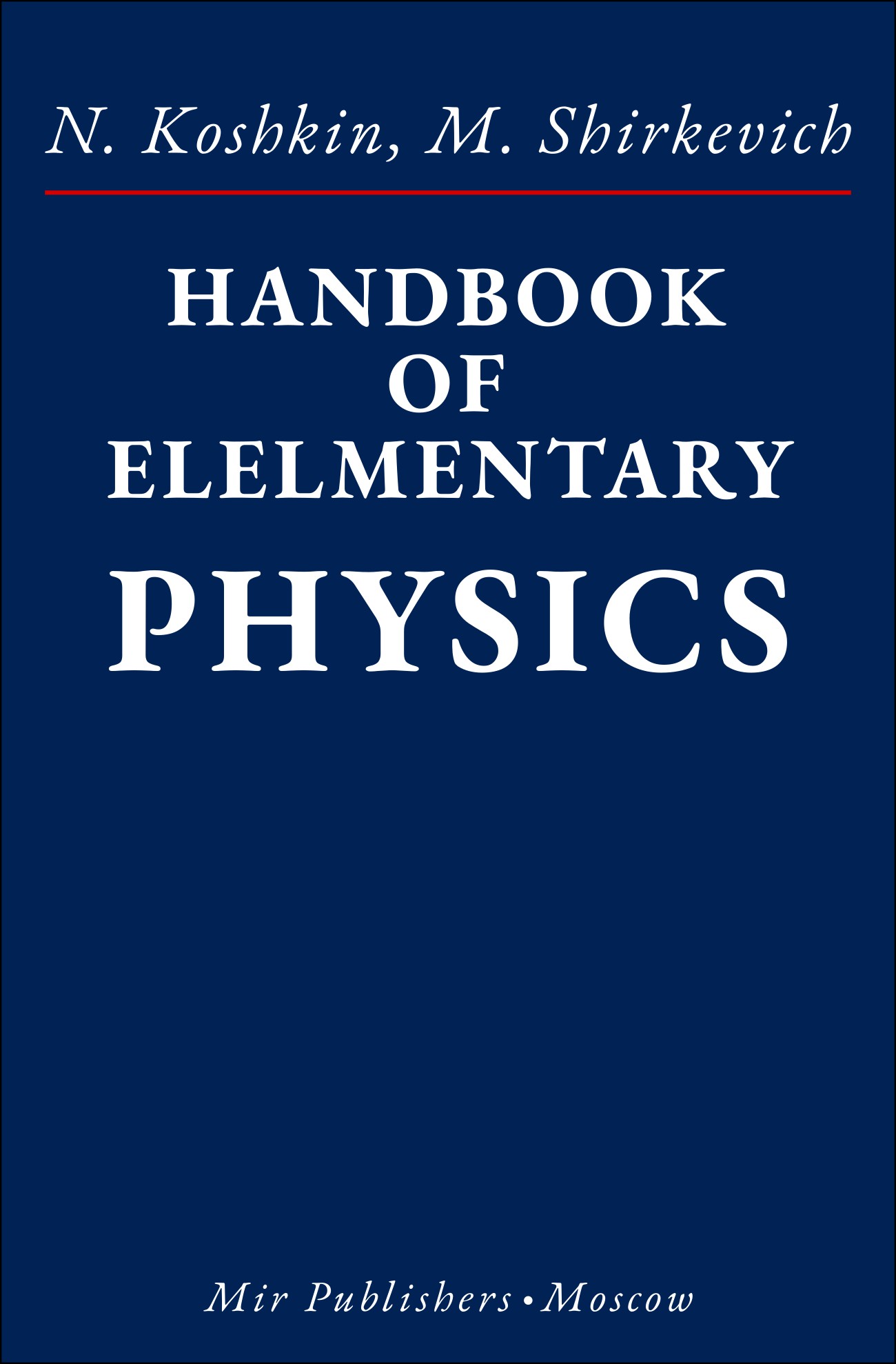
The Handbook of Elementary Physics by N. Koshkin and M. Shirkevich [ N. I. Koškin; M. G. Širkevič] is my companion since my school days. This is also one of the few technical books that have come from Foreign Languages Publishing House [most of their books I know are Children’s’ books or Russian Literature], which was also state run. This handbook runs for about 220 pages and the date of publication is not present, at least in the copy that I have. But a simple search at world-cat tells you that this Hanbook is quite old, you get results of English trnalations from 1960s till late 80s and was also published by Mir Publishers. There is also an interesting entry at world-cat about a Hindi edition of this book published in 2010, by Rachana Prakshan, Delhi [ISBN: 818104052X 9788181040527]. The title of the entry reads:
सरल भौतिकी निर्देशिका
नि. कोश्किन मि. शिर्केविच (करता );
पुनर्लेखन एवं रूपांतर अनिल शर्मा
Sarala bhautikī nidarśikā :
Ni. I. Kośakina, Mi. Gri. Śirkevica kr̥ta ;
punarlekhana evaṃ rūpāntara, Anila Śarmā.
But I could not get any other details. I do not know if there are any other translations in other Indian languages.

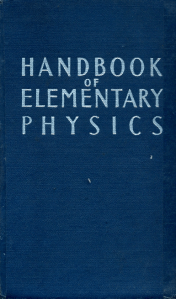
The Preface Reads:
The compilers of the present handbook, N. I. Koshkin and M. G. Shirkevich, are experienced Soviet teachers. The handbook covers all the main subjects of elementary physics and contains information most frequently required in industry and agriculture.
Special attention has been paid to the choice of data on the latest developments in physics, such as semiconductors, ferro-electrics, nuclear physics, etc. In addition to graphs and tables the book offers brief theoretical expositions, definitions of fundamental concepts and formulations of laws accompanied by explanations and examples.
The handbook is intended for wide circles of readers in various occupations, and for students with a background of secondary school physics.
The Handbook has the following Chapters: Mechanics, Heat and Molecular Physics, Mechanical Oscillations and Wave Motion, Electricity, Optics, Structure of Atoms and Elementary Particles.
If the physical significance of the tabulated quantity is not quite clear to the reader, he should refer to the relevant section: “Fundamental Concepts and Laws”.
Each chapter is further divided into two sections. First, Fundamental Concepts and Laws, which illustrate the the basic theories that describe the phenomena. Second part has actual physical data in form of Tables and Graphs, which are quite detailed and numerous for a Handbook of this size.
The numerical values of the quantities are given to two or three significant figures after the decimal point, which is sufficiently precise for most technical calculations.
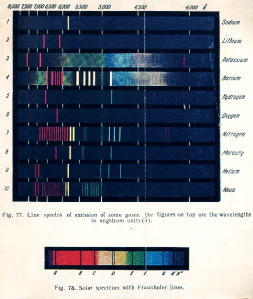
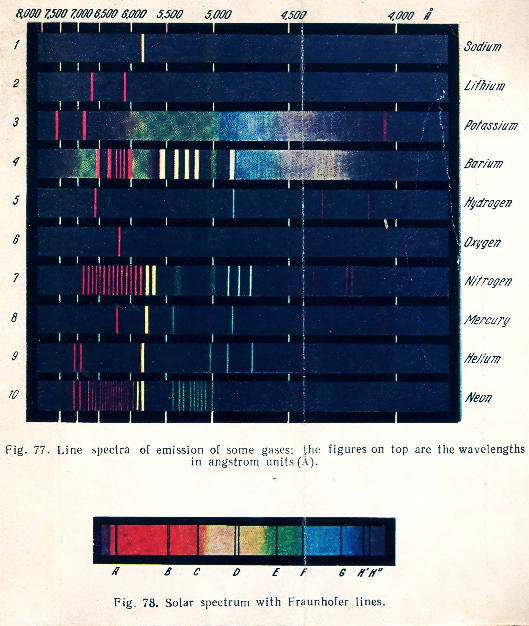
I saw my first color spectrum in this handbook, which is shown below:
Finally, there are Appendices which contain information on the units of measure of physical quantities, formulas for approximate calculations, and the values of some universal physical constants.
You can get the book from here and here.
Hindi version here and here.
Update: Internet Archive link added | 02 December 2015

 Legendary physicist Lev Landau apart from the Physics for Everyone series wrote another book on popular science, with Y. Rumer, it is called What is the theory of relativity?









 Mir Books
