Let’s Play Geometry

[The aim of the book] is to acquaint children in exciting and stimulating way with some of principle concepts of geometry, to teach them how to find bearings in simple geometrical situations and to discern geometrical patterns in the world around them.

In this post we will be looking at a book from which I have many fond memories. This book is titled Lets Play Geometry by L. N. Shevrin and V. G. Zhitomirsky. The book is written in the style of A Book About Stars and Planets which we have seen already.

The back cover of the book says:

Through fascinating stories and rhymes, young readers are introduced to some elementary geometry. The book is made up of adventures which bring in the theory, and some exercises to develop the topics. It is written in a simple and attractive language, and is particularly well-suited to 5-8-year olds

The book is intended for children and to be read to them by an adult. The activities “hands-on” and “minds-on” that are suggested in the book are amazing. I had a copies of this book in English and Marathi, and also know that there is a Hindi translation. I do not know if there are other translations in Indian languages.

The book was translated from the Russian by Alexander Repyev and was first published by Mir in 1985. Thanks for Gordon to bring this copy to my notice and all credits to gnv64 for the book.

You can get the book here and here.

Update: Added Internet Archive Link | 04 December 2015

Continue reading

Posted in books, mathematics, mir publishers | Tagged , , , , , , | 7 Comments

Science for Everyone – Taking Stock

The last post In the World of Binary Stars, completed the titles of Science for Everyone series that were accessible. When the original post was made with the listings we had listed 37 titles, out of which many are posted already. In this post I will make a stock of what has been accomplished and what remains to be done. Any inputs of how and where to get to the remaining books in this series would be greatly appreciated. This effort would not have been possible without all the people who have given their help, advise and support, mental, physical or otherwise. All credits to the respective, original uploaders! Thanks to all!!

The listing below is done year wise. The books that are with us are presented with links and the books that are not and are in red text and we need to get them.

Only 4 to go!

Update: Science for Everyone all files in one place here.

Password: http://www.mirtitles.org

Thanks to Desperaomar for these links.

Update Jan 2020: We have added four more titles. Only one Earth, Sweet Earth remains now.


Aptitude Test Problems in Physics S. S. Krotov [Ed.] 1990

Differential Equations in Applications V. V. Amel’kinn 1990

Discussions on Refraction of Light L. V. Tarasov, A. N. Tarasova 1984

Earth, Sweet Earth Ekaterina Radkevich 1990

Electrons and Crystals Th. Wolkenstein 1985

Elementary Kinematics of Elementary Particles G. I. Kopylov 1983

Encounters with Physicists and Physics I.K. Kikoin. 1989

Ethology What animals do and Why Igor Akimushkin 1988 (Link added 08-10-2013)

Flying Trains G. Zelkin 1986

How We See What We See V. Demidov 1986

In The World of Binary Stars V. N. Lipunov 1989

Learning About Chemistry G. B. Shul’pin. 1989 (Link added 20-10-2013)

Luminescence in Public Health N. N Barashkov 1988

Me or Not Me R. V. Petrov 1987

Modern Geology N.A. Yasamanov 1990

Mystery of Minerology B.I. Srebrodolsky 1989

Origin and Chemical Evolution of the Earth G.V. Voitkevich 1988

(Got the hard copy to be scanned)

Origin and Development of Life on Earth G.V. Voitkevich 1988

Our Planet – The Earth A.V. Byalko. 1987

Physics and Geometry of Disorder: Percolation Theory A. L. Efros 1986

Physics In Your Kitchen Lab I. K. Kikoin (Ed.) 1985

Problems in Plane Geometry I. F. Sharygin 1986

Problems in Solid Geometry I. F. Sharygin 1986

Puppets Without Strings V.I. Varshavsky, D.A. Pospelov 1988

(Got the hard copy to be scanned)

Physical Paradoxes and Sophisms V. N. Lange 1987

Satellite and Typhoon : Eye to Eye S.N. Baibakov and A.I. Martynov 1987

Semiconductors Made Simple A. M. Polyakov 1985

Silhouettes of Chemistry D. N. Trifonov, L. G. Vlasov 1987

Storming The Fortress of Fusion G. S. Voronov 1988

Traces of Bygone Biospheres A. V. Lapo 1987

Temperature Ya. A. Smorodisnky 1984

The Grand Biological Clock V.M. Dilman 1989

The Greatest Speed S.R. Filonovich 1986

The Nature of Magnetism M.I. Kaganov, V.M. Tsukernik 1985

This Fascinating Astronomy V. N. Komarov 1985

The Progeny of Volcanoes P.N. Erofeev 1986

Yes, No or Maybe Ya. I Khurgin 1985

Posted in books, mir publishers, science for everyone | Tagged , , | 22 Comments

Science for Everyone – In The World of Binary Stars

In the Science for Everyone series we now go to a journey In The World of Binary Stars by V. M. Lipunov. This book discusses many things about the binary stars and the exotic things that they can lead to. White dwarfs, neutron stars, black holes, X-ray pulsars you name it and this book has it. In all it gives you a very substantial overview of the field of binary stars. A must read for all the astro-enthusiasts: Clear Skies!

The back cover of the book says following:

Binary stars contain some of the most exotic objects in the sky. This is an exciting account about binary stars and the way black holes, white dwarfs, and neutron stars can evolve in them. It is, moreover, a short history of the ideas and discoveries that led to our current understanding of this fascinating heavenly object the binary.

This book was translated from the Russian by Alexander A. Kandaurov and was first published by Mir in 1989. Thanks to hawa-ka-jhonka for making this book accessible.

Update: Jan 2020

The Internet Archive Link

and here


Continue reading

Posted in astronomy, books, mir publishers, physics, science for everyone | Tagged , , , , , , , , | 11 Comments

Science for Everyone – Our Planet – The Earth

The book in this post is titled Our Planet – The Earth by A. V. Byalko. The book is wonderfully written and well illustrated. This is a book which mingles with a lot of disciplines and presents us with a better understanding of all the phenomena concerning Our Planet – The Earth: right from the astronomical to terrestrial. The mere breadth of the subject that this book covers is amazing, our path in space, other celestial bodies, the sun its working and interiors, Earth’s  atmosphere its oceans and finally the climate on the Earth.

The back cover of the book says:

The physical principles underlying the global phenomena that occur on the Earth and other planets in the solar system are presented in away accessible to older pupils at school.The similarities between the phenomenon the various planets are due to the nature of their common star, the Sun. The Sun’s structure,the nuclear reactions proceeding within its core,and the stability of its nuclear fires take up an entire chapter. This book will help answer many of the questions often asked, such as where does the wind come from,what are clouds made of, what are ocean currents, and what affects the Earth’s climate.

This wonderful book in the Science for Everyone series which is presented in this post was first introduced to me by anish.dot, thanks to him. The book was translated from the Russian by Yu. M. Taube and the Russian edition was edited by Ya, A. Smorodinsky [we have a book by him in the SFE series Temperature] and was first published by Mir in 1987.

Update Jan 2020

The Internet Archive Link

and here

Continue reading

Posted in astronomy, books, geology, meteorology, physics, science, science for everyone | Tagged , , , , , , | 8 Comments

Science for Everyone – Me Or Not Me

In continuing our previous post on Life Sciences in the Science for Everyone series, we now come to a book on human physiology and our bodily defense mechanisms against all external threats that is immunology. This one is called Me or Not Me by R. V. Petrov. As the title suggests the book explain the fundamentals of how our health is maintained and body functions.

In the preface of the book the author says:

Every particle of our body must bear an identification sign, or “tag”, saying ‘this is me’. If something does not have such a sign, or if the tag is foreign, tho particle would be saying: ‘this is not me’ Everything ‘other than me’ is destroyed by the immune system. I have compared two types of individuality spiritual and bodily to show tho all embracing significance of immunology, and the complexity and intricacy of the immune system. Only the future will reveal whether the mechanisms of the brain and the immune system are similar. This book has grown out of a booklet called Talks on New Immunology which was published in 1976 as a part of the “Eureka” series. The talks have been expanded in volume and their form revised in an effort to convey to the reader the huge volume of scientific information that has been accumulated by a young science of immunology.

The book was translated from the Russian by G. Yu. Degtyaryova and was first published by Mir in 1987.

Update Jan 2020

The Internet Archive Link

and here

Continue reading

Posted in books, life sciences, mir publishers, physiology, science for everyone | Tagged , , , , , | 11 Comments

Science for Everyone – Luminiscence in Public Health

Among the titles that have posted so far in the Science for Everyone series we do not have any on Life Sciences, so this is one starts that trend, which I hope will increase in the future. This particular book is called Luminescence in Public Health by N. N. Barashkov.

This what the back cover of the book says:

The luminescence phenomenon underlies many investigative methods in the most diverse disciplines: analytical chemistry, geology, fault detection, paleontology, forensic medicine, and other. It comprises two types of emission: fluorescence and phosphorecence. In medical and biological research, fluorescence analysis has no equal in terms of availability of equipment, simplicity of procedure, reproducibility of results, and sensitivity to minute quantities of the biological sample. This popular science book describes the application of fluorescence analysis to investigations of physiological processes and also to the diagnosis of diseases, assessment of its severity, and control of its course. Separate sections of the book are devoted to the use of this method in public health and pollution control. This book is intended for the general reader and those who are interested in problems of public health.

The book was translated from the Russian by A. Yurasovskaya and was first published by Mir in 1988.

Update 02 Jan 2020

The Internet Archive Link

and here

Continue reading

Posted in books, life sciences, mir publishers, science for everyone | Tagged , , , , , , | 3 Comments

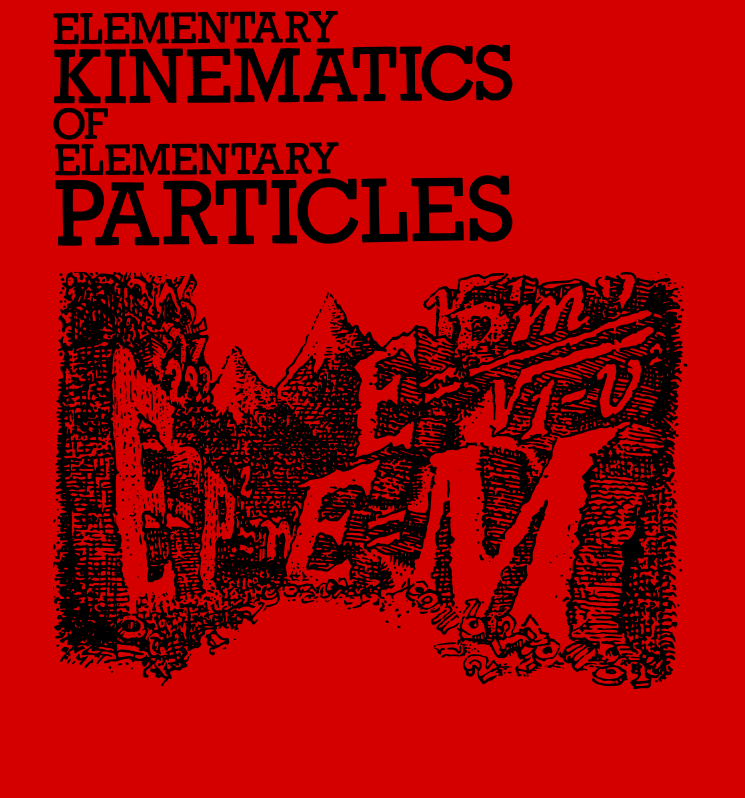
Science for Everyone – Elementary Kinematics of Elementary Particles

We now come to another interesting title in the Science for Everyone, called Elementary Kinematics of Elementary Particles by G. I. Kopylov. This book by and large introduced me to many concepts in particle physics. This book is especially relevant with the hot [literally and figuratively] discoveries being currently made in the LHC.

This is what the back cover of the book says:

This book tells a fascinating story of one of physics today: the discovery of primary building blocks of matter. This field of science is called particle or high-energy physics and is one of the frontiers of present day physical research.

How is it possible to detect particles a hundred thousand times smaller than the atom, which itself is many times smaller than an apple as the apple is smaller than the Earth? How can we follow motion of particles that have velocity almost that of light? How can we measure the lifetime of these particles when it is of the order of 0.00000000000000000000001 second? What kind of clock can we ;’use? How can we investigate the properties of these astonishing and elusive bits of matter?

All these and many other questions are comprehensively answered in this book written for the layman by the late Dr. Gersten Kopylov, who was a prominent scientist, well known in the world of particle physics. This book was written to be understood even by readers having only a secondary school education and it requires a knowledge of only  elementary algebra and geometry. Nevertheless in the author’s treatment , the material is no way oversimplified or distorted.

The book was translated from the Russian by Nicholas Weinstein and was first published by Mir in 1983.

Update Jan 2020

The Internet Archive Link

and here

Continue reading

Posted in books, physics, science for everyone, soviet | Tagged , , , , , , | 13 Comments

Science for Everyone – Satellite and Typhoon – Eye to Eye

We now come Satellite and Typhoon – Eye To Eye by S. Baibakov and A. Martynov in the Science for Everyone Series. I did not know the existence about this book till some Anonymous person reported about it in the Science for Everyone post.

The back cover of the book says:

Studies of typhoons and hurricanes based on conventional tracking technologies ground weather stations, ships aircraft, and weather rockets rarely turn out to be effective enough, since the time and place of typhoon origin are unpredictable. A new avenue of approach to the problem is opening up with advances in space technology. This book presents a detailed method to explore in, typhoons and hurricanes using satellites and satellite probes to deliver balloons with a payload of measuring instruments into their effective range. There is also an extensive discussion of problem areas in meteorology, oceanography, and environmental science capable of being addressed by space-borne technologies. The book is intended for those interested in astronautics, oceanography and in the protection of the environment.

The book was translated from the Russian by Anatoli Rosenzweig and was first published by Mir in 1986.

Update: Jan 2020

The Internet Archive Link

and here

Continue reading

Posted in books, meteorology, mir publishers, science, science for everyone, soviet | Tagged , , , , , , , | 3 Comments

Science for Everyone – Silhouttes of Chemistry

In the Science for Everyone Series we now come to Silhouttes of Chemistry by D. N. Trifonov and L. G. Vlasov. This one is for all the people who were waiting for chemistry books.

The back cover of the book says:
The authors of this book have endeavoured to touch upon
the most important and interesting problems of chemistry.
Their book describes and explains the structure of the
Periodic System of elements; it guides you through a kind
of chemical museum full of curious exhibits; it tells of the
intricate substances chemists have produced and how they
have learned to work even with single atoms of the elements;
it acquaints you with the various chemical professions
and shows how chemistry has penetrated all spheres
of human activity.
Reading these short but instructive stories about the exciting discoveries of chemistry will urge you to find out more about this fascinating science and to take up chemistry seriously.

This is a book that eluded me for years, and finally when I got it it was by surprise. The book was translated from the Russian by David Sobolev and Andrei Konyaev and this second edition was published by Mir in 1987.

Update July 2020 The Internet Archive Link

and here

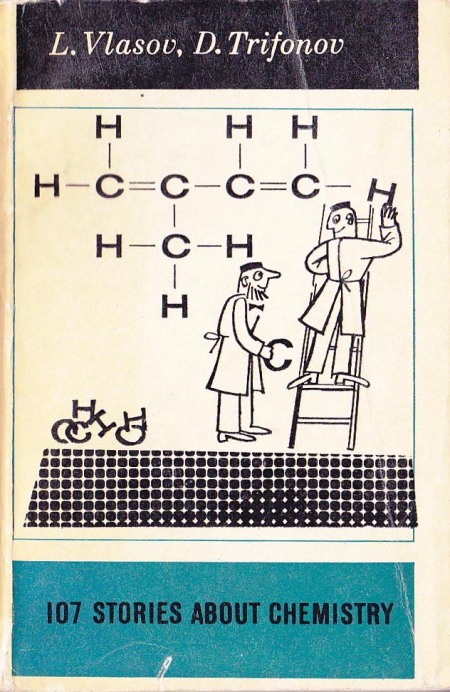
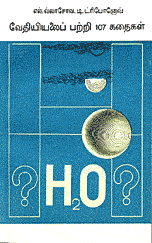
Update: As mir_fan commented, there is another cover “(some folks rearranging H and C atoms)”, reproduced below and published previously as 107 Stories About Chemistry, contents being the same. And thanks to him we also know that there is a Malayalam translation of this book.

Also there is an Hindi translation as the cover above suggests, but I do not have any other information.

Update: We came to know about Telugu and Tamil translations as well.

Continue reading

Posted in books, chemistry, mir publishers, science, science for everyone | Tagged , , , | 16 Comments

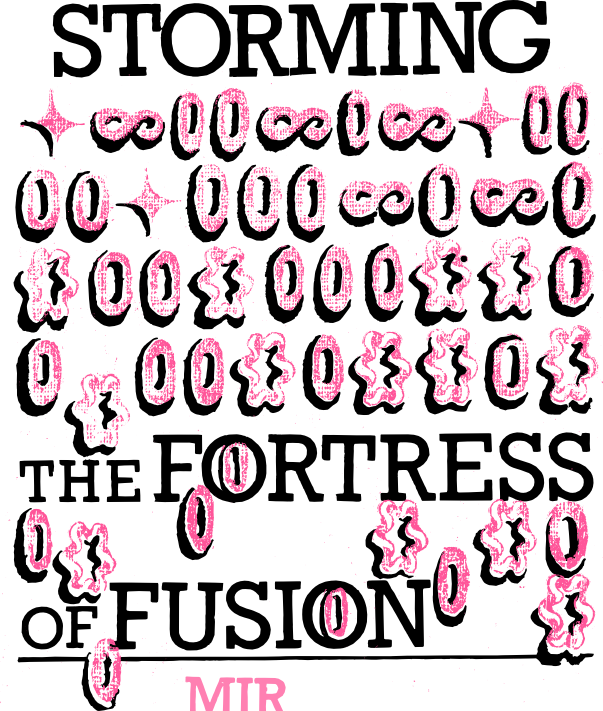
Science for Everyone – Storming the Fortress of Fusion

In the Science for Everyone Series we now come to the book Storming the Fortress of Fusion by G. S. Vornov. This book is one of the earliest Mir books that I have bought.

The back cover of the book says:

The energy we get from the Sun is generated at its core in fusion reactions, in which hydrogen is turned into helium. If these reactions could be used on Earth, humanity would be able to provide itself with an abundance of energy. The problem of maintaining practical nuclear fusion has been one of the central problems of physics for
some thirty years, and yet only now has it become clear that a solution is in fact possible. This book explains in a lively and
informal way how the investigations have developed, the cleverness of the ideas used to tackle the problems, the ingenuity behind the
experiments, and the successes and setbacks encountered in dea ing with the capricious and cunning material we call plasma.
Intended for teachers, college students, and school pupils.

This book was translated from the Russian by R. S. Wadhwa and was first published by Mir in 1988.

Update: Jan 2020

The Internet Archive Link 

and here

Continue reading

Posted in books, mir publishers, physics, science for everyone | Tagged , , , , , , | 2 Comments