Little Mathematics Library – Proof In Geometry

We now come to Proof in Geometry in by A. I. Fetisov in the Little Mathematics Library series.

The Introduction of the book says:

The pupils often fail to understand why truths should be proved that seem quite evident without proof, the proofs often appearing to be excessively complicated and cumbersome. It sometimes happens, too, that a seemingly clear and convincing proof turns out, upon closer scrutiny, to be incorrect.

This booklet was written with the aim of helping pupils clear up the following points:
1. What is proof?
2. What purpose does a proof serve?
3. What form should a proof take?
4. What may be accepted without proof in geometry?

The book was translated from the Russian by Mark Samokhvalov and was first publised by Mir in 1978.  This books was also published in the Topics in Mathematics series by Heath in 1963 and this edition was translated by Theodore M. Switz and Luise Lange. Dover [in 2006] has republished this book along with Mistakes in Geometric Proofs by Y. S. Dubnov as one single volume.

The Internet Archive Link

and here


Continue reading

Posted in books, little mathematics library, mathematics, mir publishers | Tagged , , , , , , | 19 Comments

Little Mathematics Library – The Monte Carlo Method

We now come to The Monte Carlo Method by I. M. Sobol in the Little Mathematics Library series. The book has a random number table as one of the appendices, which is sort of out dated, when we have access to computers so easily.

In the Preface the author says:

Everybody had at some moment used the words “probability”
and “random variable”. The intuitive idea of the probability (considered as frequency) corresponds more or less to the true meaning of this concept. But as a rule the intuitive idea of the random variable differs quite considerably from the mathematical definition. Thus, the notion of the probability is assumed known in Sec. 2, and only the more complicated notion of the random variable is clarified. This section cannot replace a course in the probability
theory: the presentation is simplified and proofs are omitted.
But it still presents certain concept of the random variables sufficient for understanding of Monte Carlo techniques.

The basic aim of this book is to prompt the specialists in various branches of knowledge to the fact that there are problems in their fields that can be solved by the Monte Carlo method.

The book was translated from the Russian by V. I. Kisin and was first published by Mir in 1975. This book was also published as Popular Lectures in Mathematics by University of Chicago in 1974, and this edition was translated by by Robert Messer, John Stone, and
Peter Fortini.

The Internet Archive Link

and here and PLM version here

The table of contents for (LML edition) is as follows:

Preface 7
Introduction 9
Sec. 1. General 9
Chapter I. Simulation of Random Variables 14
Sec. 2. Random Variables. 14
Sec. 3. Generation of Random Variables by Electronic Computers 25
Sec. 4. Transformations of Random Variables 30
Chapter II. Examples of Application of the Monte Carlo Method 39
Sec. 5. Simulation of a Mass Servicing System 39
Sec. 6. Computation or Quality and Reliability of Complex Devices 44
Sec. 7. Computation of Neutron Transmission Through a Plate 51
Sec. 8. Calculation of a Definite Integral 58
Appendix 64
Sec. 9. Proofs of Selected Statements 64
Sec. 10. On Pseudo-Random Numbers  70
Random Number Table 74
Bibliography 77

Posted in books, little mathematics library, mathematics, mir publishers, statistics | Tagged , , , , , , , , | 5 Comments

Little Mathematics Library – Systems of Linear Inequalities

In the Little Mathematics Library now we come to Systems of Linear Inequalities by A. S. Solodovnikov.

This booklet is one of longest in the LML series, having more than 120 pages. The back cover of the book says the following about the book.

The book tells about the relation of systems of linear inequalies to convex polyhedra, gives a description of the set of all solutions of a system of linear inequalities, analyses the questions of compatibility and incompatibility; finally, it gives an insight into linear programming as one of the topics in the theory of systems of linear inequalities. The last section but one gives a proof of the duality theorem of linear programming. The book is intended for senior pupils and all amateur mathematicians.

And the preface adds

Until recently one might think that linear inequalities would forever
remain an object of purely mathematical work. The situation
has changed radically since the mid 40s of this century when there
arose a new area of applied mathematics -linear programmingwith
important applications in the economy and engineering. Linear
programming is in the end nothing but a part (though a very important one) of the theory of systems of linear inequalities.
It is exactly the aim of this small book to acquaint the reader
with the various aspects of the theory of systems of linear inequalities, viz. with the geometrical aspect of the matter and some of the methods for solving systems connected with that aspect, with certain purely algebraic properties of the systems, and with questions of linear programming. Reading the book will not require any knowledge beyond the school course in mathematics.

The book was translated from the Russian by Vladamir Shokurov and was first published by Mir in 1979.

You can get the book here and here.

There is a Spanish version of this as well (credits to IA user danni229)

The Link to Spanish version

The following is the table of contents

CONTENTS
Preface 7
1. Some Facts from Analytic Geometry 8
2. Visualization of Systems of Linear Inequalities In Two or Three Unknowns 17
3. The Convex Hull of a System of Points 22
4. A Convex Polyhedral Cone 25
5. The Feasible Region of a System of Linear Inequalities in Two Unknowns 31
6. The Feasible Region of a System in Three Unknowns 44
7. Systems of Linear Inequalities in Any Number of Unknowns 52
8. The Solution of a System of Linear Inequalities ‘by Successive Reduction of the Number of Unknowns 57
9. Incompatible Systems 64
10. A Homogeneous System of Linear Inequalities. The Fundamental Set of Solutions 69
11. The Solution of a Nonhomogeneous System of Inequalities 81
12. A Linear Programming Problem 84
13. The Simplex Method 91
14. The Duality Theorem in Linear Programming 101
1.5. Transportation Problem 107

Posted in books, little mathematics library, mathematics | Tagged , , , , , , | 2 Comments

Little Mathematics Library – Induction in Geometry

After a break we being with our postings again. To start, we will see a title in the Little Mathematics Library which is a`natural continuation’ of last post, this one is called Induction in Geometry and the authors are L. I. Golovina and I. M. Yaglom.  One of the authors, I. M Yaglom,  has written many excellent books in mathematics, we will maybe try to cover them in the future.

The preface says:

This little book is intended primarily for high school pupils, teachers of mathematics and students in teachers training colleges majoring in physics or mathematics. It deals with various applications of the method of mathematical induction to solving geometric problems and was intended by the authors as a natural continuation of I. S. Sominsky’s booklet  The Method of Mathematical Induction published (in English) by Mir Publishers in1975. Our book contains 38 worked examples and 45 problems accompanied by brief hints. Various aspects of the method of mathematical induction are treated in them in a most instructive way. Some of the examples and problems may be of independent interest as well.

The book was translated from the Russian by Leonid Levant and was first published by Mir in 1979. This was also published in the Topics in Mathematics series in 1963, and was translated by A.W. Goodman and Olga A. Titelbaum.

You can get the book here and here.

The book contains following sections:

Introduction: The Method of Mathematical Induction 7

Sec. 1. Calculation by Induction 12

Sec. 2. Proof by Induction 20

Map Colouring 33

Sec. 3. Construction by Induction 63

Sec. 4. Finding Loci by Induction 73

Sec. 5. Definition by Induction 80

Sec. 6. Induction on the Number of Dimensions 98

1. Calculation bv Induction on the Number of Dimensions 106
2. Proof by Induction on the Number of Dimensions 109
3. Finding Loci by Induction on the Number of Dimensions 126
4. Definition by Induction on the Number of Dimensions 130

References 132

Posted in books, little mathematics library, mathematics, mir books | Tagged , , , , , | 12 Comments

Little Mathematics Library – The Method of Mathematical Induction

In the Little Mathematics Library we now come to the book called The Method of Mathematical Induction by I. S. Sominsky (aka Sominskii).
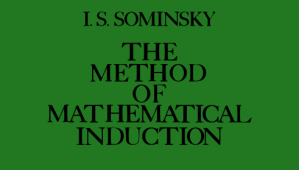
In the foreword it is said:

The method of mathematical induction, which is the subject of this book, is widely applicable in all departments of mathematics, from the elementary school course up to branches of higher mathematics only lately investigated. It is clear, therefore, that even a school course of mathematics cannot be studied seriously without mastering this method. Ideas of mathematical induction, moreover, have a wide general significance and acquaintance with them also has an importance for those whose interests are far removed from mathematics and its applications.

This book is meant for pupils in the higher forms of secondary schools, first year students in universities, teacher training colleges and technical colleges. It would also be useful for discussion in a school mathematical society.

The book was translated from Russian by Martin Greendlinger and was first published by Mir in 1975. Previous to that this booklet was also published in the West under the series of Topics in Mathematics (TiM) and also under Popular Lectures in Mathematics (PLM) Vol. 1. The link below is from the PLM version and was translated by Halina Moss, and was edited by I. N. Sneddon ans was published by Pergamon in 1961.

The essentials of the method and some simple examples of its use are given in Chapter I and in the first section of Chapter II. To study these it is sufficient for the reader to be familiar with the course of mathematics in the seven year school period. The remaining sections of this book are fully accessible to the reader who has mastered the mathematics course of a full secondary school.

All credits to the original uploader.

Update: 11 December 2015 | Added Internet Archive Link

You can get the book here.

Update: 10 October 2021 | Added PLM Link

The book was also published as a part of Popular Lectures in Mathematics series in 1961.

PLM version here.

Contents:

Foreword vii

INTRODUCTION  1

CHAPTER I
The Method of Mathematical Induction 3

CHAPTER II
Examples and Exercises  12

CHAPTER III
The Proof by Induction of Some Theorems of Elementary Algebra 39

CHAPTER IV
Solutions 45

Posted in books, little mathematics library, mathematics, mir publishers | Tagged , , , , | 13 Comments

Little Mathematics Library – Stereographic Projection

We now come to another book in the Little Mathematics Library titled Stereographic Projection by B. A. Rosenfeld and N. D. Sergeeva. As the title suggests the book deals with projections on planes.

The present booklet is devoted to proofs of the aforesaid properties of the stereographic projection and to the presentation of some of its applications. The booklet consists of eight sections dealing with different properties of projections. …The booklet is aimed to be used in the senior grades of the high schools and by the first- and second-year students.

The book was translated from the Russian by Vitaly Kisin and was first published by Mir in 1977.  All credits to the original uploader.

The Internet Archive Link

and here

Continue reading

Posted in books, little mathematics library, mathematics, mir publishers | Tagged , , , , , , | 4 Comments

Little Mathematics Library – Method of Successive Approximations

In the Little Mathematics Library we now come to Method of Successive Approximations by N. Ya. Vilenkin. As the title suggests the book has to do with approximation methods, but what kind of approximations and for what kind of use one may ask?

The preface of the book reads:

The main purpose of this book is to present various methods of approximate solution of equations. Their practical value is beyond doubt, but still little attention is paid to them either at school or a college and so someone who has passed a college level higher mathematics course usually has difficulty in solving a transcendental equation of the simplest type. Not only engineers need to solve equations, but also technicians, production technologists and people in other professions as well. It is also good for high-school students to become acquainted with the methods of approximate solution of equations. Since most approximate solution methods involve the idea of the derivative we were forced to introduce this concept. We did this intuitively, making use of a geometric interpretation. Hence, a knowledge of secondary school mathematics will be sufficient for anyone wanting to read this book.

The book was translated from the Russian by Mark Samokhvalov and was first published by Mir in 1979. All credits to the original uploader.

The Internet Archive Link

and here

Continue reading

Posted in little mathematics library, mathematics, mir publishers | Tagged , , , , , , , , , | 5 Comments

Little Mathematics Library – Gödel’s Incompleteness Theorem

After the last two posts by V. A. Uspenskii (check out his site here) which dealt with Post’s Machine, and Pascal’s Triangle, we now come to another book by him in the Little Mathematics Library series titled Gödel’s Incompleteness Theorem.

The back cover of the book reads:

 Few discoveries have had as much impact on our perception of human thought as Gödel’s proof in 1930 that any logical system such as usual rules of arithmetic, must be inevitably incomplete, i.e., must contain statements which are true but can never be proved. Professor Uspensky’s makes both a precise statement and also a proof of Gödel’s startling theorem understandable to someone without any advanced mathematical training, such as college students or even ambitious high school student. Also, Uspensky introduces a new method of proving the theorem, based on the theory of algorithms which is taking on increasing importance in modern mathematics because of its connection with computers. This book is recommended for students of mathematics, computer science, and philosophy and for scientific layman interested in logical problems of deductive thought.

The book was translated from the Russian by Neal Koblitz and was first published by Mir in 1987.

Thanks to hawa-ka-jhonka who made this book accessible.

The Internet Archive Link

and here

For magnet / torrent links go here.

Continue reading

Posted in books, computers, little mathematics library, mathematics, philosophy | Tagged , , , , | 7 Comments

Little Mathematics Library – Pascals Triangle

In continuing from the last post on Post’s Machine by V. A. Uspenskii (sometimes Uspensky) we come to another volume by him titled Pascals’s Triangle.

The book opens with an interesting note

The reader who is not familiar with Pascal’s triangle should be warned that it is not a geometric triangle with three angles and three sides. What we call Pascal’s triangle is an important numerical table, with the help of which a number of computation problems may be solved. We shall examine some of these problems and shall incidentally touch upon the question of what “solving a problem” can mean in general.

This exposition requires no preliminary knowledge beyond the limits
of the eighth-grade curriculum, except for the definition of and notation for the zeroth power of a number. That is, one must know that any non-zero number, raised to the zeroth power, is considered (by definition!) to be equal to unity: a0 = 1 for a ≠ 0.

The book was published by Mir in the Little Mathematics Library in 1976. But earlier in the West many books from this series were translated and published by University of Chicago Press under the series Popular Lectures in Mathematics. This particular title was translated from the Russian by David J, Soonke and Timothy McLarnan and was published in 1974.

You can get the book here (PLM version here.)

and here

All credits to the original uploader.

Continue reading

Posted in books, little mathematics library, mathematics, mir publishers | Tagged , , , , | 5 Comments

Little Mathematics Library – Post’s Machine

We start our posts in the Little Mathematics Library series with a book by V. A. Uspensky titled Post’s Machine.

This booklet is intended first of all for school children. The first two chapters are comprehensible even for junior schoolchildren. The book deals with a certain “toy” (“abstract” in scientific terms) computing machine – the so called Post machine – on which calculations involve many important features inherent in the computations on real electronic computers. By means of the simplest examples the students are taught the fundamentals of programming for the Post machine, and the machine, though extremely simple, is found to possess quite high potentialities.The reader is not expected to have any knowledge of mathematics beyond the primary school curriculum.

The book was translated from the Russian by R. Alavina and was first published by Mir in 1983.

All credits to the original uploader.

The Internet Archive Link

and here

Continue reading

Posted in books, little mathematics library, mathematics, mir publishers | Tagged , , , , , | 7 Comments