Science for Everyone – Progeny of Volcanoes

Till now we have not seen any books in the area of Geology, so this one is for all the people who are interested in volcanoes. In Science for Everyone series now we come to The Progeny of Volcanoes by P. N. Erofeev.

This is what the back cover of the book says:

Before setting out to acquaint the reader with the mysteries of the World Ocean, the author had himself explored the vast areas of the oceans covering the surface of our planet and had also done a great amount of researchin the fascinating domain of oceanological. studies. Fully aware of the fact that not all of his future readers would be competent enough to make their way through the complicated language used by the scientists in interpreting the data of their analysis,the author made every possible effort to facilitate his narrative without trespassing on the essence and scientific value
of the research that has been undertaken. This book provides the reader with a host of facts about the World Ocean that are not merely informative, but are also bound to create an integral picture in the reader’s mind and thus widen the scope of his or her scientific,
historical, and cultural background.

The book was translated from the Russian by G. G. Egorov and was first published by Mir in 1989.

Update: Jan 2020

The Internet Archive Link

and here

Continue reading

Posted in books, geology, mir books, mir publishers, science for everyone | Tagged , , , , , | 1 Comment

Science for Everyone – Yes, No Or Maybe

This time in the Science for Everyone series we come to a text on Statistics, this one is named Yes, No Or Maybe and is written by Ya. I Khurgin.

This is what the back cover of the book says:

Professor Yakov Khurgin is known for his works in applied mathematics, cybernetics, industrial applications of mathematics. Besides he is an imaginative popularizer of science. His book Do You Say Mathematics? has been passed through two editions in Russian and has been translated into English. His new book Yes, No or Maybe is a readable introduction to the frontiers of statistics and experiment design. The book is written in a lovely language and contains many practical examples.

The book was translated from the Russian by Alexander Repyev and was published first by Mir in 1985. The book mentioned in the back cover Do You Say Mathematics? is an amazing one, which we will get when we will start the mathematics series!

Update: Jan 2020

The Internet Archive Link

and here

Continue reading

Posted in books, mir publishers, science for everyone, statistics | Tagged , , , , , | 3 Comments

Science for Everyone – This Fascinating Astronomy

We now come to another book in Science for Everyone Series, this one is titled This Fascinating Astronomy by V. N . Komarov. This book goes a step further than the two other astronomy books (All About The Telescope, A Book About Planets and Stars) that we have already seen. Astronomy indeed is a fascinating subject. Ans Komarov makes it a point to tell the reader that. The back cover of the book says:

Written in a language easily accessible to a wide reader-ship, this book is an exposure of some extraordinary discoveries in modern astronomy and of the puzzling problems it still has to solve. It is also a presentation of facts defying traditional views, of original theoretical conjectures and new research methods. Debatable as-tronomical issues are set out in a lively and interesting form, and in conformity with the latest achievements in physics. Continue reading

Posted in astronomy, books, mir publishers, science for everyone | Tagged , , , , , | 19 Comments

Science for Everyone – Aptitude Test Problems in Physics

This book, which is a collection of physics 
aptitude test problems, draws on the experience 
of the physics olympiads conducted during the 
last fifteen years among the schoolchildren 
of Moscow.

In Science for Everyone series we now come to a book, Aptitude Test Problems in Physics edited by S. S. Krotov, and contributing authors are A. I. Buzdin, V. A. Il’lin, I. V. Krivchenkov, N. A. Sveshnokov.
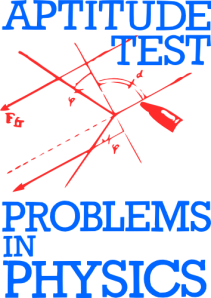
This book is hugely popular with aspirants  appearing for different entrance exams in India and this is the reason why maybe it was republished along with more famous Irodov. (Maybe all the problems are sourced from here, or books like these ; ) Any way the book is great, it makes you think about many ways of solving problems.

From the Preface

The present state of science and technology is such that a large number of scientists and engineers must be educated at an advanced level. This cannot be done without significantly raising the level of teaching physics, with an emphasis on the individual and special efforts to detect and nurture budding talents. In this respect, physics
olympiads for students at secondary school and vocational training colleges are important in bringing to light the brightest students and in correctly guiding them in their choice of profession.

This book, which is a collection of physics aptitude test problems, draws on the experience of the physics olympiads conducted during the last fifteen years among the schoolchildren of Moscow. A Moscow physics olympiad includes three preliminary theoretical rounds at the regional, city, and qualifying levels, followed by a final practical round. After the final round, a team of Moscow schoolchildren is selected for participation in the all-Union olympiad. The complexity of the problems set for each round increases gradually, starting from the simplest problems at regional level, problems which can be solved simply by havinga thorough knowledge of the basic laws and concepts of physics. The problems at the qualifying stage are much more complicated. Some of the problems at this level involve a certain amount of research as a rule, the problems make participation in the olympiads even more challenging). This collection contains problems from the theoretical rounds only. The structure of the book reflects the emphasis given to it in different sections of the physics course at such competitions. The number of problems set at an olympiad and the fraction allotted to a particular topic in the book are determined by the number of years the topic is taught at school. A detailed classification of different topics is not given since some are represented by only one or two problems, while other topics have dozens of problems. Most of the problems are originally and a considerable proportion of them was composed by the authors. The most difficult problems are marked by asterisks being  the product of a close group of authors, the book reflects certain traditions and experience drawn from Moscow olympiads only. A feature of the book is that it presents the scientific views and working style of a group of like-minded scientists.

In view of all this, the book should attract a large circle of readers. The best way to use it is as a supplementary material to the existing collections of problems in elementary physics. It will be especially useful to those who have gone through the general physics course, and want to improve their knowledge, or try their strength at nonstandard problems, or to develop an intuitive approach to physics. Although it is recommended primarily for high-school students, we believe that college students in junior classes will also find something interesting in it. The book will also be useful for organizers of physics study circles, lecturers taking evening and correspondence courses, and for teachers conducting extracurricular activities.

This is what the back cover of the book says:

This collection contains about 250 problems in
physics set for boys and girls from Moscow schools
participating in physics olympiads from 1968 to
1985. The most interesting and original problems
from these examinations have been included together
with their solutions.
Intended for schoolchildren and teachers of physics,
this book can also be used for preparation to entrance
examinations to the higher educational institutes
where an advanced knowledge of physics is required.

The contributing authors are A.I. Buzdin V.A. Il’in I.V. Krivchenkov S.S. Krotov N.A. Sveshnikov.

This book was translated from the Russian by Natalia Wadhwa (is she related anyway to Ram Wadhwa who translated Tarasov’s Quantum Mechanics?) and was first published by Mir in 1990. CBS republished the book 1996.

Update Jan 2020:

The Internet Archive Link

and here

For those who want to buy the book, it is still in print and is very cheap at Rs. 54.

All credits to the original uploader, though I had also made a copy, but this one is much better than mine, so posting the better one.

Thanks to Escapee for staying awake with me, while I made this post 🙂

Continue reading

Posted in mir publishers, physics, science for everyone | Tagged , , , , , , | 29 Comments

Science for Everyone – The Greatest Speed

We now come to another one in the Science for Everyone Series. This one is all about c; The Greatest Speed, the speed of light by S. R. Filonovich.

The book opens with a dialogue from Galileo’s book and opens up historical roots of the problem of light travel.

In the preface the author comments

This book covers the history of the determination of the velocity of light during the past three centuries. The problem originated in a seemingly abstract question: is the velocity of light finite or infinite? The answer was found in the 17th century, and the problems of measuring the light velocity has been luring scientists ever since. Step by step, the velocity of light was promoted from a commonplace number in optics to a fundamental constant playing a most important role in physics. Numerous experiments in the history of measuring this constant illustriously support Albert Einstein’s idea: science is not and will never be a completed book be-cause each essential success brings new questions, and with time every development reveals newer and deeper problems.

The reason why the determination of the velocity of light is still intriguing scientists lies in that the velocity of light in vacuum is a constant belonging to many branches of physics. The velocity of light, as it were, ‘unites’ these areas, thus substantiating convincingly the general philosophical concept on the unity of the world around us. However, the interest, in the history of this particular problem can be accounted for by not only the role of this constant in modern science.

The experiments conducted to measure the velocity of light contributed to the development of physics on the whole. Starting from the 17th century, these experiments show the progress of methods and techniques in physical experiments. Quite recently, when the Russian edition of this book has already been out of print (it ran into 150,000 copies), the velocity of light drew the attention of every experimenting physicist again: in late 1983, a basically new decision was adopted to define the metre, one of the most important physical units, and the velocity of light played the main role in the definition.

From the back cover:

The constant denoting the velocity of light in vacuum is encountered in every branch of physics, and this universality brings out the unity of the physical world. Although it is now over three hundred years since the constant was first defined, it yielded to scientific assaults only slowly, revealing as it did unexpectedly new phenomena. Its universality and the surprises that it threw up make any attempt to relate how the velocity of light came to be measured a minor history of physics. This book therefore explains the requisite science against the back-ground of the historical personalities involved. Intended for teachers and school pupils.

The book was translated from the Russian by Michael Burov and was first published by Mir in 1986.

Thanks to Gordon for bringing this book to my notice, thanks to gnv64 for this book.

Update: Jan 2020

The Internet Archive Link

and here

Continue reading

Posted in books, mir publishers, physics, science for everyone | Tagged , , , , , , , | 4 Comments

Science for Everyone – Problems in Plane Geometry

As told in the last post, we now come to the Problems in Plane Geometry by I. F. Sharygin in the Science for Everyone series.

In the preface Sharygin says:

This volume contains over 600 problems in plane geometry and consists of two parts. The first part contains rather simple problems to be solved in classes and at home. The second part also contains hints and detailed solutions. Over 200 new problems have been added to the 1982 edition, the simpler problems in the first addition having been eliminated, and a number of new sections- (circles and tangents, polygons, combinations of figures, etc.) having been introduced, The general structure of the book has been changed somewhat to
accord with the new, more detailed, classification of the problems. As a result, all the problems in this volume have been rearranged.

From the back cover of the book:

This is a translation from the revised edition of the Russian book which was issued in 1982. It is actually the first in a two-volume work on solving problems in geometry, the second volume “Problems in Solid Geometry” having been published in English first by Mir Publishers in 1986. Both volumes are designed for schoolchildren and
teachers.

This is a unique collection of interesting and elegant problems presenting the subject in a manner comprehensible to a youthful mind making it both interesting and usefulthrough a wide range of practical applications. Although the problems in this collection vary in “age” (some of them can be found in old books and journals, others were offered at mathematical olympiads or published in the journal “Quant” (Moscow, we still hope that some of the problems in the collection will be of interest to experienced geometers.

Almost every problem is non-standard (as compared with routine exercises on solving equations, inequalities, etc.): one has to think of what additional constructions must be made, or which formulas and theorems must be used. Therefore, this collection cannot be regarded as a problem hook in geometry; it is rather a collection of geometrical puzzles aimed at demonstrating the elegance of elementary geometrical techniques of proof and methods of computation (without using vector algebra and with a minimal use of the method of coordinates, geometrical transformations, though a somewhat wider use of trigonometry).

The book was translated from the Russian by Leonid Levant and was first published by Mir in 1988.

You can get the book here and here.

Link updated 01/Feb/2017

Facing Problems: FAQs

Continue reading

Posted in books, mathematics, mir publishers, science for everyone | Tagged , , , , , , , , , , , , , | 16 Comments

Science for Everyone – Problems in Solid Geometry

We are still on the Science for Everyone series. This post is first of two books by I. F. Sharygin. The two books are problem and solution books in geometry. In this post the Problems in Solid Geometry is taken up. The next post would be Problems in Plane Geometry.

From the Preface:

This book contains 340 problems in solid geometry and is a natural continuation of Problems in Plane Geometry, Nauka, Moscow, 1982. It is therefore possible to confine myself here to those points where this book differs from the first. The problems in this collection are grouped into (1) computational problems and (2) problems on proof.

The simplest problems in Section 1 only have answers, others, have brief hints, and the most difficult, have detailed hints and worked solutions. There are two reservations. Firstly, in most cases only the general outline of the solution is given, a number of details being suggested for the reader to consider. Secondly, although the suggested solutions are valid, they are not patterns (models) to be used in examinations. Sections 2-4 contain various geometric facts and theorems, problems on maximum and minimum (some of the problems in this part could have been put in Section 1), and problems on loci. Some questions pertaining to the geometry of tetrahedron, spherical geometry, and so forth are also considered here.

As to the techniques for solving all these problems, I have to state that I prefer analytical computational methods to those associated with plane geometry. Some of the difficult problems in solid geometry will require a high level of concentration from the reader, and an ability to carry out some rather complicated work.

The book was translated from the Russian by Leonid Levant and was first published by Mir in 1986.

All credits to the original uploader.

Update Jan 2020


Here and here

Continue reading

Posted in books, mathematics, mir publishers, science for everyone | Tagged , , , , , , , , | 10 Comments

Science for Everyone – Differential Equations in Applications

Continuing the Science for Everyone Series we now come to Differential Equations in Applications by V. V. Amel’kin

From the back cover:

This book is an easy-reading introduction to ordinary differential equations and their use in the study of real phenomena and processes. Problems taken from various fields of knowledge illustrate the tools used in setting up differential equations and the methods employed in their qualitative investigation. The book should be useful to  high-school students, teachers of science courses, college students, and specialists of, non-mathematical professions who use mathematics in their work.

The book discusses many interesting problems and has 2 chapters. The first one is dedicated to constructing the differential models and finding their solutions. The second chapter is more interesting, it shows you the way to deal with differential equations qualitatively.

The book was translated from the Russian by Eugene Yankovsky and was first published by Mir in 1990. This I think was one of the last books published by Mir, as after that the USSR came apart and so did all these wonderful state run publishers.

The Internet Archive Link  and here

Follow us on The Internet Archive: https://archive.org/details/mir-titles

Write to us: mirtitles@gmail.com

Updated: 15 January 2019

Update: New link has been posted, earlier link was missing pages 180-181. Thanks Khalid for reporting this.

Continue reading

Posted in books, mathematics, mir publishers, physics, science for everyone | Tagged , , , , , , , | 8 Comments

Science for Everyone – Physical Paradoxes and Sophisms

Now we come to a book in the Science for Everyone series which eluded me for years, only to be found with one of my dear friends. This book is Physical Paradoxes and Sophisms by V. N. Lange. Long before I had read about this book in the advertisements on the back pages of other books, but had never a chance to see it. Many of the problems discussed in this book are revealing and take you to deeper levels of understanding about physics. Two similar books that I have read are Surprises in Theoretical Physics and More Surprises in Theoretical Physics by Rudolf Peierls.

From the Preface

This book was written for senior schoolchildren and presents a series of physical paradoxes and sophisms differing in theme and complexity. Some of them were known long ago, yet most are published for the first time. “Sophism” and “paradox” are Greek words. A sophism is an argument, though apparently perfectly correct in form, actually contains an error that makes the final deduction absurd. A well-known sophism is “That which you did not lose, you possess. You have not lost horns, hence you possess them.”

On the contrary, a paradox is a statement that seemingly contradicts common sense, yet in fact is true. For example, as a popular Russian saying contends, “it is a fact, however incredible” that when combining velocities with the same direction, the resultant velocity is smaller than their arithmetic sum (this is one of the inferences of the special theory of relativity).

A study of sophisms and paradoxes need not be thought of as a waste of time. Indeed, they were esteemed by such eminent scientists as Gottfried Leibniz, Leonhard Euler, and Albert Einstein. Einstein was very fastidious about his books, and yet he had a shelf full of books on mathematical jokes and puzzles. Maybe it was his early love of original problems that developed his striking paradoxes has played an extraordinary role in the development of contemporary physics. We hope that this small collection will help its readers avoid making some mistakes. For example, senior schoolchildren and first—year students are often observed, in trying to solve ballistic pendulum problems and the like, finding the system’s velocity following an elastic collision by applying the law of conservation of mechanical energy only. Such mistakes will hardly be made again after studying the sophism in Problem 1.25 (a “violation” of the law of energy conservation).

The first section of the collection contains the problems, the second section gives short solutions. The latter are useful to check your own solutions and in the cases when a problem is difficult to solve on one’s own. The first two editions of the book were so popular that they quickly sold out. It has been translated into Bulgarian, Roumanian, German (two editions in GDR), Japanese, and the languages of the peoples of the USSR. Its success stimulated me to compose new paradoxes and sophisms, thus resulting in the present edition. In preparing it, I have omitted some problems, revised the text and solution of others, and added new ones.

The book was translated from the Russian by Valerii Ilyushchenko and was first published by Mir in 1987.

Thanks AlKaPRo for providing this book.

The Internet Archive Link and here

Follow us on The Internet Archive: https://archive.org/details/mir-titles

Write to us: mirtitles@gmail.com

Updated: 15 January 2019

Continue reading

Posted in books, mir publishers, physics, science for everyone | Tagged , , , , | 11 Comments

Science for Everyone – Physics and Geometry of Disorder – Percolation Theory

We now come to another gem in the Science For Everyone series, Physics and Geometry of Disorder – Percolation Theory by A. L. Efros.

From the back cover:

This book is  about percolation theory and its various applications, which occur mostly in physics and chemistry. The book is self-sufficient in that it contains chapters on elementary probability theory and Monte Carlo simulation. Most attention is paid to the relationship between the geometrical and physical properties of systems in the vicinity of their percolation thresholds. The theory is applied to examples of impurity semiconductors and doped ferromagnetics, which demonstrate its universality. Although written for students at high schools, the book is very good reading for college students and will satisfy the curiosity of a physicist for whom this will be a first encounter with percolation theory.

The book was translated from the Russian by V. I. Kisin and was first published by Mir in 1986.

The Internet Archive Link and here

Follow us on The Internet Archive: https://archive.org/details/@mirtitles

Write to us: mirtitles@gmail.com

Updated: 15 January 2019

Continue reading

Posted in books, mathematics, mir publishers, physics, science for everyone | Tagged , , , , , , , , , , | 5 Comments