Structural Design – Baikov, Strongin

In this post, we will see the book Structural Design by Baikov and Strongin.

Rydnik-ABCs-of-Quantum-Mechanics-Mir-2020 copy

About the book

The book presents a systematic and step-by-step approach to the physical and mechanical properties of concrete, reinforcing steel, reinforced concrete, masonry, and struc­tural steel.

The theoretical basis and design principles for reinforced concrete, masonry, and steel structures have been brought in line with new standards which were put in force in the Soviet Union since January, 1977. The material is presented with emphasis on Soviet, practice in highly industrialized precast reinforced concrete, type-design structural elements, and high-strength materials.

A good deal of attention is given to special engineering structures for water supply, sewage disposal, and heat supply systems, including tanks, settlers, aeration filters, aeration tanks, water lowers, buried conduits and headers, and heat-pipeline structures.

Carefully worked design examples are shown throughout the book, and an appendix gives a selection of design charts associated with the basic Soviet codes of practice.

Intended as textbook for students of building, civil, and structural engineering, the book will also be of interest to students in other departments and practising engineers.

The book was published by Mir in 1980 and was from the Russian by Alexander Kuznetsov.

Many thanks to Akbar Azimi for providing the original scans. We cleaned the 2-in-1 scan and created the pdf. There might be some warping in few of the pages, but overall it is very readable.

The Internet Archive Link

and here

CONTENTS

Preface 8

Chapter One. Basics of Structural Design. 9

I.1. Limit States. 9
I.2. Design Factors. 10
I.3. Characteristic and Design Loads and Strength. 11
I.4. Limit-State Design. 13
I.5. Units of Measure. 15

Chapter Two. Reinforced Concrete as a Construction Material. 16

II.1. General. 16
II.2. Concrete. 19
II.3. Reinforcing Steel. 25
II.4. Main Properties of Reinforced Concrete. 35

Chapter Three. Analysis and Design of Reinforced Concrete Members. 37

III.1. General. 37
III.2. Design of Prestressed Concrete Structures. 40
III.3. Practical Hints for Design and Engineering. 47
III.4. Engineering Hints for Prestressed Members. 51

Chapter Four. Members in Axial Compression. 55

IV.1. Constructional Features. 55
IV.2. Design Under Accidental Eccentricity. 57

Chapter Five. Reinforced Concrete Members in Axial Tension 62

V.l. Constructional Features. 62
V.2. State of Stress and Design of Nonprestressed Members. 63
V.3. State of Stress and Design of Prestressed Members. 67

Chapter Six. Reinforced Concrete Members in Bending. 72

VI. 1. Constructional Features. 72
VI.2. Stale of Stress in Bending Members. 80
VI.3. Normal-Section Strength Analysis of Members. 85
VI.4. Inclined-Section Shear Strength Analysis. 98
VI.5. Incipient-Cracking Resistance of Prestressed Members. 108
VI.6. Sag Analysis. 114
VI.7. Crack-Opening Analysis. 118

Chapter Seven. Reinforced’ Concrete Members in Eccentrical Compression and Tension. 120

VII.1. Constructional Features of Members in Eccentrical Compression. 120
VI1.2. Design of Members in Eccentrical Compression. 123
VII.3. Members in Eccentrical Tension. 132

Chapter Eight. Masonry and Reinforced Masonry Structures. 135

VIII.1. Masonry Materials and Strength. 135
VIII.2. Design of Masonry Members in Compression. 138
VIII.3. Reinforced Masonry Structures. 142
VIII.4. Design of Masonry Structures. 145
VIII.5. Worked Examples for Design of Masonry Members. 147

Chapter Nine. Metal Structures. 152

IX.1. Materials for Metal Structures. 152
IX.2. Joints in Metal Structures. 157
IX.3. Design and Proportioning of Beams. 164
IX.4. Design and Proportioning of Columns. 175
IX.5. Design and Proportioning of Trusses. 188
IX.6. Prestressed Steel Structures. 191

Chapter Ten. Design of Buildings. 193

X.l. Principles of Building Layout. 193
X.2. Reinforced Concrete Floors. 196
X.3. Reinforced Concrete Column Footings. 219
X.4. Prefab Reinforced Concrete One-Storey Industrial Buildings. 227
X.5. Buildings for Water Supply and Sewage Disposal Systems and Boilers. 237

Chapter Eleven. Special Structures for Water Supply and Sewage Disposal Systems. 246

XI.1. General. 246
XI.2. Construction Types of Circular Reinforced Concrete Tanks. 249
XI.3. Design of Circular Tanks. 260
XI.4. Construction Types of Reinforced Concrete Rectangular Tanks. 273
XI.5. Design of Rectangular Tanks. 285
XI.6. Construction Types and Design of Steel Circular Tanks. 292
XI.7. Reinforced Concrete Pipes and Wells for Water Supply and Sewage Disposal Systems. 296
XI.8. Construction Types and Design of Water Towers. 300

Chapter Twelve. Design of Reinforced Concrete Structures. Worked Examples. 306

XII.l. General. 306
XII.2. Nonprestrossod Ribbed Roof Slab. 306
XII.3. Prestressed Ribbed Roof Slab. 317
XII.4. Squaro Roof Slab. 324
XII.5. Roof Girder. 329
XII.6. Column and Footing. 337
XII.7. Wall of a Precast Reinforced Concrete Rectangular Tank. 342
XII.8. Wall of a Precast Circular Tank. 348

Chapter Thirteen. Structures for Heat Supply Systems. 355

XIII.1. General. 355
XIII.2. Construction Types of Conduits and Headers. 357
XIII.3. Servicing Chambers, Compensating Niches, and Supports for Heat Pipelines. 367
XIII.4. Heat Pipelines Laid without Conduits. 378
XIII.5. Overhead Heat Pipelines. 379
XIII.6. Design Principles for Heat Pipeline Structures.386

Appendices. 395

Index. 413
Posted in books, engineering, mir books, mir publishers, technology | Tagged , , , , , , , | Leave a comment

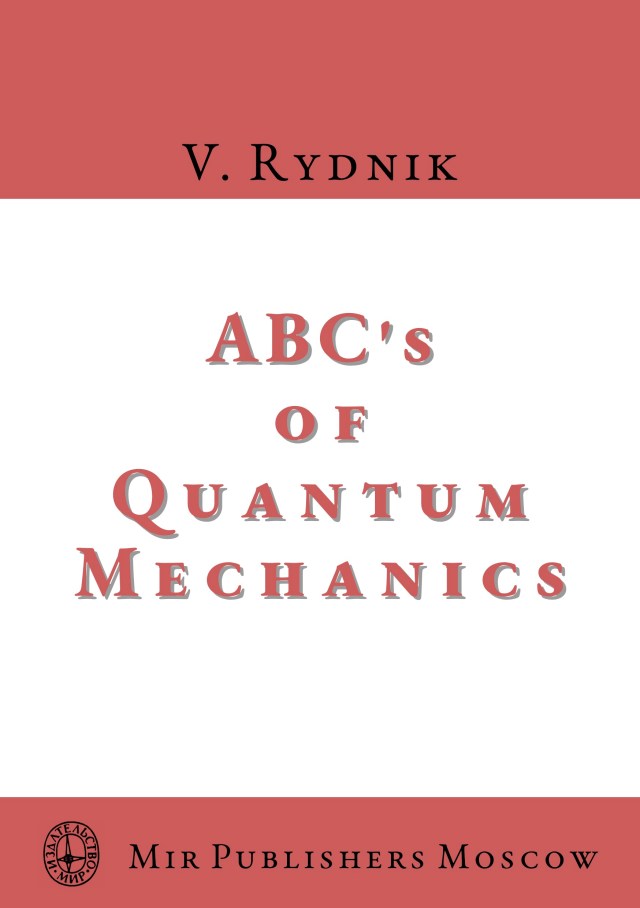
ABC’s of Quantum Mechanics – Rydnik (LaTeX version)

We have already seen this book earlier. But this post is to bring to your notice the electronic version of the book typeset using LuaLaTeX.

Rydnik-ABCs-of-Quantum-Mechanics-Mir-2020 copy

The book has come out nicely. Of course, it could have been better! I have typeset it in A5 paper, with 12 pt font with LuaLaTeX. The font used is EB Garamond. I have tried to maintain the typesetting of the original book with no chapter numbers or section numbers.

The table of elementary particles and their properties was one of the more challenging tasks in this otherwise simple book to typeset. It took me almost a day to just typeset this table. The rest was easy.

Screenshot 2020-04-04 at 18.40.17I have also created the front and back covers using TikZ, the first time I have tried this. Though they could have been done better.
The Internet Archive Link and here

The source files can be found at the gitlab project page:

https://gitlab.com/mirtitles/rydnik-abc-qm

Note: The original scan (by itanveer) which we had cleaned and posted had two pages (258-259) missing. I had already made a draft post asking for help for these two pages from people who might have the book, as I do not currently have the access to my physical collection. Except for these two pages, the rest of the book was processed and ready. Serendipitously, just a couple of days back Hemant Garach commented on the earlier post saying that he has this book! I requested him to scan these two missing pages and thanks to him we now have the complete book!

TODO: What remains to be done (in order of need):

  1. One more round of copy-editing. Though I tried my best, there will be many small typos here and there. I hope I have not screwed up in any major way. A thousand eyes are better than just two!
  2. Recreating figures (and front cover) using TikZ or other tools, so that it becomes completely electronic. For this release, I have used the scanned raster figures. Some actual photos of cloud chambers and particle tracks can be used instead of the current ones.
  3.  There has been much increase in our knowledge of particle physics (both empirical and theoretical) ever since the book was written in the 1960s. The book itself might be expanded as much of the information might seem dated to a particle physicist. Perhaps a new expanded edition of the book covering the era from the 1970s to present? Anyone interested?!
Posted in books, mir books, mir publishers, physics, science | Tagged , , , , , , , , | 7 Comments

Collection of Problems on the Dynamics of a Point in a Central Force Field – Polyakhova

In this post, we will see the book by Ye. N. Polyakhova titled Collection of Problems on the Dynamics of a Point in a Central Force Field.

About the book

The collection is a detailed selection of problems on the dynamics of the motion of a material point acted on by a central gravitational force, in particular, the dynamics of space flight. As an exception, the book presents several problems on the motion of a point acted on central non-gravitational forces. The book is written mainly for correspondence students. Topics covered include Kepler’s laws, the integral of areas, Binet’s formulas for central forces, the energy balance and velocity along a space trajectory, time of motion along a space trajectory, conditions for the existence of elliptical trajectories, transfer from orbit to orbit, sphere of action, third escape velocity problems, two-body problem, and the generalized third law of Kepler, along with miscellaneous problems.

This collection is a textbook for the course of theoretical mechanics (“Point Dynamics” section). students in correspondence departments of Leningrad State University and other higher educational institutions used in part by students in the day and evening departments. Moreover, the problem book may prove useful for beginning instructors in providing practical exercises mechanics, particularly, when they prepare modifications of test problems.

Most of the collection is a detailed sampling of problems on the dynamics of a material point acted on by gravitational force, in particular, problems on the elementary dynamics of space flight. Several problems on the motion of a point acted on by central non-gravitational forces are presented. Altogether, the collection includes about 200 problems of varying degrees of difficulties, with solutions.

Translation of Sbornik zadach po dinamike tochki v pole tsentral’nykh sil, Leningrad, Leningrad University Press, 1974, pp. 1-145. The book was published by NASA in May 1975 under its technical translation programme (NASA TT F-16,263).

The Internet Archive Link

Contents

Foreword iv
Table of Contents vi
Chapter One. Central Forces. Force of Gravity and Its Dynamic Characteristics 1
Chapter Two. Kepler’s Laws 11
Chapter Three. Integral of Areas 19
Chapter Four. Binet’s Formulas for Central Forces 26
Chapter Five. Energy Balance and Velocity Along a Space Trajectory 36
Chapter Six. Time of Motion in a Space Trajectory 63
Chapter Seven. Conditions for the Existence of Elliptical Trajectories 77
Chapter Eight. Transfer from Orbit to Orbit 90
Chapter Nine. Sphere of Action. Problems of Third Escape Velocity 109
Chapter Ten. Two-Body Problem. Third Kepler’s Law Generalized 118
Chapter Eleven. Miscellaneous Problems 127
References 163

Posted in astronomy, books, NASA Technical Translations, physics, problem books | Tagged , , , , , , , , | 1 Comment

Linear Algebra And Multi Dimensional Geometry – Efimov, Rozendorn

In this post, we will see the book Linear Algebra And Multi Dimensional Geometry by
N. V. Efimov, E. R. Rozendorn

Efimov, Rozendorn - Linear Algebra and Multi-Dimensional Geometry - Mir fc

About the book

This book was conceived as a text combining the course of linear algebra and analytic geometry. It originated as a course of lectures delivered by N. V. Efimov at Moscow State University (mechanics and mathematics department) in 1964-1966. However, the material of these lectures has been completely reworked and substantially expanded. We have tried to bear in mind the requi­rements of other mathematical disciplines and also of mechanics and physics. We hope that all parts of the text will be useful. The only preparation required for this text can be given an a first- semester course of analytic geometry and algebra at the most ele­mentary level. All that is needed is a firm grasp of the elements of these subjects. For Chapter XII the student should be ac­quainted with projective transformations and the projective pro­perties of figures in the plane. Also, in Chapter X the reader may simplify his task by skipping Subsections 13 to 23 (Section 3) and Subsection 10 of Section 7. What is left of Chapter X can serve as a minimal algebraic basis for the theory of multidimensional in­tegration.
It may be noted in conclusion that the first five chapters already contain material with broad applications in mathematics, mecha­nics, and physics. These chapters, supplemented with some of the material of subsequent chapters, can be utilized in higher tech­nical schools with a more advanced mathematics curriculum.


The book was translated from the Russian by George Yankovsky and published by Mir in 1975.

Many thanks to shankar.leo for providing the scans and the pdf.

The Internet Archive Link

Note: I tried to optimise the file for size, but somehow the archive kept on rejecting for some error in the pdf. I could have tried a few more things, but didn’t get time for that, hence the delay in post. For now, hence this large file (~120M) was uploaded. This file is OCRed but without bookmarks and pagination.

I will try to update a smaller file in the future, or if someone can add a link to a smaller file,  it would be great.

Preface 9

Introduction 11

Chapter I. Linear Spaces

1. Axioms in linear space 15
2. Examples Of linear spaces 17
3. Elementary corrolaries to the axioms of a linear space 23
4. Linear combinations. Linear dependence.25
5. Lemma on the basis minor 27
6. Basic lemma on two systems of vectors 30
7. The rank of a matrix 32
8. Finite-dimensional and infinite-dimensional spaces. Bases 34
9. Linear operations in components 36
10. Isomorphism between linear spaces 38
11. Correspondence between complex and real spaces 40
12. Linear subspace 42
13. Linear hull 44
14. Sum of subspaces. Direct sum 47

Chapter II. Linear Transformations of Variables. Transformations of Coordinates

1. Abbreviated notation for summation 53
2. Linear transformation of variables. The product of linear
transformations of variables and matrix products 56
3. Square matrices and nonsingular transformations 60
4. The rank of a product of matrices 64
5. Transformation of coordinates in a change of basis 66

Chapter III. Systems of Linear Equations. Planes In Affine Space

1. Affine space 70
2. Affine coordinates 71
3. Planes 73
4. Systems of first-degree equations 77
5. Homogeneous systems 81
6. Nonhomogeneous systems 88
7. Mutual positions of planes 91
8. Systems of linear inequalities and convex polyhedrons 98

Chapter IV. Linear, Bilinear and Quadratic Forms

1. Linear forms 108
2. Bilinear forms 112
3. The matrix of a bilinear form 116
4. Quadratic forms 118
5. Reducing a quadratic form to canonical form by Lagrange’s method 121
6. The normal form of a quadratic form 124
7. The law of inertia of quadratic forms 125
8. Reducing a quadratic form to canonical form by Jacobi’s method 127
9. Positive definite and negative definite quadratic forms 129
10. Gram’s determinant. The Cauchy-Bunyakovsky inequality 132
11. Zero subspaces of a bilinear and a quadratic form 134
12. The zero cone of a quadratic form.137
13. Elementary examples of zero cones of quadratic forms 139

Chapter V. Tensor Algebra

1. Reciprocal bases. Contravariant and covariant vectors 142
2. Tensor product of linear spaces 149
3. Basis in a tensor product. Components of a tensor 153
4. Tensors of bilinear forms 159
5. Multiple-order tensors. Tensor product 162
6. Components of multiple-order tensors 166
7. Multilinear forms and their tensors 168
8. Symmetrization and antisymmetrization (alternation). Skewsymmetric forms 170
9. An alternative description of the tensor product of two linear spaces 174

Chapter VI. Groups and Some Applications

1. Groups and subgroups. Distribution of bases into classes
with respect to a given subgroup of matrices. Orientation 180
2. Transformation groups. Isomorphism and homomorphism of groups 186
3. Invariants. Axial invariants. Pseudoinvariants 191
4. Tensor quantities 197
5. The oriented volume of a parallelepiped. The discriminant tensor 201

Chapter VII. Linear Transformations of Linear Spaces

1. Generalities 207
2. A linear transformation as a tensor 210
3. The geometrical meaning of the rank and determinant of a linear transformation. The group of nonsingular linear transformations.213
4. Invariant subspaces 216

5. Examples of linear transformations 218
6. Eigenvectors and the characteristic polynomial of a transformation 224
7. Basic theorems on the characteristic polynomial and eigenvectors 227
8 Nilpolent transformations. The general structure of singular
transformations 229
9. The canonical basis of a nilpotent transformation 233
10. Reducing a transformation matrix to the Jordan normal form 242
11. Transformations of a simple structure 248
12. Equivalence of matrices 250
13. The Hamilton-Cayley formula 252

Chapter VIII. Spaces with Quadratic Metric

1. Scalar products 254
2. The norm of a vector 256
3. Orthonormal bases 258
4. Orthogonal projection. Orthogonalization 259
5. Metric isomorphism 265
6. ^-orthogonal matrices and ^ orthogonal groups 266
7. The group of Euclidean rotations 270
8. The group of hyperbolic rotations 278
9. Tensor algebra in quadratic-metric spaces 287
10. The equation of a hyperplane in quadratic-metric space 295
11. Euclidean space. Orthogonal matrices. Orthogonal group 297
12. The normal equation of a hyperplane in Euclidean space 302
13. The volume of a parallelepiped in Euclidean space. The discriminant tensor. Vector product 304

Chapter IX. Linear Transformations of Euclidean Space

1. Adjoint of a transformation 308
2. Lemma on the characteristic roots of a symmetric matrix 310
3. Self-adjoint transformations 311
4. Reducing a quadratic form to canonical form in an orthonormal basis 317
5. The joint reduction to canonical form of two quadratic forms 319
6. Skew-adjoint transformations 322
7. Isometric transformations 325
8. The canonical form of an isometric transformation 330
9. The motion of a rigid body with one fixed point 335
10. The curvature and torsion of a space curve 338
11. The decomposition of an arbitrary linear transformation into the product of a self-adjoint and an isometric transformation 340
12. Applications to the theory of elasticity. The strain tensor and the stress tensor 343

Chapter X. Multivectors and Outer Forms

1. Alternation 346
2. Multivectors. Outer product 351
3. Bivectors 357
4. Simple multivectors 366
5. Vector product 370
6. Outer forms and operations on them 376
7. Outer forms and covariant multivectors 379
8. Outer forms in three-dimensional Euclidean space 386

Chapter XI. Quadric Hypersurfaces

1. The general equation of a quadric hypersurface 391
2. Changes in the left member of the equation under translation of the origin 392
3. Changes in the left member of the equation for a change in the orthonormal basis 395
4. The centre of a quadric hypersurface 397
5. Reducing to canonical form the general equation of a quadric hypersurface in Euclidean space 399
6. Classification of quadric hypersurfaces in Euclidean space 402
7. Affine transformations. 410
8. Affine classification of quadric hypersurfaces 414
9. The intersection of a straight line with a quadric hypersurface. Asymptotic directions 415
10. Conjugate directions.418

Chapter XII. Projective Space

1. Homogeneous coordinates in affine space. Points at infinity 422
2. The concept of a projective space 425
3. A bundle of planes in affine space 435
4. Central projection 443
5. Projective equivalence of figures 446
6. Projective classification of quadric hypersurfaces 453
7. The intersection of a quadric hypersurface and a straight line. Polars 459

Appendix 1. Proof of the theorem on the classification of linear quantities 467

Appendix 2. Hermitian forms. Unitary space.471

Bibliography. 484

Index. 486

Posted in books, mathematics, mir books, mir publishers | Tagged , , , , , , , , , , , , , , , , | 4 Comments

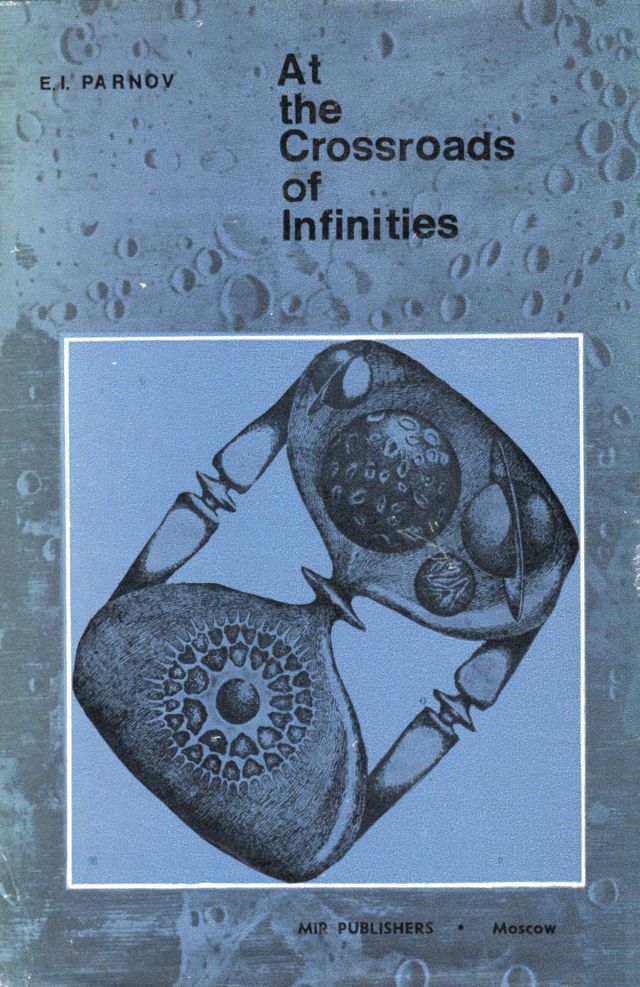
At the Crossroads of Infinities – Parnov

In this post, we will see the book At the crossroads of infinities by E. I. Parnov.

out0001 copy.jpg

About the book

At the Crossroads of Infinities is a story about the struggle of ideas out of which the modern physical picture of the world was born. Can anything move faster than light? Is the uni­verse finite or infinite? Is time revers­ible? What lies at the basis of the realities which we perceive as space, time or matter? These are the questions taken up in this book. And more, for it also tells of the roads of know­ledge, of the way man has probed the mysteries of the infinitely large and infinitely small, yet at root in­tegral world. (From the Front Jacket)

The book is a tour of the development of ideas of modern physics at the beginning of the 20th century. The book covers historical as well as philosophical issues which are at the core of modern physics. The struggle of ideas which the creators and developers of quantum mechanics and special relativity had to deal with is described very well.

The book was translated from the Russian by Vladimir Talmy and was published by Mir in 1971.

The Internet Archive Link and here

Contents

FACE TO FACE WITH THE UNIVERSE 7

PART I. LOOKING BACK 11

PART II. BUILDING BLOCKS OF THE UNIVERSE 86

PART III. AT THE THRESHOLD OF  A UNIFIED THEORY 200

PART IV. SPACE. TIME. VACUUM 252

PART V. THE MEGAWORLD 297

PART VI. THE UNIVERSE AND INFINITY 361


Posted in books, history, mir books, mir publishers, physics, science, soviet | Tagged , , , , , , , , , , , | 4 Comments

Origin and Chemical Evolution of the Earth (Science for Everyone) – Voitkevich

In this post, we will see the book Origin and Chemical Evolution of the Earth by G.V. Voitkevich.  Earlier, we had seen Origin and Development of Life on Earth by the same author, which can be seen as a companion volume to the one in this post.

This is a book in the Science for Everyone Series. With this post, we have almost completed this series. As of now, we have updated all the dead links with Internet Archive ones. Next, we will update the Little Mathematic Library.

Now only ONE book in this series remains (Earth, Sweet Earth by Ekaterina Radkevich (1990)). Many people contributed to this collection becoming almost complete, a big thanks to all those who have contributed to making this possible.

out0001.jpg

About the book

One of the most important problems in modern science is the origin of the Earth and formation of its shell. Modern views on the chemical composition of meteorites, planets and other bodies of the Solar System are pres­ented in this book. On the basis of recent achievements in cosmochemistry, the author, who is one of the leading scientists in the field of geochemistry, geophysics, describes the most probable processes that determined the chemical composition of the Earth in the remote past. Prof. George Voitkevich is also a winner of the Kar­pinsky Prize, which is given to a scientist for outstand­ing work in geology by the USSR Academy of Sciences. (From the back cover)

In this book the author attempts to describe in popular form some problems of the Earth’s origin and its chemical changes over its long geological history on the basis of cosmochem­ical, geochemical and geophysical data ob­tained in recent years. The chemical evolu­tion of the Earth is part of the chemical evolu­tion of Space. Modern cosmochemical and geo­chemical data reveal that the chemical history of the Earth as well as of other bodies of the Solar System is associated not only with pre­served stable and nonstable isotopes but also with extinct radioactive isotopes, including the isotopes of transuranium elements. (From the Introduction)

The book was translated from the Russian by V. F. Agranat and V. F. Pominov and was first published by Mir in 1988.

The Internet Archive Link and here

Contents

Preface 5

The Distribution of Elements in the Solar System and Their Geochemical Properties 9

Evidence of the Early History of the Solar System 31

The Nature and Chemical Composi­tion of Planets 45

Composition and Constitution of the Earth 71

The Present and Past Radioactivity of the Earth 87

The Birth of Atoms in Space 97

Chemical Evolution of the Protoplanetary Material 112

Formation of the Earth’s Principal Shells 136

Origin and Evolution of the Ocean and Atmosphere 152

Principal Trends in the Chemical Changes in the Earth’s Crust and Biosphere 181

The Chemical Evolution of the Earth’s Crust 202

Conclusion 223

Bibliography 232

Posted in astronomy, books, chemistry, geology, history, life sciences, mir books, mir publishers, science for everyone | Tagged , , , , , , , , , , | Leave a comment

Puppets Without Strings (Science for Everyone) – Varshavsky, Pospelov

In this post, we will see the book Puppets Without Strings: Reflections on the Evolution
and Control of Some Man-Made Systems by V. I. Varshavsky, D. A. Pospelov. This is another book in the Science For Everyone series.

out0000

About the book

Paradoxes in the evolution of technological systems. Who designed the global telephone and communication network? The whole is the sum of the parts plus their interactions. Is a simple data register really simple? Automata exploring unknown worlds. Optimum or expediency? Random interactions and information exchange. Daydreaming and cynical automata.

“I thought he thought I thought he. .. .” Heterogeneity in a group of automata is a key to success. Are we haunted by the ghost of Erehwon City? Puppets without strings: who is the puppeteer? Boundaries of centralization. How do systems evolve?
A fresh look at design. Evolution goes on. (from the Back Cover)

We seek to present a popular account of the control problems that arise in complex systems which are more generally called large-scale systems in control theory. In systems of this kind, centralized control often gives way to decentralized control, the transition being a penalty for the system’s complexity. This is because the system’s complexity makes centralized con­trol either inefficient or impracticable. How do large-scale systems arise, and is it possible that the category of large-scale system is merely a far-fetched nothing? We have tried to show in this book that large-scale man-made systems which sur­round us are steadily becoming more nu­merous and still more complex. The evolu­tion of man-made systems out of the already existing ones goes on in much the same way as living organisms evolve. Decen­tralized control is but a natural product of this evolution. We hope to convince our readers that it is just so. (from Instead of a Preface)

The book was translated from the Russian by A. Kandaurov and was first published by Mir in 1988.

The Internet Archive Link and here

Contents

Instead of a Preface 8

Chapter 1. Decentralized Control: the Whys and Wherefores 11

1.1. The Man-Made World 11
1.2. Systems That Have Never Been Designed as a Whole 17
1.3. A Few Instructive Examples 23
1.4. Analysis of the Examples 28
1.5. Why Decentralization? 33

Chapter 2. Is It Easy to Exist in a Contradictory World? 40

2.1. The Pros and Cons of Com­mon Sense 40
2.2. A “Small Animal” 45
2.3. Reaping the Fruits of Linear Tactics 49
2.4. Smart Machines: Reckless and Cautious 55
2.5. How to Live in a Transient World 60
2.6. Hungry Bats and Aerobatics 76
2.7. Put Your Heads Together 81

Chapter 3. “How Comes This Gentle Concord in the World? 86

3.1. The Sukharev Tower Pact 86
3.2. When Everybody Is Alike 103
3.3. Distribution of Limited Resources 119
3.4. What Shall ’ We Do with Random Interactions? 127
3.5. He Thought I Thought He 141
3.6. Optimists and Pessimists in the World of Automata 150
3.7. Three More Simple Models 161

Chapter 4. Jump the Queue and Call It Fair! 170

4.1. Where Do All the Queues Come From? 170
4.2. Barbers, Clients, and Prior­ities 178
4.3. How to Learn to Be a Foreman 187
4.4. One Circus Ring Is Not Enough 194
4.5. Problem Faced by Housing Board and Similar Problems 200
4.6. “Stubborn” Automata and Vot­ing 212

Chapter 5. Stringless Puppets Make a Show 223

5.1. Wait and See Them Fire 223
5.2. Have Them Fire All at Once 227
5.3. Marching and Wandering Au­tomata 236
5.4. Praise Be to Homogeneous Structures 241
5.5. Why Yoga Is Not Our Way? 255

Chapter 6. Dialectics of the Simple and the Complex 262

6.1. Synthesogenesis and Integra­tion of Efforts 262
6.2. Segregatiogenesis and Its Ef­fects 272
6.3. Evolution in the Erehwon City 282
6.4. Instead of a Conclusion. Evo­lution Goes on 287

Posted in books, computers, engineering, mir books, mir publishers, science for everyone, soviet, technology | Tagged , , , , , , , , , , , , , , | 1 Comment

The Magic of Galaxies and Stars – Gurevich, Chernin

In this post, we will see the book The Magic of Galaxies and Stars L. E. Gurevich and A. D. Chernin

Gurevich, Chernin - The Magic of Galaxies and Stars - Mir - 1987

About the book

This book is ideal for those who wish to start learning about the intriguing modem concepts of astrophysics; the birth and evolution of the universe, its large-scale structure, galaxies and their clusters, and stars. The book provides
just enough text to give a feeling of what it is all about, such as the non* Euclidean geometry of the universe, while the main point is to cover all the recent major discoveries and novel hypotheses and theories in astrophysics, from quasars and relict radiation to black holes and the neutrino rest mass, the latter having a profound impact on the entire philosophy of the universe. The Russian edition of this book ran into 100,000 copies and is sold out. (from the back cover)

This book covers the cosmogony of stars and galaxies, a new field in astrophysics. The modern development of cosmogony is related to the astronomic discoveries of the past two decades, starting from the discovery of quasars in 1963 and microwave background radiation in 1965. The researchers in this area proceed from the achieve­ments of cosmology, a science dealing with the universe as a whole, and make use of data from different branches of astronomy, physics, and mathematics

This book deals with the latest achievements of cosmog­ony, its problems and prospects, using the simple lan­guage of school physics and astronomy. In fact, the basic ideas and hypotheses allow a demonstrative presentation without mathematical formulas, and we hope that the general reader, keen on science news, will be eagerly in­terested.

This popular-science book follows our monograph Introduction to Cosmogony (Nauka, Moscow, 1978, in Russian), which reviewed and analyzed the investigations of the authors and their colleagues and gave a general presentation of the modern science of cosmogony. The prin­cipal ideas of the monograph are reflected in this book as well; furthermore, we added new material on recent star formation, the final stages of their evolution, and the role of neutrinos in cosmogony.

The book was translated from the Russian by Michael Burov and was published by Mir in 1987.

The Internet Archive Link

and here

Though not the copy in the scan, I have had a copy of this book for a long time. This book is one of my first Mir books that I had purchased in the mid-90s, when you could still get these off-the-shelf. This is one of the few books that I have perhaps read more than once. The conceptual clarity is great and helps you understand the main physics behind phenomena.

out0095-e1578492591225.jpegThis current scan copy was purchased from Blossoms in Bangalore, just for Rs. 40, a few years back. (The label you see above was removed during the cleaning.)  Blossoms has a dedicated section for Mir books (and fantastic other sections too). If you are in Bangalore, please do visit and get your hands full for all kinds of books. You can literally spend hours at this book shop, get exhausted physically, cognitively, and economically yet there are more books than you can imagine or carry back with you. A true bibliophile’s candy shop. Thanks to @DhwaniB for the photos

2019-09-16 15.02.13.jpg


Contents

Preface 5

Chapter 1. The Universe 9

Stars and Galaxies 9
Cosmological Expansion 16
The Geometry of the Universe 21
The Horizon 22
Relict Radiation 25

Chapter 2. The Origin of the Large-Scale Structure of the Universe 32

Stars, Galaxies, and Cosmological Expan­sion 32
Gravitational Instability 34
Pregalactic Structure 41
Entropy Perturbations and the Relict Background 51
The Formation of Clusters of Galaxies 54
The Large-Scale Structure of the Universe 59

Chapter 3. Stellar Eddies 63

Rotation of Galaxies 67
Eddy Cosmogony 69
Protogalactic Turbulence 71
Primordial Eddies? 77
Tidal Torques? 83
The Birth of Eddies 84
A Protocluster as a Turbulent Layer 89
The Spiral Structure 101

Chapter 4. The Birth and Evolution of Stars 109

The Sun and Stars 109
Gravitational Condensation 111
Cascade Fragmentation 113
The Interstellar Medium 118
Young Stars 126
Instabilities and Clouds 134
The Life of a Star 138
Close Binary Stars 145

Chapter 5. The Evolution of Stellar Systems 156

From a Protogalaxy to a Stellar System 156
The Motion of Stars in Galaxies 161
Violent Relaxation 162
The Evolution of Star Clusters 164

Chapter 6. “Hidden Masses”, Neutrinos, and Ein­stein’s Vacuum 168

“Hidden Masses” 169
The Neutrino Rest Mass 178
Neutrino Coronas 179
A Closed Universe? 184
Einstein’s Vacuum 186

Conclusion 192

Recommended Literature 200

Posted in astronomy, books, history, mir books, mir publishers, physics, science, soviet, used books | Tagged , , , , , , , , , , , , , , , , , , , , , | 5 Comments

Modern Geology (Science for Everyone) – Yasamanov

In this post, we will see the book Modern Geology by N. A. Yasamanov. This is another book in the Science for Everyone Series.

Yasmanov - Modern Geology - Science for Everyone - Mirfc copy

About the Book

The principal advances in geoscience are discussed in this book. Prof. N. Yasamanov tells us about the role that geology plays in human society, about the Earth’s structure, origin and history. He describes the beginnings of life on Earth, the distribution of natural resources over the globe and the problems connected with environmental protection.The book is intended for senior schoolchildren, teachers and all who are interested in Earth sciences; it would also be helpful for students of geological exploration in technical schools.

The geological science is versatile. One book cannot show all of its specifics, are­ search techniques and major advances in all of its areas. We hence merely mention here such principal avenues as mineralogy and petrology, crystallography and petrogra­phy, geochemistry and geophysics, engi­neering geology and hydrogeology. This book will help a school teacher to unfold more openly the essence of one of the fun­damental sciences and will ease the correct and duly professional orientation of a young­ster.

The book was translated from the Russian by V. F. Agranat and was published by Mir in 1990. This might perhaps be one of the last books published by Mir and other Soviet-era publishers.

Many, many thanks to the Russian book lover Angelika for the raw scans of the book.

The Internet Archive Link and here

Contents

Preface 5 Introduction 9

Geology As the Fundamental Science of the Earth 15

Geology and Humans 15
Geological Processes 19
Geology and Cities 23

The Planet Earth 27

The Shape and Size of the Earth 33
Shells of the Earth 36
The Internal Structure of the Earth 44

The Origin of the Earth and Evolu­tion of Its Interior 52

The Birth of the Earth 52
Gravitational Differentiation 56
The Origin of the Earth’s Crust 60

The Time Scale and History of the Earth 64

The Age of Rocks and Geological Time 64
Geological Time Scale 70
Principal Stages in the Formation of the Earth’s Crust 76

This Variable Face of the Earth 84

Weathering and Soils 86
Surface and Subsurface Waters 90 Glaciers 98
Wind Action 104
Geological Activity of Seas 108

Volcanoes and Earthquakes 111

Present-day Volcanoes 112
Volcanic Activity 118
Causes and Distribution of Earthquakes 123
Earthquake Studies and Prediction 128

A Biography of Life on the Earth 134

Origin of Organisms 134
The Appearance of Skeletal Faunas 138
The Conquest of Land 144
The Time of Dinosaurs and Mammals 147
The Life of Microorganisms 156

History of the Earth’s Climate and Atmosphere 164

Origin of the Atmosphere 165
Climatic Variations in the Geological Past 168
Climate and the Evolution of Organisms 174
Climate in the Future 179

Marine Geology 182

Origin and Evolution of Waters of the World Ocean 183
Why Is the Sea Salty? 186
The Structure and Geology of the Ocean Floor 191
Marine Research Laboratories 201

Motions of Continents 21

A. Wegener’s Hypothesis 211
Paleomagnetism and Neomobilism 216
The Tectonics of the Lithospheric Plates 220
The Mechanism of Motion of Lithospheric Plates 224
Global Reconstructions 227
Geosynclines as Folded Mountain Systems 236
The History of the Mediterranean Sea 241

Earth’s Natural Resources and En­vironmental Protection 246

Energy Resources 247

Mineral Resources 251

On the Protection of the Earth’s Interior and the Environment 259

Conclusions 275
Index 278

Posted in books, chemistry, engineering, geology, history, mir books, mir publishers, science for everyone | Tagged , , , , , , , , , , , , , , , , , , | Leave a comment

Mystery Of Mineralogy (Science For Everyone) – Srebrodolsky

In this post, we will see the book Mystery of Mineralogy by B. I. Srebrodolsky. This is a book in the Science for Everyone series.

Srebrodolsky - Mystery of Mineralogy - Science for Everyone - Mirfc copy

About the book

This book deals with the mysteries of geology. The basic concepts about solid mineral materials, symmetry and its elements, single crystals, intergrowths and twins, and habitual and simple crystallographic forms, which manifest themselves both in the outward appearance and in the external atomic structure of minerals are presented in this book.

This book is the result of many years of the author’s studies on an interesting mineral assemblage in sulfate-carbonate rocks. The problems, connected with the specifics of calcium sulfate conversion to sulfur and calcite, are discussed in the book. (from the back cover)

Mineralogy is a fundamental science; con­cepts about the origin of mineral deposits can be based solely on the information provided by this science. This book is the result of many years of the author’s studies on an interesting mineral assemblage in sulfate- carbonate rocks. It is intended for geologists, students, and lovers of stones. The basic concepts about solid mineral materials, sym­metry and its elements, single crystals, intergrowths and twins, and habitual and sim­ple crystallographic forms, which manifest themselves both in the outward appearance and in the internal atomic structure of minerals, are presented in this book.

The reader is acquainted with the marble onyx secret and with the secrecy of Egyptian pyramids long- living. It is intended for geologists, students, and lovers of stones. (from the Preface)

The book was translated from the Russian by V. F. Agranat and was published by Mir in 1989.

Many, many thanks to Angelika (a Russian booklover!) for providing the raw scans of this and Modern Geology (which we will see in the next post) in SFE series.

The Internet Archive Link and here

Contents

Preface 5

Why Are the Egyptian Pyramids So Long-Lived? 10

Gypsum and Anhydrite 10
Barite 25
Resistance of Stone to Weather 37

The World of Crystals 45
The Mystery of Onyx Marble 57

Calcite 57
Ornamental Calcite 72

A Mineral of Vital Importance 85

Salt Domes 91

A Mineral of the Future 111

Cryptocrystalline Sulphur 126
Coarse-Crystalline Sulphur 133
Microbiological Sulphur Accumulation 164
Contaminating Elements in Sulphur 167
Sulphur Isotopy 170
Sulphur As a Mercury Mineral Settler 173
Sulphur Caves 179

Ubiquitous and Diverse 180

Bluish Quartz 185
Chalcedony 186
Quartzine 190
Precious Opal 192

The Mystery of Melanophlogite 196

The World of Minute Minerals 204

Clay Minerals from Sulphur Deposits 214
Clay Minerals Derived from Underwater Weathering 225

Conclusion 230
Bibliography 233

Subject Index 236

Posted in books, chemistry, geology, mir books, mir publishers, science, science for everyone | Tagged , , , , , , , , , , , , , | Leave a comment