Physics for the Technician – Zhdanov

Post from user srihyd  (many, many thanks for the post)
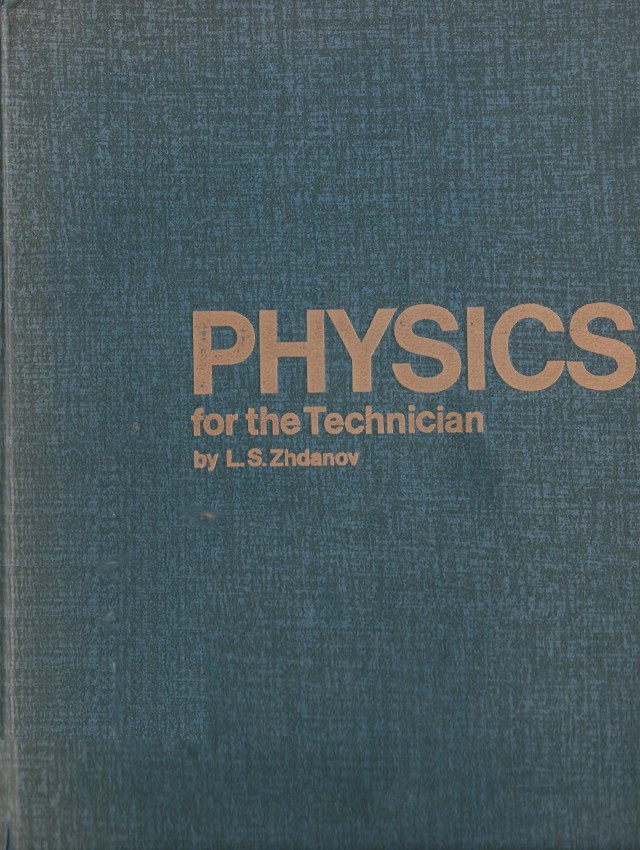
physics for the Technician-zhdanov_0000.jpg

Thanks, Mitr.
Just uploaded the following to Archive.org. This is my first scan and upload. So, let pl. let me know if anything I have to take care of in future when uploading.

https://archive.org/details/PhysicsForTheTechnicianZhdanov

Another link (cleaned) and here

Physics for the Technician
by L. S. Zhdanov
Translated from the Russian
by Mark Samokhvalov, Cand. Sc.
Mir Publisher
Moscow

This physics course is intended for students of technical
junior colleges and gives an adequate coverage of physics at
the high-school level. The aim is to provide a survey of
those basics that are essential for the specialized courses
that a future technician takes at college. The Soviet programme
in physics for technical colleges does not include mechanics because this section of physics is studied in secondary school. But since there are many courses in mechanics, brief and extended, the teacher can always select a book that is best suited for his or her purposes. One book
that we find especially useful is Theoretical Mechanics by
E. M. Nikitin (Mir Publishers, Moscow, 1980).

The physics course that follows starts with a brief introduction
about physical quantities and their measurement,
the International System of Units, and the approximations
that any scientist makes when measuring or calculating a
quantity. It then goes on to the subject of heat and molecular
physics. The other parts deal with electricity and
magnetism, oscillations and waves, optics and special relativity,
and nuclear physics and, finally, there is a brief
survey of astronomical facts. The International System of
Units is used throughout the book. However, since other
systems of units are used in physics, the author has found it
expedient to provide basic information about these, especially
in electricity (Sections 16-9 and 16-10). To this end the book includes an appendix whose first section is devoted to the base and derived units of the SI system.

The author, Leonid Zhdanov, wrote all the parts of the
book except Part 6, which was written by Evghenii Traut.
The author’s son. Grigorii Zhdanov, participated in the preparation
of the book for press.


Contents

FOREWORD 15

Introduction

1 PHYSICAL QUANTITIES AND THEIR MEASUREMENT 18

What is Physics? Physics and Technology. A Quantity and Its
Measurement. Physical Quantities. Direct and Indirect Measure¬
ments. Measurement of Angles in Astronomy. Measuring Dis¬
tances to Celestial Bodies by the Parallax Method. Units
of Time and Their Relation to Earth’s Motion. Units of
Measurement from Formulae. The International System of
Units. Treatment of Data. Combining Errors. Density of Sub¬
stance.

Part One – Heat and Molecular Physics

2 THE FUNDAMENTALS OF KINETIC THEORY OF MATTER 36

First Principles of Kinetic Theory. Concept of Temperature. Diffusion. Forces of Molecular Interaction. Kinetic and Potential Energies of Molecules. Concept of Internal Energy. Probability of an Event. The Statistical Method.

3 KINETIC THEORY OF GASES 47

The Gaseous State. Brownian Motion. Measuring Molecular Speeds. Distribution of Molecular Speeds. Mass and Size of Molecules and Atoms. Avogadro and Loschmidt Numbers. Mean Free Path. Gaseous Pressure. Pressure Gauges. Kinetic Calculation of the Pressure. Vacuum.
4 THE IDEAL GAS 61

Properties of Ideal Gas. Change of Gaseous Pressure with Temperature at Constant Volume. Absolute Zero. Thermodynamic Temperature Scale. Relation of Temperature to Kinetic Energy of Gas Molecules.

5 IDEAL-GAS EQUATION OF STATE 68

Thermodynamic Properties. Combined Gas Law. Universal Gas Constant. The Ideal-Gas Law. Dependence of Root-Mean-Square Speed of Gas Molecules on Temperature. Isochoric Process. Isobaric Process. Isothermal Process. Internal Energy of Ideal Gas. Work Performed by Gas.

6 INTERNAL ENERGY 80

Internal Energy and the Surroundings. Heat Exchange. Types of Heat Exchange. Changing Internal Energy by Means of Work. Relation of Internal Energy to State of Matter.

7 QUANTITY OF HEAT 86

The Measurement of Heat. Changing Internal Energy by Heating or Cooling. Heat of Combustion. The Law of Heat Exchange.

8 THE LAW OF CONSERVATION OF ENERGY. THE FIRST LAW OF THERMODYNAMICS 91

Mechanical Equivalent of Heat. Conservation of Energy in Mechanics. The Law of Conservation of Energy. The First Law of Thermodynamics. Some Applications of the First Law of Thermodynamics. Adiabatic Process. Some Ideas on Stellar Structure.

9 CHANGE OF STATE 101

Vapourization and Condensation. Evaporation. Heat of Vapourization.
10 PROPERTIES OF VAPOUR. BOILING 105

Nonsaturated and Saturated Vapours. Properties of Saturated Vapour. Properties of Nonsaturated Vapour. The Boiling Process. Dependence of Boiling Temperature on External Pressure. Boiling Point. The Law of Heat Exchange for Vapourization and Condensation. Superheated Steam and Its Use in Technology. Critical State of Substance. Liquefaction of Gases.
11 WATER VAPOUR IN THE ATMOSPHERE 118

Humidity. Absolute and Relative Humidities. Measuring Humidity. The Atmosphere of Planets.
12 THE LIQUID STATE 122

What Is a Liquid? The Surface Layer of a Liquid. Surface Tension. Measuring Surface Tension. Wetting. The Shape of Liquid Surfaces. Capillarity. Viscosity. Newton’s Law of Fluid Friction. Amorphous Substances.
13 THE SOLID STATE 137

What Is a Solid? Crystalline Anisotropy. Types of Crystals. Types of Deformation. Stress. Elasticity, Plasticity, Brittleness and Hardness. Hooke’s Law. Energy of a Body Under Elastic Deformation.
14 CHANGE OF STATE—II 151

Fusion and Crystallization. Specific Heat of Fusion. Changes in Volume and Density During Fusion and Solidification. Pressure Dependence of Temperature of Fusion and Heat of Fusion. The Law of Heat Exchange for Fusion and Crystallization. Solutions and Alloys. Sublimation. Phase Diagrams. Triple Point.
15 THERMAL EXPANSION 161

Basic Facts About Thermal Expansion. Linear Expansion. Volume Expansion of Heated Bodies. Thermal Expansion of Solids. Thermal Expansion of Liquids. Thermal Expansion in Nature and Technology.

Part Two – Electricity and Magnetism

16 THE FUNDAMENTALS OF THE ELECTRON THEORY OF ATOMIC STRUCTURE. COULOMB’S LAW 168

Electrification of Bodies. The Concept of an Electric Charge. The Complex Nature of the Atomic Structure. Rutherford’s Experiment and the Nuclear Idea. The Atomic structure of Chemical Elements. Electrification by Contact. Interaction Between Electric Charges. Coulomb’s Law. The Permittivity of a Medium. SI Units in Electricity. Gaussian Units in Electrostatics. The Electroscope.

17 THE ELECTRIC FIELD 179

Electric Field as a Special Form of Matter. The Electric Field Strength. Electric Field and Lines of Force. The Homogeneous Electric Field. Work Done by an Electric Field in Moving a Charge. Electric Potential^and Potential Difference. Relation Between Electric Field Strength and Voltage, a conductor in an Electric Field. The Electrometer. A Dielectric in an Electric Field. Ferroelectrics. The Piezoelectric Effect. Capacitance. Factors That Determine Capacitance. Capacitors. Combinations of Capacitors in Parallel and in Series. The Energy of a Charged Capacitor. Millikan’s Experiment.

18 ELECTRIC CURRENT IN METALS. DIRECT-CURRENT CIRCUITS 210

Charge Carriers and Electric Current. Current and Current Density. The Ammeter, the Voltmeter and the Galvanometer. Closed Electric Circuit. Electromotive Force of a Power Source. External and Internal Sections of a Circuit.* Ohm s Law for a Section of a Circuit Without EMF. Dependence of Resistance on Conductor’s Material, Length and Cross Section. The Temperature Dependence of Resistance. Superconductivity. Equivalent Resistance. Electric Power Consumers in Series. Electric Power Consumers in Parallel. Ohm’s Law for a Complete Circuit. Combinations of Cells. Ohm’s Law in General Form.

19 ELECTRIC POWER, WORK AND HEAT LOSS 232

Electric Current and Work. Power in a Direct Current Circuit. Heating Effects of Current. Relation of Resistance to Heating Effect.

20 THERMOELECTRICITY 237

Thermionic Emission. Contact Potential Difference. Thermo electromotive Force. The Peltier Effect. Application of Thermoelectricity in Science and Technology.

21 ELECTRIC CURRENT IN ELECTROLYTES 243

Electrolytic Dissociation. Electrolysis. Electrolysis Involving Anode Dissolution. Faraday’s First Law. Faraday’s Second Law. Some Applications of Electrolysis.

22 GALVANIC CELLS AND STORAGE BATTERIES 250

Transformation of Chemical Energy Into Electric Energy. Galvanic Cells. Polarization of Galvanic Cells and Its Reduction. Storage Batteries. Galvanic Cells and Storage Batteries in Modern Life.

23 ELECTRIC CURRENT IN GASES AND IN VACUUM 255

Ionization of a Gas. Dependence of Current on Voltage. Electric Discharge Through Gases at Atmospheric Pressure. Electric Discharge Through Gases at Low Pressure. Radiation and Absorption of Energy by an Atom. Cathode Rays. Plasma. Electric Current in Vacuum. The Diode. The Triode. The Cathode-Ray Tube.

24 ELECTRIC CURRENT IN SEMICONDUCTORS 271

Conductors, Dielectrics and Semiconductors. Pure (Intrinsic) Semiconductors. Impurity (Extrinsic) Semiconductors. P-N Junction. The Semiconductor Diode. The Transistor.

25 ELECTROMAGNETISM 282

Interaction of Currents. Magnetic Field as a Special Form of Matter. Magnets. Magnetic Lines of Force. Magnetic Fields in Some Simple Cases. Comparing Magnetic Properties of a Solenoid and a Permanent Magnet s Interaction Between Parallel Currents. The Permeability of a Medium. Definition of the Ampere. A Measure of the Strength of the Magnetic Field. The Homogeneous Magnetic Field. Magnetic Moment of a Current Loop. Work Done in Moving a Current-Carrying Conductor a Magnetic Field. Magnetic Induction}’Due to Currents in Conductors of Different Shape. Magnetic Field Strength. Paramagnetic, Diamagnetic and Ferromagnetic Substances. Magnetization of Ferromagnetic Substances. Construction of an Ammeter and a Voltmeter. The Lorentz Force Equation. Constant arid Variable Magnetic Fields. Magnetic Fields in Solar and Cosmic Phenomena.

26 ELECTROMAGNETIC INDUCTION 310

Flux Linkage and Inductance. Discovery of Induced Current. Induced EMF in a Straight Conductor Moving in a Magnetic Field. Faraday’s Induction Experiments. Lenz’s Law. The Magnitude of Induced EMF. Solenoidal Electric Field and Its Relation to Magnetic Field. Eddy Currents. Self-Induction and Self-Induced EMF. The Energy of a Magnetic Field.

Part Three – Oscillations and Waves

27 MECHANICAL OSCILLATIONS AND WAVES 324

Oscillatory Motion. Conditions for Appearance of Oscillations. Classification of Oscillatory Motion Based on the Forces Acting on the Source. The Parameters of Oscillatory Motion. Quantities Characteristic of the Instantaneous State of an Oscillating Particle. Harmonic Oscillations. The Equation for Harmonic Oscillations and Its Graph. The Simple Pendulum. Laws Governing the Oscillations of a Simple Pendulum. The Compound Pendulum. Practical Uses of Pendulums. Elastic Oscillations. Energy Transformation in Oscillatory Motion. Propagation of “Oscillatory Motion in an Elastic Medium. Energy Transport by Means of a Travelling Wave. Transverse and Longitudinal Waves. Waves and Rays. Wavelength. Velocity of Wave Propagation. Combination of Two Vibrations in Same Line. Reflection of Waves. Standing Waves. Interference of Waves. Mechanical Resonance.

28 SOUND WAVES AND ULTRASONIC WAVES 353

What Is Sound? The Velocity of Sound. Loudness and Intensity of Sound. Pitch and Timbre of Sound. Interference of Sound Waves. Beats. Reflection and Absorption of Sound. Acoustic Resonance. Ultrasound and Its Applications.

29 ALTERNATING-CURRENT CIRCUITS 362

Rotation of a Coil in a Homogeneous Magnetic Field. The Induction Generator. Effective Values of EMF, Voltage and Current. Inductance and Capacitance in an AC Circuit. The Transformer. Induction Coil. Production, Transport and Distribution of Electric Energy.
30 ELECTRICAL OSCILLATIONS AND ELECTROMAGNETIC WAVES 374

Transformation of Energy in a Closed Oscillatory Circuit. The Electron Tube Oscillator. High-Frequency Currents. Electromagnetic Field as a Special Form of Matter. Open Oscillatory Circuit. Electromagnetic Waves. Electrical Resonance. The Invention of Radio. Radiotelegraphy. Amplitude Modulation. Radiotelephony. A Simple Vacuum Tube Receiver. Radar. The Cathode-Ray Oscilloscope.

Part Four – Optics and Special Relativity

31 THE NATURE OF LIGHT. PROPAGATION OF LIGHT 394

Historical Survey. The Electromagnetic Theory of Light. The Quantum Theory of Light. Sources of Light. Huygens’ Principle. The Velocity of Light in a Vacuum. The Velocity of Light in a Medium.
32 REFLECTION AND REFRACTION OF LIGHT 401

Optical Phenomena at the Boundary Surface Between Two Media. The Laws of Light Reflection. Diffuse and Regular Reflection. The Plane Mirror. The Laws of Light Refraction. Absolute and Relative Refractive Indices. Total Reflection. Refraction by a Plane Parallel Plate and a Prism.
33 IMAGE FORMATION BY SPHERICAL LENSES AND MIRRORS 414

Lenses. Focal Points and Planes. Lens Power. Image Formation for a Luminous Point Lying on the Principal Axis of a Lens. The Lens Formula. Image Formation for a Luminous Point Lying on a Secondary Axis of a Lens. Image Formation by Spherical Lenses. Lateral Magnification. Spherical Mirrors. Image Formation by Spherical Mirrors.

34 THE EYE AND VISION. OPTICAL INSTRUMENTS 428

Optical Systems. Deficiencies of Optical Systems, Projection Lantern. The Photographic Camera, The Eye as an Optical System. Persistence of Vision, Angle of View# Defects of Vision. Optical Illusions. The Magnifying Glass. The Microscope, Telescopes. Galileo’s Telescope and Binoculars.
35 PHENOMENA ARISING FROM WAVE NATURE OF LIGHT 447

Interference of Light. Colours of Thin Films. Interference in a Wedge-Shaped Film. Newton’s Rings. Interference in Nature and Technology. Diffraction of Light. The Diffraction Grating. Measurement of Wavelength. Polarization of Waves. Polarization of Light. Polarization of Light by Reflection and Refraction.
36 PHOTOMETRY 464

Energy Flux of Radiation. Solid Angle. Luminous Flux. Luminous Intensity. Illuminance. Luminance. The Laws of Lumination. Light Measurements.
37 RADIATION AND SPECTRA. X RAYS 475

Dispersion of Light. Dispersion hy a Prism. Combining Colours. Complementary Colours. The Colour of Objects. Ultraviolet and Infrared Spectra. Ultraviolet and Infrared Radiation in Nature and Technology. Spectroscope and Spectrograph. Types of Spectra. Absorption of Light in Gases and Vapours, Kirchhoff’s Law of Radiation. The Stefan-Boltzmann, Wien and Planck Radiation Laws. Solar and Stellar spectra. Spectroscopic Anal¬ysis. The Doppler Effect. X Rays and Their Practical Uses. The Electromagnetic Spectrum, Types of Cosmic Radiation.
38 PHENOMENA ARISING FROM QUANTUM NATURE OF LIGHT 504

Waveband Quantum Properties of Radiation. The Pressure of Light. The Thermal Effect of Radiation, The Chemical Effect of Radiation. Photography. External Photoelectric Effect. The Laws of External Photoelectric Effect. Einstein’s Photoelectric Equation. Photocells Utilizing the External Photoelectric Effect. Internal Photoelectric Effect. Photoresistors. Photocells Utilizing the Internal Photoelectric Effect. Photocells in Science and Technology. Television. Bohr’s Atom Model. The Quantized Atom. Luminescence. Lasers and Masers.
39 THE FUNDAMENTALS OF SPECIAL RELATIVITY THEORY 536

Relativity in Classical Mechanics. Galilean Transformations, Experimental Foundations of Einstein’s Special Theory of Relativity. What Are Simultaneous Events in Special Relativity? Lorentz Transformations. Length and Time Interval in Special Relativity. The Relativistic Velocity-Composition Law. Mass and Energy in Special Relativity. Einstein’s Mass-Energy Formula. Relation Between Momentum and Energy in Special Relativity.

Part Five – Nuclear Physics

40 THE ATOMIC NUCLEUS 564

Methods of Particle Detection. Radioactivity. Transmutation of Elements. Energy and Penetrating Power of Radioactive Radiation. Cherenkov Radiation. Man-Made Transmutations. The Neutron. Nuclear Structure. Nuclear Symbols and Reactions. Isotopes. Nuclear Forces. Nuclear Binding.
41 COSMIC RAYS. ELEMENTARY PARTICLES 585

Cosmic Rays, The Positron. The Neutrino. The Discovery of New Elementary Particles. Classification of the Elementary Particles. Antiparticles. Mutual Transformation of Substance and Field. The Quark Model.
42 NUCLEAR POWER AND ITS UTILIZATION 600

Transuranium Elements. Fission, Chain Reactions. Nuclear Reactors. Production of Power by Nuclear Reactors, Fusion. Controlled Thermonuclear Reaction. Some Applications of Radioisotopes.

Part Six – Astronomy: a Brief Survey

43 THE STRUCTURE AND EVOLUTION OF THE UNIVERSE 618

The Universe. The Origin and Evolution of Celestial Bodies. Cosmology.

APPENDIX 632

NAME INDEX 635

SUBJECT INDEX 636
Posted in books, mir books, mir publishers, physics, science | Tagged , , , , , , , , , , , , , , , , , , , , , , , , , , , , , , , , | 3 Comments

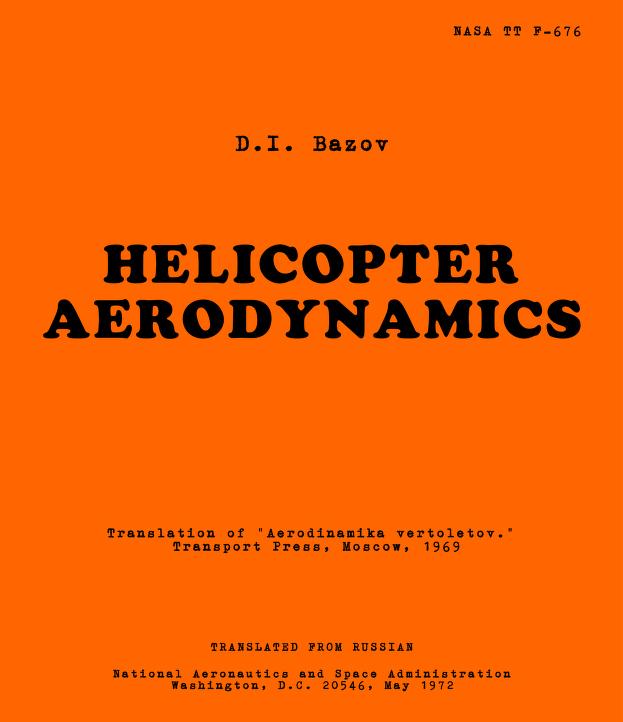
Helicopter Aerodynamics – Bazov

In this post, we will see the book Helicopter Aerodynamics by D. L. Bazov.

About the book:

Principles of helicopter flight under various conditions are reviewed, giving special attention to the operation of the main rotor. A brief history of helicopter development is presented, together with a summary of the main components of a helicopter and a classification of the various types of helicopters. The characteristics of the main rotor and its operation during autorotation and during axial and oblique flow are considered. Also considered are vertical and horizontal flight, altitude gain and descent, takeoff and landing, equilibrium, stability, and controllability, taking into account the aerodynamic forces acting on the helicopter during the various maneuvers.

The book is part of NASA Technical Translations and was published in 1972.

Cleaned, optimised scan here and here

The Internet Archive Link

Contents

TABLE OF CONTENTS 194

CHAPTER I. PRINCIPLES OF HELICOPTER FLIGHT 1

§ 1. Brief History of Helicopter Development 1
§ 2. The Helicopter and Its Basic Components 4
§ 3. Classification of Helicopters 6
CHAPTER II. BASIC CHARACTERISTICS OF THE MAIN ROTOR 10

§ 4. General Characteristics 10
§ 5. Geometric Characteristics 11
§ 6. Basic Regimes of Operation 16
§ 7. The Operating Regime Coefficient of the Main Rotor 18

CHAPTER III. OPERATION OF THE MAIN ROTOR IN THE AXIAL FLOW
REGIME 20

§ 8. Impulsive Theory of an Ideal Rotor 20
§ 9. Blade Element Theory 24
§ 10. Forces Resisting Rotation of the Main Rotor 26
§ 11. Power and Torque Required to Rotate Main Rotor 28
§ 12. Main Rotor RPM Control 31
§ 13. Techniques for Counteracting Main Rotor Reactive Torque 33
§ 14. Techniques for Transmitting Torque From Engine to Main Rotor 35
§ 15. Main Rotor Power Available 39
§ 16. Main Rotor Thrust in Vertical Climb and Vertical Descent 41
§ 17. Losses of the Real Rotor 43
§ 18. Characteristics of Operation of Coaxial System of Two Main Rotors 46

Programmed Testing Questions and Answers 50

CHAPTER IV. MAIN ROTOR OPERATION IN FORWARD FLIGHT 56

§ 19. Characteristics of Main Rotor Operation in Forward Flight 56
§ 20. Main Rotor Thrust as a Function of Flight Speed 59
§ 21. Blade Thrust and Its Azimuthal Variation 62
§ 22. Resultant Flow Velocity Over Blade Element in the Hub Rotation Plane 64
§ 23. Variation of Circumferential and Resultant Velocities Along Main Rotor Radius 66
§ 24. Drawbacks of Main Rotor With Rigid Blade Retention 68
§ 25. Purpose of Main Rotor Hub Horizontal Hinges 71
§ 26. Conditions for Blade Equilibrium Relative to the Horizontal Hinge 71

§ 27. Main Rotor Cone of Revolution 74
§ 28. Blade Flapping Motions 75
§ 29. Main Rotor Coning Axis Tilt 78
§ 30. Blade Flapping Motion Restriction and Flapping Compensator 80
§ 31. Blade Element Angle of Attack Change Owing to Flapping Motions 83
§ 32. Effect of Number of Blades on Main Rotor Aerodynamic Characteristics 85
§ 33. Azimuthal Variation of Rotational Resistance Forces and Reactive Torque 85
§ 34. Inertial Forces Acting on Main Rotor Blades 87
§ 35. Oscillatory Blade Motions 91
§ 36. Damping of Oscillatory Blade Motions 94
§ 37. Possibility of Loss of Blade Flapping Motion Stability 97

Programmed Testing Questions and Answers 100

CHAPTER V. HELICOPTER VERTICAL FLIGHT OPERATING REGIMES 107

§ 38. Hovering Regime. General Characteristics. 108
§ 39. Diagram of Forces Acting on Helicopter and Hovering Conditions 109
§ 40. Thrust and Power Required for Hovering 112
§ 41. Vertical Climb 119
§ 42. Helicopter Vertical Descent With Operating Engine 123
§ 43. Vortex Ring Regime 125

Programmed Testing Questions and Answers 126

CHAPTER VI. HELICOPTER HORIZONTAL FLIGHT 129

§ 44. General Characteristics of Horizontal Flight 129
§ 45. Thrust and Power Required for Horizontal Flight 131
§ 46. Characteristic Helicopter Horizontal Flight Speeds 136
§ 47. Effect of Helicopter Weight and Flight Altitude on Performance 138
§ 48. Factors Limiting Maximal Horizontal Flight Speed and Ways to Increase This Speed 141
§ 49. Horizontal Flight Endurance and Range 144

Programmed Testing Questions and Answers 148

CHAPTER VII. CLIMB ALONG INCLINED TRAJECTORY 152
§ 50. General Characteristics of the Climb Regime Along an Inclined Trajectory 152
§ 51. Thrust and Power Required for Climb 153
§ 52. Vertical Rate of Climb 155
§ 53. Variation of Vertical Rate of Climb With Altitude 156

CHAPTER VIII. HELICOPTER DESCENT ALONG INCLINED TRAJECTORY 160
§ 54. General Characteristics of the Descent Regime 160
§ 55. Thrust and Power Required for Helicopter Descent 162
§ 56. Helicopter Rate of Descent With Operating Engine 164

Programmed Testing Questions and Answers 166

CHAPTER IX. HELICOPTER FLIGHT IN MAIN ROTOR AUTO ROTATIVE REGIME 171

§ 57. Vertical Descent 171
§ 58. Blade Aerodynamic Forces 176
§ 59. Main Rotor Autorotation Conditions and Regimes 177
§ 60. Conditions for Autorotation of Different Blade Elements 182
§ 61. Gliding 187
§ 62. Vertical Rate of Descent in a Glide 191
§ 63. Safety Height 195
§ 64. Transition From Flight With Engine Operating to Flight in the Main Rotor Autorotation Regime 197
§ 65. Gliding Characteristics of Dual-Rotor Helicopters 200Programmed Testing Questions and Answers 202

CHAPTER X. HELICOPTER TAKEOFF AND LANDING 208 /196
§ 66. Takeoff 208
§ 67. Landing 213

CHAPTER XI. HELICOPTER BALANCE, STABILITY, AND CONTROL 222
§ 68. Helicopter Center of Gravity and Balance 222
§ 69. General Analysis of Helicopter Equilibrium 225
§ 70. Helicopter Equilibrium in the Hovering Regime 227
§ 71. Helicopter Static Stability 236
§ 72. Helicopter Dynamic Stability 242
§ 73. Concept of Helicopter Control 245
§ 74. Change of Main Rotor Collective and Cyclic Pitch 246
§ 75. Purpose and Principle of the Main Rotor Tilt Control System 247
§ 76, Single-Rotor Helicopter Control Principles 252
§ 77. Dual-Rotor Helicopter Control Principles 254
§ 78. Concept of Helicopter Controllability 257

CHAPTER XII. HELICOPTER VIBRATIONS 262
§ 79. General Analysis of Vibrations 262
§ 80. Helicopter Forced Vibrations 264
§ 81. Self-Excited Vibrations 267
§ 82. Bending and Bending-Torsion Vibrations of Rigidly
Restrained Blade 271
APPENDIX I. SYMBOL LIST 281
APPENDIX II. PROGRAMMED TESTING ANSWERS 284
REFERENCES 285
viii

Posted in Aerodynamics, books, physics, science, soviet, technology | Tagged , , , , , , , , , , , , , , , , , , , , | 3 Comments

Electricity And Man – Manoilov

In this post, we will see the book Electricity And Man by V. Manoilov.

Manoilov-Electricity-and-Man-Mir-1978-fc copy.png

About the book:

“… Life on Earth originated and developed in
interaction with electromagnetic fields. Electricity is
inherent in the living in its most complicated form – the
vital activity of man. Scientists have done much in
studying this amazing interaction of electricity and the
animate but much in nature is still concealed, much
must be analyzed and understood. This book will help
to widen the reader’s understanding of the interaction
of electricity and the living organism, although it makes
no claim to exhaust the subject … “

The book was translated from the Russian by George Kittell and was published by Mir in 1978

The Internet Archive Link and here

CONTENTS
To the English Reader 7
By Way of Preface 8

PART ONE ELECTRICITY CURES 11

Chapter One Electrophysics of Inanimate Nature 11

1. Motion, Motion, Motion… 11
2. Electric Conduction in Metals 13
3. Electrical Resistance of Solutions 18
4. Neither Conductor nor Insulator 19
5. Semiconductors with Impurity Conduction 22
6. Organic Semiconductors 27

Chapter Two Electrophysics of the Living Organism 35

1. Amazing Electrical Conductivity 35
2. Significance of Changes in the Electrical Properties of the Living Organism 42
3. Examples and Evidence 45

Chapter Three Physical Properties of the Biosphere 53

1. Electricity Round Us 53
2. Where is Magnetism and Where are the Magnetic Fields ? 57
3. Magnetic Storms and Man 60
4. Electricity and the Ratiobiosphere 66

Chapter Four Items from the Prehistory of the Use of Electricity in Medicine 74

1. First Discoveries 74
2. An Important Investigation 76
3. The Prize Awarded to Marat 78
4. Dispute between Galvani and Volta 81
5. V.V. Petrov’s Experiment The Beginning of Electrodynamics 85
6. Use of Electricity in Medicine and Biology in the 19th Century 89

Chapter Five The Physician’s Electric Assistant 93

1. The Origin of Biological Currents 93
2. The Electrocardiogram 96
3. The Electrocardiograph 101
4. Remote Diagnosis 104
5. Taking Medicine Without Powders or Pills 112

PART TWO ELECTRICITY IS DANGEROUS 118

Chapter Six In What Way is Electricity Dangerous ? 118

1. Events in Vasilevsky Island, St. Petersburg118
2. Electric Trauma and Some Statistics121
3. Temporary Wiring123
4. A “Horse Accident” 125
5. Examples of Electric Trauma 126
6. Is a Low Voltage Dangerous ? 131
7. One Hundred and TenkV Power Transmission Line in the City, and the Electric Safety of
Medical Instruments 134

Chapter Seven Biophysics of Electric Injury 139

1. Fundamentals for Study 139
2. The Dispute Continues 141
3. Man—a Self-regulating System 144
4. Something Unexpected 146
5. Danger! 149
6. Electricity Kills Animals as well as People 152

Bibliography 156

Posted in books, engineering, life sciences, mir books, mir publishers, physics, science, soviet, technology | Tagged , , , , , , , , , , , , , , , , , , , , | Leave a comment

The Mystery of The Earth’s Mantle – Malakhov

In this post, we will see the book The Mystery of The Earth’s Mantle by A. Malakhov.
Malakhov-The-Mystery-of-Earths-Mantle-Peace-1966-fc copy.png

About the book

What is the inside of the Earth like; what mysteries does its mantle conceal? What will the sensitive feelers of superdeep holes encounter there – boiling liquid magma or superhard matter, unimaginably high temperatures or cold approaching absolute zero?
Science cannot as yet give the exact answers to these questions, though myriads of different hypotheses have been put forth.
This book tells how scientists are ferreting out the secrets of the deeper zones of the Earth; its subject is the romance of the searches and tenacious investigations carried out by geologists who have devoted themselves to the study of the depths of our planet.
The book was translated from the Russian by David Sobolev and was published by Peace in 1966.
 CONTENTS
Riddles and More Riddles
An Argument 9
In the Fiery Font 12
The End of Gondwana Land 25
Rock Rhythms 35
Laws or Riddles? 43
The Black Arteries of the Depths 52
What the Neoneptunists Say 60
“We Must Not Wait for Favours.” 68
Flow of Information
A Signal into the Unknown 79
Key to the Gravity Code 100
Heat and Cold 112
You Will Not Find This in Any Textbook 119
Stray Currents 120
Hall! Radioactivity! 134
First Results 143
From Outer Space into the Depths of the Earth 145
In Search of the Unknown
Failures at First 161
Geography of the Unknown 166
The First Stone Tells Its Story 171
The Stone from the Kola Speaks 179
The Story of the Third and Fourth Stones 185
A Message from the Fifth Stone 190
Courtiers of the “Queen of the Depths” 194
An Artificial Mantle 203
And Here, Too, Synthesis 208
The World of Unsolved Riddles
Following in the Footsteps of the Classics 219
If the Magmatists are Right 224
Hardness Also Has Its Limit 231
“There’s No Magma Under the Crust!” 234
Beyond the Moho Discontinuity 240
But Who is Right? 243


Posted in books, geology, meteorology, peace publishers, science, soviet | Tagged , , , , , , , , , , , , , , , , , | Leave a comment

The Activity of Cosmonauts – Zavalova, Ponamarenko

In this post we will see the book The Activity of Cosmonauts by N. D. Zavalova and V. A. Ponomarenko.

About the book:

The problems faced by cosmonauts in space are unique in many respects. Isolation, prolonged inactivity, the need to be constantly alert, weightlessness – all of these
factors create frequently unusual sensations and illusions which cannbe dangerous if the cosmonaut does not recognize the problem and deal adequately with it. The work contains abstracts of numerous Soviet papers on spacecraft simulator experiments involving isolation, hypokinesia, and other stressful situations.

The book is a part of NASA technical translation and was published in 1972.

Translation of: “Deyatel’ nost’ Kosmonavta,” Material  for Chapter 4, Volume 2, Part 4 of the work: Osnovy Kosmicheskoy Biologii i Medisiny [Foundations of Space Biology and Medicine], Moscow, Academy of Sciences of the USSR, 1970, 160 pages.

Cleaned, optimised scan here and here

The Internet Archive Link

Contents

Section 1

General Characteristics of the Conditions and Features of Activity of Cosmonauts 1

Section 2

Indices and Methods of Studying Working Ability 19

Section 3

Factors Determining Efficiency and Reliability of Activity 47

Section 4

Information Analysis and the Making of Decisions by the Individual 68

Section 5

The Man-Machine Problem 90

References 115

Posted in books, psychology, science, soviet, statistics, technology | Tagged , , , , , , , , , , , , , , , | Leave a comment

The Moon and Man – Rebrov, Khozin

In this post, we will see the book The Moon and Man by M. Rebrov and G. Khozin.

Rebrov-Khozin-The-Moon-and-Man-Peace-1967-fc.png

About the book

The day is not far off when a spaceship will land on one of the moon’s vast plains and the first earthmen will step out onto lunar soil. Scientists and engineers are hard at work preparing for that great day. Automatic probes have reconnoitred the path to the moon, photographed its unseen side, taken close-up pictures of the visible side and answered questions the gravitational and magnetic fields and radiation belts in outer space. Several rockets have hit the moon. The next step is a manned trip to the earth’s natural satellite.
How men are preparing for a trip to the moon, what dangers astronauts may face there, and how astronautics may be expected to develop in future the subjects are some of the subjects discussed in this book.
The book was published before the moon landings by the Americans. So there is a lot of speculation involved, particularly from the Soviet perspective.
The book was translated from the Russian by Vladimir Talmy and was published by Peace in 1967.
 CONTENTS
By Way of an Introduction 9
1. The Promise of Outer Space 11
2. Moon Fables 18
3. Birth of a Dream 22
4. What We Know about the Moon 27
5. Hypotheses and Theories 34
6. Hazards of Outer Space 44
7. Automatic Explorers 48
8. Leaving the Earth 59
9. Rocket Engines 69
10.The Path to the Moon 77
11. Moon Projects 84
12. Robots on the Moon 102
13. The First Men on the Moon 106
14 The Call of the Cosmos 115
Posted in astronomy, books, engineering, mir books, mir publishers, peace publishers, physics, science, soviet, technology | Tagged , , , , , , , , , , , , , | Leave a comment

Cybernetics Within Us – Saparina

In this post, we will see the book Cybernetics Within Us by Yelena Saparina.
Saparina-Cybernetics-within-Us-Peace-fc copy
About the book
Can a rat tell the difference between a Raphael Madonna and a Picasso Girl in Blue? Would a Martian (if there is such a thing) recognize a live cat after having seen a photograph of one? Can a “seeing”electronic machine be made to tell a cat from a dog or an A from a B? How would it go about “computing” the image? And is “machine thinking”anything like human thinking?
These and other such problems are investigated in the branch of cybernetics that studies living systems: bionics, as this ultramodern science is now called. It developed when scientists began to compare the design and operation of electronic systems with living organisms. Our body, they found, is a complex cybernetic system controlled by countless self-regulating devices. In fact, every single cell of our body is an automatic control device in its own right. Millions upon millions of tiny cybernetic units are constantly at work within us. They maintain normal blood pressure, control the composition of the gastric juices, ensure the rhythmic contraction of the heart and lungs, and do a thousand other things that come under the heading of “vital functions”of the organism.
How they work and how our body functions is described in this popular exposition, which requires no previous knowledge of cybernetics, biology, electronics, or any other subject for that matter (except reading, of course).
The book was translated from the Russian by Vladimir Talmy and was published by Peace in 1966.
 CONTENTS
Page Author’s Preface 5
By Way of an Introduction 7
I. DISEASES OF MEN AND “DISEASES” OF MACHINES
Cybernetics and the Heart 13
Electronic Doctor 18
The Equations of Health 22
Feedback and Physiology
II. ONE HUNDRED MILLION MILLION AUTOMATIC UNITS WITHIN US
Spades, Clubs, Diamonds,Hearts 35
Protein Alphabet 40
Machines of Life 44
Line-Up of Molecules 48
Our “Central Heating” System 52
Beehive Cybernetics 58
Body Communication Systems 62
Living Automation 67
III. LABORATORY OF THINKING
Mapping the Brain 70
Neural Architecture 78
Telephone Exchange? 87 S
Step Search 94
Guessing Game 100
Cybernetic Training 106
King For a Day 112
Terra Incognita 118
A Brain Within the Brain 127
“Alarm Clock”and “Chronometer” 137
Pleasure Centre. 144
Reflex Circuitry 151
Voices of Neurons 155
Neuron Junctions 160
The Boons of Redundancy 165
Electronic Brains 175
IV. IF MACHINES WENT TO SCHOOL
“Insect” Machines 179
“Vertebrate” Machines 182
Guessing Games For the Brain 188
Switches and Controllers 194
A Vicious Circle 205
How to Teach a Machine 213
Of Cats and Martians 219
V. PERCEPTION IN MACHINES
Television in the Brain 225
Behind the Screen 231
Seeing Machines 240
Hearing and Talking Machines 250
A Signal of Signals 255
Transmission Capacity of the Brain 264
Language and Information 271
Machine Language 276
Is Strict Logic Necessary? 282
Algorithms of Learning 289
From a Machine’s Point of View 295
Posted in books, computers, mir books, mir publishers, peace publishers, psychology, science, soviet | Tagged , , , , , , , , , , , , , , , , , , , , , , , , | 6 Comments

The Code of Life – Shvarts

In this post, we will see the book The Code of Life by A. Shvarts.
Shvarts-Code-of-Life-Peace-1966_0000.jpg
About the book
In this book the author relates in popular language about the latest attainments of biology and medicine, and about the future of these sciences.
The reader will learn about exciting operation on the heart, the mystery of cancer, the use of electronics in – medicine and about ingenious experiments aimed at extracting fresh information. He will get acquainted with viruses and the construction of the living cell, and will learn about the role of the new and rapidly developing molecular biology.
About the author
Anatoly Shvarts
Physician and writer Anatoly Shvarts had done much to popularize biology and medicine. He has written several widely-read books about Russian doctors and physiologists.
In “The Code of Life” Shvarts takes the present-day level of biology and medicine and extends it into the future.
The book was translated from the Russian by George Yankovsky and was published by Peace publishers in 1966.
 CONTENTS
Part One Medicine takes off 8
HEALING THE HEART 9
In a Vicious Circle 10
Three Barriers 14
Cold—Enemy or Friend? 20
The “Sputnik” of Surgery 26
THE DOCTOR AND THE ELECTRON 29
Interviewing the Heart 31
Proteins Broadcast 36
Surgery in Full View 41
Diagnostic Complex 49
An Electronic Colleague 61
IRON HEALTH 67
The Iron Hand 68
Farsighted Skin 73
One Kidney in Reserve 79
The Formula of the Heart 83
FIGHTING OBSTREPEROUS TISSUE 90
The First Find 91
Strange Geography 95
Wandering Carcinogens 98
Magic Bullets 102
IN THE DEPTHS OF THE LIVING 106
Hours, Not Days! 107
The Seeds of Life 112
Hormone Plantations 117
The Heart of an Eagle 121
A Ray of Hope 126
Part TWO. THE TREASURE HOUSE OF THE CELL 136
NEVER GROWING OLD 137
The Anatomy of the Eiffel Tower 137
What People Live by 141
The Lymphocyte Builder 146
Prometheus and Monkeys 148
The Best Operation 150
VIRUS OF MANY GUISES 154
Ailment in Seven-League Boots 154
The Enemy Attacks 158
How the Virus was Tamed 162
Counterblow 164
A TRIP INTO THE MUSCLE 169
A Miracle of Molecular Technology 171
The Fire of Life 176
Pulsed Messengers   181
THE BATTLEFIELD OF IMMUNITY   185
Yours and Mine 185
The Tribulations of Insulin 189
The Profile of a Molecule 192
Medicine of the Future 198
THE CODE OF LIFE  202
Inside the Cell 203
Protein on the Production Line 207
Who? 217
Disowning One’s Own 225
NEWS FROM INSIDE THE CELL 228
A Substance or a Being? 230
This is How  234
A Tilt with the Invisible. 238
Problem “X” 247
Virus Hunters 261
Posted in books, life sciences, mir books, mir publishers, peace publishers, physiology, science | Tagged , , , , , , , , , , , , , , , , , | 1 Comment

How reliable is the brain? -Asratyan, Simonov

In this post, we will see the book How reliable is the brain? by E. Asratyan and P. Simonov.

brain-fc.png

About the book

The book deals with topical problems of contempo­rary neurophysiology related to the restoration of impaired functions of the central nervous system.

The fundamental principles underlying the work of the brain, which enable it to function for many years without interruption, today command the interest of experts not only in medicine and biology, but in automa­tion as well. This is because these principles can be utilized to make computing systems more reliable.

The book was translated from the Russian by Boris Belitsky and was published by Mir in 1960s (exact date is not given).

The Internet Archive Link

and here

CONTENTS
THE NO. 1 PROBLEM 7
THE CENTRAL “CONTROL PANEL’ OF THE ORGANISM 14
PROTECTIVE INHIBITION 58
LATENT RESERVES 109
INDEPENDENCE AND CENTRALISM 124
THE “SUPREME ORGAN’’ OF RESTORATION AND DEFENCE 140
LEARNING FROM NATURE 171


Posted in books, computers, life sciences, mir books, peace publishers, physiology, science, soviet | Tagged , , , , , , , , , , | Leave a comment

Geometry – Pogorelov

In this post, we will see the book Geometry by A. Pogorelov.

Pogorelov-Geometry-Mir-1987

ABOUT THE BOOK

This is a manual for the students of universities and teachers’ training colleges. Containing the compulsory course of geometry, its particular impact is on elementary topics. The book is, therefore, aimed at professional training of the school or university teacher-to-be. The first part, analytic geometry, is easy to assimilate, and actually reduced to acquiring skills in applying algebraic methods to elementary geometry.
The second part, differential geometry, contains the basics of the theory of curves and surfaces. The third part, foundations of geometry, is original. The fourth part is devoted to certain topics of elementary
geometry. The book as a whole must interest the reader in school or university teacher’s profession.

The book was translated from the Russian by Leonid Levant, Aleksandr Repyev and Oleg Efimov and published by Mir in 1987.

All credits to the original uploader. We have converted to pdf from djvu and added bookmarks/OCR to pdf. On a personal note, I am not a big fan of djvu format though it has a smaller size as it does not fit in one’s standard tool chain for reading/studying. PDF format has much more options for taking notes/reading etc.

The Internet Archive Link

and here


Contents

Preface 10

Part One. Analytic Geometry 11

Chapter I. Rectangular Cartesian Coordinates in the Plane 11

1. Introducing Coordinates in the Plane 11
2. Distance Between Two Points 12
3. Dividing a Line Segment in a Given Ratio 13
4. Equation of a Curve. Equation of a Circle 15
5. Parametric Equations of a Curve 17
6. Points of Intersection of Curves 19
7. Relative Position of Two Circles 20
Exercises to Chapter I 21

Chapter II. Vectors in the Plane 26

1. Translation 26
2. Modulus and the Direction of a Vector 28
3. Components of a Vector 30
4. Addition of Vectors 30
5. Multiplication of a Vector by a Number 31
6. Collinear Vectors 32
7. Resolution of a Vector into Two Non-Collinear Vectors 33
8. Scalar Product 34
Exercises to Chapter II 36

Chapter III. Straight Line in the Plane 38

1. Equation of a Straight Line. General Form 38
2. Position of a Straight Line Relative to a Coordinate System 40
3. Parallelism and Perpendicularity Condition for Straight Lines 41
4. Equation of a Pencil of Straight Lines 42
5. Normal Form of the Equation of a Straight Line 43
6. Transformation of Coordinates 44
7. Motions in the Plane 47
8. Inversion 47
Exercises to Chapter III

Chapter IV. Conic Sections 53

1. Polar Coordinates 53
2. Conic Sections 54
3. Equations of Conic Sections in Polar Coordinates 56
4. Canonical Equations of Conic Sections in Rectangular Cartesian Coordinates 57
5. Types of Conic Sections 59
6. Tangent Line to a Conic Section 62
7. Focal Properties of Conic Sections 65
8. Diameters of a Conic Section 67
9. Curves of the Second Degree 69
Exercises to Chapter IV 71

Chapter V. Rectangular Cartesian Coordinates and Vectors in Space 76

1. Cartesian Coordinates in Space. Introduction 76
2. Translation in Space 78
3. Vectors in Space 79
4. Decomposition of a Vector into Three Non-coplanar Vectors 80
5. Vector Product of Vectors 81
6. Scalar Triple Product of Vectors 83
7. Affine Cartesian Coordinates, 84
8. Transformation of Coordinates 85
9. Equations of a Surface and a Curve in Space 87

Exercises to Chapter V 89

Chapter VI.

Plane and a Straight Line in Space 95

1. Equation of a Plane 95
2. Position of a Plane Relative to a Coordinate System 96
3. Normal Form of Equations of the Plane 97
4. Parallelism and Perpendicularity of Planes 98
5. Equations of a Straight Line 99
6. Relative Position of a Straight Line and a Plane, of Two Straight Lines 100
7. Basic Problems en Straight Lines and Planes 102
Exercises to Chapter VI 103

Chapter VII. Quadric Surfaces 109

1. Special System of Coordinates 109
2. Classification of Quadric Surfaces 112
3. Ellipsoid 113
4. Hyperboloids 115
5. Paraboloids 116
6. Cone and Cylinders 118
7. Rectilinear Generators on Quadric Surfaces 119
8. Diameters and Diametral Planes of a Quadric Surface 120
9. Axes of Symmetry for a Curve. Planes of Symmetry for a Surface 122
Exercises to Chapter VII 123

Part Two. Differential Geometry 126

Chapter VIII. Tangent and Osculating Planes of Curve 126

1. Concept of Curve 126
2. Regular Curve 127
3. Singular Points of a Curve 128
4. Vector Function of Scalar Argument 129
5. Tangent to a Curve 131
6. Equations of Tangents for Various Methods of Specifying a Curve 132
7. Osculating Plane of a Curve 134
8. Envelope of a Family of Plane Curves 136
Exercises to Chapter VIII 137

Chapter IX. Curvature and Torsion of Curve 140

1. Length of a Curve 140
2. Natural Parametrization of a Curve 142
3. Curvature 142
4. Torsion of a Curve 145
5. Frenet Formulas 147
6. Evolute and Evolvent of a Plane Curve 14

Exercises to Chapter IX 149

Chapter X. Tangent Plane and Osculating Paraboloid of Surface 151

1. Concept of Surface 151
2. Regular Surfaces 152
3. Tangent Plane to a Surface 153
4. Equation of a Tangent Plane 155
5. Osculating Paraboloid of a Surface 156
6. Classification of Surface Points 158
Exercises to Chapter X 159

Chapter XI. Surface Curvature 161

1. Surface Linear Element 161
2. Area of a Surface 162
3. Normal Curvature of a Surface 164
4. Indicatrix of the Normal Curvature 165
5. Conjugate Coordinate Lines on a Surface 167
6. Lines of Curvature 168
7. Mean and Gaussian Curvature of a Surface 170
8. Example of a Surface of Constant Negative Gaussian Curvature 172
Exercises to Chapter XI 173

Chapter XII. Intrinsic Geometry of Surface 175

1. Gaussian Curvature as an Object of the Intrinsic Geometry of Surfaces 175
2. Geodesic Lines on a Surface 178
3. Extremal Property of Geodesics 179
4. Surfaces of Constant Gaussian Curvature 180
5. Gauss-Bonnet Theorem 181
6. Closed Surfaces 182
Exercises to Chapter XII 184

Part Three. Foundations of Geometry 186

Chapter XIII. Historical Survey 186

1. Euclid’s Elements 186
2. Attempts to Prove the Fifth Postulate 188
3. Discovery of Non-Euclidean Geometry 189
4. Works on the Foundations of Geometry in the Second Half of the 19th century 191
5. System of Axioms for Euclidean Geometry according to D. Hilbert 192

Chapter XIV. System of Axioms for Euclidean Geometry and Their Immediate Corollaries 194

1. Basic Concepts 194
2. Axioms of Incidence 195
3. Axioms of Order 196
4. Axioms of Measure for Line Segments and Angles 197 5. Axiom of Existence of a Triangle Congruent to a Given One 199
6. Axiom of Existence of a Line Segment of Given Length 200
7. Parallel Axiom 202
8. Axioms for Space 202

Chapter XV. Investigation of Euclidean Geometry Axioms 203

1. Preliminaries 203
2. Cartesian Model of Euclidean Geometry 204
3. “Betweenness” Relation for Points in a Straight Line. Verification of the Axioms of Order 205
4. Length of a Segment. Verification of the Axiom of Measure for Line Segments 207
5. Measure of Angles in Degrees. Verification of Axiom III* 208
6. Validity of the Other Axioms in the Cartesian Model 210
7. Consistency and Completeness of the Euclidean Geometry Axiom System 212
8. Independence of the Axiom of Existence of a Line Segment of Given Length 214
9. Independence of the Parallel Axiom 216
10. Lobachevskian Geometry 218
Chapter XVI. Projective Geometry 222

1. Axioms of Incidence for Projective Geometry 222
2. Desargues Theorem 223
3. Completion of Euclidean Space with the Elements at Infinity 225
4. Topological Structure of a Projective Straight Line and Plane 226
5. Projective Coordinates and Projective Transformations 228
6. Cross Ratio 230
7. Harmonic Separation of Pairs of Points 232
8. Curves of the Second Degree and Quadric Surfaces 233
9. Steiner Theorem 235
10. Pascal Theorem 236
11. Pole and Polar 238
12. Polar Reciprocation. Brianchon Theorem 240
13. Duality Principle 241
14. Various Geometries in Projective Outlook 243
Exercises to Chapter XVI 245
Part Four. Certain Problems of Elementary Geometry 247

Chapter XVII. Methods for Solution of Construction Problems 247

1. Preliminaries 247
2. Locus Method 248
3. Similarity Method 250
4. Reflection Method 251
5. Translation Method 251
6. Rotation Method 252
7. Inversion Method 253
8. On Solvability of Construction Problems 255
Exercises to Chapter XVII 256

Chapter XVIII. Measuring Lengths, Areas and Volumes 258

1. Measuring Line Segments 258
2. Length of a Circumference 260
3. Areas of Figures 261
4. Volumes of Solids 265
5. Area of a Surface 267

Chapter XIX. Elements of Projection Drawing 268

1. Representation of a Point on an Epure 268
2. Problems Leading to a Straight Line 269
3. Determination of the Length of a Line Segment 270
4. Problems Leading to a Straight Line and a Plane 271
5. Representation of a Prism and a Pyramid 273
6. Representation of a Cylinder, a Cone and a Sphere 274
7. Construction of Sections 275
Exercises to Chapter XIX 277

Chapter XX. Polyhedral Angles and Polyhedra 278

1. Cosine Law for a Trihedral Angle 278
2. Trihedral Angle Conjugate to a Given One 279
3. Sine Law for a Trihedral Angle 280
4. Relation Between the Face Angles of a Polyhedra Angles 281
5. Area of a Spherical Polygon 282
6. Convex Polyhedra. Concept of Convex Body 283
7. Euler Theorem for Convex Polyhedra 284
8. Cauchy Theorem 285
9. Regular Polyhedra 288
Exercises to Chapter XX 289

Answers to Exercises, Hints and Solutions 291


Posted in books, mathematics, mir books, mir publishers | Tagged , , , , , , , , , , , , , , , , , , , , , | 4 Comments