In this post, we will see the book Machines of the 20th Century by E. Muslin.

In this post, we will see the book Neuropathology for Everyone by K. G. Umansky.

About the book
The author, Professor K. G. Umansky, is a neuropathologist of high repute with many years of research and practice in this field of medicine and a wide knowledge of the neuropathological problems so often encountered in today’s stressed world. In this book he acquaints the general reader, in an easily understood and readable form, with the most frequent disorders of the nervous system and their treatment. Among them are insomnia, headache, sciatica and lumbago, certain trauma-induced diseases of the nervous system, infectious diseases (such as encephalitis, poliomyelitis, meningitis, etc.), disturbances of cerebral circulation (high pressure, stroke, etc), and several other disturbances of the nervous system. He examines the main causes of these diseases and gives advices on how to recognize the signs of such diseases in oneself. In a world where people look upon drugs as the universal cure for every ailment, and where drug abuse often leads to dangerous consequences, Profes sor Umansky reminds us of old, forgotten remedies that are both effective and harmless. He also gives advice on simple preventive measures. This book is intended for the general public.This book is not a manual on nervous disorders and not a universal reference book for every emergency. It tells its readers about neuropathology—one of the main branches of medicine, that is very closely connected with all the other spheres of medical knowledge.
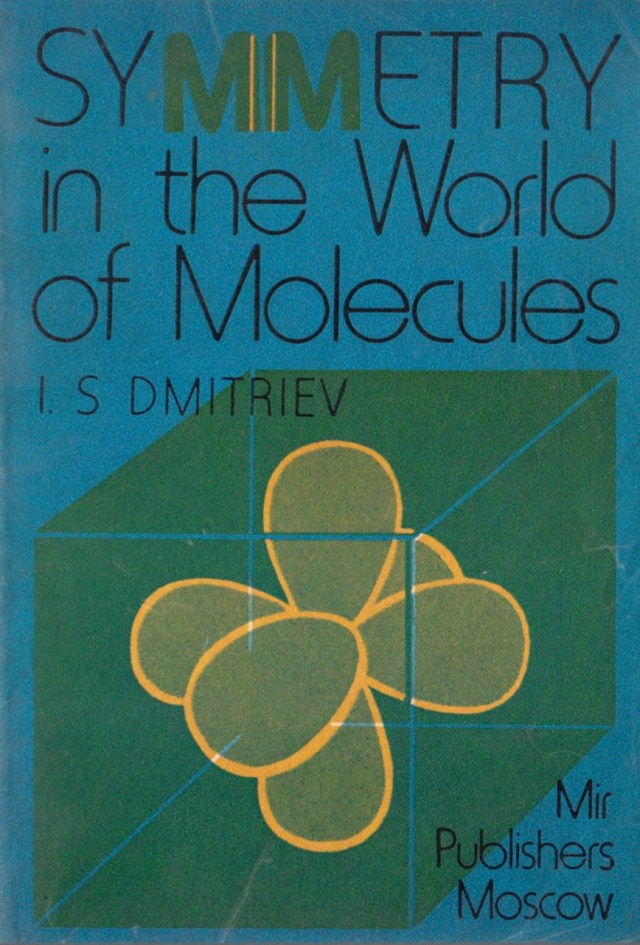
In this post, we will see the book Symmetry in the World of Molecules by I. S. Dmitriev.
This booklet is devoted to one of the most important concepts of natural science, the concept of symmetry. The beneficial impact of the symmetry theory can be traced in the theory of elementary particles, crystallography, solid state physics, space and time theory, molecular biology, quantum chemistry, the study of arts, the theory of music as well as many branches of mathematics.Since many things are necessarily omitted even in a large monograph, this is all the more so in a small unpretentious booklet. Our narration does not cover transpositional symmetry, solid state theory and nu merous problems pertaining to application of symmetry theory to organic chemistry. This booklet deals primarily with spatial symmetry of molecules.The study of any theory is to a certain extent similar to the learning of a foreign language. While some peo ple learn it in order to write and speak fluently, others are satisfied with the understanding of foreign texts even if using a dictionary. The same is true in the case of a theory. While some people learn it very comprehensively in order to work actively in the area, it is sufficient for others to understand the language of theorists and the substance of their conclusions. This book is intended for the latter group, who are much more numerous than the former. This booklet is intended just for them. We address it to experimental chemists, teachers, university students and even high school senior students.The symmetry theory is usually applied to the specific problems of physics and chemistry when non- algebraic objects such as atoms, molecules, solids are studied with algebraic methods. Therefore some readers will probably need to overcome certain barriers of mathematical reasoning.The general logical plan of the booklet is as follows. The first chapter has a narrative nature and is dedicated to the description of the major types of molecular symmetry. The second chapter may be considered as a mathematical model of the first. The next two chap ters are devoted to problems of the interrelation between the composition, geometry and electronic structure of molecules (Chapter 3) and chemical reactions(Chapter 4). The final fifth chapter is of an historic and methodological character.
In this post, we will see the book Essays About the Universe by Boris A. Vorontsov-Vel’yaminov.

This book by a prominent Soviet astronomer and imaginative interpreter of the history and latest knowledge of astronomy, an age-old science that has come through two shattering decades of exciting discovery and research, can be dubbed a popular encyclopaedia of astronomy. It is a vivid and fascinating account of almost all the celestial bodies with which astronomy is concerned: planets, comets, meteors, the Sun and stars, gaseous and dust nebulae, quasars, black hole., etc. The tome is lavishly illustrated throughout with a mixture of photographs and specially commissioned artwork in full colour. The book will appeal to the general reader with no astronomical and mathematical background, fascinated by the wonders of the Space Age.
The book has two major sections, the first deals with Solid matter, that is the planets (minor and major), comets and meteors. The second part deals with the gaseous state which includes stars, nebulae, galaxies, interstellar matter. Mathematics is avoided as much as possible with the main emphasis on explaining the physical meaning of the concepts and their implications to the reader. The book covers an impressively wide range of topics in astronomy starting from the basics to topics of cutting-edge research.

Update: 27 July 2024 New cleaned scan added
In this post, we will see the book Structural Mechanics by A. Darkov and V. Kuznetsov.
The book deals with a variety of structures and their stability from an engineering viewpoint. The structures discussed include arches, frames, trusses, roofs, retaining walls, bridges, columns and beams.
The book was translated from the Russian by B. Lachionov and the second edition was published by Mir in 1966.
All credits to the original uploader. The scan is a low-resolution one.
In this post, we will see the book Physiology for Everyone by B. F. Sergeev.

Our planet, the Earth, is the home of hundreds of thousands of living creatures. Life has permeated everywhere. It has ascended to the tops of the highest mountains, where there is hardly any air, and has hidden beneath the expanses of the oceans, reconciling itself to the tremendous pressures exerted by the waters. Life has come to the hot, arid desert; and to the eternal ice of the Arctic Living creatures have adapted themselves to an absence of oxygen, to everlasting gloom, and to silence. But, wherever living organisms have settled, they need food which has to be distributed throughout their bodies, and they have to carry out the processes of metabolism. They also need to feel at home in their environment and start families to ensure the survival of the species.This book will tell you about Nature’s amazing inventions which have made it possible for animals to populate our Earth, dealing as it does with live lanterns, radars, animal power stations, the mysteries of digestion, the automatism of the circulation of the blood, which is the body’s most perfect transportation system, the structure of photo- and audio-receptors the mysterious third eye, the secret workings of the brain, and the peculiarities of reproduction.Man has barely started to become familiar with Nature’s ingenious fantasy, but he is already getting to grips with the process of evolution and making use of all Nature’s treasures and inventions. The aim o this book is to call the reader’s attention to the endless horizons of the science of living beings.

In this post, we will see the book This Amazingly Symmetrical World by Lev Tarasov.

As we had written in the earlier post with Tarasov’s Calculus, which was remade electronically using LaTeX typesetting engine, this is another of his books which have been recreated with LaTeX.

The amount of efforts put in creating this book has been amply rewarded as the result has been aesthetically very pleasing for me. And in the process, I have learned a lot more about LaTeX and its packages. Hope this small effort is found useful by all. In case you find any typos please comment on the post.
Some snapshots from the remade book:
The Internet Archive link and here
Link to the git repo of the source files
README.md
The project has the LaTeX source files for the book This Amazingly Symmetrical
World by Lev Tarasov. We have used the scans of the book for images and have
not recreated any of the images.Though I would have liked to create all the pages, especially the cover and the
art till the title page using TiKZ, for now, I have created pdfs for those pages
in Inkscape. Purists may not like it, but at least in this version, that is how things are. Also the tables are not made using LaTeX, but are simple scans. Perhaps in a later version of the book, we will have these two issues sorted.The original typesetting of the book lets itself to be very well typeset with one of Edward Tufte’s book style implemented in LaTeX.
If there are any errors while typesetting, for example, references, or typos
please report them so that they can be addressed.As usual, you will need all the package files to compile the book correctly.
Preface 13
A Conversation 15
1 Mirror Symmetry 27
1 An Object and Its Mirror Twin 27
2 Mirror Symmetry 30
3 Enantiomorphs 31
2 Other Kinds of Symmetry 35
4 Rotational Symmetry 35
5 Mirror-Rotational Symmetry
6 Translational Symmetry
7 Bad Neighbours 39
8 Glide Plane (Axis) of Symmetry
3 Borders and Patterns 43
9 Borders 43
10 Decorative Patterns 45
11 Pattern Construction 49
12 The ‘Lizards’ Design 51
4 Regular Polyhedra 53
13 The Five Platonic Solids 53
14 The Symmetry of the Regular Polyhedra 54
15 The Uses of the Platonic Solids to Explain Some Fundamental Problems 55
16 On the Role of Symmetry in the Cognition of Nature 57
5 Symmetry In Nature 59
17 From the Concept of Symmetry to the Real Picture of a Symmetrical World 59
18 Symmetry in Inanimate Nature. Crystals 61
19 Symmetry in the World of Plants 63
20 Symmetry in the World of Animals 66
21 Inhabitants of Other Worlds 69
6 Order in the World of Atoms 71
22 Molecules 71
23 The Puzzle of the Benzene Ring 72
24 The Crystal Lattice 73
25 The Face-Centred Cubic Lattice 74
26 Polymorphism 76
27 The Crystal Lattice and the External Appearance of a Crystal 77
28 The Experimental Study of Crystal Structures 78
29 The Mysteries of Water 79
30 Magnetic Structures 80
31 Order and Disorder 82
7 Spirality In Nature 85
32 The Symmetry and Asymmetry of the Helix 85
33 Helices in Nature 87
34 The DNA Molecule 89
35 The Rotation of the Plane of Light Polarization 91
36 Left and Right Molecules. Stereoisomerism 92
37 The Left-Right Asymmetry of Molecules and Life 93
8 Symmetry and The Relativity of Motion 101
38 The Relativity Principle 101
39 The Relativity of Simultaneous Events 102
40 The Lorentz Transformations 103
41 The Relativity of Time Periods 105
42 The Speed in Various Frames 106
9 The Symmetry of Physical Laws 109
43 Symmetry Under Spatial Translations 109
44 Rotational Symmetry 111
45 Symmetry in Time 112
46 The Symmetry Under Mirror Reflection 113
47 An Example of Asymmetry of Physical Laws 114
10 Conservation Laws 117
48 An Unusual Adventure of Baron Münchhausen 117
49 The Problem of Billiard Balls 118
50 On the Law of Conservation of Momentum 121
51 The Vector Product of Two Vectors 122
52 Kepler’s Second Law 123
53 Conservation of the Intrinsic Angular Momentum of a Rotating Body 126
11 Symmetry and Conservation Laws 129
54 The Relationship of Space and Time Symmetry to Conservation Laws 129
55 The Universal and Fundamental Nature of Conservation Laws 130
56 The Practical Value of Conservation Laws 133
57 The Example of the Compton Effect 134
58 Conservation Laws as Prohibiting Rules 136
12 The World of Elementary Particles 139
59 Some Features of Particles 139
60 The Zoo of Elementary Particles 141
61 Particles and Antiparticles 142
62 Particles, Antiparticles and Symmetry 146
63 Neutrino and Antineutrino 148
64 The Instability of Particles 149
65 Inter-conversions of Particles 152
13 Conservation Laws and Particles 157
66 Conservation of Energy and Momentum in Particle Reactions 157
67 The Conservation of Electric Charge and Stability of the Electron 159
68 The Three Conservation Laws and Neutrino 160
69 Experimental Determination of Electron Antineutrino 162
70 Electron and Muon Numbers. Electron and Muon Neutrinos 163
71 The Baryon Number and Stability of the Proton 165
72 Discrete Symmetries. CPT-Invariance 167
14 The Ozma Problem 171
73 What Is the Ozma Problem? 171
74 The Ozma Problem Before 1956 173
75 The Mirror Asymmetry of Beta-Decay Processes 174
76 The Mirror Asymmetry in Decay Processes and the Ozma Problem 175
77 The Fall of Charge-Conjugation Symmetry 176
78 Combined Parity 177
79 Combined Parity and the Ozma Problem 179
80 The Solution to the Ozma Problem 180
15 Fermions and Bosons 183
81 The Periodic Table and the Pauli Principle 183
82 Commutative Symmetry. Fermions and Bosons 184
83 Symmetrical and Antisymmetrical Wave Functions 185
84 The Superfluidity of Liquid Helium. Superconductivity 187
85 Induced Light Generation and Lasers 188
16 The Symmetry of Various Interactions 189
86 The Principal Types of Interactions 189
87 Isotopic Invariance of Strong Interactions. The Isotopic Spin (Isospin) 191
88 Strangeness Conservation in Strong and Electromagnetic Interactions 194
89 Interactions and Conservations 197
90 A Curious Formula 198
91 The Unitary Symmetry of Strong Interactions 199
17 Quark-Lepton Symmetry 203
92 Quarks 203
93 The Charmed World 207
94 Quark-Lepton Symmetry 208
95 A New Discovery 210
A Conversation Between the Author and the Reader About the Role of Symmetry 213
The Ubiquitous Symmetry 213
The Development of the Concept of Symmetry 215
Symmetry-Asymmetry 217
On the Role of Symmetry in the Scientific Quest for Knowledge 219
Symmetry in Creative Arts 222
Literature 231
In this post, we will see the book Theory of Angular Momentum by A. P. Levinson, I. B. Vanagas, V. V. Yutsis.
About the book
FOREWORD
The principal results obtained up to 1935 in the quantum-mechanical theory of angular momentum are contained in chapter III of Condon and Shortley’s “Theory of Atomic Spectra” /1949/. Since then, owing to the ideas of Wigner /1931,1937/ and Racah /1942/, the theory has been enriched by the algebra of noncommuting tensor operators and the theory of y-coefficients. This has considerably increased its computational possibilities and has broadened the scope of its applications. Among the branches of theoretical physics where the methods of the theory of angular momentum are widely applied today we might mention the theory of atomic and nuclear spectra, the scattering of polarized particles in nuclear reactions, the theory of genealogical coefficients, etc. (a bibliography of the applications may be found in Edmonds’ book /1957/).
The only book known to us giving an exposition of the algebra of noncommuting tensor operators and j-coefficients is Edmonds’ “Angular Momentum in Quantum Mechanics” /1957/, which may serve as an excellent textbook for a first acquaintance with the subject. However, the exposition of the theory of j-coefficients and transformation matrices given in this book is not complete. This may constitute an impediment when the apparatus is employed m more complicated cases. The present
book fills this gap.The writing of this book began before Edmonds’ book appeared in print. The authors have utilized nearly all results known to them in the given field. Among these a certain place is occupied by the results obtained by a group of workers under the
direction of one of the present authors (A. Yutsis), the remaining two authors (I. Levmson and V. Vanagas) being the principal participants. The book corresponds to the content of the first part of a course, “Methods of Quantum-Mechanical Atomic Calculations”, given by the senior author to students of theoretical physics at the
Vilnius State University im. V. Kapsukas over the last two years.We found it worthwhile to use the elegant and powerful methods of group theory in our exposition. To avoid encumbering the book with elements of group theory we have assumed that the reader is already acquainted with linear representations of the three-dimensional rotation group. The reader who is unfamiliar with this may refer to the books by G.Ya. Lyubarskii*/1957/ and I. M, Gel’fand et al. /1958/.
We begin with the well-known theory of vector addition of two angular momenta (chapter I), turning next to the addition of an arbitrary number of angular momenta (chapter II), The following chapters (III- VI) are devoted to quantities of the theory of angular momentum where an important place is occupied by the graphical method which IS convenient for various calculations. The last chapter (VII) deals with the method of noncommuting tensor operators. Material of a supplementary character is given in the appendices.
We have cited a number of unpublished works some of which were not available to us. References to these were based on other published works. We apologise in advance for any resulting inaccuracy.
The book was translated from the Russian by A. Sen and R.N. Sen and was published by Israel Program for Scientific Translations for the National Science Foundation and the National Aeronautics and Space Administration, U.S.A. in 1962.
Cleaned, optimised scan here and here
Contents
FOREWORD
TRANSLATOR’S NOTE
Chapter I ADDITION OF TWO ANGULAR MOMENTA 1
1. Angular momentum operators and spatial rotations 1
2. Angular momentum eigenfunctions and representations of the rotation group 2
3. Addition of angular momenta, reduction of the direct product of representations of the rotation group 5
4. Expressions for the Clebsch-Gordan coefficients and their properties 8
5. Wigner coefficients and their properties 13
Chapter II ADDITION OF AN ARBITRARY NUMBER OF ANGULAR MOMENTA 16
6. General considerations on the addition of an arbitrary number of angular momenta 16
7. Group -theoretic considerations on the generalized Clebsch-Gordan coefficients 19
8. The transformation matrix 21
9. Simplification of the transformation matrix 24
10. Generalized Wigner coefficients and their properties 27
Chapter III GRAPHICAL METHODS FOR OPERATIONS WITH SUMS OF PRODUCTS OF WIGNER COEFFICIENTS 31
11. Sums of products of Wigner coefficients (jm-coefficients) 31
12. Graphical representation of jm-coefficients 34
13. Expansion of jm-coefficients in generalized Wigner coefficients 39
14. Transformation of jm-coefficients 42
15. Summation of jm-coefficients 46
Chapter IV j-COEFFICIENTS AND THEIR PROPERTIES 49
16. The 6 j-coefficient and its properties 49
17. 3n j-coefficients of the first and second kinds 55
18. The 9 j-coefficient and Its properties 59
19. 12 j-coefficients and their properties 62
20. Methods of studying j-coefficients, 15 j-coefficients 65
Chapter V UTILIZATION OF TRANSFORMATION MATRICES FOR OBTAINING SUM RULES AND TRANSFORMATION FORMULAS FOR jm-COEFFICIENTS 71
21. General considerations on the relation between transformation matrices and j-coefficients 71
22. Methods for obtaining the relation between transformation matrices and j-coefficients 74
23. Explicit expressions for the simplest transformation matrices 76
24. Utilization of matrix identities for obtaining sum rules on j-coefficients 80
25. Use of matrix identities for the transformation of jm-coefficients 83
Chapter VI EXAMPLES OF APPLICATION OF THE GRAPHICAL METHOD 87
26. Graphical summation of products of Wigner coefficients 87
27. A more complex product of Wigner coefficients 91
28 Summation of a product of j-coefficients 94
29. Summation of a product of Wigner coefficients and j-coefficients 98
30. Choice of a method of calculation 102
Chapter VII. IRREDUCIBLE TENSOR OPERATORS AND EXPRESSIONS FOR THEIR MATRIX ELEMENTS 105
31. Irreducible tensor operators and their properties 105
32. Tensor products 107
33. Expressions for matrix elements of products of tensor operators 109
34. Calculation of matrix elements of complex products of tensor operators 111
35. Double tensors, their products and matrix elements 114
Appendix 1. NOTATIONS FOR THE WIGNER, 6j-, 9j– AND ALLIED COEFFICIENTS 117
Appendix 2. ALGEBRAIC FORMULAS FOR THE CLEBSCH-GORDAN COEFFICIENTS 119
Appendix 3. DIAGRAMS OF 18 j-COEFFICIENTS 122
Appendix 4. PROPERTIES OF 18 j-COEFFICIENTS 126
Appendix 5. EXPRESSIONS FOR THE TRANSFORMATION MATRICES OF EIGENFUNCTIONS OF FIVE COUPLED ANGULAR MOMENTA 135
Appendix 6. SUM RULES ON j-COEFFICIENTS 141
Appendix 7 THE SIMPLEST SUMMATION AND TRANSFORMATION FORMULAS FOR jm-COEFFICIENTS 152
BIBLIOGRAPHY 154
SUPPLEMENTARY BIBLIOGRAPHY 157
INDEX 158