Science for Everyone – Me Or Not Me

In continuing our previous post on Life Sciences in the Science for Everyone series, we now come to a book on human physiology and our bodily defense mechanisms against all external threats that is immunology. This one is called Me or Not Me by R. V. Petrov. As the title suggests the book explain the fundamentals of how our health is maintained and body functions.

In the preface of the book the author says:

Every particle of our body must bear an identification sign, or “tag”, saying ‘this is me’. If something does not have such a sign, or if the tag is foreign, tho particle would be saying: ‘this is not me’ Everything ‘other than me’ is destroyed by the immune system. I have compared two types of individuality spiritual and bodily to show tho all embracing significance of immunology, and the complexity and intricacy of the immune system. Only the future will reveal whether the mechanisms of the brain and the immune system are similar. This book has grown out of a booklet called Talks on New Immunology which was published in 1976 as a part of the “Eureka” series. The talks have been expanded in volume and their form revised in an effort to convey to the reader the huge volume of scientific information that has been accumulated by a young science of immunology.

The book was translated from the Russian by G. Yu. Degtyaryova and was first published by Mir in 1987.

Update Jan 2020

The Internet Archive Link

and here

Continue reading →

Posted in books, life sciences, mir publishers, physiology, science for everyone | Tagged , , , , , | 11 Comments

Science for Everyone – Luminiscence in Public Health

Among the titles that have posted so far in the Science for Everyone series we do not have any on Life Sciences, so this is one starts that trend, which I hope will increase in the future. This particular book is called Luminescence in Public Health by N. N. Barashkov.

This what the back cover of the book says:

The luminescence phenomenon underlies many investigative methods in the most diverse disciplines: analytical chemistry, geology, fault detection, paleontology, forensic medicine, and other. It comprises two types of emission: fluorescence and phosphorecence. In medical and biological research, fluorescence analysis has no equal in terms of availability of equipment, simplicity of procedure, reproducibility of results, and sensitivity to minute quantities of the biological sample. This popular science book describes the application of fluorescence analysis to investigations of physiological processes and also to the diagnosis of diseases, assessment of its severity, and control of its course. Separate sections of the book are devoted to the use of this method in public health and pollution control. This book is intended for the general reader and those who are interested in problems of public health.

The book was translated from the Russian by A. Yurasovskaya and was first published by Mir in 1988.

Update 02 Jan 2020

The Internet Archive Link

and here

Continue reading →

Posted in books, life sciences, mir publishers, science for everyone | Tagged , , , , , , | 3 Comments

Science for Everyone – Elementary Kinematics of Elementary Particles

We now come to another interesting title in the Science for Everyone, called Elementary Kinematics of Elementary Particles by G. I. Kopylov. This book by and large introduced me to many concepts in particle physics. This book is especially relevant with the hot [literally and figuratively] discoveries being currently made in the LHC.

This is what the back cover of the book says:

This book tells a fascinating story of one of physics today: the discovery of primary building blocks of matter. This field of science is called particle or high-energy physics and is one of the frontiers of present day physical research.

How is it possible to detect particles a hundred thousand times smaller than the atom, which itself is many times smaller than an apple as the apple is smaller than the Earth? How can we follow motion of particles that have velocity almost that of light? How can we measure the lifetime of these particles when it is of the order of 0.00000000000000000000001 second? What kind of clock can we ;’use? How can we investigate the properties of these astonishing and elusive bits of matter?

All these and many other questions are comprehensively answered in this book written for the layman by the late Dr. Gersten Kopylov, who was a prominent scientist, well known in the world of particle physics. This book was written to be understood even by readers having only a secondary school education and it requires a knowledge of only  elementary algebra and geometry. Nevertheless in the author’s treatment , the material is no way oversimplified or distorted.

The book was translated from the Russian by Nicholas Weinstein and was first published by Mir in 1983.

Update Jan 2020

The Internet Archive Link

and here

Continue reading →

Posted in books, physics, science for everyone, soviet | Tagged , , , , , , | 13 Comments

Science for Everyone – Satellite and Typhoon – Eye to Eye

We now come Satellite and Typhoon – Eye To Eye by S. Baibakov and A. Martynov in the Science for Everyone Series. I did not know the existence about this book till some Anonymous person reported about it in the Science for Everyone post.

The back cover of the book says:

Studies of typhoons and hurricanes based on conventional tracking technologies ground weather stations, ships aircraft, and weather rockets rarely turn out to be effective enough, since the time and place of typhoon origin are unpredictable. A new avenue of approach to the problem is opening up with advances in space technology. This book presents a detailed method to explore in, typhoons and hurricanes using satellites and satellite probes to deliver balloons with a payload of measuring instruments into their effective range. There is also an extensive discussion of problem areas in meteorology, oceanography, and environmental science capable of being addressed by space-borne technologies. The book is intended for those interested in astronautics, oceanography and in the protection of the environment.

The book was translated from the Russian by Anatoli Rosenzweig and was first published by Mir in 1986.

Update: Jan 2020

The Internet Archive Link

and here

Continue reading →

Posted in books, meteorology, mir publishers, science, science for everyone, soviet | Tagged , , , , , , , | 3 Comments

Science for Everyone – Silhouttes of Chemistry

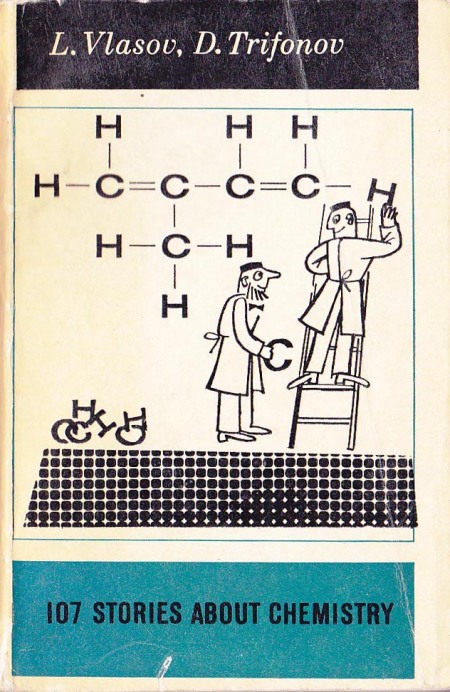
In the Science for Everyone Series we now come to Silhouttes of Chemistry by D. N. Trifonov and L. G. Vlasov. This one is for all the people who were waiting for chemistry books.

The back cover of the book says:

The authors of this book have endeavoured to touch upon
the most important and interesting problems of chemistry.
Their book describes and explains the structure of the
Periodic System of elements; it guides you through a kind
of chemical museum full of curious exhibits; it tells of the
intricate substances chemists have produced and how they
have learned to work even with single atoms of the elements;
it acquaints you with the various chemical professions
and shows how chemistry has penetrated all spheres
of human activity.
Reading these short but instructive stories about the exciting discoveries of chemistry will urge you to find out more about this fascinating science and to take up chemistry seriously.

This is a book that eluded me for years, and finally when I got it it was by surprise. The book was translated from the Russian by David Sobolev and Andrei Konyaev and this second edition was published by Mir in 1987.

Update July 2020 The Internet Archive Link

and here

Update: As mir_fan commented, there is another cover “(some folks rearranging H and C atoms)”, reproduced below and published previously as 107 Stories About Chemistry, contents being the same. And thanks to him we also know that there is a Malayalam translation of this book.

Also there is an Hindi translation as the cover above suggests, but I do not have any other information.

Update: We came to know about Telugu and Tamil translations as well.

Continue reading →

Posted in books, chemistry, mir publishers, science, science for everyone | Tagged , , , | 16 Comments

Science for Everyone – Storming the Fortress of Fusion

In the Science for Everyone Series we now come to the book Storming the Fortress of Fusion by G. S. Vornov. This book is one of the earliest Mir books that I have bought.

The back cover of the book says:

The energy we get from the Sun is generated at its core in fusion reactions, in which hydrogen is turned into helium. If these reactions could be used on Earth, humanity would be able to provide itself with an abundance of energy. The problem of maintaining practical nuclear fusion has been one of the central problems of physics for
some thirty years, and yet only now has it become clear that a solution is in fact possible. This book explains in a lively and
informal way how the investigations have developed, the cleverness of the ideas used to tackle the problems, the ingenuity behind the
experiments, and the successes and setbacks encountered in dea ing with the capricious and cunning material we call plasma.
Intended for teachers, college students, and school pupils.

This book was translated from the Russian by R. S. Wadhwa and was first published by Mir in 1988.

Update: Jan 2020

The Internet Archive Link 

and here

Continue reading →

Posted in books, mir publishers, physics, science for everyone | Tagged , , , , , , | 2 Comments

Science for Everyone – Progeny of Volcanoes

Till now we have not seen any books in the area of Geology, so this one is for all the people who are interested in volcanoes. In Science for Everyone series now we come to The Progeny of Volcanoes by P. N. Erofeev.

This is what the back cover of the book says:

Before setting out to acquaint the reader with the mysteries of the World Ocean, the author had himself explored the vast areas of the oceans covering the surface of our planet and had also done a great amount of researchin the fascinating domain of oceanological. studies. Fully aware of the fact that not all of his future readers would be competent enough to make their way through the complicated language used by the scientists in interpreting the data of their analysis,the author made every possible effort to facilitate his narrative without trespassing on the essence and scientific value
of the research that has been undertaken. This book provides the reader with a host of facts about the World Ocean that are not merely informative, but are also bound to create an integral picture in the reader’s mind and thus widen the scope of his or her scientific,
historical, and cultural background.

The book was translated from the Russian by G. G. Egorov and was first published by Mir in 1989.

Update: Jan 2020

The Internet Archive Link

and here

Continue reading →

Posted in books, geology, mir books, mir publishers, science for everyone | Tagged , , , , , | 1 Comment

Science for Everyone – Yes, No Or Maybe

This time in the Science for Everyone series we come to a text on Statistics, this one is named Yes, No Or Maybe and is written by Ya. I Khurgin.

This is what the back cover of the book says:

Professor Yakov Khurgin is known for his works in applied mathematics, cybernetics, industrial applications of mathematics. Besides he is an imaginative popularizer of science. His book Do You Say Mathematics? has been passed through two editions in Russian and has been translated into English. His new book Yes, No or Maybe is a readable introduction to the frontiers of statistics and experiment design. The book is written in a lovely language and contains many practical examples.

The book was translated from the Russian by Alexander Repyev and was published first by Mir in 1985. The book mentioned in the back cover Do You Say Mathematics? is an amazing one, which we will get when we will start the mathematics series!

Update: Jan 2020

The Internet Archive Link

and here

Continue reading →

Posted in books, mir publishers, science for everyone, statistics | Tagged , , , , , | 3 Comments

Science for Everyone – This Fascinating Astronomy

We now come to another book in Science for Everyone Series, this one is titled This Fascinating Astronomy by V. N . Komarov. This book goes a step further than the two other astronomy books (All About The Telescope, A Book About Planets and Stars) that we have already seen. Astronomy indeed is a fascinating subject. Ans Komarov makes it a point to tell the reader that. The back cover of the book says:

Written in a language easily accessible to a wide reader-ship, this book is an exposure of some extraordinary discoveries in modern astronomy and of the puzzling problems it still has to solve. It is also a presentation of facts defying traditional views, of original theoretical conjectures and new research methods. Debatable as-tronomical issues are set out in a lively and interesting form, and in conformity with the latest achievements in physics. Continue reading →

Posted in astronomy, books, mir publishers, science for everyone | Tagged , , , , , | 19 Comments

Science for Everyone – Aptitude Test Problems in Physics

This book, which is a collection of physics 
aptitude test problems, draws on the experience 
of the physics olympiads conducted during the 
last fifteen years among the schoolchildren 
of Moscow.

In Science for Everyone series we now come to a book, Aptitude Test Problems in Physics edited by S. S. Krotov, and contributing authors are A. I. Buzdin, V. A. Il’lin, I. V. Krivchenkov, N. A. Sveshnokov.
This book is hugely popular with aspirants  appearing for different entrance exams in India and this is the reason why maybe it was republished along with more famous Irodov. (Maybe all the problems are sourced from here, or books like these ; ) Any way the book is great, it makes you think about many ways of solving problems.

From the Preface

The present state of science and technology is such that a large number of scientists and engineers must be educated at an advanced level. This cannot be done without significantly raising the level of teaching physics, with an emphasis on the individual and special efforts to detect and nurture budding talents. In this respect, physics
olympiads for students at secondary school and vocational training colleges are important in bringing to light the brightest students and in correctly guiding them in their choice of profession.

This book, which is a collection of physics aptitude test problems, draws on the experience of the physics olympiads conducted during the last fifteen years among the schoolchildren of Moscow. A Moscow physics olympiad includes three preliminary theoretical rounds at the regional, city, and qualifying levels, followed by a final practical round. After the final round, a team of Moscow schoolchildren is selected for participation in the all-Union olympiad. The complexity of the problems set for each round increases gradually, starting from the simplest problems at regional level, problems which can be solved simply by havinga thorough knowledge of the basic laws and concepts of physics. The problems at the qualifying stage are much more complicated. Some of the problems at this level involve a certain amount of research as a rule, the problems make participation in the olympiads even more challenging). This collection contains problems from the theoretical rounds only. The structure of the book reflects the emphasis given to it in different sections of the physics course at such competitions. The number of problems set at an olympiad and the fraction allotted to a particular topic in the book are determined by the number of years the topic is taught at school. A detailed classification of different topics is not given since some are represented by only one or two problems, while other topics have dozens of problems. Most of the problems are originally and a considerable proportion of them was composed by the authors. The most difficult problems are marked by asterisks being  the product of a close group of authors, the book reflects certain traditions and experience drawn from Moscow olympiads only. A feature of the book is that it presents the scientific views and working style of a group of like-minded scientists.

In view of all this, the book should attract a large circle of readers. The best way to use it is as a supplementary material to the existing collections of problems in elementary physics. It will be especially useful to those who have gone through the general physics course, and want to improve their knowledge, or try their strength at nonstandard problems, or to develop an intuitive approach to physics. Although it is recommended primarily for high-school students, we believe that college students in junior classes will also find something interesting in it. The book will also be useful for organizers of physics study circles, lecturers taking evening and correspondence courses, and for teachers conducting extracurricular activities.

This is what the back cover of the book says:

This collection contains about 250 problems in
physics set for boys and girls from Moscow schools
participating in physics olympiads from 1968 to
1985. The most interesting and original problems
from these examinations have been included together
with their solutions.
Intended for schoolchildren and teachers of physics,
this book can also be used for preparation to entrance
examinations to the higher educational institutes
where an advanced knowledge of physics is required.

The contributing authors are A.I. Buzdin V.A. Il’in I.V. Krivchenkov S.S. Krotov N.A. Sveshnikov.

This book was translated from the Russian by Natalia Wadhwa (is she related anyway to Ram Wadhwa who translated Tarasov’s Quantum Mechanics?) and was first published by Mir in 1990. CBS republished the book 1996.

Update Jan 2020:

The Internet Archive Link

and here

For those who want to buy the book, it is still in print and is very cheap at Rs. 54.

All credits to the original uploader, though I had also made a copy, but this one is much better than mine, so posting the better one.

Thanks to Escapee for staying awake with me, while I made this post 🙂

Continue reading →

Posted in mir publishers, physics, science for everyone | Tagged , , , , , , | 29 Comments