
and also few from my old stack.


Several books below acquired from Abids used book market at Hyderabad.
Thanks to ArvindJ for taking me there.
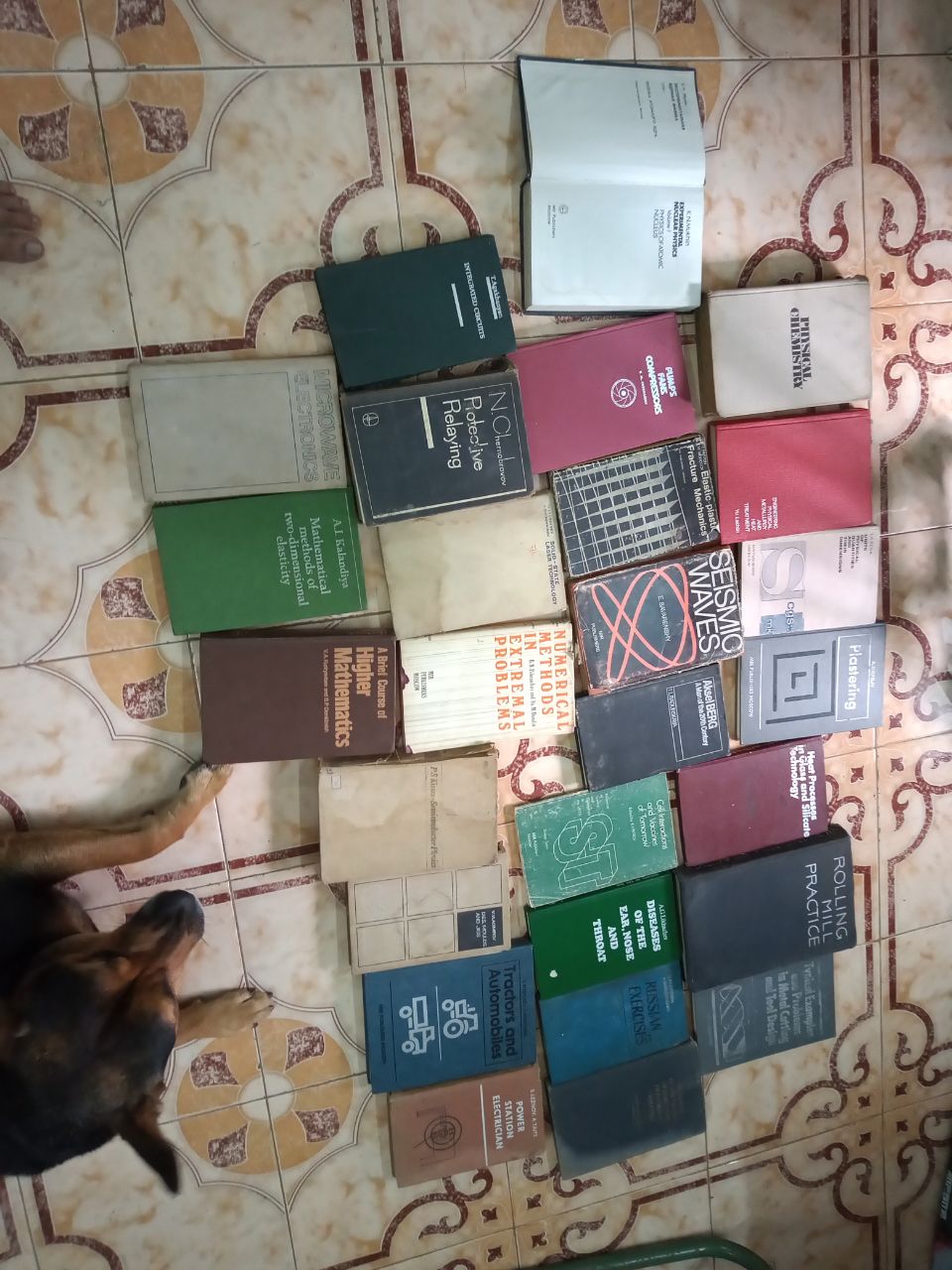
Thanks to @desperadomar for arranging books below. Lot of literature and titles in Hindi too.
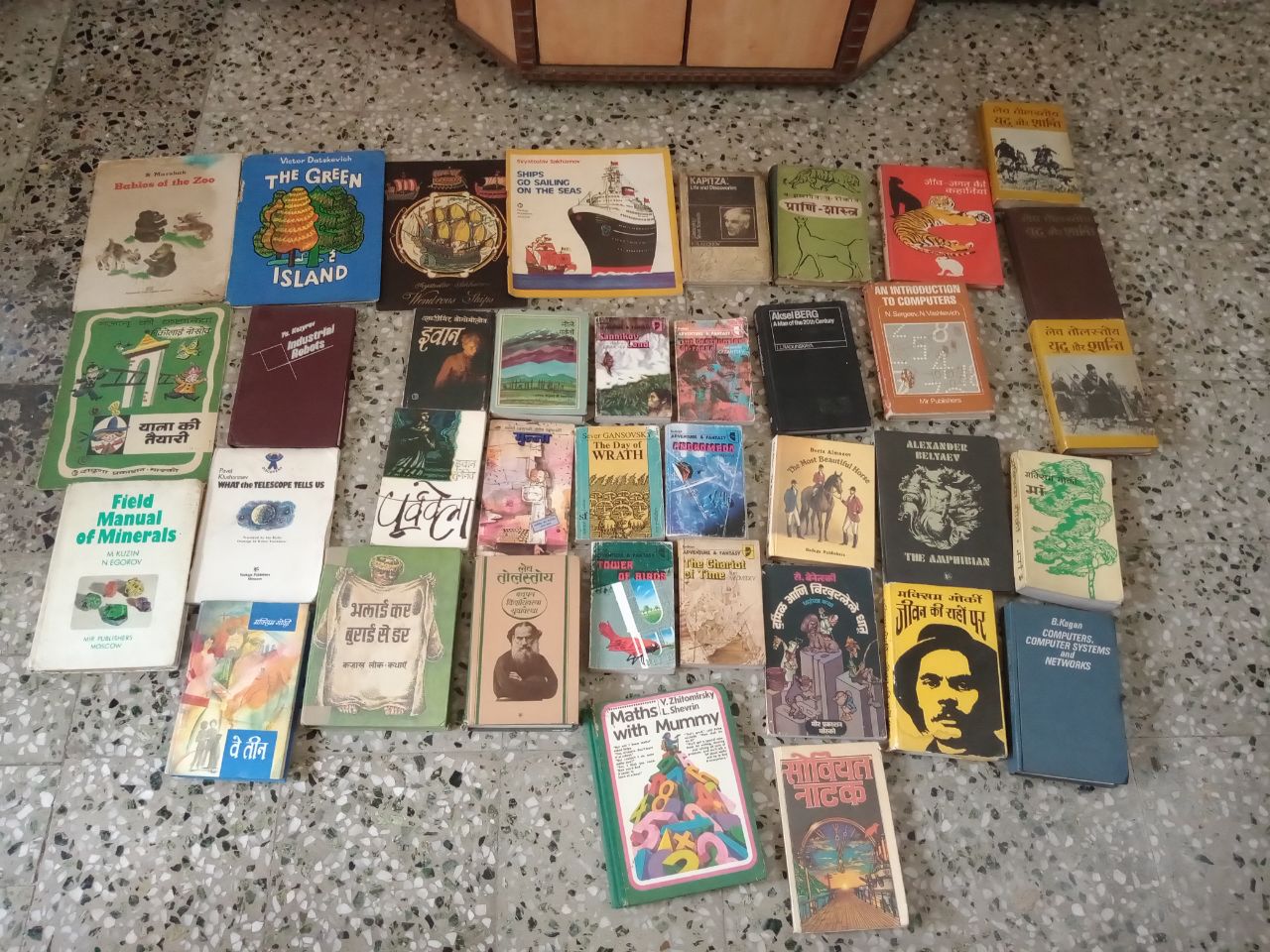
and also few from my old stack.
Several books below acquired from Abids used book market at Hyderabad.
Thanks to ArvindJ for taking me there.
Thanks to @desperadomar for arranging books below. Lot of literature and titles in Hindi too.
In this post, we will see the book Foundry Practice by N. D. Titov and Yu. A. Stepanov.

The book is based on the lectures read to the students of machine- building secondary schools and also on the foundry practice course included in the curriculum of the Bauman Higher Technical School of Moscow.
The book opens with a detailed description of sand molding technology, melting, pouring, and fettling of castings from gray iron which is one of the most widely used casting alloys. Subsequent chapters treat the methods of fabrication of castings from malleable iron, steels, and alloys of copper, aluminum, and magnesium. One part of the book places a particular emphasis on the theory of casting. The last part which includes several chapters contains basic information on special casting processes such as permanent mold casting, die casting, investment casting, and shell casting. The authors have paid special attention to the sequential presentation of various aspects of founding in a clear and readable language.
Each chapter first describes the essence of production processes, the influence of operating conditions on the quality of castings, and then presents the rational fields of application of the production methods. In the authors’ opinion, such a presentation of the material helps the reader to acquire more readily the basic knowledge of foundry practice.
The book was translated from Russian by P. S. Ivanov and was published in 1981 by Mir.
Credits to the original uploader.
You can get the book here (~ 14 MB).
The link above is an optimised version of the original file of ~ 310 MB
Follow us on The Internet Archive: https://archive.org/details/@mirtitles
Follow Us On Twitter: https://twitter.com/MirTitles
Write to us: mirtitles@gmail.com
Fork us at GitLab: https://gitlab.com/mirtitles/
Add new entries to the detailed book catalog here.
Preface 9
Chapter 1. Casting Mold 11
Chapter 2. Basics of Pattern Design and Making 18
2.1. General 18
2.2. Wood Patterns 18
2.3. Metal Patterns 35
2.4. Plastic Patterns 44
Chapter 3. Molding Materials 49
3.1. General 49
3.2. Sand Types 51
3.3. Clay. Type Binders 55
3.4. Other Binders 57
3.5. Auxiliary Molding Materials 61
3.6. Molding and Core Sands 63
3.7. Washes, Pastes, Powders, and Other Dressings 80
3.8. Preparation of Molding and Core Sands 84
3.9. Sand Control 92
Chapter 4. Production of Molds 102
4.1. General 102
4.2. Hand Molding 107
4.3. Machine Molding 124
4.4. Organization of In-Line Production, Integral Mechanization and
Automatization in the Molding Shop 140
Chapter 5. Gating Systems 146
5.1. Elements of the Gating System 146
5.2. Gating Methods and Types of Gating Systems 150
5.3. Calculation of Gates for Gray Iron Castings 153
Chapter 6. Coremaking 163
6.1. General 163
6.2. Core Design 163
6.3. Hand Coremaking 167
6.4. Machine Coremaking 171
6.5. Finishing, Inspection, and Storing of Cores 177
6.6. Mold and Core Drying 180
Chapter 7. Mold Assembly and Fastening 186
7.1. Mold Assembly 186
7.2. Mold Fastening and Weighting 187
Chapter 8. Design of Castings, Molds, and Cores 190
8.1. Design of Castings 190
8.2. Design of Molds and Cores 194
Chapter 9. Cost Effectiveness of Metal Casting 213
9.1. Technical-and-Economic Indexes 213
9.2. Economic Efficiency of a Casting Process 214
9.3. Ways of Increasing Economic Efficiency of Metal Casting 218
Chapter 1. Interaction of the Mold with Molten Metal 219
1.1. Gases in Castings 219
1.2. Effect of Molten Metal on the Mold 224
1.3. Crystallization of Alloys in the Mold 227
1.4. Internal Casting 230
Chapter 2. Casting Properties of Metals and Alloys 235
2.1. Fluidity 235
2.2. Shrinkage 237
2.3. Segregation 243
Chapter 1. Gray Cast Iron 246
1.1. General 246
1.2. Effect of the Chemical Composition on the Structure and Properties of Iron 247
1.3. Classification of Irons 252
1.4. Mechanical Properties of Cast 254
1.5. Inoculation of Gray Iron 256
1.6. High-Strength Irons 256
1.7. Alloy Cast Irons 259
Chapter 2. Charge Materials. Charge Calculation 262
2.1. Metal Charge 262
2.2. Fuels 267
2.3. Fluxes 269
2.4. Charge Calculation 271
Chapter 3. Melting Cast Iron in the Cupola 279
3.1. General 279
3.2. Metallurgical Principles of Melting Iron in the Cupola 284
3.3. Stepping up the Process of Cupola Melting 289
3.4. Disturbances іп the Cupola Run 291
3.5. Melting Process Control 292
Chapter 4. Melting Iron in Reverberatory and Electric Furnaces.297
4.1. Melting in Reverberatory Furnaces 297
4.2. Melting in Electric Arc Furnaces 298
4.3. Melting in Coreless Induction Furnaces 302
4.4. Melting in Core Induction Furnaces 305
Chapter 5. Running, Shakeout, Fettling and Acceptance of Gray Iron Castings 308
5.1. Pouring into Molds 308
5.2. Cooling and Shakeout of Castings 312
5.3. Fettling of Castings 313
5.4. Chipping and Grinding of Castings321
5.5. Heat Treatment of Iron Castings 322
Chapter 6. Casting Defects 324
6.1. General 324
6.2. Types and Causes of Defects. Preventive Measures 324
6.3. Inspection 329
6.4. Salvaging Operations 331
6.5. Product Quality Control Management 333
Chapter 1. Molding Practice and Melting 336
1.1. General 336
1.2. Some Features of Molding Practice 338
1.3. Melting White Cast Iron 340
1.4. Fettling of Castings 345
Chapter 2. Annealing of Castings 347
2.1. Malleable Annealing 347
2.2. Short-Cycle Malleable Annealing 351
Chapter 1. Steels for Shaped Castings 353
1.1. General 353
1.2. Carbon Steels 354
1.3. Alloy Cast Steels 355
Chapter 2. Design of Steel Castings and Molding Practice 357
2.1. Design of Steel Castings and Molds 357
2.2. Construction and Calculation of Gating Systems and Risers 359
Chapter 3. Melting and Casting of Steels 363
3.1. Melting in Open-Hearth Furnaces363
3.2. Melting in Basic and Acid Electric Furnaces 366
3.3. Pouring, Cleaning, and Heat Treatment of Castings 370
Part VI. Production of Nonferrous Castings 373
Chapter 1. Production of Copper-Alloy Castings 374
1.1. Composition and Properties of Copper Alloys 374
1.2. Gating and Risering… css 376
1.3. Melting Copper Alloys 378
Chapter 2. Production of Aluminum Castings 383
2.1. Composition and Properties of Aluminum Alloys 383
2.2. Molds, Gates, and Risers 386
2.3. Melting Aluminum Alloys and Pouring Molds 387
Chapter 3. Production of Magnesium Castings 393
3.1. Composition and Properties of Magnesium Alloys 393
3.2. Molds and Gates 394
3.3. Melting Magnesium Alloys 395
Chapter 1. Permanent-Mold Casting 398
4:1. General 398
4.2. Permanent Molding 399
1.3. Casting Various Alloys 404
1.4. Permanent Molding Machines 406
Chapter 2. Centrifugal Casting 408
2.1. General 408
2.2. Molds and Machines 411
Chapter 3. Die Casting 414
3.1. General 414
3.2. Pressure Casting Dies 418
3.3. Die Casting Machines 420
3.4. Gating Systems and Operating Conditions 422
3.5. Low-Pressure Die Casting 425
Chapter 4. Investment 427
4:4. General 427
4.2. Production of 429
4.3. Production of the Investment Mold 433
4.4. Investment Casting Process 436
4.5. Melting and Pouring Metal into Molds, Shakeout and Fettling of Castings 439
Chapter 5. Shell 440
5.1. General 440
5.2. Production of Shell Molds and Cores 443
5.3. Assembling and Pouring of Shell Molds. Shakeout of Castings 444
Chapter 6. Other Special Casting 446
6.1. Continuous 446
6.2. Chill Casting 448
6.3. Casting by Squeezing 451
6.4. Liquid 452
Index 454
This gallery contains 13 photos.
In this post, we will see the LaTeX version of the book Basic Concepts of Quantum Mechanics by Lev Tarasov. We had earlier seen a scanned version of the book. About the book This book gives a detailed and systematic … Continue reading
In this post, we will see the book Yushka by Alexander Kuprin.


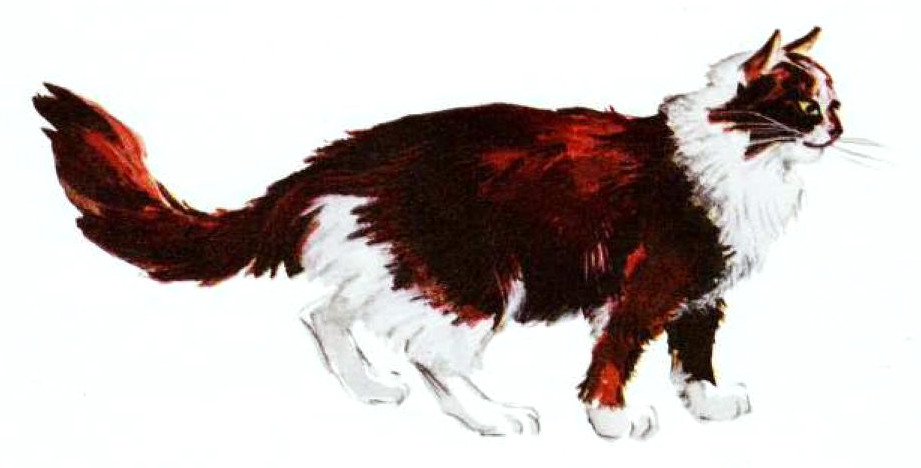
The book is about an intelligent and magnificent cat named Yushka. Her habits, behavior and experience of living with her are described.
The book was translated from Russian to English by Fainna Giagolava and was published in 1977 by Progress Publishers. We have a Telugu and a Bengali version too. The images below are the names of the translators, please do help with the names if you read these scripts.


All credits to Guptaji.

You can get the book in
English version here and here (1971).
Telugu version here and here (1981).
Bengali version here and here (1981).

In this post, we will see the book Tick Tock compiled by I. Stepnova. The fantastic illustrations are by B. Rytman.

This children’s book looks at various aspects of time from reading clocks, calendars, day and night, seasons, weather. There are several riddles for the children to solve and also lot of hands-on activities to perform.
The book was translated from Russian by and was published in 1981 by Proscveshcheniye Publishers. (This is the first time I am hearing of this publisher)
All credits to Guptaji.
Note: The resolution of the book is not very good and you might notice pixelation when zooming in, though it is perfectly readable.




You can get the book here.
Follow us on The Internet Archive: https://archive.org/details/@mirtitles
Follow Us On Twitter: https://twitter.com/MirTitles
Write to us: mirtitles@gmail.com
Fork us at GitLab: https://gitlab.com/mirtitles/
Add new entries to the detailed book catalog here.
In this post, we will see the book Thermodynamics, Statistical Physics, and Kinetics by Yu. B. Rumer and M. Sh. Ryvkin

This book is intended for readers taking up the study of thermodynamics, statistical physics and kinetics. Accordingly, readers are assumed to have a knowledge of elementary physics, higher mathematics and quantum mechanics.
The sections marked by asterisks require a deeper knowledge and can be omitted on the first reading.
The book aims to gradually familiarize readers with methods used in thermodynamics, statistical physics and kinetics, to show how the concrete problems should be solved and to bring readers as soon as possible to a level which enables them to tackle more specialized books and papers. It has therefore proved necessary to include some matter, perhaps too simple for some, as well as problems that may be too difficult for others.
The book was translated from Russian by S. Semyonov and was published in 1980 by Mir.
Credits to the original uploader.
You can get the book here.
Follow us on The Internet Archive: https://archive.org/details/@mirtitles
Follow Us On Twitter: https://twitter.com/MirTitles
Write to us: mirtitles@gmail.com
Fork us at GitLab: https://gitlab.com/mirtitles/
Add new entries to the detailed book catalog here.
Preface 5
Introduction 11
Chapter I. General Laws of Thermodynamics 13
1. Equilibrium states and equilibrium processes 14
2. Temperature. The temperature principle 16
3. Entropy. The entropy princip 18
4. Absolute temperature and absolute entropy 20
5. Work 23
6. Adiabatic and isothermal potentials 25
7. The energy principle. Supply and removal of heat 28
8. Heat capacity of gases 31
9. Cyclic processes. The Carnot cycle 33
10. Axiomatics of thermodynamics. Generalization of the concept of entropy to arbitrary thermodynamic systems. Nernst’s heat theorem 38
11. Thermodynamic coefficients. Polytropic processes 43
12. Thermodynamics of the van der Waals gas 52
13. Gas cooling methods. Gay-Lussac and Joule-Thomson processes 61
14. Thermodynamics of rods 67
15. Thermodynamics of magnetics 72
16. Thermodynamics of dielectrics 80
17. Thermodynamics of radiation 85
18. Thermodynamics of water 91
19. The thermodynamic potential. Method of thermodynamic functions 96
20. Thermodynamics of plasma 102
21. Polyvariant systems. Magnetostriction and the piezomagnetic effect 104
Chapter II. Systems with Variable Amount of Matter. Phase Transitions 110
22. Systems with variable amount of matter. The chemical potential 110
23.The increase in entropy in equalization processes. The Gibbs paradox 113
24. Extrema of thermodynamic functions 121
25. Thermodynamic inequalities 128
26. Phase equilibrium. First-order phase transitions 130
27. Three-phase equilibrium. Superheating and supercooling 141
28. Second-order phase transitions 148
29. Thermodynamics of superconductors 150
30. Multicomponent systems. Phase rule 155
31. Chemical equilibrium in a homogeneous system. The mass action law 158
Chapter III. Statistical Distributions for Ideal Gases 165
32. Statistical regularities. Distributions, most probable distributions 165
33. 𝜇-Space. Boxes and cells 170
34. Bose-Einstein and Fermi-Dirac distributions 173
35. The Boltzmann principle 180
36. The Maxwell-Boltzmann distribution 186
37. Transition to continuously varying energy. Degeneracy conditions for ideal gases 190
38. The 𝛺-potential of Bose and Fermi gases 194
39. Energy quantization. The Nernst theorem 197
Chapter IV. The Maxwell-Boltzmann Gas 202
40. The Maxwell-Boltzmann monoatomic gas in the classical approximation. Phase volume of a cell and the zero point entropy 202
41. The’ Maxwell distribution 205
42. Spatial distribution of molecules 209
43. Polyatomic gases (classical theory). The equipartition theorem 210
44. The Maxwell-Boltzmann gas with two energy levels 214
45. Quantization of translational motion 216
46. Diatomic gas. Rotational degrees of freedom 219
47. Molecules consisting of identical atoms. Ortho- and paramodifications 225
48. Vibrational degrees of freedom 230
49. Thermal ionization of atoms 234
50. Thermal dissociation of molecules 239
51. Paramagnetic gas in a magnetic field 242
Chapter V. Degenerate Gases 246
52. Equilibrium thermal radiation. Photon gas 246
53. Thermal motion in crystals. Phonon gas 253
54. A degenerate Bose gas in the absence of a field. The Bose-Einstein condensation 262
55. The Bose gas in an external field 270
56. An electron in a periodic field 273
57. Degenerate Fermi gas. Electron gas in metals 276
58. Electrons in a semiconductor 283
59. Magnetism of an electron gas 286
Chapter VI. Systems of Interacting Particles. The Gibbs Method 297
60. 𝛤-space. Liouville’s theorem 297
61. Microcanonical and canonical distributions 302
62. T-V-𝜇 and T-P-N distributions 306
63. Another derivation of the T-V-N, T-V-𝜇 and T-V-N distribution
Thermodynamic corollaries 309
64. Derivation of the Bose-Einstein and Fermi-Dirac distributions with the aid of a grand canonical ensemble 322
65. Nonideal gases 325
66. Plasma. Debye’s screening 335
67. Extreme and negative temperatures 337
68. Second quantization 345
69. Superfluidity. Bogoliubov’s theory 359
70. Superconductivity 366
Chapter VII. Theory of Fluctuations 384
71. Fluctuations in energy, volume and number of particles 384
72. Fluctuations in main thermodynamic quantities 388
73. Fluctuations in occupation numbers in idéal gases 391
74. Fluctuation limit of sensitivity of measuring instruments. Nyquist’s
theorem 393
Chapter VIII. Phase Transitions 398
75. The Lee-Yang theory 398
76. Critical exponents and phenomenological inequalities for them 403
77. Critical point for the van der Waals gas 405
78. Phase transition in ferromagnetic materials. Molecular field method and the Bragg0Williams approximation 409
79. The Landau theory of second-order phase transitions 418
80. Review of results. Comparison with experiment. Models with exact
solutions 427
81. Fluctuations and phase transitions. The Ornstein-Zernike theory. Similarity hypothesis 435
Chapter IX. Kinetics
82. The Smoluchowski equation. The principle of detailed balancing 444
83. The Fokker-Planck equation. Brownian motion 454
84. Kinetic balance equation. Einstein’s derivation of Planck’s formula 448
85. The Boltzmann kinetic equation 459
86. The Bogoliubov equations 465
87. Evolution stages for a non-equilibrium system. Bogoliubov’s derivation of Boltzmann’s equation 472
88. Dimensionless form of Bogoliubov’s equations. Factorization and the correlation functions. Free-molecule flow 483
89. Equation of a self-consistent field. Collisionless plasma 487
90. Oscillations of electron plasma 489
91. The Laws of conservation and the entropy increase law 495
92. Local equilibrium 501
93. The kinetic equation for plasma 505
94. Equations of gas dynamics 511
95. Methods of solution for Boltzmann’s equation 521
96. Irreversibility of macroscopic processes 531
97. Density matrix and its variation with time. The Cubo method 542
Chapter X. Elements of Non-Equilibrium Thermodynamics 549
98. Balance equations for mass, momentum, energy and entropy 549
99. Small deviations from equilibrium. Onsager’s principle 557
100. Corollaries of Onsager’s reciprocal relations. Theorem on the minimum production of entropy for stationary states. Examples 562
101. Far-from-equilibrium states 566
I. Jacobians (functional determinants) 570
II. Stirling’s formula 573
III. Lagrange’s method of finding the conditional extremum 574
IV. Integrals Jn 575
V. Probability function erf(x) 576
VI. Properties of function (x) = 576
VII. Integrals Kn and K’n 577
VIII. Dirac’s delta-function (x) and step function c (x) 579
IX. Integrals Ln 581
X. Integral M 581
XI. The Laplace transform 583
XII. Integrals for section 59 585
XIII. n-Dimensional sphere 586
XIV. The Gauss distribution for one and two variables 587
References 589
Name Index 591
Subject Index 593
In this post, we will see the two volume set of books titled Mathematical Analysis For Engineers Volumes 1 & 2 by M. Krasnov, A. Kiselev, G. Makarenko, E. Shikin .

This two-volume book was written for students of technical colleges who have had the usual mathematical training. It contains just enough information to continue with a wide variety of engineering disciplines. It covers analytic geometry and linear algebra, differential and integral calculus for functions of one and more variables, vector analysis, numerical and functional series (including Fourier series), ordinary differential equations, functions of a complex variable, Laplace and Fourier transforms, and equations of mathematical physics. This list itself demonstrates that the book covers the material for both a basic course in higher mathematics and several specialist sections that are important for applied problems. Hence, it may be used by a wide range of readers. Besides students in technical colleges and those starting a mathematics course, it may be found useful by engineers and scientists who wish to refresh their knowledge of some aspects of mathematics.
We tried to give the fundamental material concisely and without distracting detail. We concentrated on the presentation of the basic ideas of linear algebra and analysis to make it detailed and as comprehensible as possible. Mastery of these ideas is a requirement to understand the later material.The many examples also serve this aim. The examples were written to help students with the mechanics of solving typical problems. More than 600 diagrams are simple illustrations, clear enough to demonstrate the ideas and statements convincingly, and can be fairly easily reproduced.
In addition to the examples, we have included several carefully selected problems and exercises (around 1000) which should be of interest to those pursuing an independent mathematics course. The problems have the form of moderately sized theorems. They are very simple but are good training for those learning the fundamental ideas.
The book was translated from Russian by Alexander Yastrebov and was published by Mir in 1990.
Credits to the original uploader.
You can get Volume 1 here and Volume 2 here.
Follow us on The Internet Archive: https://archive.org/details/@mirtitles
Follow Us On Twitter: https://twitter.com/MirTitles
Write to us: mirtitles@gmail.com
Fork us at GitLab: https://gitlab.com/mirtitles/
Add new entries to the detailed book catalog here.
Preface 9
Chapter 1 An Introduction to Analytic Geometry 11
1.1 Cartesian Coordinates 11
1.2 Elementary Problems of Analytic Geometry 14
1.3 Polar Coordinates 18
1.4 Second- and Third-Order Determinants 19
Chapter 2 Elements of Vector Algebra 24
2.1 Fixed Vectors and Free Vectors 24
2.2 Linear Operations on Vectors 26
2.3 Coordinates and Components of a Vector 30
2.4 Projection of a Vector onto an Axis 33
2.5 Scalar Product of Two Vectors 34
2.6 Vector Product of Two Vectors 39
2.7 Mixed Products of Three Vectors 43
Exercises 45
Answers 46
Chapter 3 The Line and the Plane 47
3.1 The Plane 47
3.2 Straight Line in a Plane 51
3.3 Straight Line in Three-Dimensional Space 55
Exercises 60
Answers 62
Chapter 4 Curves and Surfaces of the Second Order 63
4.1 Changing the Axes of Coordinates in a Plane 63
4.2 Curves of the Second Order 66
4.3 The Ellipse 67
4.4 The Hyperbola 71
4.5 The Parabola 77
4.6 Optical Properties of Curves of the Second Order 79
4.7 Classification of Curves of the Second Order 83
4.8 Surfaces of the Second Order 89
4.9 Classification of Surfaces 90
4.10 Standard Equations of Surfaces of the Second Order 95
Exercises 102
Answers 102
Chapter 5 Matrices. Determinants. Systems of Linear Equations 103
5.1 Matrices 103
5.2 Determinants 122
5.3 Inverse Matrices 133
5.4 Rank of a Matrix 139
5.5 Systems of Linear Equations 143
Exercises 165
Answers 167
Chapter 6 Linear Spaces and Linear Operators 168
6.1 The Concept of Linear Space 168
6.2 Linear Subspaces 170
6.3 Linearly Dependent Vectors 174
6.4 Basis and Dimension 175
6.5 Changing a Basis 181
6.6 Euclidean Spaces 183
6.7 Orthogonalization 185
6.8 Orthocompliments of Linear Subspaces 189
6.9 Unitary Spaces 191
6.10 Linear Mappings 192
6.11 Linear Operators 197
6.12 Matrices of Linear Operators 200
6.13 Eigenvalues and Eigenvectors 205
6.14 Adjoint Operators 209
6.15 Symmetric Operators 211
6.16 Quadratic Forms 213
6.17 Classification of Curves and Surfaces of the Second Order 221
Exercises 227
Answers 228
Chapter 7 An Introduction to Analysis 229
7.1 Basic Concepts 229
7.2 Sequences of Numbers 239
7.3 Functions of One Variable and Limits 247
7.4 Infinitesimals and Infinities 258
7.5 Operations on Limits 266
7.6 Continuous Functions. Continuity at a Point 272
7.7 Continuity on a Closed Interval 283
7.8 Comparison of Infinitesimals 288
7.9 Complex Numbers 294
Exercises 302
Answers 304
Chapter 8 Differential Calculus. Functions of One Variable 305
8.1 Derivatives and Differentials 305
8.2 Differentiation Rules 316
8.3 Differentiation of Composite and Inverse Functions 324
8.4 Derivatives and Differentials of Higher Orders 332
8.5 Mean Value Theorems 339
8.6 L’Hospital’s Rule 344
8.7 Tests for Increase and Decrease of a Function on a Closed Interval and at a Point 349
8.8 Extrema of a Function. Maximum and Minimum of a Function on a Closed Interval 352
8.9 Investigating the Shape of a Curve. Points of Inflection 362
8.10 Asymptotes of a Curve 367
8.11 Curve Sketching 373
8.12 Approximate Solution of Equations 381
8.13 8.Taylor’s Theorem 385
8.14 Vector Function of a Scalar Argument 396
Exercises 401
Answers 403
Chapter 9 Integral Calculus. The Indefinite Integral 409
9.1 Basic Concepts and Definitions 409
9.2 Methods of Integration 414
9.3 Integrating Rational Function 424
9.4 Integrals Involving Irrational Functions 435
9.5 Integrals Involving Trigonometric Functions 445
Exercises 450
Answers 453
Chapter 10 Integral Calculus. The Definite Integral 456
10.1 Basic Concepts and Definitions 456
10.2 Properties of the Definite Integral 461
10.3 Fundamental Theorems for Definite Integrals. 467
10.4 Evaluating Definite Integrals 472
10.5 Computing Areas and Volumes by Integration 476
10.6 Computing Arc Lengths by Integration 488
10.7 Applications of the Definite Integral 495
10.8 Numerical Integration 498
Exercises 503
Answers 505
Chapter 11 Improper Integrals 506
11.1 Integrals with Infinite Limits of Integration 506
11.2 Integrals of Nonnegative Functions 511
11.3 Absolutely Convergent Improper Integrals 514
11.4 Cauchy Principal Value of the Improper Integrals 519
11.5 Improper Integrals of Unbounded Functions 520
11.6 Improper Integrals of Unbounded Nonnegative Functions. Convergence Tests 523
11.7 Cauchy Principal Value of the Improper Integral Involving Unbounded Functions 525
Exercises 526
Answers 527
Chapter 12 Functions of Several Variables 529
12.1 Basic Notions and Notation 529
12.2 Limits and Continuity 533
12.3 Partial Derivatives and Differentials 538
12.4 Derivatives of Composite Functions 545
12.5 Implicit Functions 550
12.6 Tangent Planes and Normal Lines to a Surface 555
12.7 Derivatives and Differentials of Higher Orders 558
12.8 Taylor’s Theorem 562
12.9 Extrema of a Function of Several Variables 566
Exercises 580
Answers 583
Appendix I Elementary Functions 587
Index 596
Preface 11
Chapter 13 Number Series 13
13.1 Definition. Sum of a Series 13
13.2 Operations on Series 15
13.3 Tests for Convergence of Series 18
13.4 Alternating Series. Leibniz Test 30
13.5 Series of Positive and Negative Terms. Absolute and Conditional Convergence 32
Exercises 35
Answers 37
Chapter 14 Functional Series 38
14.1 Convergence Domain and Convergence Interval 38
14.2 Uniform Convergence 40
14.3 Weierstrass Test 43
14.4 Properties of Uniformly Convergent Functional Series 45
Exercises 50
Answers 50
Chapter 15 Power Series 51
15.1 Abel’s Theorem. Interval and Radius of Convergence for Power Series 51
15.2 Properties of Power Series 56
15.3 Taylor’s Series 59
Exercises 70
Answers 71
Chapter 16 Fourier Series 73
16.1 Trigonometric Series 73
16.2 Fourier Series for a Function with Period 2𝜋 76
16.3 Sufficient Conditions for the Fourier Expansion of a Function 78
16.4 Fourier Expansions of.Odd and Even Functions 82
16.5 Expansion of a Function Defined on the Given Interval into series of Sines and Cosines 86
16.6 Fourier Series for a Function with Arbitrary Period 88
16.7 Complex Representation of Fourier Series 93
16.8 Fourier Series in General Orthogonal Systems of Functions 96
Exercises 104
Answers 105
Chapter 17 First-Order Ordinary Differential Equations 106
17.1 Basic Notions. Examples 106
17.2 Solution of the Cauchy Problem for First-Order Differential Equations 109
17.3 Approximate Methods of Integration of the Equation y’= f(x y) 113
17.4Some Equations Integrable by Quadratures 118
17.5 Riccati Equation 135
17.6 Differential Equations Insolvable for the Derivative 136
17.7 Geometrical Aspects of First-Order Differential Equations. Orthogonal Trajectories 142
Exercises 144
Answers 145
Chapter 18 Higher-Order Differential Equations 147
18.1 Cauchy Problem 147
18.2 Reducing the Order of Higher-Order Equations 149
18.3 Linear Homogeneous Differential Equations of Order n 153
18.4 Linearly Dependent and Linearly Independent Systems of Functions 155
18.5 Structure of General Solution of Linear Homogeneous Differential Equation 160
18.6 Linear Homogeneous Differential Equations with Constant Coefficients 164.
18.7 Equations Reducible to Equations with Constant Coefficients 172
18.8 Linear Inhomogeneous Differential Equations 173
18.9 Integration of Linear Inhomogeneous Equation by Variation of Constants 176
18.10 Inhomogeneous Linear Differential Equations with Constant Coefficients 180
18.11 Integration of Differential Equations Using Rower Series and Generalized Power Series 188
18.12 Bessel Equation. Bessel Functions 190
Exercises 201
Answers 201
Chapter 19 Systems of Differential Equations 203
19.1 Essentials. Definitions 203
19.2 Methods of Integration of Systems of Differential Equations 206
19.3 Systems of Linear Differential Equations 211
19.4 Systems of Linear Differential Equations With Constant Coefficients aj
Exercises 224
Answers 224
Chapter 20 Stability Theory 225
20.1 Preliminaries 225
20.2 Stability in the Sense} of Lyapunov. Basic Concepts and Definitions 227
20.3 Stability of Autonomous Systems. Simplest Types of Stationary Points 233
20.4 Method of Lyapunov’s Functions 244
20.5 Stability in First (Linear) Approximation, 248
Exercises 253
Answers 254
Chapter 21 Special Topics of Differential Equations 255
21.1 Asymptotic Behaviour of Solutions of Differential Equations as x → ∞ 255
21.2 Perturbation Method 257
21.3 Oscillations of Solutions .of Differential Equations 261
Exercises 264
Answers 264
Chapter 22 Multiple Integrals. Double Integral 265
22.1 Problem Leading to the Concept of Double Integral 265
22.2 Main Properties of Double Integral 268
22.3 Double Integral Reduced to Iterated Integral 270
22.4 Change of Variables in Double Integral 278
22.5 Surface Area. Surface Integral 286
22.6 Triple Integrals 292
22.7 Taking Triple Integral in Rectangular Coordinates 294
22.8 Taking Triple Integral in Cylindrical and Spherical Coordinates 296
22.9 Applications of Double and Triple Integrals 302
22.10 Improper Multiple Integrals over Unbounded Domains 307
Exercises 309
Answers 312
Chapter 23 Line Integrals 313
23.1 Line Integrals of the First Kind 313
23.2 Line Integrals of the Second Kind 318
23.3 Green’s Formula 322
23.4 Applications of Line Integrals 327
Exercises 331
Answers 333
Chapter 24 Vector Analysis 334
24.1 Scalar Field. Level Surfaces and Curves. Directional Derivative 334
24.2 Gradient of a Scalar Field 339
24.3 Vector Field. Vector Lines and Their Differential Equations 344
24.4 Vector Flux Through a Surface and Its Properties 349
24.5 Flux of a Vector Through an Open Surface 354
24.6 Flux of a Vector Through a Closed Surface. Ostrogradsky-Gauss Formula 363
24.7 Divergence of a Vector Field 371
24.8 Circulation of a Vector Field. Curl of a Vector. Stokes Theorem 378
24.9 Independence of the Line Integral of Integration Path 386
24.10 Potential Field 391
24.11 Hamiltonian 398
24.12 Differential Operations of the Second Order. Laplace Operator 402
24.13 Curvilinear Coordinates 406
24.14 Basic Vector Operations in Curvilinear Coordinates 408
Exercises 416
Answers 419
Chapter 25 Integrals Depending on Parameter 420
25.1 Proper Integrals Depending on Parameter 420
25.2. Improper Integrals Depending on Parameter 425
25.3 Euler Integrals. Gamma Function. Beta Function 431
Exercises 436
Answers 438
Chapter 26 Functions of a Complex Variable 441 .
26.1 Essentials. Derivative. Cauchy-Riemann Equations 441
26.2 Elementary Functions of a Complex Variable 453
26.3 Integration with Respect to a Complex: Argument. Cauchy Theorem. Cauchy Integral. Formula 461
26.4 Complex Power Series. Taylor Series 476
26.5 Laurent Series. Isolated Singularities and Their Classification 491
26.6 Residues. Basic Theorem on Residues. Application of Residues to Integrals 503
Exercises 519
Answers 522
Chapter 27 Integral Transforms. Fourier Transforms 524
27.1 Fourier Integral 524 i
27.2 Fourier Transform. Fourier Sine and Cosine Transforms 528
27.3 Properties of the Fourier Transform 535
27.4 Applications 539
27.5 Multiple Fourier Transforms 543
Exercises 544
Answers 545
Chapter 28 Laplace Transform 546
28.1 Basic Definitions 546
28.2 Properties of Laplace Transform 551
28.3 Inverse Transform 560
28.4 Applications of Laplace Transform (Operational Calculus) 565
Exercises 572
Answers 573
Chapter 29 Partial Differential Equations 575
29.1 Essentials. Examples 575
29.2 Linear Partial Differential Equations. Properties of Their Solutions 577
29.3 Classification of Second- Order Linear Differential Equations in Two Independent Variables 579
Exercises 583
Answers 584
Chapter 30 Hyperbolic Equations 585
30.1 Essentials 585
30.2 Solution of the Cauchy Problem (Initial Value Problem) for an Infinite String 587
30.3 Examination of the D’Alembert Formula 591
30.4 Well-Posedness of a Problem. Hadamard’s Example of Ill-Posed Problem 594
30.5 Free Vibrations of a String Fixed at Both Ends. Fourier Method 598.
30.6 Forced Vibrations of a String Fixed at Both Ends 606
30.7 Forced Vibrations of a String with Unfixed Ends 611
30.8 General Scheme of the Fourier Method 613
30.9 Uniqueness of Solution of a Mixed Problem 621
30.10 Vibrations of a Round Membrane 623
30.11 Application of Laplace Transforms to Solution of Mixed Problems 627
Exercises 631
Answers 632
Chapter 31 Parabolic Equations 633
31.1 Heat Equation 633
31.2 Cauchy’ Problem for Heat Equation 634
31.3 Heat Propagation in a Finite Rod 640
31.4 Fourier Method For Heat Equation 643
Exercises 649
Answers 649
Chapter 32 Elliptic Equations 650
32.1 Definitions. Formulation of Boundary Problems 650
32.2 Fundamental Solution of Laplace Equation 652
32.3 Green’s Formulas 653
32.4 Basic Integral Green’s Formula 654
32.5 Properties of Harmonic Functions 657 :.
32.6 Solution of the Dirichlet Problem for a Circle Using the Fourier Method 661
32.7 Poisson: Integral 664
Exercises 666
Answers 666
Appendix II Conformal Mappings 667
Index 693
In this post, we will see the book Steam Boilers Of Thermal Power Stations by M. I. Reznikov; Yu. M. Lipov.
This textbook has been written as a higher-education course in steam boilers for thermal power stations. It presents the theory of the processes which occur in steam boilers, designs of boilers for thermal power stations and steam generators for nuclear power stations, and the operating principles of boilers and steam generators.
The material in the book is based on four fundamental principles which are closely interrelated and reflect the current state of progress in science and technology: (1) the physico-chemical processes in the fuel, gas-air, and water-steam paths of modern high- capacity boilers; (2) the correlation between these physico-chemical processes and the design, layout and arrangement of steam boilers and their elements; (3) advanced technological processes and their technical and economical substantiation; and (4) the correlation between the processes occurring in boilers and the principles of boiler operation. This method of analysis encourages the optimal selection of technological processes, boiler designs, and operating regimes.
The book was translated from Russian by Vadim Afanasyev and was published by Mir in 1985.
Credits to the original uploader.
You can get the book here.
Follow us on The Internet Archive: https://archive.org/details/@mirtitles
Follow Us On Twitter: https://twitter.com/MirTitles
Write to us: mirtitles@gmail.com
Fork us at GitLab: https://gitlab.com/mirtitles/
Add new entries to the detailed book catalog here.
Preface 8
Chapter 1. Steam Generation at Electric Power Stations 10
1.1. The Steam Boiler at a Power Station 10
1.2. Classification of Steam Boilers 15
1.3. Flow Diagram of Steam Production 17
1.4. Principal Characteristics of Steam Boilers 21
Chapter 2. Power-producing Fuels and Their Characteristics 22
2.1. Kinds and Compositions of Fuels 22
2.2. The Heating Value and Resolved Characteristics of Fuels 25
2.3. Technical Characteristics of Solid Fuels 26
2.4. Technical Characteristics of Fuel Oil and Natural Gases 29
2.5. Main Deposits of Fossil Fuels 31
Chapter 3. Fuel Preparation at Power Stations 32
3.1. Methods of Solid Fuel Combustion 32
3.2 Pulverization Systems 34
3.3 Characteristics of Coal Dust. Optimal Degree of Pulverization 38
3.4. Pulverization Equipment 41
3.5. The Preparation of Fuel Oil and Natural Gas 45
Chapter 4. Theoretical Principles of Combustion 47
4.1. Tho Kinetics of Combustion Reactions 47
4.2. The Mechanisms of Fuel Combustion 50
4.3. Kinetic and Diffusion Regions of Combustion 54
4.4. The Ignition of Fuel-air Mixture, Combustion Front 56
4.5. The Burn-off Intensity of Fuel 59
Chapter 5. Combustion Products 60
5.1. Tho Composition of Combustion Products 60
5.2. Determination of Excess Air Ratio for an Operating Boiler 64
5.3. Toxic Substances in Waste Gases and Measures of Environmental Control 65
Chapter 6. Efficiency of Fuel Heat Utilization 67
6.1. The Heat Balanec and Efficiency of the Steam Boiler 67
6.2. Analysis of Heat Losses 70
7. Pulverized Coal-fired Furnaces 77
7.1. Principal Characteristics of Chamber Furnaces 77
7.2. Burners and Their Arrangement 80
7.3. Dry-bottom Furnaces 85
7.4. Slagging-bottom Furnaces 86
Chapter 8. Gas and Fuel Oil-fired Furnaces 90
8.1. Furnace Design 90
8.2. Fuel Oil Burners 92
8.3. Combustion of Natural Gas 95
8.4. Combined Gas-fuel Oil Burners 96
Chapter 9. Characteristics, Parameters and Motion Equations of Working Fluid 98
9.1. Principal Hydrodynamic and Heat-transfer Equations for the Water-steam Path 98
9.2. Characteristics of Motion of a Steam-water Mixture 100
9.3. Regimes of Steam-water Mixture Flow 103
9.4. Hydraulic Resistances 105
9.5. Thermophysical Properties of Working Fluid in the Path of a
Monobloc Unit 107
Chapter 10. Temperature Conditions on Heating Surfaces 110
10.1. Classification of Heating and Cooling Modes 110
10.2. Heat-transfer Crisis in Evaporating Tubes 112
10.3. Temperature Conditions Along the Length of a Channel 114
10.4. Temperature Conditions Around tho Periphery of a Channel 118
10.5. Heat Exchange in Steam Generators of Nuclear Power Stations 123
Chapter 11. Hydrodynamics of Open Hydraulic Systems 124
11.1. Classification of Open Hydraulic Systems 124
11.2. Hydrodynamic Stability of Flow in Horizontal Evaporating Tubes 126
11.3. Hydrodynamic Stability of Flow in Vertical Evaporating Tubes 130
11.4. Maldistribution of Heat 136
11.5. Effect of Headers on the Distribution of Working Fluid Between Tubes 141
11.6. Flow Pulsations 143
Chapter 12. Hydrodynamics of Closed Hydraulic Systems 145
12.1. Laws of Free Circulation 145
12.2. Calculation of Circulation Circuits 148
12.3. General Hydraulic Characteristic of Evaporating Tubes and
Its Role in Estimating tho Reliability of Circulation 151
12.4. Hydrodynamics of Descending Tubes and Its Effect on the Reliability of Circulation 155
Chapter 13. Hydrodynamics of Bubbling Systems 157
13.1. Laws of Bubbling 157
13.2. Dynamic Layer in Steam Wash 162
13.3. Release and Impurities on the Dynamic Two-phase Layer 162
Chapter 14. Physico-chemical Principles of Behaviour of Impurities in Working Fluid 165
14.1. Impurities in Feed Water and Their Effect on Equipment 165
14.2. Solubility of Impurities in an Aqueous Heat-transfer Agent and Formation of Deposits 166
14.3. Passage of Impurities from Water to Saturated Steam 172
Chapter 15. Waler Conditions 178
15.1. Removal of Impurities from the Circuit 178
15.2. Water Conditions through Boilers 180
15.3. Non-scaling Water Conditions of Drum-type Boilers 183
15.4. Methods for Generating Clean Steam 184
Chapter 16. Processes on the Fireside of Heating Surfaces 192
16.1. Mechanism of Scaling 192
16.2. Abrasion Wear of Convective Heating Surfaces 196
16.3. Corrosion of Heating Surfaces 198
Chapter 17. Evaporaling Heating Surfaces 202
17.1. Heat Absorption by Evaporating Surfaces and Their Layout 202
17.2. Reliable Designs of Wator Walls 203
17.3. Gas-light Water Walls and Methods for Enhancing Their Reliability 210
17.4. Refractory-faced Water Walls 216
Chapter 18. Steam Superheaters and Superheat Control 217
18.1. Classification of Superheaters 217
18.2. Operation and Reliability of Superheaters 222
18.3. Positioning of Superheaters 223
18.4. Superhoat Temperature Control 225
Chapter 19. Low-temperature Heating Surfaces 232
19.1. Arrangement of Low-temperature Heating Surfaces 232
19.2. Economizers 234
19.3. Air Heaters 236
19.4. Corrosion Control of Air Heating 243
Chapter 20. Heat Exchange in Heating Surfaces of Boilers 246
20.1. Thermal Characteristics of Wator Walls 246
20.2. Flame Emissivity 249
20.3. Calculation of Radiant Heat Transfer in a Furnace 251
20.4. Radiant Heat Transfer in Boiler Flue Ducts 255
20.5. Convective Hoat Transfer in Boiler Flue Ducts 257
20.6. Velocities of Gases and Working Fluid in Convectivo Heating Surfaces 260
Chapter 21. Layout and Meat Calculation of Steam Boiler 262
21.1. Boiler Layout and Structures 262
21.2. Thermal Diagram of a Boiler 270
21.3. Heat Calculation of a Boiler 273
Chapter 22. Steam Boilers of High capacity Monobloc Units 276
22.1. Selection of Boiler Design According to tho Type, Capacity and Operating Conditions of Power Station 276
22.2. Characteristics of Modern Steam Boilers 281
Chapter 23. Steam Boiler Operation 290
23.4. Operating Conditions and Characteristics 290
23.2. Steady Regimes of Boiler Operation 292
23.3. Unsteady Regimes of Operation Within Allowable Loads 294
23.4. Starting-up Circuits of Monobloc Units 298
23.5. Shut-dawn and Load-shedding Regimes 303
23.6. Regimes of Boiler Firing and Unit Starting 306
Chapter 24. Steam Generators of Nuclear Power Stations 312
24.1. Classification and Characteristics of Steam Generators for Nuclear Power Stations 312
24.2. Steam Generators with Aqueous Coolant 314
24.3. Steam Generators with Liquid-metal and Gaseous Coolants 317
24.4 Nuclear Reactor as a Steam Generator 321
Chapter 25. Metals for Steam Boilers 324
25.1. Metal Behaviour at High Temperatures 324
25.2. Metals for Steam Boilers 327
25.3. Strength Calculations 330
25.4. Metal Control in Operation 333
References 335
Index 337
In this post, we will see the book Astronomical Problems: Any Introductory Course in Astronomy by B. A. Vorontsov-Vel’yaminov. We had earlier seen his book Essays About The Universe.
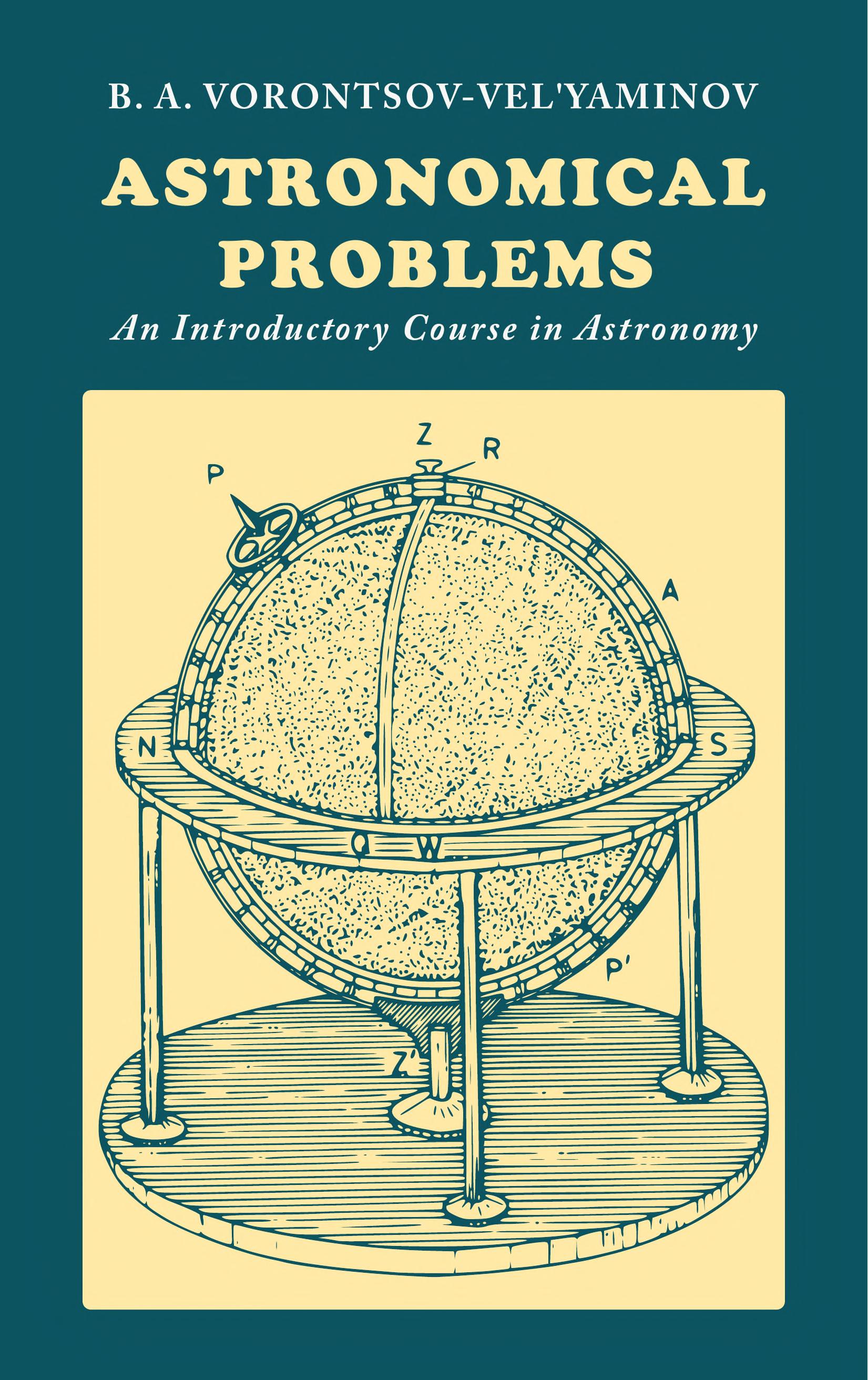
AN IMPORTANT part in the teaching of any technical subject, in higher educational establishments as well as schools, is experience in the solution of problems. As well as providing practice in the methods of computation, it enables the teacher to follow the students’ progress both in comprehension and application of theory. The literature of astronomy is badly lacking in this respect, both in quantity and range of topics; and in fact the author is aware of the existence of only one textbook devoted to exercises in astronomy. This is “Astronomical Problems” ( Astronomicheskii zadachi), a textbook for young people by Professor N. P. Kamenschikov, published in 1923.
This textbook is intended for use in universities, teachers’ training colleges, and in school college preparatory or sixth forms. The syllabus covered by all three types of institution is much the same, the differences lying in the depth rather than the field of learning. For this reason the material in each chapter is
divided into two sections. The first section is elementary. The second section is more difficult, set approximately at the level of the teachers’ training colleges.In each section the problems are grouped into sub-topics, and set in order of increasing difficulty. In every chapter the problems are preceded by a summary of the theory and the formulae to be exercised, under headings I and II, applying to sections I and II, respectively. Problems are presented, requiring both exact and
approximate solutions, so that on occasion the same data may be repeated with varying degrees of accuracy.We have presented two, and exceptionally three, examples of the most typical problems, so that the teacher may use one or more for demonstration, leaving a similar exercise for the student. However, the author realizes that students become frustrated if presented with the same problem, under different formulations (e.g. Nos. 29 and 30), and the teacher is asked to note that this occurs in a number of places in the book.
In the preparation of this book, the author used the books referred to in the first Russian Edition of this work. As many of the problems are unoriginal, or “natural”, the source of a problem is given only in those cases where the problem seemed unusual. Many of the problems and exercises were devised by the
author, but only about 300 of these (marked with an asterisk*) appear to be unique in the literature. Ninety per cent of the problems borrowed by the author were originally published without answers.
The book was translated from Russian by P. M. Rabbitt, and was published in 1969.
Credits to the original uploader.
You can get the book here.
Follow us on The Internet Archive: https://archive.org/details/@mirtitles
Follow Us On Twitter: https://twitter.com/MirTitles
Write to us: mirtitles@gmail.com
Fork us at GitLab: https://gitlab.com/mirtitles/
Add new entries to the detailed book catalog here.
Preface vii
Introduction: How to Solve Astronomical Problems ix
Chapter 1 Interpolation 1
Chapter 2 The Celestial Sphere 7
Chapter 3 Systems of Celestial Coordinates 12
Chapter 4 Culmination, The Determination of Geographical Latitude And Coordinates of Celestial Bodies 27
Chapter 5 Refraction 36
Chapter 6 The Apparent Motion of The Sun 40
Chapter 7 The Determination of Time and Longitude 44
Chapter 8 The Calendar 60
Chapter 9 The Rising and Setting of a Heavenly Body 64
Chapter 10 Precession 71
Chapter 11 Problems Solved With The Help of Celestial Globe 75
Chapter 12 Planetary Movement 81
Chapter 13 Parallax and Aberration 101
Chapter 14 The Earth 110
Chapter 15 The Movement and Phases of The Moon 123
Chapter 16 Eclipses 129
Chapter 17 Gravitation 136
Chapter 18 Astronomical Instruments and Methods 149
Chapter 19 The Moon 161
Chapter 20 The Planets 164
Chapter 21 Comets 171
Chapter 22 Meteors and Meteorites 178
Chapter 23 The Sun 186
Chapter 24 The Movements and The Nature of Stars 195
Chapter 25 Double Stars 213
Chapter 26 Variable Stars and Novae 225
Chapter 27 The Structure of the Universe 234
Chapter 28 Miscellaneous Problems 239
Answers and Solutions 247
Appendix 295
In this post, we will see the book Theory of Shock Waves and Introduction to Gas Dynamics Ya. B. Zeldovich.

Gas dynamics is defined as the science of motion at great pressure differentials and high velocities, velocity being measured in terms of the speed of sound. The book confines itself to specific phenomena of gas dynamics, i.e., those which have nc analogies in the mechanics of an incompressible liquid. Emphasis is placed on careful definition of the fundamentals of gas dynamics, fundamental laws, and methods of solving simplest problems, rather than an the computational methods
of gas dynamics or methods of numerical integration of complex two- and three-dimensional flows, etc. Attention is devoted to problems of flow around bodies moving at great speeds, motion of a gas in ducts such as nozzles and pipes, aid compressibility of the moving medium. The second main topic is shock waves considered under the theory of shock waves, shock wave laws, and the problem of the destructive effect of explosions and propagation of the explosion on the explosive substance (capable of chemical reaction). The author intends the text to also serve as an introduction to the theory of explosions.
The book was translated from Russian and was published in 1946.
Credits to the original uploader.
You can get the book here.
Follow us on The Internet Archive: https://archive.org/details/@mirtitles
Follow Us On Twitter: https://twitter.com/MirTitles
Write to us: mirtitles@gmail.com
Fork us at GitLab: https://gitlab.com/mirtitles/
Add new entries to the detailed book catalog here.
Introduction 1
Chapter 1
Gas Dynamics Equations 6
Appendix 10
Chapter 2
Principles of Acoustics. The Speed of Sound 16
Chapter 3
Gas Flow Through Nozzles 36
Chapter 4
Properties of Supersonic Jets 47
Chapter 5
Gas Flow in a Long Cylindrical Pipe 53
Chapter 6
Motion that Depends or the Relation Between Coordinates and Time 62
Chapter 7
Theory of Shock Waves. Introduction 74
Chapter 8
Hugoniot’s Adiabatic Curve. Its Derivation From the Equations of
Conservation 76
Chapter 9
Properties of Hugoniot’s Adiabatic Curve. Shock Waves in Air and
Water 82
Chapter 10
The History of the Shock Wave Problem 90
Chapter 11.
Graphical Methods of Shock Wave Theory. Waves Near a
Critical Point 95
Chapter 12
Structure of Shock Wave Front 107
Chapter 13
Propagation of Shock Waves in a Gas with Delayed Excitation of
internal Degree of Freedom 114
Chapter 14
Formation of Shock Waves 119
Chapter 15
Shock Waves in the Case of Oscillations of Large Amplitude 127
Chapter 16
Propagation of an Arbitrary Discontinuity 131
Chapter 17 .
Supersonic Flow Around a Body 144
Chapter 18
Theory of Jet Propulsion 153
Chapter 19
Reflection of a Shock Wave 166
Chapter 20
The Effect of Explosives. Introduction 171
Chapter 21
Simulation of an Explosion area of the Propagation of Blast Waves 176
Chapter 22
Simulation and Similarity of Destructions Caused by Shock Waves 184
Chapter 23
Phenomena Occurring in the Immediate Vicinity of the Charge 189
Chapter 24
Laws Governing the Propagation of a Shock Wave at a Great Distance from the Charge 200

