Mathematical Problems And Puzzles from the Polish Mathematical Olympiads (Popular Lectures in Mathematics Vol 10) – Straszewicz

In this post, we will see the book Mathematical Problems And Puzzles from the Polish Mathematical Olympiads by S. Straszewicz. This book is volume 10 of Popular Lectures in Mathematics series.

About the book

THIS book is a translation of the second Polish edition, published in 1960, in which various improvements were made.

The problems set at the contests require only a knowledge of school mathematics (i.e. elementary algebra, geometry and trigonometry) but are on the whole more difficult than the usual school exercises. Their degree of difficulty, however, is not uniform, for it is considered desirable that not only the most gifted pupils but also those of average ability should —with a certain effort— manage to solve some of the problems and gain a number of points at the contests.

This book contains the problems set at the first five Olympiads. It has been prepared in order to provide secondary school pupils with suitable topics to be worked out on their own, individually or collectively. It aims at extending their knowledge of mathematics and training them in mathematical thinking. Accordingly, the solutions of most of the problems have been given in an extended form, the readers’ attention being drawn to various details of the reasoning. In addition, several problems have been provided with commentaries containing generalizations or further development of the topics in question, including various supplementary data of elementary mathematics outside the scope of the school syllabus.

The book was translated from Polish by J. SMÓLSKA by was published in 1965.

Credits to original uploader.

You can get the book here.

Follow us on The Internet Archive: https://archive.org/details/@mirtitles

Follow Us On Twitter: https://twitter.com/MirTitles

Write to us: mirtitles@gmail.com

Fork us at GitLab: https://gitlab.com/mirtitles/

Add new entries to the detailed book catalog here.

Contents

PART I ARITHMETIC AND ALGEBRA  2

PROBLEMS 3

SOLUTIONS 10


PART 2 GEOMETRY AND TRIGONOMETRY 112

PROBLEMS 113

SOLUTIONS 123


Posted in books, mathematics, popular lectures in mathematics | Tagged , , , , , , , , , , , , , , , , , , , , , , , | 2 Comments

One Hundred Problems In Elementary Mathematics (Popular Lectures in Mathematics Vol. 7)- Steinhaus

In this post, we will see the book One Hundred Problems In Elementary Mathematics by Hugo Steinhaus. his book is volume 7 of Popular Lectures in Mathematics series.

About the book

This booklet is an answer to a challenge: a few years after the war the inadequacy of mathematical education in our high schools became evident to the staffs of universities and technological institutes. Some responsible people felt that a closer collaboration between mathematicians and school teachers could no longer be postponed. A few scientists were among those who did their best to stimulate interest in mathematics by means of elementary problems published in an educational journal. Here the reader will find one hundred elementary problems and their solutions. Some of them are familiar to students in high schools, but it was by no means my intention to provide the teacher with questions he could find in every textbook.

The book was translated from Polish and published in 1964.

Credits to original uploader.

You can get the book here.

Follow us on The Internet Archive: https://archive.org/details/@mirtitles

Follow Us On Twitter: https://twitter.com/MirTitles

Write to us: mirtitles@gmail.com

Fork us at GitLab: https://gitlab.com/mirtitles/

Add new entries to the detailed book catalog here.

Contents

Foreword
Preface

Chapter I PROBLEMS ON NUMBERS, EQUATIONS AND INEQUALITIES

Problem Solution

1. Exercise on the multiplication table 11 55
2. An interesting property of numbers 11 55
3. Division by 12 58
4. The divisibility of numbers 12 59
5. A simplified form of Fermat’s theorem 12 60
6. Distribution of numbers 12 61
7. Generalization 13 61
8. Proportions 13 65
9. Irrationality of the root 13 65
10: Inequality 13 65
11. A sequence of numbers 13 67

Chapter II PROBLEMS ON POINTS, POLYGONS, CIRCLES AND ELLIPSES

12. Points in a plane 14 68
13. Examination of an angle 14 69
14. Area of a triangle 14 69
15. Triple halving of the perimeter of a triangle 15 70
16. Division of a triangle 15 75
17. Triangles 15 77
18. Triangular network 15 77
19. Triangular network 16 78
20. What is left from a rectangle? 16 79
21. Division of a square 16 81
22. Square network 16 83
23. Lattice points 17 84
24. Lattice points inside a circle 17 84
25. 14 = 15 17 85
26. Polygon 17 85
27. Points and a circle 18 86
28. Geometrical problem 18 87

Chapter III PROBLEMS ON SPACE, POLYHEDRA AND SPHERES

29. Division of space 19 89
30. Two projections 19 89
31. Cube 19 90
32. Geodesics 20 92
33. Motion of a particle 20 95
34. Diagrams of the cube 20 96
35. Cubes 21 96
36. Hexahedron 21 98
34. Tetrahedra 21 98
38. Tetrahedron with congruent faces 21 99
39. Octahedron 21 101
40. Distance on a surface 21 103
4l. The wandering of a fly 22 104
42. Regular dodecahedron 22 105
43. Polyhedron 22 108
44. Non-convex polyhedron 23 109
45. Problem from Wonderland 23 110
46. Three spheres and a line 24 113
47. A property of the sphere 24 113

Chapter IV PRACTICAL AND NON-PRACTICAL PROBLEMS

48. Puzzle 25 115
49. Picnic ham 25 115
50. Quartering of a pie 26 116
51. Another pie 26 117
52. Weighings 26 118
55. Calibration of rollers 27 121
56. 120 ball-bearings 28 121
57. Ribbon on the roll 28 122
58. Watch with both hands identical 28 123
59. Problems of giants and midgets 29 125
60. Acks and backs 29 127
61. Statistics 30 127
62. Blood groups 31 128
63. Blood groups again 32 129
64. Excess of labour 32 130
65. Diagonal of a wooden block 32 133
66. The tying of boxes 33 133
67. A primitive device 33 134
68. The minimal length 33 136
69. Division of plots 34 136
70. A practical problem 34 143
71. Neighbouring towns 35 144
72. Railway lines (I) 35 145
73. Railway lines (II) 35 146
74. Test Flight 35 149
75. Sun and Moon 36 150
76. Cosmography 36 150

Chapter V PROBLEMS ON CHESS, VOLLEYBALL AND PURSUIT

77. Chessboard 37 153
78. Chessboard revisited 37 153
79. Rooks on the chessboard 37 157
80. Elliptical billiards 38 161
81. A sports problem (I) 38 162
82. A sports problem (II) 38 162
83. Theory of sport eliminations 38 163
84. Volleyball league 39 164
85. Tournaments 39 165
86. Bicyclist and walkers 40 165
87. Four dogs 40 166
88. Chase (I) 41 166
89. Chase (II) 41 167
90. Incomplete data 41 168
91. Motorboat (I) 41 168
92. Motorboat (II) 42 169

Chapter VI MATHEMATICAL ADVENTURES OF DR. ABRACADABRUS

93. The strange number 43 171
94. The tailor’s tape 43 171
95. Word quiz 43 171
96. Student debts 44 172
97. A strange social set 44 172
98. ABACUS 44 173
99. Washing the streets 45 174
100. French cities 45 174


Chapter VII PROBLEMS WITHOUT SOLUTION

Plus and minus 47
Triangle in a triangle 48
Parts of a square 48
Division of a circle 49
Radii in space 49
Unlimited chessboard 49
The abacus again 49
Tins in a drawer 50
Bacilli 50
The circus is coming 50
Three Cowboys 51
Investigation 51
Arrows on a dodecahedron 52


Posted in books, mathematics | Tagged , , , , , , , , , , , , , , , , , , , , | 2 Comments

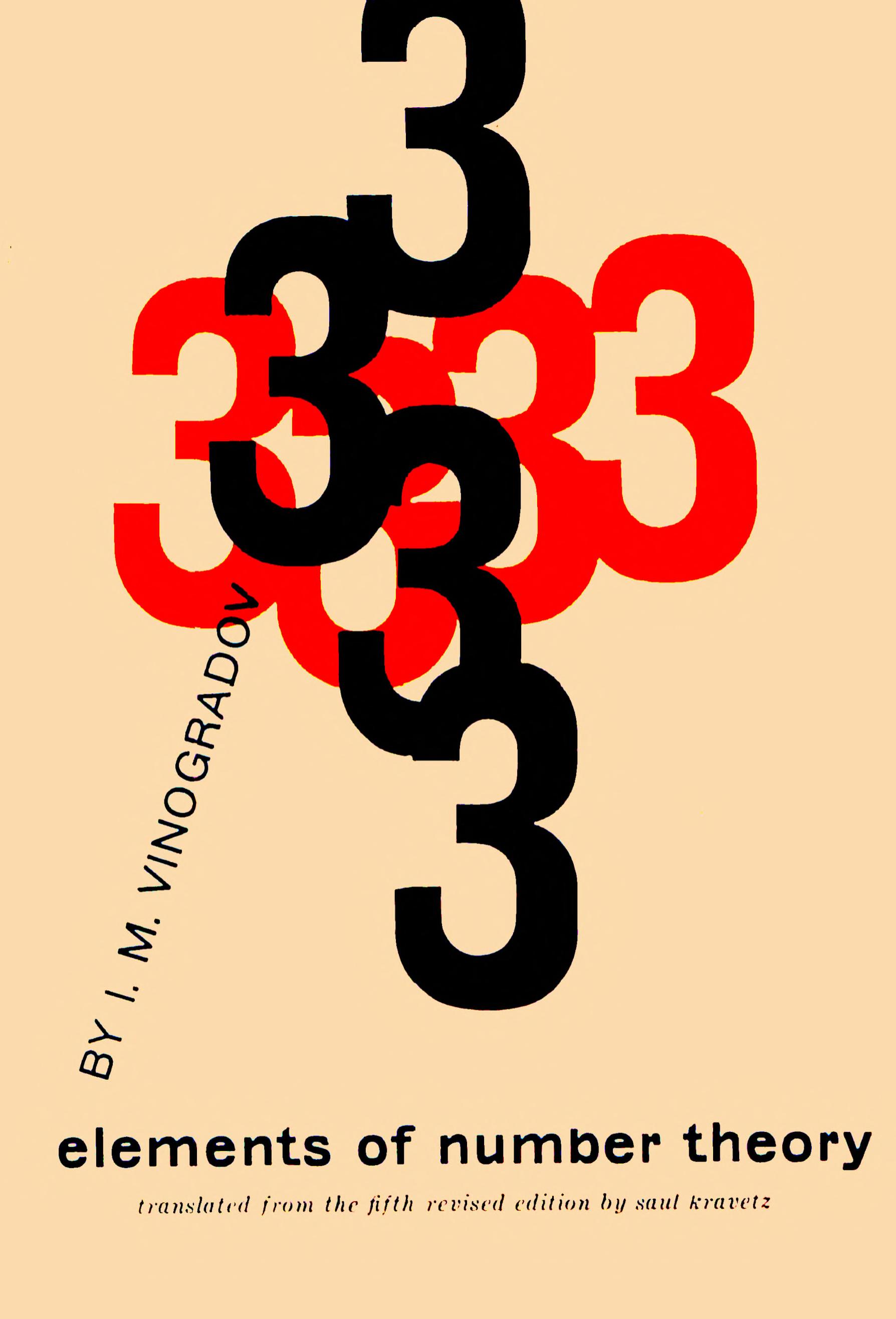
Elements of Number Theory – Vinogradov

In this post, we will see the book Elements Of Number Theory by I. M. Vinogradov.

About the book (from the author)

In my book I present a systematic exposition of the funda­ mentals of number theory within the scope of a university course. A large collection of problems introduces the reader to some of the new ideas in number theory.
This fifth edition of my book differs considerably from the fourth. A series of changes, allowing a simpler exposition, have been made in all the chapters of the book. The most important changes are the merging of the old chapters IV and V into one chapter IV (reducing the number of chapters to six) and the new, simpler proof of the existence of primitive roots.
The problems at the end of each chapter have been essentially revised. The order of the problems is now in complete correspondence with the order of the presentation of the theoretical material. Some new problems have been added; but the number of numbered problems has been substantially reduced. This was accomplished by the unification, under the letters a, b, c, . . ., of previously separate problems which were related by the method of solution or by content. All the solutions of the problems have been reviewed; in many cases these solutions have been simplified or replaced by better ones. Particularly essential changes have been made in the solutions of the problems relating to the distribution of n-th power residues and non-residues, and primitive roots, as well as in the estimations of the corresponding trigonometric sums.

The book was translated from Russian by Saul Kravetz was published in 1954.

Credits to original uploader.

You can get the book here.

Follow us on The Internet Archive: https://archive.org/details/@mirtitles

Follow Us On Twitter: https://twitter.com/MirTitles

Write to us: mirtitles@gmail.com

Fork us at GitLab: https://gitlab.com/mirtitles/

Add new entries to the detailed book catalog here.

Contents

Preface vii

Chapter I DIVISIBILITY THEORY

§1. Basic Concepts and Theorems (1).
§2. The Greatest Common Divisor (2).
§3. The Least Common Multiple (7).
§4. The Relation of Euclid’s Algorithm to Continued Fractions (8). §5. Prime Numbers (14).
§6. The Unicity of Prime Decomposition (15),
Problems for Chapter I (17).
Numerical Exercises for Chapter I (20).

Chapter II IMPORTANT NUMBER-THEORETICAL FUNCTIONS

§1. The Function’s {x},x (21).
§2. Sums Extended over the Divisors of a Number (22),
§3. The Mdbius Function (24).
§4, The Euler Function (26).
Problems for Chapter II (28).
Numerical Exercises for Chapter II (40).

Chapter III. CONGRUENCES

§1. Basic Concepts (41).
§2. Properties of Congruences Similar to those of Equations (42). §3. Further Properties of Congruences (44).
§4. Complete Systems of Residues (45).
§5. Reduced Systems of Residues (47).
§6. The Theorems of Euler and Fermat (48).
Problems for Chapter III (49).
Numerical Exercises for Chapter III (58).

Chapter IV CONGRUENCES IN ONE UNKNOWN

§1. Basic Concepts (59).
§2. Congruences of the First Degree (60).
§3. Systems of Congruences of the First Degree (63).
§4. Congruences of Arbitrary Degree with Prime Modulus (65).
§5. Congruences of Arbitrary Degree with Composite Modulus (66). Problems for Chapter IV (71).
Numerical Exercises for Chapter IV (77).

Chapter V CONGRUENCES OF SECOND DEGREE

§1. General Theorems (79).
§2. The Legendre Symbol (81).
§3. The Jacobi Symbol (87).
§4. The Case of Composite
Moduli (91).
Problems for Chapter V (95).
Numerical Exercises for Chapter V (103).

Chapter VI PRIMITIVE ROOTS AND INDICES

§1. General Theorems (105).
§2. Primitive Roots Modulo p* and 2p* (106).
§3. Evaluation of Primitive Roots for the Moduli p* and 2p* (108). §4. Indices for the Moduli p and 2p* (110).
§5. Consequences of the Preceding Theory (113).
§6. Indices Modulo 2% (116).
§7. Indices for Arbitrary Composite Modulus (119).
Problems for Chapter VI (121).
Numerical Exercises for Chapter VI (130).

SOLUTIONS OF THE PROBLEMS

Solutions for Chapter I (133).
Solutions for Chapter II (139).
Solutions for Chapter III (161).
Solutions for Chapter IV (178).
Solutions for Chapter V (187).
Solutions for Chapter VI (202).

ANSWERS TO THE NUMERICAL EXERCISES

Answers for Chapter I (217).
Answers for Chapter II (217).
Answers for Chapter III (218).
Answers for Chapter IV (218).
Answers for Chapter V (218).
Answers for Chapter VI (219).

TABLES OF INDICES 220

TABLES OF PRIMES <4000 AND THEIR LEAST PRIMITIVE 226

Posted in books, mathematics, soviet | Tagged , , , , , , , , , , , , , , , , | 1 Comment

Ukrainian Folk Tales

In this post, we will see the book Ukrainian Folk Tales.

About the book

This book is a collection of various folk tales from Ukraine. The folk tales have many magical object and animals. The book is beautifully illustrated.

The book was translated by Anatole Bilenko and edited by Olga Shartse. The book was illustrated and designed by Roman Adamovich. The book was published in 1974 by Dnipro Publishers.

Credits to original uploader.

You can get the book here.

Follow us on The Internet Archive: https://archive.org/details/@mirtitles

Follow Us On Twitter: https://twitter.com/MirTitles

Write to us: mirtitles@gmail.com

Fork us at GitLab: https://gitlab.com/mirtitles/

Add new entries to the detailed book catalog here.

Contents

PAN KOTSKY THE PUSS-0-CAT 7
FOXY-LOXY AND PALSY-WOLFIE 10
THE GOAT AND THE RAM 16
KOLOBOK THE JOHNNYCAKE 18
KOTHIROSHKO ROLLIPEA OH 32
THE WHEAT-EAR 42
THE MAGIC EGG 44
ILYA MUROMETS AND NIGHTINGALE THE ROBBER 55
THE LITTLE SHEPHERD 63
BORIS SON O’THREE 66
THE GOLEEN SLIPPER 75
THE POOR MAN AND THE RAVEN CZAR 81
THE POOR MAN AND HIS SONS 88
THE POOR LAD AND oan MERCHANT MARKO 94
DANILO WHO HAD NO LUCK 100
A TALE ABOUT THE LITTLE LINDEN TREE AND THE GREEDY OLD WOMAN 108
A TALE ABOUT THE STOLEN POSTOLI AND THE BOILED EGGS 110
MISERY 114
THE FARM 117

Posted in books, children's books, children's stories, dnipro, folk tales, soviet | Tagged , , , , , , , | Leave a comment

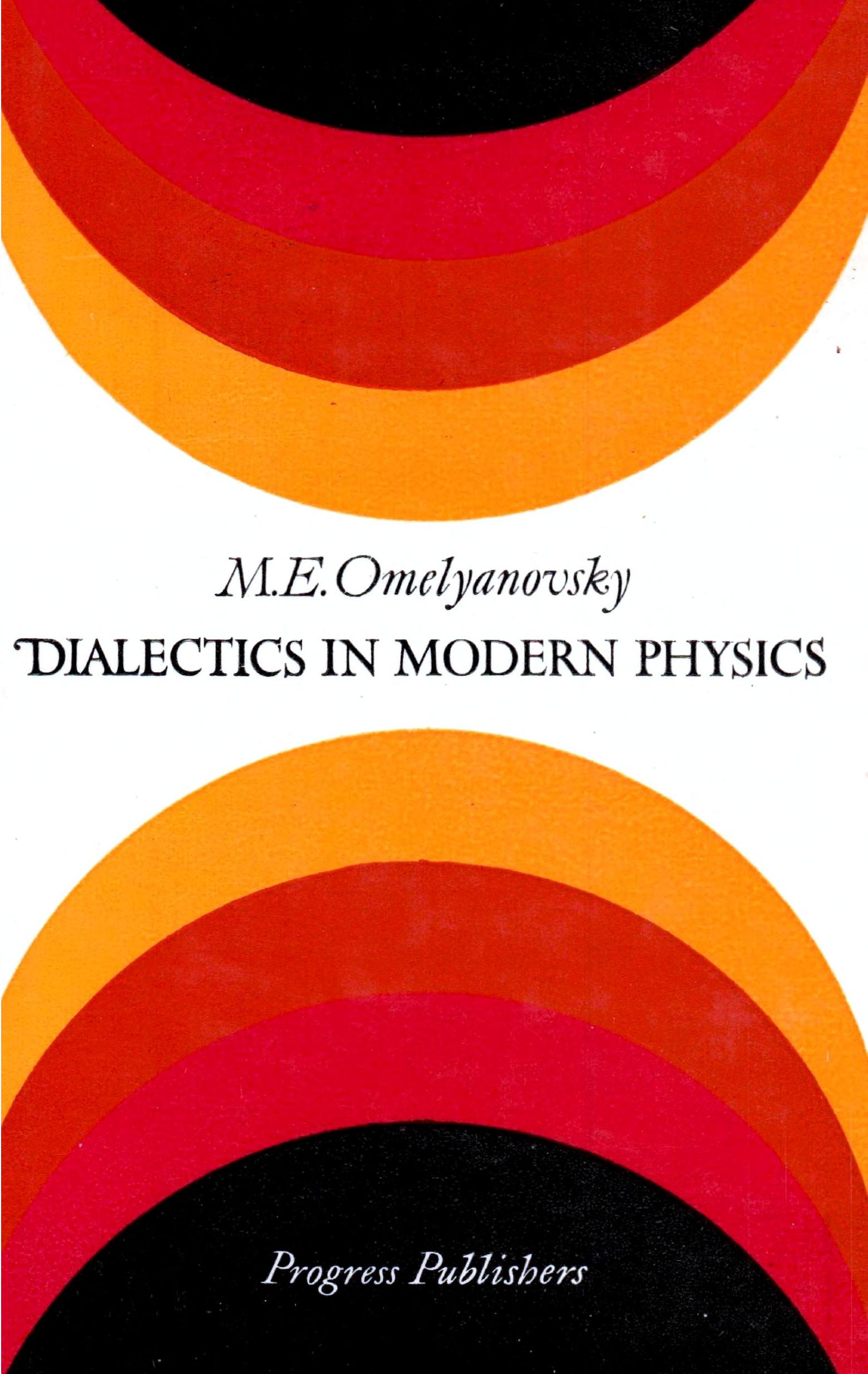
Dialectics In Modern Physics – Omelyanovsky

In this post, we will see the book Dialectics In Modern Physics by M. E. Omelyanovsky.

About the book

This monograph brings together into a unified whole the ideas and problems that have been considered in many of my published works (articles in Voprosy filosofii and papers in collective works devoted to the philosophical problems of science, published in Russian, for instance, in the series Dialectical Materialism and Modern Science. Most of the problems or the aspects of them that are treated here have been discussed in my earlier work, but the present book con­tains new material, additions, and more precise definitions, and also a number of new conclusions. I have been especially
interested to show that dialectics and its very important requirement of applying the all-round universal flexibility of concepts objectively is the logic of modern science.

The basic substance of the book (as its title says) is Marx­ist-Leninist dialectics in modern physics. Dialectics is not a formal mental construction but rather a living method of cognising nature and of searching for new truths in modern science, and in physics in particular, as far as this book is concerned.

The book was translated from Russian by H.C. Creighton and was designed by Vladimir Yeremin. The book was published in 1979 by Progress Publishers.

Credits to original uploader.

You can get the book here.

Follow us on The Internet Archive: https://archive.org/details/@mirtitles

Follow Us On Twitter: https://twitter.com/MirTitles

Write to us: mirtitles@gmail.com

Fork us at GitLab: https://gitlab.com/mirtitles/

Add new entries to the detailed book catalog here.

Contents

PREFACE TO THE ENGLISH EDITION 5
PREFACE TO THE RUSSIAN EDITION 6

Chapter I. DIALECTICAL MATERIALISM IN MODERN PHYSICS 9

Chapter II. THE PROBLEM OF OBJECTIVE REALITY IN QUANTUM THEORY 27

1. The Methodological Significance of the Idea of Objective Reality in Physics 27
2. Observation, Complementarity, and Dialectics 39
3. The Philosophical Evolution of the Copenhagen School 49
4. Physical Reality 63

Chapter III. CAN WE FORM MENTAL PICTURES OF THE CONCEPTS AND THEORIES OF MODERN PHYSICS 78

Chapter IV. THE PRINCIPLE OF OBSERVABILITY IN MODERN PHYSICS 95

1. Formulation of the Question. The Significance or Meaning of ‘Observability 95
2. What Is an Observable (or a Non-observable)? 100
3. The Heuristic Role of the Observability Principle 107

Chapter V. DIALECTICAL CONTRADICTORINESS IN MODERN PHYSICS 119

1. Introductory Remarks 119
2. The Theory of Relativity and Dialectical Contradiction 123
3. Dialectical Contradiction and Quantum Theory 130

Chapter VI. DETERMINISM IN QUANTUM THEORY 142

1. The Objective Reality and Determinacy of Phenomena 142
2. On the Relationship Between Determinism and the Principle of Causality in Physics 148
3. Statistical Laws and Determinism 157
4. Statistical Laws, Determinism, and the Uncertainty Principle 163
5. The Concepts of ‘Actuality and Possibility in Classical Physics 171
6. The Concepts of Reality and Possibility in Quantum Physics 179
7. A Contribution to the Problem of Causality in Non-local Quantum Field Theory 189

Chapter VII. THE PROBLEM OF THE ELEMENTARY AND THE COMPLEX IN QUANTUM PHYSICS 197

4. On the Concepts of the Simple and the Complex in Philosophy and Physics 197
2. Classical Science on the Elementary and the Complex 204
3. The Problem of Simplicity in Microscopic Physics 209
4. The Concept of the Elementary and Structure in the Physics or Elementary Particles 215
5. The Elementary Particle of Matter and the Universe 222

Chapter VIII. QUANTUM PHYSICS AND THE TRANSFORMABILITY OF FUNDAMENTAL PARTICLES. THE ABSOLUTE AND THE RELATIVE 231

1. The Transformability of Elementary Particles 231
2. On the Absolute and the Relative in the Modern Physics 248

Chapter IX. PHILOSOPHICAL ASPECTS OF THE THEORY OF MENSURATION 256

1. Preliminary Remarks 256
2. The Concept of Measurement. Direct Measurement 259
3. Standards and Units 265
4. Sensory Perception and Abstract Thought in Mensuration 270
5. Laws of Nature and Measurement. Indirect Measurement 276
6. The Concept of Measurement in Quantum Mechanics 289
7. On the Interaction of the Atomic Objects, and Measuring Instruments 303

Chapter X. AXIOMATICS AND THE SEARCH FOR PRINCIPLES AND FUNDAMENTAL CONCEPTS IN PHYSICS 320

1. The Axiomatic Approach to Physical Research 320
2. Perun Aspects and Functions of the Axiomatic Method 335
3. On the Axiomatics of Contemporary Physical Theories 347

IN LIEU OF A CONCLUSION 370


Posted in books, philosophy, physics, progress publishers, soviet | Tagged , , , , , , , , , , , , , , , | Leave a comment

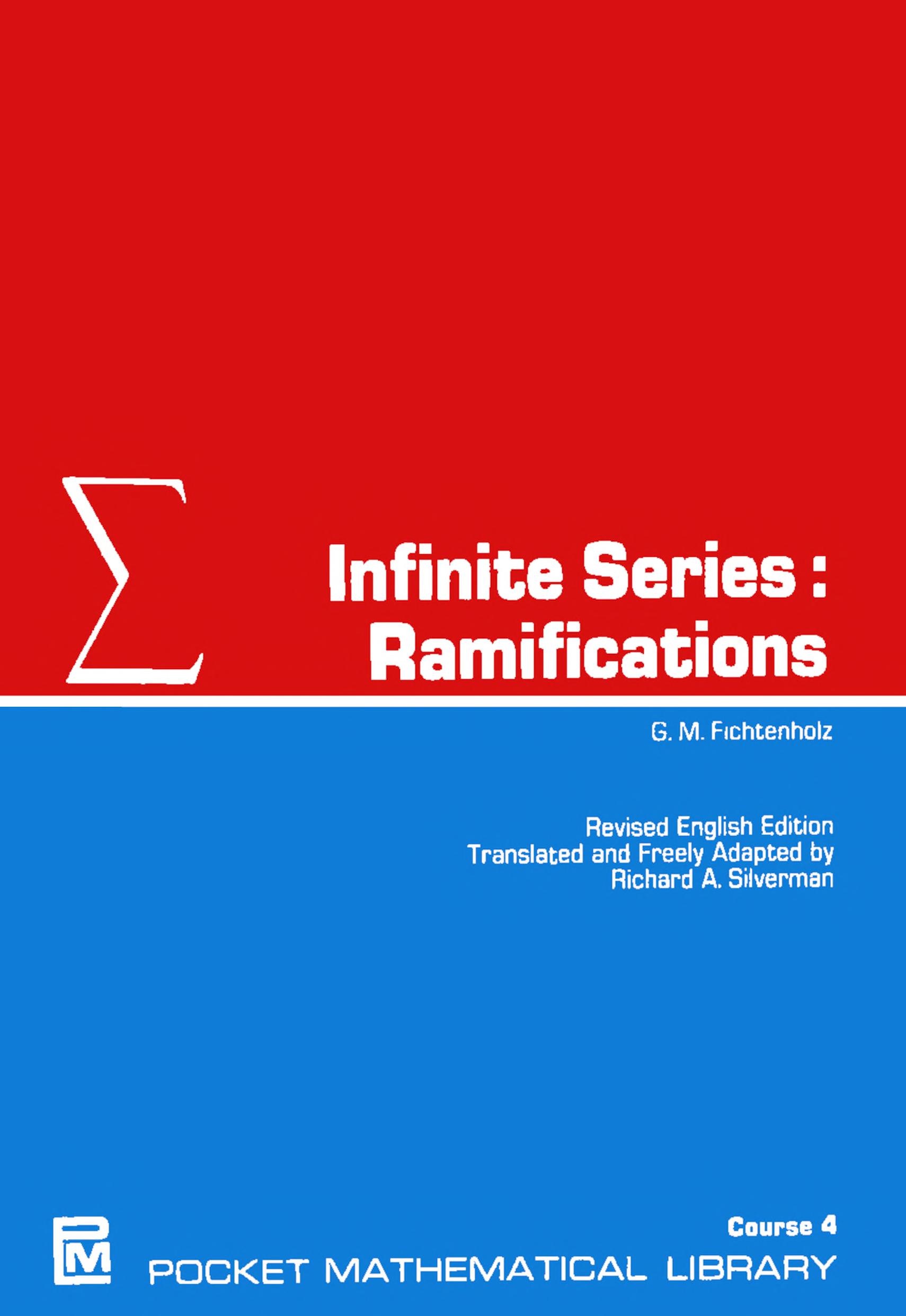
Infinite Series Ramifications (Pocket Mathematical Library Course 4) – Fichtenholz

In this post, we will see the book Infinite Series Ramifications by G. M. Fichtenholz. This book is the Course 4 of  the Pocket Mathematical Library series.

About the book

The present volume of The Pocket Mathematical Library continues the study of infinite series begun in its companion volume Infinite Series: Rudiments, by the same author. Together the two volumes give a detailed treatment of the theory of numerical series, i.e., infinite series whose terms are numbers. The picture is then completed by a third volume, entitled Functional Series, which, as its name implies, is devoted to the study of infinite series whose terms are functions. The set of three volumes makes up a comprehensive treatise on all aspects of a key topic of pure and applied mathematics.
As in the companion volume, the problems appearing at the end of each section constitute an important part of the course, and should not be neglected by the serious student.

The book was translated from Russian by Richard Silverman and was published in 1970.

Credits to original uploader.

You can get the book here.

Follow us on The Internet Archive: https://archive.org/details/@mirtitles

Follow Us On Twitter: https://twitter.com/MirTitles

Write to us: mirtitles@gmail.com

Fork us at GitLab: https://gitlab.com/mirtitles/

Add new entries to the detailed book catalog here.

Contents

Chapter 1. Operations on Series 1

l. Associativity of Convergent Series 1
2. Commutativity of Absolutely Convergent Series 5
3. Riemann’s Theorem 7
4. Multiplication of Series 13
5. Toeplitz’s Theorem 21
6. The Theorems of Mertens and Abel 26

Chapter 2. Iterated and Double Series 30

7. Iterated Series 30
8. Double Series 35
9. Examples 43
10. Power Series in Two Variables 54

Chapter 3. Computations Involving Series 61

11. General Remarks 61
12. Examples 63
13. Euler’s Transformation 70
14. The Transformations of Kummer and Markov 78

Chapter 4. Summation of Divergent Series 87

15. Introduction 87
16. The Method of Power Series 90
17. The Method of Arithmetic Means 98
18. Application of Generalized Summation to Multiplication of Series 110
19. Other Methods of Generalized Summation 113
20. The Methods of Borel and Euler 121

Index 129


Posted in books, mathematics | Tagged , , , , , , , , , , , , , , , , | 2 Comments

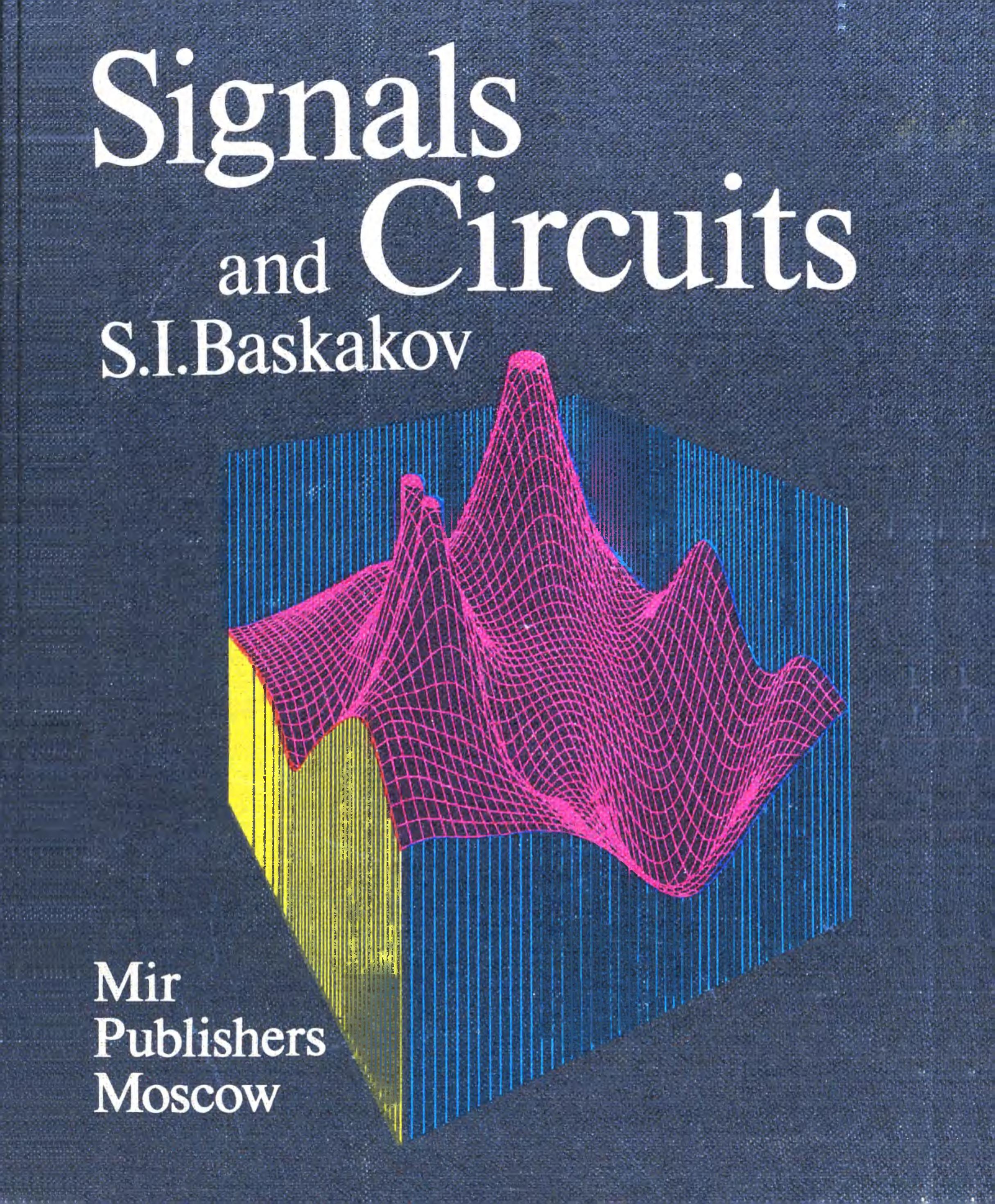
Signals and Circuits – Baskakov

In this post, we will see the book Signals And Circuits by S. I. Baskakov.

About the book

The present book is a course on signals and circuits as it is taught in the USSR. This subject figures prominently among the fundamental disciplines essential to the expertise of communication engineers. Keeping pace with overall progress in science and technology and reflecting the current trends in component design and theory, this course combines and sets forth in a systematic way the most important principles in the field of communications.
In his work on the text, the author has been guided by the idea that material should be specifically tailored to the teaching practice at college. This approach has governed the selection of material and the degree of detail in its presentation: its pages contain what, as the author believes, the student can fully assimilate during the time allotted. Specific circuit types, their study and comparative analysis-all this belongs to the specialized subjects in communication engineering.
This text includes a wide variety of material and a wealth of concepts and techniques which will come the student’s way for the first time. Ample space is devoted to mathematical tools of study. To link theory closer to practice, the chapters contain a great number of examples and problems giving the student deeper insight into the techniques of engineering analysis.

The book was translated from Russian by V. Kuznetsov was published in 1986 by Mir Publishers.

Credits to CyNtist for the original upload.

You can get the book here.

Original higher resolution scan here (1+GB pdf).

Follow us on The Internet Archive: https://archive.org/details/@mirtitles

Follow Us On Twitter: https://twitter.com/MirTitles

Write to us: mirtitles@gmail.com

Fork us at GitLab: https://gitlab.com/mirtitles/

Add new entries to the detailed book catalog here.

Contents


Preface

Introduction

Part One. Signals 15

Chapter 1 Elements of the General Theory of Signals 15

Chapter 2 Spectral Representations of Signals 42

Chapter 3 Power Spectra of Signals. Principles of Correlation Analysis 78

Chapter 4 Modulated Signals 103

Chapter 5 Band-Limited Signals 133

Chapter 6 An Outline of the Theory of Random Signals 162

Chapter 7 The Correlation Theory of Random Processes 189

Part Two. Circuits 219

Chapter 8 Response of Linear Stationary Systems to Deterministic Signals 219

Chapter 9 Response of Frequency-Selective Systems to Deterministic Signals 259

Chapter 10 Response of Linear Stationary Networks to Random Signals 290

Chapter 11 Signal Transformations in Nonlinear Circuits 313

Chapter 12 Signal Transformations in Linear Parametric Circuits 345

Chapter 13 A Basic Theory of Linear Circuit Synthesis 380

Chapter 14 Active Networks with Feedback. Self-Excited Oscillatory Systems 409

Chapter 15 Discrete Signals. Principles of Digital Filtering 448

Chapter 16 Optimum Linear Signal Filtering 487

Bibliography 510
Index 512


Posted in books, electronics, engineering, mathematics, physics, soviet, technology | Tagged , , , , , , , , , , , , , , , , , , , , , , , , , | 2 Comments

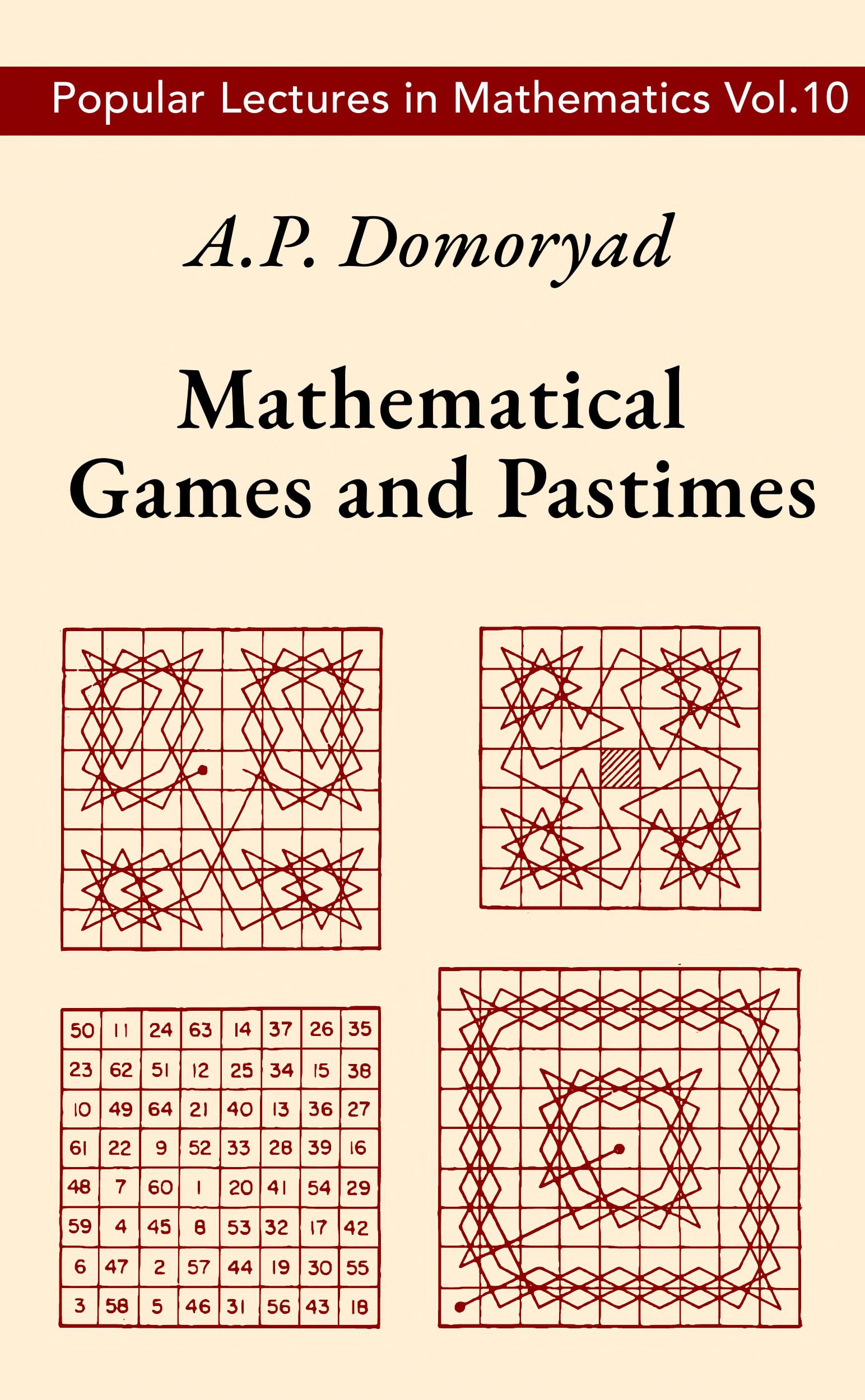
Mathematical Games And Pastimes (Popular Lectures In Mathematics Vol 10)- Domoryad

In this post, we will see the book Mathematical Games And Pastimes (Popular Lectures In Mathematics Vol 10) by A. P. Domoryad.

About the book

The greater part of this book is devoted to classical games. The first few chapters deal with various systems of notation and with certain topics in the theory of numbers, the knowledge of which is necessary for the understanding of the theory of various mathematical games. But for some readers these chapters might be interesting in themselves. The theory of some isolated games is presented fairly fully here; in other cases only results are given; and reference is made to sources, where proof of these results can be found. Side by side with classical pastimes, the book devotes much space also to “contemporary” pastimes quick reckoning, re-cutting of figures, construction of curves, and models of polyhedra. Deserving particular attention are the problems which admit a practically inexhaustible or even infinite number of solutions (“Construction of parquets”, “Construction of pleasing patterns”, etc.).
Here, everybody, by applying persistence and inventiveness, can attempt to obtain interesting results.
Whereas such classical pastimes as, for example, constructing “magic squares” may be enjoyed by a comparatively narrow section of people, the cutting out of, say, symmetrical figures in paper, the construction of pleasing patterns, searching for numerical curiosities, by not requiring any mathematical preparation, might give pleasure to both amateur and professional mathematicians. The same can be said about pastimes requiring knowledge confined to that obtained in the 8th to 10th classes of the secondary school (construction of parquets, of interesting curves and borders, etc.).
In group activities it is possible to arrange competitions in making up original parquets, in the construction of curves and borders, in obtaining attractive symmetrical figures cut out of paper, and so on. Each participant in such competitions can dazzle with his inventiveness, accuracy of execution, or artistry of colouring the figures obtained. Such collective activity can be rounded off by compiling an album or by organizing an exhibition of the best items. Many pastimes and even single problems may suggest to the amateur mathematician themes for independent investigations (the use of knight’s moves instead of the “short” moves of the fook in the “game of 15”, the search for interesting identities — see § 37 —, the generalization of the problem about tourists — problem No. 13 in §37 —and so on). On the whole, this book caters for readers with mathematical knowledge within the limits of the 9th and 10th classes of the secondary school, even though the greatest part of the material is accessible to pupils of the 8th class, and some topics — even to school- children of the 5th and 6th classes. Many chapters can be used by teachers of mathematics for extracurricular activities.
Various categories of readers can use the book in various ways: persons not particularly fond of mathematics can become acquainted with curious properties of numbers or figures, without going into the fundamentals of the games and pastimes, and taking for granted single propositions; amateur mathematicians are advised to study certain parts of the book with pencil and paper, solving the problems given and answering the questions posed. § 38 gives answers to the problems to be found in the text, questions and hints towards their solution and also proofs of certain of the theorems mentioned in the text. References to the appropriate section of § 38 are given in small figures between ordinary brackets.
References to books in which the reader may find a more detailed discussion of the topics touched upon are given by a number enclosed in square brackets. This number refers to the corresponding entry in the bibliography at the end of the book.

The book was translated from Russian by Halina Moss and was published in 1963.

Credits to original uploader.

You can get the book here.

Follow us on The Internet Archive: https://archive.org/details/@mirtitles

Follow Us On Twitter: https://twitter.com/MirTitles

Write to us: mirtitles@gmail.com

Fork us at GitLab: https://gitlab.com/mirtitles/

Add new entries to the detailed book catalog here.

Contents

  1. Various systems of Notations 1
  2. Some facts from the Theory of Numbers 10
  3. Congruences 15
  4. Continued Fractions and Indeterminate Equations 20
  5. Pythagorean and Heronic Triples 31
  6. Arithmetical Pastimes 33
  7. Numerical Tricks 37
  8. Rapid Calculations 45
  9. Numerical Giants 57
  10. Games with Piles of Objects 61
  11. Meleda 71
  12. Lucas’ Game 75
  13. Solitaire 77
  14. The “Game of Fifteen” and Similar Games 79
  15. Problems on determining the Number of ways of reaching a goal 86
  16. Magic Squares 97
  17. Euler Squares 105
  18. Pastimes with Dominoes 107
  19. Problems Connected with Chessboard 109
  20. Making up Timetables 120
  21. The “Problem of Josephus Flavius” and similar ones 124
  22. Pastimes connected with Objects Changing Places 127
  23. Simplest methods of Constructing Pleasing Patterns 136
  24. Regular Polygons from Rhombi 142
  25. The Construction of Figures from Given Parts 145
  26. The Construction of Parquets 149
  27. Re-cutting of Figures 158
  28. The Construction of Curves 166
  29. Mathematical Borders 188
  30. Models of Polyhedra 193
  31. Pastimes with a sheet and strips of paper 202
  32. The Four Colour Problem 207
  33. Drawing Figures at one stroke of the pencil 211
  34. Hamilton’s Game 215
  35. Arranging Points on a Plane and in Space 219
  36. Problems on a Logical Nature 222
  37. Rag-Bag 232
  38. Notes and Answers to Problems 246

Bibliography 297

Posted in books, mathematics, popular lectures in mathematics | Tagged , , , , , , , , , , , , , , , , , , , , , , , , , , , , , , , , , , , , , | Leave a comment

Great Grandmother Universe – Krivin

In this post, we will see the book Great Grandmother Universe by Felix Krivin.

About the book

A little book for children with beautiful illustrations describing several fascinating aspects of astronomy and the universe which we live in.

The book was translated from Russian by Eugene Yankovsky and illustrated by M. Romadin. The book was published in 1982 by Malysh Publishers.

You can get the book here.

Follow us on The Internet Archive: https://archive.org/details/@mirtitles

Follow Us On Twitter: https://twitter.com/MirTitles

Write to us: mirtitles@gmail.com

Fork us at GitLab: https://gitlab.com/mirtitles/

Add new entries to the detailed book catalog here.

Contents

What do we know about Great Grandmother?

What is Our Galaxy?

Why Cannot we walk to the place where Earth and Sky Meet?

Why does not the Sun drown in the Sea?

Can one live on the Sun?

Why does the moon shine at night?

How many stars are there in the sky?

Why are the stars so small?

Where do the stars go in the day?

Can a satellite become a planet?

Who Walks along the Mikly Way?

Posted in astronomy, books, children's books, children's science, picture books, popular science, science, soviet | Tagged , , , , , , , , , , , , , , , , , , | Leave a comment

Space Research Apparatus – Khodarev et al

In this post, we will see the book Space Research Apparatus by Yu. K. Khodarev; L. I. Shatrovskiy; V. V. Andreyanov; B. N. Rodionov; P. Ye. El’yasberg, V. S. Etkin.

About the book

The articles of this collection encompass a broad range of questions associated with theoretical analysis and design of equipment used in conducting space ex­periments. The Information on theoretical analysis of the possible apparatus solutions used to generate information streams aboard spacecraft is covered most completely. The articles on coding methods reflect the urgent necessity for more sophisticated onboard processing of the information obtained. The problems of spacecraft antenna testing, radiometric equipment, and so on are examined.
The volume will be of interest to specialists connected with the design and construction of radio-electronic and radiophysical space equipment.

The book was translated from Russian by SCITRAN under the NASA Technical Translation Programme.

Credits to original uploader.

You can get the book here.

Follow us on The Internet Archive: https://archive.org/details/@mirtitles

Follow Us On Twitter: https://twitter.com/MirTitles

Write to us: mirtitles@gmail.com

Fork us at GitLab: https://gitlab.com/mirtitles/

Add new entries to the detailed book catalog here.

Contents

Y. M. Shtar’kov and V. F. Babkin
Series-Length Coding under a Pricri Uncertainty 1

A. B. Kryukov
Coding cf Discrete Monotonic Functions 14

Yu. M. Shtartkov and V. F. Babkin
Simple Method of Jumbering Binary Sequences with Given Number of Units 24


A. V. Kantor, S. M. Perevertkin and T. 5S. Sheherbakova
Multipurpose Information Collection and Processing Systems 34


A. V. Kanten, T. A. Tolmadzheva
Associative Compressed Information Output Stream Formation by the Statistical Trial Method 43

A. V. Kantor, S. M. Perevertkin and T. S. Shcherbakova
Analytic Study of Output Stream Formation Process in Multipurpose Information Compression Systems 57

L. G. Sapogin and V. G. Sapogin
Dispersion Space Radio Links 68

A. P. Alekseyev, B. A. Prigoda and L. I. Skotnikov
Spacecraft Antenna System Design 93

B. A. Prigoda
Low-Silhouette Spacecraft Antenna Systems 108

A, Ye. Andriyevskiy, A. G. Gorshkov, V. V. Danilov,
Vv. K. Konnikova, A. S. Lobarev, Vv. G. Mirovskly,
V. V. Nikitin, V. I. Portman, Ye. A. Spangenberg,
I. A. Strukov, N. Z. Shvarts and V. S. Yetkin

High-Sensitivity 3.5-cm Modulation-Type Radiometer 105


Yu. A. Nemlikher, I. A. Strukov and L. H. Yudina

If Amplifier Liniting F-.1uency Selection in Super-heterodyne MM- and CM-Band Radiometer 132

V. F. Kolomeytsev, Yu. Yu. Kulikov, A. M. Kupriyanov, I. A. Strakov, L. I. Fedoseyev, Yu. B. Khapin and Vv. S. Yetkin
Study of Schotti:ky Barrier Diode Frequency Converter in the Short Millimeter Wavelength Band 142

Ya. E. Veyber
Influence of Phase Shifter on Frequency Divider Characteristics 148

Ye. A. Vlasov
Comb-Line Bandpass Filters 167

Posted in astronomy, books, electronics, engineering, soviet, space, technology | Tagged , , , , , , , , , , , , | 1 Comment