How to Construct Graphs? – Shilov and Simplest Maxima Minima Problems – Natanson

In this post, we will see a double book How To Construct Graphs by G. E. Shilov And Simplest Maxima And Minima Problems by I. P. Natanson. These two books are part of the Topics in Mathematics series.

About the books

The first part of this booklet. How to Construct Graphs by G. E. Shilov, presents simple methods of plotting graphs, first “by points” and then “by operations.”The latter method offers a means of constructing graphs of complicated functions by considering the function as a succession of operations performed on an initial quantity.
The second part, Simplest Maxima and Minima Problems by I. P. Natanson, shows how to solve certain maxima and minima problems by algebraic methods. This material is excellent prepa­ration for calculus, in which such problems are treated more gen­erally. (In order to relate this part to the preceding one, several paragraphs and Fig. A and Fig. B, not present in the Russian edition, have been added.)
This booklet can be read by anyone who has studied intermedi­ate algebra.

How to Construct Graphs  was translated from Russian by Jerome Kristian and Daniel A. Levine. Simplest Maxima and Minima Problems  was translated from Russian by C. Clark Kissinger and Robert B. Brown. The book was published in 1963.

Credits to original uploader.

You can get the book here.

Follow us on The Internet Archive: https://archive.org/details/@mirtitles

Follow Us On Twitter: https://twitter.com/MirTitles

Write to us: mirtitles@gmail.com

Fork us at GitLab: https://gitlab.com/mirtitles/

Add new entries to the detailed book catalog here.

Contents

HOW TO CONSTRUCT GRAPHS by G. E. Shilov 3

CHAPTER l. Graphs “by Points” 3

1. Introduction 3
2. Coordinate system 3
3. Graph of an equation 4

CHAPTER 2. Graphs “by Operations” 7

4. Graphs of first-degree equations 7
5. Graphs of second-degree equations 8
6. Graphs by multiplication 11
7. Graphs by division 13
8. Summary 18

Exercises and Solutions 20

SIMPLEST MAXIMA AND MINIMA PROBLEMS by I. P. Natanson

Introduction 25

CHAPTER l. The Fundamental Theorem on Quadratic Trinomials 26

1. Parabolas; minimum values 26
2. Quadratic trinomials 27
3. Maximum values 29
4. The Fundamental Theorem 30

CHAPTER 2. Applications 33

5. Applications of the Fundamental Theorem 7 33
6. Applications of Problem 1 38

CHAPTER 3. Further Theorems and Applications 40

7. Theorems derived from Problem 1 40
8. Generalization of Theorem l of section 42
9. Arithmetical applications 47
10. Geometrical applications 48
11. Summary 53

Posted in books, mathematics, soviet, topics in mathematics | Tagged , , , , , , , , , , , , , , , , , , , | Leave a comment

Number Systems – Fomin

In this post, we will see the book Number Systems by S. V. Fomin. This books is a part of the Popular Lectures in Mathematics series.

About the book

The most common language of numbers, the decimal system, has not always been used universally. From a purely mathematical point of view, the decimal system has no inherent advantages over other possible systems; its popularity is due to historical and biological, not mathematical factors. In this book, S. V. Fomin discusses the origin, properties, and applications of various number systems, including the decimal, the binary, and the ternary. His presentation offers the student an introduction to mathematical abstraction and then, through its examples, shows him the abstraction at work.

The book was translated from Russian by Joan. W. Teller and Thomas P. Branson. The book was published in 1974.

Credits to original uploader.

You can get the book here.

Follow us on The Internet Archive: https://archive.org/details/@mirtitles

Follow Us On Twitter: https://twitter.com/MirTitles

Write to us: mirtitles@gmail.com

Fork us at GitLab: https://gitlab.com/mirtitles/

Add new entries to the detailed book catalog here.

Contents

Preface vii

1. Round and Unrounded Numbers 1
2. The Origin of the Decimal Number System 3
3. Other Number Systems and Their Origins 4
4. Positional and Nonpositional Systems 6
5. Arithmetic Operations in Various Number Systems 7
6. Translating Numbers from One System to Another 9
7. Tests for Divisibility 13
8. The Binary System 17
9. The Game of Nim 20
10. The Binary Code and Telegraphy 25
11. The Binary System—A Guardian of Secrets 26
12. A Few Words about Computers 28
13. Why Electronic Machines “Prefer” the Binary System 29
14. One Remarkable Property of the Ternary System 31
15. On Infinite Number Representations 34

Posted in books, history, mathematics, popular lectures in mathematics, soviet | Tagged , , , , , , , , , , , , , , , | Leave a comment

Inversions (Popular Lectures In Mathematics) – Bakel’man

In this post, we will see the book Inversions by I. Ya. Bakel’man. This book is Volume of Popular Lectures In Mathematics series.

About the book

In this book, I. Ya. Bakel’man introduces inversion trans­formations in the Euclidean plane and discusses the interrelationships among more general mathematical concepts. The author begins by defining and giving examples of the concept of a transformation in the Euclidean plane, and then explains the “ point of infinity” and the “ stereographic projection” of the sphere onto the plane. With this preparation, the student is capable of applying the theory of inversions to classical construction problems in the plane.

The author also discusses the theory of pencils of circles, and he uses the acquired techniques in a proof of Ptolemy’s theorem. In the final chapter, the idea of a group is introduced with applications of group theory to geometry. The author demonstrates the group-theoretic basis for the distinction between Euclidean and Lobachevskian geometry.

The book was translated from Russian by Joan A. Teller and Susan Williams and was published in 1974.

Credits to original uploader.

You can get the book here.

Follow us on The Internet Archive: https://archive.org/details/@mirtitles

Follow Us On Twitter: https://twitter.com/MirTitles

Write to us: mirtitles@gmail.com

Fork us at GitLab: https://gitlab.com/mirtitles/

Add new entries to the detailed book catalog here.

Contents

Preface vii

1. Inversions and Pencils of Circles 1

1.1. Elementary Transformations of the Plane 1
1.2. Stereographic Projection: The Point at Infinity of a Plane 6
1.3. Inversions 8
1.4. Properties of Inversions 11
1.5. The Power of a Point with Respect to a Circle: The Radical Axis of Two Circles 19
1.6. Application of Inversions to the Solution of Construction Problems 24
1.7. Pencils of Circles 32
1.8. Structure of an Elliptical Pencil 40
1.9. Structure of a Parabolic Pencil 41
1.10. Structure of a Hyperbolic Pencil 42
1.11. Ptolemy’s Theorem 45

2. Complex Numbers and Inversions 48

2.1. Geometric Representation of Complex Numbers and Operations on Them 48
2.2. Linear Functions of a Complex Variable and Elementary Transformations of the Plane 52
2.3. Linear Fractional Functions of a Complex Variable and Related Pointwise Transformations of the Plane 54

3. Groups of Transformations: Euclidean and Lobachevskian Geometries 58

3.1. The Geometry of a Group of Transformations 58
3.2. Euclidean Geometry 64
3.3. Lobachevskian Geometry 68

Posted in books, mathematics, popular lectures in mathematics, soviet | Tagged , , , , , , , , , | Leave a comment

Vector and Tensor Analysis with Applications – Borisenko, Tarapov

In this post, we will see the book Vector And Tensor Analysis With Applications by A. I. Borisenko; I. E. Tarapov.
About the book

The present book is a freely revised and restyled version of the third edition of the Russian original (Moscow, 1966). As in other volumes of this series, I have not hesitated to introduce a number of pedagogical and mathematical improvements that occurred to me in the course of doing the translation. 1 have also added a brief Bibliography, confined to books in English dealing with approximately the same topics, at about the same level.

The book was translated from Russian by Richard Silverman and was published in 1968.

Credits to original uploader.

You can get the book here.

Follow us on The Internet Archive: https://archive.org/details/@mirtitles

Follow Us On Twitter: https://twitter.com/MirTitles

Write to us: mirtitles@gmail.com

Fork us at GitLab: https://gitlab.com/mirtitles/

Add new entries to the detailed book catalog here.

Contents

Chapter 1 VECTOR ALGEBRA, Page 1.

1.1 Vectors and Scalars, 1.
1.1.1. Free, sliding and bound vectors, 2.

1.2 Operations on Vectors, 3.

1.2.1. Addition of vectors, 3.
1.2.2. Subtraction of vectors, 5.
1.2.3. Projection of a vector onto an axis, 6.
1.2.4. Multiplication of a vector by a scalar, 7.

1.3 Bases and Transformations, 7.
1.3.1. Linear dependence and linear independence of vectors, 7.
1.3.2. Expansion of a vector with respect to other vectors, 8.
1.3.3. Bases and basis vectors, 9.
1.3.4. Direct and inverse transformations of basis vectors, 13.

1.4 Products of Two Vectors, 14.

1.4.1. The scalar product, 14.
1.4.2. The vector product, 16.
1.4.3. Physical examples, 19.

1.5 Products of Three Vectors, 20.

1.5.1. The scalar triple product, 20.
1.5.2. The vector triple product, 21.
1.5.3. “Division” of vectors, 23.

1.6 Reciprocal Bases and Related Topics, 23.
1.6.1. Reciprocal bases, 23.
1.6.2. The summation convention, 26.
1.6.3. Covariant and contravariant components of a vector, 27.
1.6.4. Physical components of a vector, 29.
1.6.5. Relation between covariant and contravariant components, 31.
1.6.6. The case of orthogonal bases, 33.

1.7 Variable Vectors, 35.

1.7.1. Vector functions of a scalar argument, 35.
1.7.2. The derivative of a vector function, 36.
1.7.3. The integral of a vector function, 37.

Solved Problems, 38.
Exercises, 54.

Chapter 2 THE TENSOR CONCEPT, Page 59.

2.1 Preliminary Remarks, 59.
2.2 Zeroth-Order Tensors (Scalars), 60.

2.3 First-Order Tensors (Vectors), 6l.
2.3.1. Examples, 62.

2.4 Second-Order Tensors, 63.

2.4.1. Examples, 64.
2.4.2. The stress tensor, 66.
2.4.3. The moment of inertia tensor, 68.
2.4.4. The deformation tensor, 70.
2.4.5. The rate of deformation tensor, 72.

2.5 Higher-Order Tensors, 76.
2.6 Transformation of Tensors under Rotations about a Coordinate Axis, 77.
2.7 Invariance of Tensor Equations, 81.

2.8 Curvilinear Coordinates, 82.

2.8.1. Coordinate surfaces, 84.
2.8.2. Coordinate curves, 84.
2.8.3. Bases and coordinates axes, 85.
2.8.4. Arc length. Metric coefficients, 86.

2.9 Tensors in Generalized Coordinate Systems, 88.

2.9.1. Covariant, contravariant and mixed components of a tensor, 88.
2.9.2. The tensor character of giz, g™* and g;*, 89.
2.9.3. Higher-order tensors in generalized coordinates, 90.
2.9.4. Physical components of a tensor. The case of orthogonal bases, 90.
2.9.5. Covariant, contravariant and mixed tensors as such, 91.

Solved Problems, 94.
Exercises, 100.

3 TENSOR ALGEBRA, Page 103.

3.1 Addition of Tensors, 103.
3.2 Multiplication of Tensors, 104.
3.3 Contraction of Tensors, 104.

3.4 Symmetry Properties of Tensors, 105.

3.4.1. Symmetric and antisymmetric tensors, 105.
3.4.2. Equivalence of an antisymmetric second-order tensor to an axial vector, 107.

3.5 Reduction of Tensors to Principal Axes, 109,

3.5.1. Statement of the problem, 109.
3.5.2. The two-dimensional case, 110.
3.5.3. The three-dimensional case, 113.
3.5.4. The tensor ellipsoid, 118.

3.6 Invariants of a Tensor, 121.

3.6.1. A test for tensor character, 122.

3.7 Pseudotensors, 122.

3.7.1. Proper and improper transformations, 122.
3.7.2. Definition of a pseudotensor, 124.
3.7.3. The pseudotensors 125.

Solved Problems, 126.
Exercises, 131.

Chapter 4 VECTOR AND TENSOR ANALYSIS: RUDIMENTS, Page 134.

4.1 The Field Concept, 134.

4.1.1. Tensor functions of a scalar argurnent, 134.
4.1.2. Tensor fields, 135.
4.1.3. Line integrals. Circulation, 135.

4.2 The Theorems of Gauss, Green and Stokes, 137.

4.2.1. Gauss’ theorem, 137.
4.2.2. Green’s theorem, 139.
4.2.3. Stokes’ theorem, I41.
4.2.4. Simply and multiply connected regions, 144.

4.3 Scalar Fields, 145.

4.3.1. Level surfaces, 145.
4.3.2. The gradient and the directional derivative 146.
4.3.3. Properties of the gradient. The operator 𝛁149.
4.3.4. Another definition of grad 9, 150.

4.4 Vector Fields, 151.

4.4.1. Trajectories of a vector field, 151.
4.4.2. Flux of a vector field, 152.
4.4.3. Divergence of a vector field, 155,
4.4.4. Physical examples, 157.
4.4.5. Curl of a vector field, 161.
4.4.6. Directional derivative of a vector field, 164.

4.5 Second-Order Tensor Fields, 166.

4.6 The Operator V and RelatedDifferential Operators, 168.
4.6.1. Differential operators in orthogonal curvilinear coordinates, 171.
Solved Problems, 174.
Exercises, 182.

Chapter 5 VECTOR AND TENSOR ANALYSIS: RAMIFICATIONS, Page 185.

5.1 Covariant Differentiation, 185.

5.1.1. Covariant differentiation of vectors, 185.
5.1.2. Christoffel symbols, 187.
5.1.3. Covariant differentiation of tensors, 190.
5.1.4. Ricci’s theorem, 191.
5.1.5. Differential operators in generalized coordinates, 192.

5.2 Integral Theorems, 196.

5.2.1. Theorems related to Gauss’ theorem, 197.
5.2.2. Theorems related to Stokes’ theorem, 198.
5.2.3. Green’s formulas, 201.

5.3 Applications to Fluid Dynamics, 203.

5.3.1. Equations of fluid motion, 203.
5.3.2. The momentum theorem, 208.

5.4 Potential and Irrotational Fields, 211.

5.4.1. Multiple-valued potentials, 213.

5.5 Solenoidal Fields, 216.

5.6 Laplacian Fields, 219.

5.6.1. Harmonic functions, 219.
5.6.2. The Dirichlet and Neumann problems, 222.

5.7 The Fundamental Theorem of Vector Analysis, 223.

5.8 Applications to Electromagnetic Theory, 226.
5.8.1. Maxwell’s equations, 226.
5.8.2. The scalar and vector potentials, 228.
5.8.3. Energy of the electromagnetic field. Poynting’s vector, 230.

Solved Problems, 232.

Exercises 247.

BIBLIOGRAPHY 251.

INDEX 253.


Posted in books, mathematics, physics, soviet | Tagged , , , , , , , , , , , , , , , , , , , , , , , | 2 Comments

Topics in Theory of Surfaces in Elliptic Space – Pogorelov

In this post, we will see the book Topics In Theory Of Surfaces In Elliptic Space by A. V. Pogorelov.

About the book

This book deals with the solution of a number of problems in the theory of surfaces in elliptic space,through consideration of isometric surfaces. The principal method of investigation is comparison of a pair of isometric figures in elliptic space with a pair of isometric figures in a Euclidean space which corresponds geodesically to the elliptic space. This enables us to transpose the main difficulties in the proof to Euclidean space, where they can be overcome by the appropriate theorems.

The book was translated from Russian by Rogey and Royer Inc. and was Richard Sacksteder edited by  published in 1961.

Credits to original uploader.

You can get the book here.

Follow us on The Internet Archive: https://archive.org/details/@mirtitles

Follow Us On Twitter: https://twitter.com/MirTitles

Write to us: mirtitles@gmail.com

Fork us at GitLab: https://gitlab.com/mirtitles/

Add new entries to the detailed book catalog here.

Contents

Chapter I. Elliptic Space 1

1. Four-dimensional vector space 1
2. The concept of elliptic space 5
3. Curves in elliptic space 9
4. Surfaces in elliptic space 14
5. Fundamental equations in the theory of surfaces in elliptic space 18

Chapter II. Convex Bodies and Convex Surfaces in Elliptic Space 23

1. The concept of a convex body 23
2. Convex surfaces in elliptic space 35
3. The deviation of a segment on a convex surface from its semitangent at its initial point 30
4. Manifolds of curvature not less than K.A.D. Aleksandrov’s theorem 34

Chapter III. Transformation of Congruent Figures 41

1. Transformation of congruent figures in elliptic space to congruent figures in Euclidean space 41
2. Transformation of congruent figures in Euclidean space onto congruent figures in elliptic space 45
3. Transformation by infinitesimal motions 49
4. Transformation of straight lines and Planes 53

Chapter IV. Isometric Surfaces 59

1. Transformation of isometric surfaces 59
2. Transformation of locally convex isometric surfaces in elliptic space 63
3. Proof of lemma 1 67
4, Transformation of locally convex isometric surfaces in Euclidean space. 71
5. Proof of lemma 2 74

Chapter V. Infinitesimal Deformations of Surfaces in Elliptic Space 77

1. Pairs of isometric surfaces and infinitesimal deformations 77
2. Transformation of surfaces and their infinitesimal deformations 81
3. Some theorems on infinitesimal deformations of surfaces in elliptic space. 85

Chapter VI. Single-Value Definiteness of General Convex Surfaces in Elliptic Space 89

1. A lemma on rib points on a convex surface 89
2. Transformation of isometric dihedral angles and cones 92
3. Local convexity of the surfaces 𝜙_1 and 𝜙_2 at smooth points 97
4, Convexity and isometry of the surfaces 𝜙_1 and 𝜙_2 101
5. Various theorems on uniqueness of convex surfaces in elliptic space 105

Chapter VIL. Regularity of Convex Surfaces with a Regular Metric 113

1. The deformation equation for surfaces in elliptic space 113
2. Evaluation of the normal curvatures of a regular convex cap in elliptic space 117
3. Convex surfaces of bounded specific curvature in elliptic space 122
4. Proof of the regularity of convex surfaces with a regular metric in elliptic space 125

Bibliography 131


Posted in books, mathematics, soviet | Tagged , , , , , , , , , | 1 Comment

Handbook Of Thermionic Properties – Fomenko, Samsonov (Ed)

In this post, we will see the book Handbook Of Thermionic Properties by V. S. Fomenko,  further edited by G. V. Samsonov .

About the book

The current rapid development of cathode electronics has led to extensive investigations of the emission properties of chemical elements and their compounds. This expansion of research is aimed at the continual refinement of data already available and the steady widening of the circle of materials under investigation. These events have necessitated a whole series of additions and changes in this handbook, even though the original Russian edition was published only in 1964.
Every effort has been made to include all available information on each element or compound. Particular attention has been given to bringing the sections on borides and carbides of the transition and rare metals up to date, since interest in these compounds has recently been fanned by their widespread use as cathode materials. A whole new section on the thermionic properties of aluminides has been introduced.

The list of pertinent literature has been augmented by new contributions published in the years 1963-1965, as well as some earlier publications that had escaped notice in the Russian edition.

It is the author’s hope that the handbook will prove of great value to American readers interested in the emission properties of the elements and compounds, and that it will contribute to the further development of research in this promising and most timely field of electronics.

The book was translated from Russian and was published in 1966.

Credits to original uploader.

You can get the book here.

Follow us on The Internet Archive: https://archive.org/details/@mirtitles

Follow Us On Twitter: https://twitter.com/MirTitles

Write to us: mirtitles@gmail.com

Fork us at GitLab: https://gitlab.com/mirtitles/

Add new entries to the detailed book catalog here.

Contents

I. CHEMICAL ELEMENTS 1

II. CHEMICAL COMPOUNDS 5

1. Simple Oxides 69
2. Complex Oxides 80
3. Salts 86
4. Borides 87
5. Carbides 93
6. Nitrides 103
7. Aluminides 104
8. Silicides 105
9. Chalcogenides 106
10. Intermetallides 117
11. Miscellaneous Chemical Compounds 117

III CHEMICAL ELEMENTS ON SUBSTRATES (METAL—FILM) 118

IV CHEMICAL COMPOUNDS ON SUBSTRATES 126

REFERENCES 139


Posted in books, engineering, physics, soviet, technology | Tagged , , , , , , , , , , , | Leave a comment

Nonconservative Problems Of The Theory Of Elastic Stability – Bolotin

In this post, we will see the book Nonconservative Problems Of The Theory Of Elastic Stability by V. V. Bolotin.

About the book

The present book is devoted to the study of the stability of elastic systems under the action of non-conservative forces. It is well known that for such systems the usual methods of the theory of elastic stability, which are based on an examination of forms of equilibrium close to the undisturbed form, are in general no longer applicable. Here we need to use more general methods and more involved means of investigation.
The book contains an introduction and four chapters. The first chapter covers general problems, their formulation and methods of solution. It is based on a paper read by the author at the Third All-Soviet Mathematical Conference in Moscow in 1956. The remaining chapters are devoted to applications. The second chapter considers the stability
of elastic systems under the action of non-conservative forces which during the process of loss of stability behave according to some pre-determined law (so called “follower” forces). The third chapter considers the stability of high-speed rotating elastic rotors under the action of various disturbing forces, for example, forces of internal friction, hydrodynamic and electric forces, etc. The fourth chapter deals with problems of stability of elastic systems in a high-speed gas flow; particular attention is paid to the problem of supersonic flutter of elastic plates and shells. A number of problems are con­sidered in non-linear form, which enables the behavior of the system to be studied after loss of stability. It will be seen that all these problems are of considerable interest in present day mechanical, aeronautical and rocket engineering.

The book was translated from Russian by T. K. Lusher and edited by G. Herrmann and was published in 1963.

Credits to original uploader.

You can get the book here.

Follow us on The Internet Archive: https://archive.org/details/@mirtitles

Follow Us On Twitter: https://twitter.com/MirTitles

Write to us: mirtitles@gmail.com

Fork us at GitLab: https://gitlab.com/mirtitles/

Add new entries to the detailed book catalog here.

Contents

PREFACE ix
AUTHOR’s PREFACE TO ENGLISH EDITION xi
TRANSLATION EDITOR’S PREFACE TO ENGLISH EDITION xii

INTRODUCTION

1. Evolution of the problem of elastic stability 1
2. Longitudinal bending of an axially compressed bar 5
3. Bar under the action of a “follower” force. Euler’s method 7
4. Stability with respect to small disturbances 9
5. Critical value of “follower” force 11
6. Critical value of “follower” force (continued). System with two degrees of freedom 12
7. Discussion of results. Potential of external forces 15
8. Range of problems covered in the book 18

CHAPTER 1. General Principles

1.1. Introductory remarks 25
1.2. Finite strain 28
1.3. Equilibrium equations and boundary conditions 30
1.4. Geometrical interpretation of results 33
1.5. Relation between stresses and strains 36
1.6. Curvilinear coordinates 36
1.7. Equations of the non-linear theory of elasticity in an arbitrary system of curvilinear coordinates 41
1.8. Formulation of the stability problem. Variational Equations 43
1.9. Various cases of load behavior 47
1.10. Static boundary-value problem 49
1.11. Oscillations about the equilibrium position and Euler’s method 55
1.12. Reduction to a system of ordinary differential equations 58
1.13. Evaluation of coefficients for certain particular systems 62
1.14. Investigation of stability 72
1.15. Example. System with two degrees of freedom 75
1.16. Effect of dissipative forces on stability 79

CHAPTER 2. Stability of equilibrium of elastic systems in the presence of follower forces

2.1. Historical background 86
2.2. Problem of the stability of a bar compressed by a tangential force 90
2.3. Influence of mass distribution 93
2.4. Approximate solution of the problem 95
2.5. Effect of damping on stability 98
2.6. Problem of the stability of a bar compressed by a force with a fixed line of action 100
2.7. Stability of the plane form of bending (derivation of the equations) 104
2.8. Some numerical results 111
2.9. Some further problems 115
2.10. Equations of equilibrium of a bar in compression and torsion 119
2.11. Stability of the rectilinear form of a bar in compression and torsion (Euler’s method). Classification of the boundary conditions 124
2.12. Bar with a concentrated mass at the end. Method of small oscillations 131
2.13. Effect of the distributed mass of the bar and of damping 134

CHAPTER 3. Stability of flexible shafts with controlled speed of revolution

3.1. Introductory remarks 139
3.2. Equations of motion of a flexible shaft 143
3.3. Viscous internal friction. Instability caused by internal friction 146
3.4. Friction independent of velocity 150
3.5. The case of arbitrary dependence of friction on frequency 155
3.6. Generalization of the problem to the case of unequal principal stiffnesses and an infinite number of degrees of freedom 157
3.7. Non-linear problem 161
3.8. Steady asynchronous precession 166
3.9. Examples of amplitude relations 171
3.10. Friction caused by macroscopic thermal diffusion 176
3.11. Effect of frictional forces in the case of components shrunk on a shaft 184
3.12. Instability of rotors due to the effect of an oil layer in the bearings 186
3.13. Instability in centrifuges incompletely filled with liquid 191
3.14. Instability of rotors in a magnetic field 194

CHAPTER 4. Stability of elastic bodies in a gas flow

4.1. Short historical introduction 199
4.2. Flutter of a wing as a non-conservative problem of elastic stability 203
4.3. General formulation of problems of stability of elastic bodies in potential gas flow 208
4.4. Stability of an elastic cylindrical shell in compressible gas flow 214
4.5. Case of an infinitely long shell. Various types of flow 218
4.6. Determination of critical flutter and divergence velocities 223
4.7. Stability of elastic plates in potential gas flow 231
4.8. Determination of aerodynamic forces in the case of high supersonic velocities. Law of plane sections 236
4.9. Stability of elastic plates at high supersonic velocities 242
4.10. Application of Galerkin’s variational method. Effect of damping and of forces in the middle surface 247
4.11. Limits of application of Galerkin’s method. Explanation of a paradox in the problem of membrane flutter 257
4.12. Non-linear problems in the theory of aeroelasticity. Effect of geometric and aerodynamic non-linearities 265
4.13. Derivation of the equations of non-linear flutter of a shallow shell at high supersonic velocities. 274
4.14, Approximate method of solution of the equations 280
4.15. Panel supported over its entire contour 285
4.16. Non-linear flutter of a flat panel. Solution by trigonometric series 290
4.17. Small-parameter method for investigation of non-linear flutter 298
4.18. Analysis of results 306

CONCLUDING REMARKS. Suggested directions for future research 313

AUTHOR INDEX 319

SUBJECT INDEX 321


Posted in Aerodynamics, books, mathematics, physics, soviet | Tagged , , , , , , , , , , , , , , , , , , , , , , , | 1 Comment

Textbook Of General Chemistry – Nekrasov

In this post, we will see the book Textbook Of General Chemistry by B. Nekrasov.

About the book

This book is a text-book of general chemistry for college students specialising in chemistry. It will also be useful as an aid to students of non-chemical colleges and to persons studying chemistry by way of self-education.

The book was translated from Russian by J. Vegoda and was edited by D. Sobolev. The book was published in 1969 by Peace Publishers.

Credits to original uploader.

You can get the book here.

Follow us on The Internet Archive: https://archive.org/details/@mirtitles

Follow Us On Twitter: https://twitter.com/MirTitles

Write to us: mirtitles@gmail.com

Fork us at GitLab: https://gitlab.com/mirtitles/

Add new entries to the detailed book catalog here.

Contents

I. Introduction. Atomic and Molecular Theory. 9

I-1. The Development of Chemistry 9
I-2. The Beginnings of Modern Chemistry 14
I-3. Atoms and Molecules 17
I-4. Molecular Weight 20
I-5. Atomic Weight 23
I-6. Chemical Formulas and Equations 26

II. Air. Oxygen. 35

II-1. Air 35
II-2. The Inert Gases 38
II-3. Oxygen 40
II-4. Ozone 43
II-5. Principal Classes of Compounds 46
II-6. Pure Substances 48

III. Fundamentals of the internal Structure of Substance 53

III-1. How Real Are Atoms and Molecules? 53
III-2. The Complexity of Atomic Structure 56
III-3. Atomic Models 62
III-4. The Valency Bond 67
III-5. Types of the Simplest 71
III-6. Intermolecular Forces 73
III-7. Structure of Solids 78

IV. Hydrogen. Water. 83

IV-1. Hydrogen 83
IV-2. The Hydrogen Atom 87
IV-3. Chemical Equilibrium 94
IV-4. Water 102
IV-5. Hydrogen Peroxide 108

V. Solutions 112

V-1. Disperse Systems 112
V-2. Molecular Solutions 113
V-3. Properties of Solutions 129
V-4. Ionisation Hypothesis 122
V-5. Electrolytic Dissociation 126
V-6. Ionic Reactions 136
V-7. Hydrolysis 142
V-8. Chemistry and Electricity 146

VI. The Periodic Table of the Elements 155

VI-l. The Work of Mendeleyev 155
VI-2. Development of the Periodic Law 159
VI-3. Structure of the Periodic Table 163
VI-4. Electronic Analogues 168

VII. Seventh Group of the Periodic Table 173

VII-1. Fluorine 173
VII-2. Chlorine 177
VII-3. Adsorption 184
VII-4. The Bromine Subgroup 186
VH-5. Oxidation-reduction (Redox) Reactions 193
VII-6. The Manganese Subgroup 200

VIII. Sixth Group of the Periodic Table 207

VIII-1. Sulphur 207
VIII-2. Catalysis 220
VIII-3. The Selenium Subgroup 223
VIII-4. The Chromium Subgroup 227

IX. Fifth Group of the Periodic Table 234

IX-1. Nitrogen 234
IX-2. Complex Formation 242
IX-3. The Oxygen Compounds of Nitrogen 247
IX-4. Phosphorus 256
IX-5. The Arsenic Subgroup 264
IX-6. The Vanadium Subgroup 270

X. Fourth Group of the Periodic Table 273

X-1. Carbon 273
X-2. Organic Compounds 286
X-3. Silicon 301
X-4. Colloids 308
X-5. The Germanium Subgroup 314
X-6. The Titanium Subgroup 322

XI. Third Group of the Periodic Table 326

XI-l. Boron 326
XI-2. Aluminium 330
XI-3. Physicochemical Analysis 335
XI-4. The Gallium Subgroup 343
XI-5. The Scandium Subgroup 344
XI-6. The Lanthanide Family 346
XI-7. The Actinide Family 348

XII. Second Group of the Periodic Table 352

XII-1. Beryllium and Magnesium 352
XII-2. Crystals 354
XII-3. The Alkaline Earth Metals 361
XII-4. The Zinc Subgroup 369

XIII. First Group of the Periodic Table 375

XIII-1. The Alkali Metals 375
XIII-2. The Copper Subgroup 385
XIII-3. Complex Compounds 393

XIV. Eighth Group of the Periodic Table 399

XIV-l. The Iron Family 399
XIV-2. The Platinum Metals 411
XIV-3. A Concluding Survey of the Elements 416

XV. The Atomic Nucleus 421

XV-1. Natural Radioactivity 421
XV-2. Isotopes 430
XV-3. The Composition of Atomic Nuclei 436
XV-4. Transmutation of Elements 443
XV-5. Artificial Radioactivity 449
XV-6. Nuclear Fission 453
XV-7. Thermonuclear Processes 459

Index 462


Posted in chemistry, mir books, peace publishers, soviet | Tagged , , , , , , , , , , , , , , , , , , | 1 Comment

Soviet Sputniks

In this post, we will see the book Soviet Sputniks. This book is based on articles by Ambartsumyan; Blagonravov; E. Blinov; S. Vemov; K. Gilzin; Professor Dobronravov; S. Dolginov; P. Isakov; A. Karpenko; Dr. V. Krasovsky; Y. Krylov; Professor Romadin; V. Parin; N. Pushkov; Professor Predvoditelcv; Professor Pobedonostsev; Professor Pokrovsky; Academician Topchiev; A. Shternfeld

About the book

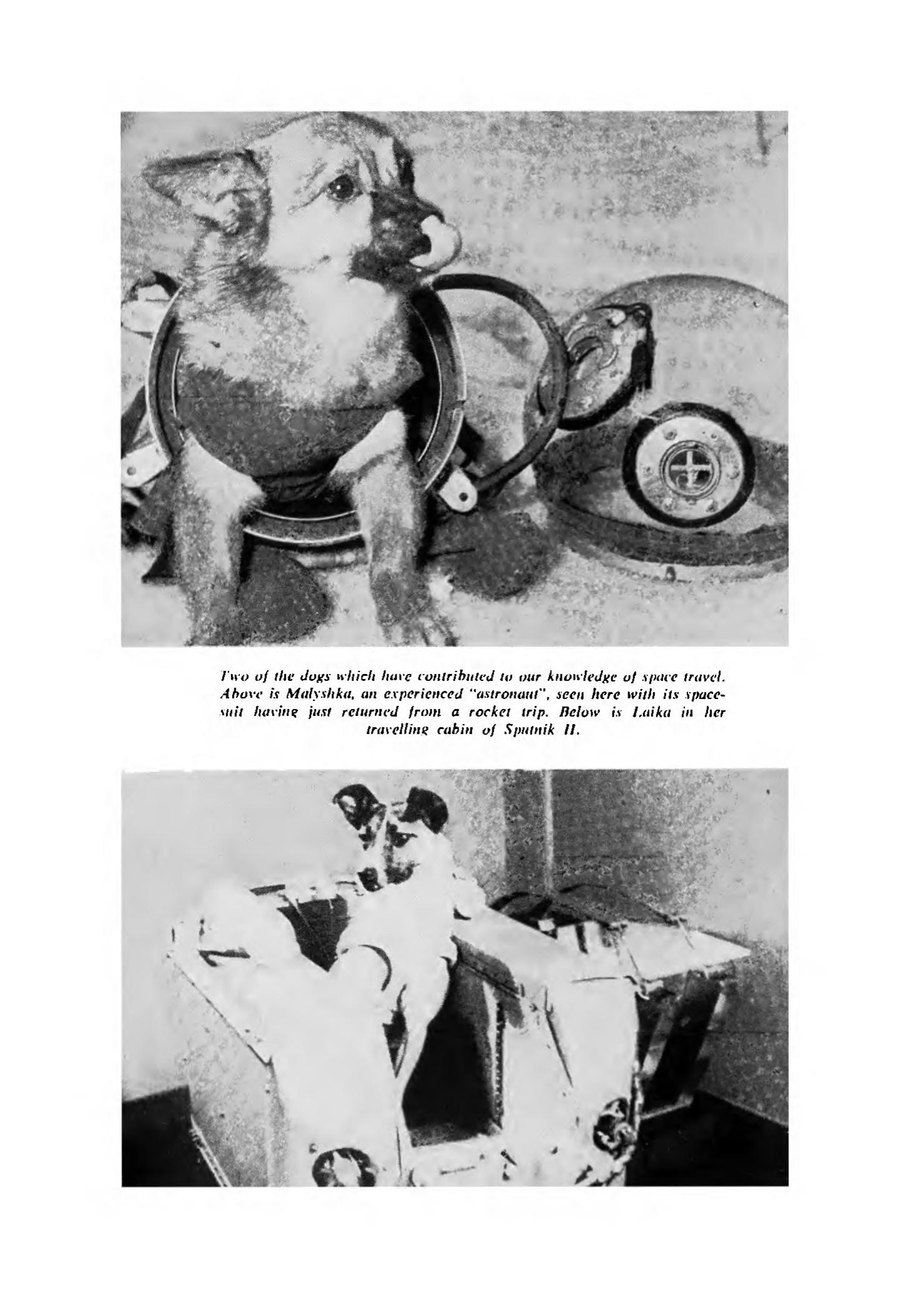
On October 4. 1957, a truly history-making event took place—the Soviet Union successfully launched Sputnik 1, the first artificial Earth satellite. Less than a month later it was followed by Sputnik If, its younger but much bigger brother.

The launching of the first sputnik was a great triumph of man over nature. Man had surmounted the physical barriers which have kept him out of cosmic space; he had overcome the force of gravity and the resistance of the atmosphere. However, there still remained the biological barrier. Could a living organism endure the conditions of space beyond the Earth’s atmosphere? The second sputnik furnished the answer to that question. This was the first step toward man’s travel in cosmic space. This booklet is based on material published in the Soviet press in connection with the launchings of the sputniks.

The book  was published in 1958 under Soviet News Booklet, London.

Credits to original uploader.

You can get the book here.

Follow us on The Internet Archive: https://archive.org/details/@mirtitles

Follow Us On Twitter: https://twitter.com/MirTitles

Write to us: mirtitles@gmail.com

Fork us at GitLab: https://gitlab.com/mirtitles/

Add new entries to the detailed book catalog here.


Posted in Aerodynamics, popular science, science, soviet, space, technology | Tagged , , , , , , | Leave a comment

The Physics of Ice – Bogoroskii (Ed.)

In this post, we will see the book The Physics Of Ice edited by V. V. Bogorodskii.

About the book

The present volume is a collection of the most significant reports read at the Symposium on Ice Physics which was held at the Arctic and Antarctic Scientific Research Institute in June 1968.

The book was translated from Russian by Israel Programme for Scientific Translation was published in 1971.

Credits to original uploader.

You can get the book here.

Follow us on The Internet Archive: https://archive.org/details/@mirtitles

Follow Us On Twitter: https://twitter.com/MirTitles

Write to us: mirtitles@gmail.com

Fork us at GitLab: https://gitlab.com/mirtitles/

Add new entries to the detailed book catalog here.

Contents

Editor’ s preface V

V.V. BOGORODSKII and B.A. FEDOROV. Radar probing of Severnaya
Zemlya glaciers 1

V. V. BOGORODSKII, G.P.KHOKHLOV, B.A. FEDOROV and G. V. TREPOV,
Electrical parameters of the models of morainic layers in the
region of the anomalous dispersion of ice 17

G.P. KHOKHLOV,
Investigation of the electrical characteristics of sweet ice for various textural models 22

G.P., KHOKHLOV,
Measurements of the electrical properties of ice with two wire line 27

V.V. BOGORODSKII, G.V. TREPOV, and B.A. FEDOROV.
Application Of lasers to studies of ice dynamics 30

M.N. VITUSHKINA. Some experimental results of radiometric probing of glaciers 33

V. V. BOGORODSKII and M.N. VITUSHKINA.
Passive radar probing of glaciers 38

G.V. TREPOV and G.P. KHOKHLOV.
Interferometric measurements of the electrical parameters of the ice cover in the meter wavelength 42

B. Ya. GAITSKHOKI,
Spectral transmission of snow and some ice varieties 44

B. Ya. GAITSKHOKI,
A photometric model of the snow-ice cover 48

G.V. TREPOV.
Measuring the velocity of propagation of electro-Magnetic waves in a glacier 53

I, GALKINA and V.A. SPITSYN,
Measuring the temperature of the surface of water, snow, and ice with a radiation thermometer 56

E.A. MARTYNOVA and V.A. SPITSYN.
Some results of tests of infrared scanners for heat charting of polar regions 60

G.P..KHOKHLOV.
Results of experimental measurements of the electrical parameters of Arctic sea ice at frequencies between 100 Hz and 1 MHZ 64

V.V. BOGORODSKII and G.P. KHOKHLOV.
Measurements of the permittivity and conductivity of sea ice without contact electrodes 71

V. V. BOGORODSKII and G.P. KHOKHLOV.
The effect of some salt components and their composition on the electrical properties Of ice 76

Yu.A. MACH. Measurements of the magnitude of the mirror reflection coefficient of the real surface of sea ice for acute incidence angles 82

V.V. BOGORODSKII and G.P. KHOKIILOV
Interlayer polarization in ice with NaCl inclusions 88

B. Ya. GAITSKHOKI, P.T. MOROZOV, and L.I SOVALKOV.
Studies of the structure and composition of sea ice in the Arctic Basin 92

V.V. BOGORODSKII, G. V. TREPOV, B.A. FEDOROV, and G.P. KHOKHLOV.
The use of electromagnetic waves propagating in fresh water for active probing and other purposes 98

V.V. BOGORODSKII, G. V. TREPOV, and B.A. FEDOROV
Tensor electromagnetic properties of glacier ice 101

V.P. GAVRILO, A. V. GUSEV, and D.B. DIANOV.
Radial oscillations of an ice sphere in water 104

A. E. KOLESNIKOV and A.V. PROKOF’EVA.
Calibration of spherical piezotansducers in ice 110

V.P. GAVRILO and A. V. GUSEV.
Acoustic pulses produced by impact excitation of floating ice 116

V.P. GAVRILO and A. V. GUSEV.
The mechanism of the acoustic effect accompanying the breaking of ice rods in a liquid 121

V.P. GAVRILO and B, Ya. GAITSKHOKI.
The statistics of air inclusions in ice 125

B. Ya. GAITSKHOKI and V.A. SPITSYN.
Some results of ice temperature measurements on SP-13f drifting station 129

V.V. BOGORODSKII, V.P. GAVRILO, and A.V. GUSEV.
Nonlinear effects accompanying ice breaking ina liquid 133

V.P. GAVRILO, A.V. GUSEV, and A.P. POLYAKOV.
Acoustic recording of the critical state of stress in ice 139

V. V. BOGORODSKII, S.A. SMIRNOV, and V.L. SINITSYN.

Simulation of the scattering of underwater sound by sweet ice specimens immersed in artificial sea water 146

V.P. GAVRILO.
Subglacial noise accompanying formation of thermal
cracks in ice 153

V. V. BOGORODSKII, G.V. TREPOV, B.A. FEDOROV, and G.P. KHOKHLOV KHOKHLOV.
Radar probing of fresh water 156


Posted in books, physics, science, soviet, technology | Tagged , , , , , , , , , , , , , , , , , , , , , | Leave a comment