Lev Vygotsky (Outstanding Soviet Psychologists) – Yaroshevsky

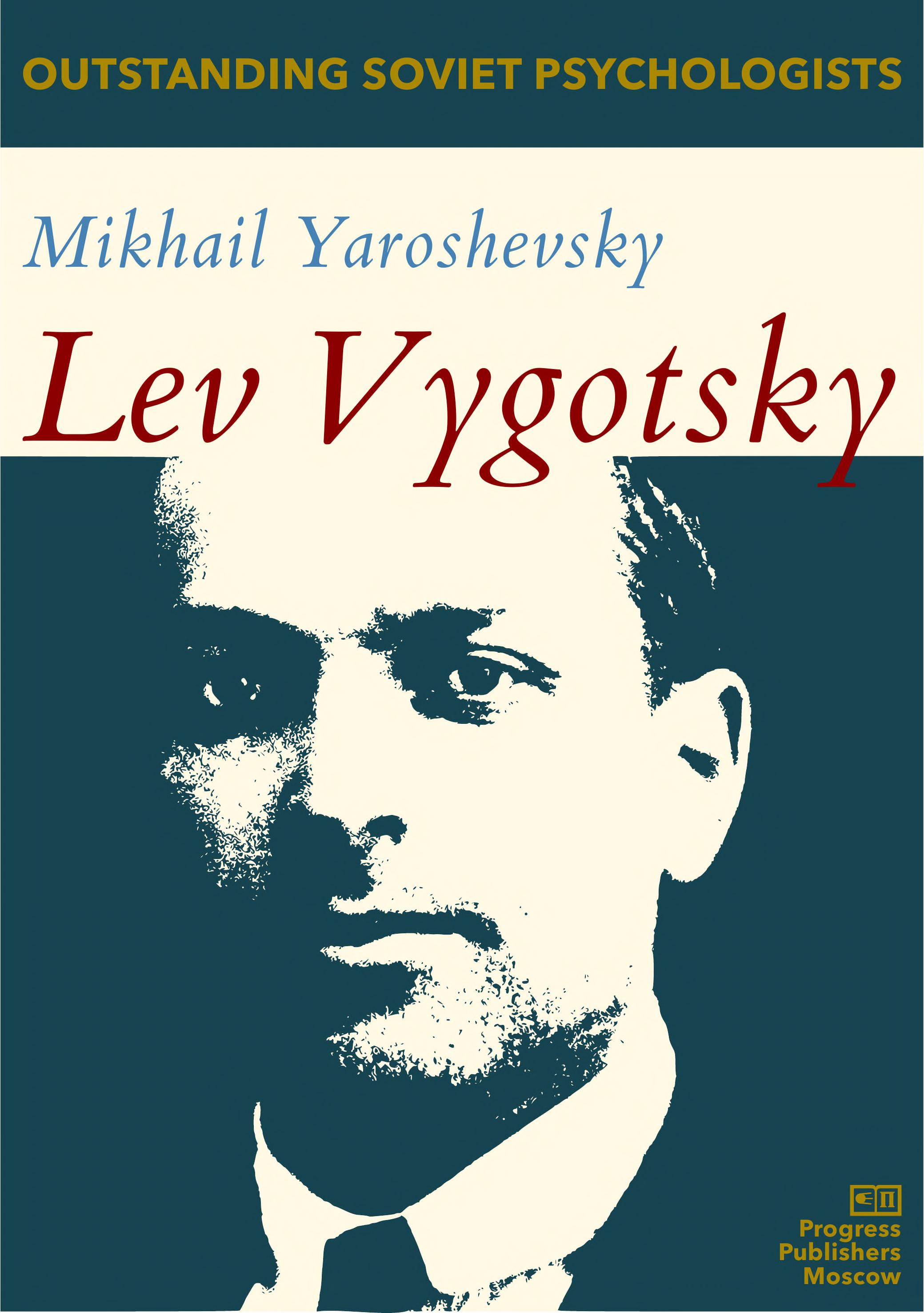
In this post, we will see the book Lev Vygotsky by Mikhail Yaroshevsky. The book is a part of Outstanding Soviet Psychologists series.

About the book

Lev Vygotsky, known as the “Mozart of Psychology”, was one of the most influential psychologists from Soviet Russia. Vygotsky’s genius swept a wide range of problems in psychology and education in his brilliant but short career. Vygotsky provided deep and unique insights to a variety of problems in both pedagogy and psychology. His theories have influenced a variety of fields and given a socio-cultural lens to researchers. This book traces the thought process of building of his system of psychology: the ideas and authors who influenced him along with newly formed Soviet society on his work and worldview. Each of the chapters thematically discusses various dimensions of his wide ranging work and is a scientific biographical overview of his life and work.

The book was translated from Russian by Sergei Syrovatkin was published in 1989  by Progress Publishers.

This is a completely electronic version typeset using LaTeX from a 1989 scan. The original scan though readable was in pretty low resolution.  I am pretty happy with the design and typesetting of the book and hope that this would be useful version for future pedagogues and psychologists.

You can get the book here.

You can find the source LaTeX files here.

Follow us on The Internet Archive: https://archive.org/details/@mirtitles

Follow Us On Twitter: https://twitter.com/MirTitles

Write to us: mirtitles@gmail.com

Fork us at GitLab: https://gitlab.com/mirtitles/

Add new entries to the detailed book catalog here.

Contents


Introduction 7

Family and School 25

University Years. The Riddle of Hamlet 29

Teacher in Gomel 41

From Reflexology To Psychology 49

The Abnormal Child In The World Of Culture 67

Art: A Social Technique For The Emotions 91

The Crisis In Psychology And Its Historical Meaning 111

In Search Of Traps For The Psyche 133

Psychology In Terms Of Drama 141

The Discovery Of The Mechanism Of The Higher Forms Of Behaviour 155

The Path To Concept 171

The Fate Of The Word In The Life Of Individual Thought 187

Integral Schema Of The Structure Of Consciousness 199


Posted in books, philosophy, progress publishers, psychology | Tagged , , , , , , , , , , , , , , , , , , , , , , , , , , | Leave a comment

Foundations of the Theory of Probability – Kolmogorov

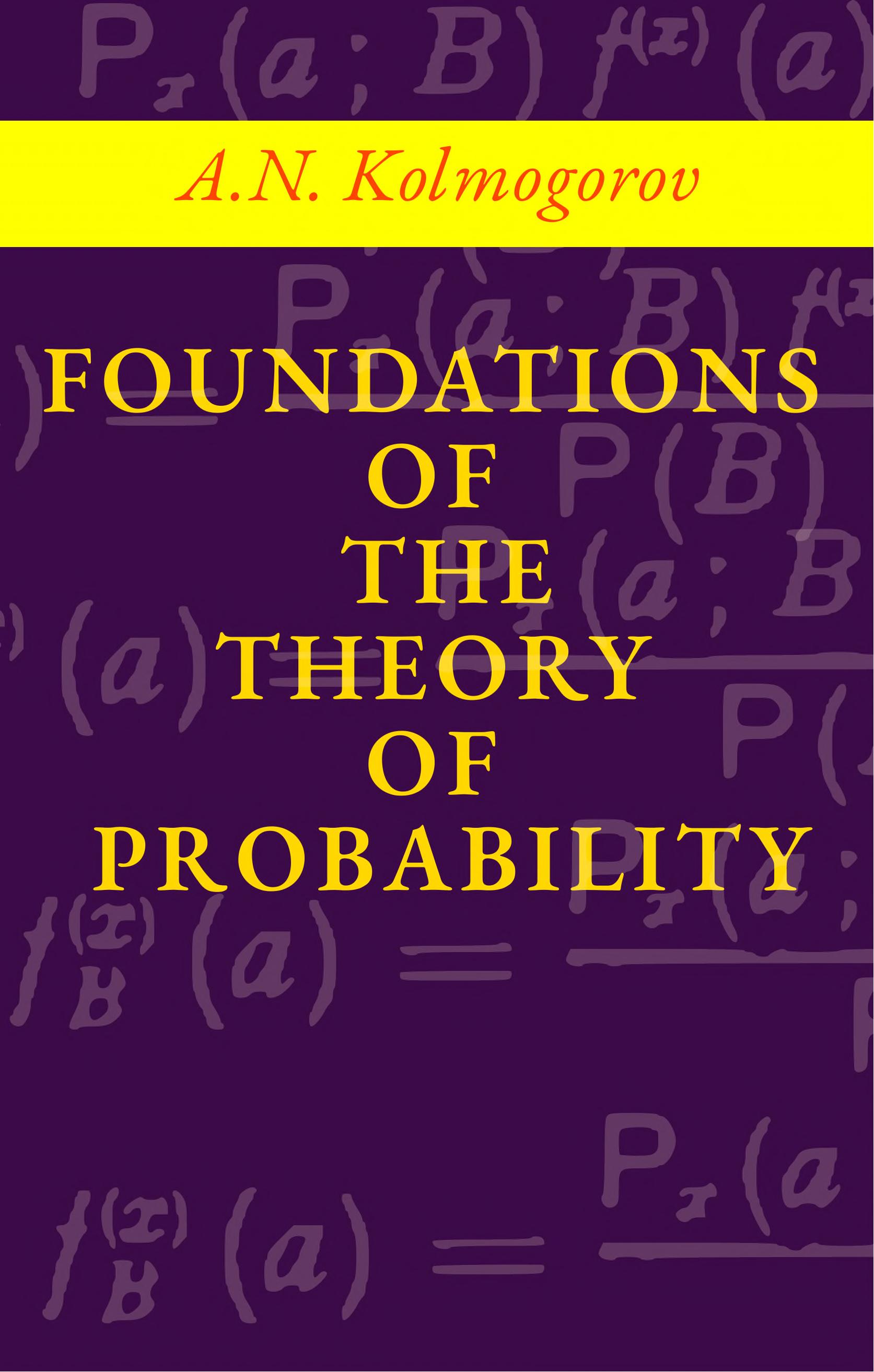
In this post, we will see the book Foundations of the Theory of Probability by A. N. Kolmogorov.

About the book

The purpose of this monograph is to give an axiomatic foundation for the theory of probability. The author set himself the task of putting in their natural place, among the general notions of modern mathematics, the basic concepts of probability theory—concepts which until recently were considered to be quite peculiar.

This task would have been a rather hopeless one before the introduction of Lebesgue’s theories of measure and integration. However, after Lebesgue’s publication of his investigations, the analogies between measure of a set and probability of an event, and between integral of a function and mathematical expectation of a random variable, became apparent. These analogies allowed of further extensions; thus, for example, various properties of independent random variables were seen to be in complete analogy with the corresponding properties of orthogonal functions. But if probability theory was to be based on the above analogies, it still was necessary to make the theories of measure and integration independent of the geometric elements which were in the foreground with Lebesgue. This has been done by Frechet.

While a conception of probability theory based on the above general viewpoints has been current for some time among certain mathematicians, there was lacking a complete exposition of the whole system, free of extraneous complications.

I wish to call attention to those points of the present exposition which are outside the above-mentioned range of ideas familiar to the specialist. They are the following: Probability distributions in infinite-dimensional spaces (Chapter III, § 4) ; differentiation and integration of mathematical expectations with respect to a parameter (Chapter IV, § 5) ; and especially the theory of condi­ tional probabilities and conditional expectations (Chapter V). It should be emphasized that these new problems arose, of neces­sity, from some perfectly concrete physical problems.

The sixth chapter contains a survey, without proofs, of some results of A. Khinchine and the author of the limitations on the applicability of the ordinary and of the strong law of large numbers. The bibliography contains some recent works which should be of interest from the point of view of the foundations of the subject.

The book was translated from Russian by Nathan Morrison and was published in 1950.

Credits to original uploader.

You can get the book here.

Follow us on The Internet Archive: https://archive.org/details/@mirtitles

Follow Us On Twitter: https://twitter.com/MirTitles

Write to us: mirtitles@gmail.com

Fork us at GitLab: https://gitlab.com/mirtitles/

Add new entries to the detailed book catalog here.

Contents

EDITOR’S NOTE iii
PREFACE v

I. ELEMENTARY THEORY OF PROBABILITY

§ 1. Axioms 2
§ 2. The relation to experimental data 3
§ 3. Notes on terminology 5
§ 4. Immediate corollaries of the axioms; conditional probabilities; Theorem of Bayes 6
§5. Independence 8
§6. Conditional probabilities as random variables; Markov Chains 12

II. INFINITE PROBABILITY FIELDS

§ 1. Axiom of Continuity 14
§ 2. Borel fields of probability 16
§ 3. Examples of infinite fields of probability 18

III. RANDOM VARIABLES

§ 1. Probability functions 21
§ 2. Definition of random variables and of distribution functions 22
§ 3. Multi-dimensional distribution functions 24
§ 4. Probabilities in infinite-dimensional spaces 27
§ 5. Equivalent random variables; various kinds of convergence 33

IV. MATHEMATICAL EXPECTATIONS

§1. Abstract Lebesgue integrals 37
§ 2. Absolute and conditional mathematical expectations 39
§ 3. The Tchebycheff inequality 42
§ 4. Some criteria for convergence 43
§ 5. Differentiation and integration of mathematical expectations with respect to a parameter 44

V. CONDITIONAL PROBABILITIES AND MATHEMATICAL EXPECTATIONS

§ 1. Conditional probabilities 47
§ 2. Explanation of a Borel paradox 50
§ 8. Conditional probabilities with respect to a random variables 51
§ 4. Conditional mathematical expectations 52

VI. INDEPENDENCE THE LAW OF LARGE NUMBERS

§ 1. Independence 57
§ 2. Independent random variables 58
§ 3. The Law of Large Numbers 61
§ 4. Notes on the concept of mathematical expectation 64
§ 5. The Strong Law of Large Numbers; convergence of a series 66
APPENDIX Zero-or-one law in the theory of probability 69

BIBLIOGRAPHY 71


Posted in books, mathematics, soviet, statistics | Tagged , , , , , , , , , , , , , , , , | 1 Comment

The Philosophy Of Quantum Mechanics – Blokhintsev

In this post, we will see the book The Philosophy Of Quantum Mechanics by D. I. Blokhintsev.

About the book

The present monograph is devoted to the principal problems of quantum mechanics and is based on the conception first stated in my course on ‘Fundamentals of Quantum Mechanics’. The scope and purpose of the above course did not allow some principal questions to be brought out as fully as they deserved, and besides, some important points were only very recently developed to a sufficient extent. This refers especially to the analysis of the action of the measuring instrument, whose dual role as an analyser of a quantum ensemble and as a detector of individual events was insufficiently elucidated.

The reader will find that the present monograph is concerned more with theoretical physics than with philosophy. However, I have never separated Weltanschauung from science (and particularly theoretical physics) so that the philosophical implications are also discussed, justifying publication in the philosophical series.

The book was translated from Russian by Express Translation Service and was published in 1968.

Credits to original uploader.

You can get the book here.

Follow us on The Internet Archive: https://archive.org/details/@mirtitles

Follow Us On Twitter: https://twitter.com/MirTitles

Write to us: mirtitles@gmail.com

Fork us at GitLab: https://gitlab.com/mirtitles/

Add new entries to the detailed book catalog here.

Contents

PREFACE V

I. THE ILLUSION OF DETERMINISM 1

II. CLASSICAL MECHANICS AND CAUSALITY 3

A. Effects of Initial Data 5
B. Random Forces 7
C. Boundary Conditions 10
D. Some Remarks on Fields 11
E. Conclusions 14

III. A GIBBS ENSEMBLE 15

IV. A QUANTUM ENSEMBLE 19

V. THE DENSITY MATRIX 26

VI. CAUSALITY IN QUANTUM MECHANICS 33

A. Equations of Motion for a Mixed Ensemble, Density Matrix p(q, q’) 37
B. Explicit Form of the Equation for the Density Matrix p(q, q’) 39

VII. IS THE WAVE FUNCTION AVOIDABLE? 41

VIII. IS THE WAVE FUNCTION MEASURABLE? 45

IX. DEDUCTION OF THE STRUCTURE OF A MICRO-OBJECT FROM PARTICLE SCATTERING 53

X. THE INVERSE PROBLEM IN QUANTUM MECHANICS 58

XI. A MEASURING INSTRUMENT IS A MACROSCOPIC DEVICE 64

XII. SCHEME OF A MACROSCOPIC INSTRUMENT 70

A. Analysis of a Polarized Beam 71
B. Momentum Measurement 72
C. Determination of the Quantum State of an Atom 75

XIII. THE THEORY OF MEASUREMENT 81

A. Determination of the Internal State of an Atom 82
B. Momentum of a Microparticle determined by Interaction with a Macroscopic Body 85
C. Thermodynamically Unstable Detector 91

XIV. THE WAVE FUNCTION AS THE OBSERVER’S NOTEBOOK 99

XV. IS QUANTUM MECHANICS A COMPLETE THEORY? 104

XVI. LATENT PARAMETERS 109

A. Observable Latent Parameters 110
B. Unobservable Latent Parameters 114

XVII. CAN A PARTICLE HAVE AN INDIVIDUAL HISTORY? 123

SELECTED BIBLIOGRAPHY 132


Posted in books, physics, soviet | Tagged , , , , , , , , , , , , , , , , , , | Leave a comment

Multicolor Problems ( Mathematical Conversations Part 1) – Dynkin, Uspenskii

In this post, we will see the book Multicolor Problems ( Mathematical Conversations Part 1) by E. B. Dynkin and V. A. Uspenskii.

About the book

Multicolor Problems is a translation of Part One of Mathe­matical Conversations by E. B. Dynkin and V. A. Uspenskii, which was published in the Russian series. Library of the Mathematics Circle. The originality of the exposition and the variety of the problems presented here make this booklet especially useful in stimulating an inventive approach to mathematics.
This booklet deals with several of the classical map-coloring problems. The technique is one of developing an ordered presentation of problems and extensive solutions to them. A discussion of the famous four-color problem, which has puz­zled mathematicians for nearly a century, is included.
The booklet is designed for the reader’s active participation, as the problems are carefully integrated with the text and should be solved in sequence. The reader should have a back­ ground of high school algebra and should also be acquainted with the method of mathematical induction.
E. B. DYNKIN, a Professor at Moscow State University, is an eminent mathematician and author, whose specialties are higher algebra, topology, and probability theory. V. A. USPENSKII, a Lecturer at Moscow State University, spe­ cializes in mathematical logic.

The book was translated from Russian by was published in 1962. There is a recent volume by Dover which has all three parts in one book.

Credits to original uploader.

You can get the book here.

Follow us on The Internet Archive: https://archive.org/details/@mirtitles

Follow Us On Twitter: https://twitter.com/MirTitles

Write to us: mirtitles@gmail.com

Fork us at GitLab: https://gitlab.com/mirtitles/

Add new entries to the detailed book catalog here.

Contents

Introduction 1

CHAPTER 1. Coloring with Two Colors 3

1. Simple two-color problems 3
2. Problems on square boards 5
3. Problems involving even and odd numbers 6
4. Networks and maps 7
5. General two-color problems 9

CHAPTER 2. Coloring with Three Colors 12

6. A simple three-color problem 12
7. Problems on hexagonal boards 12
8. Dual diagrams 14
9. Triangulation 16
10. Dual maps 19
11. Normal maps in three colors 23

CHAPTER 3. The Four-Color Problem 24

12. Normal maps in four colors 24
13. Volynskii’s theorem 25

CHAPTER 4. The Five-Color Theorem 27

14. Euler’s theorem 27
15. The five-color theorem 32

Concluding Remarks 33

Appendix 34
Coloring a sphere with three colors 34

Solutions to Problems 40

Bibliography 66

Posted in books, mathematics, soviet | Tagged , , , , , , , , , , , , , | Leave a comment

Random Walks ( Mathematical Conversations Part 3) – Dynkin, Uspenskii

In this post, we will see the book Random Walks ( Mathematical Conversations Part 3) by E. B. Dynkin and V. A. Uspenskii.

About the book

Random Walks is a translation of Part Three of Mathematical Conversations by E. B. Dynkin and V. A. Uspenskii, which was published in the Russian series, Library of the Mathematics Circle. The originality of the exposition and the variety of the problems presented here make this booklet especially useful in stimulating an inventive approach to mathematics. Extensive solutions to all problems are provided.

This booklet deals with some of the more elementary problems in probability theory. The exposition ranges from the simplest examples of a random walk on a line to such more complex examples as random walks through a city, and Markov chains.

The booklet is designed for the reader’s active participation, as the problems are carefully integrated with the text and should be solved in sequence. The reader should have a background of high school algebra.

E. B. DYNKIN, a Professor at Moscow State University, is an eminent mathematician and author, whose specialties are higher algebra, topology, and probability theory. V. A. USPENSKII, a Lecturer at Moscow State University, specializes in mathematical logic.

The book was translated from Russian by Norman D. Whaland, Jr., Olga A. Titelbaum was published in 1963. There is a recent reprint of all three parts combined into one by Dover.

Credits to original uploader.

You can get the book here.

Follow us on The Internet Archive: https://archive.org/details/@mirtitles

Follow Us On Twitter: https://twitter.com/MirTitles

Write to us: mirtitles@gmail.com

Fork us at GitLab: https://gitlab.com/mirtitles/

Add new entries to the detailed book catalog here.

Contents

Introduction 1

CHAPTER 1. Probability 5

1. Fundamental properties of probability 5
2. Conditional probability 8
3. The formula for complete probability 13

CHAPTER 2. Problems Concerning a Random Walk on an Infinite Line 17

4. Graph of coin tosses 17
5. The triangle of probabilities 18
6. Central elements of the triangle of probabilities 21
7. Estimation of arbitrary elements of the triangle 25
8. The law of the square root of n 26
9. The law of large numbers 34

CHAPTER 3. Random Walks with Finitely Many States 37

10. Random walks on a finite line 37
11. Random walks through a city 39
12. Markov chains 46
13. The meeting problem 47

CHAPTER 4. Random Walks with Infinitely Many States 50

14. Random walks on an infinite path 51
15. The meeting problem 53
16. The infinitely large city with a checkerboard pattern 57

Concluding Remarks 62

Solutions to Problems 64


Posted in books, mathematics, soviet | Tagged , , , , , , , , | Leave a comment

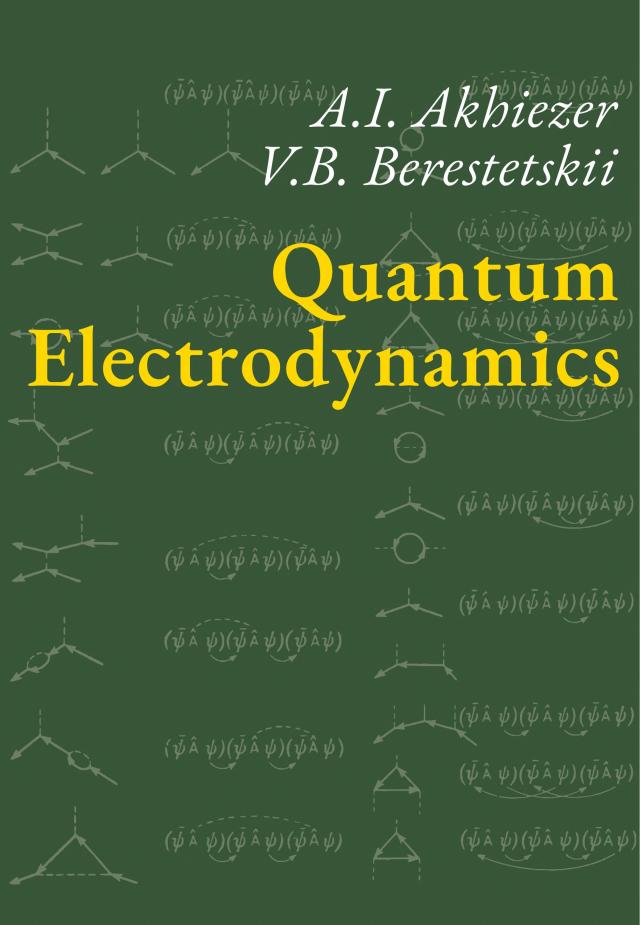
Quantum Electrodynamics – Akhiezer, Berestetskii

In this post, we will see the book Quantum Electrodynamics by A. I. Akhiezer; V. B. Berestetskii.
About the book

At the present time a number of particles is known which correspond to various quantum fields interacting with each other. However, of the many types of physical interactions existing in nature the only one, apart from gravitation, that has been studied in sufficient detail is the electromagnetic interaction. The theory of the latter interaction is the subject of quantum electrodynamics, to which the systematic exposition of this book is devoted.

Since the electromagnetic interaction is the fundamental one in the case of electrons and photons, quantum electrodynamics enables us to explain and to predict a wide range of phenomena related to the behavior of these particles.

In preparing the second edition we have subjected the book to extensive revision. The principal aim and the contents of the book have not been altered; the book is devoted to the systematic presentation of electromagnetic processes only. Only some general theorems and methods go beyond the framework of electrodynamics proper. In the second edition the space devoted to these has been increased

(reflection properties, Green’s functions, functional methods, etc.).
In the presentation of the principles of quantum electrodynamics the theory of renormalizations has been subjected to the most extensive revision. Without claiming complete mathematical rigor we have attempted to present the concept of renormalization from a single simple physical point of view, avoiding purely prescription-like methods of eliminating divergences, and making maximum use of the general properties of quantum mechanical systems.

The book was translated from Russian by G. M. Volkoff  was published in 1965.

Credits to original uploader.

You can get the book here.

Follow us on The Internet Archive: https://archive.org/details/@mirtitles

Follow Us On Twitter: https://twitter.com/MirTitles

Write to us: mirtitles@gmail.com

Fork us at GitLab: https://gitlab.com/mirtitles/

Add new entries to the detailed book catalog here.

Contents

CHAPTER I
QUANTUM MECHANICS OF THE PHOTON

§ 1. The Photon Wave Function 1

1. Introduction.
2. The Photon Wave Function in k-Space.
3. Energy.
4. Normalization of the Photon Wave Function.

§ 2. Photon States of Definite Momentum 9

1. Photon Momentum Operator.
2. Impossibility of Introducing a Photon Wave Function in the Coordinate
Representation.
3. Plane Waves.
4. Polarization Density Matrix for the Photon.

§ 3. Angular Momentum. Photon Spin 17

1. Angular Momentum Operator.
2. Photon Spin Operator.
3. Photon Spin Wave Functions.

§ 4. Photon States of Definite Angular Momentum and Parity

1. Eigenfunctions of the Photon Angular Momentum Operator.
2. Longitudinal and Transverse Vector Spherical Harmonics.
3. Parity of Photon States.
4. Expansion in Spherical Waves.
5. Expressions for the Electric and Magnetic Fields.

§ 5. Scattering of Photons by a System of Charges 36

1. Incoming and Outgoing Waves.
2. Effective Scattering Cross Section.
3. The Optical Theorem. 4. Dispersion Relations.

§ 6. The Photon Field Potentials 46

1. Transverse, Longitudinal, and Scalar Potentials.
2. Longitudinally Polarized “Photon.”
3. Potentials for Plane and Spherical Waves.

§ 7. System of Photons 52

1. Wave Function for a System of Two Photons.
2. Even and Odd States of Two Photons.
3. Classification of the States of Two Photons of Definite Angular Momentum.
4. Wave Function for a System of an Arbitrary Number of Photons.

§ 8. L-Vectors and Spherical Harmonics 62

1. Irreducible Tensors.
2. The Algebra of L-Vectors.
3. Spherical Harmonics.

CHAPTER II
RELATIVISTIC QUANTUM MECHANICS OF THE ELECTRON

§ 9. The Dirac Equation 73

1. Spinors. Pauli Matrices.
2. Dirac Equations. Dirac Matrices.
3. Unitary Transformations of Bispinors.
4. The Necessity for Four-Component Electron Wave Functions.
5. Symmetric Form of the Dirac Equation. Equation of Continuity.
6. Invariance of the Dirac Equation.
7. Bilinear Combinations of the Components of the Wave Function.

§ 10. Electron and Positron States. States of Definite
Momentum and Polarization 86

1. Solutions with Positive and Negative Frequencies.
2. The Charge Conjugation Transformation.
3. The Positron Wave Function.
4. Plane Waves.
5. Polarization of a Plane Wave.
6. Polarization Density Matrix for the Electron.
7. Averaging over Polarization States.

§ 11. Electron States of Definite Angular Momentum and Parity 105

1. Orbital and Spin Functions. Spherical Spinors.
2. Wave Function of a State of Definite Angular Momentum.
3. Parity of a State.
4. Expansion in Spherical Waves.

§ 12. Electron in an External Field 122

1. The Dirac Equation with an External Field.
2. Separation of Variables in a Central Field.
3. Asymptotic Behavior of the Radial Functions.
4. Behavior of Energy Levels as Functions of the Potential Well Depth.
5. Electron in a Constant Homogeneous Magnetic Field.

§ 13. Motion of an Electron in the Field of a Nucleus 131

1. Solution of the Radial Equations for the Coulomb Field.
2. Wave Functions for the Continuous Spectrum.
3. Isotopic Level Shift.
4. General Investigation of the Effect of Finite Nuclear Size.


§ 14. Electron Scattering 144

1. Spinor Scattering Amplitude.
2. Expression for the Cross Section in Terms of Phases.
3. Polarization and Azimuthal Asymmetry.
4. Scattering by a Coulomb Field.
5. Small Angle Scattering.

§ 15. Nonrelativistie Approximation 153

1. Transition to the Pauli Equation.
2. Second Approximation.
3. Application of the Dirac Equation to Nucleons.

CHAPTER III
QUANTIZED ELECTROMAGNETIC AND ELECTRON-POSITRON FIELDS

§ 16. Quantization of the Electromagnetic Field 153

1. Four-Dimensional Form of the Field Equations.
2. Variational Principle. Energy-Momentum Tensor of the Electromagnetic Field.
3. Expansion of the Potentials into Plane Waves.
4. Quantization of the Electromagnetic Field.
5. Use of the Indefinite Metric.

§ 17. Commutators of the Electromagnetic Field 174

1. Commutation Relations for the Potentials and the Field Components.
2. Chronological and Normal Products of Components of the Potential. 3. Singular Functions Associated with the Operators ▢ and (▢^2 — m^2).

§ 18. Quantization of the Electron-Positron Field 195

1. Variational Principle for the Dirac Equation. Energy-Momentum Tensor of the Electron-Positron Field.
2. Quantization Rules for the Electron-Positron Field.


§ 19. Anticommutators of the Electron-Positron Field. Chronological and Normal Products of Field Components. Current Density 205

1. Commutation Relations for Field Components.
2. Chronological and Normal Products of Operators of
the Electron-Positron Field. 3. Electric Current Density.

§ 20. General Properties of Wave Fields 214

1. Wave Functions of a Field and the Lorentz Group.
2. Irreducible Finite-Dimensional Representations of the Lorentz Group.
3. Energy-Momentum Tensor and Angular Momentum Tensor.
4. Current Density Vector.
5. Relativistically Invariant Field Equations.
6. Wave Equations for Particles of Spin Zero and Unity.


§ 21. Quantization of Fields. Connection between Spin and
Statistics 237

1. Nondefiniteness of the Charge in the Case of Integral Spin and of the Energy in the Case of Half-Integral Spin.
2. Quantization of Fields for Integral and Half-Integral Spin. Pauli’s Theorem.
3. Inversion of Coordinates and Time Reversal.

CHAPTER IV
FUNDAMENTAL EQUATIONS OF QUANTUM ELECTRODYNAMICS

§ 22. Interacting Electromagnetic and Electron-Positron
Fields 253

1. System of Equations for Interacting ) Fields.
2. Lagrangian. Energy-Momentum Tensor.
3. Field Equations in Poisson Bracket Form.
4. Invariance Properties of the Equations of Quantum Electrodynamics.


§ 23. Equations of Quantum Electrodynamics in the Interaction Picture. Invariant Perturbation Theory 268

1. Heisenberg and Schrödinger Pictures. Interaction Picture.
2. Transition to the Interaction Picture in Quantum Electrodynamics. 3. Charge Conjugation Operator.
4. Perturbation Theory.

§ 24. The Scattering Matrix 290

1. The Scattering Problem and the Definition of the Scattering Matrix.
2. Matrix Elements of Field Operators.
3. Representation of the Scattering Matrix as a Sum of Normal Products.
4. General Relation between T- and N-Orderings.
5. Symmetry of the Scattering Matrix under Time Reversal.

§ 25. Graphical Representation of the Elements of the Scattering Matrix. The Scattering Matrix in Momentum Space 307

1. Graphical Representation of Normal Products.
2. Various Interaction Processes between Fields.
3. Transition to Momentum Space.
4. Closed Electron Loops with an Odd Number of Vertices.
5. Rules for Writing Down Matrix Elements.

§ 26. Probabilities of Various Processes 327

1. General Formula for the Probability.
2. Effective Cross Section.
3. Summation and Averaging over Polarization States of Electrons and Photons.
4. Probabilities of Processes Involving Polarized Particles.
5. Probabilities of Processes in the Presence of an External Field.
6. Feynman’s Notation.

CHAPTER V
INTERACTION OF ELECTRONS WITH PHOTONS

§ 27. Emission and Absorption of a Photon 345

1. General Expression for the Matrix Element.
2. Electric Multipole Radiation.
3. Magnetic Multipole Radiation.
4. Selection Rules.
5. Angular Distribution and Polarization of the Radiation.

§ 28. Scattering of a Photon by a Free Electron 363

1. Scattering Matrix Element.
2. Application of Conservation Laws.
3. Differential Cross Section for Unpolarized Particles.
4. Angular Distribution and Total Cross Section.
5. Distribution of Recoil Electrons.
6. Scattering of Polarized Photons.
7. Scattering of Photons by Polarized Electrons.

§ 29. Bremsstrahlung. 378

1. Perturbation Theory for an Electron Wave Function in the Continuum. Incoming and Outgoing Waves.
2. Effective Cross Section for Bremsstrahlung.
3. Angular Distribution of the Radiation in a Coulomb Field.
4. Polarization of the Radiation.
5. Spectrum of the Radiation.
6. Screening.
7. Radiative Energy Losses.
8. Exact Theory of Bremsstrahlung in the Nonrelativistic Domain.
9. Exact Theory of Bremsstrahlung in the Extreme Relativistic Domain.
10. Radiation Emitted in Electron-Electron and Electron-Positron Collisions.

§ 30. Emission of Photons of Long Wavelength 413

1. “The Infrared Catastrophe.”
2. Investigation of the Divergence in the Low Frequency Domain by Means of the Scattering Matrix.
3. Relation between the Photon “Mass” and the Minimum Frequency.

§ 31. Photoeffect 429

1. Photoeffect in the Nonrelativistic Domain.
2. Photoeffect in the Relativistic Domain.

§ 32. Production of Electron-Positron Pairs 438

1. Production of an Electron-Positron Pair by a Photon in the Field of a Nucleus.
2. Exact Theory of Pair Production by a Photon in the Field of a Nucleus in the Nonrelativistic and Extreme Relativistic Cases.
3. Pair Production by Two Photons.
4. Pair Production in a Photon-Electron Collision.
5. Pair Production in a Collision of Two Fast Charged Particles.

§ 33. Annihilation of Electron-Positron Pairs into Photons 457

1. Annihilation of a Pair into Two Photons.
2. Polarization Effects in the Two-Photon Annihilation of a Pair.
3. Annihilation of a Pair into One Photon.
4. Positronium Decay.
5. Three-Photon Decay of Orthopositronium.
6. Multiple Photon Production Accompanying the Annihilation of a Pair.

§ 34. The Method of Equivalent Photons 473

1. The Number of Equivalent Photons.
2. Bremsstrahlung from a Fast Electron in the Field of a Nucleus.
3. Radiation Emitted in an Electron-Electron Collision.
4. Pair Production by a Photon in the Field of a Nucleus.
5. Pair Production in a Collision of Two Fast Particles.

§ 35. Scattering of a Photon by a Bound Electron. Emission of Two Photons 484

1, The Dispersion Formula.
2. Resonance Scattering.
3. Compton Scattering by Bound Electrons.
4. Emission of Two Photons. The Metastable 2s;, State of the Hy-
drogen Atom.

§ 36. Electron-Electron and Positron-Electron Scattering 499

1. Electron-Electron Scattering.
2. Positron-Electron Scattering.
3. Scattering of Polarized Electrons and Positrons.
4. Annihilation of an Electron-Positron Pair into a 𝜋-Meson Pair.

CHAPTER VI
RETARDED INTERACTION BETWEEN TWO CHARGES

§ 37. Retarded Potentials 509

1. Interaction Function for Two Charges.
2. General Form of the Matrix Element.
3. Retarded Potentials and Transition Currents.

§ 38. Interaction Energy of Two Electrons to Terms of Order v2/c? 517

1. The Breit Formula.
2. Schrödinger Equation for a Two-Electron System.
3. Interaction between an Electron and a Positron.
4. Exchange Interaction between an Electron and a Positron.

§ 39. Positronium. 527

1. Hamiltonian Operator and the Unperturbed Equation.
2. Perturbation Operator.
3. Fine Structure.
4. Zeeman Effect.

§ 40. Internal Conversion of Gamma-Rays 537

1. Expansion of Retarded Potentials in Spherical Waves.
2. Conversion Coefficient.
3. Conversion in the K-Shell.
4. Effect of Finite Nuclear Size.
5. Effect of Electron Shells on Radiation from the Nucleus.

§ 41. Conversion Accompanied by Pair Production. Excitation of Nuclei by Electrons 554

1. Conversion of Magnetic Multipole Radiation.
2. Conversion of Electric Multipole Radiation.
3. Excitation of Nuclei by Electrons.
4. Monoenergetic Positrons.

§ 42. Coulomb (Monopole) Transitions 565

1. Reduction to the Static Interaction.
2. Conversion and Nuclear Excitation in the Case of an E0-Transition.

CHAPTER VII
INVESTIGATION OF THE SCATTERING MATRIX

§ 43. Properties of Exact Solutions of the Equations of Quantum Electrodynamics. Propagators 571

1. Stationary States of a System of Interacting Fields.
2. Propagators and Their Spectral Representation.
3. Connection between Propagators and the Scattering
Matrix. Integral Equations for Propagators.
4. Electromagnetic Mass of the Electron.

§ 44. Structure of the Scattering Matrix 593

1. Self-Energy Parts of Diagrams.
2. Vertex Parts of Diagrams.
3. Renormalization of Electron Mass.

§ 45. Renormalization of Electron Charge 605

1. Physical Charge of the Electron.
2. Renormalization of Propagators and Vertex Parts.
3. Three-Photon Vertex Parts.
4. Renormalization of Matrix Elements.
5. Formulation of Perturbation Theory as an Expansion of Powers of e_c.


§ 46. Divergences in the Scattering Matrix and their Removal 619

1. Divergences in Irreducible Diagrams.
2. Introduction of a Cut-Off Momentum.
3. Convergence of Regularized Expressions for Irreducible Vertex Parts and Self-Energy Parts.
4. Convergence of Regularized Quantities in the Case of Reducible Diagrams.

§ 47. Evaluation of Self-Energy and Vertex Parts 631

1. Evaluation of Integrals over Four-Dimensional Regions.
2. Second Order Electron Self-Energy Part.
3. Second Order Photon Self-Energy Part.
4. Third Order Vertex Part in the Case of External Electron Lines.
5. Third Order Vertex Part in the Case of One External Electron Line.

§ 48. Functional Properties of Green’s Functions. Limits of
Applicability of Quantum Electrodynamics 657

1. Expansion Parameters of Perturbation Theory.
2. Zero Order Approximation in the Expansion in Powers of e_c.
3. Integral Equations for the Zero Order Approximation.
4. The Renormalization Group. 5. Derivation of Asymptotic Expressions for the Green’s Functions with the Aid of Differential Equations of the Renormalization Group.
6. The Problem of Closure of Quantum Electrodynamics.

§ 49. Generalized Green’s Functions 676

1. Green’s Functions in the Presence of External Fields.
2. Green’s Function for Two Electrons. Equation for Bound States of the Electron-Positron System.
3. Equations for Green’s Functions in Terms of Variational Derivatives.
4. Expressions for Green’s Functions in Terms of Functional Integrals.

CHAPTER VIII
RADIATION CORRECTIONS TO ELECTROMAGNETIC PROCESSES

§ 50. Effective Potential Energy of the Electron. Radiation Corrections to the Electron Magnetic Moment and to Coulomb’s Law 693

1. Energy of Interaction of the Electron with the Electromagnetic Field Taking into Account Corrections of Order 𝛼.
2. Radiation Corrections to the Electron Magnetic Moment.
3. Radiation Corrections to Coulomb’s Law.

§ 51. Radiation Corrections to Electron Scattering 705

1. Electron Scattering by the Coulomb Field of a Nucleus in the Second Born Approximation.
2. Differential Cross Section for the Scattering of an Electron by the Coulomb Field of a Nucleus taking into Account Radiation Corrections of Order 𝛼.
3. Elimination of the Photon “Mass” from the Scattering Cross Section.
4. Removal of the Infrared Divergence for an Arbitrary Scattering Process.
5. Scattering of High Energy Electrons by an External Field.
6. Radiation Corrections to Electron-Electron and Electron-Positron Scattering.

§ 52. Radiation Corrections to Photon-Electron Scattering, to Pair Creation and Annihilation, and to Bremsstrahlung. 731

1. Radiation Corrections to the Compton Effect.
2. Limiting Cases of Low and High Energies.
3. Radiation Corrections to Two-Photon Pair Annihilations.
4. Radiation Corrections to Bremsstrahlung.
5. Radiation Corrections to Photon Production and Single Photon Annihilation of Pairs.

§ 53. Radiation Corrections to Atomic Levels 751

1. Radiation Shift of Atomic Levels.
2. Radiation Shift of the Levels of 𝜇-Mesohydrogen.
3. Natural Line Widths.
4. Photon Scattering near Resonance.

§ 54. Photon-Photon Scattering and the Lagrangian for the
Electromagnetic Field 764

1. Photon-Photon Scattering Tensor of the Fourth Rank.
2. Photon-Photon Scattering.
3. Connection between the Photon-Photon Scattering Cross Section and the Radiation Corrections to the Lagrangian of the Electromagnetic Field.
4. Exact Expressions for the Lagrangian of the Electromagnetic Field.

§ 55. Photon Scattering by the Coulomb Field of a Nucleus 792

1. General Expression for the Cross Section for Photon Scattering by a Constant Electromagnetic Field.
2. Relation between the Forward Scattering Amplitude for a Photon and Pair-Production by a Photon in the Field of a Nucleus.
3. Momentum Distribution of Recoil Nuclei Accompanying Pair Production by a Photon in the Field of a Nucleus.
4. Angular Distribution of Recoil Nuclei and Total Cross Section for Pair Production by a Photon in the Coulomb Field of a Nucleus.
5. Small Angle Coherent Scattering of Photons by the Field of a Nucleus.

CHAPTER IX
ELECTRODYNAMICS OF PARTICLES OF SPIN ZERO

§ 56. Field Equations for Scalar Particles 819

1. First Order Equations.
2. Quantization of the Free Scalar Field.
3. Commutators of the Field. Vacuum Expectation Values of Products of Field Components.


§ 57. The Scattering Matrix in Scalar Electrodynamics 827

1. The Interaction Picture.
2. Rules for Calculating Elements of the Scattering Matrix.
3. Divergences of the Scattering Matrix.

§ 58. Scattering of Scalar Particles 835

1. Scattering of Scalar Particles by the Coulomb Field of a Nucleus. 2. Scattering of a Charged Scalar Particle by a Scalar Particle.

§ 59. Scattering of a Photon by a Scalar Particle. Bremsstrahlung Photons from a Scalar Particle 838

1. Scattering of a Photon by a Scalar Particle.
2. Bremsstrahlung from Scalar Particles.

§ 60. Production and Annihilation of Pairs of Scalar Particles. 842

1. Production of Pairs of Scalar Particles by a Photon in the Coulomb Field of a Nucleus.
2. Production of a Pair of Scalar Particles by Two Photons.
3. Two-Photon Annihilation of a Pair of Scalar Particles.
4. Annihilation of Pairs of Scalar Particles into Electron-Positron Pairs and the Inverse Process.

§ 61. Polarization of the Vacuum in the Case of Charged Scalar Particles 847

1. Vacuum Polarization Tensor for Scalar Particles.
2. Correction to Coulomb’s Law.
3. Photon-Photon Scattering. Radiation Corrections to the Lagrangian of the Electromagnetic Field.

Concluding Remarks 852

References 855

Subject Index 863


Posted in books, mathematics, physics, soviet | Tagged , , , , , , , , , , , , , , , , , | Leave a comment

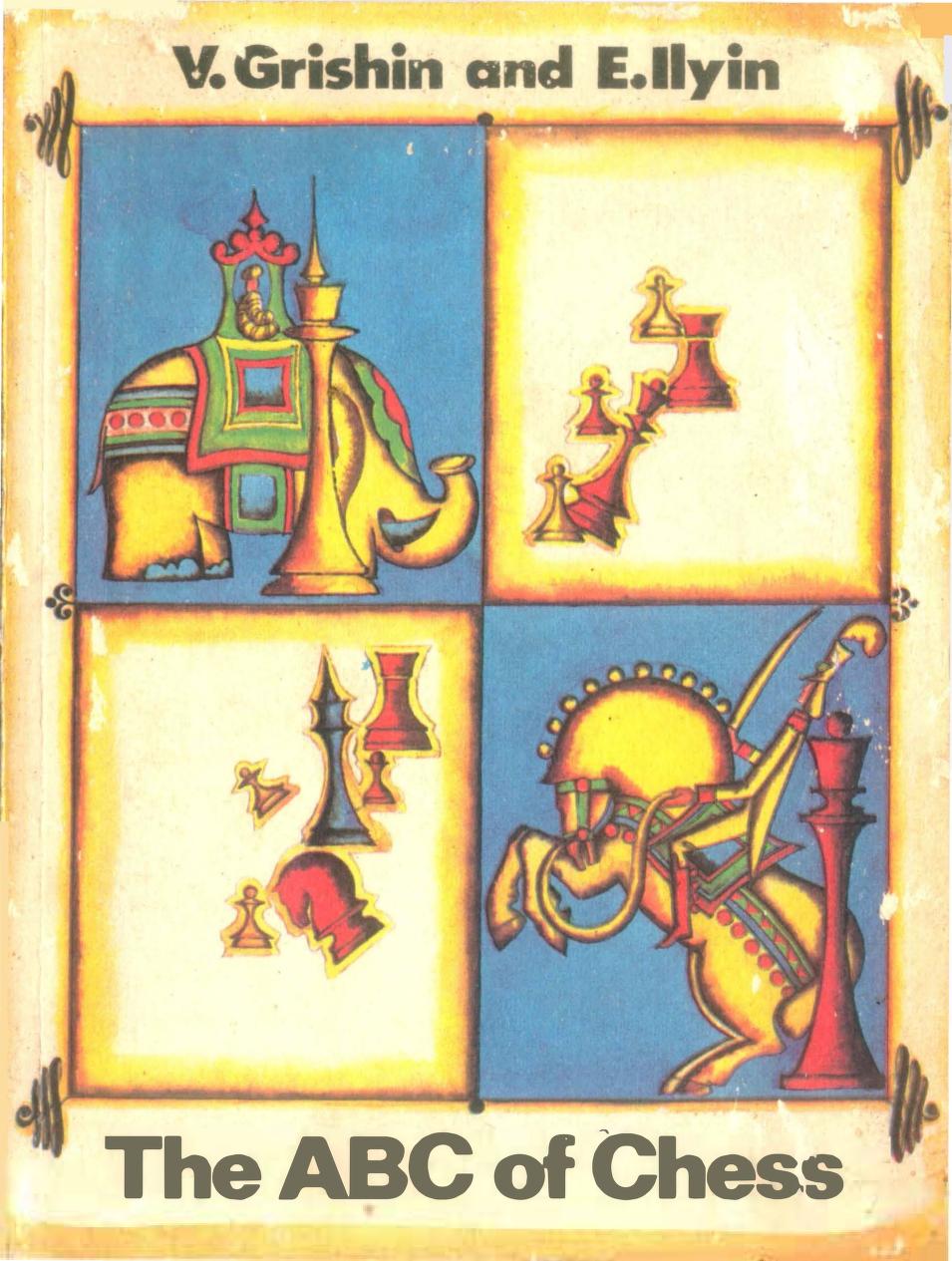
The ABC of Chess – Grishin, Ilyin

In this post, we will see the book The ABC of Chess by V. Grishin and E. llyin.

About the book

An introductory book for children to learn chess. Teaches the basics of the game. There are a lot of children between the ages of 5 – 7 who are interested in chess and want to learn to play. This book is written to help younger children take their first steps on the chessboard. As a rule the first books a child comes to know are read aloud to him by his parents and this one need be no exception. Don’t hurry when you read “The ABC of Chess” to your child, don’t cover more than one chapter a week. In your instruction pay more attention to the principle of play.

The book was translated from Russian by Vivienne Burdon was published in 1986 by Raduga Publishers.

All credits to gnv64   and Guptaji.

You can get the book here , here and here.

Follow us on The Internet Archive: https://archive.org/details/@mirtitles

Follow Us On Twitter: https://twitter.com/MirTitles

Write to us: mirtitles@gmail.com

Fork us at GitLab: https://gitlab.com/mirtitles/

Add new entries to the detailed book catalog here.

Contents

Foreword for Parents. 3

A War of Wood. 7

A Revealing Story. 15

The Battlefield. 23

Only Straightforward!. 29

Who Has Been Placed in the Corner?. 35

Leaping Horses. 41

“Lightweight” Bishops. 47

The Most Powerful Piece. 51

Watch Out, Your Majesty!. 57

Touch — Move. 63

Who’s Won? IPs a Stalemate!. 69

Not Numbers but Know-How. 75

The King Goes on the March. 79

All Children Should Learn. 83

Appendix. 86

Answer These Questions Without Your Parents Help.87

Posted in books, chess, children's books, raduga publishers | Tagged , , , , , , , , , | Leave a comment

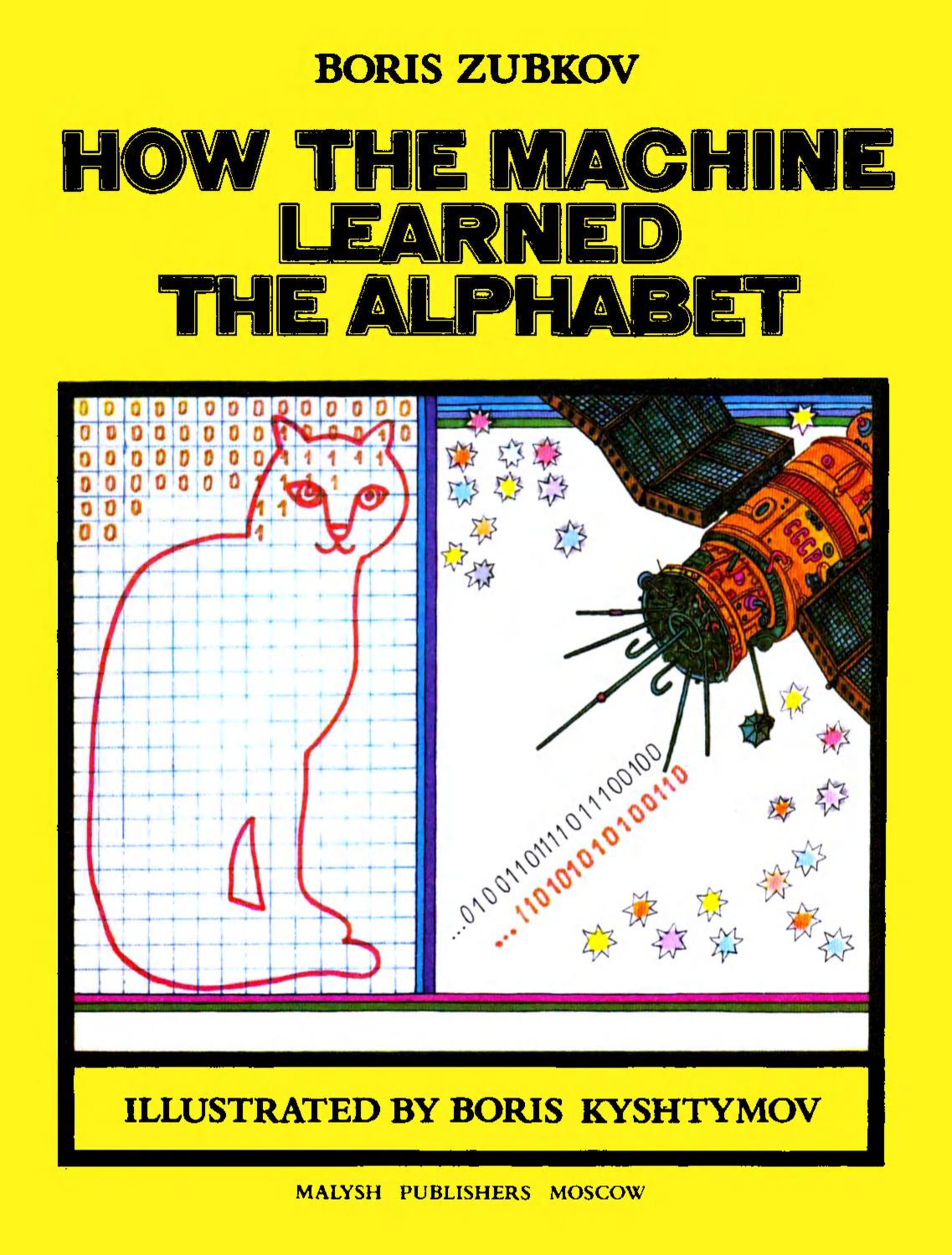
How The Machine Learned The Alphabet – Zubkov

In this post, we will see the book .

About the book

A little book describing how machines (computers) a can learn various things and think.

The book was translated from Russian by Vladimir Korotky and illustrated by Boris Kyshtymov. The book was published in 1985 by Malysh Publishers.

All credits to Guptaji.

You can get the book here (cleaned optimised) and here.

Follow us on The Internet Archive: https://archive.org/details/@mirtitles

Follow Us On Twitter: https://twitter.com/MirTitles

Write to us: mirtitles@gmail.com

Fork us at GitLab: https://gitlab.com/mirtitles/

Add new entries to the detailed book catalog here.

Contents

How to make a machine that can read and why we write postcodes on envelopes 3

The importance of “Yes” and “No” and How People speak with lifts, mills, steam engines and rockets 8

How machines learned that a cat was a cat and why people began calling machines intelligent 12

Iron ducks and Trumpeters, What is automation and how many automatons there are around 16

Why a robot is called a robot, One scientific experiment and what kind of arms and legs robots have 20


Posted in books, children's books, children's science, computers, engineering, history, malysh publishers, picture books, popular science, science, soviet, technology | Tagged , , , , , , , , , , , | Leave a comment

Tomorrow? … Yesterday? – Zubkov

In this post, we will see the book Tomorrow? … Yesterday? by Boris Zubkov.

About the book

A book describing history and evolution of measuring time at different epochs. Discusses various natural phenomena which were used to keep calendars and inventions of clocks to measure time. The book also touches upon the circadian rhythm present in all living organisms. Final part discusses aspects of time management in factories.

The book was translated from Russian by Eleanor Yankovskaya and illustrated by I. Kabakov. The book was published in 1978 by Malysh Publishers.

You can get the book here (hi-res and cleaned). Another copy from Guptaji here.

Follow us on The Internet Archive: https://archive.org/details/@mirtitles

Follow Us On Twitter: https://twitter.com/MirTitles

Write to us: mirtitles@gmail.com

Fork us at GitLab: https://gitlab.com/mirtitles/

Add new entries to the detailed book catalog here.

Contents

What happens everyday? 3

How People Learned to Measure Time? (and about clocks that travel in the sky, fire a gun and even race around a city) 6

There Has Always Been Time (and travels to distant places, a faithful keeper of Time in Leningrad, what Tomorrow means, and why a lazy person is bored) 13

The Clock Inside Us (also how oysters and bean plants  remember Time, and who night owls and early birds are) 17

Every Minute is Precious (What does time mean for factories? How does Time help people work better? 22


Posted in astronomy, books, children's books, children's science, engineering, malysh publishers, popular science, science, soviet, technology | Tagged , , , , , , , , , , , | Leave a comment

Foundations Of Combinatorial Topology – Pontryagin

In this post, we will see the book Foundations Of Combinatorial Topology by L. S. Pontryagin.

About the book

This book represents essentially a semester course in combinatorial topology which I have given several times at the Moscow National University. It contains a very rigorous but concise presentation of homology theory. The formal prerequisites are merely a few simple facts about functions of a real variable, matrices, and commutative groups. Actually, how­ ever, considerable mathematical maturity is required of the reader. An essential defect in the book is its complete omission of examples, which are so indispensable for clarifying the geometric content of combinatorial topology. In this sense a good complementary volume would be Sketch of the Fundamental Notions of Topology by Alexandrov and Efremovitch, in which the attention is focused on the geometric content rather than on the completeness and rigor of proofs. In spite of this shortcoming, it seems to me that the present work has certain advantages over the existing voluminous treatises, especially in view of its brevity. It can be used as a reference for obtaining preliminary information required for participation in a serious seminar on combinatorial topology. It is convenient in preparing for an examination in a course, since the proofs are carried out in the book with sufficient detail. For a more qualified reader, e.g., an aspiring mathematician, it can also serve as a source of basic information on combinatorial
topology.

The present book makes use of a few facts concerning metric spaces which are now ordinarily included in a course in the theory of functions of a real variable, and which can be found in the sixth chapter of Hausdorff’s Mengenlehre or in the third chapter of Alexandrov and Kolmogorov’s Theory of Functions of a Real Variable. Information concerning commutative groups may be found in the fifth chapter (see §21 and §22) of Kurosh’s Theory of Groups.

The book was translated from Russian by F. Bagemihl, H. Komm and W. Seidel. The book was published in 1952.

Credits to original uploader.

You can get the book here.

Follow us on The Internet Archive: https://archive.org/details/@mirtitles

Follow Us On Twitter: https://twitter.com/MirTitles

Write to us: mirtitles@gmail.com

Fork us at GitLab: https://gitlab.com/mirtitles/

Add new entries to the detailed book catalog here.

Contents

Preface vii
Introduction ix
Notation xi

CHAPTER I COMPLEXES AND THEIR BETTI GROUPS

§ 1. Euclidean Space. I
§ 2. Simplex. Complex. Polyhedron 9
§ 3. Application to Dimension Theory. 16
§ 4. The Betti Groups. 23
§ 5. Decomposition into Components. The Zero-dimensional Betti Group. 26
§ 6. The Betti Numbers. The Euler-Poincaré Formula. 30

CHAPTER II THE INVARIANCE OF THE BETTI GROUPS

§ 7. Simplicial Mappings and Approximations. 36
§ 8. The Cone Construction. 43
§ 9. Barycentric Subdivision of a Complex. 48
§ 10. A Lemma on the Covering of a Simplex, and its Application. 53
§ 11. The Invariance of the Betti Groups under Barycentric Sub-division. 58
§12. The Invariance of the Betti Groups. 61

CHAPTER III CONTINUOUS MAPPINGS AND FIXED POINTS

§13. Homotopic Mappings. 69
§14. The Cylinder Construction. 72
§15. Homology Invariants of Continuous Mappings. 79
§16. The Existence Theorem for Fixed Points. 84

List of Definitions. 94
List of Theorems. 95

Basic Literature on Combinatorial Topology. 96

Posted in books, mathematics, soviet | Tagged , , , , , , , , , , , , , | Leave a comment