Science for Everyone – Temperature

This book on temperature was written to explain 
how physical concepts arise, how new methods of 
measuring physical quantities are developed, 
and how the progress in physics makes well-worn 
concepts move into modern fields of physics of 
which our predecessors were understandably 
quite ignorant. - Ya. Smorodinsky

We now come to the next title in the Science for Everyone Series, Temperature written by Ya. A. Smorodinsky.

The books has a lot of historical perspective on how the ideas of thermodynamics developed over the ages. Also the book takes you to many quantum phenomena and discusses in detail about many of them.

From the back cover

This book starts with a historical background on the notion of temperature and the development of the temperature scale. Then Ya. A. Smorodinsky covers the fundamentals of thermodynamics and statistical physics, only using concepts that will be familiar to high-school students. Having built a solid foundation, he exposes the reader to a number of phenomena that are essentially quantum-mechanical, but for which the concept of temperature “works”, and works very well. These include the spins in crystal lattices, inverse population of energy levels, microwave background radiation, black holes, and cooling antiproton beams. Although it has been written for high-school students, the book contains a minimum amount of mathematics. Nevertheless, Ya.A. Smorodinsky compensates for this
severe restriction by the lucid manner in which he discusses complicated effects.

The book was translated from the Russian by V. I. Kisin and was first published by Mir in 1984.

The Internet Archive Link

and here

Follow us on The Internet Archive: https://archive.org/details/@mirtitles

Write to us: mirtitles@gmail.com

Updated: 15 January 2019

Continue reading

Posted in books, mir publishers, physics, science for everyone | Tagged , , , , , | 2 Comments

Science for Everyone – How We See What We See

We now come to another book in the Science for Everyone Series called How We See What We See by V. Demidov.

The title of the book is self-explanatory. The back cover of the book says:

Pattern recognition and freaks of fashions, the perception of color and the structure of the visual tract, optical illusions and shaping of the mental model of the world are some of the topics discussed in this fascinating and enlightening account of the extremely important frontiers of neurophysiology, and psychology, cybernectics and medicine. The author (a journalist and an engineer) visited many laboratories even participated in many experiments – that is why he is so successful in conveying the atmosphere of scientific search and adventure. The book will appeal to the general reader  and non-specialist researcher.

From the foreword

The author of this book is a journalist and an engineer. The book itself is a result of tive years of fruitful cooperation between the author and the investigators of the Vision Physiology Laboratory at the I.P. Pavlov Physiology Institute of the USSR Academy of Sciences at Koltushi, near Leningrad. During this time the author has kept a keen eye on the advances of the Laboratory and covered them in the mass media. Demidov presents his case drawing on the holographic hypothesis of the workings of the brain, which in recent years has been developed actively by international authors (it is to be noted, however, that this concept is shared not by all the workers). Prominent among these studies are  contributions of Soviet scientists, notably at the Pavlov Institute. And since holography is a creation of engineers, it is clear why one of them has been able freely and easily to take bearing using the holographic compass in the sea of evidence, which on the face of it seems to be scrappy,but in fact demonstrates the profound unity of the material foundations of the world before us.

Demidov’s book is one of the most successful attempts to expose the tight interplay of results from a wide variety of fields of learning. Furthermore Demidov relates these findings to problems of vital interest for literally every human being. The book is a brilliant combination of the insight of a scientist and the lively, provoking style of a man of letters.

With that said, the book explores also the history of how we came to know about what we know in this matter.

The book was translated in Hindi as दृश्य और दृष्टि, we do not know of any other translations.

The book was translated from the Russian by Alexander Repyev and was first published by Mir in 1986.

The Internet Archive Link

and here

Follow us on The Internet Archive: https://archive.org/details/@mirtitles

Write to us: mirtitles@gmail.com

Updated: 15 January 2019

Continue reading

Posted in books, mir publishers, physiology, psychology, science for everyone | Tagged , , , , , , , , , | 7 Comments

Science For Everyone – Flying Trains

It is impossible to convince people of a novelty. 
One has to wait for a new generation to accept 
new ideas. - Max Planck

In continuing our run on the Science for Everyone series, we now come to another title in the series Flying Trains by G. Zelkin. The book is about future and transportation, and makes you think  for ‘out of the box’ solutions.


From the back cover

We can hardly imagine how many transportation modes are now in existence. It is life that motivates advent of new vehicles. Our current progress in science and technology provides basis for new forms of transportation.  We may suppose that the immediate decades will see superspeed trains with magnetic and air suspension. Air traffic will be dominated by large jet aircraft, primarily airbuses, and airships will also find numerous applications. For cross water routes hydrofoils. hovercraft. and ground effect machines will be used whose time tables and navigation will be controlled from space.

The book discusses the development of a number of promising vehicles, such as fast wheelless trains, and shows the perspective of their advancement, The material of the book is based on a great deal of facts concerning the latest achievements in the field.

The book is intended for those who are interested in the history of transportation, anew technical ideas, and prospects of transport technology.

The author was the first one to float the idea of a train supported on an air cushion
or magnetic suspension rather than wheels in  1957. At the time almost nothing had been written about such vehicles, while the idea itself aroused skepticism.

Today these vehicles are regarded as a new and promising mode of transportation, they are being developed, and are under construction or being operable in many countries. The author did not just witness the debate that accompanied the development and establishment of this new form of transportation in the Soviet Union, but took an active part in it.

Ideas, like people, are sometimes born easily and sometimes with pain, and their fate too may be different. That of wheelless trains as a practicality has not been all roses.

No wheels means no dynamic loading on the rail. Therefore the monorail can be made of concrete rather than expensive metal. The absence of wheels also removes the speed limitations intrinsic in ordinary trains.

This book becomes especially important now, as many of our cities are running metros. And the author not only discusses the technological side of the story but also the human side.
The book was translated from the Russian by Alexander Repyev and was first published by Mir in 1986.

Update Jan 2020

The Internet Archive Link

and here

Continue reading

Posted in books, mir books, science for everyone | Tagged , , , , , , , , , | 4 Comments

Science for Everyone – Electrons and Crystals – Wolkenstein

The mission of a popular science writer is to reawaken in the 
reader his feelings of astonishment and curiosity.

The aim is not so much to supply the reader with knowledge about
 a subject, but to kindle his interest in it. If a reader, having 
read the book, reaches for another book on the same or a similar 
topic, then the popular science writer has fulfilled his task.

In this post we will be seeing another wonderful book in the Science for Everyone series. Electrons and Crystals by Theodore Wolkenstein helped me understand many physical concepts, in solid state physics.

The book is very interesting in many ways, for example, the book doesn’t have a Preface. You would say what’s great in that, but wait, there is a section Instead of  Preface: On the Laws of Popular Science !

Now something about the book:

This book tackles some of the problems of solid-state physics. We are going to discuss the behaviour of electrons in metals, semiconductors,
and dielectrics (insulators), and some of the properties of solids affected by this behaviour. We do not pretend this is an exhaustive review of the latest achievements in solid-state physics, but we hope we have described some of the fundamental concepts in the physics of metals, semiconductors, and dielectrics. The book is a supplement to appropriate parts of a physics course in secondary schools and is intended for someone who is finishing secondary school or who has finished it and remembers his school physics. We do not expect a reader to know anything and remembers his school physics. Moreover, sometimes a topic is tackled somewhat differently than it might be treated in school. The mathematics used in the book does not go beyond elementary algebra and the mathematical analysis that should be familiar to anyone finishing secondary school.

The back cover of the book says:

The increasingly important field of solid-state physics concerns the behavior of electrons in various crystals. Problems of solid-state physics, which include specific differences between metals and dielectrics and the remarkable properties of semiconductors, are particularly topical in todays `electronic’ society.

Electrons and Crystals by Dr. Theodore Wolkenstein covers fundamentals of solid state physics in an engaging way. Written in an easy, readable style, the book is intended as a supplement to textbook in secondary school physics courses, and the approach to certain topics in the volume is, therefore, unique. The material is presented in terms of models and required no special additional knowledge.

Suitable for general reader with a good command of elementary physics and mathematics, this book can also serve as a useful study guide for high-school students.

The book was translated from the Russian by Michael Burov and was edited by R. N. Hainsworth, first published by Mir in 1985.

Thanks Anish.Dot for this book.

The Internet Archive Link

and here

Follow us on The Internet Archive: https://archive.org/details/@mirtitles

Write to us: mirtitles@gmail.com

Updated: 15 January 2019

Continue reading

Posted in mir books, mir publishers, physics, science for everyone | Tagged , , , , , , , , , | 13 Comments

Science for Everyone – Physics In Your Kitchen Lab – Kikoin

Physics is an experimental science since it 
studies the fundamental laws of nature by 
direct experimentation
The first step in becoming an accomplished 
physicist is mastering of the techniques of 
physical experimentation.

Continuing our rendezvous with the Science for Everyone series, we now see a new volume titled Physics in Your Kitchen Lab, which is edited by Academician I. K. Kikoin.

This book is a collection of articles from the Russian journal Kvant (Quantum). All the issues of Kvant are available freely online in Russian here, and the official website is here.  As far as I know, there are no translations available. May be in the future I will try to create an interface wherein we can translate the articles, into many Indian languages. Actually the Science for Everyone series was originally published in the Russian by series named The Library of Kvant. The preface by the editors makes the purpose of the book very clear.

Editor’s Note
Physics is an experimental science since it studies the fundamental laws of nature by direct experimentation. The experimenter asks questions of nature in any experimental work, but only correctly formulated questions are answered. This means that unless a physical experiment is set up correctly, the experimenter will not get the desired results. An experimenter’s skill, therefore, depends on his ability to formulate experiments correctly. The experimental physics is a fascinating science, which enables us to understand, explain and, sometimes, even discover new phenomena in nature. The first step in becoming an accomplished physicist is mastering of the techniques of physical experimentation.
Modern experimental physics uses very sophisticated and expensive apparatus, housed, for the most part, in large research institutes and laboratories where many of the readers of this book may one day conduct their own original research. Until then, however, the engaging experiments described in this book can be performed right at home. Most of the experiments included here were first published separately in the journal Kvant. Just as “a picture is worth a thousand words”, an experiment once performed is worth a thousand  descriptions of one. It is recommended, therefore, that readers  perform the experiments described themselves. The means for this are readily available, and it should soon become obvious that  experimentation is a captivating pastime. The experiments presented here need not be confining; they may be varied and expanded, providing, i n this way, an opportunity for real scientific investigation.
The book is dedicated to Georgii Ivanovich Kosourov, one of the founding fathers of Kvant. Kosourov, who edited the experimental section of the journal in its first year of publication,
has contributed several very interesting articles to this collection. Among the other authors of this book are a number of famous physicists, as well as young researchers just beginning their careers. We hope this book will fascinate not only students already interested in physics who intend to make it their lifework but also the friends to whom they demonstrate the experiments in a laboratory made right at home.

You can get the book here.

and here

Thanks Anish.Dot for this book.

Follow us on The Internet Archive: https://archive.org/details/@mirtitles

Write to us: mirtitles@gmail.com

Update: 17 December 2015 | Added Internet Archive Link

Continue reading

Posted in books, mir publishers, physics, science, science for everyone | Tagged , , , , , , , , | 10 Comments

Science for Everyone – Semiconductors Made Simple

In continuing our roll of Science for Everyone series, we now come to book by A. M. Polyakov titled Semiconductors Made Simple.

The back cover of the book says:

Semiconductors have made an enormous impact on 20th century science and technology. This is because components made from semiconductors have very favourable properties such as low energy consumption, compactness, and high reliability, and so they now dominate electronics and radio engineering. Semiconductors are indispensable for space exploration and where the requirements of small size, low weight and low energy consumption are especially stringent.

The book uses quantum-mechanical concepts and band theory to present the theory of semiconductors in a comprehensible for. It also describes how basic semiconductor devices (e.g. diodes, transistors, and lasers) operate. The book was written for senior high-school students interested in physics.

The book was translated from the Russian by Natasha Deineko and was first published by Mir in 1985.

Thanks to Anish.Dot for this book.

The Internet Archive Link

and here

Follow us on The Internet Archive: https://archive.org/details/@mirtitles

Write to us: mirtitles@gmail.com

Updated: 15 January 2019

Continue reading

Posted in books, mir publishers, physics, science for everyone | Tagged , , , , , , , | 16 Comments

Science for Everyone – Nature of Magnetism – Kaganov, Tsukernik

We now come to another book in the Science for Everyone series called Nature of Magnetism. The authors of the book M. I. Kaganov and V. M. Tsukernik say in the opening chapter of the book What is the subject of this book?

The title of the book represents fairly well the subject this book. We shall attempt to explain the Nature of Magnetism. One of the large branches of physics is the physics of electromagnetic phenomena. By the beginning of the 20th century it has seemed that the work of Faraday and Maxwell successfully completed this field of science: completed it in the sense that the main laws governing the behavior of electromagnetic fields were understood, that is, the necessary equations were written, and the task of subsequent generations of physicists was to search for more and more exotic solutions of these equations. But gradually it became clear that research in the field was far from complete. Owing to the injection of quantum ideas, the theory of electromagnetic phenomena has undergone essential changes, no less serious than those in mechanics. Nowadays we are much more careful in evaluating whether a part of physics has been completed or not. Any sufficiently developed science formulates not only its fundamental principles but also the boundaries beyond which these principles are not valid. Unless we go into the atomic structures, quantum mechanics and the theory of electromagnetism, that are basic for our upderstanding of the structure and properties of the surrounding world, can be successfully applied to study an enormously broad field of phenomena. There is no reason to doubt the validity of the laws at present: we are within the limits of their application.

And they continue

Readers are often scared away by mathematical complexities. We did take this factor into account but could not avoid using vectors and operations with them, the notions of function, and of its derivative and integral; however, we never go beyond this level. Some  mathematical operations are intentionally shifted to Problems. A reader who solves the problems will understand the book much more profoundly than one who puts off solving them for some time in the future. But what worries us most about the reader’s response does not concern mathematical difficulties. We expect that the main obstacle for the reader will be many new physical concepts.

And it is so, if you are put off by glimpse of a mathematical equation, then the best way is to confront it, otherwise it will be always so. The back cover of the book says:

This popular science physics book, dealing with precisely what the title suggests, exposes the reader to a fascinating interplay of classical, statistical, and quantum approaches to matter.

The book describes microscopic sources of magnetic field and explains why not all macroscopic bodies  produce magnetic fields. The question why different bodies behave differently in a response to applied magnetic field is considered, and ferro-magnetism and  anti-ferro-magnetism are explained in detail. The study of magnetic structures and other interesting problems are also discussed.

The book was translated from the Russian by V. I. Kisin and was first published by Mir in 1985. I had a hard copy of the book, which I lost after I gave it to someone, the person never returned it (was it purposeful or not I do not know). This electronic copy is a sort of consolation now, thanks Anish.Dot for this book.

The Internet Archive Link

and here

Follow us on The Internet Archive: https://archive.org/details/@mirtitles

Write to us: mirtitles@gmail.com

Updated: 19 January 2019

Continue reading

Posted in books, mir books, mir publishers, physics, science for everyone | Tagged , , , , , , , | 6 Comments

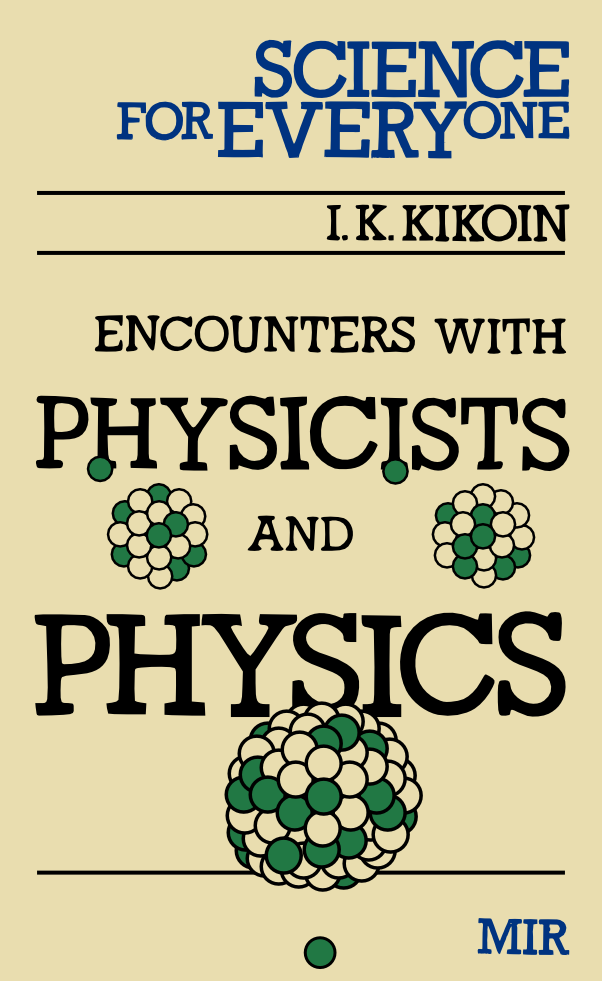
Science for Everyone – Encounters with Physicists and Physics

This is one of the second posts in the Science for Everyone series. Earlier in this series, we have seen Discussions on Refraction of Light by Tarasov and Tarasova.

This book is a compilation of essays by the author on various topics, and the central theme is that of physics and physicists.

From the introduction:

Isaak Kikoin was one of those brilliant physicists who played a
crucial role in the development of Soviet science.

From the back cover

The book contains some of the articles Academician Kiokin
published in the Kvant journal. The author describes in these
articles the advance of Soviet physics as he witnessed it, his
encounters and work with other outstanding scientists, and
some interesting physical phenomena.

Intended for school pupils, teachers, engineers and scientists.

The book was translated from the Russian by Svetlana Landau and was first published by Mir in 1989.

The Internet Archive Link

and here

Follow us on The Internet Archive: https://archive.org/details/@mirtitles

Write to us: mirtitles@gmail.com

Updated: 15 January 2019


Continue reading

Posted in books, mir publishers, physics, science for everyone | Tagged , , , , , , , , | 9 Comments

I Am A Physicist

In I Am A Physicist, Prof. Kitaigorodsky takes 
up a difficult but worthwhile task: that of 
introducing the young reader to the world of 
science and showing the world surrounding him 
through the eyes of a physicist.

We now come to another book by A. Kitaigorodsky, which is an autobiography of his.

The book describes the academic journey of the author through various institutes and the people he met there. The title can be misleading for some, as the book is meant not only for Physicists!! More appropriately it could have been I am A Scientist, as he describes the qualities of a good scientist and is very inspirational in his writing. But  The book makes a wonderful reading, you must read it!

It was translated from the Russian by Vladamir Talmy and was published by Mir in 1971.

The purpose of the book is made clear in the foreword:

Professor Alexander Kitaigorodsky, Doctor of Science in physics and mathematics, is well known not only among his professional colleagues but to a wide circle of readers as well, for he is an ardent popularizer of science. In I Am A Physicist, Prof. Kitaigorodsky takes up a difficult but worthwhile task: that of introducing the young reader to the world of
science and showing the world surrounding him through the eyes of a physicist. He has succeeded remarkably in this endeavour. A scientist in love with his profession, he conveys the complexity of the problems faced by contemporary physics, the intensity of scientific quest and the excitement involved in it with flare and imagination.

lf there is one thing Alexander Kitaigorodsky does not lack it is versatility. The range of problems he raises is truly staggering. What is the measure of patience? ls telepathy possible?
Is money spent on scientific missions and conferences justified? What is the relative importance of the natural and applied sciences? What does the word “explanation” mean? What, if any, are the differences between man and machine? How has physical thinking changed since Aristotle’s time? How should a young man go about choosing a profession? And these are but some of the problems he touches upon. However, for all his diversity of approach, Prof. Kitaigorodsky has a definite singularity of purpose, which is to reveal to the reader the role of physics in natural science and the role of natural science in science and life.

Updated: 15 January 2019
The Internet Archive Link

and here

Follow us on the Internet Archive: https://archive.org/details/@mirtitles

Write to us: mirtitles@gmail.com

Continue reading

Posted in books, mir books, mir publishers, physics | Tagged , , , , , , , , , | 5 Comments

Introduction To Physics

Frankly speaking I did not know about this book from A. Kitagorodsky (thanks Gordon for pointing it out). But this seems to be full fledged and comprehensive textbook, quite different from the popular science books by Kitaigorodsky that we have seen so far.

In the preface he says:

A broad knowledge of physics is a necessity for the specialist working in any branch of science or engineering if he desires to comprehend the fundamental of his field of knowledge and is striving to, take a creative part in its development. The task of a course in physics for students of a technical institute consists, therefore, in helping them to understand the physical basis of engineering.

In addition to this main task, a course in physics in a technical institute should be organised in such a manner as to help the student to master experimental technique and acquaint him with equipment used to measure physical quantities. Skill in experimental physics is attained by working in the laboratory. It seems to us that familiarising oneself with ‘experimental physics is a completely distinct task in the study of physics in technical institutes. The
interweaving of experimental physics with the study of general physical laws and phenomena is only occasionally pedagogically justified. This is due to the fact that modern experimental physics cannot be sharply subdivided. The measurement of coefficients of expansion is accomplished with the aid of interferometry, radio equipment is required for experiments in mechanics and heat, and the investigation of the structure of metals is inseparably linked with experiments in electricity. Physical experiments conducted with the aid of outmoded techniques are of interest only to specialists in physics desiring to trace the development of one or another experiment. It would probably be most expedient to arrange the curriculum in such a manner that laboratory work followed a course in general physics.
Thus, the author believes that lectures in physics, and consequently the corresponding textbook, should include only outlines of experiments, i.e., the goal of the experiments.
Once agreed on the necessity for excluding experimental physics from our course, we must then choose between the inductive approach (from particular experimental facts to theoretical generalities) and the deductive approach (from theory to its experimental corroboration and manifold applications). In a very extensive course, it is probably possible to combine these two approaches as they are linked in the development of science. This possibility was not open to the author and so the second approach was chosen. Presentation of the basic theoretical propositions, the deduction of corollaries that could be verified experimentally, and then the illustration of these experiments by means of diagrams – this was the approach adopted in practically every chapter of this book. Naturally, this meant that the historical method had to be completely disregarded. The history of the origin of ideas, the formul ation and discard of physical theories, remained beyond the scope of this book, since it is written for the student who is not training to be a professional physicist.
It seems to me that only such a method of presentation makes, for clarity and conciseness.

The book was published by Foreign Languages Publishing House in 1966 and was translated from the Russian by O. Smith, the design of the book was done by V. Dober.

You can download the book here and here.

Update: 06 December 2015 | Added Internet Archive link


Continue reading

Posted in books, foreign languages publishing, physics, science | Tagged , , , , , , | 14 Comments