
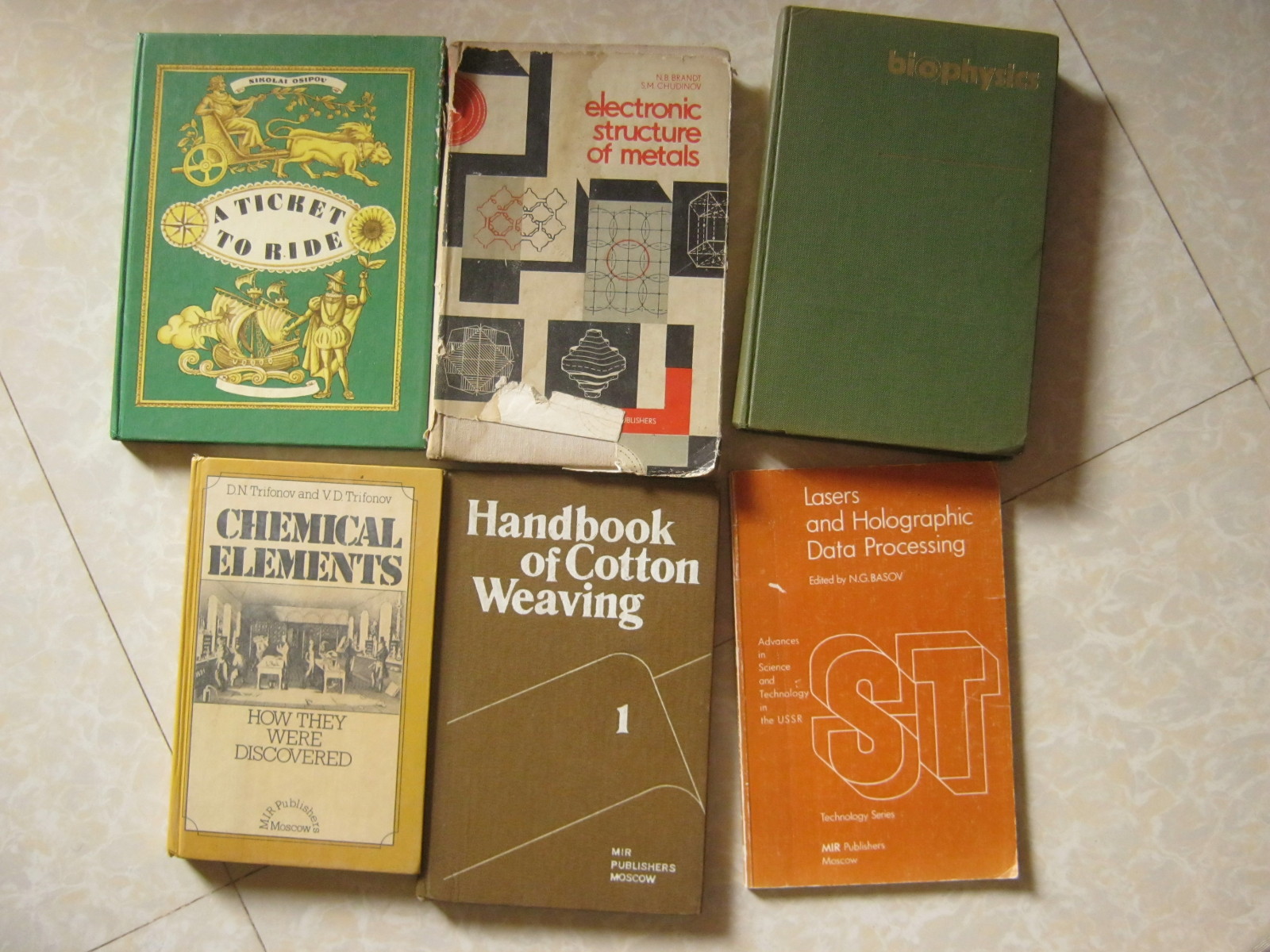


From Blossoms in Bangalore. If you are in B’lore do visit., you might get some surprises there.
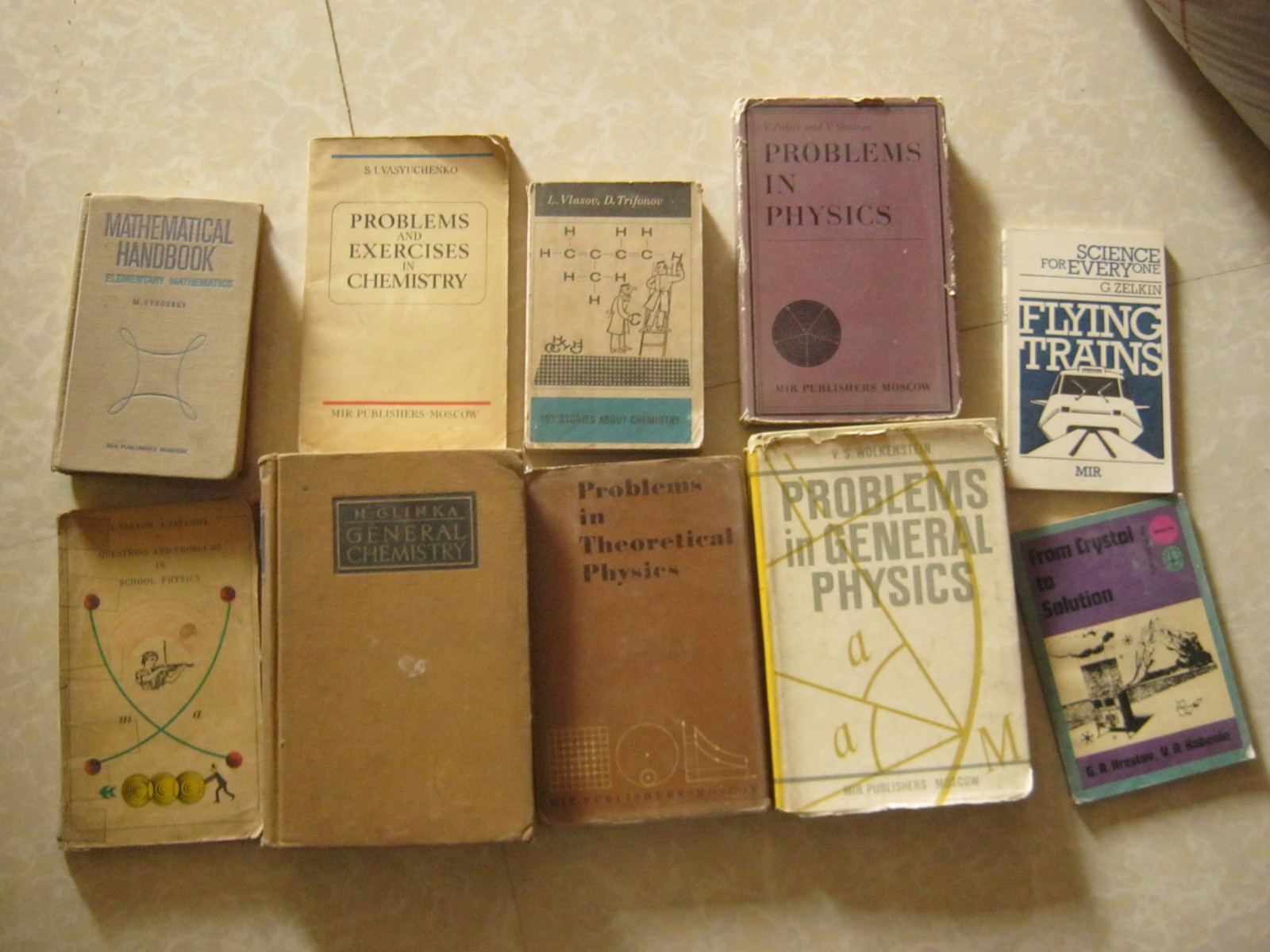
 Received via Hawakajhonka with many thanks from Guptaji

Received with thanks from Ajay.ssa
From Blossoms in Bangalore. If you are in B’lore do visit., you might get some surprises there.
Received via Hawakajhonka with many thanks from Guptaji
Received with thanks from Ajay.ssa


In this post we will see the long awaited two volume Fundamentals of Physics by B. M. Yavorsky and A. A. Pinsky.
This textbook explains the concepts and most important advances of modern physics without resort to higher mathematics. Avoids the traditional division between classical and modern physics and endeavours to present all material so as to develop quantum mechanical concepts.
The textbook is intended for secondary schools and as a teaching aid for physics teachers in general and technical secondary schools. Will be found useful by correspondence students studying ‘A ’ level and first year physics.
Contents.
Vol. I. Motion and Forces, Conservation Laws, Molecular Kinetic Theory of Gases, Molecular Forces and states of aggregation of matter, Electrodynamics
Vol. II . Vibrations and Waves. Quantum Physics of Atoms, Molecules and Solids. Physics of the Nucleus and Elementary Particles.
Comment submitted by Node:
Fundamentals of Physics Volume: 1
Author(s): B. M. Yavorsky, A. A. Pinsky
Updated pdfs with covers an bookmarks here and here
(20 July 2024)
PDF | 544 pp. | OCR | 20 MB
Fundamentals of Physics Volume: 2
Author(s): B. M. Yavorsky, A. A. Pinsky
IA
PDF | OCR | 489 pp. | 24.5 MB
Updated pdfs with covers an bookmarks here and here
(20 July 2024)
All credits to the original uploader. Thanks to node for pointing out the links.
In this post we will see A Course of Differential Geometry and Topology – A. Mishchenko and A. Fomenko. Earlier we had seen the Problem Book on Differential Geometry and Topology by these two authors which is the associated problem book for this course.

About the book
The present course deals with the fundamentals of differential geometry and topology whose present state is the culmination of contributions of generations of mathematicians.
The English edition has been thoroughly revised in line with comments and suggestions, made by our readers, the mistakes and misprints that were detected have been corrected. This is essentially a textbook for modern course on differential geometry and topology, which is much wider than the traditional courses on classical differential geometry, and it covers many branches of mathematics a knowledge of which has become essential for a modern mathematical education. We hope that a reader who has mastered this material will be able to do independent research both in geometry and related fields. To gain a deeper understanding of the material of this book, we recommend the reader should solve the questions in A. S. Mishchenko, Yu. P. Solovyev and A. T. Fomenko Problems in Differential Geometry and Topology which was specially compiled to accompany this course.
The book was translated from the Russian by Anatoly Talshev and was first published by Mir in 1988.
PDF | 75 MB | 459 Pages | Cover |
All credits to the original uploader.
Note: Though the file size is large ~ 75 MB, the scan quality is poor, OCR may not be of any help.
The Internet Archive link and here (optimised pdf ~20MB)
Preface to English Edition 8
Preface to Russian Edition 9
Chapter 1 Introduction to Differential Geometry 12
Chapter 2 General Topology 67
Chapter3 Smooth Manifolds (General theory) 92
Chapter 4 Smooth Manifolds (Examples) 147
Chapter 5 Tensor Analysis and Riemannian Geometry 294
Chapter 6 Homology Theory 371
Chapter 7 Simple Variational Problems in Riemannian Geometry 407
In this post we will see the book Senior Physics 1 by I. K. Kikoin and A. K. Kikoin. 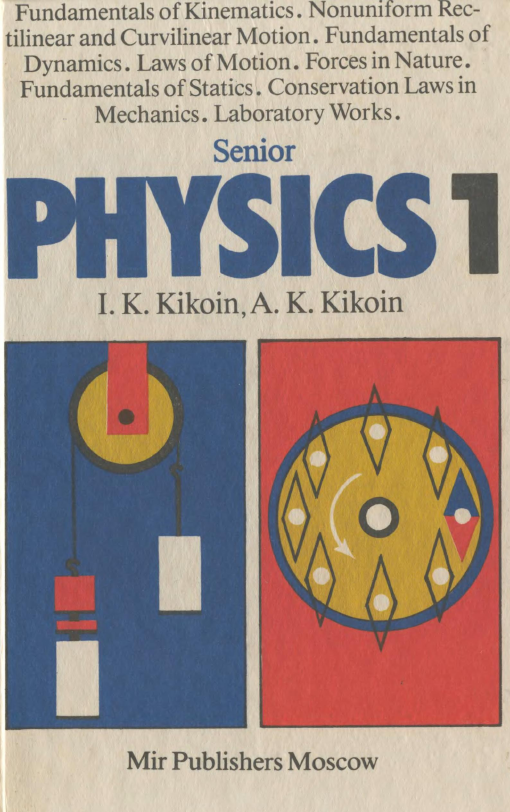 About the book
This book is the second in the series the first one being Junior Physics. There is a second volume in this series which we do not have now. This book covers fundamentals of motion, its laws, forces in nature and conservation laws also. There is a section on Practical work at the end of the book.
The book was translated from the Russian by Natalia Wadhwa. And was first published by Mir in 1987.
PDF| 256 Pages | Cover | Bookmarked | OCR | BW | 8.4 M
All credits to the original uploader.
You can get book here (libgen link) and here (IA link) and here.
Contents
Table of contents :
Introduction……Page 13
Basic Problem of Mechanics……Page 15
1.1. Translational Motion of Bodies. Material Point……Page 16
1.2. Position of a Body in Space. Reference System……Page 17
1.3. Displacement……Page 19
1.4. On Vector Quantities……Page 20
1.5. Projections of a Vector onto Coordinate Axes and Operations on Projections……Page 23
1.6. Uniform Rectilinear Motion. Velocity……Page 28
1.7. Graphic Representation of Motion……Page 32
1.8. Relative Nature of Motion……Page 35
1.9. On System of Units……Page 40
Summary……Page 42
2.1. Velocity of Nonuniform Motion……Page 43
22. Acceleration. Uniformly Accelerated Motion……Page 46
2.3. Displacement in Uniformly Accelerated Motion……Page 50
24. Measurement of Acceleration……Page 58
2.5. Free Fall. Acceleration Due to Gravity……Page 59
Summary……Page 61
3.1. Displacement and Velocity in Curvilinear Motion……Page 63
3.2. Acceleration in Uniform Motion of a Body in a Circle……Page 66
3.3. Period and Frequency of a Body Moving in a Circle……Page 69
3.4. Motion on a Routing Body……Page 70
Summary……Page 71
4.1. Bodies and Surroundings. Newton’s First Law……Page 73
4.2. Interaction of Bodies. Acceleration of Bodies as a Result of Their Interaction……Page 77
4.3. Inertia of Bodies……Page 80
4.4. Mass of Bodies……Page 82
4.5. Force……Page 86
4.6. Newton’s Second Law……Page 88
4.7. What Do We Learn from Newton’s Second Law?……Page 91
4.8. Measurement of Force……Page 94
4.9. Newton’s Third Law……Page 97
Summary. The Importance of Newton’s Laws……Page 99
Are There Many Types of Force in Nature?……Page 102
5.1. Elastic Forces……Page 103
5.2. Motion Is the Cause of Deformation……Page 106
5.3. Force of Universal Gravitation……Page 108
5.4. Gravitational Constant……Page 111
5.5. Force of Gravity……Page 113
5.6. Friction. Static Friction……Page 116
5.7. Sliding Friction……Page 120
Summary……Page 123
6.1. Motion of a Body Under the Action of Elastic Force……Page 124
6.2. Motion Under the Action of Force of Gravity: a Body Moves Along the Vertical……Page 125
6.3. Motion Under the Action of Force of Gravity: Initial Velocity of a Body Is at an Angle to the Horizontal……Page 130
6.4. Weight of a Body. Weightlessness……Page 136
6.5. Weight of a Body Moving with an Acceleration……Page 139
6.6. Artificial Earth’s Satellites. Orbital Velocity……Page 143
6.7. Motion of a Body Under the Action of Friction……Page 146
6.8. Motion of a Body Under the Action of Several Forces……Page 148
6.9. Motion on Bends……Page 153
6.10. Conditions of Translatory Motion of Bodies. Centre of Mass and Centre of Gravity……Page 156
6.11. Are the Laws of Newtonian Mechanics Always Valid? (Motion from Different Points of View)……Page 158
Summary……Page 161
7.1. Equilibrium of Bodies in the Absence of Rotation……Page 162
7.2. Equilibrium of Bodies with a Fixed Axis of Rotation……Page 165
7.3. Stability of Equilibrium of Bodies……Page 171
Summary……Page 176
8.1. Force and Momentum……Page 177
8.2. The Law of Conservation of Momentum……Page 179
8.3. Reaction Propulsion……Page 183
Summary……Page 187
9.1. Mechanical Work……Page 188
9.2. Work Done by Forces Applied to a Body and the Change in Its Velocity……Page 191
9.3. Work Done by the Force of Gravity……Page 195
9.4. Potential Energy of a Body Acted upon by the Force of Gravity……Page 198
9.5. Work Done by an Elastic Force: Potential Energy of a Body Subject to Elastic Deformation……Page 201
9.6. The Law of Conservation of Total Mechanical Energy……Page 205
9.7. Friction Work and Mechanical Energy……Page 209
9.8. Power……Page 212
9.9. Energy Transformation. Utilization of Machinery……Page 215
9.10. Efficiency……Page 217
9.11. Flow of Fluid in Pipes. Bernoulli’s Law……Page 220
On the Importance of Conservation Laws……Page 224
Conclusion……Page 226
1. Determination of the Acceleration of a Body in Uniformly Accelerated Motion……Page 234
2. Measurement of the Rigidity of a Spring……Page 235
3. Determination of the Coeflicient of Sliding Friction……Page 237
4. Analysis of Motion of a Body Along a Parabola……Page 238
5. Analysis of Motion of a Body in a Circle……Page 239
6. Equilibrium Conditions for a Lever……Page 241
7. Determination of the Centre of Gravity of a Flat Plate……Page 242
8. Experimental Investigation of the Law of Conservation of Mechanical Energy……Page 243
Answers to Exercises……Page 245
Index……Page 247
In this post we will see Molecular Physics by A. N. Matveev. In the past we have seen Mechanics and Theory of Relativity, Electricity and Magnetism and Optics.
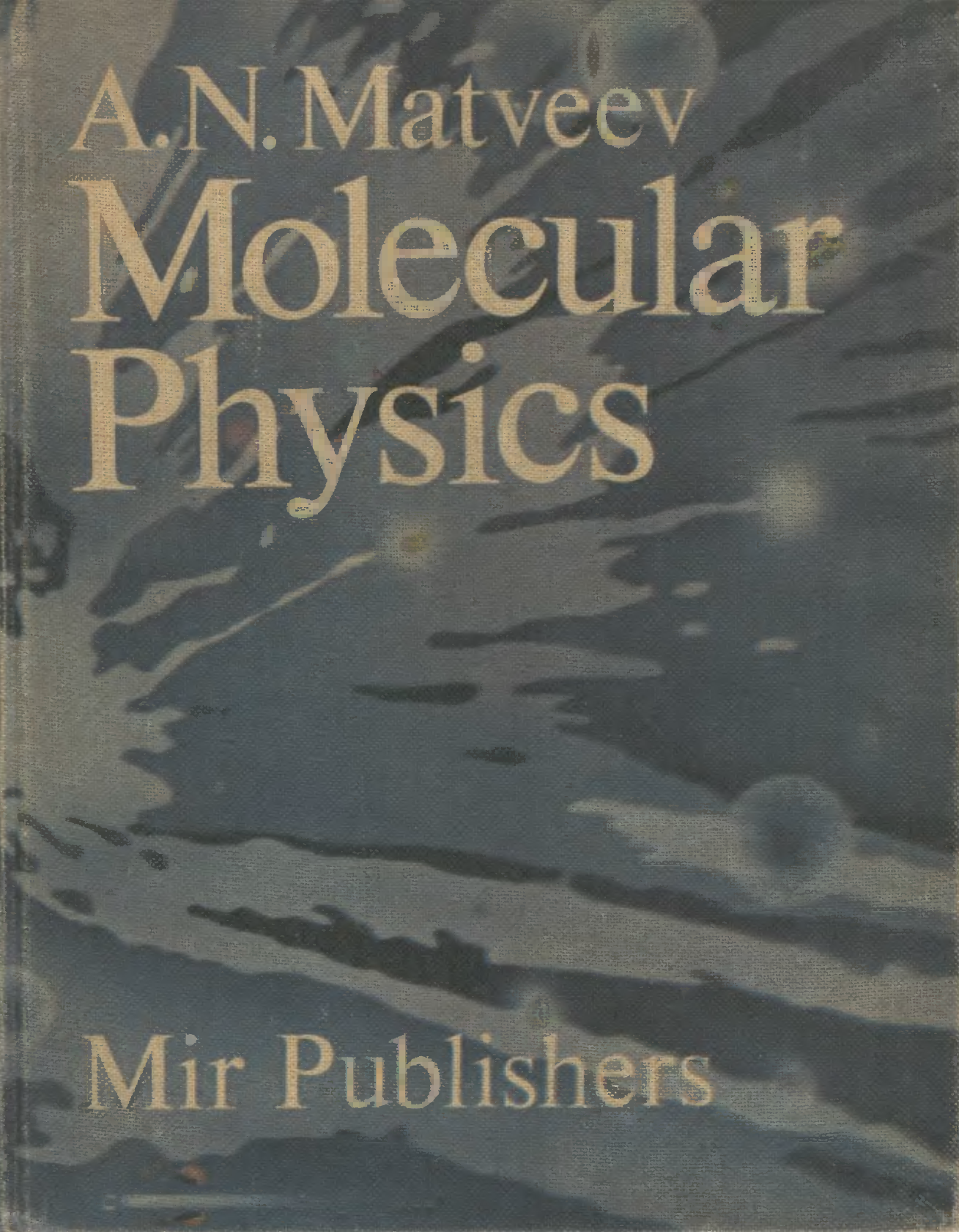
About the book
The book also contains material not covered by
traditional courses but required for solving a wider range of
problems than just the study of the properties of molecular
systems. In the first place this applies to the electron and
phonon gases. Although this material does not necessarily
form a part of the existing curriculum, it is recommended as
an optional reading since it gives the student a better idea
about the distribution in the statistical description of
phenomena.
This book is based on the course of lectures delivered by
the author for many years at the Lomonosov Moscow State
University.
The book was translated from the Russian by by Natasha Deineko
and Ram Wadhwa. The English version was first published in 1985.
Many thanks to Pseudoanonymous Greek for pointing out the libgen link.
All credits to the original uploader.
DJVU | OCR | COVER | BOOKMARKED | 8 M | 450 Pages
You can get the book here (IA Link) and here (Libgen Link) and here.
Contents
Table of contents :
Preface ……Page 6
Contents ……Page 8
Sec.l. Methods of Investigating Many-particle Systems ……Page 16
Sec. 2. Mathematical Concepts ……Page 25
Sec. 3. Macroscopic and Microscopic States of a System ……Page 41
Sec. 4. The Equal Probability Postulate and the Ergodic Hypothesis ……Page 44
Sec. 5. The Probability of a Macroscopic State ……Page 52
Sec. 6. Fluctuations ……Page 67
Sec. 7. The Canonical Ensemble. Gibbs Distribution ……Page 73
Sec. 8. Maxwell Distribution ……Page 78
Sec. 9. Boltzmann Distribution ……Page 92
Sec. 10. Pressure ……Page 102
Sec. 11. Temperature ……Page 111
Sec. 12. Distribution of Energy among the Degrees of Freedom ……Page 120
Sec. 13. Brownian Movement ……Page 129
Problems ……Page 135
Sec. 14. The First Law of Thermodynamic ……Page 138
Sec. 15. Differential Forms and Total Differentials ……Page 144
Sec. 16. Reversible and Irreversible Processes ……Page 149
Sec. 17. Heat Capacity ……Page 151
Sec. 18. Processes in Ideal Gases ……Page 161
Sec. 19. Entropy of Ideal Gas ……Page 169
Sec. 20. Cyclic Processes ……Page 174
Sec. 21. Absolute Thermodynamic Temperature Scale ……Page 186
Sec. 22. The Second Law of Thermodynamics ……Page 194
Sec. 23. Thermodynamic Functions and the Conditions of Thermodynamic Stability ……Page 211
Problems ……Page 223
Sec. 24. Various Models of the Behaviour of Particles ……Page 226
Sec. 25. The Fermi-Dirac Distribution ……Page 228
Sec. 26. Bose-Einstein Distribution ……Page 231
Sec. 27. The Electron Gas ……Page 233
Sec. 28. The Photon Gas ……Page 241
Problems ……Page 245
Sec. 29. Forces of Interaction ……Page 248
Sec. 30. Liquefaction of Gases ……Page 257
Sec. 31. Clausius-Clapeyron Equation ……Page 263
Sec. 32. Van der Waals Equation ……Page 266
Sec. 33. Joule-Thomson Effect ……Page 285
Sec. 34. Surface Tension ……Page 295
Sec. 35. Evaporation and Boiling of Liquids ……Page 303
Sec. 36. Structure of Liquids. Liquid Crystals ……Page 312
Sec. 37. Liquid Solutions ……Page 318
Sec. 38. Boiling of Liquid Solutions ……Page 322
Sec. 39. Osmotic Pressure ……Page 325
Sec. 40. Chemical Potential and Phase Equilibrium ……Page 327
Sec. 41. Phase Rule ……Page 330
Problems ……Page 332
Sec. 42. Symmetry of Solids ……Page 336
Sec. 43. Crystal Lattice ……Page 339
Sec. 44. Defects of Crystal Lattices ……Page 347
Sec. 45. Mechanical Properties of Solids ……Page 348
Sec. 46. Heat Capacity of Solids ……Page 357
Sec. 47. Crystallization and Melting ……Page 373
Sec. 48. Alloys and Solid Solutions ……Page 382
Sec. 49. Polymers ……Page 384
Problems ……Page 391
Sec. 50. The Types of Transport Processes ……Page 394
Sec. 51. Kinematic Characteristics of Molecular Motion ……Page 395
Sec. 52. Transport Processes in Gases ……Page 403
Sec. 53. Relaxation Time ……Page 416
Sec. 54. Physical Phenomena in Rarefied Gases ……Page 421
Sec. 55. Transport Phenomena in Solids ……Page 426
Sec. 56. Transport Phenomena in Liquids ……Page 430
Sec. 57. Basic Concepts of Thermodynamics of Irreversible Processes ……Page 432
Problems ……Page 441
Appendix 1. SI Units Used in Molecular Physics ……Page 443
Appendix 2. Physical Constants ……Page 445
Subject Index ……Page 446
We had previously seen Mechanics and Theory of Relativity, and Electricity and Magnetism by A. N. Matveev. In this post we will see another book, Optics by this great author.
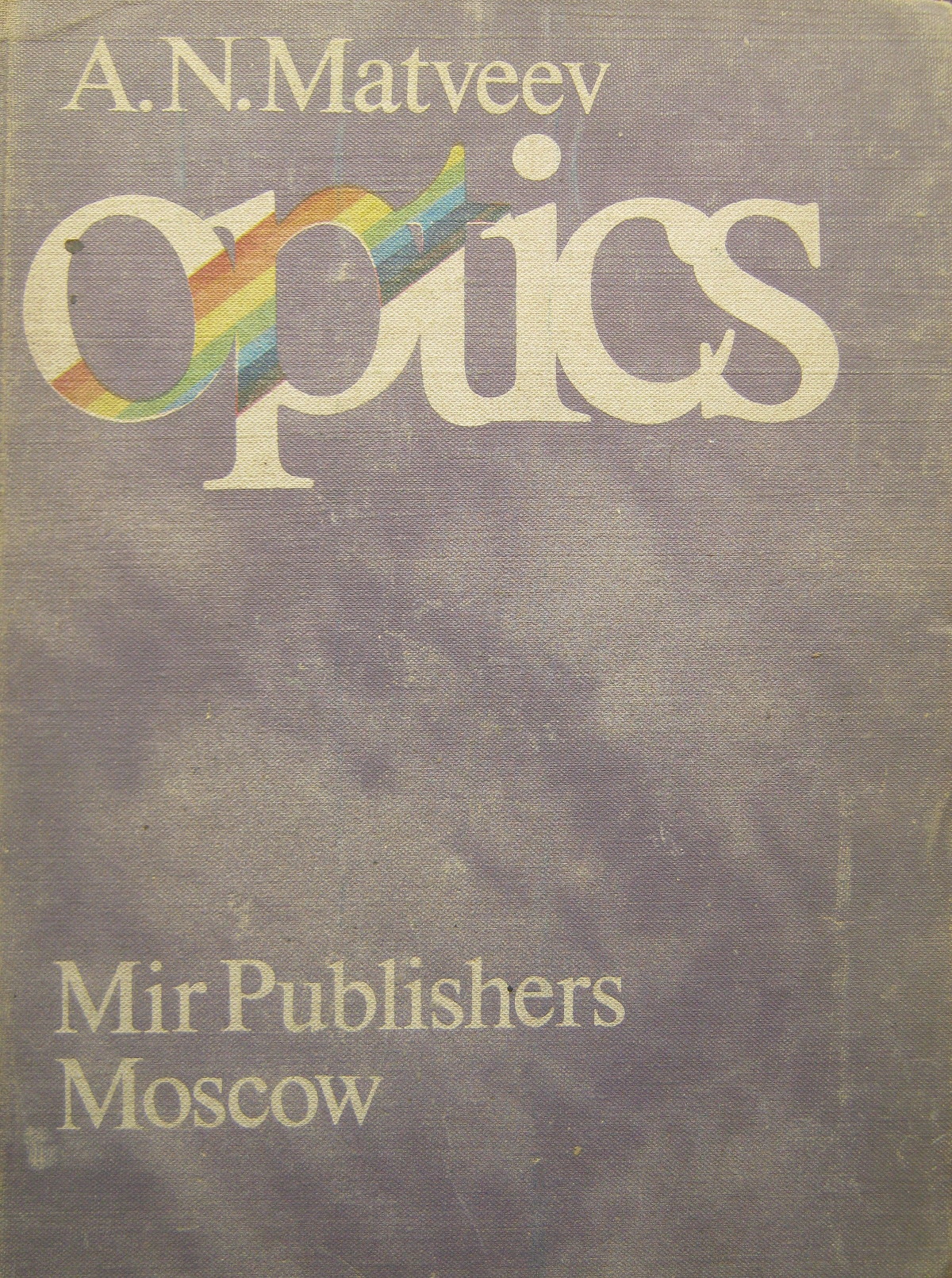
The subject matter of the book is completely reflected in Contents. Statistical properties of light and its spectral representation are covered in greater detail than usual. Diffraction of light is described in the framework of Kirchhoffs integral. The effectiveness of the matrix methods is shown in sections covering geometrical optics and interference of light in thin films. A unified approach involving Fourier optics has been adopted for describing the diffraction theory of image formation, spatial filtration of images, holography, and other allied topics. Analysis of partial coherence and partial polarization is carried out in terms of the first correlation function. The mathematical aspect of the material presented in this book has been kept as simple as possible, and at the same time in line with the rigorous scientific approach.
The most significant aspect in which this book differs from the books dealing with mechanics, molecular physics and electricity is that its basic principles lie beyond the scope of this course. Because of this, considerable emphasis has been laid on the deductive method of description. The material of this course
is therefore presented in deductive form and in most cases (though not always) the experimental results are analyzed to show the agreement between the theoretical results and the experimental data, or to explain the observed phenomena. The book is based on the author’s experience of teaching physics for many years at the Physics Faculty of the Lomonosov State University, Moscow.
This link was pointed out by Amit in a comment on Matveev’s Electricity and Magnetism. Many thanks to him.
All credits to the original uploader.
PDF | OCR | 24 MB
You can get the book here (original link posted in the comment above) here. (IA Link)
and here
Preface
1. Electromagnetic Waves
Sec. 1. Optical Range of Electromagnetic Waves 15
Wavelengths of the visible range.
Wave frequencies in the visible range.
Optical and other ranges of electromagnetic waves.
Why can we see only in the visible range?
Why is microwave range unsuitable for vision?
Night vision.
Sec. 2. Properties of Electromagnetic Waves 22
Electromagnetic nature of light.
Wave equation.
Plane waves.
Spherical waves.
Plane harmonic waves.
Wave vector.
Complex representation of a plane wave.
Complex representation of a spherical wave.
Plane electromagnetic wave.
Invariance of a plane wave.
Phase invariance.
Four-dimensional wave vector.
Transformation formulas for frequency and direction of propagation of a plane
wave.
Doppler effect.
Sec. 3. Flux Densities of Energy and Momentum of Electromagnetic Waves. Light Pressure 35
Energy flux density.
Flux density distribution over beam cross section.
Gaussian beam.
Momentum density of electromagnetic waves.
Light pressure.
Effect of light pressure on small particles.
Laser fusion.
Transformation of amplitude and normal vector of a plane electromagnetic wave.
Energy of a plane wave train.
Momentum of a plane wave train.
Sec. 4. Superposition of Electromagnetic Waves 43
Superposition of field vectors of a wave.
Superposition of travelling monochromatic electromagnetic plane waves.
Beats.
Standing waves.
Energy transformation in a standing electromagnetic wave.
Experimental proof of the electromagnetic nature of light.
Sec. 5. Polarization of Electromagnetic Waves 49
Polarization.
Linear polarization.
Superposition of linearly polarized waves.
Elliptical and circular polarizations.
Variation of the electric field vector in space for elliptical and circular polarizations.
Degenerate case of elliptical polarization.
Number of independent polarizations.
Linearly polarized wave as a superposition of circularly polarized waves.
Sec. 6. Averaging 52
Averaging operation.
Averaging of harmonic functions.
Averaging of squares of harmonic functions.
Linearity of the averaging operation.
Calculations involving complex scalars.
Calculations involving complex vector quantities.
Sec. 7. Photometric Concepts and Quantities 57
Radiant and photometric quantities.
Radiant quantities.
Radiant intensity.
Radiance.
Radiant emittance (exitance).
Radiant illuminance.
Photometric quantities.
Luminous flux.
Luminance.
Luminous emittance.
Illuminance. Light exposure.
Relations between radiant and luminous characteristics of radiation.
2. Nonmonochromatic and Random Radiation
Sec. 8. Spectral Composition of Functions 71
Fourier series in real form.
Fourier series in complex form.
Fourier integral in real form.
Fourier integral in complex form.
Amplitude spectrum and phase spectrum.
Determination of the amplitude and phase spectra from complex form of Fourier series.
Continuous spectrum. Spectrum of rectangular pulses.
Spectrum of sawtooth pulses.
Spectrum of a single rectangular pulse.
Spectrum of an exponentially decreasing function.
Relation between the pulse duration and the spectral width.
Displacement of the time reference point.
Frequency displacement of spectrum.
Negative frequencies.
Parseval’s theorem.
Plancherel’s theorem.
Sec. 9. Natural linewidth of Radiation 79
Classical model of a radiator.
Spectral composition of radiation.
Lorentz shape and width of emission line.
Emission time.
Shape of absorption line.
Quantum interpretation of the shape of emission line.
Quasi-monochromatic wave.
Sec. 10. Spectral Line Broadening 86
Reasons for broadening.
Uniform and nonuniform broadening.
Natural width of emission line as a uniform broadening.
Collision broadening.
Doppler broadening.
Shape of a composite emission line.
Sec. 11. Modulated Waves 91
Modulation.
Amplitude modulation.
Frequency and phase modulation.
Oscillation spectrum with harmonic frequency modulation.
Sec. 12. Wave Packets 94
Wave packet formed by two waves.
Group velocity.
Superposition of oscillations with equidistant frequencies.
Quasi-plane wave.
Sec. 13. Random Light 98
Superposition of waves with random phases.
Resolution time.
Averaging over oscillation period.
Effect of increasing time interval on the result of averaging.
Coherence time.
Coherence length.
Gaussian light.
Energy flux density fluctuations for random light.
Polarization.
Sec. 14. Fourier Analysis of Random Processes 103
Power spectrum (spectral function).
Autocorrelation function.
Wiener-Khintchine theorem.
Correlation interval.
Relation between the correlation interval and the normalized spectral function.
3. Propagation of Light in Isotropic Media
Sec. 15. Propagation of Light in Dielectrics 111
Monochromatic waves.
Dispersion.
Normal dispersion.
Anomalous dispersion.
Scattering of light.
Propagation of a wave packet.
Replacement of a light wave in a medium.
Dispersion of light in interstellar space.
Colour of bodies.
Sec. 16. Reflection and’ Refraction of Light at the Interface Between Two Dielectrics. Fresnel’s Formulas 121
Boundary conditions.
Constancy of the wave frequency upon reflection and refraction.
The plane of incident, reflected and refracted rays.
Relation between the angles of incidence, reflection and refraction.
Decomposition of a plane wave into two waves with mutually perpendicular linear polarizations.
Vector E is perpendicular to the plane of incidence.
Fresnel’s formulas for the perpendicular components of the field vector.
Vector E lies in the plane of incidence.
Fresnel’s formulas for parallel components of field vector.
Brewster effect.
Relation between the phases of reflected and refracted waves.
Degrees of polarization.
Sec. 17. Total Reflection of Light 135
Formulas for angles \theta_in >= \theta_lim
Wave in the second medium.
Penetration depth.
Phase velocity. Reflected wave.
Sec. 18. Energy Relations for Reflection and Refraction of Light 139
Energy flux densities.
Reflection coefficient.
Transmission coefficient.
Law of energy conservation.
Polarization of light upon reflection and refraction.
Sec. 19. Propagation of Light in Conducting Media 142
Complex permittivity.
Penetration depth.
Physical reason behind absorption.
Phase velocity and wavelength.
Relation between the phases of field vector oscillations.
Relation between amplitudes of field vectors.
Media with low conductivity.
Media with high conductivity.
Sec. 20. Reflection of Light from a Conducting Surface 147
Boundary conditions.
Relation between wave amplitudes.
Reflection coefficient.
Connection between reflecting and absorbing properties.
4. Geometrical Optics
Sec. 21. Geometrical Optics Approximation 153
Eikonal equation.
Ray of light.
Range of applicability of the ray approximation.
Fermat’s principle.
Derivation of the law of refraction from Fermat’s principle.
Propagation of a ray in a medium with varying refractive index.
Sec. 22. Lenses, Mirrors and Optical Systems 159
Paraxial approximation.
Refraction at a spherical surface.
Matrix notation.
Propagation of a ray in a lens.
Refraction of the ray at the second spherical surface.
Refraction of a ray by a lens.
Propagation of a ray through an optical system.
Reflection from spherical surfaces.
Sec. 23. Optical Image 165
Matrix of an optical system.
Transformation of a ray from object plane to image plane.
Cardinal elements of an optical system.
Physical meaning of the Gauss constants.
Construction of images.
Lens equation.
Thin lenses.
A system of thin lenses.
Utilization of computers.
Sec. 24. Optical Aberration 173
Sources of aberration.
Exact transformation matrices.
Spherical aberration.
Coma.
Aberration caused by off-axis inclined rays.
Chromatic aberration.
Oil-immersion lens.
Abbe’s sine condition.
Sec. 25. Optical Instruments 180
Diaphragming.
Basic concepts associated with diaphragming.
Eye as an optical system.
Photographic camera.
Magnifying glass.
Microscope.
Telescope.
Optical projectors.
5. Interference
Sec. 26.
Two-beam Interference Caused by Amplitude Division 189
Definition of interference.
Light intensity upon superposition of two monochromatic waves.
Methods of producing coherent waves in optics.
Interference of monochromatic waves propagating strictly along the axis of a Michelson
interferometer.
Interference of monochromatic waves propagating at an angle to the interferometer axis.
The reason behind the blurring of interference fringes.
Interference of nonmonochromatic light.
Fourier transform spectroscopy.
Visibility for a Gaussian line.
Visibility for a Lorentz line.
Michelson’s interferometer with linear fringes.
White light interference pattern.
Mach-Zehnder interferometer.
Twyman-Green interferometer.
Jamin refractometer.
Sec. 27. Two-beam Interference Through Wave Front Splitting 205
Huygens’ principle.
Young’s two-slit interferometer.
White light interference.
Finite-sized source.
Source with a uniform distribution of emission intensity.
Space and time coherence.
Coherence angle and coherence width.
Stellar interferometer.
Measurement of the diameters of stars.
Measurement of the distance between components of a double star.
Fresnel biprism.
Billet split lens.
Lloyd’s mirror interference.
Fresnel mirrors.
Law of energy conservation in interference.
Sec. 28. Multiple-beam Interference Through Amplitude Divisio 216
Fabry-Perot interferometer.
Intensity distribution in interference pattern.
Interference rings.
Resolving power.
Factors limiting the resolving power.
Dispersion region.
Fabry-Perot scanning interferometer.
Interference filters.
Lummer-Gehrcke plate. Michelson echelon grating.
Sec. 29. Interference in Thin Films 226
Optical path length.
Reflection from parallel surfaces.
Uniform inclination fringes.
The role of source size.
The role of plate thickness and monochromaticity of radiation.
Uniform thickness fringes (isopachic fringes).
Newton rings.
Multiple reflection.
Layer with zero reflectivity.
Layer with a high reflectivity.
Matrix method of computations for multilayer films.
Multilayer dielectric mirrors.
Translucent materials.
Sec. 30. Partial Coherence and Partial Polarization 239
Partial coherence.
Mutual coherence function.
Normalized coherence function.
Coherence function.
Brown-Twiss experiment.
Partial polarization.
Coherence matrix for a quasi-monochromatic plane wave.
Normalized coherence function for mutually perpendicular projections of the electric field strength of a wave.
Natural (nonpolarized) light.
Completely polarized light.
Degree of polarization of a light wave.
Expression of degree of polarization in terms of extremal intensities.
Representation of natural light. Relation between the degrees of polarization and coherence function.
Van-Zittert-Zemike theorem.
6. Diffraction
Sec. 31. Fresnel Z ne Method 263
Huygens-Fresnel principle.
Fresnel zones.
Graphic computation of amplitude.
Poisson’s spot.
Diffraction at the knife-edge of a semi-infinite screen.
Zone plate as a lens.
Drawbacks of the Fresnel zone method.
Sec. 32. Kirchhoff s Approximation 269
Green’s formula.
Helmholtz-Kirchhoff theorem.
Radiation condition.
Kirchhoffs approximation.
Optical approximation.
Fresnel-Kirchhoff diffraction relation.
Helmholtz’ reciprocity theorem.
Secondary sources.
Fresnel’s approximation.
Sec. 33. Fraunhof er Diffraction 277
Fraunhofer diffraction region.
Diffraction at a rectangular aperture.
Diffraction at a slit.
Diffraction at a circular aperture.
Diffraction grating.
Diffraction of white light at a grating.
Dispersion region.
Resolving power.
Reflection gratings.
Diffraction at a slit for a continuously varying wave phase.
Phase gratings.
Amplitude and phase gratings.
Oblique incidence of rays on a grating.
Diffraction at continuous periodic and aperiodic structures.
Diffraction by ultrasonic waves.
Comparison of the characteristics of spectral instruments.
Sec. 34. Fresnel Diffraction 29
Fresnel’s diffraction region.
Diffraction at a rectangular aperture.
Fresnel integrals.
Cornu’s spiral.
7. Basic Concepts of Fourier Optics
Sec. 35. Lens as an Element Accomplishing a Fourier Transformation 299
Phase transformation by a thin lens.
Evaluation of the thickness function.
Types of lenses.
Lens as an element accomplishing a Fourier transformation.
Sec. 36. Diffraction Formation of Images by a Lens 303
Fourier transformation of amplitudes between the focal planes of a lens.
Image formation by a lens.
Limiting resolving power of optical instruments.
Dark-field illumination method.
Phase-contrast method.
Sec. 37. Spatial Filtering of Images 313
The essence of spatial filtering of images.
Spatial filtering of the diffraction grating images.
Abbe-Porter experiment.
Sec. 38. Holography 315
Synchronous detection.
Hologram of a plane wave.
Reconstruction of the image.
Hologram of a point object.
Hologram of an arbitrary object.
Quality of a photographic plate and the exposure time.
Three-dimensional reproduction of the object.
Thick holograms (Denisyuk’s method).
Bragg’s law.
Recording of holograms and reconstruction of a plane wave.
Recording of holograms and reconstruction of a spherical wave.
Holographic recording and reconstruction of the image of an arbitrary object.
Three-dimensional coloured image.
Peculiarities of holograms as carriers of information.
Applications of holography.
8. Propagation of Light in Anisotropic Media
Sec. 39. Anisotropic Media 331
Sources of anisotropy.
Anisotropic dielectric media.
Permittivity tensor.
Sec. 40. Propagation of a Plane Electromagnetic Wave in an Anisotropic Medium 334
Plane electromagnetic wave in anisotropic medium.
Dependence of phase velocity on the direction of wave propagation and oscillations of vector D.
Fresnel equation.
Possible types of waves.
Sec. 41. Passage of Rays Through an Anisotropic Medium 338
Dependence of ray (group) velocity on direction.
Ellipsoid of group velocities.
Analysis of ray path through ellipsoid of group velocities.
Optical axis.
Biaxial and uniaxial crystals.
Index ellipsoid.
Ray surface.
Sec. 42. Birefringence 344
Ordinary and extraordinary rays.
Essence of birefringence.
Huygens’ construction.
Optical axis is perpendicular to the crystal surface.
Optical axis is parallel to the crystal surface.
Optical axis is at an angle to the crystal surface.
Malus’ law of rays.
Polarization in birefringence.
Polaroid.
Polarizing prisms and birefringent prisms.
Nicol prism.
Birefringent prism.
Polychroism.
Sec. 43. Interference of Polarized Waves 349
Interference of rays with mutually perpendicular directions of linear polarization.
Quarter-wave plate.
Half-wave plate.
Wave plate.
Analysis of linearly polarized light.
Analysis of elliptically polarized light.
Analysis of circularly polarized light.
Compensators.
Colours of crystal plates.
Phenomena occurring in convergent rays.
Sec. 44. Rotation of the Polarization Plane 354
Rotation of polarization plane in crystalline bodies.
Rotation of polarization plane in amorphous substances.
Phenomenological theory of the rotation of polarization plane.
Optical isomerism.
Rotation of polarization plane in a magnetic field.
Sec. 45. Artificial Anisotropy 358
Anisotropy due to deformation.
Anisotropy caused by an electric field.
Anisotropy caused by a magnetic field.
Pockels effect.
9. Scattering of Light
Sec. 46. Scattering Pro.cesses · 365
Sec. 47. Rayleigh Scattering and M e Scattering 366
Nature of scattering.
Types of scattering.
Multiple scattering.
Model of an elementary scatterer.
Rayleigh scattering.
Rayleigh law.
Angular distribution and polarization of light in Rayleigh scattering.
Attenuation of light intensity.
Mie scattering.
Angular intensity distribution and polarization of radiation in Mie scattering.
Manifestations of Mie scattering.
Sec. 48. Brillouin Scattering 375
Sec. 49. Raman Scattering 376
Brillouin components.
Undisplaced component.
Brillouin scattering in solids.
Classical interpretation.
Experimental facts.
Quantum interpretation.
Applications of Raman scattering.
10. Generation of Light
Sec. 50. Blackbody Radiation 38
Radiation density.
Equilibrium density of radiation.
Kirchhoff’s first law of radiation.
Absorptive power and radiant emittance.
Kirchhoff’s second law of radiation.
Blackbody.
Number density of oscillation modes.
Rayleigh-Jeans formula.
Wien’s formula.
Planck’s formula.
Stefan-Boltzmann law.
Wien’s displacement law.
Elementary quantum theory.
Spontaneous and induced transitions.
Einstein’s coefficients.
Sec. 51. Optical Amplifiers 391
Passage of light through a medium.
Burger’s law.
Amplification conditions.
Effect of light flux on the population density of levels.
Saturation conditions.
Creation of population inversion.
Sec. 52. Lasers 394
Schematic diagram of a laser.
Lasing threshold.
Steady-state lasing conditions.
Q-factor.
Continuous-wave (CW) and pulsed lasers.
Enhancement of the emission power.
Q-switching method.
Sec. 53. Laser Radiation 398
Radiation modes.
Resonator with plane rectangular mirrors.
Axial (longitudinal) modes.
Width of emission lines.
Side modes.
Cylindrical resonator with spherical mirrors.
Mode synchronization.
Pulse duration.
Attainment of mode synchronization.
Laser speckles.
Sec. 54. Characteristics of Some Lasers 406
Various types of lasers.
Ruby laser.
Helium-neon laser.
Closed-volume C02 laser.
CW-mode C0 2 -laser.
T-laser.
Gasdynamic lasers.
Dye lasers.
11. Nonlinear Phenomena in Optics
Sec. 55. Nonlinear Polarization 413
Linear polarization.
Nonlinear polarization.
Quadratic nonlinearity.
Nonlinear susceptibility.
Combination frequencies.
Sec. 56. Generation of Harmonics 417
Linear polarization waves.
Nonlinear polarization waves.
Spatial synchronism
condition. Coherence length.
Attainment of spatial synchronism.
Generation of higher harmonics.
Vector condition for spatial synchronism.
Generation of sum and difference frequencies.
Spontaneous decay of a photon.
Parametric amplification of light.
Parametric generators of light.
Sec. 57. Self-focussing of Light in a Nonlinear Medium 427
Nonlinear correction to the refractive index.
Self-focussing and defocussing of a beam.
Self-focussing length.
Threshold energy flux.
Main reasons behind nonlinearity of the refractive index.
Time lag.
Appendix. SI units used in the book 432
Conclusion 434
Subject Index 441
Post from Arvind Gupta
Just finished scanning and uploading 10 Soviet Children’s Books in Hindi
love and peace
arvind
AAFANTI KE KISSE
https://archive.org/details/AafantiKeKisse-Hindi-SovietChildrensBook
JAHAN CHAH WAHAN RAAH
https://archive.org/details/JahanChahWahanRaah-Hindi-SovietChildrensBook
JAB PAPA BACHCHE THE – ALEXANDER RASKIN
https://archive.org/details/JabPapaBachcheThe-Hindi-AlexanderRaskin
BACHCHON SUNO KAHANI – LEO TOLSTOY
https://archive.org/details/BachchonSunoKahani-Hindi-LevTolstoy
TEEN MOTE
https://archive.org/details/TeenMote-Hindi-YuriOlesha
UKRAINI LOK KATHAYEN
https://archive.org/details/UkrainiLokKathain-Hindi-SovietChildrensBook
THE WHITE STORK IN THE SKY
https://archive.org/details/UkrainiLokKathain-Hindi-SovietChildrensBook
KAHANIYAN DHATUYON KI – S. VENETSKY – STORIES OF METALS
https://archive.org/details/KahaniyanDhatuyonKi-Hindi-TalesOfMetals-S.Venetsky
HEERE-MOTI – SOVIET STORIES FROM ITS REGIONS
https://archive.org/details/HeereMoti-Hindi-CollationOfSovietFolkTales
BHALAI KAR, BURAI SE BACH – SOVIET FOLKTALES
https://archive.org/details/BhalaiKarBuraiSeDar-Hindi-TalesFromKazhakistan
In this post we will see the book Problems in Differential Geometry and Topology by A. S. Mishchenko, Yu. P. Solovyev and A. T. Fomenko
 About the book
This problem book is compiled by eminent Moscow university teachers.
Based on many years of teaching experience at the mechanics-and-mathematics department, it contains problems practically for all sections of the differential geometry and topology course delivered for university students: besides classical branches of the theory of curves and surfaces, the reader win be offered problems in smooth manifold theory, Riemannian geometry, vector fields and differential forms, general topology, homotopy theory and elements of variational calculus. The structure of the volume corresponds to A Course of Differential Geometry and Topology (Moscow University Press 1980) by Prof. A. T. Fomenko and Prof. A. S. Mishchenko Some problems however, touch upon topics outside the course lectures. The corresponding sections are provided with all necessary theoretical foundations.
About the authors
Alexander Sergeevich Mishchenko, D.Sc. (Phys.-Math.), is a professor at Moscow State University. His doctoral dissertation was devoted to modern aspects of algebraic K-theory. The author of more than 50 scientific papers and 4 books, Professor Mishchenko is a regular invited speaker at the International Congress of Mathematicians. He is a member of the Inspection Committee of the Moscow Mathematical Society.
Anatoly Timofeevich Fomenko, D.Sc. (Phys.-Math.), is a professor at Moscow State University. In his dissertation “Multidimensional Problem of Plateau on Riemannian Manifolds”, which was awarded a prize by the Moscow Mathematical Society, he solved the classical problem of variational calculus. He is a regular invited speaker at the International Congress of Mathematicians. Professor Fomenko has published more than 70 scientific papers and 5 books. His book Modern Geometry, coauthored with Academician S. R Novikov and B. A. Dubrovin, was published in French by Mir Publishers.
Yury Petrovich Solovyev, Cand.Sc. (Phys.-Math.), is a senior scientific worker at Moscow State University. Solovyev’s scientific interests lie in the field of algebraic K .. theory. He has published more than 40 papers, and serves as deputy editor-in-chief of the popular mathematics magazine Quantum.
The book was translated from the Russian by Oleg Efimov and was first published by Mir in 1985.
Credits to the original uploader for the scans.
The original copy was cleaned at bit, ocred, bookmarked and cover added.
PDF | OCR | Bookmarked | Cover | 6.2 MB | 209 pages
You can get the book here. and here
Contents
Preface 5
1. Application of Linear Algebra to Geometry 7
2. Systems of Coordinates 9
3. Riemannian Metric 14
4. Theory of Curves 16
5. Surfaces 34
6. Manifolds 53
7. Transformation Groups 60
8. Vector Fields 64
9. Tensor Analysis 70
10. Differential Forms, Integral Formulae, De Rham Cohomology 75
11. General Topology 81
12. Homotopy Theory 87
13. Covering Maps, Fibre Spaces, Riemann Surfaces 97
14. Degree of Mapping 105
15. Simplest Variational Problems 108
Answers and Hints 113
Bibliography 208
In this post we will see the book The Theory of Functions of A Complex Variable by A. G. Sveshnikov and A. N. Tikhonov.
 About the book
The book covers basic aspects of complex numbers, complex variables and complex functions. It also deals with analytic functions, Laurent series etc.
The book was translated from the Russian by Eugene Yankovsky and was first published by Mir in 1971 with a reprint in 1973. The current book is the second edition first published in 1978 and reprinted in 1982.
PDF | OCR | Bookmarked | 600 dpi | Cover | 17.5 MB
You can get the book here. and here
Introduction 9
Chapter 1. THE COMPLEX VARIABLE AND FUNCTIONS OF A COMPLEX VARIABLE 11
1.1. Complex Numbers and Operations on Complex Numbers 11
a. The concept of a complex number 11
b. Operations on complex numbers 11
c. The geometric interpretation of complex numbers 13
d. Extracting the root of a complex number 15
1.2. The Limit of a Sequence of Complex Numbers 17
a. The definition of a convergent sequence 17
b. Cauchy’s test 19
c. Point at infinity 19
1.3. The Concept of a Function of a Complex Variable. Continuity 20
a. Basic definitions 20
b. Continuity 23
c. Examples 26
1.4. Differentiating the Function of a Complex Variable 30
a. Definition. Cauchy-Riemann conditions 30
b. Properties of analytic functions 33
c. The geometric meaning of the derivative of a function of a complex variable 35
d. Examples 37
1.5. An Integral with Respect to a Complex Variable 38
a. Basic properties 38
b. Cauchy’s Theorem 41
c. Indefinite Integral 44
1.6. Cauchy’s Integral 47
a. Deriving Cauchy’s formula 47
b. Corollaries to Cauchy’s formula 50
c. The maximum-modulus principle of an analytic function 51
1.7. Integrals Dependent on a Parameter 53
a. Analytic dependence on a parameter 53
b. An analytic function and the existence of derivatives of all orders 55
Chapter 2. SERIES OF ANALYTIC FUNCTIONS 58
2.1. Uniformly Convergent Series of Functions of a Complex Variable 58
a. Number series 58
b. Functional series. Uniform convergence 59
c. Properties of uniformly convergent series. Weierstrass’ theorems 62
d. Improper integrals dependent on a parameter 66
2.2. Power Series. Taylor’s Series 67
a. Abel’s theorem 67
b. Taylor’s series 72
c. Examples 74
2.3. Uniqueness of Definition of an Analytic Function 76
a. Zeros of an analytic function 76
b. Uniqueness theorem 77
Chapter 3. ANALYTIC CONTINUATION. ELEMENTARY FUNCTIONS OF A COMPLEX VARIABLE 80
3.1. Elementary Functions of a Complex Variable. Continuation
from the Real Axis 80
a. Continuation from the real axis 80
b. Continuation of relations 84
c. Properties of elementary functions 87
d. Mappings of elementary functions 91
3.2. Analytic Continuation. The Riemann Surface 95
a. Basic principles. The concept of a Riemann surface 95
b. Analytic continuation across a boundary 98
c. Examples in constructing analytic continuations. Continuation across a boundary 100
d. Examples in constructing analytic continuations. Continuation by means of power series 105
e. Regular and singular points of an analytic function 108
f. The concept of a complete analytic function 111
Chapter 4. THE LAURENT SERIES AND ISOLATED SINGULAR POINTS 113
4.1. The Laurent Series 113
a. The domain of convergence of a Laurent series 113
b. Expansion of an analytic function in a Laurent series 115
4.2. A Classification of the Isolated Singular Points of a Single-Valued Analytic Function 118
Chapter 5. RESIDUES AND THEIR APPLICATIONS 125
5.1. The Residue of an Analytic Function at an Isolated Singularity 125
a. Definition of a residue. Formulas for evaluating residues 125
b. The residue theorem 127
5.2. Evaluation of Definite Integrals by !\leans of Residues 130
a. Integrals of the form $\int^{2 \pi}_{0}R (\cos \theta \sin \theta ) d \theta$ 131
b. Integrals of the form $\int^{\infty}_{\infty} f(x)dx$ 132
c. Integrals of the form $\int^{\infty}_{\infty} \exp(iax)f(x)dx$. Jordan’s lemma 135
d. The case of multiple-valued functions 141
5.3. Logarithmic Residue 147
a. The concept of a logarithmic residue 147
b. Counting the number of zeros of an analytic function 149
Chapter 6. CONFORMAL MAPPING 153
6.1. General Properties 153
a. Definition of a conformal mapping 153
b. Elementary examples 157
c. Basic principles 160
d. Riemann’s theorem 166
6.2. Linear-Fractional Function 169
6.3. Zhukovsky’s Function 179
6.4. Schwartz-Christoffel Integral. Transformation of Polygons 181
Chapter 7. ANALYTIC FUNCTIONS IN THE SOLUTION OF BOUNDARY-VALUE PROBLEMS 191
7. 1. Generalities 191
a. The relationship of analytic and harmonic functions 191
b. Preservation of the Laplace operator in a conformal mapping 192
c. Dirichlet’s problem 194
d. Constructing a source function 197
7.2. Applications to Problems in Mechanics and Physics 199
a. Two-dimensional steady-state flow of a fluid 199
b. A two-dimensional electrostatic field 211
Chapter 8. FUNDAMENTALS OF OPERATIONAL CALCULUS 221
8.1. Basic Properties of the Laplace Transformation 221
a. Definition 221
b. Transforms of elementary functions 225
c. Properties of a transform 227
d. Table of properties of transforms 236
e. Table of transforms 236
8.2. Determining the Original Function from the Transform 238
a. Mellin’s formula 238
h. Existence conditions of the original function 241
c. Computing the Mellin integral 245
d. The case of a function regular at infinity 249
8.3. Solving Problems for Linear Differential Equations by the Operational Method 252
a. Ordinary differential equations 252
b. Heat-conduction equation 257
c. The boundary-value problem for a partial differential equation 259
Appendix I. SADDLE-POINT METHOD 261
I.1. Introductory Remarks 261
I.2. Laplace’s Method 264
I.3. The Saddle-Point Method 271
Appendix II. THE WIENER-HOPF METHOD 280
II.1. Introductory Remarks 280
11.2. Analytic Properties of the Fourier Transformation 284
11.3. Integral Equations with a Difference Kernel 287
II.4. General Scheme of the Wiener-Hopf Method 292
II.5. Problems Which Reduce to Integral Equations with a Difference
Kernel 297
a. Derivation of Milne’s equation 297
b. Investigating the solution of Milne’s equation 301
c. Diffraction on a flat screen 305
II.6. Solving Boundary-Value Problems for Partial Differential Equations by the Wiener-Hopf Method 306
Appendix III. FUNCTIONS OF MANY COMPLEX VARIABLES 310
III.1. Basic Definitions 310
III.2. The Concept of an Analytic Function of Many Complex Variables 311
III.3. Cauchy’s Formula 312
III.4. Power Series 314
III.5. Taylor’s Series 316
III.6. Analytic Continuation 317
Appendix IV. WATSON’S METHOD 320
References 328
Name Index 329
Subject Index 330
In this post we will see the book Lectures on the Theory of Functions of a Complex Variable by Yu. V. Sidorov, M. V. Fedoryuk, M. I. Shabunin.

This book is based on more than ten years experience in teaching the theory of functions of a complex variable at the Moscow Physics and Technology Institute. It is a textbook for students of universities and institutes of technology with an advanced mathematical program.
We believe that it can also be used for independent study.
We have stressed the methods of the theory that are often used in applied sciences. These methods include series expansions, conformal mapping, application of the theory of residues to evaluating definite integrals, and asymptotic methods. The material is structured in a way that will give the reader the maximum assistance in mastering the basics of the theory. To this end we have provided a wide range of worked-out examples. We hope that these will help the reader
acquire a deeper understanding of the theory and experience in
problem solving.
The book was translated from Russian by Eugene Yankovsky and was first published by Mir in 1985.
PDF | OCR | 600 dpi | 25 MB | Bookmarked
You can get the book here. and here
Preface 5
Chapter I Introduction 9
1 Complex Numbers 9
2 Sequences and Series of Complex Numbers 20
3 Curves and Domains in the Complex Plane 25
4 Continuous Functions of a Complex Variable 36
5 Integrating Functions of a Complex Variable 45
6 The Function arg z 51
Chapter II Regular Functions 59
7 Differentiable Functions. The Cauchy-Riemann Equations 59
8 The Geometric Interpretation of the Derivative 66
9 Cauchy’s Integral Theorem 76 .–
10 Cauchy’s Integral Formula 84
11 Power Series 87
12 Properties of Regular Functions 90
13 The Inverse Function 102
14 The Uniqueness Theorem 108
15 Analytic Continuation 110
16 Integrals Depending on a Parameter 112
Chapter III The Laurent Series. Isolated Singular Points of a Single-Valued Functions 123
17 The Laurent Series 123
18 Isolated Singular Points of Single- Valued Functions 128
19 Liouville’s Theorem 138
Chapter IV Multiple-Valued Analytic Functions 141
20 The Concept of an Analytic Function 141
21 The Function In z 147
22 The Power Function. Branch Points of Analytic Functions 155
23 The Primitive of an Analytic Function. Inverse Trigonometric
Functions 166
24 Regular Branches of Analytic Functions 170
25 Singular Boundary Points 189
26 Singular Points of Analytic Functions. The Concept of a Riemann
Surface 194
27 Analytic Theory of Linear Second-Order Ordinary Differential
Equations 204
Chapter V Residues and Their Applications 220
28 Residue Theorems 220
29 Use of Residues for Evaluating Definite Integrals 230
30 The Argument Principle and Rouche’s Theorem 255
31 The Partial-Fraction Expansion of Meromorphic Functions 260
Chapter VI Conformal Mapping 270
32 Local Properties of Mappings Performed by Regular Functions 270
33 General Properties of Conformal Mappings 276
34 The Linear-Fractional Function 282
35 Conformal Mapping Performed by Elementary Functions 291
36 The Riemann-Schwarz Symmetry Principle 315
37 The Schwarz-Cristoffel Transformation Formula 326
38 The Dirichlet Problem 339
39 Vector Fields in a Plane 354
40 Some Physical Problems from Vector Field Theory 363
Chapter VII Simple Asymptotic Methods 371
41 Some Asymptotic Estimates 371
42 Asymptotic Expansions 389
43 Laplace’s Method 396
44 The Method of Stationary Phase 409
45 The Saddle-Point Method ‘•18
46 Laplace’s Method of Contour Integration 434
Chapter VIII Operational Calculus 446
47 Basic Properties of the Laplace Transformation 446
48 Reconstructing Object Function from Result Function 454
49 Solving Linear Differential Equations via the Laplace Transformation
468
50 String Vibrations from Instantaneous Shock 476
Selected Bibliography 486
Name Index 488
Subject Index 489
 Mir Books