
In recent past we have added many of the books on The Internet Archive. The process is not complete but many have been added.
In case the old links are broken you might find them there:
https://archive.org/details/@mirtitles
Happy Reading 🙂
In recent past we have added many of the books on The Internet Archive. The process is not complete but many have been added.
In case the old links are broken you might find them there:
https://archive.org/details/@mirtitles
Happy Reading 🙂
In this post we will see another book on fairy-tales titled Kutkha The Raven

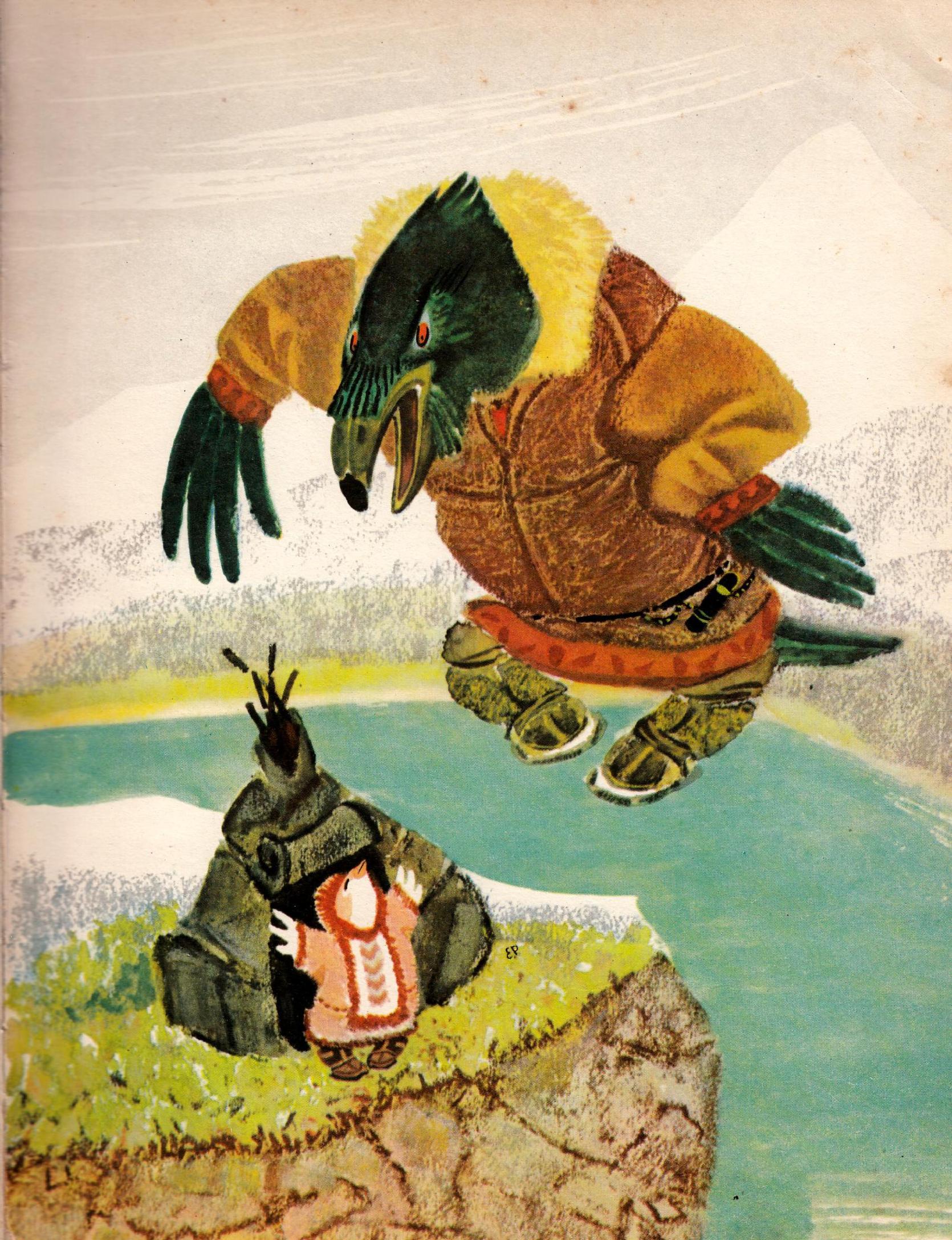
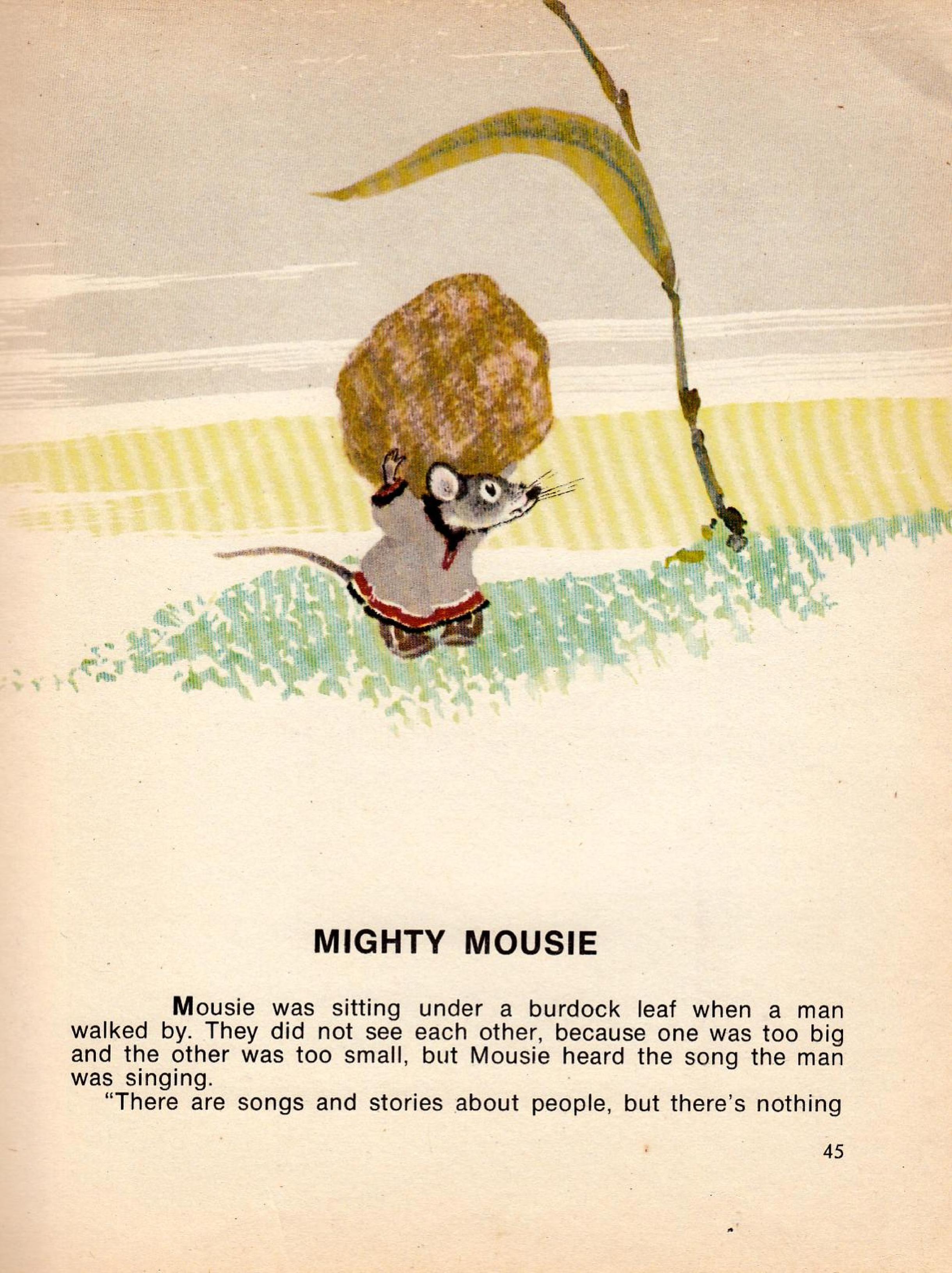
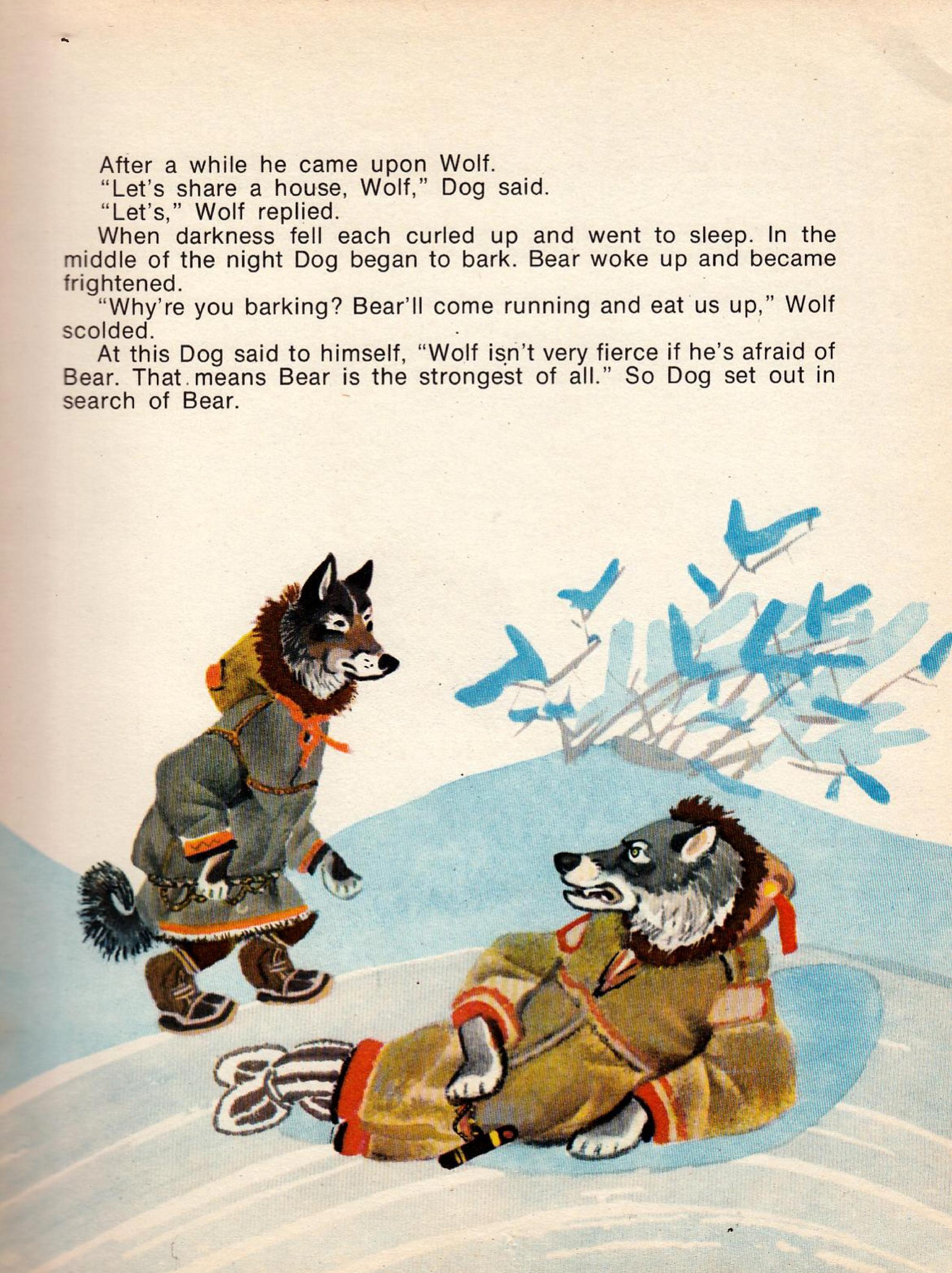
This is a book of folk tales and fables of the peoples of the Soviet Far North, the Chukchi Nentsi, Eskimos and others, in which all the characters are animals.
…
According to an ancient northern custom, people gathered and made merry after a lucky hunt, or in winter when snowstorms raged and they were forced to wait for calmer weather. This was the time for story-telling.The best story-tellers were always greatly respected, since these peoples had no written books. A story-teller had to know many fables and legends by heart. Besides, he had to tell a story well, to make it interesting. He also had to have a pleasant voice. The story-teller was treated to the best food. Many people gathered round to hear his tales. An Eskimo hunter named Kivagme was one of these fine story-tellers whose name has come down to us. Several of his tales have been included in this book.
…
The tundra and taiga have always been full of birds and beasts. This is why so many stories of the North are about animals and why the animals in them resemble humans in every way: they live in tents, ride in reindeer sleds and cross rivers in boats.These stories praise honesty, courage and common-sense and disapprove of idle talk, bragging and, especially, laziness. All were handed down from generation to generation.
This edition has been illustrated by Yevgeny Rachov, People’s Artist of the RSFSR, known for his many fine illustrations of folk tales and
children’s books.
The book was translated by Fainna Solasko and the wonderful illustrations are by Illustrated by Y. Rachov. Malysh publishers first printed the book in 1981.




Many thanks to Guptaji for this book.
You can get the book here. and here
Contents
CONTENTS
THE LOST SONG. An Eskimo Story 5
HARE. A Mansi Story 11
TRY TO CATCH ME. An Eskimo Story told by Kivagme 14
WHY OWL HAS A SPOOKY VOICE. An Eskimo Story told by Kivagme 16
BEAR AND WIND. A Chukcha Story 19
SLY FOX. A Koryak Story 23
REINDEER AND BULLHEAD. A Chukcha Story 24
MAN AND DOG. A Nenets Story 26
VIXEN THE MERCHANT. A Chukcha Story 30
TRYING TO THINK. A Chukcha Story 32
MOUSE. A Nenets Story 35
RAVEN AND WOLF. A Chukcha Story 38
HOW VIXEN TRICKED SEAL. An Orochi Story 41
MIGHTY MOUSIE. An Eskimo Story 45
HOW GOPHER AND BEAR EXCHANGED HOUSES. A Chukcha Story 49
I WANT TO — DON’T WANT TO GO. A Chukcha Story 52
MOUSE THE BRAGGART. An Eskimo Story told by Kivagme 57
FOX CUB AND BULLHEAD. An Eskimo Story 58
MOUSE AND FOX. A Chukcha Story 60
BEAR AND CHIPMUNK. A Nivkh Story 62
HOW MOUSE FROZE FAST. A Chukcha Story 65
FOXY VIXEN. A Koryak Story 68
BRAVE VUVYLTU. An Eskimo Story told by Kivagme 72
PANCAKES. A Nenets Story 74
WHY HARE HAS LONG EARS. A Mansi Story 76
BEAR AND VIXEN. A Nanai Story 78
WHAT A FRIEND! An Eskimo Story told by Kivagme 80
WILY TEACHES CRAFTY A LESSON. An Eskimo Story told by Kivagme 82
BRAVE BEAR. A Nenets Story 84
BAT. An Evenk Story 86
WHAT’LL I BE? An Eskimo Story told by Kivagme 88
VIXEN, BIRDIE AND RAVEN. A Nenets Story 91
KUTKHA THE RAVEN. An Itelmen Story 94
POOR FROG. A Nanai Story 96
YOU’RE LUCKIER THAN WE ARE. An Eskimo Story told by Kivagme 99
FOX CUB AND ECHO. An Eskimo Story told by Kivagme 101
WHALE AND REINDEER. A Chukcha Story 105
WOLF, RAVEN AND MOUNTAIN GOAT, A Chukcha Story 106
WOLVERINE AND VIXEN. An Evenk Story 1-09
FOX AND THE TEALS. An Eskimo Story 113
FRIENDSHIP BUILDS STRENGTH 116
Hello everyone, some maintenance is due with regards to dead links.
Please report all the broken links as reply to this post.
We will try to add new links on IA as soon as possible and update.
Thanks for all the help in advance.


In this post we will see a story collection for children. A Mountain Of Gems: Fairy Tales of the Peoples of the Soviet Land.


Many different peoples live in this huge country, each with their own habits and traditions, their own language. The Uzbek language, for instance, bears as little resemblance to the Russian or, say, the Moldavian as the Arabic does to the English or the Chinese.
And all of the peoples of the Soviet Union have their own fairy tales.
The Chukchi and Nenets tales as well as the tales of other peoples of Russian North transport us into the snowy tundra, a realm of fierce frosts and howling blizzards, where the dog and the reindeer are man’s best friends. In the tales of the peoples of Central Asia caravans of camels plod slowly over the scorching sands, and the ceaseless murmur of water comes from the numerous canals that feed the ever thirsty fields. Other scenes and images rise up before us when we read Russian fairy tales. The stout-hearted young heroes of these tales gallop on horseback over hills and dales which are green in summer anti carpeted with snow in winter, while their lovely tsarevnas sit patiently waiting for them in their log towers with windows of mica.
Do you know why I have translated all these fairy cates for you? It was because I enjoyed reading them so much.
Open the book, and you will find yourselves in a world of magic. Together with Ivan the Peasant’s Son you will cross words with Chudo-Yudo, the fire-breathing monster, follow Pokati-Goioshek, or Pea-Roll Along, into the underground kingdom and return from there on the back of an eagle or marvel at the cleverness of Zarniyar who outwitted a cruel Shah, be filled with admiration for Boroldoi-Merger the brave hunter of the Altai mountains who risked the Life of his own
son in order to save his people, delight in the resourcefulness of a simple weaver who surpassed in wisdom the wisest councillors of the Tsar.And I know that when you have met them, these and other characters in this book, you will grow to love them, and they will become your good and faithful friends.

The book was translated by Irina Zhelenova and was illustrated by Vladimir Minayev. The book was first published in 1962, with second printing by Raduga in 1983.
Many. many thanks to Guptaji for this Mountain of Gems. 🙂
You can get the book here.
PDF | 42.5 M | Color | OCR | 231 Pages
An older print, with new clean, scan here and here
CONTENTS
FROM THE TRANSLATOR 7
THE FROG TSAREVNA. A Russian Fairy Tale 9
AXE PORRIDGE. A Russian Fairy Tale 16
CHESTNUT GREY. A Russian Fairy Tale 18
IVAN THE PEASANT’S SON AND THE THREE CHUDO-YUDOS. A Russian Fairy Tale 24
A TRIAL LIKE NO OTHER. A Russian Fairy Tale 34
PEA-ROLL ALONG. A Ukrainian Fairy Tale 37
GOOD AND EVIL. A Ukrainian Fairy Tale 50
THE WOLF, THE DOG AND THE CAT. A Ukrainian Fairy Tale 57
HOW A MUZHIK DINED WITH A LORD. A Ukrainian Fairy Tale 60
THE MAGIC FIDDLE. A Byelorussian Fairy Tale 63
WHY THE BADGER AND THE FOX LIVE IN HOLES. A Byelorussian Fairy Tale 66
HOW VASIL VANQUISHED THE DRAGON. A Byelorussian Fairy Tale 70
PILIPKA. A Byelorussian Fairy Tale 75
OLD FROST AND YOUNG FROST. A Lithuanian Fairy Tale 82
HOW A LORD TURNED INTO A HORSE. A Latvian Fairy Tale 85
TO EACH HIS DESERTS. An Estonian Fairy Tale 88
HIYSI’S MILLSTONE. A Karelian Fairy Tale 91
THE THREE BROTHERS AND THE POT OF GOLD. A Moldavian Fairy Tale 98
BASIL, FET-FRUMOS AND ILANA COSINZANA, SISTER OF THE SUN. A Moldavian Fairy Tale 101
THE STORY OF ZARNIYAR WHO HAD ALL HER WITS ABOUT HER. An Azerbaijan Fairy Tale 113
SHEIDULLAH THE LOAFER. An Azerbaijan Fairy Tate 117
ANAIT. An Armenian Fairy Tale 120
THE TSAR AND THE WEAVER. An Armenian Fairy Tale 133
DEER-CHILD AND YELENA THE BEAUTIFUL. A Georgian Fairy Tale 136
THE LION AND THE HARE. A Georgian Fairy Tale 149
A LESSON IN WISDOM. A Georgian Fairy Tale 151
ALTYN-SAKA THE GOLDEN KNUCKLEBONE. A Bashkir Fairy Tale 153
TSARKIN KHAN AND THE ARCHER. A Kalmyk Fairy Tale 161
A MOUNTAIN OF GEMS. A Turkmen Fairy Title 184
THE CLEVER BROTHERS. An Usbek Fairy Tale 188
THE GREEDY KAZI. A Tajik Fairy Tale 193
BOROLDOI-MERGEN AND HIS BRAVE SON. A Fairy Tale of the Altai 198
WHICH WAS THE BIGGEST? A Kirghiz Fairy Tale 202
ALDAR-KOSE AND SHIGAI-BAI. A Kazaakh Fairy Tale 206
THE FERN GIRL. A Yakut Fairy Tale 213
THE GOLDEN CUP. A Buryat Fairy Tale 222
KOTURA, LORD OF THE WINDS, A Nenets Fairy Tale 227
THE GIRL AND THE MOON MAN. A Chukchi Fairy Tale 235
In this post we will see Man and Animals by Yuri Dmitriyev.
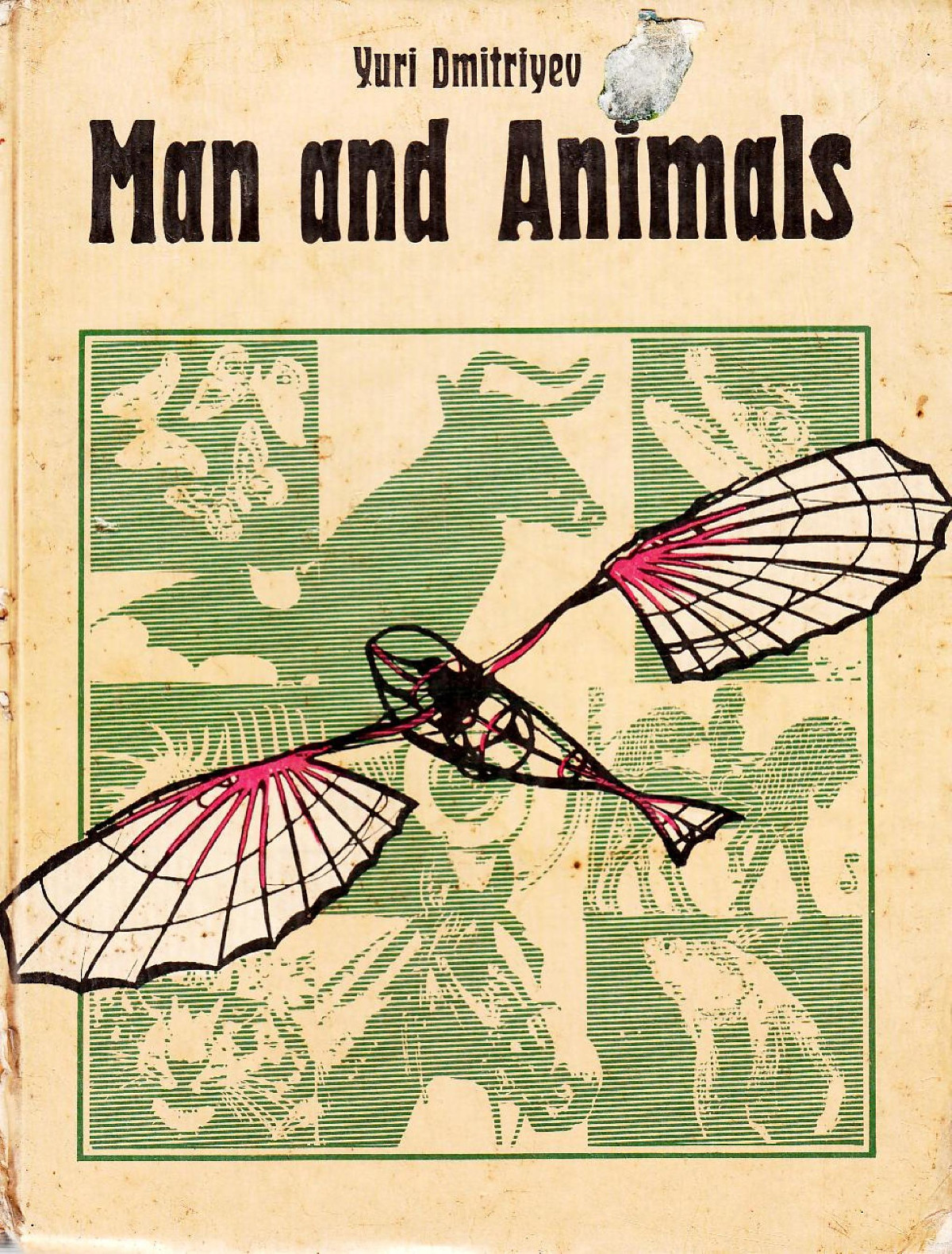
Man’s life on Earth is bound up fast with animals, birds, and fish t insects and beasts, octopi and worms.
But over the millennia Man’s relationships with animals have undergone many changes. Animals supplied Man with food and clothes inspired him with fear and gave him joy, originated customs and beliefs that sometimes influenced the entire mode of life of the given society, they have been enemies, friends and tutors.
God-animals were replaced by worker-animals, wild animals were replaced by domestic ones as the main source of meat. The importance of some animals was enhanced and of other diminished. And, naturally, throughout Man’s history he has brought influence to bear on the animal world — directly or indirectly, consciously or unconsciously.
One book is not really enough to tell about the many different relationships between Man and animals. Nor have I tried to embrace the subject in its entirety. I wrote this hook for children, striving, above all, to make them understand how important it is to know, love and protect animals.

The book is full of photos and illustrations of animals from varied cultures and geographical regions.
There is a Hindi translation of the book. I don’t if it was translated to other Indian languages also.
The book was traslated from the Russian by Raissa Bobrova. The design of the book is by B. P. Kishtymov and I. V. Borisova. The book was first published by Raduga in 1984 and was reprinted in 1988.
All credits to Guptaji for this book.
You can get the book here. (Cleaned, Optimised copy here and here
PDF | 85.7 MB | OCR | 339 Pages | Color |
Contents
The book has seven chapters tracing the history of human and animal relations from antiquity to present.
1. MAN WORSHIPS AND CURSES
Eyewitness Accounts 11
Dancing Is a Serious Business 14
Don’t Be Angry That I Killed You! 17
Birds or Animals? 19
The Divine Apis, the Sa cred Scarab and the “Keeper of the Horizon” 25
Sacred Cows and the “Owner of the White Elephant” 27
Victims and Oracles 31
Love and Hatred 36
Animal-People and Animal-Devils 39
The Power of Words or a Curse on Eels 40
Judges, Defendants, Lawyers 44
TO SUM UP THE PREVIOUS CHAPTER AND INTRODUCE THE NEXT ONE 47
2. MAN LEARNS AND STUDIES
A Great Greek and a Roman Patrician 51
Two Millennia 55
Life and Death of Konrad Gesner 59
Carl Linnaeus’s System of Nature 65
The Theory of the Great but Unlucky Man 74
Facts, Nothing but Facts and God! 78
Darwinism and Zoogeography 84
The Battle of Oxford 87
The Life of Animals and Its Author 92
TO SUM UP THE PREVIOUS CHAPTER AND INTRODUCE THE NEXT ONE 100
3. MAN FINDS AND DISCOVERS
The Story of an Unfinished List 105
The Okapi Makes Zoological History 109
The Mammoth Boar, the Black Tapir, the Giant Bull and the Two Discoveries of Hans Schomburgk 115
More “Kinsmen” Are Discovered 122
How Many Different Cats Are There on Earth? 130
Three Unexpected Discoveries Made in a Shop, a Cinema and a Storeroom 133
Dragons Are Rea] After All! 137
Ocean Dwellers 142
The Discovery of the Century 148
TO SUM UP THE PREVIOUS CHAPTER AND INTRODUCE THE NEXT ONE 153
4. MAN BELIEVES, DOUBTS AND SEEKS
Does The Tatielwurm Exist? 159
The Mystery of Rivers and Lakes 160
The Mystery of Loch Ness 167
The Mystery of the Seas and Oceans (“The Case of the Sea Serpent) 169
TO SUM UP THE PREVIOUS CHAPTER AND INTRODUCE THE NEXT ONE 182
5. MAN KILLS AND DESTROYS
The Kansas Tragedy 187
Predators Appeal for Help 196
Giants Need to Be Saved 200
Our “Kinsmen” Are in Danger 205
“The Fur Fever” 208
In Only Twenty-Seven Years 213
Cranes Under Escort 216
TO SUM UP THE PREVIOUS CHAPTER AND INTRODUCE THE NEXT ONE 221
6. MAN PROTECTS AND SAVES
Once in 1919 225
What Is a Nature Preserve and What Is Its Purpose? 227
The “Duck” Flies to Africa 235
Perhaps a Zoo as Well? 246
Bisons in Moscow Environs 253
Predators — Harmful or Otherwise? 259
Problems Galore 268
Biological, Not Chemical Protection 276
TO SUM UP THE PREVIOUS CHAPTER AND INTRODUCE THE NEXT ONE, 295
7 MAN STUDIES AND LEARNS
The Birth of a New Science 301
“Soothsayers” 304
The “Paradox of the Dolphin” and Other Paradoxes 310
On the Ground and Beneath It 315
Birds or Insects? 318
Again Birds or Insects 322
Echolocators 330
“Chemists” and Others 333
In this post we will see Theory of Elasticity by M. Filonenko-Borodich.

The book was translated from the Russian by Marina Konyaeva and was first published by PEACE PUBLISHERS MOSCOW in 1963.
All credits to the original uploader.
In this post we will see the book Elementary Physics: Problems and Solutions by I. P. Gurskii

The book is intended for those preparing for university entrance examinations in physics. The contents and sequence of topics are in keeping with the requirements for such examinations. The few sections beyond the entrance examination programme are marked by circles. In view of the introduction of the elements of higher mathematics to the high-school curriculum, some problems have also been illustrated using differential calculus. The author has endeavoured to present the basic principles of school physics in a compact form to help the candidates revise the entire course in the shortest possible time. All sections have been illustrated with problems to give a better understanding of the subject. Each problem and its solution is followed by one or more exercises on the same topic, the exercises corresponding to problems that have been solved in the text are assigned the same number.Those intending to use this book independently are advised to attempt the exercises after going through the theoretical part. The relevant solved problems should be consulted if difficulties are encountered while solving the exercises. After this, the exercise should be tried again, and if there is more than one exercise bearing the same number, another exercise (preferably the last one) should be tackled. In most cases, the last exercises in a series are the most difficult.
The book was translated from Russian by Natalia Wadhwa and was first published in 1987.
PDF | OCR | 13.1 MB
All credits to Siddharth for scanning and posting this book.
You can get the book here (IA link) or here (mega)
Contents
Foreword
From the Preface to the Second Russian Edition
INTRODUCTION
1.1. SI System of Units
1.2. Vectors. Some Mathematical Operations on Vectors
1.3. Projections of Points and Vectors onto an Axis
1.4. General Methodical Hints to the Solution of Problems
1. MECHANICS
1.1. Basic Concepts
A. Kinematics
1.2. Kinematics of Translatory Motion
1.3. Uniform Rectilinear Motion. Velocity. Graphs of Velocity and Path Length in Uniform Motion
1.4. Nonuniform Motion. Average and Instantaneous Velocities. Acceleration
1.5. Uniformly Variable Motion. Graphs of Velocity and Path Length in Uniformly Variable Motion
Problems with Solutions
Exercises
B. Dynamics of Translatory Motion
1.6. Force
1.7. Newton’s First Law. Inertial and Noninertial Reference Systems
1.8. Newton’s Second Law. Momentum of a Body
1.9. Newton’s Third Law
1.10. Principle of Independence of Action
1.11. Addition of Forces Acting at an Angle
1.12. Resolution of a Force into Two Components at an Angle to Each Other
1.13. Law of Momentum Conservation
1.14. Idea of Reaction Propulsion
1.15. Friction. Coefficient of Friction
1.16. Elastic Force. Hooke’s Law
1.17. Law of Universal Gravitation
1.18. Force of Gravity. Free Fall of Bodies
1.19. Weight of a Body. Weighing
1.20. Weightlessness
Problems with Solutions
Exercises
1.21. Work and Power
1.22. Energy. Kinetic and Potential Energies
1.23. Law of Energy Conservation
Problems with Solutions
Exercises
C. Kinematics and Dynamics of Rotational Motion of a Rigid Body
1.24. Uniform Rotational Motion. Angular Velocity. Linear Velocity
1.25. Centripetal Acceleration
1.26. Weight of a Body Considering the Rotation of the Earth
1.27. Reasons Behind the Emergence of Weightlessness in Artificial Satellites. Orbital Velocity
Problems with Solutions
Exercises
D. Statics
1.28. Equilibrium of a Nonrotating Body. Equilibrium Conditions for a Body on an Inclined Plane
Problems with Solutions
Exercises
1.29. Moment of Force
1.30. Addition of Parallel Forces. A Couple
1.31. Equilibrium of a Body with a Fixed Rotational Axis (Law of Torques)
1.32. Equilibrium of a Rigid Body in the General Case
Problems with Solutions
Exercises
1.33. Types of Equilibrium
1.34. Centre of Mass of a Body
1.35. Determination of the Centre of Mass for Bodies of Various Shapes
Problems with Solutions
Exercises
2. FLUIDS
2.1. Pressure
2.2. Pascal’s Law
2.3. Hydraulic Press
2.4. Pressure of a Fluid on the Bottom and Walls of a Vessel. Law of Communicating Vessels
2.5. Atmospheric Pressure. Barometers
2.6. Archimedean Principle
Problems with Solutions
Exercises
3. MOLECULAR PHYSICS. THERMAL PHENOMENA
A. Molecular Physics
3.1. Basic Concepts of Molecular-Kinetic Theory
3.2. Brownian Movement. Gas Pressure
3.3. Diffusion in Gases, Liquids, and Solids
3.4. Motion of Molecules in Gases, Liquids, and Solids
3.5. Intermolecular Interaction
B. Thermal Phenomena
3.6. Internal Energy of a Body
3.7. Law of Conservation and Transformation of Energy. First Law of Thermodynamics
3.8. Temperature Gradient. Thermodynamic Temperature Scale. Absolute Zero
3.9. Heat Capacity
3.10. Experimental Determination of Specific Heat of a Substance
3.11. Heat of Combustion of a Fuel
3.12. Efficiency of a Heat Engine
3.13. Phase of a Substance. Fusion. Latent Heat of Fusion
3.14. Evaporation. Condensation. Vaporization and Boiling. Latent Heat of Vaporization
Problems with Solutions
Exercises
3.15. Temperature Coefficients of Linear and Cubic Expansion
Problems with Solutions
Exercises
C. Gas Laws
3.16. Isobaric Process. Charles’ Law
3.17. Isothermal Process. Boyle’s Law. Dalton’s Law
3.18. Isochoric Process. Gay-Lussac’s Law
3.19. Adiabatic Process
3.20. The Boyle-Charles Generalized Law. Equation of State for an Ideal Gas
3.21. The Clapeyron-Mendeleev Equation. Avogadro’s Law
3.22. Ideal Gas. Physical Meaning of Thermodynamic Temperature
3.23. Work Done by a Gas During Expansion
Problems with Solutions
Exercises
3.24. Saturated and Unsaturated Vapours. Temperature Dependence of Saturation Vapour Pressure
3.25. Absolute Humidity. Relative Humidity
3.26. Instruments for Determining Humidity
Problems with Solutions
Exercises
4. FUNDAMENTALS OF ELECTRODYNAMICS
A. Electrostatics
4.1. Law of Electric Charge Conservation. Electric Field. Coulomb’s Law. Effect of Medium on the Force of Interaction of Charges
4.2. Charge Equilibrium in Metals. Electrostatic Induction
4.3. Electroscope
4.4. Electric Field Strength. Electric Field Lines
4.5. Work Done on a Charge by the Forces of Electrostatic Field. Potential
4.6. Relation Between Potential and Field Strength for a Uniform Electric Field
4.7. Capacitance
4.8. Capacitors. Energy of a Charged Capacitor
Problems with Solutions
Exercises
B. Direct Current
4.9. Electric Current. Current Intensity. Electromotive Force
4.10. Ohm’s Law for a Subcircuit. Resistance of Conductors
4.11. Temperature Dependence of Resistance. Semiconductors
4.12. Series Connection of Conductors
4.13. Parallel Connection of Conductors
4.14. Rheostats
4.15. Current Sources. Ohm’s Law for a Closed Circuit
4.16. Parallel and Series Connection of Current Sources
4.17. Direct Current Power. Joule’s Law
Problems with Solutions
Exercises
4.18. Electrolysis
4.19. Faraday’s Laws of Electrolysis
Problems with Solutions
Exercises
4.20. Electric Current in Gases
4.21. Electron and Ion Beams, Their Properties and Application
4.22. Thermionic Emission.’ Electron Work Function
Problems with Solutions
Exercises
C. Magnetic Phenomena
4.23. Interaction of Currents. Magnetic Field. Magnetic Induction. Magnetic Field Lines
4.24. Force Acting on a Current-Carrying Conductor in a Magnetic Field. Magnetic Forces
4.25. Permeability of a Medium. Magnetic Field Strength
4.26. Forces of Interaction Between Parallel Current-Carrying Conductors
4.27. Magnetic Flux
4.28. Ammeter and Voltmeter
D. Electromagnetic Phenomena
4.29. Electromagnetic Induction
4.30. Induced Electromotive Force
4.31. Lenz’s Law
4.32. Self-Induction. Inductance
Problems with Solutions
Exercises
5. OSCILLATIONS AND WAVES
5.1. Oscillatory Motion. Amplitude, Period, and Frequency of Oscillations
5.2. Harmonic Oscillations. Phase of Oscillation
5.3. Pendulum. Period of Oscillations of a Mathematical Pendulum
5.4. Free and Forced Oscillations. Resonance
5.5. Waves. Velocity and Wavelength
5.6. Sonic Waves
Problems with Solutions
Exercises
5.7. Electromagnetic Oscillations and Waves
5.8. Oscillatory Circuit
Problems with Solutions
Exercises
5.9. Alternating Current. A.C. Generator
5.10. Period and Frequency of Alternating Current. Effective Current and Voltage
5.11. Transmission and Distribution of Electric Energy
5.12. Transformer
5.13. D.C. Generator
Problems with Solutions
Exercises
5.14. Electron Tubes (Valves)
5.15. Diode as a Rectifier of Alternating Current
5.16. Cathode-Ray Tube
5.17. Electron Tubes as Generators and Amplifiers
5.18. Open Oscillatory Circuit. Emission and Reception of Electromagnetic Waves
5.19. Scale of Electromagnetic Waves
Problem with Solution
Exercise
6. OPTICS
6.1. Light Sources. Propagation of Light in a Straight Line
6.2. Velocity of Light. Michelson’s Experiment
A. Photometry
6.3. Luminous Flux. Luminous Intensity
6.4. Illuminance (Illumination Intensity)
6.5. Comparison of Luminous Intensity of Different Sources. Photometers
Problems with Solutions
Exercises
B. Geometrical Optics
6.6. Law of Reflection of Light. Construction of Image Formed by a Plane Mirror
6.7. Construction of Image Formed by a Spherical Mirror. Spherical Aberration
Problems with Solutions
Exercises
6.8. Laws of Refraction of Light. Refractive Index
6.9. Total Internal Reflection. Critical Angle
6.10. Ray Path in a Plane-Parallel Plate. Ray Path in a Prism
6.11. Converging and Diverging Lenses
6.12. Lens Formula. Lens Power
6.13. Image Formation by a Lens
Problems with Solutions
Exercises
C. Optical Instruments
6.14. Searchlight. Projection Lantern
6.15. Photographic Camera
6.16. Magnifying Glass. Human Eye as an Optical Instrument
6.17. Accommodation of Eye. Myopia and Hyperopia. Spectacles
Problems with Solutions
Exercises
D. Composition of Light. Invisible Rays
6.18. Dispersion of Light. Spectrum. Spectroscope
6.19. Infrared and Ultraviolet Radiation
6.20. Emission and Absorption Spectra. Fraunhofer Lines. Spectral Analysis
6.21. On the Wave and Quantum Nature of Light
6.22. Interference of Light
6.23. Diffraction of Light
6.24. Photoelectric Effect
6.25. Photocells and Their Application
6.26. Effects of Light
Problems with Solutions
Exercise
7. STRUCTURE OF THE ATOM 492
7.1. Structure of the Atom and Its Energy
7.2. Atomic Nucleus
7.3. Radioactivity
7.4. Uranium Nuclear Fission. Chain Reaction
7.5. Binding Energy of Atomic Nucleus
Problem with Solution
Exercise
Graphical Solutions to Exercises
Appendices
In this post we will see Forest Homes by Vitaly Bianki.
The book is actually a compilation of four children’s stories
Forest Homes – Translated by Fainna Glagoleva
Red Hill – Translated by Olga Shartse
Ant Hurries Home – Translated by Fainna Glagoleva
The First Hunt – Translated by Ronald Vroon

Lot of wonderful illustrations through the book done by Mai Miturich. The book was first published by Raduga Publishers in 1988.


All credits to Guptaji.
You can get the book here, here. and here
Update:
Telugu version of the book as well. You can get it here. and here
Kannada here and here
In this post we will see the two volume set titled Fundamentals of Theoretical Physics by I. V. Savelyev. Previously we have seen Physics A General Course by the same author.

The book being offered to the reader is a logical continuation of the author’s three-volume general course of physics. Everything possible has been done to avoid repenting what has been set out in the three-volume course. Particularly. the experiments underlying the advancing of physical ideas are not treated, and some of the results obtained are not discussed.
The book has been conceived as a training aid for students of non- theoretical specialities of higher educational institutions. I had in mind readers who would like to grasp the main ideas and methods of theoretical physics without delving into the details that are of interest only for a specialist. This book will be helpful for physics instructors at higher schools, and also for everyone interested in the subject but having no time to become acquainted with it (or re- store it in his memory) according to fundamental manuals.
The books were translated from the Russian by G. Leib and was first published in 1982.
We have added new covers to existing pdfs. All other credits to original uploaders. Thanks to commentators for points the libgen links.
Fundamentals of Theoretical Physics Vol 1 and here
Fundamentals of Theoretical Physics Vol 2 and here
Contents of Volume 1
Part One: Mechanics
Chapter I. The Variational Principle in Mechanics
1. Introduction – 11
2. Constraints – 13
3. Equations of Motion in Cartesian Coordinates – 16
4. Lagrange’s Equations in Generalized Coordinates – 19
5. The Lagrangian and Energy – 24
6. Examples of Compiling Lagrange’s Equations – 28
7. Principle of Least Action – 33
Chapter II. Conservation Laws
8. Energy Conservation – 36
9. Momentum Conservation – 37
10. Angular Momentum Conservation – 39
Chapter III. Selected Problems in Mechanics
11. Motion of a Particle in a Central Force Field – 41
12. Two-Body Problem – 45
13. Elastic Collisions of Particles – 49
14. Particle Scattering – 53
15. Motion in Non-Inertial Reference Frames – 57
Chapter IV. Small-Amplitude Oscillations
16. Free Oscillations of a System Without Friction – 64
17. Damped Oscillations – 66
18. Forced Oscillations – 70
19. Oscillations of a System with Many Degrees of Freedom – 72
20. Coupled Pendulums – 77
Chapter V. Mechanics of a Rigid Body
21. Kinematics of a Rigid Body – 82
22. The Euler Angles – 85
23. The Inertia Tensor – 88
24. Angular Momentum of a Rigid Body – 95
25. Free Axes of Rotation – 99
26. Equation of Motion of a Rigid Body – 101
27. Euler’s Equations – 105
28. Free Symmetric Top – 107
29. Symmetric Top in a Homogeneous Gravitational Field – 111
Chapter VI. Canonical Equations
30. Hamilton’s Equations – 115
31. Poisson Brackets – 119
32. The Hamilton-Jacobi Equation – 121
Chapter VII. The Special Theory of Relativity
33. The Principle of Relativity – 125
34. Interval – 127
35. Lorentz Transformations – 130
36. Four-Dimensional Velocity and Acceleration – 134
37. Relativistic Dynamics – 136
38. Momentum and Energy of a Particle – 139
39. Action for a Relativistic Particle – 143
40. Energy-Momentum Tensor – 147
Part Two: Electrodynamics
Chapter VIII. Electrostatics
41. Electrostatic Field in a Vacuum – 157
42. Poisson’s Equation – 159
43. Expansion of a Field in Multipoles – 161
44. Field in Dielectrics – 166
45. Description of the Field in Dielectrics – 170
46. Field in Anisotropic Dielectrics – 175
Chapter IX. Magnetostatics
47. Stationary Magnetic Field in a Vacuum – 177
48. Poisson’s Equation for the Vector Potential – 179
49. Field of Solenoid – 182
50. The Biot-Savart Law – 186
51. Magnetic Moment – 188
52. Field in Magnetics – 194
Chapter X. Time-Varying Electromagnetic Field
53. Law of Electromagnetic Induction – 199
54. Displacement Current – 200
55. Maxwell’s Equations – 201
56. Potentials of Electromagnetic Field – 203
57. D’Alembert’s Equation – 207
58. Density and Flux of Electromagnetic Field Energy – 208
59. Momentum of Electromagnetic Field – 211
Chapter XI. Equations of Electrodynamics in the Four-Dimensional Form
60. Four-Potential – 216
61. Electromagnetic Field Tensor – 219
62. Field Transformation Formulas – 222
63. Field Invariants – 225
64. Maxwell’s Equations in the Four-Dimensional Form – 228
65. Equation of Motion of a Particle in a Field – 230
Chapter XII. The Variational Principle in Electrodynamics
66. Action for a Charged Particle in an Electromagnetic Field – 232
67. Action for an Electromagnetic Field – 234
68. Derivation of Maxwell’s Equations from the Principle of Least Action – 237
69. Energy-Momentum Tensor of an Electromagnetic Field – 239
70. A Charged Particle in an Electromagnetic Field – 244
Chapter XIII. Electromagnetic Waves
71. The Wave Equation – 248
72. A Plane Electromagnetic Wave in a Homogeneous and Isotropic Medium – 250
73. A Monochromatic Plane Wave – 255
74. A Plane Monochromatic Wave in a Conducting Medium – 260
75. Non-Monochromatic Waves – 265
Chapter XIV. Radiation of Electromagnetic Waves
76. Retarded Potentials – 269
77. Field of a Uniformly Moving Charge – 272
78. Field of an Arbitrarily Moving Charge – 276
79. Field Produced by a System of Charges at Great Distances – 288
80. Dipole Radiation – 288
81. Magnetic Dipole and Quadrupole Radiations – 291
Appendices
I. Lagrange’s Equations for a Holonomic System with Ideal Non-Stationary Constraints – 297
II. Euler’s Theorem for Homogeneous Functions – 299
III. Some Information from the Calculus of Variations – 300
IV. Conics – 309
V. Linear Differential Equations with Constant Coefficients – 313
VI. Vectors – 316
VII. Matrices – 330
VIII. Determinants – 338
IX. Quadratic Forms – 347
X. Tensors – 355
XI. Basic Concepts of Vector Analysis – 370
XII. Four-Dimensional Vectors and Tensors in Space – 393
XIII. The Dirac Delta Function – 412
XIV. The Fourier Series and Integral – 413
Index – 419
Contents of Volume 2
Chapter I. Foundations of Quantum Mechanics
1. Introduction – 9
2. State – 10
3. The Superposition Principle – 12
4. The Physical Meaning of the Psi-Function – 14
5. The Schrödinger Equation – 16
6. Probability Flux Density – 20
Chapter II. Mathematical Tools of Quantum Mechanics
7. Fundamental Postulates – 23
8. Linear Operators – 27
9. Matrix Representation of Operators – 31
10. The Algebra of Operators – 38
11. The Uncertainty Relation – 45
12. The Continuous Spectrum – 48
13. Dirac Notation – 51
14. Transformation of Functions and Operators from One Representation to Another – 55
Chapter III. Eigenvalues and Eigenfunctions of Physical Quantities
15. Operators of Physical Quantities – 63
16. Rules for Commutation of Operators of Physical Quantities – 67
17. Eigenfunctions of the Coordinate and Momentum Operators – 71
18. Momentum and Energy Representations – 74
19. Eigenvalues and Eigenfunctions of the Angular Momentum Operator – 78
20. Parity – 81
Chapter IV. Time Dependence of Physical Quantities
21. The Time Derivative of an Operator – 83
22. Time Dependence of Matrix Elements – 86
Chapter V. Motion of a Particle in Force Fields
23. A Particle in a Central Force Field – 89
24. An Electron in a Coulomb Field: The Hydrogen Atom – 94
25. The Harmonic Oscillator – 106
26. Solution of the Harmonic Oscillator Problem in the Matrix Form – 109
27. Annihilation and Creation Operators – 116
Chapter VI. Perturbation Theory
28. Introduction – 123
29. Time-Independent Perturbations – 123
30. Case of Two Close Levels – 132
31. Degenerate Case – 136
32. Examples of Application of the Stationary Perturbation Theory – 141
33. Time-Dependent Perturbations – 148
34. Perturbations Varying Harmonically with Time – 156
35. Transitions in a Continuous Spectrum – 163
36. Potential Energy as a Perturbation – 164
Chapter VII. The Quasiclassical Approximation
37. The Classical Limit – 169
38. Boundary Conditions at a Turning Point – 174
39. Bohr-Sommerfeld Quantization Rule – 184
40. Penetration of a Potential Barrier – 188
Chapter VIII. Semiempirical Theory of Particles with Spin
41. Psi-Function of a Particle with Spin – 192
42. Spin Operators – 194
43. Eigenvalues and Eigenfunctions of Spin Operators – 202
44. Spinors – 205
Chapter IX. Systems Consisting of Identical Particles
45. Principle of Indistinguishability of Identical Particles – 214
46. Psi-Functions for Systems of Particles: The Pauli Principle – 216
47. Summation of Angular Momenta – 222
48. Psi-Function of a System of Two Particles Having a Spin of 1/2 – 225
49. Exchange Interaction – 229
50. Second Quantization – 233
51. Second Quantization Applied to Bosons – 235
52. Second Quantization Applied to Fermions – 250
Chapter X. Atoms and Molecules
53. Methods of Calculating Atomic Systems – 258
54. The Helium Atom – 259
55. The Variation Method – 263
56. The Method of the Self-Consistent Field – 268
57. The Thomas-Fermi Method – 275
58. The Zeeman Effect – 278
59. The Theory of Molecules in the Adiabatic Approximation – 281
60. The Hydrogen Molecule – 285
Chapter XI. Radiation Theory
61. Quantization of an Electromagnetic Field – 291
62. Interaction of an Electromagnetic Field with a Charged Particle – 301
63. One-Photon Processes – 305
64. Dipole Radiation – 308
65. Selection Rules – 312
Chapter XII. Scattering Theory
66. Scattering Cross Section – 315
67. Scattering Amplitude – 317
68. Born Approximation – 319
69. Method of Partial Waves – 321
70. Inelastic Scattering – 328
Appendices
I. Angular Momentum Operators in Spherical Coordinates
II. Spherical Functions
III. Chebyshev-Hermite Polynomials
IV. Some Information from the Theory of Functions of a Complex Variable
V. Airy Function
VI. Method of Green’s Functions
VII. Solution of the Fundamental Equation of the Scattering Theory by the Method of Green’s Functions
VIII. The Dirac Delta Function
In this post we will see the three volume Physics – A General Course by I. V. Savelyev.
I have done everything in my power to acquaint students with the basic ideas and methods of physics and to teach them how to think physically. This is why the book is not encyclopedic in its nature. It is mainly devoted to explaining the meaning of physical laws and showing how to apply them consciously. What I have tried to achieve is a deep knowledge of the fundamental principles of physics rather than a shallower acquaintance with a wide range of questions.
While using the book, try not to memorize the material formalistically and mechanically, but logically, i.e. memorize the material by thoroughly understanding it. I have tried to present physics not as a science for “cramming”, not as a certain volume of information to be memorized, but as a clever, logical, and attractive science.
Notwithstanding my desire to reduce the size, I considered it essential to include a number of mathematical sections in the course: on vectors, linear differential equations, the basic concepts of the theory of probability, etc. This was done to impart a “physical” tinge to the relevant concepts and relations. In addition, the mathematical “inclusions” make it possible to go on with the physics even if, as is often the case, the relevant material has not yet been covered in a mathematics course.
The present course is intended above all for higher technical schools with an extended syllabus in physics. The material has been arranged, however, so that the book can be used as a teaching aid for higher technical schools with an ordinary syllabus simply by omitting some section


The books were translated from the Russian by G. Leib and were first publised in 1980, this copy is the third reprint in 1989.
We have added new covers to the existing pdfs. All other credits to the original uploaders. Thanks to all the commentators who pointed to the libgen links.
Contents
 Mir Books