The Races of Mankind – Nesturkh

In this post, we will see the book The Races of Mankind by M. Nesturkh.

races-fc

About the book (from the Preface):

This present book, by Professor M. F. Nesturkh, is based on the methodological principles of Soviet anthropology and the factual data obtained by that science. The author connects the origin of the races with the origin of mankind as a whole and acquaints the reader with the present status of these two problems; he deals at length with the history of the formation, dissemination and mingling of individual anthropological (racial) types and their groups, uses facts to expose the reactionary nature of racism and proves that it has no foundation in science.

Professor Nesturkh naturally devotes greater attention to anthropology proper, but he makes extensive use of other natural and social sciences-comparative anatomy, physiology, palaeontology, archaeology, ethnography, psychology, and linguisticsin accordance with Frederick Engels’s well-known postulate that anthropology is the transition from the morphology and physiology of man and his races to history.

It must not be thought that Professor Nesturkh’s book is limited to an exposure of racism. The problems dealt with are of a much broader cognitive significance. Among other things the reader will find the latest information on the anthropoids of the Tertiary period (the distant ancestors of man and the modern anthropoid apes), the earliest hominids (Pithecanthropus and Sinanthropus), Neanderthal man and the fossil men of the modern type. The author also deals with the natural selection of the earliest men, geographical isolation, inter-racial crossing, the times and places in which the great races were formed, the ways in which they became disseminated and the relation of tribes, nationalities and nations to the races. He takes the reader on a journey through the animal kingdom to the world of man and introduces him to the beginnings of human history, in the course of which the laws of evolution that apply to the organic world have been replaced by the qualitatively new laws of social development.

In the final chapter Professor Nesturkh, in addition to his exposureof racism, touches on such important scientific problems as “Race and Language”, “Race and Mentality”. He adduces convincing evidence of the absence of any causal relation between the racial groups and language groups of mankind; he also shows that all modern races and nations are identical in their mental abilities. Stress is properly laid on the tremendous successes of communist construction in the U.S.S.R. and socialist construction of the People’s Democracies of Europe and Asia. The experience of these countries has completely destroyed the reactionary myth that mankind is divided into “higher” and “lower” races and shown that all peoples, irrespective of their racial make-up, are capable of developing genuinely progressive culture and science. The unscientific concept of racism is also refuted by the economic, political and cultural development of the young states in Asia, Africa and Latin America, recently liberated from the yoke of colonialism.

A Western reviewer Coon has this to say about the book:

Its bibliogarphy of 43 sources include only two non-Soviet works, one by Charles Darwin and the other by Marx and Engels. All of the photographs have been retouched, and none accredited to its proper source; many are easily recognizable.

The text is divided into four sections : Definition of the Races of
Mankind, Races and Origins of Man, The Origin of Races, and Races and Racism. In Section One, Nesturkh follows the threefold classification of ” great races ” devised by the aforementioned Cheboksarov in 1956: (1) Negroid or Afro-Asian, (2) Europeoid or Eurasian, and (3) Mongoloid or Asio- American. Under the first category he lumps Negroes, Pygmies, Bushmen, Negritos, Australian aborigines, Tasmanians, and Melanesians.

Genetics is studiously avoided, except once, apparently a slip. Classifications of race by blood groups are passed by in silence.

He uses the word mutation once (the previously mentioned slip) to explain the parallel evolution of the African and Australoid dwarfs, and in this I agree.

The last Section is on “racists” whom he blasts but does not name, and on “racism ” which he says can be explained very simply, as follows : “The theory of ‘ higher’ and ‘ lower 5 races, of the right of one race to dominate over another, justifies war between nations – it is the ideological mask concealing imperialistic politics” (p. 98).

Having explained “racism” he then tries to disprove it. This too is very simple. According to him, the ” racists ” claim that rich people are dolichocephalic and poor people mesocephalic or brachycephalic. But in Sweden the “bourgeois,” workers, and peasants all have cephalic indices of 77.0. So much for “racism.”

He disproves Aryanism by showing, like Boas, that language is acquired independently of racial features. As a final blow, he discredits intelligence tests. ” Bourgeois ” scientists, he says, believe in intelligence tests, while “genuine scientists, of course, display a sharply negative attitude toward them” (p. 102).

He ends with a pean of praise for the elysian treatment of minorities
in the U. S. S. R., overlooking the forced migrations of the Kalmucks and others, the recurrent waves of anti-Semitism, and the recent troubles with African students.

It is important for educated Americans to read this book, alongside some of our domestic books and articles on the same subject.

Carleton S. Coon Human Biology, Vol. 37, No. 1 (February, 1965), pp. 57-59

The era when the book was published (in the 1960s) the Soviet science was just coming out of the pseudoscientific theories of Lysenko, who was a leading figure in the biological sciences in Soviet Russian from 1940s-50s. After he became director of the Institute of Genetics within the USSR’s Academy of Sciences, he used this position of power along with his political connections to push for anti-Mendelian doctrines in Soviet science and education.

Soviet scientists who refused to renounce genetics were dismissed from their posts and left destitute. Hundreds if not thousands of others were imprisoned. Several were sentenced to death as enemies of the state, including the botanist Nikolai Vavilov. Scientific dissent from Lysenko’s theories of environmentally acquired inheritance was formally outlawed in the Soviet Union in 1948. Though Lysenko remained at his post in the Institute of Genetics until 1965, his influence on Soviet agricultural practice had declined by the 1950s. [some text from his wikipage] So it is no wonder, that Nesturkh’s book makes scant references to the idea of genetics and is driven by a larger agenda of the ideology of the state. The state of Soviet biology never fully recovered from this setback. Meanwhile, mainly due to efforts of Sakhrov (I may be wrong here), the physical sciences could actually work mostly without much interference from the state ideology.

The book was translated from the Russian by George Hanna and was designed by Vladimir An. The book was first published by Foreign Languages Publishing House in 1964/1966 (as no date is printed on the book).

PDF | OCR | Cover | Bookmarked | 146 p.

Original scan by IA user. We cleaned, OCRed, Bookmarked, added the cover.

The Internet Archive link. and here

Contents


CONTENTS

PREFACE 5

INTRODUCTION 8

DEFINITION OF THE RACES OF MANKIND 11

I. Racial Characteristics and Their Study 11

2. The Negroid Great Race 18

3. The Europeoid Great Race 23

4· The Mongoloid Great Race 25

5· Features Common to All Races 29

RACES AND THE ORIGIN OF MAN 31

1. Fossil Men of the Modern Type 31

2. Neanderthal Man-the Ancestor of Modern Man 33

3. Earliest Man-the Ancestor of the Neanderthaler  36

4. The Anthropoids-the Ancestors of the Earliest Men 41

5. The Racial Peculiarities of Man and the Anthropoid Type of

Structure 46

6. The Main Features of the Structure of the Human Body: Band,

Foot, Brain 52

THE ORIGIN OF THE RACES 57

1. The Races of Mankind-the Result of Historical Development 57

2. Geographical and Social Isolation 59

3. Natural Selection 61

4. Intermarriage 63

5. The Formation of the Great Races 66

6. The Europeoid Great Race 69

7. The Negroid Great Race 75

8. The Mongoloid Great Race 89

RACES AND RACISM 96

1. The Essence of Racism  96

2. Race and Language 99

3· Race and Mentality 101

4· Equality of Races and Nations in the U.S.S.R 105
Posted in books, foreign languages publishing, history, life sciences, science, sociology, soviet | Tagged , , , , , , , , , , , , , , , , , , , | Leave a comment

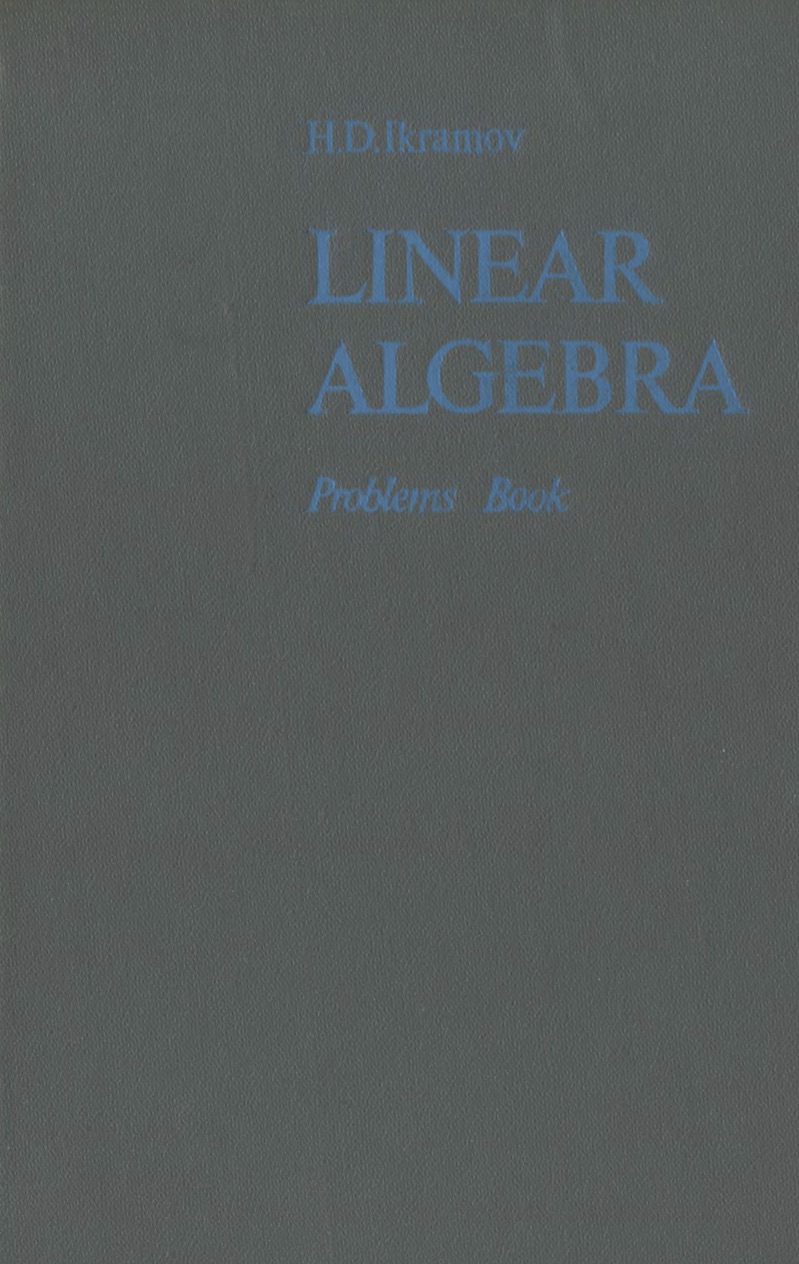
Linear Algebra: Problems Book – Ikramov

In this post, we will see the book Linear Algebra: Problems Book by H. D. Ikramov. This is the associated problem book for the Linear Algebra by V. V. Voyevodin which we saw in the last post.

About the book:

The present book closely follows the structure of the book by V. Voyevodin with some insignificant deviations demanded by the particulars of the course of study. Thus, since the corresponding topic of the course of lectures is studied at the very end of the first term, seminar classes cannot keep up with the course and so the section devoted to metric spaces is included in Chapter 8.

It is a basic requirement that any problem book should contain a sufficient number of useful and comprehensive problems for seminar classes, home-assignments, tests and examinations. The author hopes that this requirement has been fulfilled. Moreover, he has attempted to supply the strongest students with a material for personal study, and to lead them to problems currently faced in computational algebra.

PDF | OCR | Bookmarked | 330 p.

All credits to the original uploader.

The Internet Archive link. and here

Contents

Front Cover 1 ,-7
Title Page 4 ,-72
Contents 6 ,-161
Preface 8 ,-197
CHAPTER 1 Linear Spaces 12 42
1.0. Terminology and General Notes 12 ,42
1.1. Definition of Linear Space 18 ,457
1.2. Linear Dependence 20 ,372
1.3. Spans. Rank of Vector Sets 23 ,75
1.4. Basis and Dimension of Space 27 ,-144
1.5. Sum and Intersection of Subspaces 30 ,281
CHAPTER 2 Euclidean and Unitary Spaces 34 45
2.0. Terminology .and General Notes 34 ,45
2.1. Definition of Euclidean Space 36 ,405
2.2. Orthogonality, Orthonormal Basis, Orthogonalization Procedure 39 ,238
2.3. Orthogonal Complement, Orthogonal Sums of Subspaces 42 ,202
2.4. Lengths, Angles, Distances 46 ,232
2.5. Unitary Spaces 49 ,392
CHAPTER 3 Determinants 53 -105
3.0. Terminology and General Notes 53 ,-105
3.1. Evaluation and the Simplest Properties of Determinants 57 ,389
3.2. Minors, Cofactors and the Laplace Theorem 64 ,297
3.3. Determinants and the Volume of a Parallelepiped in a Euclidean Space 70 ,291
3.4. Computing the Determinants by the Elimination Method 75 ,72
CHAPTER 4 Systems of Linear Equations 82 -298
4.0. Terminology and General Notes 82 ,130
4.1. The Rank of a Matrix 83 ,526
4.2. Planes in a Linear Space 87 ,438
4.3. Planes in a Euclidean Space 90 ,170
4.4. Homogeneous Systems of Linear Equations 93 ,382
4.5. Nonhomogeneous Systems of Linear Equations 100 ,143
CHAPTER 5 Linear Operators and Matrices 108 598
5.0. Terminology and General Notes 109 ,85
5.1. The Definition of a Linear Operator, the Image and Kernel of an Operator 113 ,212
5.2. Linear Operations over Operators 118 ,291
5.3. Multiplication of Operators 120 ,490
5.4. Operations over Matrices 125 ,-43
5.5. The Inverse of a Matrix 138 ,147
5.6. The Matrix of a Linear Operator, Transfer to Another Basis, Equivalent and Similar Matrices 147 ,-43
CHAPTER 6 Linear Operator Structure 153 -213
6.0. Terminology and General Notes 153 ,-213
6.1. Eigenvalues and Eigenvectors 154 ,127
6.2. The Characteristic Polynomial 157 ,287
6.3. Invariant Subspaces 162 ,415
6.4. Root Subspaces and the Jordan Form 167 ,245
CHAPTER 7 Unitary Space Operators 179 -229
7.0. Terminology and General Notes 179 ,-148
7.1. Conjugate Operator. Conjugate Matrix 183 ,-174
7.2. Normal Operators and Matrices 188 ,238
7.3. Unitary Operators and Matrices 192 ,150
7.4. Hermitian Operators and Matrices 197 ,-331
7.5. Positive-Semi definite and Positive-Definite Operators and Matrices 202 ,470
7.6. Singular Values and the Polar Representation 209 ,232
7.7. Hermitian Decomposition 214 ,441
7.8. Pseudosolutions and Pseudoinverse Operators 217 ,143
7.9. Quadratic Forms 222 ,88
CHAPTER 8 Metric Problems in Linear Space 228 -331
8.0. Terminology and General Notes 228 ,-49
8.1. Normed Linear Space 231 ,274
8.2. Norms of Operators and Matrices 236 ,-112
8.3. Matrix Norms and Systems of Linear Equations 240 ,611
8.4. Matrix Norms and Eigenvalues 245 ,343
Hints 254 ,-229
Answers and Solutions 267 ,-59
Index 325 ,-23

Posted in books, mathematics, mir books, mir publishers, problem books | Tagged , , , , , , , , , , , , , , , , , , , | 3 Comments

Linear Algebra – Voyevodin

In this post, we will see the book Linear Algebra by V. V. Voyevodin. The associated problem book by by H. D. Ikramov can be seen here.

About the book:

This textbook is a comprehensive united course in linear algebra and analytic geometry based on lectures read by the author for many years at various institutes to future specialists in computational mathematics.
It is intended mainly for those in whose education computational mathematics is to occupy a substantial place. Much of the instruction in this speciality is connected with the traditional mathematical courses. Nevertheless the interests of computational mathematics make it necessary to introduce large enough changes in both the methods of presentation of these courses and their content.

The book was translated from the Russian by Vladimir Shokurov and was first published by Mir Publishers in 1983.

PDF | OCR | Bookmarked | 393 p.

All credits to the original uploader.

The Internet Archive link. and here

Contents

Front Cover 1
Title Page 4
Contents 5
Preface 9

PART I Vector Spaces 11 396

CHAPTER 1 Sets, Elements, Operations 11 396

1. Sets and elements 12 107
2. Algebraic operation 14 104
3. lnverse operation 18 588
4. Equivalence relation 20 95
5. Directed line segments 22 41
6. Addition of directed line segments 25 452
7. Groups 28 540
8. Rings and fields 31 85
9. Multiplication of directed line segments by a number 35 531
10. Vector spaces 38 517
11. Finite sums and products 41 21
12. Approximate calculations 44 311

CHAPTER 2 The Structure of a Vector Space 45 329

13. Linear combinations and spans 46 225
14. Linear dependence 48 79
15. Equivalent systems of vectors 51 465
16. The basis 54 146
17. Simple examples of vector spaces 56 143
18. Vector spaces of directed line segments 57 299
19. The sum and intersection of subspaces 61 113
20. The direct sum of subspaces 64 403
21. Isomorphism of vector spaces 66 90
22. Linear dependence and systems of linear equations 70 324

CHAPTER 3 Measurements in Vector Space 75 452

23. Affine coordinate systems 75 452
24. Other coordinate systems 80 429
25. Some problems 82 317
26. Scalar product 89 310
27. Euclidean space 92 67
28. Orthogonality 95 128
29. Lengths, angles, distances 99 109
30. Inclined line, perpendicular, projection 102 577

CHAPTER 4 The Volume of a System of Vectors in Vector Space 110 44

31. Euclidean isomorphism 106 533
32. Unitary spaces 107 223
33. Linear dependence and orthonormal systems 108 213
34. Vector and triple scalar products 110 171
35. Volume and oriented volume of a system of vectors 115 9
36. Geometrical and algebraic properties of a volume 118 299
37. Algebraic properties of an oriented volume 122 0
38. Permutations 125 595
39. The existence of an oriented volume 126 95
40. Determinants 128 333
41. Linear dependence and determinants 133 27
42. Calculation of determinants 136 137

CHAPTER 5 The Straight Line and the Plane in Vector Space 137 104

43. The equations of a straight line and of a plane 137 104
44. Relative positions 142 220
45. The plane in vector space 146 164
46. The straight line and the hyperplane 149 229
47. The half space 154 230

CHAPTER 6 The Limit in Vector Space 161 146

49. Metric spaces 161 146
50. Complete spaces 163 359
51. Auxiliary inequalities 166 542
52. Normed spaces 168 53
53. Convergence in the norm and coordinate convergence 170 116
54. Completeness of normed spaces 173 76
55. The limit and computational processes 175 35

PART II Linear Operators 177 197

CHAPTER 7 Matrices and Linear Operators 177 400

56. Operators 177 400
57. The vector space of operators 181 115
58. The ring of operators 183 232
59. The group of nonsingular operators 185 248
60. The matrix of an operator 188 21
61. Operations on matriees 192 139
62. Matrices and determinants 196 449
63. Change of basis 199 72
64. Equivalent and similar matrices 202 345

CHAPTER 8 The Characteristic Polynomial 205 424

65. Eigenvalues and eigenvectors 205 424
66. The characteristic polynomial 208 271
67. The polynomial ring 210 238
68. The fundamental theorem of algebra 214 318
69. Consequences of the fundamental theorem 218 5

CHAPTER 9 The Structureof a Linear Operator 223 530

70. Invariant subspaees 223 530
71. The operator polynomial 225 384
72. The triangular form 228 211
73. A direct sum of operators 229 277
74. The Jordan canonical form 232 291
75. The adjoint operator 236 326
76. The normal operator 240 329
77. Unitary and Hermitian operators 243 546
78. Operators A*A and AA* 246 282
79. Decomposition of an arbitrary operator 249 169
80. Operators in the real space 251 304
81. Matrices of a special form 254 39

CHAPTER 10 Metric Properties of an Operator 257 454

82. The continuity and boundedness of an operator 257 454
83. The norm of an operator 259 23
84. Matrix norms of an operator 263 283
85. Operator equations 266 243
86. Pseudosolutions andthe pseudoinverse operator 268 412
87. Perturbation and nonsingularity of an operator 271 16
88. Stable solution of equations 275 276
89. Perturbation and eigenvalues 280 104

PART III Bilinear Forms 283 296

CHAPTER 11 Bilinear and Quadratic Forms 284 107

90. General properties of bilinearand quadratic forms 284 107
91. The matrices of bilinear and quadratic forms 290 359
92. Reduction to canonical form 296 331
93. Congruence and matrix decompositions 304 368
94. Symmetric bilinear forms 309 240
95. Second degree hypersurfaces 316 273
96. Second degree curves 321 109
97. Second degree surfaces 328 331

CHAPTER 12 Bilinear Metric Spaces 333 227

98. The Gram matrix and determinant 334 4
99. Nonsingular subspaces 340 248
100. Orthogonality in bases 344 509
101. Operators and bilinear forms 350 352
102. Bilinear metric Isomorphism 355 480

CHAPTER 13 Bilinear Forms in Computational Processes 358 213

103. Orthogonalization processes 358 213
104. Orthogonalizatio of a power sequence 363 322
105. Methods of conjugate directions 368 289
106. Main variants 374 71
107. Operator equations and pseudoduality 377 313
108. Bilinear forms in spectral problems 382 248

Conclusion 388 498

INDEX 390 336

Posted in mathematics, mir books, mir publishers | Tagged , , , , , , , , , , , , , , | 1 Comment

¡Hola! Spanish volunteers needed!

Since there are many Mir Publications in Spanish, it will be terrific to have posts with Spanish titles too. Do reply to this post in case you are interested in helping us posting Spanish titles!

Cheers!!

Posted in books | Tagged , | 28 Comments

Secrets Of The Second World War – Deborin

In this post, we will see the book Secrets of the Second World War by G. Deborin.

About the book:

A book about the second world war from the perspective of Soviet Russia. It discusses major events and the alleged nexus between the powers during the second world war. The implicit idea is that there was a tacit understanding between the nations, imperialist and capitalist before, during and after the war.

The book was translated from the Russian by Vic Schneierson and was designed by Yuri Markov. The book was published by Progress Publishers in 1971.

Original scan by IA user . We cleaned OCRed and bookmarked the scan.

The Internet Archive link

and here

Continue reading

Posted in books, history, progress publishers | Tagged , , , , , , , , , , , , , , , , , , , , , , | Leave a comment

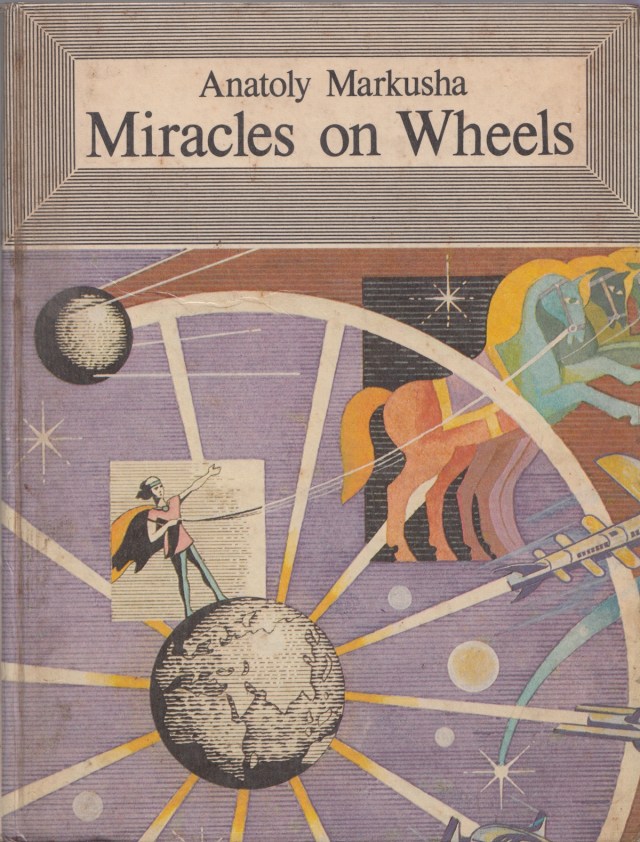
Miracles on Wheels – Markusha

In this post, we will see the book Miracles on Wheels: A Book for Inquiring Minds by Anatoly Markusha.

miracles-on-wheels

About the book:

This book has been written not only for budding engineers and mechanics: it is addressed to anyone who is thinking of becoming closely involved with machines and technology at any level, to anyone who is interested in the history of technology, or who likes to solve absorbing puzzles and make useful things with their own hands. In short, Miracles on Wheels is a book for inquiring minds.

The title of the book was chosen because our world literally runs on wheels, the wheels of cars, lorries and trains, and the wheels turning inside millions of machines. Wheels have a complex and dramatic history, a history which is also the history of technology.

About the author:

Anatoly Markusha has written more than fifty books, and he never tires of telling young people about technology’s past and present, about its development, its achievements and the prospects for its future. He always tries to help the young reader share his enthusiasm, and he explains how to master technology and find a common language with machines.

Before he began writing books, Anatoly Markusha had been a reporter for an evening newspaper, he was a fighter pilot during the war and he gained a qualification as a test-pilot. After his health forbade him to continue flying, he began working as a mechanic. It was then that he started his first book, entitled You Have Take-off.

He has now been writing books for over twenty years and his works have been published in over a dozen languages, both in the Soviet Union and abroad, with a total output of around ten million copies.

And always, in every book, the author returns to his main theme of Man and Machine. For him the world of technology is not merely a world of amazing machines, it is also a world of restless and thinking people who make great demands both on themselves and on others. The author calls on young people not to delay, not to put off their entry into this remarkable world. And his books help his young readers to make their choice and to find their way in an active and interesting life.

There are some remarkable drawings inside the book. Prints of many of these adored my work desk for many years.

And of course the coloured drawings at the chapter headings are awesome:

The book was translated from the Russian by Graham Whittaker and the amazing illustrations are by Boris Lavrov. The book was first published by Raduga in 1987.

Note: This was one of the first books I owned. I think I got it from a used bookstore when I was still in school. This is one amazing book especially if you read it in your formative years. The exercises and problems make you think out of the box for solutions. And advises on a variety of things concerning a thinking mind. Also, design thinking explored in various areas.

PDF | OCR | Bookmarked | 216 pages

( I have not cleaned and made the pages b/w as I usually do, hence the file size if ~ 60 MB)

The Internet Archive link.

and here

Contents

About This Book and Its Author 8

1

Three “Notches” for My Memory 10
An Unexpected, Though Quite Relevant, Digression 14
A Definition from an Old Dictionary 17
A Little Something from the Biography of a Most Useful Machine 22
For Those Who Are Not Convinced 26
Something to Think About, Problems to Solve 28
Some Useful Hints 31
Dates on the Calendar 36

2

Something Quite Clear, and Something Not So Clear 40
The Indispensable Language 44
In Praise of Our Oldest Teacher 52
Something to Think About, Problems to Solve 56
Some Useful Hints 59
Dates on the Calendar 63

3

Two Unforgettable Encounters 66
And If We Come Down to Earth? 71
Something to Think About, Problems to Solve 79
Some Useful Hints 82
Dates on the Calendar 85

4

A Few Particulars About an Engineer’s Character 90
Something to Think About, Problems to Solve 105
Some Useful Hints 107
Dates on the Calendar 110

5

What Do You Know About Charles Goodyear? 116
How to Test Yourself, How Not to Make a Mistake? 120
The Melancholy Boy with the Large Album 124
Something to Think About, Problems to Solve (Answers) 131
Some Useful Hints 135
Dates on the Calendar 139

6

The Uninvited Sequel to an Unexpected Meeting 142
A Sense of Time, an Ability to Foresee, and a Readiness to Fight 146
Something to Think About, Problems to Solve (Answers) 151
Some Useful Hints 153
Dates on the Calendar 157

7

A Matter of Getting the Job Done. Anywhere, Any Time. On Your Own, or with Others 160
It Won’t Get You a Monument, but… 164
The Last of the Mohicans 168
If You Work at It, then Everything’s Possible 172
Something to Think About, Problems to Solve (Answers) 176
Some Useful Hints 178
Dates on the Calendar 181
When Engineers Get Together 183
A Short Glossary of Technical Terms 192

Posted in books, engineering, history, philosophy, physics, psychology, raduga publishers, science, technology | Tagged , , , , , , , , , , , , | 2 Comments

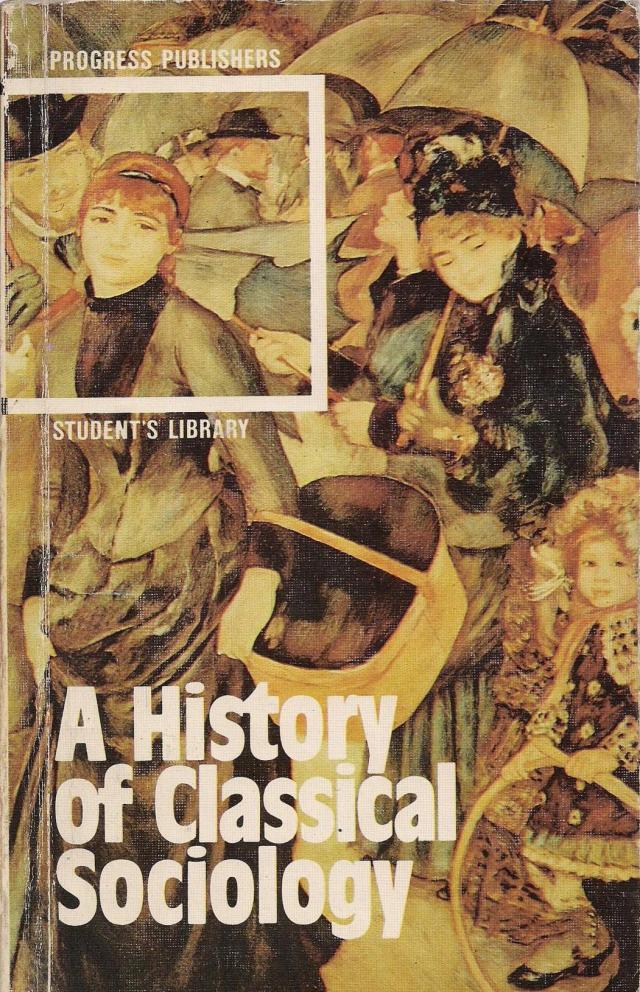
A History of Classical Sociology – Kon

In this post, we will see the book A History of Classical Sociology by Igor Kon (Ed.).

Kon_History_of_Classical_Sociology_0000

About the book
This is a study of the shaping and development of sociology in Western Europe, the United States, and Russia at the turn of the century, a period particularly important for the establishing of sociology as an independent discipline. The authors examine its development from social philosophy to sociology proper, and discuss how it grew from the rather vague programme it was, for example, in the conceptions of Auguste Comte, into a leading social science at the beginning of the twentieth century. They trace how it developed its conceptual apparatus, and how it began a systematic treatment of problems of the methodo­logy and techniques of research.
The contribution to sociology of the great spokesmen of its classical period, like Tönnies, Simmel, Durkheim, Max Weber, and Pareto, are examined in detail. Essays on the history of so­ciology of the nineteenth and early twentieth centuries in the West and in pre-revolutionary Russia, written from a Marxian standpoint.


The book was translated from the Russian by H. Campbell Creighton,  and was published by Progress Publishers in 1989.

The book seems to be scanned and converted to text (perhaps a word file?), as the formatting does not seem to match other texts from that time or the cover.

All credits to IA user Kahonor

The Internet Archive link

and here

Contents


CONTENTS

Introduction (by Igor Kon) 5

1. From Social Philosophy to Sociology (by Igor Kon) 9

2. Auguste Comte and the Origin of Positivist Sociology (by Elena Osipova) 22

3. Herbert Spencer’s Sociological Conception (by Igor Kon) 43

4. Naturalism in Sociology of the Turn of the Century (by Alexander Hofman and Alexander Kovalev) 57

5. The Psychological Sociology of the Turn of the Century (by Igor Kon) 96

6. Empirical Social Studies in the Nineteenth Century (by Marina Kovaleva) 122

7. The Crisis of Evolutionism and the Antipositivist Trends in Sociology at the Turn of the
Century (by Igor Kon) 151

8. K. Ferdinand Tonnies’ Sociological Conception (by Leonid Ionin) 173

9. Georg Simmel’s Sociology (by Leonid Ionin) 189

10. Emile Durkheim’s Sociology (by Elena Osipova) 206

11. The Sociology of Max Weber (by Piama Haidenko) 255

12. The Sociological System of Vilfredo Pareto (by Elena Osipova) 312

13. Sociology in Prerevolutionary Russia (by Igor Golosenko) 337

Conclusion (by Igor Kon) 357

Subject Index

Name Index


INTRODUCTION 8

Notes 9

1 FROM SOCIAL PHILOSOPHY TO SOCIOLOGY 1 1

1 . The Ideological and Theoretical Premisses of Sociological Knowledge 11

2. The Social and Class Premisses of Sociology 14

Notes 17

2 AUGUSTE COMTE AND THE ORIGIN OF POSITIVIST SOCIOLOGY 19

1 . Comte and His Time 19

2. The Classification of the Sciences 20

3. The Subject-matter and Tasks of Sociology 21

4. The Methods of Sociology 22

5. Social Statics 24

6. Social Dynamics 25

7. The Positive Polity 27

8. Comte’s Place in the History of Sociology 28

Notes 29

3 HERBERT SPENCER’S SOCIOLOGICAL CONCEPTION 31

1 . Spencer and His Time 31

2. The Subject-matter of Sociology 32

3. Organicism and Evolutionism 33

4. Spencer’s Place in the History of Sociology 36

Notes 37

4 NATURALISM IN SOCIOLOGY OF THE TURN OF THE CENTURY 39

1. Evolutionism — the Basis of the Naturalistic Schools of Sociology 39

2. The Mechanistic School 40

3. The Geographical School 41

4. The Racial, Anthropological School 46

5. The Bio-Organic School 48

6. The Social Darwinist School 51

*** 57

Notes 58

5 THE PSYCHOLOGICAL SOCIOLOGY OF THE TURN OF THE CENTURY 61

1. Psychology and Sociology in the Nineteenth Century 61

2. Psychological Evolutionism 62

3. Instinctivism 63

4. Folk Psychology 65

5. Group Psychology and the Theory of Imitation 66

6. The Birth of Interactionism 71

7. Psychological Sociology in the Historical Perspective 73

Notes 74

6 EMPIRICAL SOCIAL STUDIES IN THE NINETEENTH CENTURY 75

1. Empirical Social Studies in the United Kingdom 76

2. Empirical Social Studies in France 80

3. Empirical Social Research in Germany 86

Notes 89

7 THE CRISIS OF EVOLUTIONISM AND THE ANTIPOSITIVIST TRENDS IN
SOCIOLOGY AT THE TURN OF THE CENTURY 91

1. The Methodological Situation in Social Science at the Turn of the Century 91

2. The Changes in the Philosophy of the Social Sciences. Dilthey and Neo-Kantianism 94

3. The Position of Sociology 99

Notes 102

8 FERDINAND TONNES’ SOCIOLOGICAL CONCEPTION 104

Notes 112

9 GEORG SIMMEL’S SOCIOLOGY 1 13

Life and Activity 113

1. The Origin and Main Problem of Sociology 113

2. Form and Content. The Project of Formal Sociology 114

3. Patterns of Social Forms 1 14

4. Philosophical Sociology. The Theory of Understanding 116

5. Historical Sociology 117

6. Analysis of the ‘Spirit of Modernity’ 118

7. A Critical Assessment of Simmel’s Sociology 120

8. The Scientific Significance of Simmel’s Conception 121

Notes 121

10 EMILE DURKHEIM’S SOCIOLOGY 123

1 . Durkheim’s Socio-Political Position 123

2. The Subject-Matter of Sociology and Its Place Among the Other Social Sciences 125

3. ‘Sociologism’ as a Theory of Society 127

4. The Rules of Sociological Method 1 29

5. Social Solidarity and the Division of Labour 132

6. ‘Abnormal’ Forms of the Division of Labour. Personality and Society 134

7. Application of the Principles of ‘Sociologism’ to Study of the Causes of Suicide 137

8. The Philosophical and Sociological Conception of Morality 140

9. The Philosophical and Sociological Conception of Religion 142

10. Durkheim’s Place in the History of Sociology. ‘Sociologism’ and Marxism 147

Notes 149

1 1 THE SOCIOLOGY OF MAX WEBER 152

1 . Max Weber and His Times 152

2. Methodological Problems of the Sciences of Culture 154

3. The Ideal Type as a Logical Construct 155

4. The Problem of Understanding and the Category of ‘Social Action’ 157

5. The Goal-Oriented Rational Action as a Methodological Category of Weber’s Sociology
161

6. Social Action and ‘Orientation to Another’ — ‘Expectation’ 163

7. Types of Social Action 165

8. Formal Rationality as a Category of Weber’s Sociology 167

9. Weber’s Theory of Types of Domination 169

10. The Contradictory Nature of Weber’s Political Stance 173

1 1 . The Sociology of Religion 175

12. Max Weber in Historical Perspective 180

Notes 182

12 THE SOCIOLOGICAL SYSTEM OF VILFREDO PARETO 185

1 . Pareto and His Time 185

2. Methodology 186

3. Society as a System of the Interactions of Individuals 187

4. Psychological Reductionism 189

5 . The Conception of Ideology 1 90

6. The Idea of the Circulation of Elites 193

7. Pareto in the Historical Perspective 196

Notes 198

13 SOCIOLOGY IN PREREVOLUTIONARY RUSSIA 200

Notes 210

CONCLUSION 212

Notes 215

Posted in books, philosophy, progress publishers, sociology, soviet | Tagged , , , , , , , , , , , , , , , , , , , , , , , , , , , , , , , , , , , , | Leave a comment

Fundamentals of Philosophy – Spirkin

In this post, we will see the book Fundamentals of Philosophy by Alexander Spirkin.

Spirkin_Fundamentals_of_Philosophy_0000

About the book

The book offers a systematic exposition of  foundations of dialectical and historical materialism. It begins with deliberations on the nature of  philosophical knowledge, the role of worldview, and the purpose of methodology. There is also a brief excursus into the history of philosophy. Relying on a wealth of theoretical and practical materials, the author gives an all-sided analysis of such fundamental concepts as being and consciousness, matter and motion, cognition and activity; step by step, he identifies the main principles, laws and categories of dialectics, and closely studies the socioeconomic, political and cultural aspects of society’s life against the background of the global problems of modern times. The book shows conclusively that a consistent scientific philosophy did not develop as a mechanical accumulation of previously discovered grains of the truth but through their critical analysis and creative elaboration under the changing historical conditions.

The book was awarded a prize at a competition of textbooks for students of higher educational establishments.

The book was translated from the Russian by Sergei Syrovatkin. And was published by Progress Publishers in 1990.

All credits to IA user Kahonor

The Internet Archive link

and here

Contents

INTRODUCTION

Chapter I WHAT IS PHILOSOPHY? 7

  1. The Subject Matter and Nature of Philosophical Knowledge 7
  2. Philosophy as the Theoretical Basis of Worldview 23
  3. Philosophy as General Methodology 31

Chapter II. AN OUTLINE HISTORY OF PHILOSOPHY 37

  1. A History of Pre-Marxian Philosophy 37
  2. The Emergence and Development of the Philosophy of Marxism 60

BEING AND CONSCIOUSNESS

Chapter III MATTER: THE UNITY AND DIVERSITY OF THE FORMS OF ITS MANIFESTATION 66

  1. The General Concept of Matter 66
  2. Motion as the Mode of Existence of Matter 82
  3. Space and Time 88

Chapter IV. CONSCIOUSNESS; ESSENCE AND ORIGIN 99

  1. The General Concept of Consciousness 99
  2. The Path from Animal Psyche to Man’s Consciousness 110
  3. Consciousness. Language. Communication .114

AN OUTLINE THEORY OF DIALECTICS

Chapter V. CONNECTION AND DEVELOPMENT AS THE MAIN PRINCIPLES OF DIALECTICS 119

  1. On the Universal Connections and Interactions 119
  2. The Idea of Development and the Principle of Historism 123
  3. The Principle of Causality and Objective Goal-Directedness 132
  4. The Systems Principle 141
  5. Law and Regularity 147

Chapter VI, THE BASIC CATEGORIES AND LAWS OF DIALECTICS 152

  1. On the Unity of and Differences Between the Categories and Laws of Dialectics 152
  2. Essence and Phenomenon 154
  3. The Individual, the Particular and the General 162
  4. Necessity and Chance 165
  5. Possibility, Reality and Probability 172
  6. Part and Whole. System 178
  7. Content and Form 184
  8. Quality, Quantity and Measure 189
  9. Contradiction and Harmony 196
  10. Negation, Continuity and Innovations 203

KNOWLEDGE AND CREATIVITY

Chapter VII. ON THE ESSENCE AND MEANING OF KNOWLEDGE 208

  1. What Does It Mean to Know? 208
  2. Practice as the Basis and Purpose of Cognition 216
  3. What Is Truth? 220

Chapter VIII THE PHILOSOPHY OF THOUGHT 228

  1. Intellectual-Sensuous Contemplation 228
  2. Thought: Essence, Levels and Forms 230
  3. The Creative Power of Human Reason 240
  4. The Operations and Modes of Thought 246
  5. The Empirical and Theoretical Levels of Scientific Cognition 254

QUESTIONS OF SOCIAL PHILOSOPHY

Chapter IX. SOCIETY AND NATURE 267

  1. A Historico-Materialist Conception of Society 267
  2. Interaction between Society and Nature 277
  3. Demography: Socio-Philosophical Problems 282

Chapter X. THE ECONOMIC SPHERE OF SOCIETY’S LIFE:

THE SOCIO-PHILOSOPHICAL ASPECT 286

Material Production: The Concept and the Main Elements 286

Chapter XI. THE SOCIAL SPHERE OF SOCIETY’S LIFE 298

  1. Classes and Class Relations 298
  2. Nations and National Relations 301
  3. Family and Everyday Life 303

Chapter XII. THE POLITICAL SPHERE OF SOCIETY’S LIFE 309

Politics, the State, and Law .309

Chapter XIII. SOCIAL CONTROL 317

  1. Social Information and Control 317
  2. Types of Control and Their Impact on Social Development 321

Chapter XIV. A PHILOSOPHICAL CONCEPTION OF MAN 325

  1. Man. Personality. Society 325
  2. Man in the Flow of History 338

Chapter XV. THE SPIRITUAL AND INTELLECTUAL SPHERE OF SOCIETY’S LIFE 343

  1. Social Consciousness: Essence and Levels 343
  2. Political Consciousness 349
  3. Legal Consciousness 352
  4. Moral Consciousness 354
  5. Aesthetic Consciousness 363
  6. Religious Consciousness 375
  7. The Scientific Perception of the Universe and the World of Science .380
  8. The Philosophy of Culture 387

Chapter XVI. HISTORICAL PROGRESS AND THE GLOBAL PROBLEMS OF OUR TIMES 400

  1. Progress as a Historically Necessary Direction of Society’s Development 400
  2. The Dialectics of World Development in the Present Epoch 410

NAME INDEX 413

SUBJECT INDEX 417

Posted in books, philosophy, progress publishers, soviet | Tagged , , , , , , , , , , , , , , , , , , , , , , , , , , , | 5 Comments

The Main Trends in Philosophy – Oizerman

In this post, we will see the book The Main Trends in Philosophy: A Theoretical Analysis of the History of Philosophy by Teodor Oizerman.

Oizerman_Main_trends_in_Philosophy_0000

About the book
This monograph is a theoretical investigation of the process of the history of philosophy. The author examines the polarisation of philosophical systems in their main trends, viz., the materialist and idealist. He traces the struggle between materialism and idealism on the basis of the dialectical-materialist conception of the history of philosophy, and brings out the scientific and cultural-historical significance of dialectical materialism in present-day world philosophical thought.

The book was in 1979 awarded the Plekhanov prize under the decision of the USSR Academy of Sciences.

The book was translated from the Russian by H. Campbell Creighton, and was published by Progress Publishers in 1988.

All credits to IA user Kahonor

The Internet Archive link

and here

Contents

Page
INTRODUCTION 5

Part One. THE BASIC PHILOSOPHICAL QUESTION AS A PROBLEM OF THE HISTORY OF PHILOSOPHY

I. THE SENSE AND MEANING OF THE BASIC PHILOSOPHICAL QUESTION 19

1. The Basic Philosophical Question and the Problematic of Philosophy 19

2. Self-Awareness and the External World. The Epistemological Necessity of the Basic Philosophical Question 22

3. On the Origin and Development of the Basic Philosophical Question 33

4. The Basic Philosophical Question: Objective Content and Subjective Form of Expression. The Real Starting Point of Philosophical
Inquiry 37

II. THE TWO SIDES OF THE BASIC PHILOSOPHICAL QUESTION 54

1. The Ontological Aspect: the Materialist Answer to the Basic Question 54

2. The Oncological Aspect: a Contribution to the Delineation of the Idealist Answer to the Basic Philosophical Question 74

3. The Epistemological Aspect. The Principle of Reflection and the Idealist Interpretation of the Knowability of the World 87

4. The Epistemological Aspect. The Principle of the Knowability of the World and Philosophical Scepticism 104

Part Two. PHILOSOPHICAL TRENDS AS AN OBJECT OF RESEARCH IN THE HISTORY OF PHILOSOPHY

HI. THE DIVERGENCE OF PHILOSOPHICAL DOCTRINES AND ITS INTERPRETATION. METAPHYSICAL SYSTEMS AND THE DEVELOPMENT OF THE ANTITHESIS BETWEEN MATERIALISM AND IDEALISM 138

1. Dispute about Trends or Dispute of Trends? 138

2. Metaphysical Systems. Spiritualism and the Naturalist Tendency 155

3. Materialism — the Sole Consistent Opponent of Speculative Metaphysical Systems 165

4. Kant’s Transcendental Dualist Metaphysics 173

5. Toward a Critique of Irrationalist Speculative Metaphysics 184

6. The Dispute between Materialism and Idealism and Differences in Understanding Speculative Metaphysics 195

IV. THE GREAT CONFRONTATION: MATERIALISM VS IDEALISM. THE ARGUMENTS AND COUNTERARGUMENTS 215

1. The Struggle of Materialism and Idealism as an Epochal Cultural and Historical Phenomenon 215

2. Idealism vs Materialism. Materialism vs Idealism. Results and Prospects 234

3. The Dialectical-Materialist Critique of Idealism. The Epistemological Roots of Idealist Fallacies 262

4. The Dialectical-Materialist Critique of Idealism. The Principle of the Partisanship of Philosophy 274

CONCLUSION 296

LITERATURE 306

NAME INDEX

SUBJECT INDEX

Posted in books, philosophy, progress publishers, soviet | Tagged , , , , , , , , , , , , , , , , , | Leave a comment

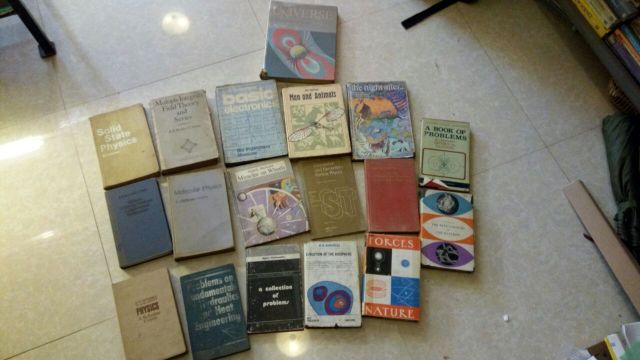
A glimpse of this months upcoming posts

2018-05-08 14.14.37

  • Essays on the Universe
  • Solid State Physics – Epifanov
  • Multiple Integrals, Field Theory and Series – Fomin, Budak
  • Basic Electronics – Zerbestov
  • Man and Animals
  • The Night After
  • A book of problems in ODE
  • The Nine Colours of the Rainbow – Steinhaus
  • Forces of Nature – Griggoryev, Myakishev
  • Selected problems and questions in strength of materials – Feodosyev (red book)
  • Gravitation, Elementary Particle Physics – Longunov (Ed.)
  • Miracles on Wheels – Markusha
  • Molecular Physics – Kiokin and Kiokin
  • Methods of Solving problems in high school mathematics – (blue book)
  • Physics a refresher course – Yavorksy
  • Problems on Fundamentals of Hydraulic and Heat Engineering –
  • A collection of problems – minorsky
  • Evolution of the Biosphere
  • Biophysics – Wolkenstein (not in the pic)


Sorry for the potato quality of the photo!

We hope to post these by the end of this month!!

Cheers!!!

Posted in books, mathematics, mir books, mir publishers, physics, science, soviet, technology | Tagged , , , , | 16 Comments