Neuropathology for Everyone – Umansky

In this post, we will see the book Neuropathology for Everyone by K. G. Umansky.

Umansky-Neuroopathology-for-Everyone-Mir-1989.jpg

About the book

 The author, Professor K. G. Umansky, is a neuropathologist of high repute with many years of research and practice in this field of medicine and a wide knowledge of the neuropathological problems so often encountered in today’s stressed world. In this book he acquaints the general reader, in an easily understood and readable form, with the most frequent disorders of the nervous system and their treatment. Among them are insomnia, headache, sciatica and lumbago, certain trauma-induced diseases of the nervous system, infectious diseases (such as encephalitis, poliomyelitis, meningitis, etc.), disturbances of cerebral circulation (high pressure, stroke, etc), and several other disturbances of the nervous system. He examines the main causes of these diseases and gives advices on how to recognize the signs of such diseases in oneself. In a world where people look upon drugs as the universal cure for every ailment, and where drug abuse often leads to dangerous consequences, Profes­ sor Umansky reminds us of old, forgotten reme­dies that are both effective and harmless. He also gives advice on simple preventive measures. This book is intended for the general public.
 This book is not a manual on nervous disor­ders and not a universal reference book for every emergency. It tells its readers about neuropathology—one of the main branches of medicine, that is very closely connected with all the other spheres of medical knowl­edge.
The book was translated from the Russian by P. Chernilovskaya and was first published by Mir in 1989.
Contents
PREFACE 7
I AM A NEUROPATHOLOGIST 9
DANGER SIGNALS 17
ERRORS OF NATURE OR OUR OWN MISTAKES? 69
TESTING FOR STRENGTH 98
DO YOU SLEEP WELL? 146
A HUNDRED AND TWENTY THOUSAND KILOMETERS 1 6 6
ETERNAL WAR? 202
WE CANNOT CHANGE YOUR NATURE 247
IN VINO VERITAS? 281
CONFRONTATION WITH THE TIMES 305
Posted in books, life sciences, medical, mir books, mir publishers, science, science for everyone, soviet | Tagged , , , , , , , , , , , , , , , , , , , , , , , , | Leave a comment

Symmetry in the World of Molecules – Dmitriev

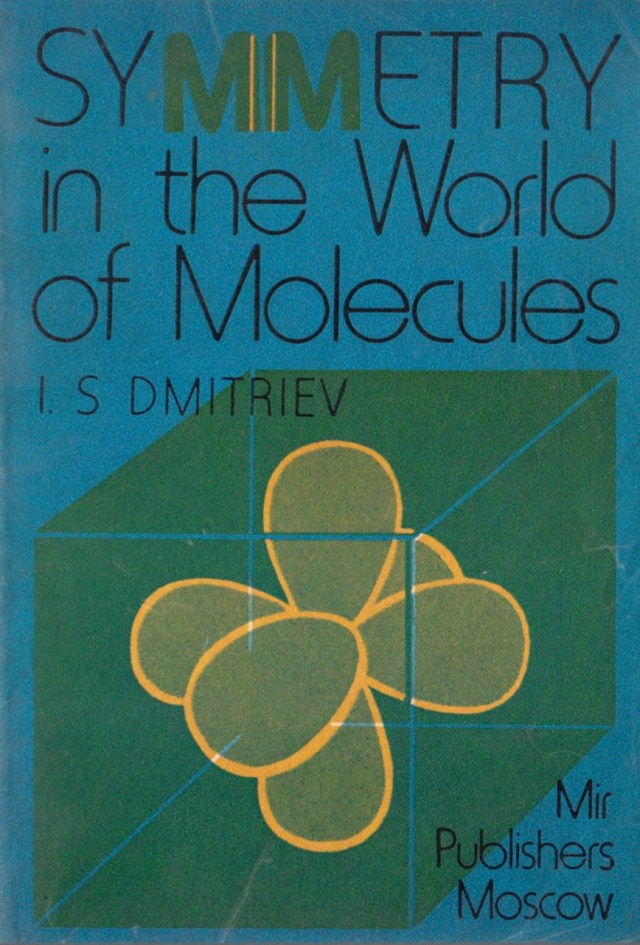
Dmitriev-Symmetry-in-the-World-of-Molecules-Mir-1979In this post, we will see the book Symmetry in the World of Molecules by I. S. Dmitriev.

About the book

This booklet is devoted to one of the most important concepts of natural science, the concept of symmetry. The beneficial impact of the symmetry theory can be traced in the theory of elementary particles, crystallography, solid state physics, space and time theory, molecular biology, quantum chemistry, the study of arts, the theory of music as well as many branches of mathematics.
Since many things are necessarily omitted even in a large monograph, this is all the more so in a small unpretentious booklet. Our narration does not cover transpositional symmetry, solid state theory and nu­ merous problems pertaining to application of symmetry theory to organic chemistry. This booklet deals pri­marily with spatial symmetry of molecules.
The study of any theory is to a certain extent similar to the learning of a foreign language. While some peo­ ple learn it in order to write and speak fluently, others are satisfied with the understanding of foreign texts even if using a dictionary. The same is true in the case of a theory. While some people learn it very comprehen­sively in order to work actively in the area, it is suf­ficient for others to understand the language of theo­rists and the substance of their conclusions. This book is intended for the latter group, who are much more numerous than the former. This booklet is intended just for them. We address it to experimental chemists, teachers, university students and even high school senior students.
The symmetry theory is usually applied to the specific problems of physics and chemistry when non- algebraic objects such as atoms, molecules, solids are studied with algebraic methods. Therefore some read­ers will probably need to overcome certain barriers of mathematical reasoning.
The general logical plan of the booklet is as follows. The first chapter has a narrative nature and is dedicat­ed to the description of the major types of molecular symmetry. The second chapter may be considered as a mathematical model of the first. The next two chap­ ters are devoted to problems of the interrelation be­tween the composition, geometry and electronic structure of molecules (Chapter 3) and chemical reactions
(Chapter 4). The final fifth chapter is of an historic and methodological character.
The book was translated from the Russian by Yuri Atanov and was published by Mir in 1979.

Contents

Foreword 5

Chapter One SYMMETRY OF A NUCLEAR POLYHEDRON 9

Elements and operations of symmetry 9
Concept of a group 15
Hierarchy of point groups 19

Chapter Two SYMMETRY IN MATHEMATICAL TERMS 30

In the footsteps of Descartes 30
Symmetry and molecular orbitals 42

Chapter Three SYMMETRY AND STEREOCHEMISTRY 54

First variation on the theme of Coulomb law 55
Second variation on the theme of Coulomb law 63
Theory of crystalline field (TCF) 71
Electronic transitions 76
Method of molecular orbitals and structure of complex compounds 81
Jahn-Teller effect 92
Pearson’s rule 96
Symmetry appears and disappears 104

Chapter Four SYMMETRY AND CHEMICAL REACTION:  108

A few words about chemical process 108
Permitting symmetry and forbidding symmetry 111
Orbital symmetry conservation in some organic reactions 114

Chapter Five FORWARD INTO HISTORY!  125

Σιμμετρια-Apocryphal times  125
Testament of Evariste Galois  126
Non-Euclidean geometries and chemistry 128
Symmetry concept in natural sciences  123
Group theory in quantum chemistry 142
Index vocabulary  146
Posted in books, chemistry, mir books, mir publishers, physics, science | Tagged , , , , , , , , , , , , , , , , , , , , , , | Leave a comment

The Sky Will Be Blue – Gordon, Gordon

In this post, we will look at the book The Sky Will Be Blue by G. Gordon and L. Gordon.

Gordon-Gordon-Sky-Will-be-Blue-Mir-1984-fc

About the book

This book tells the reader in popular form just what dust and gaseous impurities consist of how they originate in metallurgical works, what a grave dan­ger they are to all living things on the Earth, and how man protects himself and his habitat from them. A picture is drawn of the future when metallurgy will be free of dust and harmful gases. Original drawings supplement this interesting narrative. The book is intended for general public.

There are some fantastic illustrations in the book.

The book was translated from the Russian by Y. Nadler and was published by Mir in 1984.

Many thanks to Guptaji for the cover of the book. He had generously given the cover when I had visited his library some years back. Note that pages 151-154 are missing – the physical copy of the book I had did not have these pages.

The Internet Archive Link and here

CONTENTS

Preface 7

ONE PLANET FOR ALL 9 (Instead of Introduction)

ELIXIR OF LIFE 13 Natural Balance on Earth 13

Air Cocktail 16

Smog Alarm 22 

BIRTHPLACE-METALLURGICAL WORKS 27

Forced to be First 27 

Distant Reconnaissance 32

A Pound of Down or a Pound of Iron? 36 

The Triple Alliance 41

DUST-COLLECTING SERVICE 47 

Prior to Choosing 47

In a New Capacity 51

The Way to Perfection 54

Cleansing Shower 60

A Reliable Screen 67

St. Elmo’s Fire 78

To Be or Not To Be? 88

IN THE LANGUAGE OF MATHEMATICS 92

Ultimate Destination 95 

“The Taming of the Shrew” 97 

DROPS IN A SIEVE 101

MOLECULES VERSUS MOLECULES 104 

A Second Vocation of Scrubbers 104

The Marvelous Lace 109

How Long Will the Torches Burn? 114 

ON THE WATCH 117

Inevitable Co-Travellers 117 

In Step with the Times 120 

A hatter of the Future 123

Sources of Economy 124

Hand in Hand with Chemists 126

The Good and Evil Sides of the “Wing” Metal 133 

A Multiple Solution 137

Using All Available Means 142

A LOOK AT THE FUTURE 145

Air of the Highest Quality 145

Waste-Free Metallurgy 148

Filters of the 21st Century 152

Economical Aspects 155 

Computers on the Watch 158

Posted in books, chemistry, metals, mir books, mir publishers, science, soviet, technology | Tagged , , , , , , , , , , , , , , , | Leave a comment

Essays About the Universe – Vorontsov-Vel’yaminov

In this post, we will see the book Essays About the Universe by Boris A. Vorontsov-Vel’yaminov. 

Essays-about-the-Universe-Mir-1985-fc

About the book:

This book by a prominent Soviet astronomer and imaginative interpreter of the history and latest knowledge of astronomy, an age-old science that has come through two shattering decades of exciting discovery and research, can be dubbed a popular encyclopaedia of astronomy. It is a vivid and fascinating account of almost all the celestial bodies with which astronomy is concerned: planets, comets, meteors, the Sun and stars, gaseous and dust nebulae, quasars, black hole., etc. The tome is lavishly illustrated throughout with a mixture of photographs and specially commissioned artwork in full colour. The book will appeal to the general reader with no astronomical and mathematical background, fascinated by the wonders of the Space Age.

The book has two major sections, the first deals with Solid matter, that is the planets (minor and major), comets and meteors. The second part deals with the gaseous state which includes stars, nebulae, galaxies, interstellar matter. Mathematics is avoided as much as possible with the main emphasis on explaining the physical meaning of the concepts and their implications to the reader. The book covers an impressively wide range of topics in astronomy starting from the basics to topics of cutting-edge research.

The book was translated from the Russian by Alexander Repyev and was published by Mir 1985.
Note: The book is large in size (~ 190 MB). It took some time to scan it, as I had to scan individual pages because of their large size almost A4 in size. Unfortunately, before the optimisation of the images could be completed, I lost all the raw images to a disk crash. Hence I have uploaded the pdf that could be salvaged. You might notice some inconsistencies in the pages here and there. There are some amazing full-page illustrations, one of my favourites is one explaining the meteor path for different observers.
Essays-about-the-Universe-Mir-1985-meteor

Update: 27 July 2024 New cleaned scan added

Get it here and here

Contents

Introduction 7

The Starry Skies

A Heavenly Menagerie 7.
Brightness and Names of Stars 10.
Addresses of Stars in the Sky 11.

Eyes, Ears and Hands of Astronomers 14.

General Survey of an Observatory 14.
Optical Telescopes-Astronomer’s Eyes 16.
Telescope’s Auxiliaries 21.
Spectroscopy and Spectra 22.
Spectral Language 24.
Astronomers’ “Ears”-Radio Telescopes 28.
Astronomers’ “Fingers”: Radar and Laser or… Is It Possible to Feel Planets and Illuminate the Moon? 32.
The Hunt for High- Energy Cosmic Rays 33.
Through Soviet Observatories 34.
“Smart” Satellites 34.
You Yourself Can Observe and Study the Universe 35.
How Astronomical Discoveries Are and Aren’t Done 36.

The World of Solid Matter 39

1. The Main Members of the Solar System 40

Distant Worlds-Satellites of the Sun 40.
Kepler’s Laws 40.
Orbital Elements 42.
Space Near Our Home Planet 42.
Planetary and Lunar Studies 43.
The Old and New About Our Eternal Satellite 45.
Lunokhods and First Astronauts on the Moon 52.
Two More Earth’s Moons, but Made of Dust 57.
The Moon’s Twin-Mercury 58.
Mysteries of Beautiful Venus 60.
Mars from Far and Near 65.
Once More About Life on Mars 69.
Are the Martian Satellites Artificial? 71.
Is There Life on Earth? 74.
The Giants Jupiter and Saturn 74.
At the Far Reaches of the Solar System 79.
The Ringed Planets 81.
Are There Any Other Planetary Systems? 85.

2. The Little Planets 87

The Planet Hunters 87.
A Chain of Discoveries 88.
The Farther into the Forest, the More Firewood There Is 91.
Our Nearest Neighbours 93.
Travels To and On Hermes 96

3. Visible Nothing 100

Heralds of Terror 100.
Celestial Chameleons 103.
Halley’s Discovery 105.
Short-Period Comets 107.
Members of the Family or Aliens? 109.
Discovery of Comets 110.
Lost Comets 112.
Visible Nothing 115.
The Cause of Luminescence of Comets and Their Chemical Composition 117.
What Occurs Within Comets 118.
A Collision Between the Earth and a Cornet 121.
Where Were Comets Born? Are They Born Now? 122.

4. Shooting Stars and Meteoric Storms 124

Shooting Stars and Stones from the Skies 124.
Meteor Portraits and Passports 127.
Meteor Storms and Streams 128.
More About Meteors 129.
A Census of Meteors 132.
Meteoric Swarms 133.
Cometary Dust 136.
Meteors in the Atmosphere 138.
New Techniques in Meteoric Studies 143.

5. Heavenly Rocks and Dust 146

The Stones in Figures 148.
Structure and Age of Meteorites 150.
The Chemical Composition of Earth and Meteorites 152.
In Search of Ancestry 154.
Canyon Diablo 156.
Other Meteorite Craters 157.
The Tunguska Object 159.
Sikhote-Alin Meteorite 161.
Bombardments from the Heavens 162.
Zodiacal Light and the Gas Tail of the Earth 164.
Light and Dark Nebulae 167.
Interstellar Wastes 170.

 Contents (Part 2)

The World of Gas 175

1. The Sun-the Closest of the Stars 176

Introduction 176.
The Sphere of Light 177.
Even the Sun Is Not Without Spots 179.
Observation of the Invisible and the Sun’s Anatomy 182.
The Envelopes of the Sun 184.
The Highest Fountains in the Universe 185.
The Solar Corona and Its Mysteries 186.
How Three Astronomers Deceived Nature 188.
Solar Chemistry 190.
A History of Two Strangers 191.
Active Regions, Chromospheric Flares, X-Ray and Radio Emission of the Sun 194.
Magnetic Phenomena on the Sun 195.
The Solar Wind and Polar Aurorae 198.

2. The Stars Are Distant Suns 203

Comprehending the Incomprehensible 203.
Stellar Luminosity 203.
Spectra – Stellar Credentials 204.
What Do Stars Consist of and Why Are Their Spectra Different? 206.
Thermometers for Stars 207.
Stellar Spectrum – Distance Indicator 208.
Sounding Rod in the Depths of Space 209.
Motion of Fixed Stars 211.
“Traffic Control” for Stars 213.
Where Are We Going? 213.
Taking a Star’s Measure 214.
Star Pairs 215.
“Devil” Stars 217.
Portrait Gallery of Coloured Stars 218.
Portraits of White Stars and Their History 220.
Anatomy of Stellar Atmospheres 222.
Stars Are Like Tops 224.
In the Neighbourhood of the Sun 224.
Neighbours of the Sun 227.
Distribution of Stellar Luminosities 229.
Census of the Star Population on the Hertzsprung-Russell Diagram 230.

3. Stellar Pulsations and Explosions

Cepheids – the Lighthouses of the Universe 231.
Other Physical Variable and Flare Stars 231.
Swollen Atmospheres 234.
Stars with Escaping Gas 235.
Stars That Cast Off Their Envelopes 236.
Supernova Explosions 240.
Stellar Tops – Pulsars and Black Holes 245.

4. The World of Star Clusters and Diffuse Gases 247

Open and Globular Star Clusters and Associations 247.
Clearer About the Nebulous World 250.
Nebular Gas 250.
Luminescence and Nature of Gaseous Nebulare 251.
Diffuse Gaseous Nebulae 253.
Planetary Nebulae 257.
Expansion of Planetary Nebulae 259.
Evolution of Planetary Nebulae and Their Nuclei 261.
Interstellar Gas 264.

5. Islands of the Universe

Milestones and the Structure of Our Galaxy 269.
Structure of Our Stellar Home 272.
Galaxies – Islands of the Universe 275.
More About Galaxies 279.
Galactic Groups and Clusters 285.
Your Address in the Infinite Universe 286.
From Atomic Nucleus to Meta-galaxy 287.
Interaction of Galaxies 287.
Radio Galaxies and Enigmatic Quasars 288.
Explosions in Island Universes 292.
Is There a Boundary of the World and What Is Beyond? 295.
Is Any Communication Possible with Extraterrestrial Civilizations ? 295.

6. Birth, Life and Death of Stars 231

How Old Are the Stars and the Milky Way? 300.
Where Does Stellar Energy Come From? 303.
Nuclei and Nuclear Reactions 305.
“Feed Cycle” of Stars 309.
Internal Structure of Stars 312.
The Origin of Diffuse Matter 314.
The Origins of Stars 316.
The Life and Death of Stars 317.

7. The History of the Earth and Planets 323

Posted in astronomy, books, mir books, mir publishers, physics, science | Tagged , , , , , , , , , , , , , , , , , , , , , , , , , , , , | Leave a comment

Structural Mechanics – Darkov, Kuznetsov

In this post, we will see the book Structural Mechanics by A. Darkov and V. Kuznetsov.

The book deals with a variety of structures and their stability from an engineering viewpoint. The structures discussed include arches, frames, trusses, roofs, retaining walls, bridges, columns and beams.

The book was translated from the Russian by B. Lachionov and the second edition was published by Mir in 1966.

All credits to the original uploader. The scan is a low-resolution one.

The Internet Archive Link

Contents

Introduction 11

  1. Kinematic Analysis of Structures

  2. Beams

  3. Three-Hinged Arches and Frames

  4. The Trusses

  5. Space Framework

  6. Kinematic Method of Influence Line Construction

  7. Retaining Walls and Earth Pressure Computation

  8. Strain Energy Theory and General Methods of Displacement Computation

  9. Analysis of the Simpler Statically Indeterminate Structures by the method of forces

  10. Continuous Beams

  11. Redundant Arches

  12. Analysis of highly redundant structures

  13. Slope and Deflections. Combined and Mixed Methods

  14. Approximate methods of stress analysis in redundant frames

  15. Modern design methods


Posted in books, engineering, mir books, mir publishers, physics, technology | Tagged , , , , , , , , , , , , , , | Leave a comment

Physiology for Everyone – Sergeev

In this post, we will see the book Physiology for Everyone by B. F. Sergeev.

Sergeev-Physiology-for-Everyone-Mir-1973-fc copy

About the book

Our planet, the Earth, is the home of hundreds of thousands of living creatures. Life has permeated everywhere. It has ascended to the tops of the highest mountains, where there is hardly any air, and has hid­den beneath the expanses of the oceans, reconciling itself to the tremendous pressures exerted by the waters. Life has come to the hot, arid desert; and to the eternal ice of the Arctic Living creatures have adapted themselves to an absence of oxygen, to ever­lasting gloom, and to silence. But, wherever living organisms have settled, they need food which has to be distributed throughout their bodies, and they have to carry out the processes of metabolism. They also need to feel at home in their environment and start families to ensure the survival of the species.
This book will tell you about Nature’s amazing inventions which have made it possible for animals to po­pulate our Earth, dealing as it does with live lanterns, radars, animal power stations, the mysteries of digestion, the automatism of the circulation of the blood, which is the body’s most perfect transportation system, the structure of photo- and audio-receptors the mysterious third eye, the secret workings of the brain, and the peculiarities of reproduction.
Man has barely started to become familiar with Nature’s ingenious fantasy, but he is already getting to grips with the process of evolution and making use of all Nature’s treasures and inventions. The aim o this book is to call the reader’s attention to the endless horizons of the science of living beings.
The book was published in 1973 and was translated from the Russian in Oleg Meshkov.

Note:

The book was very tightly bound with threads running through the text body by the previous owner. I had to cut the thread and in the process also destroyed the spine of the book. Now the book is in four smaller parts. Every now and then you will see some “spots” in the text near the edges, these are the marks of the holes for the threads. The covers were also in bad shape, I have tried to restore some parts of it. It feels sad to destroy a book while scanning, but at times there is no other way to do it. Looking at it in another way, this sacrifice of the physical book has in a way made it immortal in the cyberspace.
On the front cover, there is an adaptation of Durer’s Rhinoceros. The book is dotted with many cute illustrations, though they are not credited.
PDF | OCR | Bookmarked | Paginated | Cover | 600 dpi

Contents

Water – A Personal Ocean
The Substance to Which Our Planet Owes Its Existence  7
‘Live’ Water 11 Dead Water 16
How Much Do We Weigh? 19
Crocodile Tears 22
Do Fish Drink? 26
Can the Air Be Squeezed Dry? 28
The Water Manufactory 32
Construction Materials
Lucullus’ Feats 37
Teeth Which ‘Crawl’  48
A Thousand-year-old Mystery Solved 55
What Do Cows Eat? 59
There Are Different Kinds of Pans 64
The Food Industry 73
The ‘Health Stores’ of Nature  79
Ventilation
A Vital Element 91
Supply Department  93
Diving Suits and Aqualungs 103
In Search of Oxygen 108
Slag and Ballast 120
Thousands of Millions of Carriers
It Just Dare Not Get Tired 129
Waves  142
Hydraulics 152
Where Can One Get Some Firewood? 157
The Fire-bird
Just Like a Fairy-Tale 176
Solving the Mystery 182
Living Lanterns 186
The Fire-bird Serves Man 193
Live Electricity
Historical Highlights 195
The Metal Conductor and the Nerve 200
An Underwater Electric Power Station 206
Locators and Oscillographs 213
Information Service
The All-purpose Antenna 218
Where Did It All Come From? 221
A Third Eye 230
The Wonderful World of Light 236
Whispering Planet  252
A Personal Refrigerator
A Strange Gland 268
The Functions of the Brain Convolutions 272
Delay Spells Death 277
When One Is Crazy about Frenchmen 287
The Speculations and Doubts of Scientists 293
A Courageous Deceiver 298
The Blues  301
The Racial Problem  304
Storks and Cabbages
Why Does It Always Take Two? 309
Marriage and Family 314
Two Sources 324
The Request of the Enamoured Salmacis 332
Innocent Conception 336
How Many Chicks Can Hatch From One Egg? 341
Posted in books, life sciences, mir books, mir publishers, science, science for everyone | Tagged , , , , , , , , , , , , , | 7 Comments

MISHA Stack

Here are some issues of Misha on the Internet Archive

Screen Shot 2018-11-11 at 9.39.54 PM.png

All Credits to original uploaders


Posted in books, children's stories, soviet | Tagged , , , | 1 Comment

This Amazingly Symmetrical World – Tarasov

symmetry-1.jpg

In this post, we will see the book This Amazingly Symmetrical World by Lev Tarasov.

Screen Shot 2018-11-04 at 7.41.39 PM.png

As we had written in the earlier post with Tarasov’s Calculus, which was remade electronically using LaTeX typesetting engine, this is another of his books which have been recreated with LaTeX.

tarasov-symmetry-fc.jpg

The amount of efforts put in creating this book has been amply rewarded as the result has been aesthetically very pleasing for me. And in the process, I have learned a lot more about LaTeX and its packages. Hope this small effort is found useful by all. In case you find any typos please comment on the post.

Some snapshots from the remade book:


The Internet Archive link and here

Link to the git repo of the source files

README.md

The project has the LaTeX source files for the book This Amazingly Symmetrical
World by Lev Tarasov. We have used the scans of the book for images and have
not recreated any of the images.

Though I would have liked to create all the pages, especially the cover and the
art till the title page using TiKZ, for now, I have created pdfs for those pages
in Inkscape. Purists may not like it, but at least in this version, that is how things are. Also the tables are not made using LaTeX, but are simple scans. Perhaps in a later version of the book, we will have these two issues sorted.

The original typesetting of the book lets itself to be very well typeset with one of Edward Tufte’s book style implemented in LaTeX.

If there are any errors while typesetting, for example, references, or typos
please report them so that they can be addressed.

As usual, you will need all the package files to compile the book correctly.


Also found a copy of the original Russian it has some different illustration.

Contents

Preface 13

A Conversation 15

Part I Symmetry Around Us 23

1 Mirror Symmetry 27

1 An Object and Its Mirror Twin 27
2 Mirror Symmetry 30
3 Enantiomorphs 31

2 Other Kinds of Symmetry 35

4 Rotational Symmetry 35
5 Mirror-Rotational Symmetry
6 Translational Symmetry
7 Bad Neighbours 39
8 Glide Plane (Axis) of Symmetry

3 Borders and Patterns 43

9 Borders 43
10 Decorative Patterns 45
11 Pattern Construction 49
12 The ‘Lizards’ Design 51

4 Regular Polyhedra 53

13 The Five Platonic Solids 53
14 The Symmetry of the Regular Polyhedra 54
15 The Uses of the Platonic Solids to Explain Some Fundamental Problems 55
16 On the Role of Symmetry in the Cognition of Nature 57

5 Symmetry In Nature 59

17 From the Concept of Symmetry to the Real Picture of a Symmetrical World 59
18 Symmetry in Inanimate Nature. Crystals 61
19 Symmetry in the World of Plants 63
20 Symmetry in the World of Animals 66
21 Inhabitants of Other Worlds 69

6 Order in the World of Atoms 71

22 Molecules 71
23 The Puzzle of the Benzene Ring 72
24 The Crystal Lattice 73
25 The Face-Centred Cubic Lattice 74
26 Polymorphism 76
27 The Crystal Lattice and the External Appearance of a Crystal 77
28 The Experimental Study of Crystal Structures 78
29 The Mysteries of Water 79
30 Magnetic Structures 80
31 Order and Disorder 82

7 Spirality In Nature 85

32 The Symmetry and Asymmetry of the Helix 85
33 Helices in Nature 87
34 The DNA Molecule 89
35 The Rotation of the Plane of Light Polarization 91
36 Left and Right Molecules. Stereoisomerism 92
37 The Left-Right Asymmetry of Molecules and Life 93

Part II Symmetry Around Us 97

8 Symmetry and The Relativity of Motion 101

38 The Relativity Principle 101
39 The Relativity of Simultaneous Events 102
40 The Lorentz Transformations 103
41 The Relativity of Time Periods 105
42 The Speed in Various Frames 106

9 The Symmetry of Physical Laws 109

43 Symmetry Under Spatial Translations 109
44 Rotational Symmetry 111
45 Symmetry in Time 112
46 The Symmetry Under Mirror Reflection 113
47 An Example of Asymmetry of Physical Laws 114

10 Conservation Laws 117

48 An Unusual Adventure of Baron Münchhausen 117
49 The Problem of Billiard Balls 118
50 On the Law of Conservation of Momentum 121
51 The Vector Product of Two Vectors 122
52 Kepler’s Second Law 123
53 Conservation of the Intrinsic Angular Momentum of a Rotating Body 126

11 Symmetry and Conservation Laws 129

54 The Relationship of Space and Time Symmetry to Conservation Laws 129
55 The Universal and Fundamental Nature of Conservation Laws 130
56 The Practical Value of Conservation Laws 133
57 The Example of the Compton Effect 134
58 Conservation Laws as Prohibiting Rules 136

12 The World of Elementary Particles 139

59 Some Features of Particles 139
60 The Zoo of Elementary Particles 141
61 Particles and Antiparticles 142
62 Particles, Antiparticles and Symmetry 146
63 Neutrino and Antineutrino 148
64 The Instability of Particles 149
65 Inter-conversions of Particles 152

13 Conservation Laws and Particles 157

66 Conservation of Energy and Momentum in Particle Reactions 157
67 The Conservation of Electric Charge and Stability of the Electron 159
68 The Three Conservation Laws and Neutrino 160
69 Experimental Determination of Electron Antineutrino 162
70 Electron and Muon Numbers. Electron and Muon Neutrinos 163
71 The Baryon Number and Stability of the Proton 165
72 Discrete Symmetries. CPT-Invariance 167

14 The Ozma Problem 171

73 What Is the Ozma Problem? 171
74 The Ozma Problem Before 1956 173
75 The Mirror Asymmetry of Beta-Decay Processes 174
76 The Mirror Asymmetry in Decay Processes and the Ozma Problem 175
77 The Fall of Charge-Conjugation Symmetry 176
78 Combined Parity 177
79 Combined Parity and the Ozma Problem 179
80 The Solution to the Ozma Problem 180

15 Fermions and Bosons 183

81 The Periodic Table and the Pauli Principle 183
82 Commutative Symmetry. Fermions and Bosons 184
83 Symmetrical and Antisymmetrical Wave Functions 185
84 The Superfluidity of Liquid Helium. Superconductivity 187
85 Induced Light Generation and Lasers 188

16 The Symmetry of Various Interactions 189

86 The Principal Types of Interactions 189
87 Isotopic Invariance of Strong Interactions. The Isotopic Spin (Isospin) 191
88 Strangeness Conservation in Strong and Electromagnetic Interactions 194
89 Interactions and Conservations 197
90 A Curious Formula 198
91 The Unitary Symmetry of Strong Interactions 199

17 Quark-Lepton Symmetry 203

92 Quarks 203
93 The Charmed World 207
94 Quark-Lepton Symmetry 208
95 A New Discovery 210

A Conversation Between the Author and the Reader About the Role of Symmetry 213

The Ubiquitous Symmetry 213
The Development of the Concept of Symmetry 215
Symmetry-Asymmetry 217
On the Role of Symmetry in the Scientific Quest for Knowledge 219
Symmetry in Creative Arts 222

Literature 231

Posted in books, life sciences, mathematics, mir books, mir publishers, physics, science | Tagged , , , , , , , , , , , , , , , , , , , , , , , | 10 Comments

Theory of Angular Momentum – Yutsis, Levinson, Vanagas

In this post, we will see the book Theory of Angular Momentum by A. P. Levinson, I. B. Vanagas, V. V. Yutsis.

About the book

FOREWORD

The principal results obtained up to 1935 in the quantum-mechanical theory of angular momentum are contained in chapter III of Condon and Shortley’s “Theory of Atomic Spectra” /1949/. Since then, owing to the ideas of Wigner /1931,1937/ and Racah /1942/, the theory has been enriched by the algebra of noncommuting tensor operators and the theory of y-coefficients. This has considerably increased its computational possibilities and has broadened the scope of its applications. Among the branches of theoretical physics where the methods of the theory of angular momentum are widely applied today we might mention the theory of atomic and nuclear spectra, the scattering of polarized particles in nuclear reactions, the theory of genealogical coefficients, etc. (a bibliography of the applications may be found in Edmonds’ book /1957/).

The only book known to us giving an exposition of the algebra of noncommuting tensor operators and j-coefficients is Edmonds’ “Angular Momentum in Quantum Mechanics” /1957/, which may serve as an excellent textbook for a first acquaintance with the subject. However, the exposition of the theory of j-coefficients and transformation matrices given in this book is not complete. This may constitute an impediment when the apparatus is employed m more complicated cases. The present
book fills this gap.

The writing of this book began before Edmonds’ book appeared in print. The authors have utilized nearly all results known to them in the given field. Among these a certain place is occupied by the results obtained by a group of workers under the
direction of one of the present authors (A. Yutsis), the remaining two authors (I. Levmson and V. Vanagas) being the principal participants. The book corresponds to the content of the first part of a course, “Methods of Quantum-Mechanical Atomic Calculations”, given by the senior author to students of theoretical physics at the
Vilnius State University im. V. Kapsukas over the last two years.

We found it worthwhile to use the elegant and powerful methods of group theory in our exposition. To avoid encumbering the book with elements of group theory we have assumed that the reader is already acquainted with linear representations of the three-dimensional rotation group. The reader who is unfamiliar with this may refer to the books by G.Ya. Lyubarskii*/1957/ and I. M, Gel’fand et al. /1958/.

We begin with the well-known theory of vector addition of two angular momenta (chapter I), turning next to the addition of an arbitrary number of angular momenta (chapter II), The following chapters (III- VI) are devoted to quantities of the theory of angular momentum where an important place is occupied by the graphical method which IS convenient for various calculations. The last chapter (VII) deals with the method of noncommuting tensor operators. Material of a supplementary character is given in the appendices.

We have cited a number of unpublished works some of which were not available to us. References to these were based on other published works. We apologise in advance for any resulting inaccuracy.

The book was translated from the Russian by A. Sen and R.N. Sen and was published by Israel Program for Scientific Translations for the National Science Foundation and the National Aeronautics and Space Administration, U.S.A. in 1962.

Cleaned, optimised scan here and here

The Internet Archive Link

Contents

FOREWORD

TRANSLATOR’S NOTE

Chapter I ADDITION OF TWO ANGULAR MOMENTA 1

1. Angular momentum operators and spatial rotations 1
2. Angular momentum eigenfunctions and representations of the rotation group 2
3. Addition of angular momenta, reduction of the direct product of representations of the rotation group 5
4. Expressions for the Clebsch-Gordan coefficients and their properties 8
5. Wigner coefficients and their properties 13

Chapter II ADDITION OF AN ARBITRARY NUMBER OF ANGULAR MOMENTA 16

6. General considerations on the addition of an arbitrary number of angular momenta 16
7. Group -theoretic considerations on the generalized Clebsch-Gordan coefficients 19
8. The transformation matrix 21
9. Simplification of the transformation matrix 24
10. Generalized Wigner coefficients and their properties 27

Chapter III GRAPHICAL METHODS FOR OPERATIONS WITH SUMS OF PRODUCTS OF WIGNER COEFFICIENTS 31

11. Sums of products of Wigner coefficients (jm-coefficients) 31
12. Graphical representation of jm-coefficients 34
13. Expansion of jm-coefficients in generalized Wigner coefficients 39
14. Transformation of jm-coefficients 42
15. Summation of jm-coefficients 46

Chapter IV j-COEFFICIENTS AND THEIR PROPERTIES 49

16. The 6 j-coefficient and its properties 49
17. 3n j-coefficients of the first and second kinds 55
18. The 9 j-coefficient and Its properties 59
19. 12 j-coefficients and their properties 62
20. Methods of studying j-coefficients, 15 j-coefficients 65

Chapter V UTILIZATION OF TRANSFORMATION MATRICES FOR OBTAINING SUM RULES AND TRANSFORMATION FORMULAS FOR jm-COEFFICIENTS 71

21. General considerations on the relation between transformation matrices and j-coefficients 71
22. Methods for obtaining the relation between transformation matrices and j-coefficients 74
23. Explicit expressions for the simplest transformation matrices 76
24. Utilization of matrix identities for obtaining sum rules on j-coefficients 80
25. Use of matrix identities for the transformation of jm-coefficients 83

Chapter VI EXAMPLES OF APPLICATION OF THE GRAPHICAL METHOD 87

26. Graphical summation of products of Wigner coefficients 87
27. A more complex product of Wigner coefficients 91
28 Summation of a product of j-coefficients 94
29. Summation of a product of Wigner coefficients and j-coefficients 98
30. Choice of a method of calculation 102

Chapter VII. IRREDUCIBLE TENSOR OPERATORS AND EXPRESSIONS FOR THEIR MATRIX ELEMENTS 105

31. Irreducible tensor operators and their properties 105
32. Tensor products 107
33. Expressions for matrix elements of products of tensor operators 109
34. Calculation of matrix elements of complex products of tensor operators 111
35. Double tensors, their products and matrix elements 114

Appendix 1. NOTATIONS FOR THE WIGNER, 6j-, 9j– AND ALLIED COEFFICIENTS 117

Appendix 2. ALGEBRAIC FORMULAS FOR THE CLEBSCH-GORDAN COEFFICIENTS 119

Appendix 3. DIAGRAMS OF 18 j-COEFFICIENTS 122

Appendix 4. PROPERTIES OF 18 j-COEFFICIENTS 126

Appendix 5. EXPRESSIONS FOR THE TRANSFORMATION MATRICES OF EIGENFUNCTIONS OF FIVE COUPLED ANGULAR MOMENTA 135

Appendix 6. SUM RULES ON j-COEFFICIENTS 141

Appendix 7 THE SIMPLEST SUMMATION AND TRANSFORMATION FORMULAS FOR jm-COEFFICIENTS 152

BIBLIOGRAPHY 154

SUPPLEMENTARY BIBLIOGRAPHY 157

INDEX 158


Posted in books, physics, soviet | Tagged , , , , , , , , , | Leave a comment

Physics for the Technician – Zhdanov

Post from user srihyd  (many, many thanks for the post)
physics for the Technician-zhdanov_0000.jpg

Thanks, Mitr.
Just uploaded the following to Archive.org. This is my first scan and upload. So, let pl. let me know if anything I have to take care of in future when uploading.

https://archive.org/details/PhysicsForTheTechnicianZhdanov

Another link (cleaned) and here

Physics for the Technician
by L. S. Zhdanov
Translated from the Russian
by Mark Samokhvalov, Cand. Sc.
Mir Publisher
Moscow

This physics course is intended for students of technical
junior colleges and gives an adequate coverage of physics at
the high-school level. The aim is to provide a survey of
those basics that are essential for the specialized courses
that a future technician takes at college. The Soviet programme
in physics for technical colleges does not include mechanics because this section of physics is studied in secondary school. But since there are many courses in mechanics, brief and extended, the teacher can always select a book that is best suited for his or her purposes. One book
that we find especially useful is Theoretical Mechanics by
E. M. Nikitin (Mir Publishers, Moscow, 1980).

The physics course that follows starts with a brief introduction
about physical quantities and their measurement,
the International System of Units, and the approximations
that any scientist makes when measuring or calculating a
quantity. It then goes on to the subject of heat and molecular
physics. The other parts deal with electricity and
magnetism, oscillations and waves, optics and special relativity,
and nuclear physics and, finally, there is a brief
survey of astronomical facts. The International System of
Units is used throughout the book. However, since other
systems of units are used in physics, the author has found it
expedient to provide basic information about these, especially
in electricity (Sections 16-9 and 16-10). To this end the book includes an appendix whose first section is devoted to the base and derived units of the SI system.

The author, Leonid Zhdanov, wrote all the parts of the
book except Part 6, which was written by Evghenii Traut.
The author’s son. Grigorii Zhdanov, participated in the preparation
of the book for press.


Contents

FOREWORD 15

Introduction

1 PHYSICAL QUANTITIES AND THEIR MEASUREMENT 18

What is Physics? Physics and Technology. A Quantity and Its
Measurement. Physical Quantities. Direct and Indirect Measure¬
ments. Measurement of Angles in Astronomy. Measuring Dis¬
tances to Celestial Bodies by the Parallax Method. Units
of Time and Their Relation to Earth’s Motion. Units of
Measurement from Formulae. The International System of
Units. Treatment of Data. Combining Errors. Density of Sub¬
stance.

Part One – Heat and Molecular Physics

2 THE FUNDAMENTALS OF KINETIC THEORY OF MATTER 36

First Principles of Kinetic Theory. Concept of Temperature. Diffusion. Forces of Molecular Interaction. Kinetic and Potential Energies of Molecules. Concept of Internal Energy. Probability of an Event. The Statistical Method.

3 KINETIC THEORY OF GASES 47

The Gaseous State. Brownian Motion. Measuring Molecular Speeds. Distribution of Molecular Speeds. Mass and Size of Molecules and Atoms. Avogadro and Loschmidt Numbers. Mean Free Path. Gaseous Pressure. Pressure Gauges. Kinetic Calculation of the Pressure. Vacuum.
4 THE IDEAL GAS 61

Properties of Ideal Gas. Change of Gaseous Pressure with Temperature at Constant Volume. Absolute Zero. Thermodynamic Temperature Scale. Relation of Temperature to Kinetic Energy of Gas Molecules.

5 IDEAL-GAS EQUATION OF STATE 68

Thermodynamic Properties. Combined Gas Law. Universal Gas Constant. The Ideal-Gas Law. Dependence of Root-Mean-Square Speed of Gas Molecules on Temperature. Isochoric Process. Isobaric Process. Isothermal Process. Internal Energy of Ideal Gas. Work Performed by Gas.

6 INTERNAL ENERGY 80

Internal Energy and the Surroundings. Heat Exchange. Types of Heat Exchange. Changing Internal Energy by Means of Work. Relation of Internal Energy to State of Matter.

7 QUANTITY OF HEAT 86

The Measurement of Heat. Changing Internal Energy by Heating or Cooling. Heat of Combustion. The Law of Heat Exchange.

8 THE LAW OF CONSERVATION OF ENERGY. THE FIRST LAW OF THERMODYNAMICS 91

Mechanical Equivalent of Heat. Conservation of Energy in Mechanics. The Law of Conservation of Energy. The First Law of Thermodynamics. Some Applications of the First Law of Thermodynamics. Adiabatic Process. Some Ideas on Stellar Structure.

9 CHANGE OF STATE 101

Vapourization and Condensation. Evaporation. Heat of Vapourization.
10 PROPERTIES OF VAPOUR. BOILING 105

Nonsaturated and Saturated Vapours. Properties of Saturated Vapour. Properties of Nonsaturated Vapour. The Boiling Process. Dependence of Boiling Temperature on External Pressure. Boiling Point. The Law of Heat Exchange for Vapourization and Condensation. Superheated Steam and Its Use in Technology. Critical State of Substance. Liquefaction of Gases.
11 WATER VAPOUR IN THE ATMOSPHERE 118

Humidity. Absolute and Relative Humidities. Measuring Humidity. The Atmosphere of Planets.
12 THE LIQUID STATE 122

What Is a Liquid? The Surface Layer of a Liquid. Surface Tension. Measuring Surface Tension. Wetting. The Shape of Liquid Surfaces. Capillarity. Viscosity. Newton’s Law of Fluid Friction. Amorphous Substances.
13 THE SOLID STATE 137

What Is a Solid? Crystalline Anisotropy. Types of Crystals. Types of Deformation. Stress. Elasticity, Plasticity, Brittleness and Hardness. Hooke’s Law. Energy of a Body Under Elastic Deformation.
14 CHANGE OF STATE—II 151

Fusion and Crystallization. Specific Heat of Fusion. Changes in Volume and Density During Fusion and Solidification. Pressure Dependence of Temperature of Fusion and Heat of Fusion. The Law of Heat Exchange for Fusion and Crystallization. Solutions and Alloys. Sublimation. Phase Diagrams. Triple Point.
15 THERMAL EXPANSION 161

Basic Facts About Thermal Expansion. Linear Expansion. Volume Expansion of Heated Bodies. Thermal Expansion of Solids. Thermal Expansion of Liquids. Thermal Expansion in Nature and Technology.

Part Two – Electricity and Magnetism

16 THE FUNDAMENTALS OF THE ELECTRON THEORY OF ATOMIC STRUCTURE. COULOMB’S LAW 168

Electrification of Bodies. The Concept of an Electric Charge. The Complex Nature of the Atomic Structure. Rutherford’s Experiment and the Nuclear Idea. The Atomic structure of Chemical Elements. Electrification by Contact. Interaction Between Electric Charges. Coulomb’s Law. The Permittivity of a Medium. SI Units in Electricity. Gaussian Units in Electrostatics. The Electroscope.

17 THE ELECTRIC FIELD 179

Electric Field as a Special Form of Matter. The Electric Field Strength. Electric Field and Lines of Force. The Homogeneous Electric Field. Work Done by an Electric Field in Moving a Charge. Electric Potential^and Potential Difference. Relation Between Electric Field Strength and Voltage, a conductor in an Electric Field. The Electrometer. A Dielectric in an Electric Field. Ferroelectrics. The Piezoelectric Effect. Capacitance. Factors That Determine Capacitance. Capacitors. Combinations of Capacitors in Parallel and in Series. The Energy of a Charged Capacitor. Millikan’s Experiment.

18 ELECTRIC CURRENT IN METALS. DIRECT-CURRENT CIRCUITS 210

Charge Carriers and Electric Current. Current and Current Density. The Ammeter, the Voltmeter and the Galvanometer. Closed Electric Circuit. Electromotive Force of a Power Source. External and Internal Sections of a Circuit.* Ohm s Law for a Section of a Circuit Without EMF. Dependence of Resistance on Conductor’s Material, Length and Cross Section. The Temperature Dependence of Resistance. Superconductivity. Equivalent Resistance. Electric Power Consumers in Series. Electric Power Consumers in Parallel. Ohm’s Law for a Complete Circuit. Combinations of Cells. Ohm’s Law in General Form.

19 ELECTRIC POWER, WORK AND HEAT LOSS 232

Electric Current and Work. Power in a Direct Current Circuit. Heating Effects of Current. Relation of Resistance to Heating Effect.

20 THERMOELECTRICITY 237

Thermionic Emission. Contact Potential Difference. Thermo electromotive Force. The Peltier Effect. Application of Thermoelectricity in Science and Technology.

21 ELECTRIC CURRENT IN ELECTROLYTES 243

Electrolytic Dissociation. Electrolysis. Electrolysis Involving Anode Dissolution. Faraday’s First Law. Faraday’s Second Law. Some Applications of Electrolysis.

22 GALVANIC CELLS AND STORAGE BATTERIES 250

Transformation of Chemical Energy Into Electric Energy. Galvanic Cells. Polarization of Galvanic Cells and Its Reduction. Storage Batteries. Galvanic Cells and Storage Batteries in Modern Life.

23 ELECTRIC CURRENT IN GASES AND IN VACUUM 255

Ionization of a Gas. Dependence of Current on Voltage. Electric Discharge Through Gases at Atmospheric Pressure. Electric Discharge Through Gases at Low Pressure. Radiation and Absorption of Energy by an Atom. Cathode Rays. Plasma. Electric Current in Vacuum. The Diode. The Triode. The Cathode-Ray Tube.

24 ELECTRIC CURRENT IN SEMICONDUCTORS 271

Conductors, Dielectrics and Semiconductors. Pure (Intrinsic) Semiconductors. Impurity (Extrinsic) Semiconductors. P-N Junction. The Semiconductor Diode. The Transistor.

25 ELECTROMAGNETISM 282

Interaction of Currents. Magnetic Field as a Special Form of Matter. Magnets. Magnetic Lines of Force. Magnetic Fields in Some Simple Cases. Comparing Magnetic Properties of a Solenoid and a Permanent Magnet s Interaction Between Parallel Currents. The Permeability of a Medium. Definition of the Ampere. A Measure of the Strength of the Magnetic Field. The Homogeneous Magnetic Field. Magnetic Moment of a Current Loop. Work Done in Moving a Current-Carrying Conductor a Magnetic Field. Magnetic Induction}’Due to Currents in Conductors of Different Shape. Magnetic Field Strength. Paramagnetic, Diamagnetic and Ferromagnetic Substances. Magnetization of Ferromagnetic Substances. Construction of an Ammeter and a Voltmeter. The Lorentz Force Equation. Constant arid Variable Magnetic Fields. Magnetic Fields in Solar and Cosmic Phenomena.

26 ELECTROMAGNETIC INDUCTION 310

Flux Linkage and Inductance. Discovery of Induced Current. Induced EMF in a Straight Conductor Moving in a Magnetic Field. Faraday’s Induction Experiments. Lenz’s Law. The Magnitude of Induced EMF. Solenoidal Electric Field and Its Relation to Magnetic Field. Eddy Currents. Self-Induction and Self-Induced EMF. The Energy of a Magnetic Field.

Part Three – Oscillations and Waves

27 MECHANICAL OSCILLATIONS AND WAVES 324

Oscillatory Motion. Conditions for Appearance of Oscillations. Classification of Oscillatory Motion Based on the Forces Acting on the Source. The Parameters of Oscillatory Motion. Quantities Characteristic of the Instantaneous State of an Oscillating Particle. Harmonic Oscillations. The Equation for Harmonic Oscillations and Its Graph. The Simple Pendulum. Laws Governing the Oscillations of a Simple Pendulum. The Compound Pendulum. Practical Uses of Pendulums. Elastic Oscillations. Energy Transformation in Oscillatory Motion. Propagation of “Oscillatory Motion in an Elastic Medium. Energy Transport by Means of a Travelling Wave. Transverse and Longitudinal Waves. Waves and Rays. Wavelength. Velocity of Wave Propagation. Combination of Two Vibrations in Same Line. Reflection of Waves. Standing Waves. Interference of Waves. Mechanical Resonance.

28 SOUND WAVES AND ULTRASONIC WAVES 353

What Is Sound? The Velocity of Sound. Loudness and Intensity of Sound. Pitch and Timbre of Sound. Interference of Sound Waves. Beats. Reflection and Absorption of Sound. Acoustic Resonance. Ultrasound and Its Applications.

29 ALTERNATING-CURRENT CIRCUITS 362

Rotation of a Coil in a Homogeneous Magnetic Field. The Induction Generator. Effective Values of EMF, Voltage and Current. Inductance and Capacitance in an AC Circuit. The Transformer. Induction Coil. Production, Transport and Distribution of Electric Energy.
30 ELECTRICAL OSCILLATIONS AND ELECTROMAGNETIC WAVES 374

Transformation of Energy in a Closed Oscillatory Circuit. The Electron Tube Oscillator. High-Frequency Currents. Electromagnetic Field as a Special Form of Matter. Open Oscillatory Circuit. Electromagnetic Waves. Electrical Resonance. The Invention of Radio. Radiotelegraphy. Amplitude Modulation. Radiotelephony. A Simple Vacuum Tube Receiver. Radar. The Cathode-Ray Oscilloscope.

Part Four – Optics and Special Relativity

31 THE NATURE OF LIGHT. PROPAGATION OF LIGHT 394

Historical Survey. The Electromagnetic Theory of Light. The Quantum Theory of Light. Sources of Light. Huygens’ Principle. The Velocity of Light in a Vacuum. The Velocity of Light in a Medium.
32 REFLECTION AND REFRACTION OF LIGHT 401

Optical Phenomena at the Boundary Surface Between Two Media. The Laws of Light Reflection. Diffuse and Regular Reflection. The Plane Mirror. The Laws of Light Refraction. Absolute and Relative Refractive Indices. Total Reflection. Refraction by a Plane Parallel Plate and a Prism.
33 IMAGE FORMATION BY SPHERICAL LENSES AND MIRRORS 414

Lenses. Focal Points and Planes. Lens Power. Image Formation for a Luminous Point Lying on the Principal Axis of a Lens. The Lens Formula. Image Formation for a Luminous Point Lying on a Secondary Axis of a Lens. Image Formation by Spherical Lenses. Lateral Magnification. Spherical Mirrors. Image Formation by Spherical Mirrors.

34 THE EYE AND VISION. OPTICAL INSTRUMENTS 428

Optical Systems. Deficiencies of Optical Systems, Projection Lantern. The Photographic Camera, The Eye as an Optical System. Persistence of Vision, Angle of View# Defects of Vision. Optical Illusions. The Magnifying Glass. The Microscope, Telescopes. Galileo’s Telescope and Binoculars.
35 PHENOMENA ARISING FROM WAVE NATURE OF LIGHT 447

Interference of Light. Colours of Thin Films. Interference in a Wedge-Shaped Film. Newton’s Rings. Interference in Nature and Technology. Diffraction of Light. The Diffraction Grating. Measurement of Wavelength. Polarization of Waves. Polarization of Light. Polarization of Light by Reflection and Refraction.
36 PHOTOMETRY 464

Energy Flux of Radiation. Solid Angle. Luminous Flux. Luminous Intensity. Illuminance. Luminance. The Laws of Lumination. Light Measurements.
37 RADIATION AND SPECTRA. X RAYS 475

Dispersion of Light. Dispersion hy a Prism. Combining Colours. Complementary Colours. The Colour of Objects. Ultraviolet and Infrared Spectra. Ultraviolet and Infrared Radiation in Nature and Technology. Spectroscope and Spectrograph. Types of Spectra. Absorption of Light in Gases and Vapours, Kirchhoff’s Law of Radiation. The Stefan-Boltzmann, Wien and Planck Radiation Laws. Solar and Stellar spectra. Spectroscopic Anal¬ysis. The Doppler Effect. X Rays and Their Practical Uses. The Electromagnetic Spectrum, Types of Cosmic Radiation.
38 PHENOMENA ARISING FROM QUANTUM NATURE OF LIGHT 504

Waveband Quantum Properties of Radiation. The Pressure of Light. The Thermal Effect of Radiation, The Chemical Effect of Radiation. Photography. External Photoelectric Effect. The Laws of External Photoelectric Effect. Einstein’s Photoelectric Equation. Photocells Utilizing the External Photoelectric Effect. Internal Photoelectric Effect. Photoresistors. Photocells Utilizing the Internal Photoelectric Effect. Photocells in Science and Technology. Television. Bohr’s Atom Model. The Quantized Atom. Luminescence. Lasers and Masers.
39 THE FUNDAMENTALS OF SPECIAL RELATIVITY THEORY 536

Relativity in Classical Mechanics. Galilean Transformations, Experimental Foundations of Einstein’s Special Theory of Relativity. What Are Simultaneous Events in Special Relativity? Lorentz Transformations. Length and Time Interval in Special Relativity. The Relativistic Velocity-Composition Law. Mass and Energy in Special Relativity. Einstein’s Mass-Energy Formula. Relation Between Momentum and Energy in Special Relativity.

Part Five – Nuclear Physics

40 THE ATOMIC NUCLEUS 564

Methods of Particle Detection. Radioactivity. Transmutation of Elements. Energy and Penetrating Power of Radioactive Radiation. Cherenkov Radiation. Man-Made Transmutations. The Neutron. Nuclear Structure. Nuclear Symbols and Reactions. Isotopes. Nuclear Forces. Nuclear Binding.
41 COSMIC RAYS. ELEMENTARY PARTICLES 585

Cosmic Rays, The Positron. The Neutrino. The Discovery of New Elementary Particles. Classification of the Elementary Particles. Antiparticles. Mutual Transformation of Substance and Field. The Quark Model.
42 NUCLEAR POWER AND ITS UTILIZATION 600

Transuranium Elements. Fission, Chain Reactions. Nuclear Reactors. Production of Power by Nuclear Reactors, Fusion. Controlled Thermonuclear Reaction. Some Applications of Radioisotopes.

Part Six – Astronomy: a Brief Survey

43 THE STRUCTURE AND EVOLUTION OF THE UNIVERSE 618

The Universe. The Origin and Evolution of Celestial Bodies. Cosmology.

APPENDIX 632

NAME INDEX 635

SUBJECT INDEX 636

Posted in books, mir books, mir publishers, physics, science | Tagged , , , , , , , , , , , , , , , , , , , , , , , , , , , , , , , , | 3 Comments