Equality, Resemblance and Order – Schreider

In this post, we will see the book Equality, Resemblance, and Order by Ju. A. Schreider.
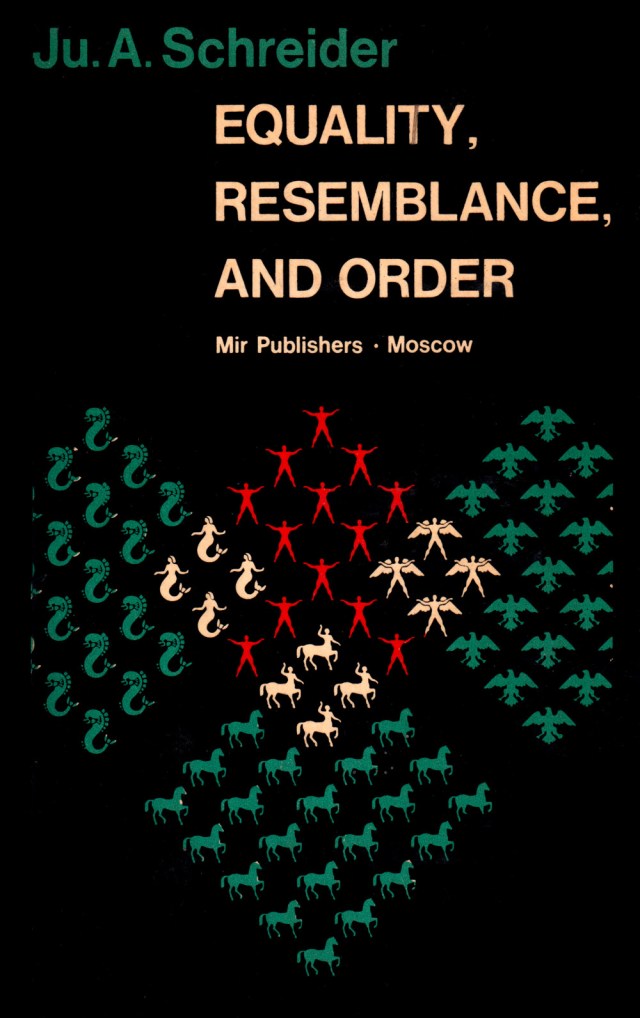
Schreider-Equality-Resemblance-Order-Mir-1975-fc.jpg


Posted in books, mathematics, mir books, mir publishers | Tagged , , , , , , , , , , , , , , , , , , , , | Leave a comment

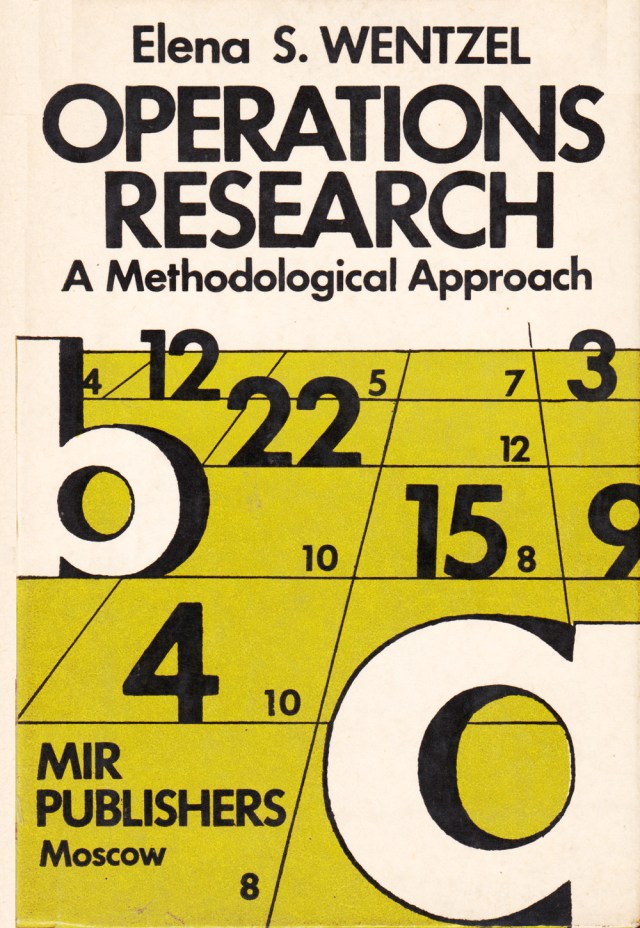
Operations Research – Wentzel

In this post, we will see the book Operations Research: A Methodological Approach by Elena S. Wentzel.

IMG_20181226_0146

About the book

The aim of this book is to present in a widely appealing form the sub­ject matter and methods of operations research
(OR), a managerial tool designed to increase the effectiveness of mana­gerial decisions as an ob­jective supplement to the subjective assessment.
With no confinement to an exclusive area of practice, the discussion in the book is focused on the methodological as­pects which are common to all OR problems is simple and requires wherever they might ap­pear. Therefore the main emphasis is placed on such methodological treatises as problem formulation, model development, and assessment of computational results, rather than on mathematical rigor.
In writing this text the author — a well known Soviet mathematician and popular novelist – employed her many-year experience in govern­mental OR projects and lectureship at the Mos­cow Institute of Trans­portation Engineering to give a vivid presentation of the relevant methods of mathematical pro­gramming, game theory, queueing models, and decision analysis. The mathematics of the book is simple and requires only expertise in probability theory. The book is devoted primarily to the practitioners who are novices to the subject.
It will be interesting to students, engineers, managerial staff and all those involved in deci­sion making.
The book was translated from the Russian by Michael G. Edelev and was published by Mir in 1983.

CONTENTS

FOREWORD 7
1. THE NATURE AND USE OF OPERATIONS RESEARCH 11
1.1 Operations Research—What It Is and What It Does 11
1.2 Main Concepts and Approaches of Operations Research 18
1.3 Model Development 25
2. APPROACHING OPERATIONS RESEARCH PROBLEMS 31
2.1 Two Ways of Posing the Problem. Deterministic Models 31
2.2 Decision Making under Uncertainty 35
2.3 Multiobjective Problems 49
3. LINEAR PROGRAMMING 62
3.1 Linear Programming Problems 62
3.2 Moving to Algebraic Solution 72
3.3 A Geometric Method of Solution 76
3.4 The Transportation Problem 86
3.5 Integer Progamming. The Concepts of Nonlinear Programming 98
4. DYNAMIC PROGRAMMING 104
4.1 Concepts of Dynamic Programming 104
4.2 Solving Dynamic Programming Examples 114
4.3 A General Form of DP Problem. The Principle of Optimality 131
5. MARKOV PROCESSES 138
5.1 The Concept of the Markov Process 138
5.2 Arrivals Defined 145
5.3 The Kolmogorov Balance of State Equations 15
6. QUEUEING OR WAITING LINE THEORY 163
6.1 Objectives and Models of the Theory 163
6.2 The Birth and Death Process. The Little Formula 168
6.3 Analysis of Simplest Queueing Models 174
6.4 More Complex Queueing Models 193
7. STATISTICAL MODELING OF RANDOM PROCESSES (THE MONTE CARLO METHOD) 199
7.1 Idea, Purpose and Scope of the Method 199
7.2. Organizing a Random Sampling Mechanism 203
7.3 Modeling a Stationary Random Process by a Single Realization 210
8. GAME THEORY FOR DECISION MAKING 214
8.1 Subject and Problems of Game Theory 8.2 Matrix Games 219
8.3 Resolving Finite Games 228
8.4 Statistical Decision Analysis 240
BIBLIOGRAPHY 254
Posted in books, mathematics, mir books, mir publishers, statistics | Tagged , , , , , , , , , , , , , , , , , , , , , | 2 Comments

Current scanning setup

This is my current scanning setup: looks nice hence thought of sharing

2018-12-26 22.30.10.jpg

Sorry for the potato quality…

Posted in meta | Tagged , , , | 11 Comments

Solid State Physics – Epifanov

In this post, we will see the book Solid State Physics by G. I. Epifanov.


Epifanov-Solid-State-Physics-Mir-1979.jpg

About the book

This is a classic book on the topic of solid state physics. and covers the various topics comprehensively. Starting from the structure of matter and various types of bonds in the first chapter the mechanical properties are treated in the second chapter. The second chapter also includes a discussion of Hooke’s Law, plastic flow, dislocations, elasticity etc. The third chapter deals with statistical mechanics and discusses degenerate and non-degenerate ensembles and various distribution functions. The fourth chapter looks at thermal properties of solids with reference to crystal lattice, heat capacity, heat conductivity etc. The fifth chapter discusses band theory of solids with reference to energy spectrum, effective mass and semiconductors. Some of the graphs in this chapter are revealing of the physical processes in the working of band structure. Sixth and seventh chapter deal with electrical and magnetic properties of solids. Sixth chapter also discusses deviations from Ohm’s Law (Section 58). Seventh chapter includes discssion on various types of magnetism their origins, and magnetic properties of solids and atoms along with magnetic resonance.  Eighth chapter discusses contact phenomenon, work functions between different of materials including p-n junctions. The last chapter discusses thermoelectric and galvanomagnetic phenomena including Seeback effect, Peltier effect, Thomson effect and some of their practical applications.

As in the first edition, the presentation of material has followed the aim of elucidating the physical nature of the phenomena dis­cussed. But, where possible, the qualitative relations are also pre­sented, often though without rigorous mathematics.
The book was translated from the Russian by Mark Samokhvalov and was published by Mir in 1979. We didn’t have the original cover, so we have recreated one.
Note: The book had many notes and underlines at various pages in the book left by the previous owner. We had to clean the marks and underlines manually. Though on some page they may have been left.
Contents
Preface 5
1 Bonding. The Internal Structure of Solids
§ 1 The van der Waals forces 11
§ 2 The ionic bond 15
§ 3 The covalent bond 16
§ 4 The metallic bond 21
§ 5 The hydrogen bond 22
§ 6 Comparison between bonds of various kinds 23
§ 7 Forces of repulsion 24
§ 8 Crystal lattice 25
§ 9 Notation used to describe sites, directions, and planes in a crystal 29
§10 Classification of solids based on the nature of bonds 32
§11 Polymorphism 38
§12 Imperfections and defects of the crystal lattice 42
2 Mechanical Properties of Solids
§ 13 Elastic and plastic deformations. Hooke’s law 46
§ 14 Principal laws governing plastic flow in crystals 51
§ 15 Mechanical twinning 55
§ 16 Theoretical and real shear strengths of crystals 56
§ 17 The dislocation concept. Principal types of dislocations 58
§ 18 Forces needed to move dislocations 64
§ 19 Sources of dislocations. Strengthening of crystals 66
§ 20 Brittle strength of solids 71
§ 21 Time dependence of the strength of solids 77
§ 22 Methods of increasing the strength of solids 81
3 Elements of Physical Statistics
§ 23 Methods used to describe the state of a macroscopic system 84
§ 24 Degenerate and nondegenerate ensembles 88
§ 25 The number of states for microscopic particles 91
§ 26 Distribution function for a nondegenerate gas 94
§ 27 Distribution function for a degenerate fermion gas 96
§ 28 Distribution function for a degenerate boson gas 103
§ 29 Rules for statistical averaging 105
4 Thermal Properties of Solids
§ 30 Normal modes of a lattice 107
§ 31 Normal modes spectrum of a lattice 110
§ 32 Phonons 112
§ 33 Heat capacity of solids 115
§ 34 Heat capacity of electron gas 120
§ 35 Thermal expansion of solids 122
§ 36 Heat conductivity of solids 126
5 The Band Theory of Solids
§ 37 Electron energy levels of a free atom 133
§ 38 Collectivization of electrons in a crystal 136
§ 39 Energy spectrum of electrons in a crystal 138
§ 40 Dependence of electron energy on the wave vector 142
§ 41 Effective mass of the electron 147
§ 42 Occupation of bands by electrons. Conductors,dielectrics, and semiconductors 151
§ 43 Intrinsic semiconductors. The concept of a hole 153
§ 44 Impurity semiconductors 156
§ 45 Position of the Fermi level and free carrier concentration in semiconductors 159
§ 46 Nonequilibrium carriers 166
6 Electrical Conductivity of Solids
§ 47 Equilibrium state of electron gas in a conductor in the absence of an electric field 169
§ 48 Electron drift in an electric field 170
§ 49 Relaxation time and mean free path 171
§ 50 Specific conductance of a conductor 173
§ 51 Electrical conductivity of nondegenerate and degenerate gases 174
§ 52 Wiedemann-Franz-Lorenz law 176
§ 53 Temperature dependence of carrier mobility 177
§ 54 Electrical conductivity of pure metals 183
§ 55 Electrical conductivity of metal alloys 184
§ 56 Intrinsic conductivity of semiconductors 188
§ 57 Impurity (extrinsic) conductivity of semiconductors 190
§ 58 Deviation from Ohm’s law. The effect ofa strong field 193
§ 59 The Gunn effect 195
§ 60 Photoconductivity of semiconductors 196
§ 61 Luminescence 203
§ 62 Fundamentals of superconductivity 207
7 Magnetic Properties of Solids
§ 63 Magnetic field in magnetic materials 224
§ 64 Magnetic properties of solids 225
§ 65 Magnetic properties of atoms 232
§ 66 Origin of diamagnetism 238
§ 67 Origin of paramagnetism 240
§ 68 Origin of ferromagnetism 247
§ 69 Antiferromagnetism 254
§ 70 Ferrimagnetism. Ferrites 255 § 71 Magnetic resonance 257
§ 72 Fundamentals of quantum electronics 259
8 Contact Phenomena
§ 73 Work function 265
§ 74 Contact of two metals 268
§ 75 The metal-semiconductor contact 271
§ 76 Contact between two semiconductors of different types of conductivity 278
§ 77 Physical principles of semiconductor p~n junction devices 288 § 78 Fundamentals of integrated circuit electronics (microelectron­
ics) 299
9 Thermoeleletric and Galvanomagnetic Phenomena
§ 79 The Seebeck effect 302.
§ 80 The Peltier effect 307
§ 81 The Thomson effect 310
§ 82 Galvanomagnetic phenomena 310
§ 83 Practical applications of thermoelectric and galvanomag­netic phenomena 315
Appendices
I Derivation of the Maxwell-Boltzmann distribution function 317
II Derivation of the Fermi-Dirac distribution function 318
III Derivation of the Bose-Einstein distribution function 320
IV Tables 321
Glossary of Symbols and Notations 322
Bibliography 326 Index 329
Posted in books, electronics, metals, mir books, mir publishers, physics, science, soviet | Tagged , , , , , , , , , , , , , , , , , , , , , , , , , , , , , , , , | Leave a comment

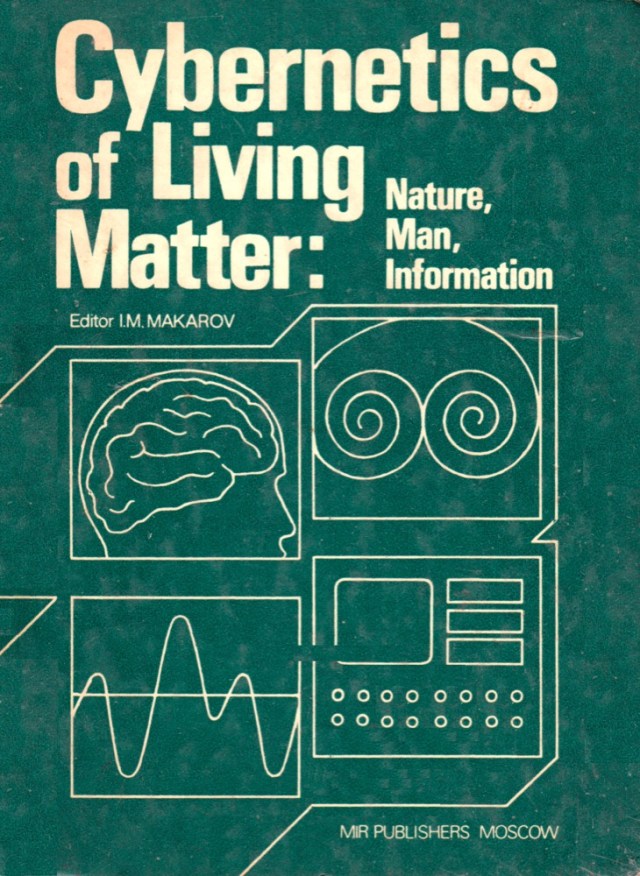
Cybernetics Of Living Matter: Nature, Man, Information – Markov (Ed.)

In this post, we will look at the book Cybernetics Of Living Matter: Nature, Man, Information edited by I. M. Markov.

Markov-Cybernetics-of-Living-Matter-Mir-1987.jpg

About the book:

The book has been written by a team of leading Soviet authorities in the field of cybernetics, among them Academicians Yu. Ovchinnikov, A. Baev, V. Afanasyev, P. Anokhin, A. Migdal, Yu. Gulyaev.

The contributors discuss the latest achievements in biology from the viewpoint of cybernetics, describe multiple functions that constitute living matter, the basis of brain reliability, the psychics modeling limits, and the mathematical methods in psychology. Also, they examine the problems relating to life and age, death and immortality, and the experimental ways of making life longer. The book will undoubtedly be of interest to all
those interested in or concerned with, cybernetics or allied fields.

The book was translated from the Russian by Vitaly Kisin and compiled by V. D. Pekelis and edited by I. M. Makarov.

The Internet Archive Link and here

Contents

Preface. Yu. A. Ovchinnikov 7

Note from the Compiler. V. D. Pekelis 10

I. Biology and Information 23

Biology Today 23

Basic Tendencies in Physico-Chemical Biology. Yu. A. Ovchin­nikov 23

Genetics, Evolution, and Theoretical Biology. N. V. Timofeev-Resovsky 33

Transition to Constructing Living Systems. A. A. Baev 41

Autowaves: An Interdisciplinary Finding. G. R. Ivanitskyt V. I. Krinsky, and 0. A. Mornev 52

Cybernetics’ Standpoint 75

Cybernetics Approach to Theoretical Biology. A. A. Lyapunov 75

Information Tneory and Evolution. M. V. Volkenshtein 83

Control Sciences and the Harvest. Yu. M. Svirezhev 94

II. The Complexity of Living Systems 105

Integrity of Life 105

On Systematic and Integral Nature of Man. V. G. Afanasyev 105

The Contribution of Psychology to Systems Research of Man. B. F. Lomov 115

Brain and Intelligence 127

Natural Intelligence versus Artificial Intelligence: The Phi­losophical View. P. K. Anokhin 127

On Reliability of the Brain. A. B. Kogan 142

Novel Aspects 154

Diurnal Rhythms and Adaptation. V. N. Reushkin 154

Searching Activity, Sleep, and Stability of the Organism. V. S. Rotenberg 183

On Man’s “Third State”. V. I. Klimova 195

III. Difficulties on the Road to Truth 203

Science and New Information 203

Road to Truth (on the scientific method of cognition. A. B. Migdal and E. V. Netesova 203

The Dynamics of New Truths in Biological Sciences. S. E. Shnol 217

On New Knowledge in Biological Studies. B. V. Biryukov 229

Criteria of Existence and Conflicting Situations in Science. D. I. Dubrovsky 237

New Horizons in Cognition 244

The Physical Fields of Biological Objects. Yu. V. Gulyaev and E. E. Godik 244

Man’s Magnetic Fields. V. L. Vvedensky and V. I. Ozhogin 225

Radio Freguency Emission of Human Body and Medical Diag­nostics. V. S. Troitsky 266

Several Problems in Psychology 276

The Psychology of Cognition and Cybernetics. B. M. Velich-kovsky 276

Subconsciousness and Superconsciousness. P. V. Simonov 292

The Principle of Active Operator in Engineering Psychology. B. F. Lomov 307

The Organism and Age 325

Ageing and Old Age. V. I. Klimova 325

Extension of Human Life: The Biological Dimension and Expe­rimentation. V. V. Frolkis and Kh. K. Muradyan 336

Overhaul of Man. V. D. Pekelis 352

About The Authors 361

Posted in books, computers, life sciences, mir books, mir publishers, psychology, science, science for everyone, soviet | Tagged , , , , , , , , , , , , , , , , | Leave a comment

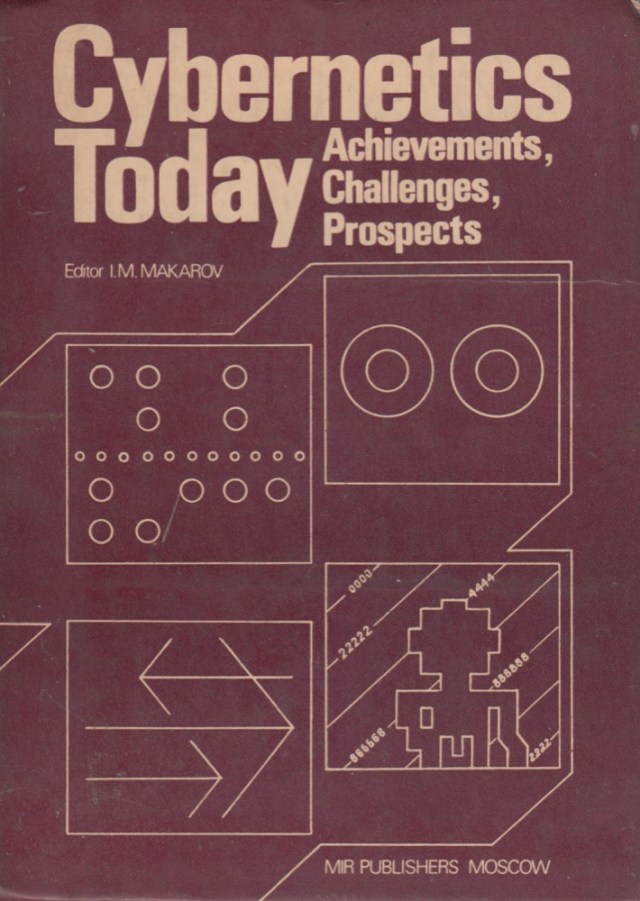
Cybernetics Today: Achievements, Challenges and Prospects – Makarov (Ed.)

In this post, we will see the book Cybernetics Today: Achievements, Challenges and Prospects edited by I. M. Makarov.

Markov-Cybernetics-Today-Mir-1984-fc.jpg

About the book

The book has been written by a team of leading Soviet authorities in the field of cybernetics, among them Academicians O. Belotserkovsky, V. Glushkov, B. Petrov, A. Kolmogorov, E. Velikhov. Approaching the subject from various points of view, the contributors examine the key problems of cybernetics, both theoretical and applied. In doing so, they draw upon a wide range of disciplines related to cybernetics in one way or another. Ample space is devoted to the economic aspects of informational technology, man-machine systems and interactions, and the prospects for cybernetics in the future, notably the creation of the artificial intellect novel for computers, and advanced robots. All this and more comes first-hand from men in the fore-front of present-day science. The book will undoubtedly be of interest to all those interested in, er concerned with, cybernetics or allied fields.

The book was translated from the Russian by Felix Palkin and Valerian Palkin and was compiled by V. D. Pekelis.

The Internet Archive Link and here

Preface. E-P. Velikhov 7

Note from the Compiler. V.D. Pekelis 10

From Discussions of Different Years 20

Automata and Life. A.N. Kolmogorov 20
Cybernetics Today. B.N. Petrov 41
Where Is Cybernetics Heading? M-G. Gaaze-Rapoport 54

The State of the Art 68
Cybernetics and Practice. O.M. Belotserkovsky 68
Ways of Developing Automation. I.A. Apokin 79
The Emergence of Computer Networks. E.A. Yakubaitis 95 The Robots in Present-Day Industry. I-M. Makarov 99

Artificial Intelligence: Pros and Cons 110

New Approach to Computer Application. G.S. Pospelov
Why Artificial Intelligence? M.M. Botvinnik 119
Occupation and Problem Oriented Intelligent Systems. B.A. Pospelov 120
Why Artificial Intelligence Is Impossible. A.F. Brushlinsky 123
Relative Capabilities of Natural and Artificial Intelligence. V.S. Tyukhtin 126
On the Capabilities of Artificial Intelligence. B.V. Biryukov 131

On Some Control Problems 138

Semiotic Models in Control Systems. D.A. Pospelov 138
Systems Analysis and Artificial Intelligence for Planning and Management. G.S. Pospelov 160
A New Branch of the Economy: Information Handling Indus­try. V.M. Glushkov and Yu. M. Kanygin 172

The Fine Arts and Cybernetics 182

Cybernetics and Culture. B.V. Biryukov and S.N. Plotnikov 182 Modelling in Music. R.Kh. Zaripov 210
Polemics and Its By-Products: About the “Machine Creative­ness” Controversy. I. Grekova 228

From a New Angle 253

Man-Machine Interaction. G.L. Smolyan 253
Man and Machine: The Limits to Computer Application.
V.M. Glushkov and Yu. M. Kanygin 266
Social Applications of Cybernetics. V.D. Pekelis 276

Foreseeing the Future 291

The Formula of a Collective Genius. V.D. Pekelis 291
How to Create an Artificial Brain. F.G. Staros 310
How to Create an Optical Brain. V.M. Zakharchenko and G.V. Skrotsky 318
The Cybernetic Double. I.M. Rosokhovatsky rand A.A. Stogny 328
Extraterrestrial Civilizations and Artificial Intelligence. I. S. Shklovsky 333
Cybernetics and the Computer: Some Predictions. V.D. Pekelis 355

About the Authors 363


Posted in books, computers, mir books, mir publishers, philosophy, physiology, psychology, science | Tagged , , , , , , , , , , , , , , , , , , , , | Leave a comment

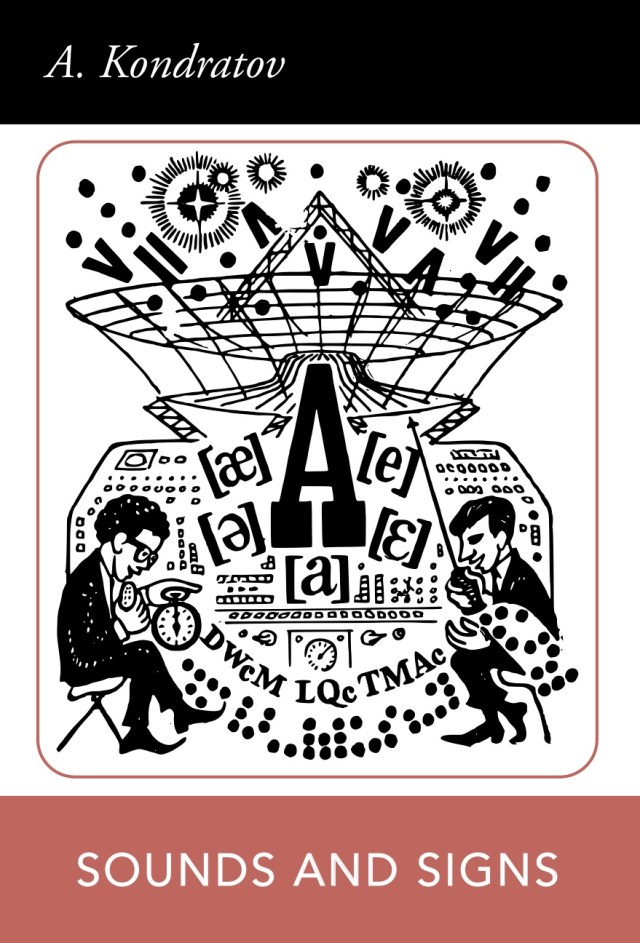
Sounds and Signs – Kondratov

In this post, we will see the book Sounds and Signs by A. Kondratov.

Kondratov-Sounds-and-Signs-Mir-1969.jpg

About the book

Over the ages man has wondered what language is, how it is constructed, how one’s mother tongue differs from the languages of other peoples, and how the language of human beings differs from the signal cries of animals, and how our everyday speech differs from other media of communication in human society.
Thinking on these problems gave birth to linguistics, the science of the laws of language. Methods of investigating language improved with the development of linguistics and the accumulation of facts and knowledge. Today the latest tool is in the form of numbers and exact measures. Mathematical statistics and the theory of information, probability theory and mathematical logic, computers and sign theory are more and more coming to the aid of students of language.
That is what our story is about.
The book was translated from the Russian by George Yankovsky and was first published by Mir in 1979.
Contents
Introduction 7
What Semiotics Has to Say 9
Languages and Codes 41
People, Things, Words 78
Numbers and Language 104
The Linguistic Clock 127
The Universal Code of Science 149
The Tower of Babel 173
Machine Translation 199
Sounds and Meaning 225
Space Linguistics 255
Subject Index  278
Name Index 283
Posted in books, mir books, mir publishers, psychology, science, science for everyone | Tagged , , , , , , , , , | Leave a comment

Problems And Exercises In Chemistry – Vasyuchenko

In this post, we will see the book Problems And Exercises In Chemistry by S. I. Vasyuchenko.

Vasyuchenko-Problems-and-Exercises-in-Chemistry-Mir-1974.jpg

About the book

This is the translation of the third revised and enlarged Russian edition of the textbook, which is intended for the secondary and vocational schools, and is a companion volume
to the sixth edition of Vasyuchenko’s Chemistry (1966).

The problems in each section are preceded by concise reviews of theoretical principles and exemplary solutions of typical problems. The numeration of the problems con­sists of two parts, the first designating the chapter to which a particular problem belongs and the second figure denoting the ordinal number of the problem within the given chapter.
For example, problem 5 in Chapter Six is designated 6.5.

The book was translated from the Russian by A. Rosinkin and was first published by Mir in 1974.

The Internet Archive Link and here

 CONTENTS

Introduction 10

Chapter One. Basic Concepts and Laws of Chemistry. Theory of Atoms and Molecules. 11

1. Gram-Atom. Gram-Molecule . 11

2. Gram-Molecular Volume. Relative Density of Gas 12

3. Calculations from Chemical Formulas. 16

4. Calculations from Chemical Equations. 22

Chapter Two. The Halogens . 33

5. Chlorine and Its Compounds. 33 

6. Bromine and Its Compounds. 39 

7. Iodine and Its Compounds. 41 

8. Fluorine and Its Compounds. 42 

9. Laboratory Exercises. 43

10. Review Problems 43

Chapter Three. Alkali Metals 45 

11. Sodium and Potassium. 45

Chapter Four. ‘Periodic Law and Periodic System of Elements of D. I. Mendeleyev. Structure of Matter 46

12. Periodic Law and Periodic System of Elements. 46 

13. Radioactivity and Atomic Structure. 48 

14. Electronic Theory of Atomic Structure. Atom Nucleus and Its Electron Shells. 49 

15. Atomic Structure and Valence. Formation of Chemical Compounds and Simple Substances. 50

Chapter Five. Solutions. Basic Principles of Theory of Electro­lytic Dissociation. 50

16. Solutions. Solubility. 50 

17. Percentage Concentration of Solutions. 52 

18. Determining Quantities of Acids and Alkalis in Given Quantities of Solutions from Density of the Starting Substance 56

19. Mixing Rule. 59

20. Laboratory Exercises (Preparation of Solutions) 68

21. Molar Concentration of Solutions. 68

22. Equivalent Weight. Gram-Equivalent. 71 

23. Normality of Solutions 73

24. Electrolytic Dissociation. Electrolysis. 77

25. Laboratory Exercises 82

26. Oxidation-Reduction Reactions. 82

Chapter Six. Oxygen. Sulphur and Its Compounds 91

27. Ozone. Hydrogen Peroxide 91

28. Sulphur and Hydrogen Sulphide. 92

29. Sulphur Dioxide and Sulphurous Acid. 93

30. Sulphur Trioxide, Sulphuric Acid and ItsSalts. 94

31. Laboratory Exercises 96

32. Review Problems  96

Chapter Seven. Nitrogen, Phosphorus and Their Compounds 97

33. Nitrogen and Its Compounds. 97

34. Laboratory Exercises. 100

35. Review Problems. 101

36. Phosphorus and Its Compounds. 101

Chapter Eight. Carbon, Silicon and Their Compounds 104

37. Carbon and Its Compounds. 104 

38. Laboratory Exercises. 106 

39. Review Problems. 107

40. Silicon and Its Compounds 107

Chapter Nine. Metals 109

41. Interaction Between Metals and Acids. 109 

42. Physical and Chemical Properties of Metals 111

43. Magnesium and Its Compounds. 113

44. Alkaline-Earth Metals. 114

45. Aluminium. 116

46. Tin. 117

47. Lead. 118

48. Chromium. 119

49. Manganese. 120

50. Iron. 121

51. Copper. 123

52. Silver. 125 

53. Gold. 125

54. Zinc. 125 

55. Mercury. 127

56. Laboratory Exercises. 128

57. Review Problems. 129  

Chapter Ten. Hydrocarbons. 130

58. Hydrocarbons. 130 

59. Laboratory Exercises 135

Chapter Eleven. Alcohols. Phenols. Aldehydes. 135

60. Alcohols. 135 

61. Phenols. 137 

62. Aldehydes. Ketones  138

Chapter Twelve. Carboxylic Acids. Esters. Fats . 140

63. Carboxylic Acids  140 

64. Esters. Fats. 143 

65. Laboratory Exercises and Review Problems. 143

Chapter Thirteen. Carbohydrates. Nitrocompounds. 144

66. Carbohydrates 144

67. Nitrocompounds. Amines. Carbamide. 145

68. Laboratory Exercises and review Problems 147

Chapter Fourteen. High-Molecular Synthetic Substances (Poly­mers)  148

69. Monomers. 148 

70. Laboratory Exercises 148

Appendices. 149 

Answers to Problems T54

Posted in books, chemistry, mir books, mir publishers, problem books | Tagged , , , , , , , , , , , , , , , , , , , , , | 1 Comment

How people discovered the Shape of the Earth – Tomilin

In this post, we will see the book How people discovered the Shape of the Earth by A.  Tomilin.

Tomilin-How-People-Discovered-the-Shape-of-the-Earth-Raduga-1984

About the book

What is the shape of the Earth? An odd question, isn’t it? The world’s a globe. It’s round.
To me and you it’s obvious. We’re 20th century people. The grass is green, the sky is blue and the world is round. We’ve known it From our early childhood. But is it really all that obvious?
Go out in the country. Walk to the middle of the largest field, till all that you can see is grass and flowers to the far horizon. Does it look round? Can you see the bulge? No. It lies before you flat as a pancake right to the horizon. Every bush and tree, every tiny hillock stands out clearly. So who says the world is round?
When computers were used to calculate the surface of the earth with information from the satellites, it was found that the shape of our planet is not quite so simple. It is slightly pear-shaped. The Northern Hemisphere is stretched up a bit towards the pole, and the Southern Hemisphere is dented in. There are dents and bumps on its surface. And if you could slice the Earth through the middle at the equator the result would be a circle a little bit out of true. So it’s a bit a slightly crooked one at that. What should this shape be called?
Scientists tried out all sorts of names. Finally they chose “geoid”. This is made up of “geo”, the Greek for “earth”, and “eidos”, the Greek for “view”. So all it really means is earthlike. In fact the earth is a slightly imperfect sphere. How people found this out is a long and interesting story. And that is what this book is all about.


The book was translated from the Russian to English by Diana Miller. The wonderful illustrations are drawn by Yuri Smolnikov. The English version book was published by Raduga in 1984. The Hindi version was translated by Yogendra Nagpal and was published by Raduga in 1986 and then by People’s Publishing House.

The original scan was done by Guptaji (linked below) we cleaned and OCRed the scan. Though the resolution is not as good. There is a Hindi (black and white) scan from the Digital Library of India.

Original scan by Guptaji

English version here and here

Hindi version here and here

Bengali version here and here

Kannada version here and here

Marathi version here and here

Gujarati version here and here

Odia version here and here

Telugu version here and here

Contents

Introduction 3
Chapter 1
My Land – the Whole Earth 7
Why People Left the Places Where They Lived 9
How People Learnt to Live Together 11
The First Travels  13
Chapter 2
How People Thought the Earth Is Flat  17
The Land of Sages and Philosophers 21
Why the Phoenicians Thought the Earth Is Arched 25
Who First Suggested that the Earth Is Round 29
Chapter 3
Who Was the First to Measure the Earth 35
The Retreat  40
Chapter 4
Who Invented Maps 47
An Arab Geographer’s Silver Map 50
A Map for the Stay at Home 52
Maps for Distant Journeys 55
Chapter 5
From Map to Globe 63
The History of a Globe 67
Chapter 6
What Size Is Our Earth? 73
Is the Earth a Melon or an Apple? 75
Conclusion 79


Posted in astronomy, books, history, raduga publishers, science, science for everyone | Tagged , , , , , , , , , , , , , , | 2 Comments

Machines of the 20th Century – Muslin

In this post, we will see the book Machines of the 20th Century by E. Muslin.

Muslin-Machines-of-the-20th-Century-Mir-1974.jpg

About the book

This book is a review of the 20th-century machines, hundreds of thousands of various machines and mechanisms for moving tremendous masses of earth, for weaving fabrics, for “baking” diamonds and for many other jobs. It tells you about machines which hop around like grasshoppers, about machines which can work for weeks without conventional motors and batteries, and about: lose that can repair themselves.
The book also introduces the reader to unusual materials possessing amazing properties, new components of machines, ingenious methods of flaw detection and control.
The reader will find that the history of machine tools, rolling mills, forging presses, excavators and other mechanisms, which at first glance seem so routine, is full of dramatic clashes of ideas, fascinating adventures, great discoveries and bitter disillusions.
The book is written in a popular form and will be interesting for those who are keen on engineering, and also, for specialists.
And although written in a popular scientific style, the present work is neither concerned with spectacular spaceships heading for far-away planets, nor with “nautili” exploring the depths of the ocean; it mainly
deals with such modest unassuming hard workers as rolling mills, excavators, lathes, presses and turbines which make up the machinery backbone of the present day industry.
The book was translated from the Russian by V. Vopyan and was published by Mir in 1974.

Contents

Preface 7

1. Materials – Flesh and Blood of Modern Machines 9

2000 Times Stronger Than Steel 11
Steel as Soft as Wax 17
A Plastic Matryoshka as a Reduction Gear 19
1000 Times the Heat Conduction of Silver 27
Chromoplastic and Chromoplasticity 35
Wing Made of Balls 36
Friction Without Wear 38
Uncrowning the Involute 45

2. Meaningful Noises: Flaw Detection and Control 49

Foucault Currents in the Role of Sherlock Holmes 49
Pigeons as Assembly Line Inspectors 55
The Smell of Drill: a Sign Not to Be Overlooked 63
Gauge from a Rainbow 67
Pressurized Airscrew 71

3. Giants of Modern Machine Construction 72

Mechanical Titans 75
Agrobridge, a Giant Agricultural Machine 94
Midget Machines with Huge Productivity 99
The Needs of “Gulliver” 111

4. Electric “Sphynxes” Break Tradition 120

Magnetohydrodynamic AC Generator 120
Electricity and Fertilizers from a Gas Stream 125
Multimillion-Volt Generator 132
Piston-Operated Generator 139
Mirror Switch 140
Electromotor from Ball Bearings 141

5. Jet Engine Down from Heaven 142

By Rocket from the Depth of the Earth 142
Jet Mill 149
Jet Engine Drills Earth 151
Jet Engine in Reverse 152
Jet Engine in a Fire Helmet 162
Jet Engines Clean Railroad Tracks 164

6. Machines Dig Earth 165

Beam-Control Device 165
Pick-Hammer Made of Plastic 172
Leaping Wheel 182
Excavator Drills Dams 184
Fire-Spitting Excavator 187

7. Machine-Making Machines 191

Light-Controlled Machine-Tool 192
Wriggling Machine-Tool 197
Heating and Cooling Mirror 201
Machine-Tool with a Float 205
Laser and Electric Shaver 209
Magnetic Field Assembles Machines 213
Continuous Casting of Round Hollow Steel Pipes 216
Walking Thermopress 222

8. Machines of Tomorrow 226

Beams Make Patterns 226
Machines with Ultrahigh Efficiency 231
Light Beam Serves as a Working Member 241
Walking Machines 249
Forward to “Iron Make” 261
Posted in books, engineering, metals, mir books, mir publishers, science, soviet, technology | Tagged , , , , , , , , , , , , , , , , | Leave a comment