Updates…

Physics for Everyone  series has been upped, with improved versions (single page, ocr, covers, pagination and bookmarked). Links in the originals posts have also been updated. Check the files and report problems if any.

Physics for Everyone – Motion and Heat

Book 1- Physical Bodies

Book 2  – Molecules

Book 3 – Electrons

Book 4 – Photons and Nuclei

Posted in books, mir books, mir publishers, physics, physics for everyone | Tagged , , , , | 6 Comments

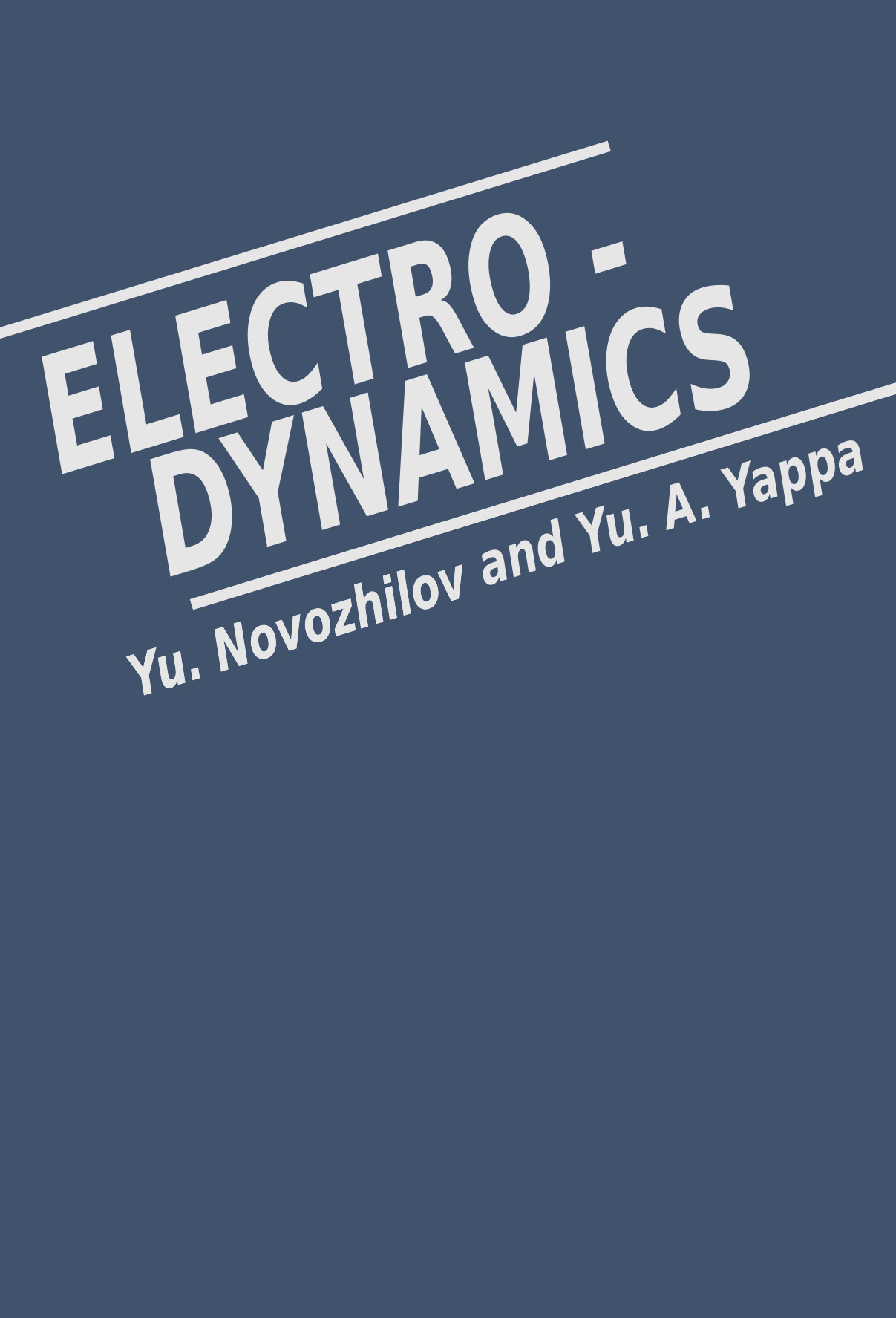
Mathematical Models of Electric Machines – I. P. Kopylov

The book covers topics devoted to the application the electronic computers to the solutions of problems in electro-mechanics. It is expected that the reader is already familiar with computer programming, and algorithmic languages. The author’s objective is to teach the students how to formulate equations for most of the problems in the analysis of the energy conversion processes in electric machines and  reduce them to a convenient form for their solution by computers. Much consideration is given to analysis of the obtained solutions. Three chapters are devoted to the synthesis of electric machines and the computer-aided design system; the latter being the highest achievements in electro-mechanics.

Primary attention is focused on differential equations of electro-mechanical energy conversion, which form the most general and rigorous mathematical model for describing both transient and  steady-state modes of operation . Polynomial models are also given
due treatment.

The present book is designed for students and postgraduates studying electric machines and also for electromechanical and power engineers engaged in the design and service of electric, machinery.

The book was translated from the Russian by P. S. Ivanov and was first published by Mir in 1984.

The Internet Archive Link

and here

All credits to the original uploader.

Also see the FAQs

Continue reading

Posted in books, mathematics, mir publishers, science | Tagged , , , , , | 15 Comments

Integeral and Differential Calculus – N. Piskunov

Piskunov’s book is considered to be a classic.

This text is designed as a course of mathematics for higher technical schools. It contains many worked examples that illustrate the theoretical material and serve as models for solving problems. The first two chapters “Number. Variable. Function” and “Limit.  Continuity of a Function” have been made as short as possible. Some of the questions that are usually discussed in these chapters have been put in the third and subsequent chapters without loss of continuity. This has made it possible to take up very early the basic concept of differential calculus—the derivative— which is required in the study of technical subjects. Experience has shown this arrangement of the material to be the best and most convenient for the student.

A large number of problems have been included, many of which illustrate the interrelationships of mathematics and other disciplines. The problems are specially selected (and in sufficient number) for each section of the course thus helping the student to master the theoretical material. To a large extent, this makes the use of a separate book of problems unnecessary and extends the usefulness of this text as a course of mathematics for  self-instruction.

This was a long due.

This was the message that I got from vivisimo:

It’s nice to know that a member(s) from Library.nu are continue contributing to the ebook community.

I have scanned N. Piskunov – Differential and Integral Calculus 1969, and intended to post on LNU, but too bad, the site’s now closed.

I think your site is the best place to post this book, a MIR books’ site.

The book is 20MB size, in DJVU, 600dpi, OCRed, no cover:

Thanks for posting this vivisimo

The book was translated from the Russian by G. Yankovsky and was published by Mir in 1969. Subsequently it was also republished as a single and two volume format.

You can get the book  here and here.

For Magnet/Torrent links on TPB go here.

Update two volume new scans


English Version

Volume 1 here

and here

Volume 2 here

and here

Versión en Español

Volume 1 here

and here

Volume 2 here

and here

Version Française

Volume 1 here

and here

Volume 2 here

and here

Versão em Português

Volume 1 here

and here

Volume 2 here

and here


Continue reading

Posted in books, mathematics, mir books, mir publishers | Tagged , , , | 49 Comments

Updates…

Check this post regularly for updates on the link status of various books!

Update 1 :

A new and improved (better clean up, OCRed, bookmarked) version of Tarasov’s book This Amazingly Symmetric World has been upped.

The LaTeX Version

Scanned version

The link in the main post has also been updated.

Will try to re-up the rest (new and improved versions) of Tarasov with two new additions (Laser Physics, and Laser Physics and Applications) this week.

Check this post for more updates, till we get back on track.

D

Posted in books, mir books | 11 Comments

All the links are dead!

All the links to all the post are dead!

Will see what can be done, and update you soon.

Thanks NK for pointing out.

Update: will start uploading enhanced/better versions of all files soon.

D

Posted in Uncategorized | 27 Comments

Little Mathematics Library – Lobachevskian Geometry

We now come to Lobachevskian Geometry by A. S. Smogorzhevsky in the Little Mathematics Library series.As the title of the book suggests the book is about one of the non-Euclidean geometries viz. the one by Lobachevsky. The back cover of the book says:

The author, the late Alexander Smogorzhevsky, D.Sc., was professor of mathematics at Kiev Polytechnical Institute and a specialist in Lobachevskian geometiy. He began his career as a school teacher in the Vinnitsa Region of the Ukraine, and later lectured at Kiev Polytechnical Institute for nearly forty years. He published over a hundred papers, both of original research and of a popularizing character, many of them devoted to non-Euclidean geometry: The Theory of Geometrical Constructions in Lobachevskian Space, On Some Plane Curves in Lobachevskian Geometry, and Lobachevsky’s Basic Ideas, to name a few.

And the Author’s Note before the book begins says:

The aim of this book is to acquaint the reader with the fundamentals of Lobachevsky’s non-Euclidean geometry.

The famous Russian mathematician N. I. Lobachevsky was an outstanding thinker, to whom is credited one of the greatest mathematical discoveries, the construction of an original geometric
system distinct from Euclid’s geometry. The reader will find
a brief biography of N. I. Lobachevsky in Sec. I.

Euclidean and Lobachevskian geometries have much in common,
differing only in their definitions, theorems and formulas as
regards the parallel-postulate. To clarify the reasons for these
differences we must consider how the basic geometric concepts
originated and developed, which is done in Sec. 2.

Apart from a knowledge of school plane geometry and trigonometry reading our pamphlet calls for a knowledge of the transformation known as inversion, the most important features of which are reviewed in Sec. 3. We hope that the reader will be able to grasp its principles with profit to himself and without great difficulty, since it, and Sec. 10, play very important, though ancillary, role in our exposition.

The book was translated from the Russian by V. Kisin and was first published by Mir in 1976 with reprint in 1982.

The Internet Archive Link

and here

Continue reading

Posted in books, little mathematics library, mathematics | Tagged , , , , , , , , , | 12 Comments

Little Mathematics Library – Remarkable Curves

In the Little Mathematics Library series we now come to Remarkable Curves, by a very remarkable author A. I. Markushevich. I am saying that he is remarkable as he has many good books under his sleeve, some of which we may see in the future.

As the title suggests the books takes the reader through various curves and how they can be materialised, just have a look at the table of contents below.  The preface of the book says:

This book has been written mainly for high school students, but it will also be helpful to anyone studying on their own whose mathematical education is confined to high school mathematics. The book is based on a lecture I gave to Moscow schoolchildren of grades 7 and 8 (13 and 14 years old).

In preparing the lecture for publication I expanded the material,while at the same time trying not to make the treatment any less accessible. The most substantial addition is Section 13 on the ellipse, hyperbola and parabola viewed as conic sections.

For the sake of brevity most of the results on curves are given with-
out proof, although in many cases their proofs could have been given
in a form that readers could understand.

The third Russian edition is enlarged by including the results on
Pascal’s and Brianchon’s theorems (on inscribed and circumscribed
hexagons), the spiral of Archimedes, the catenary, the logarithmic
spiral and the involute of a circle.

The book was translated from the Russian by Yu. A. Zdorovov and was first published by Mir in 1980.

The Internet Archive Link

and here

Continue reading

Posted in little mathematics library, mathematics, mir publishers, physics | Tagged , , , , , , , , , , , , , | 12 Comments

Little Mathematics Library – Proof In Geometry

We now come to Proof in Geometry in by A. I. Fetisov in the Little Mathematics Library series.

The Introduction of the book says:

The pupils often fail to understand why truths should be proved that seem quite evident without proof, the proofs often appearing to be excessively complicated and cumbersome. It sometimes happens, too, that a seemingly clear and convincing proof turns out, upon closer scrutiny, to be incorrect.

This booklet was written with the aim of helping pupils clear up the following points:
1. What is proof?
2. What purpose does a proof serve?
3. What form should a proof take?
4. What may be accepted without proof in geometry?

The book was translated from the Russian by Mark Samokhvalov and was first publised by Mir in 1978.  This books was also published in the Topics in Mathematics series by Heath in 1963 and this edition was translated by Theodore M. Switz and Luise Lange. Dover [in 2006] has republished this book along with Mistakes in Geometric Proofs by Y. S. Dubnov as one single volume.

The Internet Archive Link

and here


Continue reading

Posted in books, little mathematics library, mathematics, mir publishers | Tagged , , , , , , | 19 Comments

Little Mathematics Library – The Monte Carlo Method

We now come to The Monte Carlo Method by I. M. Sobol in the Little Mathematics Library series. The book has a random number table as one of the appendices, which is sort of out dated, when we have access to computers so easily.

In the Preface the author says:

Everybody had at some moment used the words “probability”
and “random variable”. The intuitive idea of the probability (considered as frequency) corresponds more or less to the true meaning of this concept. But as a rule the intuitive idea of the random variable differs quite considerably from the mathematical definition. Thus, the notion of the probability is assumed known in Sec. 2, and only the more complicated notion of the random variable is clarified. This section cannot replace a course in the probability
theory: the presentation is simplified and proofs are omitted.
But it still presents certain concept of the random variables sufficient for understanding of Monte Carlo techniques.

The basic aim of this book is to prompt the specialists in various branches of knowledge to the fact that there are problems in their fields that can be solved by the Monte Carlo method.

The book was translated from the Russian by V. I. Kisin and was first published by Mir in 1975. This book was also published as Popular Lectures in Mathematics by University of Chicago in 1974, and this edition was translated by by Robert Messer, John Stone, and
Peter Fortini.

The Internet Archive Link

and here and PLM version here

The table of contents for (LML edition) is as follows:

Preface 7
Introduction 9
Sec. 1. General 9
Chapter I. Simulation of Random Variables 14
Sec. 2. Random Variables. 14
Sec. 3. Generation of Random Variables by Electronic Computers 25
Sec. 4. Transformations of Random Variables 30
Chapter II. Examples of Application of the Monte Carlo Method 39
Sec. 5. Simulation of a Mass Servicing System 39
Sec. 6. Computation or Quality and Reliability of Complex Devices 44
Sec. 7. Computation of Neutron Transmission Through a Plate 51
Sec. 8. Calculation of a Definite Integral 58
Appendix 64
Sec. 9. Proofs of Selected Statements 64
Sec. 10. On Pseudo-Random Numbers  70
Random Number Table 74
Bibliography 77

Posted in books, little mathematics library, mathematics, mir publishers, statistics | Tagged , , , , , , , , | 5 Comments

Little Mathematics Library – Systems of Linear Inequalities

In the Little Mathematics Library now we come to Systems of Linear Inequalities by A. S. Solodovnikov.

This booklet is one of longest in the LML series, having more than 120 pages. The back cover of the book says the following about the book.

The book tells about the relation of systems of linear inequalies to convex polyhedra, gives a description of the set of all solutions of a system of linear inequalities, analyses the questions of compatibility and incompatibility; finally, it gives an insight into linear programming as one of the topics in the theory of systems of linear inequalities. The last section but one gives a proof of the duality theorem of linear programming. The book is intended for senior pupils and all amateur mathematicians.

And the preface adds

Until recently one might think that linear inequalities would forever
remain an object of purely mathematical work. The situation
has changed radically since the mid 40s of this century when there
arose a new area of applied mathematics -linear programmingwith
important applications in the economy and engineering. Linear
programming is in the end nothing but a part (though a very important one) of the theory of systems of linear inequalities.
It is exactly the aim of this small book to acquaint the reader
with the various aspects of the theory of systems of linear inequalities, viz. with the geometrical aspect of the matter and some of the methods for solving systems connected with that aspect, with certain purely algebraic properties of the systems, and with questions of linear programming. Reading the book will not require any knowledge beyond the school course in mathematics.

The book was translated from the Russian by Vladamir Shokurov and was first published by Mir in 1979.

You can get the book here and here.

There is a Spanish version of this as well (credits to IA user danni229)

The Link to Spanish version

The following is the table of contents

CONTENTS
Preface 7
1. Some Facts from Analytic Geometry 8
2. Visualization of Systems of Linear Inequalities In Two or Three Unknowns 17
3. The Convex Hull of a System of Points 22
4. A Convex Polyhedral Cone 25
5. The Feasible Region of a System of Linear Inequalities in Two Unknowns 31
6. The Feasible Region of a System in Three Unknowns 44
7. Systems of Linear Inequalities in Any Number of Unknowns 52
8. The Solution of a System of Linear Inequalities ‘by Successive Reduction of the Number of Unknowns 57
9. Incompatible Systems 64
10. A Homogeneous System of Linear Inequalities. The Fundamental Set of Solutions 69
11. The Solution of a Nonhomogeneous System of Inequalities 81
12. A Linear Programming Problem 84
13. The Simplex Method 91
14. The Duality Theorem in Linear Programming 101
1.5. Transportation Problem 107

Posted in books, little mathematics library, mathematics | Tagged , , , , , , | 2 Comments