Space Chemistry

We now come to Space Chemistry by L. Nikolaev. The book covers aspects of astrophysics and astronomy with stars, planets, comets and meteorites and other celestial bodies from a perspective of chemistry and hence that of spectroscopy. The last chapter is on ways of formation of organic molecules in space.
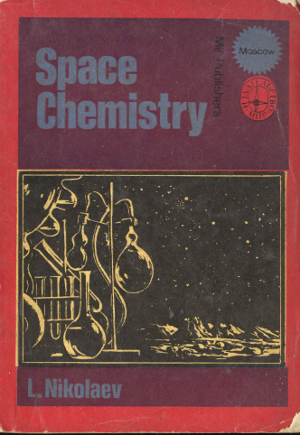
In this small book an attempt has been made to set forth the distinguishing features of the chemical phenomena characteristic of outer space. We have allotted special attention to the theoretical and experimental methods of investigation of space, avoiding however, repetition of the material contained in school courses of physics and chemistry. At the same time, striving to make the book as popular as possible, we confined ourselves only to the most essential information concerning the nature of the atomic nucleus, the laws of nuclear energetics, the origin of various kinds of spectra, etc. The scope of the knowledge of physics, chemistry and mathematics given at our secondary schools is quite sufficient for understanding this book.

The textbook is designed for upper grade students of secondary schools. It contains information about the chemical composition of the planets of solar system, meteorites, the Sun, about synthesis of elements on the stars, the methods of studying space chemistry, as well as catalytic nature of nuclear processes.

The author describes the behaviour of substances at very high and very low temperatures and pressures, considers the possibility of the formation of organic compounds in outer space and in pre-biological period on Earth.

This book was translated from the Russian by Y. Nadler and was first published by Mir in 1976.

You can get the book here. and here

Update: Added Internet Archive link. 03 December 2015

Continue reading

Posted in astronomy, books, chemistry, life sciences, mir books, mir publishers, physics, science, soviet | Tagged , , , , , , , , , | 8 Comments

Chemical Elements: How They Were Discovered

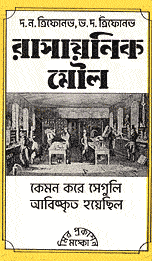
We now come to another book by D. N. Trifonov and V. D. Trifonov  on history of chemistry titled Chemical Elements: How They Were Discovered.

In this book we shall describe how the alphabet of chemistry has been designed and how the inquisitive mind of the researchers discovered new chemical elements, one after another.

The history of chemical elements begins with their discovery. Although hefty volumes in which elements are described in detail pay very little attention to their discoveries, they are a major part of the history of human knowledge.

Each element has its own “biography”, interesting in its own way. The history of the discovery of many elements has not yet been exhaustively studied and quite a number of unclear issues should be cleared by historians of chemistry. Perhaps you will be one of them…

This is again one of the first books in my collection, and I had stumbled on it accidentally while looking for some other book when I was in school. We do know of translations in Hindi and Bengali. I do not know if there are any other translations of this book, any inputs in this regard would be great.

The book was translated from the Russian by O.A. Glebov and I.V. Poluyan and was first published by Mir in1982 and was reprinted in 1985.


Many thanks to gnv64 for this book.

You can get the book here. and here

Bengali version here and here

Hindi version here and here

Update:  Added IA link 12 August 2016

For torrent go here.

Continue reading

Posted in books, chemistry, history, metals, meteorology, mir books, mir publishers, science | Tagged , , , , , , | 5 Comments

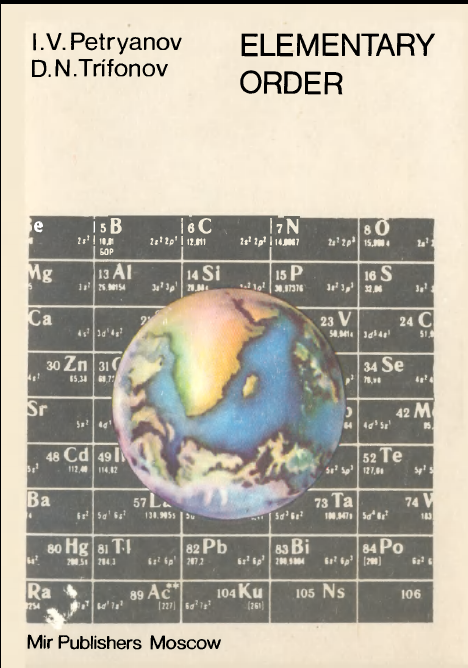
Elementary Order: Mendeleev’s Periodic System

In this post we look at another book by I. V. Petryanov and D. N. Trifonov (whom we have met earlier in a Science for Everyone book titled Silhouttes of Chemistry) This book traces the history of development of periodic table and is titled Elementary Order: Mendeleev’s Periodic System.

Also we see how we have developed a better and deeper understanding of the order in elements after advent of quantum mechanics .

The book was translated from Russian by Nicholas Weinstein and was first published by Mir in 1984.

You can get the book here.

and here

Update: 06 December 2015 | Added Internet Archive Link

Many thanks to gnv64 for this book.


Continue reading

Posted in books, chemistry, history, mir books, mir publishers, physics, science | Tagged , , , , , , , | 2 Comments

Experiments Without Explosions

We now see another wonderful book in chemistry titled Experiments Without Explosions by O. M. Olgin.

The book consists of six parts. The first part contains advice on how to set up a home laboratory, and preliminary instructions that are essential for any beginning chemist on how to work, and the dos and don’ts of chemistry. The other five parts of this book describe the experiments, experiments without explosions. In order to separate the groups of experiments, and make it easier for the reader to select an experiment, each part is divided into chapters.

Many thanks to gnv64 for this book.

You can get the book here.

and here

Update: 23 December 2015, Added Internet Archive Link

Continue reading

Posted in books, chemistry, mir books, mir publishers, science | Tagged , , , , , , , , , , , | 11 Comments

On Rare and Scattered Metals – Venetsky

In this post we will see a book titled On Rare and Scattered Metals by S. Venetsky, which is a sort of sequel to the book titled Tales About Metals.

This book tells about some rare metals (including those called trace elements) and can be regarded as a second part of S. I. Venetsky’s Tales About Metals (It was published in English by Mir Publishers, Moscow, in 1981).
The author follows the same principle as in his previous work: rather than giving the reader any exhaustive information about every chemical element he describes, to tell him some interesting facts, curious incidents and tales associated with rare metals, to tell about the thorny path of any major scientific discovery and about some paths yet to be trodden in the amazing world of metals.

There is a Marathi translation of the prequel Tales About Metals titled घातुंच्या नवलकथा and was one of the first Mir Books that I read.  I do not know if there are translations of this book in any other Indian language, if you know of any, please let us know.

Update: Hindi translation titled काहानियां धातुओं की for Tales About Metals is there and Marathi translation of On Rare and Scattered Metals titled दुर्मिळ आणि विखुरलेले धातु is there.

Will try to post Tales About Metals soon is posted.

This book was translated from the Russian by by N. G. Kittell, and was first published by Mir in 1983.

Many thanks to gnv64 for making this available.

You can get the book here.

and here

To get torrent for this file go here.

Continue reading

Posted in books, chemistry, metals, mir books, mir publishers, science | Tagged , , , , , , , , , , | 6 Comments

Updates…

Following links have been updated some improvements from original files, check and report any errors if any:

Science for Everyone – Aptitude Test Problems in Physics

Science for Everyone – Differential Equations in Applications

Science for Everyone – Electrons and Crystals

Facing Problems? See FAQs

Posted in books | 1 Comment

Updates: Tarasov and Tarasova

Following links to Tarasov’s books have been updated.

Science for Everyone – Discussions on Refraction of Light – L. V. Tarasov, A. N. Tarasova

Calculus – Basic Concepts for High Schools – L. V. Tarasov,

another version of Calculus here (thanks to Dr. Narayanan)

Laser Age in Optics – L. V. Tarasov

Some are significantly improved versions of earlier files, single page, cleaned, indexed, OCRed. Links to the original post have also been updated.

Password, if needed: mirtitles

Facing Problems? See FAQs

Posted in books | 3 Comments

The Extraordinary Properties of Ordinary Solutions

 I, too, invite you to share my amazement at the extraordinary, 
extremely extraordinary properties of ordinary solutions.

We now come to an interesting book on chemistry titled Extraordinary Properties of Ordinary Solutions by Yu. Ya. Fialkov.
Why is it that the mixture has to be dissolved for the reaction to take place?
The answer is, Corpora non agunt soluta, which is the Latin for “Bodies (substances) do not react unless dissolved”. Alchemists discovered this rule many centuries ago. We take it for granted that chemical reactions take place in solutions, but hold this fact at the back of our minds or even completely forget about it. As chemists well know, 199 reactions out of 200 can only take place in solution.

The title of this book promises to take up some extraordinary properties of solutions. Some readers may disagree with the choice of the word. They may argue, for example, that there is nothing extraordinary in the fact that salt solutions can conduct electricity or that a solution would freeze at a lower temperature than a pure solvent. Science has explanations for everything, they may add, what is unclear today will be clarified tomorrow.
Nothing extraordinary? Well, it depends. It depends on how you look at things. Here is a tree, an ordinary tree. But if you stop to think of how its luxuriant foliage has grown out of carbon dioxide and water, you will feel it is a wonder.

The book was translated from the Russian by Boris V. Kuznetsov and was published first by Mir in 1985. The book says it is part of series Scientists to Schoolchildren, I do not about any other books in this series.

Many thanks to gnv64 for this amazing book!

You can get the book here.

and here

Update: 11 December 2015 | Added Internet Archive Link

For torrents go here.

Continue reading

Posted in books, chemistry, mir books, mir publishers, science | Tagged , , , , , | 6 Comments

FAQs

Answers to some Frequently-Asked-Questions
  • What is the password needed to open archives?

The password (unless mentioned otherwise), if needed is: mirtitles

  • The archive does not open or reports to be corrupted.

Try downloading the file again, if the error persists check this site for a proper de-compressor.

  • The zip contains djvu file instead of pdf.

djvu is a better compression format than pdf for smaller size, though some quality may be compromised. You can get the djvu reader here.

  • Link is broken / not working.

It may take some time for the broken links to be operational again, check Updates.

People who have the files can help the site by posting alternative download links, they are welcome.

  • Premium account is needed to download files.

Premium account is NOT needed, check the links again, maybe with a different browsers and try to pass the Turing test.

  • Can you send me the links / books on my email?

No. I cannot. That is why there are links in the post.

Posted in books | Tagged , , | 33 Comments

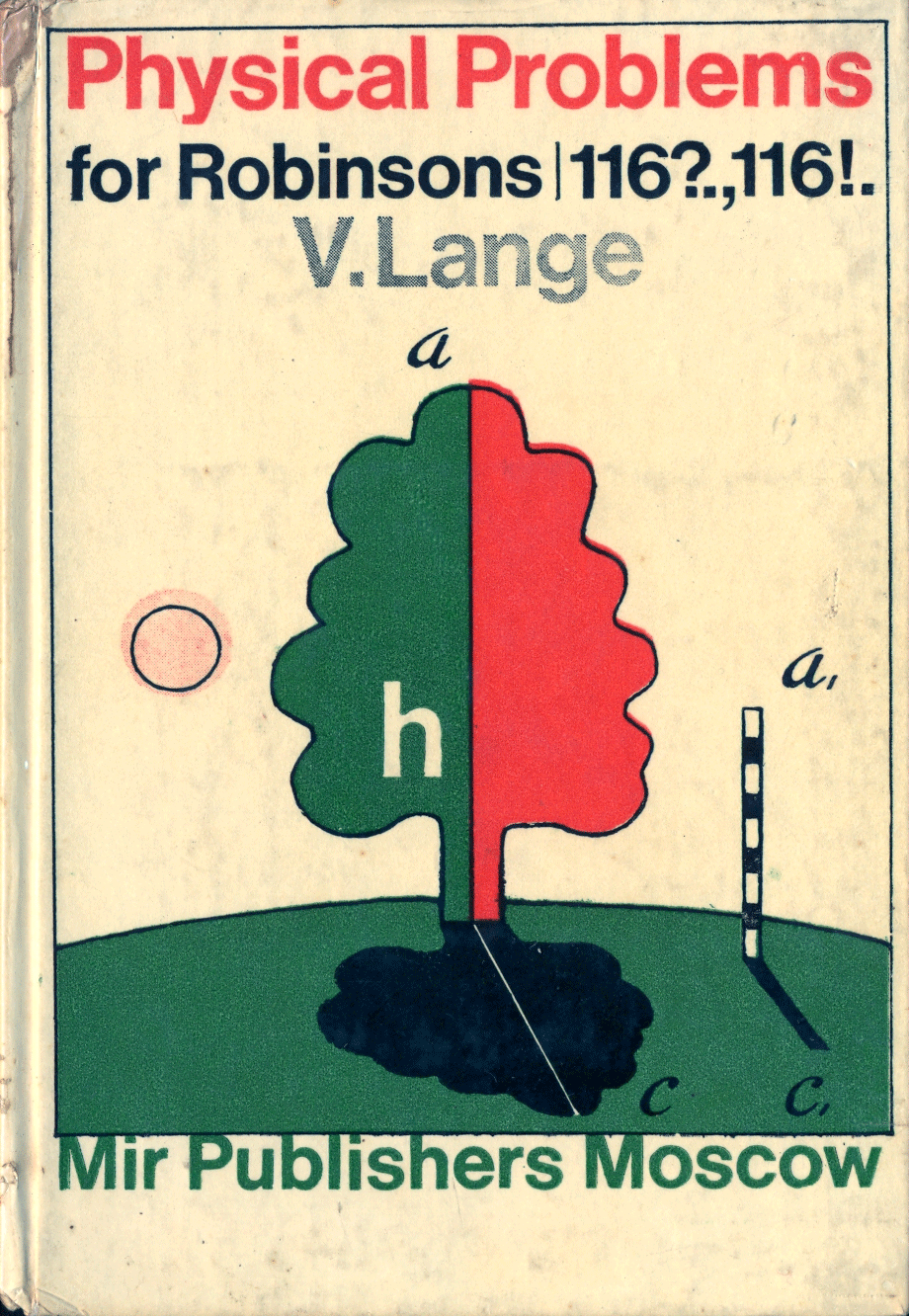
Physical Problems for Robinsons – Lange

In some of the problems given in this book we offer the use of what seem to be utterly unsuitable instruments and objects in order to determine various quantities. The problems, however, can be solved if these objects are applied with due skill.

This is a wonderful little book by V. Lange titled Physical Problems for Robinsons, 116?., 116!. This book is in line with that of Perelman’s works and is an excellent book on Back of the Envelope / Order of Magnitude kind of physics with experiments, with really unsuitable instruments to measure the physical quantities. You actually become a Robinson Crusoe-esque physicist, who can also do anything!

This book has little likeness to a school collection of problems, since in solving many of them items of knowledge from many different divisions of physics may be required. Therefore the author decided to divide the problems into groups according to the situation in which the task is to be performed. In each group the problems are arranged in the order of increasing difficulty, though certainly the author’s opinion on the complexity of the problem need not necessarily coincide with the reader’s.

The book is intended, in the first place, for pupils of “O” level classes, who have already mastered a considerable amount of knowledge in physics, but there are many problems which pupils who only have started to study this wonderful science will be able to cope with. It seems that the book can prove useful to teachers of secondary school, for example, in compiling a questionnaire for a school party devoted to “entertaining physics”.

Update: A translation of this book was done in Bengali, I do not know of any other translations, any inputs would be great.

The book was translated from the Russian by V. Zhitomirsky and was first published by Mir in 1976.

You can get the book here. and here

CONTENTS
FOREWORD 17
PROBLEMS:
At Home 113
On a Ramble 118
On the Lake 120
During a Journey 122
In the School Lab I23
At the Factory 127
In Outer Space I29
HINTS AND POINTERS 132
SOLUTIONS OF THE PROBLEMS 1 40

Posted in astronomy, books, chemistry, mathematics, mir books, mir publishers, physics, science | Tagged , , , , , | 10 Comments