Fundamentals of Machine Design – Orlov

In this post, we will see the three out of five-volume set Fundamentals of Machine Design by P. Orlov.

About the books:

The purpose of the present book is to offer the reader an attempt at a systematic exposition of rules for rational designing.

With all the diversity of the modern, machine-building the tasks facing the designer are similar in many respects. It is the reduction of the weight and specific metalwork weight of the machine, the improved suitability for industrial production, greater durability and reliability that are of importance for the design of any machine, the difference lying only in the relative significance of these factors. All this enables one to formulate the principles of rational designing as a code of general rules for machine building.

The prime intention of the book is to make the designer learn to work creatively. To design imaginatively means: to abstain from blindly copying the existing prototypes and to design meaningfully, selecting from the entire store of the design solutions offered by the present-day mechanical engineering the ones that are most suitable under given conditions; to be able to combine various solutions and find new, better ones, i. e., display initiative and put vim in the work; to continually improve the machines’ characteristics and to contribute to the progress in the given branch of mechanical engineering; to follow the dynamic development of the industry and devise versatile machines of long life, amenable to further modernization and capable of meeting the ever-growing demands of the national economy without running the risks of obsolescence for a long time to come.

Particular attention in the book is attached to the problems of durability and reliability. The author endeavoured to strongly emphasis the leading role of the designer in tackling these problems. In presenting the material the author followed the principle  “qui vidit—bis legit” (the one who sees reads twice). Most of the designers are individuals of visual thinking and visual memory.  For them a drawing or even a simple sketch means much more than many pages of explanatory notes. For this reason, each point in the text is accompanied by design examples.

To better the understanding most of the illustrations are arranged in such a way as to enable it to compare wrong and correct, inexpedient and expedient design versions.

The solutions given as correct are not the only possible ones. They should be regarded not as precepts, suitable for use in all cases, but rather as examples. In particular conditions other versions may prove more advisable.


All credits to the original uploader. Credits to edgato for posting the IA links.

Volume 1 Translated from the Russian by YU. TRAYNICHEV, published in 1976

Optimised, cleaned version here and here

Volume 2 Translated from the Russian by YU. TRAYNICHEV, published in 1976

Optimised, cleaned version here and here

Volume 3 Translated from the Russian by A. TROTSKY, published in 1977

Optimised, cleaned version here and here

Volume 4 (Not available, published 1977)

Optimised, cleaned version here and here

Volume 5 (Not available, published 1980)

Posted in books, engineering, mir books, mir publishers | Tagged , , , , , , , , , , , , , , , , , , , | 10 Comments

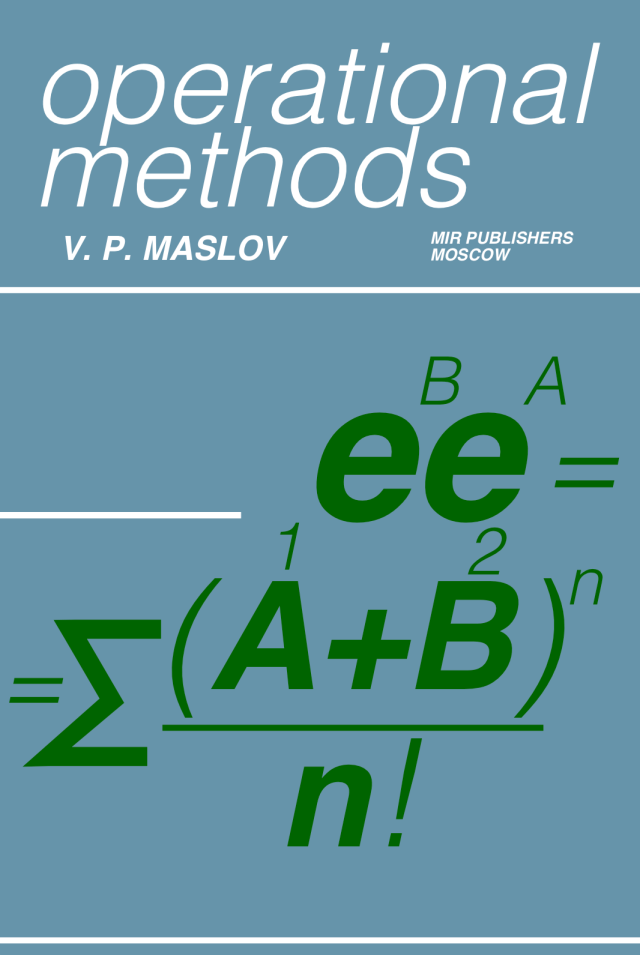
Operational Methods – Maslov

In this post, we will see the book Operational Methods by V. P. Maslov.

Maslov-Operational-Methods-Mir-1976-fc copy.png

…This book is devoted to one, but sufficiently general operational method, which absorbs many operational methods known to date and allows for the uniform solution of both classical problems, involving differential equations with partial derivatives, and the absolutely new problems of mathematical physics, including those connected with non-linear equations in partial derivatives.

…This book on operational methods should be accessible to senior course students of mathematics and physics faculties at universities and departments of applied mathematics. This means that only a knowledge of classical analysis is required of the reader. The book provides explanations in sufficient volume of such concepts as the theory of Banach algebras of distributions (Chapter I), the theory of linear differential and difference equations (Sees. 1, 2, and 3 of Introduction), the theory of non-linear equations of the first order with partial derivatives (Chapter IV). This material may be also of use to the reader who is already familiar with these questions, because rather often it is not presented in traditional style, and adapted for further reference. The reader who studies the book thoroughly will be equipped to carry on independent research in the modern theory of linear, non-linear differential and differential-difference equations with partial derivatives.

…This book has been written in such a way as to serve the widest possible circle of readers. It is suitable for two methods of study. The reader, who seeks to avoid fine assessments and passing to the limit and only wishes to master the practical techniques for obtaining asymptotic solutions, may omit that part of the book which is devoted to functional analysis.

…The most effective way of mastering the subject, however, consists rather in first reading Introduction and then reading all the book in succession. The reader should nevertheless be warned that all these methods are not at all easy, because the book provides a new operational calculus-the calculus of ordered operators.

The book was translated from the Russian by V. Golo, N. Kulman and G. Voropaeva and was published by Mir in 1976.

Credits to the original uploader for the scan, in this link we have converted to pdf from djvu, added bookmarks and cover.

The Internet Archive Link and here

French version here

CONTENTS
Preface 7
Introduction to Operational Calculus 13
Sec. 1. Solution of Ordinary Differential Equations by the Heaviside Operational Method 13
Sec. 2. Difference Equations 20
Sec. 3. Solution of Systems of Differential Equations by the Heaviside Operational Method 22
Sec. 4. Algebra of Convergent Power Series of Noncommutative Operators 24
Sec. 5. Spectrum of a Pair of Ordered Operators 35
Sec. 6. Algebras with \mu-Structures 40
Sec. 7. An Example of a Solution of a Differential Equation 56
Sec. 8. Passage of the Equation of Oscillations of a Crystal Lattice into a Wave Equation 58
Sec. 9. The Concept of a Quasi-Inverse Operator and Formulation of
the Main Theorem 100

Chapter I Functions of a Regular Operator 147

Sec. 1. Certain Spaces of Continuous Functions and Related Spaces 149
Sec. 2. Embedding Theorems 154
Sec. 3. The Algebra of Functions of a Generator 158
Sec. 4. The Extension of the Class of Possible Symbols 173
Sec. 5. Homomorphism of Asymptotic Formulas. The Method of Stationary Phase 181
Sec. 6. The Spectrum of a Generator 188
Sec. 7. Regular Operators 194
Sec. 8. The Generalized Eigenfunctions and Associated Functions 198
Sec. 9. Self-Adjoint Operators as Transformers in the Schmidt Space 205

Chapter II Calculus of Noncommutative Operators 210
Sec. 1. Preliminary Definitions 210
Sec. 2. The Functions of Two Noncommutative Self-Adjoint Operators 224
Sec. 3. The Functions of Noncommutative Operators 228
Sec. 4. The Spectrum of a Vector-Operator 231
Sec. 5. Theorem on Homomorphism 239
Sec. 6. Problems 242
Sec. 7. Differentiation of the Functions of an Operator Depending on a Parameter 251
Sec. 8. Formulas of Commutation 256
Sec. 9. Growing Symbols 261
Sec. 10. The Factor-Spectrum 265
Sec. 11. The Functions of Components of a Lie Nilpotent Algebra and Their Representations 266

Chapter III Asymptotic Methods 273

Sec. 1. Canonical Transformations of Pseudodifferential Operators 273
Sec. 2. The Homomorphism of Asymptotic Formulas 294
Sec. 3. The Geometrical Interpretation of the Method of Stationary
Phase 301
Sec. 4. The Canonical Operator on an Unclosed Curve 303
Sec. 5. The Method of Stationary Phase 312
Sec. 6. The Canonical Operator on the Unclosed Curve Depending on Parameters Defined Correct to 0 ( 1/\omega ) 315
Sec. 7. V-Objects on the Curve 321
Sec. 8. The Canonical Operator on the Family of Unclosed Curves 327
Sec. 9. The Canonical Operator on the Family of Closed Curves 333
Sec. 10. An Example of Commutation of a Canonical Operator with a Hamiltonian 339
Sec. 11. Commutation of a Hamiltonian with a Canonical Operator 346
Sec. 12. The General Canonical Transformation of the Pseudodifferential Operator 348

Chapter IV Generalized Hamilton-Jacobi Equations 355

Sec. 1. Hamilton-Jacobi Equations with Dissipation 356
Sec. 2. The Lagrangean Manifold with a Complex Germ 360
Sec. 3. y-Atlases and the Dissipativity Inequality 372
Sec. 4. Solution of the Hamilton-Jacobi Equation with Dissipation 378
Sec. 5. Preservation of the Dissipativity Inequality. Bypassing Focuses Operation 386
Sec. 6. Solution of Transfer Equation with Dissipation 401

Chapter V Canonical Operator on a Lagrangean Manifold with a Complex Germ and Proof of the Main Theorem 419

Sec. 1. Quantum Bypassing Focuses Operation 419
Sec. 2. Commutation Formulas for a Complex Exponential and a Hamiltonian 440
Sec. 3. C-Lagrangean Manifolds and the Index of a Complex Germ 452
Sec. 4. Canonical Operator 469
Sec. 5. Proof of the Main Theorem 482
Appendix to Sec. 5 493
Sec. 6. Cauchy Problem for Systems with Complex Characteristics 503
Sec. 7. Quasi-Inverse of Operators with Matrix Symbols 519
Appendix. Spectral Expansion of T-products 545
Index 557

Posted in books, mathematics, mir books, mir publishers | Tagged , , , , , , , , , , , , , , , , , , , , | Leave a comment

Strength of Materials – Belyaev

In this post, we will see the book Strength of Materials by N. M. Belyaev.

Screen Shot 2018-10-13 at 1.27.47 PM

About the book:

The new edition of Strength of Materials by N. M. Belyaev has been published after 11 years. In 33 years that lapsed between the publication by N. M. Belyaev of the first edition in 1932 and the last fourteenth edition in 1965 a total of 675 000 copies of the book were sold, testifying to its wide popularity. During this period the book was periodically enlarged and revised by N. M. Belyaev and, after his death in 1944, by a group of four of his co-workers. This group, which prepared from the fifth to the fourteenth editions for publication, did not consider it proper to make substantial changes in the original work of N. M. Belyaev. Additions were done at one time or another only when they became absolutely necessary due to changes in standards and technical specifications and in the light of recent research.

In the present edition, prepared by the same group, a number of topics have been dropped either owing to their irrelevance to strength of materials or because they are rarely taught in the main course.

Considering the availability of a large number of problem books (see, for instance, Problems on Strength of Materials edited by V. K. Kachurin) on the market, most of the examples have been dropped from the present edition. Only examples that are essential for the explanation of theoretical part have been retained. For greater compactness the problem of design for safe loads has now been included in Chapter 26 For the first time the chapter includes the principles of design for limiting states, which though beyond the limits of the basic course of strength of materials are important enough to require an exposition of the basic concepts even at this stage of teaching.

The problems of strength, which in the previous editions occupied two chapters, have been grouped into one. The part dealing with actual stresses has been transferred to Chapter 2, where it has been presented in a sufficiently detailed manner. The tables containing data on materials have been dropped from the appendices. A part of the data on materials has been transferred to 8 Preface to the Fifteenth Russian Edition corresponding sections. The obsolete steel proliles grading has been replaced by new ones.

As in the previous editions it was our endeavour to preserve Belyaev’s style and method of presentation of material. Therefore the author’s text has in general been preserved. If Nikolai Mikhailovich Belyaev were alive today he would possibly write many things in a different way. However, since the book won wide popularity as written by N. M. Belyaev, we tried to preserve the original text as far as possible.

(perhaps someone with an engineering background can post a much better review)

The book was translated from the Russian by N. K. Mehta and was published by Mir in 1979. This is the fifteenth edition of the book.

All credits to the original uploader. Credits to Tor, db.jan for posting the links.

The Internet Archive Link (djvu only) from IA user quailhacker

The Internet Archive Link (pdf+other formats)  and here


Contents

PART 1. Introduction. Tension and Compression

Chapter 1. Introduction 17

§ 1. The science of strength of materials 17
§ 2. Classification of forces acting on elements of structures 18
§ 3. Deformations and stresses 21
§ 4. Scheme of a solution of the fundamental problem of strength of materials 23
§ 5. Types of deformations 27

Chapter 2. Stress and Strain in Tension and Compression Within the Elastic Limit Selection of Cross-sectional Area 27

§ 6. Determining the stresses in planes perpendicular io tile axis of the bar 27
§ 7. Permissible stresses. Selecting the cross-sectional area 30
§ 8. Deformations under tension and compression. Hooke’s law 32
§ 9. Lateral deformation coefficient. Poisson’s ratio 36

Chapter 3. Experimental Study of Tension and Compression In Various Materials and
the Basis of Selecting the Permissible Stresses 40

§ 10. Tension test diagram. Mechanical properties of materials 40
§ 11. Stress-strain diagram 47
§ 12. True stress-strain diagram 48
§ 13. Stress-strain diagram for ductile and brittle materials 62
§ 14. Rupture in compression of brittle and ductile materials. Compression test diagram 64
§ 16. Comparative study of the mechanical properties of ductile and brittle materials 57
§ 16. Considerations in selection of safety factor 59
§ 17. Permissible stresses under tension and compression for various materials 64

PART II. Complicated Cases of Tension and Compression

Chapter 4. Design of Statically Indeterminate Systems for Permissible Stresses 66

$ 18. Statically indeterminate systems 66
§ 19. The effect of manufacturing inaccuracies on the forces acting in the elements of statically indeterminate structures 73
§ 20. Tension and compression in bars made of heterogeneous materials 77
§ 21. Stresses due to temperature change 79
§ 22. Simultaneous account for various factors 82
§ 23. More complicated cases of statically indeterminate structures 85

Chapter 5. Account for Dead Weight In Tension and Compression* Design of Flexible Strings 88

§ 24. Selecting the cross-sectional area with the account for the dead weight (in tension and compression) 86
§ 25. Deformations due to dead weight 81
§ 26. Flexible cables 92

Chapter 6. Compound Stressed State. Stress and Strain 99

§ 27. Stresses along Inclined sections under axial tension or compression (uniaxial stress) 99
§ 28. Concept of principal stresses. Types of stresses of materials 101
§ 29. Examples oil biaxial and triaxial stresses. Design of a cylindrical reservoir 103
§ 30. Stresses In a biaxial stressed state 107
§ 31. Graphic determination of stresses (Mohr’s circle) 110
§ 32. Determination of the. principal stresses with the help of the stress circle 114
§ 33. Stresses in triaxial stressed state 117
§ 34. Deformations In the compound stress 121
§ 35. Potential energy of elastic deformation in compound stress 124
§ 36. Pure shear. Stresses and strains. Hooke’s law. Potential energy 127

Chapter 7. Strength of Materials in Compound Stress 132

§ 37. Resistance to failure. Rupture and shear 132
§ 38. Strength theories 136
§ 39. Theories of brittle failure (theories of rupture) 138
§ 40. Theories of ductile failure (theories of shear) 140
§ 41. Reduced stresses according to different strength theories 147
§ 42. Permissible stresses in pure shear 149

PART III. Shear and Torsion

Chapter 8. Practical Methods of Design on Shear 151

§43. Design of riveted and bolted joints 151
§44. Design of welded joints 158

Chapter 9. Torsion. Strength and Rigidity of Twisted Bars 164

§ 45. Torque 164
§ 46. Calculation of torques transmitted to the shaft 167
§ 47. Determining stresses in a round shaft under torsion 168
§ 48. Determination of polar moments of inertia and section moduli of a shaft section 174
§ 49. Strength condition in torsion 176
§ 50. Deformations in torsion. Rigidity condition 176
§ 51. Stresses under torsion in a section inclined to the shaft axis 178
§ 52. Potential energy of torsion 180
§ 53. Stress and strain In dose-coiled helical springs 181
§ 54. Torsion in rods of non-circular section 187

PART IV. Bending. Strength of Beams

Chapter 10. Internal Forces In Bending. Shearing-force and Bending-moment Diagrams 198
$ 55. Fundamental concepts of deformation in bending. Construction of beam supports 195
§ 56. Nature of stresses in a beam. Bending moment and shealine force 200
§ 57. Differential relation between the intensity of a continuous load, shearing force and bending moment 205
§ 58. Plotting bending-moment and shearing-force diagrams 207
§ 59. Plotting bending-moment and shearing-force diagrams for more complicated loads 214
§ 60. The check of proper plotting of Qr and M-diagrams 221
§ 61. Application of the principle of superposition of forces In plotting shearing-force and bending-moment diagrams 223

Chapter 11. Determination of Normal Stresses in Bending and Strength of Beams 225

§ 62. Experimental investigation of the working of materials in pure bending 225
§ 63. Determination of norma) stresses In bending. Hooke’s law and potential energy of bending 228
§ 64. Application of the results derived above in checking the strength of beams 235

Chapter 12. Determination of Moments of Inertia of Plane Figures 239

§ 65. Determination of moments of inertia and section moduli for simple sections 239
§ 66. General method of calculating the moments of inertia of complex sections 244
§ 67. Relation between moments of inertia about two parallel axes one of which is the central axis 246
§ 68. Relation between the moments of inertia under rotation of axes 247
§ 69. Principal axes of inertia and principal moments of inertia 250
§ 70. The maximum and minimum values oi the central moments of
inertia 254
§ 71. Application of the formula for determining normal stresses to
beams of non-symmetrical sections 254
§ 72. Radii of inertia. Concept of the momenta! ellipse 256
§ 73. Strength check, choice of section and determination of permissible load in bending 258

Chapter 13. Shearing and Principal Stresses In Beams 263

§ 74. Shearing stresses in a beam of rectangular section 263
§ 75. Shearing stresses in I-beams 270
§ 76. Shearing stresses in beams of circular and ring sections 272
§ 77. Strength check for principal stresses 275
§ 78. Directions the principal stresses 280

Chapter 14. Shear Centre. Composite Beams 283

§ 79. Shearing stresses parallel to the neutral axis. Concept of shear centre 233
§ 80, Riveted and welded beams 289

PART V. Deformation of Beams due to Bending

Chapter 15. Analytical Method of Determining Deformations 292

§ 81. Deflection and rotation oi beam sections 292
$ 82. Differential equation of the deflected axis 294
§ 83. Integration oi the differentia) equation of the deflected axis of a beam fixed at one end 296
84. Integrating the differential equation of the deflected axis of a simply supported beam 299
§ 85. Method of equating the constants of integration oi differential equations when the beam has a number of differently loaded portions 301
§ 86. Method of initial parameters for determining displacements in beams 304
§ 87, Simply supported beam unsymmetrically loaded by a force 305
§ 88. Integrating the differential equation for a hinged beam 307
§ 89. Superposition of forces 310
§ 90. Differential relations in bending 312

Chapter 16. Graph-analytic Method of Calculating Displacement in Bending 313

§ 91. Graph-analytic method 313
§ 92. Examples of determining deformations by the graph-analytic method 317
§ 93. The graph-analytic method applied to curvilinear bending-moment diagrams 320

Chapter 17. Non-uniform Beams 324

§ 94. Selecting the section in beams of uniform strength 324
§ 95. Practical examples of beams of uniform strength 325
§ 96. Displacements in non-uniform beams 326

PART VI. Potential Energy. Statically Indeterminate Beams

Chapter 18. Application of the Concept of Potential Energy in Determining Displacements 331

§ 97. Statement of the problem 331
§ 98. Potential energy in the simplest cases of loading 333
§ 99. Potential energy ior the case of several forces 334
§ 100. Calculating bending energy using internal forces 336
§ 101. Castigliano’s theorem 337
$ 102. Examples of application of Castigiiano’s theorem 341
$ 103. Method of introducing an external force 344
§ 104. Theorem of reciprocity of works 346
§ 105. The theorem of Maxwell and Mohr 347
§ 106. Vereshchagin’s method 349
§ 107. Displacements In frames 351
§ 108. Deflection of beams due to shearing force 353

Chapter 19. Statically indeterminate Beams 356

§ 109. Fundamental concepts 356
§ 110. Removing static indeterminacy via the differential equation of the deflected beam axis 357
§ 111. Concepts of redundant unknown and base beam 359
§ 112. Method of comparison of displacements 360
§ 113. Application of the theorems of Castigliano and Mohr and Vereshchagin’s method 362
§ 114. solution of a simple statically Indeterminate frame 364
§ 115. Analysis of continuous beams 366
§ 116. The theorem of three moments 366
§ 117. An example on application erf the theorem of three moments 372
§ 118. Continuous beams with cantilevers. Beams with rigidly fixed ends 375

PART VII. Resistance Under Compound Loading

Chapter 20. Unsymmetric Bending 378

§ 119. Fundamental concepts 378
§ 120. Unsymmetric bending. Determination of stresses 379
§ 121. Determining displacements in unsymmetric bending 365

Chapter 21. Combined Bending and Tension or Compression 389

§ 122. Deflection of a beam subjected to axial and lateral forces 389
§ 123. Eccentric tension or compression 392
§ 124. Core of section 396

Chapter 22. Combined bending and torsion 401

§ 125. Determination erf twisting and bending moments 401
§ 126. Determination of stresses and strength check In combined bending and torsion 404

Chapter 23. General Compound Loading 408

§ 127. Stresses in a bar section subjected to general compound loading 408
§ 128. Determination of normal stresses 410 1129. Determination of shearing stresses 413
130. Determination of displacements 414
131. Design of a simple crank rod 417

Chapter 24. Curved Bars 423

§ 132. General concepts 423
§ 133. Determination of bending moments and normal and shearing forces 424
§ 134. Determination of stresses due to normal and shearing forces 420
§ 135. Determination of stresses due to bending moment 427
§ 136. Computation of the radius of curvature of the neutral layer in a rectangular section 433
§ 137. Determination of the radius of curvature oi the neutral layer for circle and trapezoid 434
§ 138. Determining the location of neutral layer from tables 436
§ 139. Analysis of the formula for normal stresses In a curved bat 436
§ 140. Additional remarks on the formula for normal stresses 439
§ 141. An example on determining stresses in a curved bar 441
1 142. Determination of displacements in curved bars 442
§ 143. Analysis of a circular ring 445
Chapter 25. Thick-walled and Thin-walled Vessels 446

$ 144. Analysis of thick-walled cylinders 446
§ 145. Stresses in thick spherical vessels 453
§ 146. Analysis of thin-walled vessels 454

Chapter 26. Design for Permissible toads. Design for Limiting States 467

§ 147. Design for permissible loads. Application to statically determinate systems 457
§ 146. Design or statically indeterminate systems under tension or compression by the method of permissible loads 458
§ 149. Determination of limiting lifting capacity of a twisted rod 462
§ 150. Selecting beam section Tor permissible loads 465
§ 151. Design of statically indeterminate beams for permissible loads. The fundamentals. Analysis of a two-span beam 468
§ 152. Analysis of a three-span beam 472
§ 153. Fundamentals of design by the method of limiting states 474

PART VIII. Stability of Clements of Structures

Chapter 27. Stability ot Ban Under Compression 477

§ 154. Introduction. Fundamentals of stability of shape of compressed bars 477
6 155. Euler’s formula for critical force 480
§ 156. Effect of constraining the bar ends 484
§ 157. Limits of applicability of Euler’s formula. Plotting of the diagram of total critical stresses 488
§ 158. ‘The stability check of compressed bars 494
§ 159. Selection of the type of section and material 498
§ 160. Practical importance of stability check 502

Chapter 28. More Complicated Questions of Stability in Elements of Structures 604

§ 161. Stability of plane surface in bending of beams 504
§ 162. Design of compressed-bent ban 512
§ 163. Effect of eccentric compressive force and initial curvature of bar 517

PART IX. Dynamic Action of Forces

Chapter 29. Effect of Forces of Inertia. Stresses due to Vibrations 521

§ 164. Introduction 521
§ 165. Determining stresses in uniformly accelerated motion of bodies 523
§ 166. Stresses In a rotating ring (flywheel rim) 524
§ 167. Stresses in connecting rods 525
$ 168. Rotating disc of uniform thickness 529
1 169. Disc o f uniform strength 533
§ 170. Effect of resonance on the magnitude of stresses 535
§ 171. Determination of stresses in elements subjected to vibration 536
§ 172. The effect of mass of the elastic system on vibrations 541

Chapter 30. Stresses Linder Impact Loading 548

§ 173. Fundamental concepts 548
§ 174. General method of determining stresses under impact loading 549
§ 175. Concrete cases of determining stresses and conducting strength checks under impact 5S4
$ 176. Impact stresses in a non-uniform bat 559 1177. Practical conclusions from the derived results 660
178. The effect of mass of the elastic system on impact 562
179. Impact testing for failure 565
180. Effect of various factors on the results of impact testing 568

Chapter 31. Strength Check of Materials Under Variable Loading 571

§ 181. Basic ideas concerning the effect of variable stresses on the – strength of materials 571
§ 182. Cyclic stresses 573
§ 183. Strength condition under variable stresses 575
§ 184. Determination of endurance limit in a symmetrical cycle 576
1 185. Endurance limit in an unsymmetrical cycle 579
1 186. Local stresses 682
§ 187. Effect of size of part and other factors on endurance limit 589
§ 188. Practical examples of failure undo: variable loading. Causes of
emergence and development of fatigue cracks 593
§ 189. Selection of permissible stresses 597
§ 190. Strength check under variable stresses and compound stressed state 600
§ 191. Practical measures for preventing fatigue failure 602

Chapter 32. Fundamentals of Creep Analysis 605

§ 192. Effect of high temperatures on mechanical properties of metals 605
§ 193. Creep and after-effect 607
§ 194. Creep and after-effect curves 609
§ 195. Fundamentals of creep design 615
§ 196. Examples on creep design 620
Appendix 630
Name index 639
Su

Posted in books, engineering, mir books, mir publishers, physics | Tagged , , , , , , , , , , , , , , , , , , , | 1 Comment

Mechanisms in Modern Engineering Design – Artobolevsky

In this post, we will see the set of books (6/7) in the series Mechanisms in Modern Engineering Design: A Handbook for Engineers, Designers and Inventors by I. I. Artobolevsky.

About the books (From the preface of the first volume):

One of the problems facing the modern theory of mechanisms is the study and systematization of the huge inheritance accumulated in mechanical engineering practice and consisting of numerous mechanisms applied in various machines, instruments and devices.

An analysis of this data and its classification into the various kinds of mechanisms have shown that their systematization should be broken down into two stages. The first is the compilation of collections of mechanisms employed in all branches of the engineering industries. The next stage consists of collections compiled for different branches, such as mechanisms for precision instruments, mechanisms of machine tools, mechanisms of aircraft engines.

The need of such systematically compiled data is evidently very great because information on the various kinds of mechanisms that have been devised is scattered, for the most part, among diverse reference sources: textbooks, monographs, journals, patent applications, etc. This data is difficult to use because some of the editions may be more or less unique, and because the data does not, as a rule, contain the necessary descriptions, classification and system that would enable a mechanism to be quickly selected for some definite purpose specified by a designer.

It is of equal importance, in the author’s opinion, to meet the needs of inventors. A vast number of inventions are being made in “the USSR and’abroad, and their quantity is increasing year by year. Inventors require convenient handbooks where they can readily find elementary schemes of mechanisms’ that can accomplish the forms of motion needed for the designs they propose.

To meet this demand, in 1947-52 the author compiled a four-
volume work called Mechanisms which was published (in Russian) by the USSR Academy of Sciences. This work contains drawings and descriptions of 4000 mechanisms and includes those made up of hydraulic, pneumatic and electrical devices, as well as purely mechanical systems. This four-volume work has long been out of print and, judging from letters received by the author from a great many engineers, designers, technicians and inventors, a new edition is more than timely. To meet this demand the author has prepared the present completely revised and considerably supplemented edition. This
work is to comprise five volumes. The first two volumes contain drawings and descriptions of lever mechanisms, i.e. mechanisms based on kinematic chains made up of lower pairs.  The third volume is devoted to gear mechanisms. The fourth volume contains cam, friction and flexible-link mechanisms. The final volume is to deal with hydraulic, pneumatic and electrical mechanisms.

The author’s aim was to produce a handbook for engineers and technicians of all ranks, as well as inventors, and not only for experts in the field of mechanisms theory. Hence, he has conscientiously avoided special terminology and notation intelligible only to experts in this line. The author has tried to use the simplest possible drawings furnished with the simplest possible descriptions that should be understandable even to persons without any special engineering training.

The books were translated from the Russian by Nicholas Weinstein and were first published by Mir in 1976 and reprinted in 1979.

Credits to GianniN for posting this comment:

Hi to everyone, I want to share the set of 5 volumes of Artobolevsky – Mechanism in modern engineering design , at the moment only one of the 7 book is missing (volume 5 par 2)

I will very happy if anyone can provide the missing book.

You can download the pdf file from

https://drive.google.com/drive/folders/0B3JbH2O6FXFTRXRxejFZbFdiQVk?usp=sharing

if you find any problem to download the books pls let me know,

Gerson uploaded it to IA, (links are from this upload)

Hi all,

I’ve uploaded “Mechanisms in Engineering Design: Volume 1 – Lever Mechanisms” by Ivan I. Artobolevsky.

https://archive.org/details/mechanism_in_modern_engineering_V1-lever_mechanism
Check it out!

I’ll be doing other volume, but it’s extremely extremely time consuming.

Enjoy!

There are a total of 7 books in 5 Volumes, with Volumes 2 and 5 having two parts each.


Volume 1 Lever Mechanisms

and here

Volume 2 Part 1 Lever Mechanisms and here

Volume 2 Part 2 Lever Mechanisms and here

Volume 3 Gear Mechanisms and here

Volume 4 Cam and Friction Mechanisms Flexible-Link Mechanisms 

and here

Volume 5 Part 1 Hydraulic, Pneumatic and Electric Mechanisms

and here

Volume 5 Part 2 Electric Mechanisms (Not available) and here


Follow us on The Internet Archive: https://archive.org/details/@mir-titles
Follow Us On Twitter: https://twitter.com/MirTitles
Write to us: mirtitles@gmail.com
Fork us at GitLab: https://gitlab.com/mirtitles/


Posted in books, engineering, mir books, mir publishers | Tagged , , , , , , , , , , , , , , , , | 4 Comments

The Quiet Sun – Pushkov, Silkin

In this post, we will see the book The Quiet Sun by N. Pushkov and B. Silkin.

Pushkov-Silkin-The-Quiet-Sun-Mir-1968-fc copy.png

About the book:
How can events 150 million kilometres away affect us here on earth? But if you have ever complained of poor radio reception, if the compass needle has ever gone wrong, if you have ever wondered what has happened to the weather, the trouble most likely has to be sought at this great distance. Blame it all on the sun. This book is an account of that great world-wide undertaking— the International Quiet Sun Year— in which scientists of over 60 countries participated. Following the International Geophysical Year, it disclosed many secrets about our luminary. Everyone who wants to learn more about our sun and how it affects the planet we live on should read this book.
The book was translated from the Russian by George Yankovsky and was published by Mir in 1968.
and here
CONTENTS
FROM SUN-WORSHIP TO KNOWLEDGE 7
OUR OWN STAR 12
A DISCOVERY WITH A STRANGE HISTORY 14
THE PROJECT AND ITS OUTLINE 41
WE LIVE ON AN ENORMOUS MAGNET 56
WORLD-WIDE MAGNETIC SURVEY 94
EARTH CURRENTS 103
HERALDS FROM DISTANT WORLDS 108
THE INVISIBLE BELTS OF THE EARTH 134
WHEN THE SKY IS ON FIRE 153
INVISIBLE CELESTIAL LIGHT 173
THE IONOSPHERE 182
ATMOSPHERICS—CHILD OF THUNDERSTORMS 208
DOES THE SUN MAKE THE WEATHER? 212
GALILEO: “PROVANDO E RIPROVANDO” 235
THE FINDINGS OF THE IQSY ARE OPEN TO THE WHOLE WORLD 239
Posted in astronomy, books, engineering, geology, history, meteorology, mir books, mir publishers, physics, science, soviet | Tagged , , , , , , , , , , , , , | Leave a comment

A Planet of Riddles – Novikov

In this post, we will see the book A Planet of Riddles by E. Novikov.

Novikov-A-Planet-of-Riddles-Mir-1974-fc copy.png

About the book (from the back cover):

This book is about our planet, the Earth we know so well. But is it then a planet of riddles? Read this book, and you will see that it is.

Whence the strange names of the sections: “Embracing the Boundless”, “Seeing the Invisible”? Has the author forgotten Kozma Prutkov’s aphorism: “You can’t embrace the boundless”? Not at all! But he does not agree.

The book gives a brief history of the study of our planet. But history contains the roots of scientific novelty, of wonderful discoveries. Kozma Prutkov also said, and not without reason: “Heed the roots!”

The book explores a variety of topics related to the Earth. It forays into areas of astronomy, geology, physics to ask questions and explain the physical origin of the objects and events we see on the Earth. For example, it also explains how the mud is formed. Peppered with historical anecdotes and updated with the latest scientific research (until the date of publication) this is an amazing read.

The book was translated from the Russian by David Sobolev, and was first published by Mir in 1972, with a reprint in 1974.


PDF | Cover | Bookmarked

The Internet Archive Link and here


Contents

EMBRACING THE BOUNDLESS

Onwards, to the Truth I 7

Its Shape Was Determined at a Writing Desk, Its Size Measured Outdoors and Its Weight Indoors 24

It Revolves and Vibrates 38 An Invisible Field 53

The EC Mystery 75

The Depths of Time 89

A Rocky Ocean 110
The Planet’s Strange Disguise 126

Facts for Thought 139


SEEING THE INVISIBLE

The Search for Exploration Methods 144

Invisible Elements Hiide in the Earth 156

On the Earth, in the Air, and at Sea 167

Invisible Signals 186

An Abstraction That Is Real 208

Crossword Puzzles of the Familiar 219

Is It Solid Ground We Tread on? 236

Facts for Thought 253

Posted in astronomy, books, geology, mir books, mir publishers, physics, science, soviet | Tagged , , , , , , , , , , , , , , , , | Leave a comment

Solving Problems In Algebra and Trigonometry – Litvinenko, Mordkovich

In this post, we will see the book Solving Problems In Algebra and Trigonometry – V. Litvinenko, A. Mordkovich. In an earlier post, we had seen the companion volume to this book Solving Problems in Geometry. The companion volume also has been updated with a fresh scan and new links have been added.

Litivinenko-Mordkovich-Solving-Problems-In-Algebra-and-Trigonometry-Mir-1988-fc copy.png

About the book:

This study aid is intended for students of physical and mathemati­cal faculties of pedagogical institutes.
The book contains about 2000 examples, problems, and exercises of which 1700 problems are for solving independently. Along with rather simple problems, there are also problems whose solution requires serious and sometimes inventive work. In the course of preparing the manuscript for print we tried to distribute the space among the basic types of “school” problems in algebra and trigonom­etry. Solving these problems will help the student to acquire pro­fessional skill necessary for a teacher who must know how to solve mathematical problems of the high-school level.
This book is not only a collection of problems, it is rather a study aid for practical work, as can be seen in the structure of the text­ book. Each section contains necessary theoretical material and an ample number of worked examples (the total number of which amounts to about 300), which are very useful for the student pri­ marily from the methodological point of view.

The book was translated from the Russian by Leonid Levant and was first published by Mir in 1987.

PDF | Bookmarked | Cover

The Internet Archive Link

and here

Contents

PART 1. ALGEBRA 7

Chapter 1. IDENTICAL TRANSFORMATIONS 7

Sec. 1. Factorization of Polynomials 7
Sec. 2. Identical Transformations of Rational Functions 11
Sec. 3. Identical Transformations of Irrational Functions 20
Sec. 4. Identical Transformations of Exponential and Logarith­mic Functions 29
Sec. 5. Proving Inequalities 33
Sec. 6. Comparing Numerical Expressions 41

Chapter 2. SOLVING EQUATIONS AND INEQUALITIES 45

PART II. TRIGONOMETRY 202

Chapter 3. IDENTICAL TRANSFORMATIONS 202

Sec. 21. Identical Transformations of Trigonometric Functions 202
Sec. 22. Transforming Functions Containing Inverse Trigonometric Functions 218
Sec. 23. Proving Inequalities 224

Chapter 4. SOLVING EQUATIONS AND INEQUALITIES 234

Sec. 24. Equations 234
Sec. 25. Systems of Equations 254
Sec. 26. Inequalities 265
Sec. 27. Parametric Equations and Inequalities 276

Answers 287

Posted in books, mathematics, mir books, mir publishers, problem books | Tagged , , , , , , , , , , , , , | 6 Comments

The Nine Colours of The Rainbow – Steinhaus

In this post, we will see the book The Nine Colours of The Rainbow by A. Steinhaus.

Steinhaus-The-Nine-Colours-Of-The-Rainbow-Mir-fc copy.png

About the book (from the front jacket)

Have you ever stopped to think how many colours there are in a rainbow? Seven or, perhaps, nine as the title of the book suggests? It appears, there are many more and still the title is correct. Why so?
The book will tell you what is visible and invisible light, how it helps man to acquaint himself with his environment, investigate it, penetrate into the mysteries of matter and space. You will also find out how man learned to see in the dark, transmit images over long distances and record processes occurring within millionth fractions of a second. The book contains a wealth of other information on the latest achievements in science and technology.
The author, Alexander Steinhaus, is a Soviet specialist in electronics and TV. Many years of industrial experience served as a fertile ground for his literary career on which he embarked with ardour. He has written many sci-fic articles, some stories and a few books, among which are “The Nine Colours of the Rainbow”, “A Factory Without Men”, and others. At present A. Steinhaus is working at a large sci-fic book on television.
The book was translated from the Russian by David Sobolfy and was published by Mir in 1966.
and here
Contents
LIGHT 9
A Piece of Glass 10
Simple Experiments that Explained Very Complex Phenomena and Even the Rainbow 13 Questions and Answers 20
What Language Does Science Speak? 24
A Word from the Dictionary 26
Free Son of Ether 31
Pros and Cons 34 Searches, and Again Bells 38
Light and Shade 43
Light and Electricity 48
Two Discoveries 51
Spectrum of Electromagnetic Vibrations 54
Extraordinary Tails 60
The Very Tiniest 63
The Photoelectric Effect  72
Interlude 81
After the Crisis 82
THE EYE AND VISION 93
Prelude 93
Our Eyes 94
Properties of the Human Eye 105
Colours 129
From Facts to Theory 142
Inexplicable Phenomena 144
TELESCOPES AND MICROSCOPES 153
Telescopes 164
Microscopes 197
PHOTOGRAPHY AND CINEMATOGRAPHY 210
Imprinted Light 210
A Ray of Light in a Dark Room 212
Photons, Silver and Chemistry 219
Rivals or Friends? 225
The All-Seeing Bye 231
The Three-Colour Theory in Action 243
Autographs of Invisible Particles 246
Recorded Movement 249
Stopping the Instant 252
A Cinematograph Gun 258
LIGHT AND ELECTRONICS 262
Electronic Cells 266
The Multiplication Principle 269
Sensitive Eyes 275
The Fate of the Lost Photons 260
New Roads 263
A Light Amplifier 286
An Electricity Factory 286
Secret of the Code 289
The Electronic Eye 296
TELEVISION 307
Telecasting from Space 315
Now Trends in Old Fields 322
The Television Eye in the Air 327
The Control Room Engineer’s Helpers 331
Television and the Worker 334
Into the Depths of Seas and Oceans 338
The Eyes and Hands of the Experimenter 341
AFTERWORD 344
APPENDICES 347
INDEX 351
Posted in astronomy, books, electronics, mir books, mir publishers, physics, science, technology | Tagged , , , , , , , , , , , , , , | Leave a comment

Git repo for Tarasov’s Calculus

So, as promised I have created a git repo containing LaTeX source files for Tarasov’s Calculus. Currently, the work that is needed includes converting all the figures to TikZ code and any other changes which might make the document better.

You can find the public repository at the URL below:

https://gitlab.com/mirtitles/tarasov-calculus.git

I have other books by Tarasov also ready to be released, maybe by this month-end, we will see them:

  • The World is Built on Probability,
  • Questions and Answers in School Physics,
  • Basic Concepts of Quantum Mechanics,
  • This Amazingly Symmetrical World.

I hope you find this useful and contribute to the project.


Posted in mathematics, mir books | Tagged , , , , | 6 Comments

Problems in Geometry – Modenov

In this post, we will see the book Problems in Geometry by P. S. Modenov.

Modenov-Problems-In-Geometry-Mir-fc.png

About the book

This text offers certain general methods of solving problems in elemen­tary geometry and is designed for teachers of mathematics in secondary schools and also for senior students.
The present text includes material that goes beyond the scope of mathe­matics curricula for secondary schools (the use of complex numbers in plane geometry, inversion, pencils of circles and others).
The book consists of five chapters. The first four chapters deal with the application of vector algebra, analytic geometry, complex numbers and the inversion transformation to geometric problems. Chapter V contains a list of the basic definitions and formulas used in the first four chapters. Before starting a new chapter, the reader is advised to refresh his memory with the appropriate material of Chapter V. Some of the derivations of formulas given in Chapter V are familiar to senior students of secondary school. More detailed theoretical material can be found in the bibliography at the end of the book.
The book was translated from the Russian by George Yankovsky and published by Mir 1981.
and here
Contents
PREFACE 7CHAPTER I. VECTOR ALGEBRA

Sec. 1. Vectors in the plane (solved problems) 11
Sec. 2. Vectors in space (solved problems) 14
Sec. 3. Vectors in the plane and in space (problems with hints and
answers) 30

CHAPTER II. ANALYTIC GEOMETRY

Sec. 1. Application of analytic geometry(solved problems) 44
Sec. 2. Application of analytic geometry(problems with hints and answers) 66
1. Plane geometry 66
2. Solid geometry 78

CHAPTER III. THE USE OF COMPLEX NUMBERS IN PLANE GEOMETRY

Sec. 1. Solved problems 82
Sec. 2. Problems with hints and answers 253

CHAPTER IV. INVERSION

Sec. 1. Inversion defined. Properties of inversion 281
Sec. 2. Problems involving inversion 285
Sec. 3. Mapping of regions under inversion 297
Sec. 4. Mechanical inversors: the Peaucellier cell and the Hart cell 308
Sec. 5. The geometry of Mascheroni 309
Sec. 6. Inversion of space 313

CHAPTER V. BASIC DEFINITIONS, THEOREMS AND FORMULAS
Sec. 1. Determinants of order three 334
Sec. 2. Vector algebra 373
Sec. 3. Analytic geometry 347
Sec. 4. Complex numbers 377

LIST OF SYMBOLS 387
APPENDIX. LIST OF BASIC FORMULAS FOR REFERENCES 390
BIBLIOGRAPHY 394
NAME INDEX 395
SUBJECT INDEX 396

Posted in books, mathematics, mir books, mir publishers, problem books | Tagged , , , , , , , , , , , , , | 2 Comments