We now come to another title in the Little Mathematics Library, this one is titled Images of Geometric Solids by N. M. Beskin
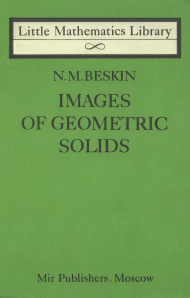 Drawing a plane figure is not geometrically difficult because the image drawn is either an exact copy of the original or a similar figure, e.g. the drawing of a circle looks like the original circle. Drawing geometric solids is quite a different matter. Unfortunately, there are no “spatial pencils” which can trace an object in the air. Such a pencil would “draw” a cube by tracing along its edges. Hence, we have to sketch a cube on paper with an ordinary pencil. A plane image will never be an exact copy of a solid and, therefore, a certain routine ought to be followed in drawing a solid that would create an image of the original in the best way.
What is the book about. Descriptive geometry embraces so
many methods that even a brief account would make up a rather thick volume. Therefore, we shall discuss just one of these methods, so as to enable the reader to make stereometric drawings and solve the respective problems…
This book presents a geometric theory of constructing
stereometric drawings. Having mastered this theory, a reader will be able to make the drawings himself rather than have to stick to the few sample ones.
The first chapter presents the theory, the second one is devoted
to its applications (drawing of a cube, a cone, a cylinder, etc.),
and the third one describes a method of plotting the points of an
image if their coordinates are known.
It is these strategies and routine that this book discusses. Though many things are possible with modern computer programs, but the logic may not be known to people who are using them.
The book was translated from the Russian by Valery Barvashov and was first published by Mir in 1985. All credits to the original uploader.
Update 26 May 2018
The Internet Archive link.
and here
Continue reading →

 Many of us have pleasant and unforgettable memories of reading Misha – The Chidlren’s Illustrated Monthly. And suddenly all of them seem to have disappeared. They are no where to be found.



 Mir Books