Mechanisms in Modern Engineering Design – Artobolevsky

In this post, we will see the set of books (6/7) in the series Mechanisms in Modern Engineering Design: A Handbook for Engineers, Designers and Inventors by I. I. Artobolevsky.

About the books (From the preface of the first volume):

One of the problems facing the modern theory of mechanisms is the study and systematization of the huge inheritance accumulated in mechanical engineering practice and consisting of numerous mechanisms applied in various machines, instruments and devices.

An analysis of this data and its classification into the various kinds of mechanisms have shown that their systematization should be broken down into two stages. The first is the compilation of collections of mechanisms employed in all branches of the engineering industries. The next stage consists of collections compiled for different branches, such as mechanisms for precision instruments, mechanisms of machine tools, mechanisms of aircraft engines.

The need of such systematically compiled data is evidently very great because information on the various kinds of mechanisms that have been devised is scattered, for the most part, among diverse reference sources: textbooks, monographs, journals, patent applications, etc. This data is difficult to use because some of the editions may be more or less unique, and because the data does not, as a rule, contain the necessary descriptions, classification and system that would enable a mechanism to be quickly selected for some definite purpose specified by a designer.

It is of equal importance, in the author’s opinion, to meet the needs of inventors. A vast number of inventions are being made in “the USSR and’abroad, and their quantity is increasing year by year. Inventors require convenient handbooks where they can readily find elementary schemes of mechanisms’ that can accomplish the forms of motion needed for the designs they propose.

To meet this demand, in 1947-52 the author compiled a four-
volume work called Mechanisms which was published (in Russian) by the USSR Academy of Sciences. This work contains drawings and descriptions of 4000 mechanisms and includes those made up of hydraulic, pneumatic and electrical devices, as well as purely mechanical systems. This four-volume work has long been out of print and, judging from letters received by the author from a great many engineers, designers, technicians and inventors, a new edition is more than timely. To meet this demand the author has prepared the present completely revised and considerably supplemented edition. This
work is to comprise five volumes. The first two volumes contain drawings and descriptions of lever mechanisms, i.e. mechanisms based on kinematic chains made up of lower pairs.  The third volume is devoted to gear mechanisms. The fourth volume contains cam, friction and flexible-link mechanisms. The final volume is to deal with hydraulic, pneumatic and electrical mechanisms.

The author’s aim was to produce a handbook for engineers and technicians of all ranks, as well as inventors, and not only for experts in the field of mechanisms theory. Hence, he has conscientiously avoided special terminology and notation intelligible only to experts in this line. The author has tried to use the simplest possible drawings furnished with the simplest possible descriptions that should be understandable even to persons without any special engineering training.

The books were translated from the Russian by Nicholas Weinstein and were first published by Mir in 1976 and reprinted in 1979.

Credits to GianniN for posting this comment:

Hi to everyone, I want to share the set of 5 volumes of Artobolevsky – Mechanism in modern engineering design , at the moment only one of the 7 book is missing (volume 5 par 2)

I will very happy if anyone can provide the missing book.

You can download the pdf file from

https://drive.google.com/drive/folders/0B3JbH2O6FXFTRXRxejFZbFdiQVk?usp=sharing

if you find any problem to download the books pls let me know,

Gerson uploaded it to IA, (links are from this upload)

Hi all,

I’ve uploaded “Mechanisms in Engineering Design: Volume 1 – Lever Mechanisms” by Ivan I. Artobolevsky.

https://archive.org/details/mechanism_in_modern_engineering_V1-lever_mechanism
Check it out!

I’ll be doing other volume, but it’s extremely extremely time consuming.

Enjoy!

There are a total of 7 books in 5 Volumes, with Volumes 2 and 5 having two parts each.


Volume 1 Lever Mechanisms

and here

Volume 2 Part 1 Lever Mechanisms and here

Volume 2 Part 2 Lever Mechanisms and here

Volume 3 Gear Mechanisms and here

Volume 4 Cam and Friction Mechanisms Flexible-Link Mechanisms 

and here

Volume 5 Part 1 Hydraulic, Pneumatic and Electric Mechanisms

and here

Volume 5 Part 2 Electric Mechanisms (Not available) and here


Follow us on The Internet Archive: https://archive.org/details/@mir-titles
Follow Us On Twitter: https://twitter.com/MirTitles
Write to us: mirtitles@gmail.com
Fork us at GitLab: https://gitlab.com/mirtitles/


Posted in books, engineering, mir books, mir publishers | Tagged , , , , , , , , , , , , , , , , | 4 Comments

The Quiet Sun – Pushkov, Silkin

In this post, we will see the book The Quiet Sun by N. Pushkov and B. Silkin.

Pushkov-Silkin-The-Quiet-Sun-Mir-1968-fc copy.png

About the book:
How can events 150 million kilometres away affect us here on earth? But if you have ever complained of poor radio reception, if the compass needle has ever gone wrong, if you have ever wondered what has happened to the weather, the trouble most likely has to be sought at this great distance. Blame it all on the sun. This book is an account of that great world-wide undertaking— the International Quiet Sun Year— in which scientists of over 60 countries participated. Following the International Geophysical Year, it disclosed many secrets about our luminary. Everyone who wants to learn more about our sun and how it affects the planet we live on should read this book.
The book was translated from the Russian by George Yankovsky and was published by Mir in 1968.
and here
CONTENTS
FROM SUN-WORSHIP TO KNOWLEDGE 7
OUR OWN STAR 12
A DISCOVERY WITH A STRANGE HISTORY 14
THE PROJECT AND ITS OUTLINE 41
WE LIVE ON AN ENORMOUS MAGNET 56
WORLD-WIDE MAGNETIC SURVEY 94
EARTH CURRENTS 103
HERALDS FROM DISTANT WORLDS 108
THE INVISIBLE BELTS OF THE EARTH 134
WHEN THE SKY IS ON FIRE 153
INVISIBLE CELESTIAL LIGHT 173
THE IONOSPHERE 182
ATMOSPHERICS—CHILD OF THUNDERSTORMS 208
DOES THE SUN MAKE THE WEATHER? 212
GALILEO: “PROVANDO E RIPROVANDO” 235
THE FINDINGS OF THE IQSY ARE OPEN TO THE WHOLE WORLD 239
Posted in astronomy, books, engineering, geology, history, meteorology, mir books, mir publishers, physics, science, soviet | Tagged , , , , , , , , , , , , , | Leave a comment

A Planet of Riddles – Novikov

In this post, we will see the book A Planet of Riddles by E. Novikov.

Novikov-A-Planet-of-Riddles-Mir-1974-fc copy.png

About the book (from the back cover):

This book is about our planet, the Earth we know so well. But is it then a planet of riddles? Read this book, and you will see that it is.

Whence the strange names of the sections: “Embracing the Boundless”, “Seeing the Invisible”? Has the author forgotten Kozma Prutkov’s aphorism: “You can’t embrace the boundless”? Not at all! But he does not agree.

The book gives a brief history of the study of our planet. But history contains the roots of scientific novelty, of wonderful discoveries. Kozma Prutkov also said, and not without reason: “Heed the roots!”

The book explores a variety of topics related to the Earth. It forays into areas of astronomy, geology, physics to ask questions and explain the physical origin of the objects and events we see on the Earth. For example, it also explains how the mud is formed. Peppered with historical anecdotes and updated with the latest scientific research (until the date of publication) this is an amazing read.

The book was translated from the Russian by David Sobolev, and was first published by Mir in 1972, with a reprint in 1974.


PDF | Cover | Bookmarked

The Internet Archive Link and here


Contents

EMBRACING THE BOUNDLESS

Onwards, to the Truth I 7

Its Shape Was Determined at a Writing Desk, Its Size Measured Outdoors and Its Weight Indoors 24

It Revolves and Vibrates 38 An Invisible Field 53

The EC Mystery 75

The Depths of Time 89

A Rocky Ocean 110
The Planet’s Strange Disguise 126

Facts for Thought 139


SEEING THE INVISIBLE

The Search for Exploration Methods 144

Invisible Elements Hiide in the Earth 156

On the Earth, in the Air, and at Sea 167

Invisible Signals 186

An Abstraction That Is Real 208

Crossword Puzzles of the Familiar 219

Is It Solid Ground We Tread on? 236

Facts for Thought 253

Posted in astronomy, books, geology, mir books, mir publishers, physics, science, soviet | Tagged , , , , , , , , , , , , , , , , | Leave a comment

Solving Problems In Algebra and Trigonometry – Litvinenko, Mordkovich

In this post, we will see the book Solving Problems In Algebra and Trigonometry – V. Litvinenko, A. Mordkovich. In an earlier post, we had seen the companion volume to this book Solving Problems in Geometry. The companion volume also has been updated with a fresh scan and new links have been added.

Litivinenko-Mordkovich-Solving-Problems-In-Algebra-and-Trigonometry-Mir-1988-fc copy.png

About the book:

This study aid is intended for students of physical and mathemati­cal faculties of pedagogical institutes.
The book contains about 2000 examples, problems, and exercises of which 1700 problems are for solving independently. Along with rather simple problems, there are also problems whose solution requires serious and sometimes inventive work. In the course of preparing the manuscript for print we tried to distribute the space among the basic types of “school” problems in algebra and trigonom­etry. Solving these problems will help the student to acquire pro­fessional skill necessary for a teacher who must know how to solve mathematical problems of the high-school level.
This book is not only a collection of problems, it is rather a study aid for practical work, as can be seen in the structure of the text­ book. Each section contains necessary theoretical material and an ample number of worked examples (the total number of which amounts to about 300), which are very useful for the student pri­ marily from the methodological point of view.

The book was translated from the Russian by Leonid Levant and was first published by Mir in 1987.

PDF | Bookmarked | Cover

The Internet Archive Link

and here

Contents

PART 1. ALGEBRA 7

Chapter 1. IDENTICAL TRANSFORMATIONS 7

Sec. 1. Factorization of Polynomials 7
Sec. 2. Identical Transformations of Rational Functions 11
Sec. 3. Identical Transformations of Irrational Functions 20
Sec. 4. Identical Transformations of Exponential and Logarith­mic Functions 29
Sec. 5. Proving Inequalities 33
Sec. 6. Comparing Numerical Expressions 41

Chapter 2. SOLVING EQUATIONS AND INEQUALITIES 45

PART II. TRIGONOMETRY 202

Chapter 3. IDENTICAL TRANSFORMATIONS 202

Sec. 21. Identical Transformations of Trigonometric Functions 202
Sec. 22. Transforming Functions Containing Inverse Trigonometric Functions 218
Sec. 23. Proving Inequalities 224

Chapter 4. SOLVING EQUATIONS AND INEQUALITIES 234

Sec. 24. Equations 234
Sec. 25. Systems of Equations 254
Sec. 26. Inequalities 265
Sec. 27. Parametric Equations and Inequalities 276

Answers 287

Posted in books, mathematics, mir books, mir publishers, problem books | Tagged , , , , , , , , , , , , , | 6 Comments

The Nine Colours of The Rainbow – Steinhaus

In this post, we will see the book The Nine Colours of The Rainbow by A. Steinhaus.

Steinhaus-The-Nine-Colours-Of-The-Rainbow-Mir-fc copy.png

About the book (from the front jacket)

Have you ever stopped to think how many colours there are in a rainbow? Seven or, perhaps, nine as the title of the book suggests? It appears, there are many more and still the title is correct. Why so?
The book will tell you what is visible and invisible light, how it helps man to acquaint himself with his environment, investigate it, penetrate into the mysteries of matter and space. You will also find out how man learned to see in the dark, transmit images over long distances and record processes occurring within millionth fractions of a second. The book contains a wealth of other information on the latest achievements in science and technology.
The author, Alexander Steinhaus, is a Soviet specialist in electronics and TV. Many years of industrial experience served as a fertile ground for his literary career on which he embarked with ardour. He has written many sci-fic articles, some stories and a few books, among which are “The Nine Colours of the Rainbow”, “A Factory Without Men”, and others. At present A. Steinhaus is working at a large sci-fic book on television.
The book was translated from the Russian by David Sobolfy and was published by Mir in 1966.
and here
Contents
LIGHT 9
A Piece of Glass 10
Simple Experiments that Explained Very Complex Phenomena and Even the Rainbow 13 Questions and Answers 20
What Language Does Science Speak? 24
A Word from the Dictionary 26
Free Son of Ether 31
Pros and Cons 34 Searches, and Again Bells 38
Light and Shade 43
Light and Electricity 48
Two Discoveries 51
Spectrum of Electromagnetic Vibrations 54
Extraordinary Tails 60
The Very Tiniest 63
The Photoelectric Effect  72
Interlude 81
After the Crisis 82
THE EYE AND VISION 93
Prelude 93
Our Eyes 94
Properties of the Human Eye 105
Colours 129
From Facts to Theory 142
Inexplicable Phenomena 144
TELESCOPES AND MICROSCOPES 153
Telescopes 164
Microscopes 197
PHOTOGRAPHY AND CINEMATOGRAPHY 210
Imprinted Light 210
A Ray of Light in a Dark Room 212
Photons, Silver and Chemistry 219
Rivals or Friends? 225
The All-Seeing Bye 231
The Three-Colour Theory in Action 243
Autographs of Invisible Particles 246
Recorded Movement 249
Stopping the Instant 252
A Cinematograph Gun 258
LIGHT AND ELECTRONICS 262
Electronic Cells 266
The Multiplication Principle 269
Sensitive Eyes 275
The Fate of the Lost Photons 260
New Roads 263
A Light Amplifier 286
An Electricity Factory 286
Secret of the Code 289
The Electronic Eye 296
TELEVISION 307
Telecasting from Space 315
Now Trends in Old Fields 322
The Television Eye in the Air 327
The Control Room Engineer’s Helpers 331
Television and the Worker 334
Into the Depths of Seas and Oceans 338
The Eyes and Hands of the Experimenter 341
AFTERWORD 344
APPENDICES 347
INDEX 351
Posted in astronomy, books, electronics, mir books, mir publishers, physics, science, technology | Tagged , , , , , , , , , , , , , , | Leave a comment

Git repo for Tarasov’s Calculus

So, as promised I have created a git repo containing LaTeX source files for Tarasov’s Calculus. Currently, the work that is needed includes converting all the figures to TikZ code and any other changes which might make the document better.

You can find the public repository at the URL below:

https://gitlab.com/mirtitles/tarasov-calculus.git

I have other books by Tarasov also ready to be released, maybe by this month-end, we will see them:

  • The World is Built on Probability,
  • Questions and Answers in School Physics,
  • Basic Concepts of Quantum Mechanics,
  • This Amazingly Symmetrical World.

I hope you find this useful and contribute to the project.


Posted in mathematics, mir books | Tagged , , , , | 6 Comments

Problems in Geometry – Modenov

In this post, we will see the book Problems in Geometry by P. S. Modenov.

Modenov-Problems-In-Geometry-Mir-fc.png

About the book

This text offers certain general methods of solving problems in elemen­tary geometry and is designed for teachers of mathematics in secondary schools and also for senior students.
The present text includes material that goes beyond the scope of mathe­matics curricula for secondary schools (the use of complex numbers in plane geometry, inversion, pencils of circles and others).
The book consists of five chapters. The first four chapters deal with the application of vector algebra, analytic geometry, complex numbers and the inversion transformation to geometric problems. Chapter V contains a list of the basic definitions and formulas used in the first four chapters. Before starting a new chapter, the reader is advised to refresh his memory with the appropriate material of Chapter V. Some of the derivations of formulas given in Chapter V are familiar to senior students of secondary school. More detailed theoretical material can be found in the bibliography at the end of the book.
The book was translated from the Russian by George Yankovsky and published by Mir 1981.
and here
Contents
PREFACE 7CHAPTER I. VECTOR ALGEBRA

Sec. 1. Vectors in the plane (solved problems) 11
Sec. 2. Vectors in space (solved problems) 14
Sec. 3. Vectors in the plane and in space (problems with hints and
answers) 30

CHAPTER II. ANALYTIC GEOMETRY

Sec. 1. Application of analytic geometry(solved problems) 44
Sec. 2. Application of analytic geometry(problems with hints and answers) 66
1. Plane geometry 66
2. Solid geometry 78

CHAPTER III. THE USE OF COMPLEX NUMBERS IN PLANE GEOMETRY

Sec. 1. Solved problems 82
Sec. 2. Problems with hints and answers 253

CHAPTER IV. INVERSION

Sec. 1. Inversion defined. Properties of inversion 281
Sec. 2. Problems involving inversion 285
Sec. 3. Mapping of regions under inversion 297
Sec. 4. Mechanical inversors: the Peaucellier cell and the Hart cell 308
Sec. 5. The geometry of Mascheroni 309
Sec. 6. Inversion of space 313

CHAPTER V. BASIC DEFINITIONS, THEOREMS AND FORMULAS
Sec. 1. Determinants of order three 334
Sec. 2. Vector algebra 373
Sec. 3. Analytic geometry 347
Sec. 4. Complex numbers 377

LIST OF SYMBOLS 387
APPENDIX. LIST OF BASIC FORMULAS FOR REFERENCES 390
BIBLIOGRAPHY 394
NAME INDEX 395
SUBJECT INDEX 396

Posted in books, mathematics, mir books, mir publishers, problem books | Tagged , , , , , , , , , , , , , | 2 Comments

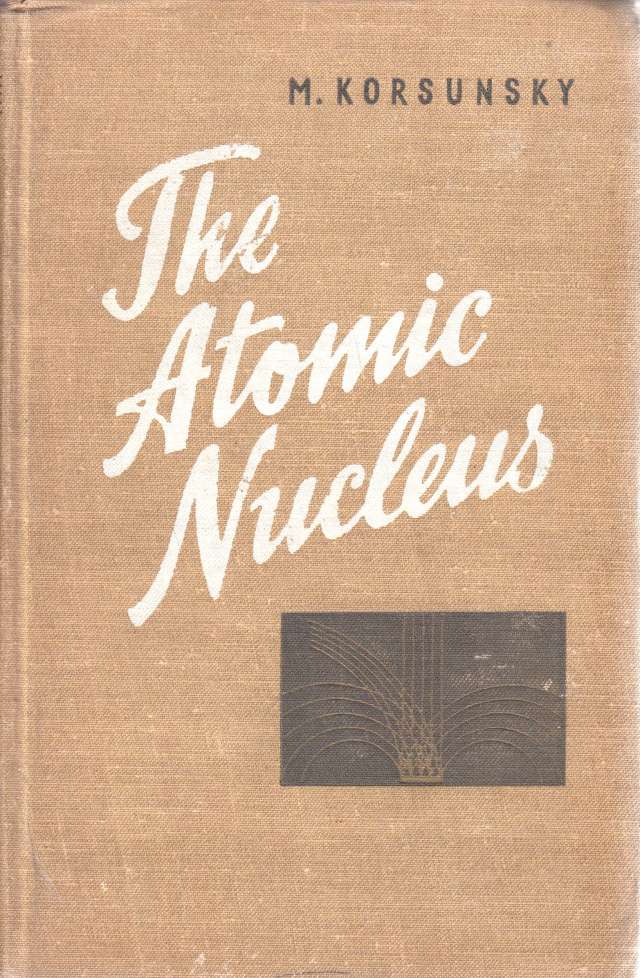
The Atomic Nucleus – Korsunsky

In this post we will see the book, The Atomic Nuclues by M. Korsunsky.
IMG_20180920_0001.jpg
About the book:
(from the Dover print of the book)
The study of atomic structure is among the most important topics in modern physics, and in this age of nuclear fission and fusion the atomic nucleus has top priority as an object of intensive investigation and experimental research. This modern survey, originally published in 1958, presents all the available important facts about the nuclei of atoms in an unusually readable text.
After a clear summary of early theory and experiment in radioactivity, the author devotes chapters to the nuclear model of the atom (Rutherford’s equation, Mendeleyev’s periodic table and nuclear charge, X-ray measurements, Bohr’s theory of excitation, etc.), mass of nuclei (measuring techniques, work of Thomson and Aston, isotopes, nuclear binding energy, methods for separating isotopes, etc.), disintegration of nuclei (Rutherford’s disintegration of nitrogen, Blackett’s work, the neutron, Curie-Joliot experiments, nuclear transformations, etc.), the positron (cosmic rays, Bothe’s experiments, work of Skobeltsyn, birth and death of positrons and electrons, etc.), artificial transformation of nuclei (Cockcroft and Walton, Van de Graaff generators, acceleration of ions, cyclotrons, betatrons, synchrotons, cosmotrons, etc.), artificial radioactivity (Curie, Joliot, Fermi, low-energy neutrons, isomerism, new elements, etc.), mesons (Bethe, radiative loss, showers, Yukawa, types of meson, etc.), the neutrino (Pauli’s theory, K capture, Allen’s experiments, etc.), structure of nuclei, forces acting between nuclear particles, fission, transuranium elements, nuclear chain reactions, reactors, atomic energy and thermonuclear reactions.
This is an extremely accurate, up-to-date, very thorough coverage of these important topics on a verbal level, completely free of nationalistic bias. It does not limit itself to the familiar material in most books on the atom, but presents much material that is not generally known except to specialists in the field. Yet because of its clear non-mathematical treatment, it can be read with full understanding as an introduction or survey for the beginning student and layman; it is also a first-rate summary for the specialist, indicating chains of development that might not have been clear to him, and formulating many difficult concepts in clear language.
The book was translated from the Russian by G. Yankovsky and was first published by Foreign Languages Publishing House Moscow in 1958.
PDF | OCR | 300 dpi | Bookmarked | Cover
I dedicate this post to one of my teachers who told me about this book. He read this book in the 60s, got inspired and eventually did research in nuclear physics.
The Internet Archive Link
and here
Table of Contents
Chapter 1 Radioactivity……………………………………………………….. 7
Becquerel’s Discovery……………………………………………………….. 7
The Properties of Radioactive Radiation ……………………………11
The Energy Radiated by Radium………………………………………..12
Alpha, Beta and Gamma Rays ……………………………………………15
The Properties of Alpha, Beta and Gamma Rays ……………..17
What Is an Alpha Particle?………………………………………………….20
Radium Emanation (Radon)………………………………………………….24
The Hypothesis of Radioactive Decay………………………………….29
The Spinthariscope……………………………………………………………….32
The Geiger Counter………………………………………………………………33
The Cloud Chamber……………………………………………………………… 37
The Photographic Method of Registering Alpha Particles . 40
The Charge of an Alpha Particle ‘ ……………………………………….. 41
The Decay Time of Radium and Uranium……………………………42
Once More About the Energy Contained in Atoms of Radium 49
Radioactive Series………………………………………………………………49
Isotopes . . ……………………………………………………………………….. 51
Brief Summary…………………………………………………………………….57
Chapter II. The Nuclear Model of the A to m ……………………………60
Scattering of Alpha Particles………………………………………………60
The Experiments of Geiger and Marsden……………………………61
The Static Model of the Atom ……………………………………………62
The Nuclear Model of the Atom …………………………………… . . 64
The Relation Between the Place of an Element in Mende­leyev’s. Periodic System and the Charge of Its Nucleus 69
Measuring the Charge of the Nucleus with X-Rays 73
Chapter III. The Mass of Atomic Nuclei…………………………….. 84
Measuring the Mass of an Atom ……………………………………….. 84
Separating the Isotopes ofNeon……………………………………………86 3
 Isotopes of Stable Elements………………………………………………….92
Prout’s Hypothesis………………………………………………………………94
The Binding Energy of Nuclei ……………………………………………97
Methods of Separating Isotopes………………………………………….103
Separating the Isotopes of Hydrogen…………………………………105
Chapter IV. The Disintegration of Atomic Nuclei……………………109
Anomalous Scattering of Alpha Particles …………………………. 110
The Disintegration of Nitrogen Nuclei …………………………….. 111
The Disintegration of Other Elements ……………………………..114
Blackett’s Experiments……………………………………………………… 116
Nitrogen Converted into Oxygen ……………………………………….118
Why Don’t All Elements Disintegrate Under the Action of
Alpha Particles? ……………………………………………………………..123
The Discovery of the Neutron……………………………………………..125
Ways of Observing Neutrons……………………………………………..132
Nuclear Transformations That Produce Neutrons…………………134
Nuclear Transformations Produced by Neutrons…………………136
Chapter V. The Discovery of the Positron ……………………………..140
What Is a Positron?…………………………………. 140
Cosmic Rays ……………………………………………………. 141
Skobeltsyn’s Experiments……………………………………………………149
How Lhe Positron Was Discovered……………………………………… 153
The “Birth and Death” of Electrons……………………………………156
Chapter VI. The Artificial Transformation of Atomic Nuclei 161
The First Apparatus for the Artificial Disintegration ol’ Atomic Nuclei………………………………………………………………..162
The Disintegration of Lithium ………………………………………….167
An Experimental Verification of Einstein’s Equation 170
The Van de Graaff Generator……………………………………………..172
Acceleration by an Alternating Electric Field……………………178
The Cyclotron ……………………………………………………………………182
The Betatron………………………………………………………………………186
Now Types of Charged-Particle Accelerators ……………………..199
Chapter VII. Artificial Radioactivity…………………………………………205
The Discovery of Artificial Radioactivity………………………….205
Artificial Radioactivity Induced by Neutrons…………………….. 211
Thermal Neutrons………………………………………………………………..215
Neutron Capture That Does Not Load to Radioactivity 218
Isomerism of Atomic Nuclei………………………………………………..221
New Chemical Elements………………………………………………………223
Chapter VIII. Mesons……………………………………………………………..225
Ionization and Radiative Losses ………………………………………226
Showers ……………………………………………………………………………. 232
The Discovery of the Meson………………………………………………..235
The Lifetime of a Meson……………………………………………………238
The Mass of Mesons……………………………………………………………..241
Nuclear Transformations Produced by Pi-Mesons and The
Transformation of Pi- and Mu-Mesons ………………………….247
Heavy Mesons ……………………………………………………………………250 Hyperons……………………………………………………………………………..251
Again About Cosmic Rays ………………………………………………..254
Chapter IX. The Neutrino………………………………………………………261
Beta-Ray Spectra………………………………………………………………..261
The Pauli Hypothesis………………………………………………………….266
K-Capture …………………………………………………………………………. 269
Allen’s Experiments ………………………………………………………….275
Chapter X. The Structure of Atomic Nuclei and the Forces Acting Between Nuclear Particles ………………………277
Are There Electrons in Atomic Nuclei?……………………………..277
What Are Atomic Nuclei Made o f ? ……………………………………280
The Radioactivity of the Neutron………………………………………284
Nuclear Forces……………………………………………………………………287
A Model of the Nucleus………………………………………………………291
Nuclear Transformations Accompanied by the Ejection of Several Particles……………………………………………………………..296
Chapter XI. Nuclear Fission ……………………………………………….. 300
Neutron Capture by Uranium…………………………………………….300
An Investigation of the Nature of the Transuranium Elements 302
The Discovery of Rare-Earth Elements Among the Decay
Products of Uranium………………………………………………………304
The Fission of Uranium……………………………………………………….306
Chemical Elements with Atomic: Numbers Above 92 308
Nuclear Fragments and Their Energy………………………………..315
Secondary Neutrons……………………………………………………………..320
Thermal Neutrons and the Fission of Uranium ……………….. 324
 The Spontaneous Fission of Uranium-235 Nuclei………………..326
Chapter XII. Nuclear Chain Reactions……………………………………329
The Chain Reaction……………………………………………………………..329
The Nuclear Reactor………………………………………………………….336
The First Soviet Uranium Reactor ……………………………………339
The Atomic Bomb ……………………………………………………………..341
Chapter XIII . The Peaceful Uses of Atomic Energy ……………..347
Atomic Power Stations……………………………………………………….347
Atomic Power Plants………………………………………………………….353
Tracer Atoms and Their Use in the National Economy . . 355
Chapter XIV. Thermonuclear Reactions 369
The Binding Energy per Nuclear Particle 369
The Energy Liberated in Nuclear Fusion 371
Thermonuclear Reactions 373
The Hydrogen Bomb …………………………………………………………. 378
Controlled Thermonuclear Reactions……………………………………380
Appendix ………………………………………………………………………. 383
Posted in books, foreign languages publishing, physics, soviet | Tagged , , , , , , , , , , , , , , | 6 Comments

Problems in Theoretical Physics – Grechko, Sugakov, Tomasevich, Fedorchenko

In this post, we will see the much awaited and somewhat rare book Problems in Theoretical Physics by L. G. Grechko, V. I. Sugakov, O. F. Tomasevich A. M. Fedorchenko.

grechko-front-cover

About the book:

From the Front Jacket

This book is a collection of problems covering mechanics, electrodynamics, nonrelativistic quantum mechanics, !statistical physics and thermodynamics. Each Section opens with a brief outline of the main laws and relationships used to solve the problems. Also information about the needed mathematical apparatus is included. Along with answers there are guides to solving the more complicated problems. SI units are used throughout the book. Problems in Theoretical Physics is intended for physics majors at universities and other institutions of higher learning. Some of the problems are specifically for students majoring in theoretical physics. Certain ones can be used in the physics and mathematics departments of teachers colleges.

From the Preface

The text draws largely on the Course of Theoretical Physics by L. D. Landau and E. M. Lifshitz, but also makes use of other textbooks and handbooks recommended for the university course in theoretical physics. Some of the problems have been taken from published problem books listed at the end of this book, but many are original. The student will be able to solve the problems if he has a good knowledge of the fundamentals of theoretical physics, which are briefly outlined in each section of this book.

The book was translated from the Russian by Eugene Yankovsky and was published by Mir in 1977.

PDF | OCR | Bookmarked | Cover | 600dpi

The Internet Archive Link

and here

Contents

PREFACE 5

Section I. Classical Mechanics 9

Problems 25

Answers 141

Section II. Electrodynamics 50

Problems 61

Answers 160

Section III. Quantum Mechanics 78

Problems 92

Answers 230

Section IV. Statistical Physics and Thermodynamics 110

Problems 119

Answers 356

APPENDICES 424

1. Basic formulas of vector analysis 424

2. Curvilinear coordinates 425

3. Differential operators in curvilinear coordinates 429

4. Mathematical supplement 434

5. Legendre polynomials 441

6. Hermite polynomials 444

7. The confluent hypergeometric junction 446

BOOKS ON THE SUB1ECT 448

Posted in books, mir books, mir publishers, physics, problem books | Tagged , , , , , , , , , , , | 4 Comments

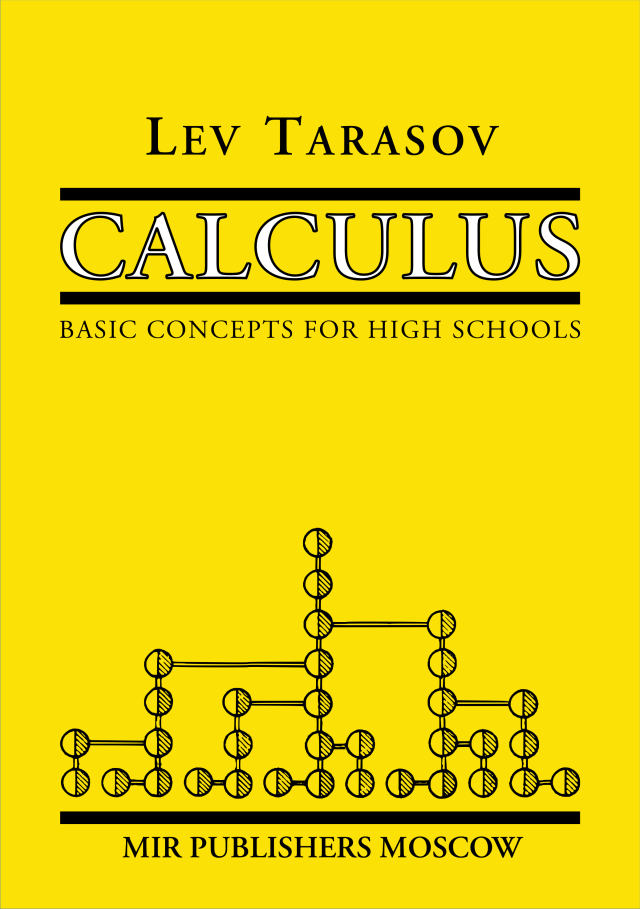
Calculus: Basic Concepts for High Schools – Tarasov (LaTeX Version)

In this post, we will see the book Calculus: Basic Concepts for High Schools by Lev Tarasov. Now, many of you must be wondering why a re-post of a book? The answer is that this is not a scan of the original book. But instead, it is a completely electronic version of the book created using LaTeX!

tarasov-calculus-fc.png

We have used XeLaTeX for typesetting the book, and friends it was fun indeed to do it. With LaTeX the equations are typeset really beautifully. And the final result is a beautifully typeset book which is of the best out there for the given subject. The result was immensely satisfying to see and is aesthetically pleasing as well.

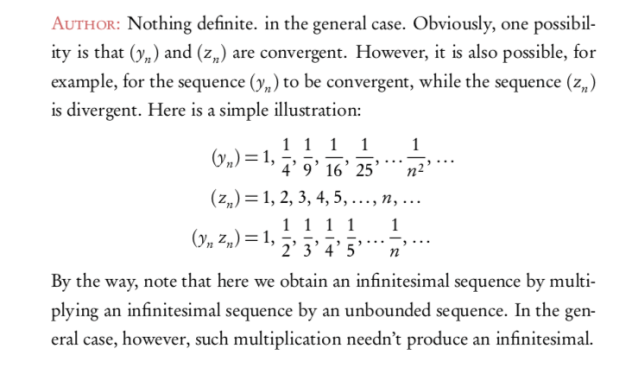
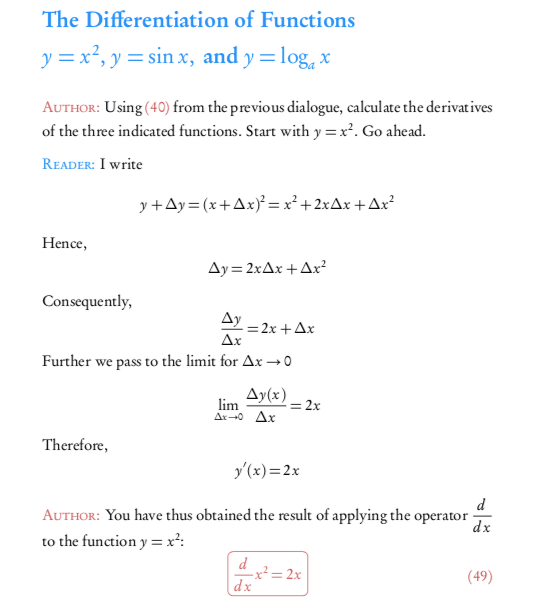
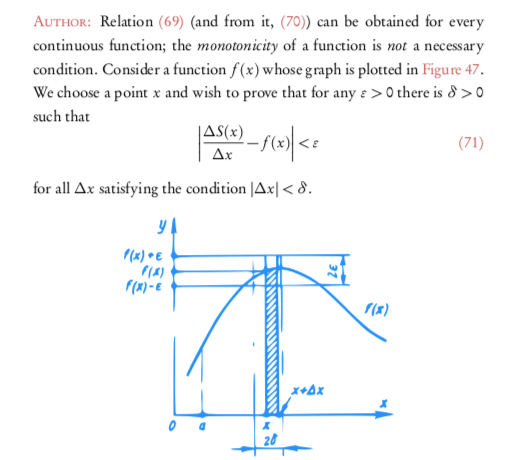
Below are a few sample pages from the book:

Screen Shot 2018-09-04 at 1.04.49 PM

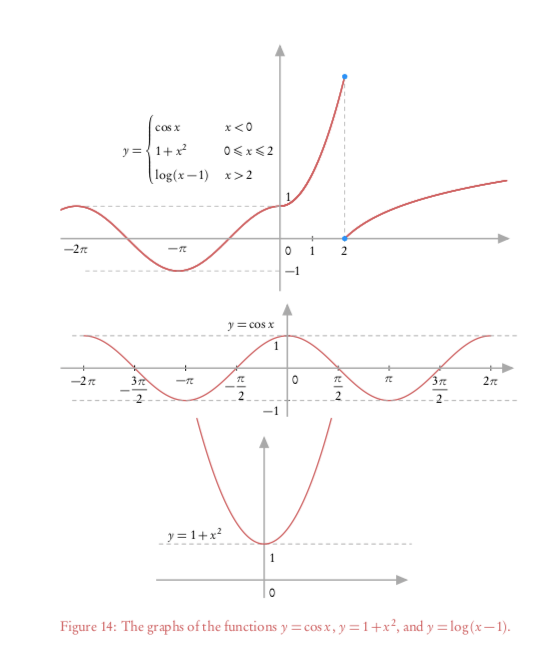
Some of the diagrams I have drawn using TiKz.

Screen Shot 2018-09-04 at 1.06.46 PMScreen Shot 2018-09-04 at 1.07.12 PM

At other places, I have used the existing diagrams.

Screen Shot 2018-09-04 at 1.07.25 PM

For now, I have used the some of the old figures from the scan, but it would be fun to redraw them using TiKz. I have redrawn some of them like the ones above, but I would need some help with doing all of them. let me know if you are ready for volunteering for that. There might be a few typos here and there or the mathematical mistakes. Please point them and I will correct them. What better way to proofread than using 1000s of eyes?  We plan to digitise all the important books with LaTeX in the near future, let me know if you want to pitch in.

About the book

The whole book is presented as a relatively free-flowing
dialogue between the AUTHOR and the READER. From one discussion
to another the AUTHOR will lead the inquisitive and receptive
READER to different notions, ideas, and theorems of calculus,
emphasizing especially complicated or delicate aspects, stressing the
inner logic of proofs, and attracting the reader’s attention to special
points. I hope that this form of presentation will help a reader of the
book in learning new definitions such as those of derivative, antiderivative, definite. integral, differential equation, etc. I also expect that
it will lead the reader to better understanding of such concepts as
numerical sequence, limit of sequence, and function. Briefly, these
discussions are intended to assist pupils entering a novel world of
calculus. And if in the long run the reader of the book gets a feeling
of the intrinsic beauty and integrity of higher mathematics or even
is appealed to it, the author will consider his mission as successfully
completed.

Thanks to Anish.dot for the original scan.

The Internet Archive link. and here

Link to the old scan.

Update: Link to the Gitrepo with source files

Contents

Preface v

1 INFINITE NUMERICAL SEQUENCE 1

2 LIMIT OF SEQUENCE 17

3 CONVERGENT SEQUENCE 29

4 FUNCTION 45

5 MORE ON FUNCTION 61

6 LIMIT OF FUNCTION 85

7 MORE ON THE LIMIT OF FUNCTION 103

8 VELOCITY 115

9 DERIVATIVE 129

10 DIFFERENTIATION 147

11 ANTIDERIVATIVE 169

12 INTEGRAL 185

13 DIFFERENTIAL EQUATIONS 199

14 MORE ON DIFFERENTIAL EQUATIONS 215

PROBLEMS 227


Posted in books, mathematics, mir books, mir publishers | Tagged , , , , , , | 24 Comments