A History of Classical Sociology – Kon

In this post, we will see the book A History of Classical Sociology by Igor Kon (Ed.).

Kon_History_of_Classical_Sociology_0000

About the book
This is a study of the shaping and development of sociology in Western Europe, the United States, and Russia at the turn of the century, a period particularly important for the establishing of sociology as an independent discipline. The authors examine its development from social philosophy to sociology proper, and discuss how it grew from the rather vague programme it was, for example, in the conceptions of Auguste Comte, into a leading social science at the beginning of the twentieth century. They trace how it developed its conceptual apparatus, and how it began a systematic treatment of problems of the methodo­logy and techniques of research.
The contribution to sociology of the great spokesmen of its classical period, like Tönnies, Simmel, Durkheim, Max Weber, and Pareto, are examined in detail. Essays on the history of so­ciology of the nineteenth and early twentieth centuries in the West and in pre-revolutionary Russia, written from a Marxian standpoint.


The book was translated from the Russian by H. Campbell Creighton,  and was published by Progress Publishers in 1989.

The book seems to be scanned and converted to text (perhaps a word file?), as the formatting does not seem to match other texts from that time or the cover.

All credits to IA user Kahonor

The Internet Archive link

and here

Contents


CONTENTS

Introduction (by Igor Kon) 5

1. From Social Philosophy to Sociology (by Igor Kon) 9

2. Auguste Comte and the Origin of Positivist Sociology (by Elena Osipova) 22

3. Herbert Spencer’s Sociological Conception (by Igor Kon) 43

4. Naturalism in Sociology of the Turn of the Century (by Alexander Hofman and Alexander Kovalev) 57

5. The Psychological Sociology of the Turn of the Century (by Igor Kon) 96

6. Empirical Social Studies in the Nineteenth Century (by Marina Kovaleva) 122

7. The Crisis of Evolutionism and the Antipositivist Trends in Sociology at the Turn of the
Century (by Igor Kon) 151

8. K. Ferdinand Tonnies’ Sociological Conception (by Leonid Ionin) 173

9. Georg Simmel’s Sociology (by Leonid Ionin) 189

10. Emile Durkheim’s Sociology (by Elena Osipova) 206

11. The Sociology of Max Weber (by Piama Haidenko) 255

12. The Sociological System of Vilfredo Pareto (by Elena Osipova) 312

13. Sociology in Prerevolutionary Russia (by Igor Golosenko) 337

Conclusion (by Igor Kon) 357

Subject Index

Name Index


INTRODUCTION 8

Notes 9

1 FROM SOCIAL PHILOSOPHY TO SOCIOLOGY 1 1

1 . The Ideological and Theoretical Premisses of Sociological Knowledge 11

2. The Social and Class Premisses of Sociology 14

Notes 17

2 AUGUSTE COMTE AND THE ORIGIN OF POSITIVIST SOCIOLOGY 19

1 . Comte and His Time 19

2. The Classification of the Sciences 20

3. The Subject-matter and Tasks of Sociology 21

4. The Methods of Sociology 22

5. Social Statics 24

6. Social Dynamics 25

7. The Positive Polity 27

8. Comte’s Place in the History of Sociology 28

Notes 29

3 HERBERT SPENCER’S SOCIOLOGICAL CONCEPTION 31

1 . Spencer and His Time 31

2. The Subject-matter of Sociology 32

3. Organicism and Evolutionism 33

4. Spencer’s Place in the History of Sociology 36

Notes 37

4 NATURALISM IN SOCIOLOGY OF THE TURN OF THE CENTURY 39

1. Evolutionism — the Basis of the Naturalistic Schools of Sociology 39

2. The Mechanistic School 40

3. The Geographical School 41

4. The Racial, Anthropological School 46

5. The Bio-Organic School 48

6. The Social Darwinist School 51

*** 57

Notes 58

5 THE PSYCHOLOGICAL SOCIOLOGY OF THE TURN OF THE CENTURY 61

1. Psychology and Sociology in the Nineteenth Century 61

2. Psychological Evolutionism 62

3. Instinctivism 63

4. Folk Psychology 65

5. Group Psychology and the Theory of Imitation 66

6. The Birth of Interactionism 71

7. Psychological Sociology in the Historical Perspective 73

Notes 74

6 EMPIRICAL SOCIAL STUDIES IN THE NINETEENTH CENTURY 75

1. Empirical Social Studies in the United Kingdom 76

2. Empirical Social Studies in France 80

3. Empirical Social Research in Germany 86

Notes 89

7 THE CRISIS OF EVOLUTIONISM AND THE ANTIPOSITIVIST TRENDS IN
SOCIOLOGY AT THE TURN OF THE CENTURY 91

1. The Methodological Situation in Social Science at the Turn of the Century 91

2. The Changes in the Philosophy of the Social Sciences. Dilthey and Neo-Kantianism 94

3. The Position of Sociology 99

Notes 102

8 FERDINAND TONNES’ SOCIOLOGICAL CONCEPTION 104

Notes 112

9 GEORG SIMMEL’S SOCIOLOGY 1 13

Life and Activity 113

1. The Origin and Main Problem of Sociology 113

2. Form and Content. The Project of Formal Sociology 114

3. Patterns of Social Forms 1 14

4. Philosophical Sociology. The Theory of Understanding 116

5. Historical Sociology 117

6. Analysis of the ‘Spirit of Modernity’ 118

7. A Critical Assessment of Simmel’s Sociology 120

8. The Scientific Significance of Simmel’s Conception 121

Notes 121

10 EMILE DURKHEIM’S SOCIOLOGY 123

1 . Durkheim’s Socio-Political Position 123

2. The Subject-Matter of Sociology and Its Place Among the Other Social Sciences 125

3. ‘Sociologism’ as a Theory of Society 127

4. The Rules of Sociological Method 1 29

5. Social Solidarity and the Division of Labour 132

6. ‘Abnormal’ Forms of the Division of Labour. Personality and Society 134

7. Application of the Principles of ‘Sociologism’ to Study of the Causes of Suicide 137

8. The Philosophical and Sociological Conception of Morality 140

9. The Philosophical and Sociological Conception of Religion 142

10. Durkheim’s Place in the History of Sociology. ‘Sociologism’ and Marxism 147

Notes 149

1 1 THE SOCIOLOGY OF MAX WEBER 152

1 . Max Weber and His Times 152

2. Methodological Problems of the Sciences of Culture 154

3. The Ideal Type as a Logical Construct 155

4. The Problem of Understanding and the Category of ‘Social Action’ 157

5. The Goal-Oriented Rational Action as a Methodological Category of Weber’s Sociology
161

6. Social Action and ‘Orientation to Another’ — ‘Expectation’ 163

7. Types of Social Action 165

8. Formal Rationality as a Category of Weber’s Sociology 167

9. Weber’s Theory of Types of Domination 169

10. The Contradictory Nature of Weber’s Political Stance 173

1 1 . The Sociology of Religion 175

12. Max Weber in Historical Perspective 180

Notes 182

12 THE SOCIOLOGICAL SYSTEM OF VILFREDO PARETO 185

1 . Pareto and His Time 185

2. Methodology 186

3. Society as a System of the Interactions of Individuals 187

4. Psychological Reductionism 189

5 . The Conception of Ideology 1 90

6. The Idea of the Circulation of Elites 193

7. Pareto in the Historical Perspective 196

Notes 198

13 SOCIOLOGY IN PREREVOLUTIONARY RUSSIA 200

Notes 210

CONCLUSION 212

Notes 215

Posted in books, philosophy, progress publishers, sociology, soviet | Tagged , , , , , , , , , , , , , , , , , , , , , , , , , , , , , , , , , , , , | Leave a comment

Fundamentals of Philosophy – Spirkin

In this post, we will see the book Fundamentals of Philosophy by Alexander Spirkin.

Spirkin_Fundamentals_of_Philosophy_0000

About the book

The book offers a systematic exposition of  foundations of dialectical and historical materialism. It begins with deliberations on the nature of  philosophical knowledge, the role of worldview, and the purpose of methodology. There is also a brief excursus into the history of philosophy. Relying on a wealth of theoretical and practical materials, the author gives an all-sided analysis of such fundamental concepts as being and consciousness, matter and motion, cognition and activity; step by step, he identifies the main principles, laws and categories of dialectics, and closely studies the socioeconomic, political and cultural aspects of society’s life against the background of the global problems of modern times. The book shows conclusively that a consistent scientific philosophy did not develop as a mechanical accumulation of previously discovered grains of the truth but through their critical analysis and creative elaboration under the changing historical conditions.

The book was awarded a prize at a competition of textbooks for students of higher educational establishments.

The book was translated from the Russian by Sergei Syrovatkin. And was published by Progress Publishers in 1990.

All credits to IA user Kahonor

The Internet Archive link

and here

Contents

INTRODUCTION

Chapter I WHAT IS PHILOSOPHY? 7

  1. The Subject Matter and Nature of Philosophical Knowledge 7
  2. Philosophy as the Theoretical Basis of Worldview 23
  3. Philosophy as General Methodology 31

Chapter II. AN OUTLINE HISTORY OF PHILOSOPHY 37

  1. A History of Pre-Marxian Philosophy 37
  2. The Emergence and Development of the Philosophy of Marxism 60

BEING AND CONSCIOUSNESS

Chapter III MATTER: THE UNITY AND DIVERSITY OF THE FORMS OF ITS MANIFESTATION 66

  1. The General Concept of Matter 66
  2. Motion as the Mode of Existence of Matter 82
  3. Space and Time 88

Chapter IV. CONSCIOUSNESS; ESSENCE AND ORIGIN 99

  1. The General Concept of Consciousness 99
  2. The Path from Animal Psyche to Man’s Consciousness 110
  3. Consciousness. Language. Communication .114
AN OUTLINE THEORY OF DIALECTICS

Chapter V. CONNECTION AND DEVELOPMENT AS THE MAIN PRINCIPLES OF DIALECTICS 119

  1. On the Universal Connections and Interactions 119
  2. The Idea of Development and the Principle of Historism 123
  3. The Principle of Causality and Objective Goal-Directedness 132
  4. The Systems Principle 141
  5. Law and Regularity 147

Chapter VI, THE BASIC CATEGORIES AND LAWS OF DIALECTICS 152

  1. On the Unity of and Differences Between the Categories and Laws of Dialectics 152
  2. Essence and Phenomenon 154
  3. The Individual, the Particular and the General 162
  4. Necessity and Chance 165
  5. Possibility, Reality and Probability 172
  6. Part and Whole. System 178
  7. Content and Form 184
  8. Quality, Quantity and Measure 189
  9. Contradiction and Harmony 196
  10. Negation, Continuity and Innovations 203

KNOWLEDGE AND CREATIVITY

Chapter VII. ON THE ESSENCE AND MEANING OF KNOWLEDGE 208

  1. What Does It Mean to Know? 208
  2. Practice as the Basis and Purpose of Cognition 216
  3. What Is Truth? 220

Chapter VIII THE PHILOSOPHY OF THOUGHT 228

  1. Intellectual-Sensuous Contemplation 228
  2. Thought: Essence, Levels and Forms 230
  3. The Creative Power of Human Reason 240
  4. The Operations and Modes of Thought 246
  5. The Empirical and Theoretical Levels of Scientific Cognition 254

QUESTIONS OF SOCIAL PHILOSOPHY

Chapter IX. SOCIETY AND NATURE 267

  1. A Historico-Materialist Conception of Society 267
  2. Interaction between Society and Nature 277
  3. Demography: Socio-Philosophical Problems 282

Chapter X. THE ECONOMIC SPHERE OF SOCIETY’S LIFE:

THE SOCIO-PHILOSOPHICAL ASPECT 286

Material Production: The Concept and the Main Elements 286

Chapter XI. THE SOCIAL SPHERE OF SOCIETY’S LIFE 298

  1. Classes and Class Relations 298
  2. Nations and National Relations 301
  3. Family and Everyday Life 303

Chapter XII. THE POLITICAL SPHERE OF SOCIETY’S LIFE 309

Politics, the State, and Law .309

Chapter XIII. SOCIAL CONTROL 317

  1. Social Information and Control 317
  2. Types of Control and Their Impact on Social Development 321

Chapter XIV. A PHILOSOPHICAL CONCEPTION OF MAN 325

  1. Man. Personality. Society 325
  2. Man in the Flow of History 338

Chapter XV. THE SPIRITUAL AND INTELLECTUAL SPHERE OF SOCIETY’S LIFE 343

  1. Social Consciousness: Essence and Levels 343
  2. Political Consciousness 349
  3. Legal Consciousness 352
  4. Moral Consciousness 354
  5. Aesthetic Consciousness 363
  6. Religious Consciousness 375
  7. The Scientific Perception of the Universe and the World of Science .380
  8. The Philosophy of Culture 387

Chapter XVI. HISTORICAL PROGRESS AND THE GLOBAL PROBLEMS OF OUR TIMES 400

  1. Progress as a Historically Necessary Direction of Society’s Development 400
  2. The Dialectics of World Development in the Present Epoch 410

NAME INDEX 413

SUBJECT INDEX 417

Posted in books, philosophy, progress publishers, soviet | Tagged , , , , , , , , , , , , , , , , , , , , , , , , , , , | 5 Comments

The Main Trends in Philosophy – Oizerman

In this post, we will see the book The Main Trends in Philosophy: A Theoretical Analysis of the History of Philosophy by Teodor Oizerman.

Oizerman_Main_trends_in_Philosophy_0000

About the book
This monograph is a theoretical investigation of the process of the history of philosophy. The author examines the polarisation of philosophical systems in their main trends, viz., the materialist and idealist. He traces the struggle between materialism and idealism on the basis of the dialectical-materialist conception of the history of philosophy, and brings out the scientific and cultural-historical significance of dialectical materialism in present-day world philosophical thought.

The book was in 1979 awarded the Plekhanov prize under the decision of the USSR Academy of Sciences.

The book was translated from the Russian by H. Campbell Creighton, and was published by Progress Publishers in 1988.

All credits to IA user Kahonor

The Internet Archive link

and here

Contents

Page
INTRODUCTION 5

Part One. THE BASIC PHILOSOPHICAL QUESTION AS A PROBLEM OF THE HISTORY OF PHILOSOPHY

I. THE SENSE AND MEANING OF THE BASIC PHILOSOPHICAL QUESTION 19

1. The Basic Philosophical Question and the Problematic of Philosophy 19

2. Self-Awareness and the External World. The Epistemological Necessity of the Basic Philosophical Question 22

3. On the Origin and Development of the Basic Philosophical Question 33

4. The Basic Philosophical Question: Objective Content and Subjective Form of Expression. The Real Starting Point of Philosophical
Inquiry 37

II. THE TWO SIDES OF THE BASIC PHILOSOPHICAL QUESTION 54

1. The Ontological Aspect: the Materialist Answer to the Basic Question 54

2. The Oncological Aspect: a Contribution to the Delineation of the Idealist Answer to the Basic Philosophical Question 74

3. The Epistemological Aspect. The Principle of Reflection and the Idealist Interpretation of the Knowability of the World 87

4. The Epistemological Aspect. The Principle of the Knowability of the World and Philosophical Scepticism 104

Part Two. PHILOSOPHICAL TRENDS AS AN OBJECT OF RESEARCH IN THE HISTORY OF PHILOSOPHY

HI. THE DIVERGENCE OF PHILOSOPHICAL DOCTRINES AND ITS INTERPRETATION. METAPHYSICAL SYSTEMS AND THE DEVELOPMENT OF THE ANTITHESIS BETWEEN MATERIALISM AND IDEALISM 138

1. Dispute about Trends or Dispute of Trends? 138

2. Metaphysical Systems. Spiritualism and the Naturalist Tendency 155

3. Materialism — the Sole Consistent Opponent of Speculative Metaphysical Systems 165

4. Kant’s Transcendental Dualist Metaphysics 173

5. Toward a Critique of Irrationalist Speculative Metaphysics 184

6. The Dispute between Materialism and Idealism and Differences in Understanding Speculative Metaphysics 195

IV. THE GREAT CONFRONTATION: MATERIALISM VS IDEALISM. THE ARGUMENTS AND COUNTERARGUMENTS 215

1. The Struggle of Materialism and Idealism as an Epochal Cultural and Historical Phenomenon 215

2. Idealism vs Materialism. Materialism vs Idealism. Results and Prospects 234

3. The Dialectical-Materialist Critique of Idealism. The Epistemological Roots of Idealist Fallacies 262

4. The Dialectical-Materialist Critique of Idealism. The Principle of the Partisanship of Philosophy 274

CONCLUSION 296

LITERATURE 306

NAME INDEX

SUBJECT INDEX

Posted in books, philosophy, progress publishers, soviet | Tagged , , , , , , , , , , , , , , , , , | Leave a comment

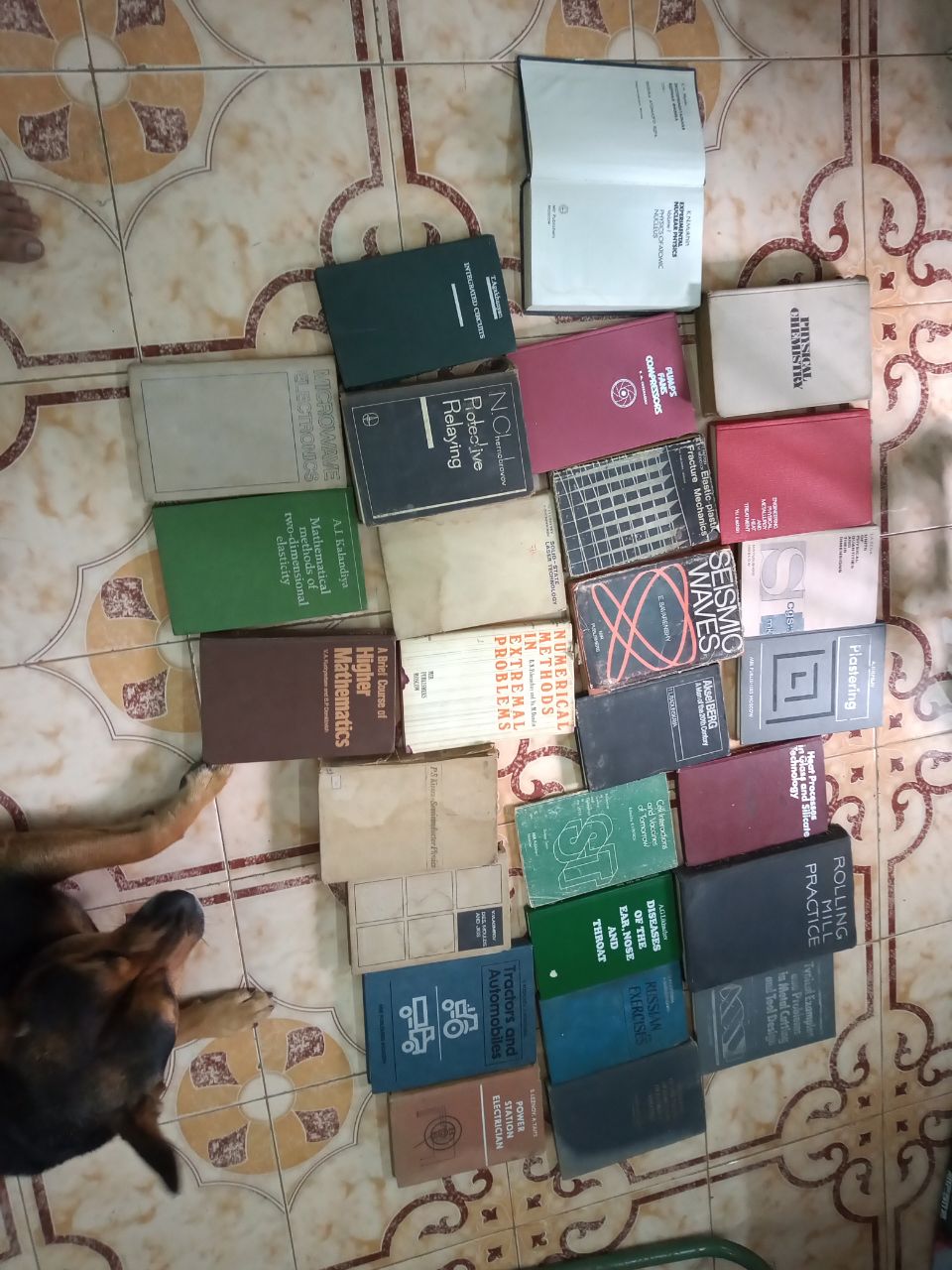
A glimpse of this months upcoming posts

2018-05-08 14.14.37

  • Essays on the Universe
  • Solid State Physics – Epifanov
  • Multiple Integrals, Field Theory and Series – Fomin, Budak
  • Basic Electronics – Zerbestov
  • Man and Animals
  • The Night After
  • A book of problems in ODE
  • The Nine Colours of the Rainbow – Steinhaus
  • Forces of Nature – Griggoryev, Myakishev
  • Selected problems and questions in strength of materials – Feodosyev (red book)
  • Gravitation, Elementary Particle Physics – Longunov (Ed.)
  • Miracles on Wheels – Markusha
  • Molecular Physics – Kiokin and Kiokin
  • Methods of Solving problems in high school mathematics – (blue book)
  • Physics a refresher course – Yavorksy
  • Problems on Fundamentals of Hydraulic and Heat Engineering –
  • A collection of problems – minorsky
  • Evolution of the Biosphere
  • Biophysics – Wolkenstein (not in the pic)


Sorry for the potato quality of the photo!

We hope to post these by the end of this month!!

Cheers!!!

Posted in books, mathematics, mir books, mir publishers, physics, science, soviet, technology | Tagged , , , , | 16 Comments

Rags, Borya And The Rocket – Baranova and Veltistov

In this post, we will see the book Rags, Borya And The Rocket: a tale of home-less dogs and how they became famous by M. Baranova, Y. Veltistov.

About the book:

This is a semi-fictional book. If you like space travel and love dogs, then perhaps this is the book for you. The book explores the theme of training dogs for space travel, set during the start of space-age. Mixed with this is the story of a boy who is looking for his lost dog. It turns out his dog is not a simple dog but is space-traveller! Out of the dogs featured, only one I knew was Laika. 

A story of the real “space dogs” of Russia mixed in with a fictional story of how a particular dog joined the space program. [source]

This is the story of the dogs who went into space in the Russian Space Program’s beginnings.  The story is told through the eyes and experiences of a little boy named Borya and his white Spitz dog Rags.  Through a series of mishaps Rags become lost and Borya spends most of the book searching for him.  This gives an opportunity to go to a dog show in Moscow and various other sites around the city.  To shorten a bit, Rags is found by the scientists searching for good space traveler candidates and taken into the training program for dogs that will be sent into space.  The training, procedure etc. is all explained, tho in terms of this fictional account.  Rags is given the name of Courageous and does indeed rocket into space.  When he is safely returned from his space travel he and Borya once again are reunited and are heroes,.or at least Rags aka Courageous is a Soviet hero.  Book is profusely illustrated with black and white drawings of many and various breeds of dog but the star, the little white Spitz, Rags, is thoughout. [source]

The line drawings are amazing. If I ever write a book, these are the kind of illustrations that I would want!

The book was translated from the Russian by Anne Hansen. The beautiful illustrations are by Y. Migunov and K. Rotov (pages 119-122). The book was first published in English by progress publishers in 1964.

All credits to Guptaji

The Internet Archive link and here

Bengali here and here

CONTENTS

The Incident at the Premiere 5

The Explosion in the Field 9

Rags Disappears 12

At the Dog Show 18

Snapper 26

The Space Doctor  29

Don’t Be Afraid! Nothing to Be Afraid of!32

Now We Begin  37

An Unsuccessful Trip 44

Here Lived Laika 49

The Helpful Pencil 56

Chlorella 62

A Cannon or a Rocket? 65

Three … Two … Go! 76

The Whims of Fame 85

Is It Him or Not? 91

The Journey Round the Moon 98

Sputnik Calling 103

Borya Gives an Interview 111

The Keys to the Universe 118

Posted in books, children's stories, progress publishers, science, soviet, technology | Tagged , , , , , , , , , | Leave a comment

Masha And The Bear – Irina Zheleznova

In this post, we will see the book Masha and the Bear translated by Irina Zheleznova.

masha-01

The amazing drawings in the book are by Evgeny Rachev. The book was first published by Raduga Publishers in 1965, this scan is from the third reprint of 1988.

This slideshow requires JavaScript.

All credits to Guptaji.

The Internet Archive link and here

Posted in books, children's stories, raduga publishers, soviet | Tagged , , , , , , , | Leave a comment

The Bear Sits On The Log: A Byelorussian Folk Song

In this post, we will see the book titled The Bear Sits On The Log: A Byelorussian Folk Song
translated from the Byelorussian by Walter May.

bear-01

The book has some fantastic illustrations set in the song.

This slideshow requires JavaScript.

The fantastic illustrations are by T. Beresenskaya. The book was published by Mastatskaya Litaratura Publishing House in 1980.

All credits to Guptaji.

The Internet Archive link. and here

Posted in books, children's stories, soviet | Tagged , , , , , , | Leave a comment

Jug With Gold Coins: A Moldovian Folk Tale – Grigore Botezatu

In this post, we will see another children’s illustrated storybook: Jug With Gold Coins Moldovian Fairy Tale by Grigore Botezatu.

jug-01

The book is about three brothers who are told by their dying father about a treasure buried in their farm. The brothers dig up the entire farm in search of the treasure. In this process, they themselves become hardworking farmers and thus discover “a jug of gold”.

The book was translated by Irina Zheleznova and drawings are by A Sviatchenko. The book was published by Kishinev Literatura artistika in 1986.

All credits to Guptaji

The Internet Archive link and here


Posted in books, children's stories, soviet | Tagged , , , , , , , , , , | Leave a comment

The Stolen Sun – Kornei Chukovsky

In this post, we will see the illustrated children’s book The Stolen Sun
by Kornei Chukovsky.

stolen-02

In the book, a crocodile steals the Sun, which is then brought back by a bear. The book is beautifully illustrated:

The book was translated from the Russian by Dorian Rottenberg and was illustrated by Yuri Vasnetsov. The book was first published by Raduga Publishers in 1965, this scan is from the 1989 reprint.

The Internet Archive link. and here

All credits to Guptaji.

Bengali here and here

Malayalam here and here


Posted in books, children's stories, raduga publishers, soviet | Tagged , , , , , , , | 1 Comment

Sister Fox And The Rolling Pin

In this post, we will see the children’s illustrated book titled Sister Fox And The Rolling Pin based on a Russian folk tale translated by Michelle MacGrath.

fox-00

As usual, the book is lavishly and beautifully illustrated. Here are some snippets:

The book was translated from the Russian by Michelle Macgrath and is based on a Russian folk tale. The beautiful illustrations are by A. Yeliseyev. The book was published by Malysh Publishers in 1980.

The Internet Archive Link. and here

All credits to Guptaji.


Posted in books, children's stories, malysh publishers, soviet | Tagged , , , , , , , , | Leave a comment