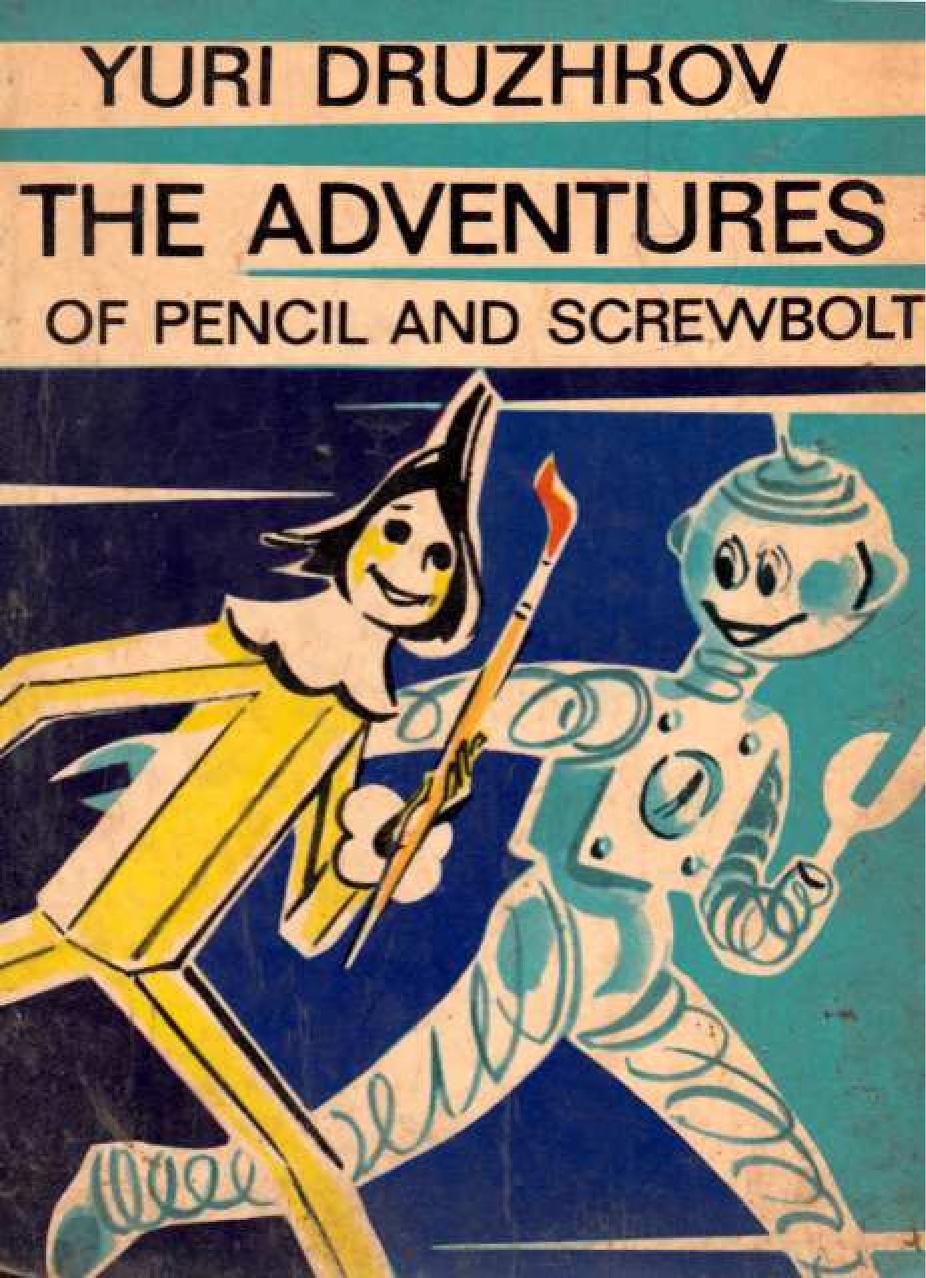
The Adventures of Pencil and Screwbot

In this post, we will see the book The Adventures Of Pencil And Screw Bolt by Yuri Druzhkov.

About the book

Our Dear Little Friends,

In this book you will meet two very outstanding characters. Pencil who is an artist and a real magician, and Screwbolt, a little iron man, who is a very cleaver mechanic. Both are very nice people and we hope you will like them and will want to learn from them.

If so, write to us and tell us how you understood this book and what it has taught you.

We get very many letters from our young readers. The boy wrote “Please tell me where I can learn to draw like Pencil. I would them draw myself a bicycle, a toy gun and a two toy cars.”

And another boy wants to learn to draw for a very different reason: “I want to draw a magic school where all my chums could learn to be magicians. Ans I also want to draw a river by our house so that granny doesn’t have to go far with her washing. She’s old you know.”

Frankly, we like the second letter better. Why do you think?

The book was translated from Russian by Fainna Glagoleva and drawings are by Nikolai Grishin. The book was was published in 1973 by Progress.

All credits to Guptaji.

You can get the book here.

Follow us on The Internet Archive: https://archive.org/details/@mirtitles

Follow Us On Twitter: https://twitter.com/MirTitles

Write to us: mirtitles@gmail.com

Fork us at GitLab: https://gitlab.com/mirtitles/

Add new entries to the detailed book catalog here.

Posted in books, children's books, children's stories, progress publishers, soviet | Tagged , , , , , , , | 1 Comment

Random Processes In Electrical And Mechanical Systems – Lebedev

In this post, we will see the book Random Processes In Electrical And Mechanical Systems by V. L. Lebedev.

About the book

This book deals with stationary and non-stationary random processes in linear systems and in inertialess nonlinear systems which have either one or several in­puts and outputs. The application of the mathematical methods expounded is illus­trated by many practical examples related to various physical and engineering pro­blems.

The book was translated from Russian by J. Flancreich and M. Segal  and was published in 1961 by The Israel Program for Scientific Translations.

Credits to the original uploader.

You can get the book here.

Follow us on The Internet Archive: https://archive.org/details/@mirtitles

Follow Us On Twitter: https://twitter.com/MirTitles

Write to us: mirtitles@gmail.com

Fork us at GitLab: https://gitlab.com/mirtitles/

Add new entries to the detailed book catalog here.

Contents

Preface 1

Chapter One. GENERAL CONCEPTS OF RANDOM PROCESSES 3

§ 1. Dynamical and statistical laws 3
§ 2. Random processes 5
§ 3. The role of the theory of random processes in engineering 6

Chapter Two. RANDOM FUNCTIONS AND THEIR LINEAR TRANSFORMATIONS 8

§ 4. The concept of random function 8
§ 5. Stationary and nonstationary random functions 9
§ 6. Moments 9
§ 7. The derivative of a random function 14
§ 8. Integral transformations of random functions 18
§ 9. A set of several integral transformations of the random function 20
§ 10. Linear transformations of random functions 21

Chapter Three. RANDOM FORCES UPON A LINEAR SYSTEM WITH LUMPED CONSTANTS 24

§ 11. Statement of the problem and terminology 24
§ 12. The method of stochastic differential equations 25
§ 13. The method of impulse characteristics 28
§ 14. The spectral method 32
§ 15. An RC circuit excited by a stationary fluctuating voltage 42
§ 16. Uncorrelated input 47
§ 17. The problem of two RC-circuits with a common input 50
§ 18. The problem of two RC-circuits with a common output 53

Chapter Four. SOME LINEAR PROBLEMS IN THE THEORY OF
RANDOM PROCESSES 57

§ 19. One-dimensional Brownian motion 57
§ 20. Thermal noise in electric circuits 59
§ 21. Thermal noise in an electrical oscillation circuit 61
§ 22. Thermal motion of a galvanometer 64
§ 23. The passage of irregular telegraph signals through a linear filter 69
§ 24. The optimal filter problem 73
§ 25. Elements of the theory of potential-noise stability 79

Chapter Five. RANDOM FORCE ON A NONLINEAR SYSTEM

§ 26. Simplest problem of random force on an inertialess
nonlinear system
§ 27. The general problem of random force on an inertialess
nonlinear system
§ 28. Random process in inertial nonlinear systems

Chapter Six. SOME NONLINEAR PROBLEMS IN THE THEORY
OF RANDOM PROCESSES 93

§ 29. Action of fluctuation noise on a detector with exponential
characteristic 93
§ 30. Statistical properties of the noise voltage envelope at the output of a selective system 96
§ 31. Statistical properties of the phase of a noise voltage at the output of a selective system 104
§ 32. Statistical dependence between envelopes of noise
voltages at the outputs of two selective four-poles with their inputs connected in parallel 108
§ 33. Statistical properties of the voltage envelope at the
output of a selective system under action of non-modulated signal and fluctuation noise 112
§ 34. Statistical properties of the voltage phase at the output
of a selective system under action of a nor modulated
signal and fluctuation noise 115
§ 35. Computation of the detector output for given statistical
properties of the applied voltage envelope 116

Bibliography 119

Posted in books, electronics, engineering, mathematics, physics, soviet, technology | Tagged , , , , , , , , , , , , , , , , , , , , , , , , | 1 Comment

Foundations Of One Electron Theory Of Solids – Yatrebov, Katsnelson.

In this post, we will see the book Foundations Of One Electron Theory Of Solids by L. I. Yatrebov and A. A. Katsnelson.

About the book

The book was translated from Russian by and was published in .

Credits to the original uploader.

You can get the book here.

Follow us on The Internet Archive: https://archive.org/details/@mirtitles

Follow Us On Twitter: https://twitter.com/MirTitles

Write to us: mirtitles@gmail.com

Fork us at GitLab: https://gitlab.com/mirtitles/

Add new entries to the detailed book catalog here.

Contents

Preface 7

Introduction 11

Chapter 1. Principles of the one-electron theory

Part 1 Theoretical principles of the pseudopotential method

Chapter 2. Scattering theory for “solid-state people”

2.1. Mathematical formalism 23
2.2. Scattering on an isolated potential 31
2.3. Pseudism and scattering 46
2.4. Bound states, pseudopotentials and the convergence of series 54
2.5. Scattering theory and potential form factors 61

Chapter 3. Theory of potential

3.1. Potential seen by an atomic electron 69
3.2. Dielectric screening 83
3.3. The self-consistency of pseudopotential and additive screening 99
3.4. Muffin-tin potential 107
3.5. Average value of the screened potential 124

Chapter 4. Theory of pseudopotential form factors

4.1. Nonlocality, the energy dependence of form factors and per­turbation theory 132
4.2. The OPW formfactor 144
4.3. Phase-shift form factors 157
4.4. Effective medium and pseudopotential form factors 173

Chapter 5. Pseudism and the secular equations of band theory

5.1. The Green’s function (or KKR) method 181
5.2. Pseudopotential secular equations 196

Part 2 The use of pseudopotential theory for crystal-structure calculations

Chapter 6. Formalism of crystal-structure energy calculations

6.1. Basic assumptions 205
6.2. Band structure energy of pure metals and binary alloys 205
6.3. Electrostatic energy 223
6.4. The total internal energy of an alloy: second-order pertur­bation theory and the locality approximation 227
6.5. Higher-order perturbation analysis 232
6.6. OPW nonlocal alloy theory 236

Chapter 7. Pseudopotential theory of alloys. Structure stabili­ty application

7.1. Phase boundaries in terms of pseudopotential theory 241
7.2. Ordered phases, their structures, and existence conditions 245
7.3. Short-range order problems 256
7.4. Crystal structure stability in the OPW approach 261

Chapter 8. Pseudopotential theory and imperfections in crystals

8.1. Introductory remarks 267
8.2. Crystal lattice vibrations 267
8.3. Static imperfections 279

Chapter 9. Principles of pseudopotential calculations of the properties of metals

9.1. Genera 287
9.2. Calculation of the atomic properties of crystalline metals and alloys 287
9.3. Transport properties of noncrystalline metals and alloys 297

References 317

Index 331

Posted in books, metals, mir books, mir publishers, physics, soviet | Tagged , , , , , , , , , , , , , , , , , , , , | 1 Comment

The Night After – Climatic and Biological Consequences of a Nuclear War – Scientists’ Warning – Velikhov (Ed.)

In this post, we will see the book The Night After – Climatic and Biological Consequences of a Nuclear War – Scientists’ Warning edited by Yevgeni Velikhov, Vice President USSR Academy of Sciences.

About the book

One cannot overestimate the sensational impacts of the conclusion of prominent Soviet scientists based on their investigations into the long­ term Global after-effects of a nucLear war. Their results were completely consistent with the data obtained vt American scientists, even though they used different research programs and methodologies. Leading Soviet and American Scientists delivered their grim and disturbing message at international conferences held in Moscow and Washington, and at a Seminar at the Pontifical Academy of Sciences in the Vatican in January 1984.
The scientists conclusion is clear and unambiguous: the use of even a fraction of the nuclear arsenal that exists in the world today would result in a nuclear night and a nuclear winter which would ultimately cause unprecedented global ecological disaster. Such atmospheric bomb would mean extermination of all living things on Earth.
This book covers the main research on the subject by Soviet scientists conducted under the auspices of the Soviet Scientists Committee for the Defence of Peace Against Nuclear threat.
The leading Soviet scientists, contributors to this collection, described in a popular manner, but on a highly scientific level the essence of those vital investigations which may well become the turning point in this extremely dangerous and senseless nuclear arms race.

The Soviet Scientists Committee for the Defence of Peace Against Nuclear Threat is a public organization of Soviet scientists formed in May 1983. The Com­mittee consists of 25 members, includ­ing Members and Corresponding Mem­bers of the USSR Academy of Sciences, and world-renowned specialists from various fields—physics, biology, medi­cine. politics, economy, etc. The Com­mittees main objective is to conduct scientific research of complex, interdis­ciplinary problems, bearing directly on the most important task facing mankind today: the preservation of peace and the prevention of a nuclear catastrophe. One of the most important areas of research conducted under the aegis of the Com­mittee is the study of long-term world­ wide consequences of a nuclear war.

The book was translated from Russian by Anatoli Rosenzweig,
Yuri Taube and compiled by Boris Gontarev. The book was designed by Maxim Zhukov Diagrams by Sergei Stulov and was published in 1985 by Mir.

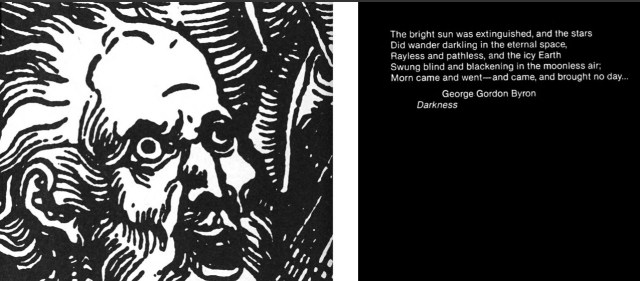
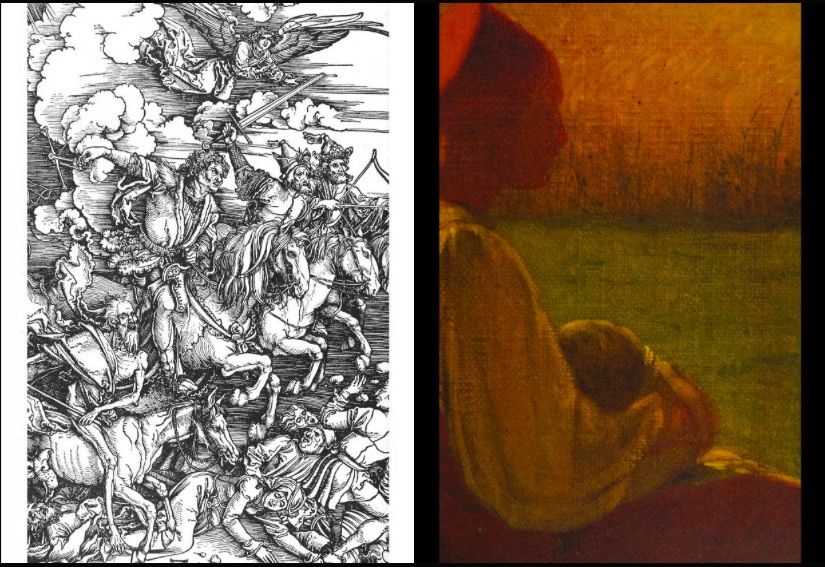
The cover of the book is an interesting design. It features Albrecht Dürer’s woodcut Die vier apokalyptischen Reiter (‘The four horsemen of the Apocalypse’) and Alexei Venetsianov oil painting Na zhatve.Leto. (‘The Harvest Summer’)

You can get the book here.

archiveorg velikhov-ed.-the-night-after… width=560 height=384 frameborder=0 webkitallowfullscreen=true mozallowfullscreen=true]

Follow us on The Internet Archive: https://archive.org/details/@mirtitles

Follow Us On Twitter: https://twitter.com/MirTitles

Write to us: mirtitles@gmail.com

Fork us at GitLab: https://gitlab.com/mirtitles/

Add new entries to the detailed book catalog here.

Contents


Contributors

Anatoli Alexandrov

Agadzhan Babayev

Aleksandr Bayev

Nikolai Blokhin Nikolai Bochkov

Lev Feoktistov

Aleksandr Ginsburg

Georgi Golitsyn

Anatoli Gromyko

Yuri Izrael

Aleksandr Obukhov

Georgi Stenchikov

==

Acknowledgements

Introduction by Yevgeni Velikhov

Part One Long-term worldwide consequences of a nuclear war

37 Yuri Izrael
Changes in the atmosphere due to a nuclear war

53 Georgi Stenchikov
Climatic consequences of nuclear war: CCAS Model

83 Georgi Golitsyn , Aleksandr Ginsburg
Natural analogs of a nuclear catastrophe

99 Aleksandr Bayev, Nikolai Bochkov
Medical consequences of a nuclear war

113 Anatoli Gromyko
Ecological disaster: Impact on the Third World

Part Two Abstracts from the reports at the National Scientists’ Conference to Save the World from the Threat of Nuclear War and to Ensure Disarmament and Peace Moscow, May 17-19, 1983

139 Anatoli Alexandrov
Lessons of the past and the main task of the present

143 Nikolai Blokhin
A real threat to the existence of mankind

145 Aleksandr Obukhov
The Earth’s atmosphere: Catastrophe after a nuclear strike

147 Lev Feoktistov
Nuclear weapons: Super-dangerous factor

149 Agadzhan Babayev
Will our planet becomeac a radioactive desert?

Supplement
Scientists’ Appeals and other relevant documents on the prevention of nuclear war

153 Appeal to the Second Special Session of the General Assembly of the United Nations on Disarmament by the Presidium of the USSR Academy of
Sciences. Moscow, May 13, 1982

154 Pugwash Declaration on its 25th anniversary. Warsaw,
August 26-31, 1982

155 Declaration on Prevention of Nuclear War by an Assembly of Presidents of scientific academies and other scientists from all over the world, convened by the Pontifical Academy of Sciences. Vatican, September 23-24, 1982

158 Appeal to all scientists of the world by Soviet scientists’. Moscow,
April 10, 1983

159 Appeal of the National Scientists’ Conference to Save the World from the Threat of Nuclear War and to Ensure Disarmament and Peace. Moscow,
May 17-19, 1983

161 Appeal to the Chairman of the Presidium of the USSR Supreme Soviet, Yuri Andropov, and to the President of the United States, Ronald Reagan, by the Third Congress of International Physicians for the Prevention of Nuclear War. The Hague, June 17-21, 1983

162 The International Physicians’ call for an end to the nuclear arms race by the Third Congress of International Physicians for the Prevention of Nuclear War. The Hague, June 17-21, 1983

163 Physicians’ Oaths and Statements of Medical Ethics: a Proposed Adaptation for the Nuclear Age, by the Third Congress of International Physicians for the Prevention of Nuclear War. The Hague, June 17-21, 1983

163 Nuclear winter: A warning. Information Paper of an Assembly of Presidents of scientific academies and other scientists from all over the world, convened by the Pontifical Academy of Sciences. Vatican, January 23-24-25, 1984

164 Nuclear war: Its consequences and prevention. A statement from a Conference of scientists and religious leaders. Bellagio, Italy, November 23, 1984

 

Posted in books, mir books, mir publishers, soviet | Tagged , , , , , , , , , , , , , , , , , , , , , , , , | Leave a comment

There Was Once A Fox – Akimushkin

In this post, we will see the book There Was Once A Fox by Igor Akimushkin.

About the book

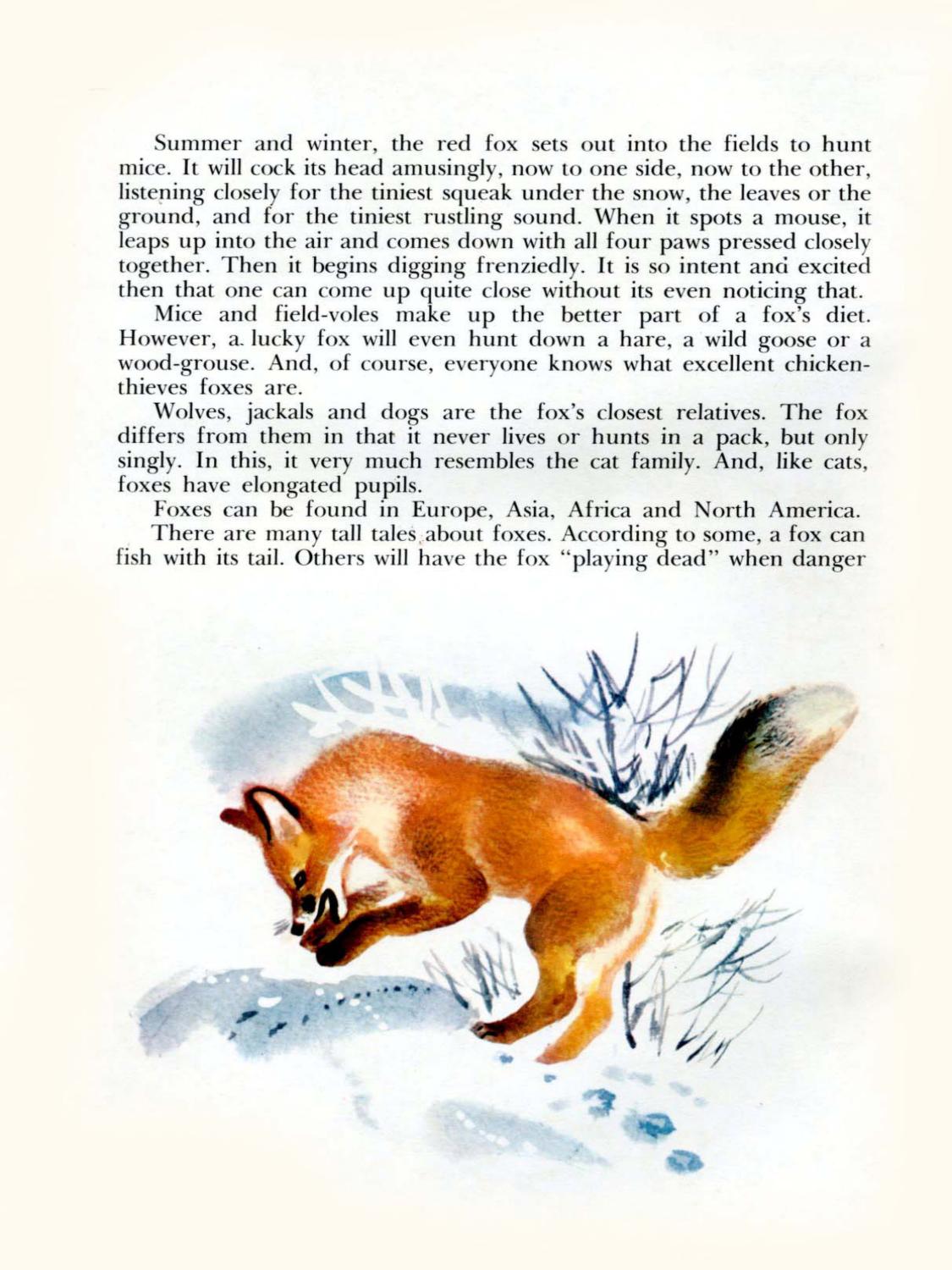
This short book (12 pages) is a book about foxes and their habits and habitats. We start the book with a family of a vixen who is raising a litter of little foxes. The author then describes the three types of foxes that are found in Russia, and their habitats. Finally, we come back to the start of the book..

The book was translated from Russian by Galina Glagoleva and was illustrated by Tatyana Vasilyeva. The book was published in 1983 by Malysh.

All credits to Guptaji.

You can get the book here (cleaned version) and here.

Follow us on The Internet Archive: https://archive.org/details/@mirtitles

Follow Us On Twitter: https://twitter.com/MirTitles

Write to us: mirtitles@gmail.com

Fork us at GitLab: https://gitlab.com/mirtitles/

Add new entries to the detailed book catalog here.


Posted in books, children's books, children's stories, life sciences, malysh publishers, soviet | Tagged , , , , , , , , , , | Leave a comment

Fundamentals Of Radio – Zherebtsov

In this post, we will see the book Fundamentals Of Radio by I. Zherebtsov.

About the book

A book explaining fundamental working of radio. Topics covered include oscillatory circuits, aerials, radio wave propagation, electron valves, rectifiers, amplifiers, transmitters, receivers, circuits, diodes, triodes, tetrodes and measurements.


Some of the technologies might be dated.

The book was translated from Russian by Vladimir P. Vallessuk and was published in 1963 by Foreign Languages Publishing House.

Credits to the original uploader.

You can get the book here.

Follow us on The Internet Archive: https://archive.org/details/@mirtitles

Follow Us On Twitter: https://twitter.com/MirTitles

Write to us: mirtitles@gmail.com

Fork us at GitLab: https://gitlab.com/mirtitles/

Add new entries to the detailed book catalog here.

Contents

Chapter I General Information on Radio Communication

1. Radio Broadcasting and Communication 9
2. Wavelength 12
3. Radio Wave Ranges 14
4. Questions and Problems 16

Chapter II Oscillatory Circuits

5. Free Electrical Oscillations 17
6. Amplitude and Frequency of the Free Oscillations in a Circuit 21
7. Damped and Continuous Oscillations 24
8. Series Resonance 27
9. Parallel Resonance 29
10. Bandwidth of a Tuned Circuit 33
11. Coupled Circuits 38
12. Shielding 41
13 Types of Tuned Circuits and Their Components 47
14. Forced Oscillations and Resonance 49
15. Simplified Design of Tuned Circuits and Their Components 60
16 Questions and Problems 63

Chapter III Aerials and Propagation of Radio Waves

17. Electromagnetic Waves 65
18. The Aerial as an Open Oscillatory Circuit 66
19. Voltage and Current Distribution in an Aerial 71
20. Natural Frequency and the Wavelength of an Aerial 74
21. Receiving Aerials 76
22. Loop and Magnetic Aerials 79
23. Earthing Facilities and Counterpoise 81
24. Transmitting Aerials 83
25. Propagation of Radio Waves 87
26. Questions and Problems 98

Chapter IV Electron Valves

27. Design and Operating Principle of the Two-Electrode Valve 99
28. Diode Circuits 102
29. Types of Cathode106
30. Diode Characteristics 110
31. Design and Opcration of Triodes 112
32. The Triode as an Amplifier 115
33. The Triode as an Oscillator 118
34. Triode Characteristics 119
35. Triode Parameters 124
36. Dynamic Operating Condition of Valves 131
37. Receiving and Amplifying Triodes 135
38. Disadvantages of Triodes 140
39. Design and Opcration of a Tetrode 142
40. Tetrode Connections 143
4l. Grid Characteristics and Parameters of a Tetrode 146
42. Dynatron Effect in Tetrodes 148
43. Design and Operation of a Pentode 149
44. Beam Tetrodes 153
45. Variable-mu Valves 155
46. Receiving and Low-Power Amplifying Tetrodes and Pentodes 156
47. Complex Valves 158
48. Interchangeability of Valves 162
49. Valve. Testing 162
50. Cathode-Ray Tubes (CRT) 164
51. Neon Lamp 168
52. Questions and Problems 170

Chapter V Rectifiers

53. Kenotron Rectifier Circuits 172
54. Smoothing Filters 177
55. Types of Kenotron and Their Design 184
56. Kenotron Rectifier Components 185
57. Fundamentals of Power Transformer Design 187
58. Gas-Filled Valve Rectifiers, Thyratrons and Ionic Voltage Stabilisers 189
59. Semiconductor Rectifiers 191
60. Vibrapacks 193
6l. Current Stabilisers (Bartetters) 200
62. Questions and Problems 203

Chapter VI Electroacoustic Devices

63. Properties of Sound. The Sense of Hearing 205
64. Microphone and Earphone 208
65. Loudspeakers 213
66. Gramophone Pickups 216
67. The ‘Decibel’ 217
68. Questions and Problems 220

Chapter VII Low-Frequency Amplifiers

69. The Basic Parameters of Amplifiers 221
70. Voltage Amplifiers and Power Amplifiers 226
71. A Triode Amplifier 226
72. Resistance-Coupled Amplifiers 235
73. Choke-Coupled Amplifiers 241
74. Transformer-Coupled Amplifiers 243
75. Grid Bias Voltage in Amplifiers 254
76. Single-Ended Final Stage of Amplification 259
77. Double-Ended or the Push-Pull Output Stage 268
78. Multi-Stage Amplifiers 276
79. Negative Feedback in Amplifiers 282
80. Questions and Problems 287

Chapter VIII Valve Oscillators and Transmitters

81. Self-Excited Valve Oscillators 290
82. Operating Conditions, Power and Efficiency of a Valve Oscillator 292
83. Self-Excited Valve Oscillator Circuits 297
84. Self-Excited Oscillators Employing No Feedback 302
85. A Self-Excited Valvo Transmitter 304
86. M.O.P.A. Transmitters 306
87. Electron-Coupled Oscillators 309
88. Frequency Control 312
89. Telegraph Keying of Radio Transmitters 318
90. Transmitting Valves 320
91. The Principle of Modulation 322
92. The Make-up of Modulated Oscillations 325
93. Grid Modulation 329
94. Anode Modulation 332
95. Modulation of Tetrodes and Pentodes 335
96. Frequency Modulation 336
97. Questions and Problems 339

Chapter IX Radio Receivers

98. General Definitions 342
99. The Basic Parameters of Radio Receivers 344
100. Detection 347
101. Crystal Receivers 348
102. Straight-Amplification Receivers 352
103. The Diode Detector 353
104. Grid Detector 356
106. The Anode Detector 358
106. The Principle and the Peculiarities of Superheterodyne Reception 360
107. The Input Circuit and High-Frequency Amplification 369
108. Frequency Conversion 376
109. Intermediate-Frequency Amplification 383
110. The Second Detector, Beat-Frequency Oscillator and Low-Frequency Amplification 387
111. Regenerative Detectors 390
112. Superregenerative Receivers 398
113. Reflex Receivers 406
114. Various Methods of Controlling the Amplification, the Tone and the Selectivity of Radio Receivers 408
116. The: “Magic Eye” 413
116. Interference and Methods of Its Elimination 416
117, The Reception of Frequency-Modulated Signals 421
118, Automatic Frequency Control 426
119. Questions and Problems 428

Chapter X Radio Measurements

120. Current Measurements 431
121. Voltage Measurements 438
122. Resistance Measurements 449
123. Audio- Frequency 455
124. Signal Generators 462
125. Electron Oscillographs 466
126. Frequency Measurements 471
127. Capacitance and Inductance Measurements 477
128. Questions and Problems 482

Chapter XI Semiconductor Devices in Radio

129. General Properties of Semiconductor Diodes and Triodes 484
130. Electron-Type and Hole-Type Conductivity in Semiconductors 486
131. Rectification at the Boundary of Two Semiconductors 490
132. Semiconductor Diodes 493
133. Semiconductor Triodes (Transistors) 500
134. Transistor Characteristics 509
135. Transistor Parameters and Equivalent Circuits 512
136. Basic Circuits of Transistorised Amplifiers 517
137. Soviet Transistors 520
138. Transistorised Radio Circuits 524
139. How To Handle Semiconductor Devices 536
140. Questions and Problems 537

Posted in books, electronics, engineering, foreign languages publishing, physics, soviet, technology | Tagged , , , , , , , , , , , , , , , , , , , , , | 3 Comments

Riddles In Rhymes

In this post, we will see the book Riddles In Rhymes by Yuli Polyakov.

About the book

Dear boys and girls!
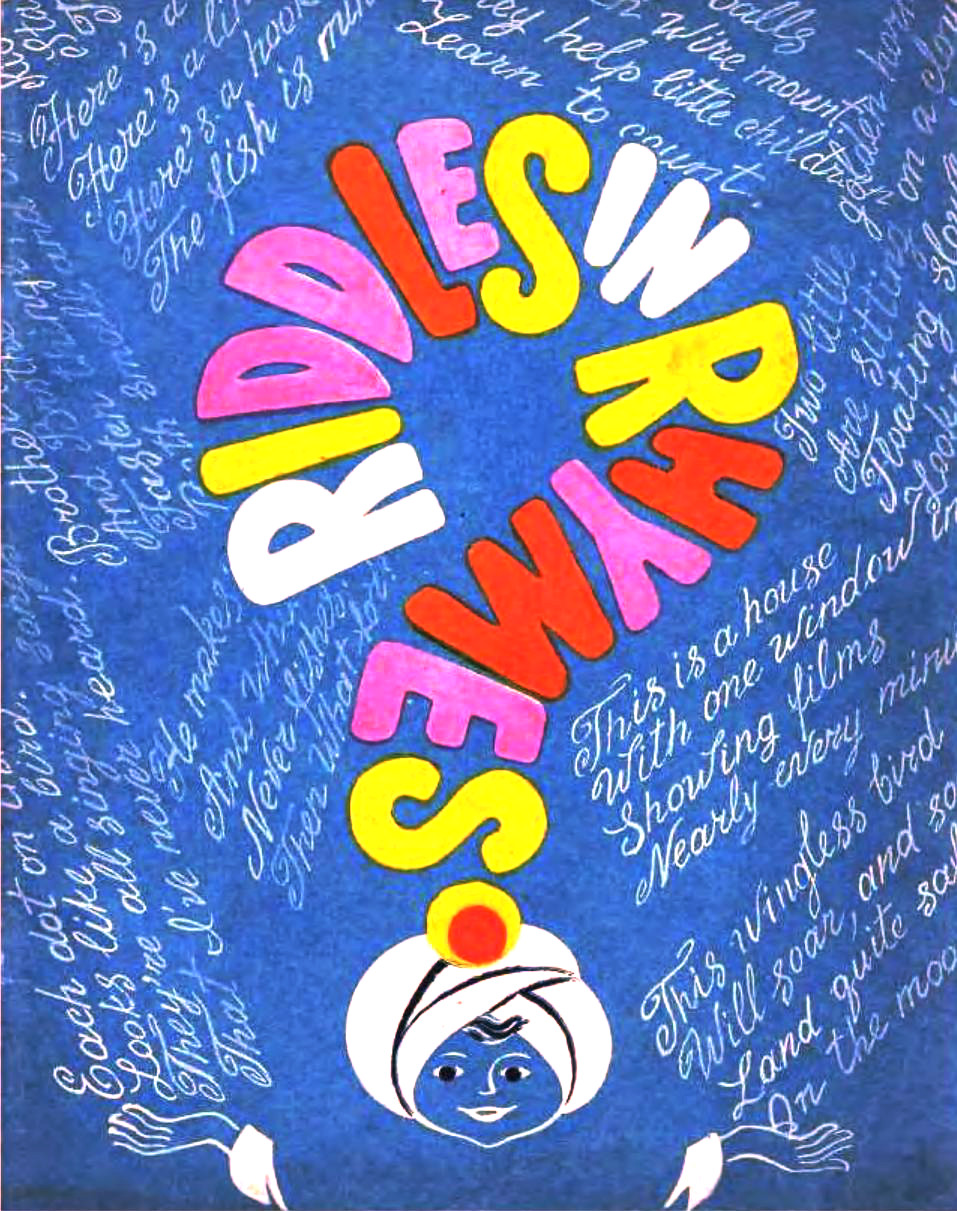
On each page of this book you will find merry riddles in rhymes and coloured pictures to these riddles. They are about things that surround you in your everyday life: at home, in school, in the street, etc. Some o f the riddles are about animals, birds and insects.

Head the rhymes, look at the pictures, and guess what’s what. This done, verify your choice with the answers at the end of the book.

And now — go ahead!

The book was translated from Russian by and funtastic illustrations are by Boris Rytman. The book was published in 1981 by Prosveshcheniye publishers.

All credits to Guptaji.

You can get the book here (cleaned version) and here. The scan is not very high resolution, but readable.

Follow us on The Internet Archive: https://archive.org/details/@mirtitles

Follow Us On Twitter: https://twitter.com/MirTitles

Write to us: mirtitles@gmail.com

Fork us at GitLab: https://gitlab.com/mirtitles/

Add new entries to the detailed book catalog here.

Posted in books, children's books, children's stories | Tagged , , , , , , | Leave a comment

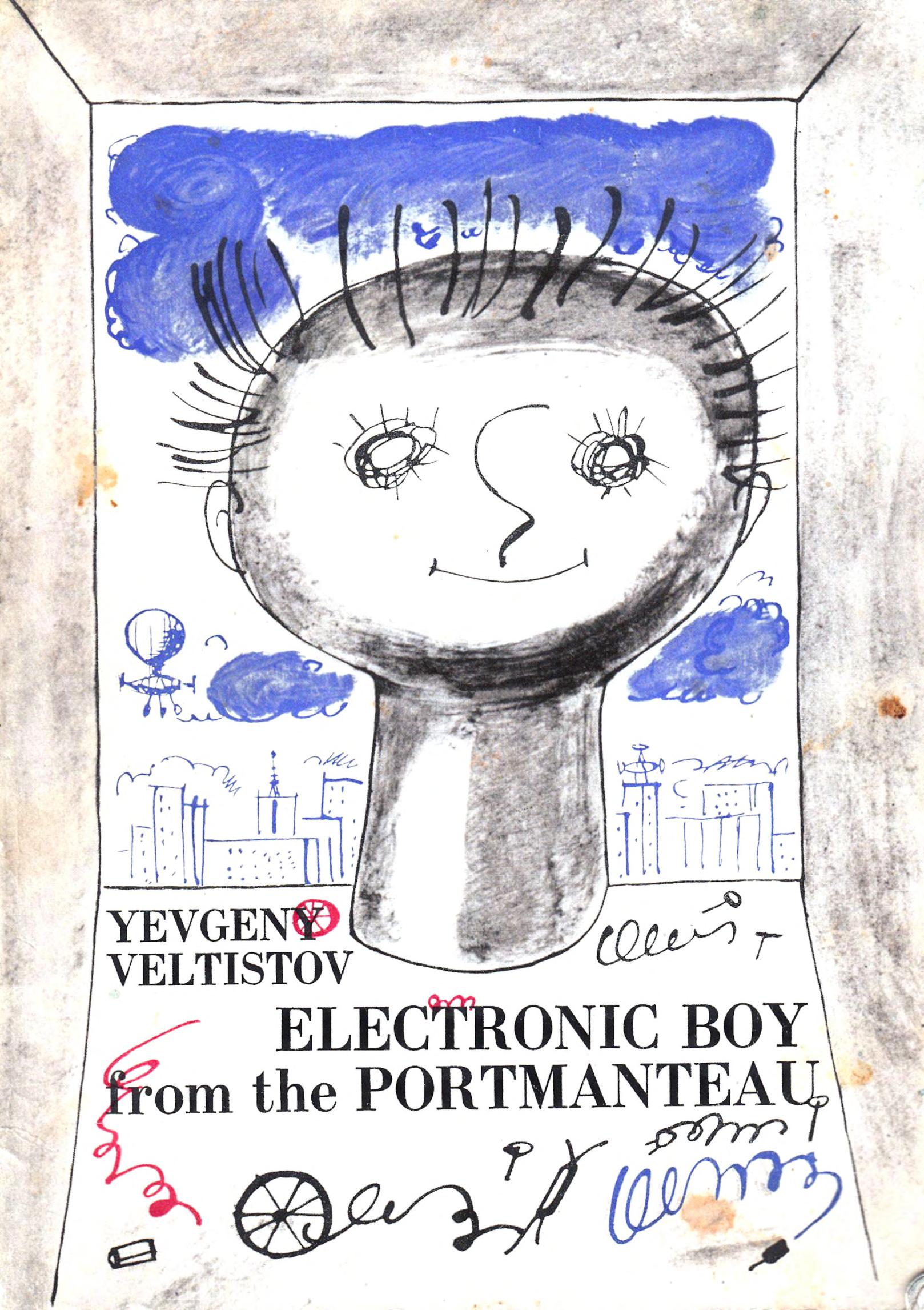
Electronic Boy From The Portmanteau

In this post, we will see the book Electronic Boy From The Portmanteau by Yevgevy Veltistov.

About the book

Boys and Girls,

You’ve probably guessed what Electronic is? Right, he’s a boy-robot! But the cream of the joke is that, by sheer chance, he turns out to be the live double of a schoolboy, Sergei Cheesekov. They meet and make friends – and immediately fantastic and funny adventures happen to them both. Sergei quickly gains fame as a World Champion runner, an animal-trainer, and an honor pupil at school – but that’s enough. Read the book yourselves, and join Sergei and Electronic at a math lesson in a Moscow school, see the circus with them, and visit the cybernetics laboratory of Professor Gromov. Finally, when the cat’s out of the bag, and their secret is discovered – join the children who teach Electronic to laugh. Wouldn’t it be fun if you had a friend like Electronic?

About the Author

Yevgeny Serafimovich Veltistov was a Soviet writer and screenwriter, who wrote a series of science fiction tales for young readers.

He was born into the family of a military engineer in 1934. In the second year of the Great Patriotic War, he came to study at school. There were few books. There are even fewer notebooks. I wanted to read very much. When asked who you will become, he replied: “A seller of children’s books. To read everything.”
Then he changed his mind. I decided to become a journalist. It was a firm decision. Graduated from the Faculty of Journalism of Moscow State University named after M.V. Lomonosov in 1956. He began to work – first in newspapers, then – as a department editor in the popular magazine “Ogonyok”. He was in charge of feuilletons and all sorts of things that were printed on the last pages.

He brought the manuscript of the first book to the Children’s Literature publishing house. Soon she saw the light. Others saw the light behind it.

from goodreads page

The book was translated from Russian by Gladys Evans and was illustrated and designed by Y. Krasny. The book was published in 1969 by Progress.

All credits to Guptaji.

You can get the book here (a cleaner version of the next link) and here.

Follow us on The Internet Archive: https://archive.org/details/@mirtitles

Follow Us On Twitter: https://twitter.com/MirTitles

Write to us: mirtitles@gmail.com

Fork us at GitLab: https://gitlab.com/mirtitles/

Add new entries to the detailed book catalog here.

Contents

THE FOUR-HANDLED PORTMANTEAU 6

AN UNEXPECTED FRIEND

White Lab-Coat, or Formulas? 17
Who’s the Champion? 29
The Magician of All Time 43

ALL ABOUT ELECTRONIC

The Cunning Y, the Dog’s Head and Other Relatives of Electronic 53
How Electronic Was Born 61
Teaching Electronic 68
X-Rays Show Nothing 74

THE SECRET

You Are Me! 81
Programmist-Optimist 85
“The Bride’s Chair” 90
Three Chancellors of the Theorem 95
Electronic’s First Failures 104
Hippopotamus Code Language 112
Conversations with a Goose and a Serpentonian 122
A Good Thing Dogs Don’t Talk 132

THE SECRET TURNS BURDEN

After All, Pm a Human Being! 137
What Does It Mean—to Think? 144
Duel with the “Trainer” 150
If Only There Were a Time Machine 154

MEN AT THE HELM

Quiz Day 169
Cheesekov — That’s Me 177
Hes Laughing! 178
What Happened After 186

Posted in books, children's books, children's stories, literature, progress publishers, science fiction, soviet | Tagged , , , , , , , , | Leave a comment

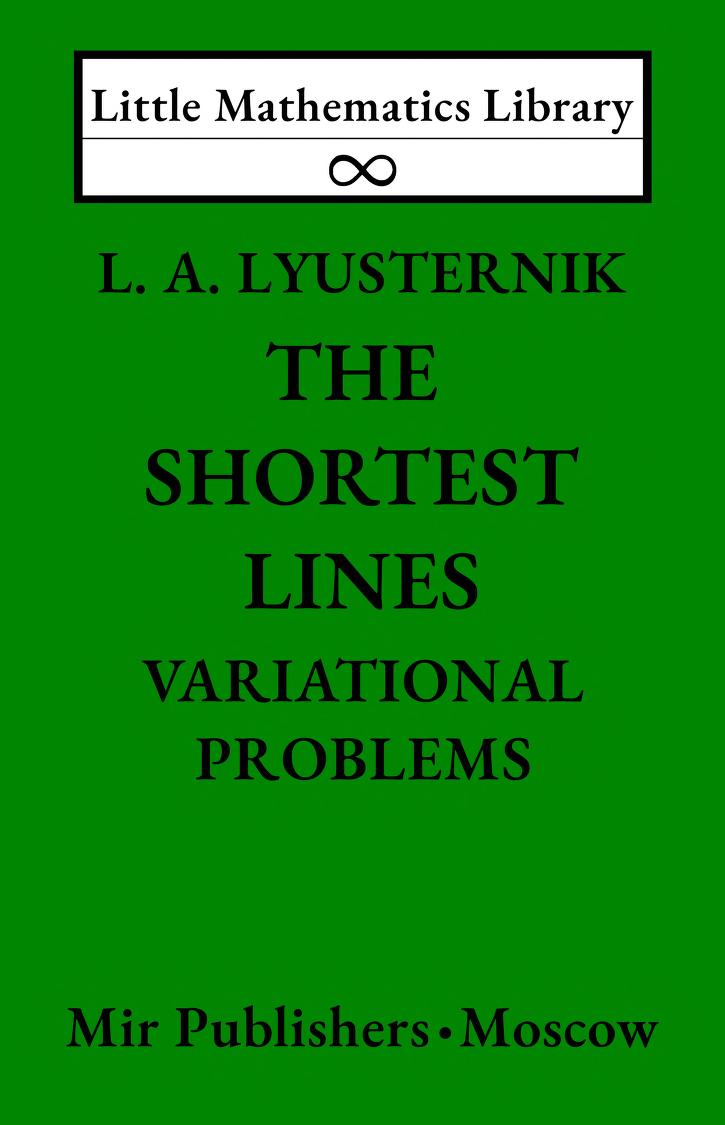
The Shortest Lines (Little Mathematics Library) – Lyusternik

In this post, we will see another book from the Little Mathematics Library titled The Shortest Lines Variational Problems by Lyusternik.

About the book

A pamphlet based on lectures read by the author to Moscow University’s schools mathematics club. Deals in an elementary way with a number of variational problems, such as finding the shortest curve uniting two points on a given surface. Suitable for readers with “O” level mathematics.

This book is an attempt to examine from the elementary
point of view a number of so-called variational problems.
These problems deal with quantities dependent on a curve,
and a curve for which this quantity is either maximum or
minimum is sought. Such are, for example, problems in
which it is required to find the shortest of all the curves connecting two points on a surface, or among all the closed curves of a given length on a plane it is necessary to find that one which bounds the maximum area, and so on.

The material of this book was basically presented by the author in his lectures at a school mathematical circle of the
Moscow State University. The contents of the first lecture
(Secs. I.1-III.3) in the main coincides with the contents of
Geodesic Lines, published by the author in 1940. Only the knowledge of elementary mathematics is required to master this course. Moreover, the first chapters are quite elementary. Others while not requiring special knowledge demand a greater aptitude for mathematical perusal and meditation.

The entire material of this book may be considered as an
elementary introduction to the calculus of variations (a
branch of mathematics dealing with problems of finding the
functional minimum or maximum). The calculus of variations does not enter into the first concentric cycle of the higher mathematics course that is studied, for example, in
technical colleges. In our opinion, however, for a student
who begins to study higher mathematics, it is not useless
to look further ahead.

The book was translated from Russian by Yuri Ermolyev and was published in 1983.

A big thank you to @4evercla6 for this and two more books from LML series. See the comment in the LML taking stock post. We will see them in the next couple of posts.

Now only The Euler Characteristic by Yu. A. Shaskin remains from the list!

You can get the book here.

Follow us on The Internet Archive: https://archive.org/details/@mirtitles

Follow Us On Twitter: https://twitter.com/MirTitles

Write to us: mirtitles@gmail.com

Fork us at GitLab: https://gitlab.com/mirtitles/

Add new entries to the detailed book catalog here.

Contents

Introduction 7

LECTURE 1

Chapter I. Shortest Lines on Simple Surfaces 9

I.1. Shortest Lines on Polyhedral Surfaces 9
I.2. Shortest Lines on a Cylindrical Surface 14
I.3. Shortest Lines on a Conical Surface 22
I.4. Shortest Lines on a Spherical Surface 30

Chapter II. Some Properties of Plane and Space Curves and Associated Problems 38

II.1. Tangent and Normals to Plane Curves and Associated Problems 38
II.2. Some Information on the Theory of Plane and Space Curves 42

Chapter III. Geodesic Lines 49

III.1. Bernoulli’s Theorem on Geodesic Lines 49
III.2. Additional Remarks Concerning Geodesic Lines 54
III.3. Geodesic Lines on Surfaces of Revolution 58

LECTURE 2

Chapter IV. Problems Associated with the Potential Energy of Stretched Threads 61

IV.1. Motion of Lines that Does Not Change Their Length 61
IV.2. Evolutes and Involutes 67
IV.3. Problems of Equilibrium of a System of Elastic Threads 68

Chapter V. The Isoperimetric Problem 73

V.1. Curvature and Geodesic Curvature 73
V.2. An Isoperimetric Problem 76

Chapter VI. Fermat’s Principle and Its Corollaries 82

VI.1. Fermat’s Principle 82
VI.2. The Refraction Curve 85
VI.3. The Problem of Brachistochrone 89
VI.4. The Catenary and the Problem of the Minimal Surface of Revolution 92
VI.5. Interrelation Between Mechanics and Optics 101

Posted in books, little mathematics library, mathematics, mir books, mir publishers, soviet | Tagged , , , , , , , , , , , , , , , , , , , , , , , , , | 6 Comments

Geometrical Constructions With Compasses Only (Little Mathematics Library) – Kostovskii

In this post, we will see the book from the series Little Mathematics Library titled Geometrical Constructions With Compasses Only by A. Kostovskii.

About the book

This booklet is intended for a wide circle of readers. It should help teachers and pupils of senior classes of secondary schools to acquaint themselves in greater detail with geometrical constructions carried out by compasses alone. It can serve as a teaching aid in school mathematical clubs. The booklet can also be used by students of physical and mathematical departments of universities and teachers’ training colleges to deepen their knowledge of elementary mathematics.

The book was translated from the Russian by Janna Suslovich and was first published by Mir Publishers in 1986. There is a Topics in Mathematics version of this book too.

A big thank you to @4evercla6 for this and two more books from LML series. See the comment in the LML taking stock post. We will see them in the next couple of posts.

Now only The Euler Characteristic by Yu. A. Shaskin remains from the list!

You can get the Little Mathematics Library version of the book here.


Topics in Mathematics version here.

Follow us on The Internet Archive: https://archive.org/details/@mirtitles

Follow Us On Twitter: https://twitter.com/MirTitles

Write to us: mirtitles@gmail.com

Fork us at GitLab: https://gitlab.com/mirtitles/

Add new entries to the detailed book catalog here.

Contents

Preface 6

Introduction 7

PART 1
CONSTRUCTIONS WITH COMPASSES ALONE
1. On the possibility of solving geometrical construction problems by means of compasses alone: the basic theorem 9
2. Solution of geometrical construction problems by means of compasses alone 19
3. Inversion and its principal properties 33
4. The application of the method of inversion to the geometry of compasses 37

PART 2
GEOMETRIC CONSTRUCTIONS BY MEANS OF COMPASSES ALONE BUT WITH RESTRICTIONS

5. Constructions by means of compasses alone with the opening of the legs restricted from above 46
6. Constructions by means of compasses alone with the angle restricted from below 63
7. Constructions using only compasses with constant opening of the legs 66
8. Constructions with compasses alone on condition that all circles pass through the same point 67

Appendices 76

Appendix 1 Symbols and Notations Used in the Book 76

Appendix 2 Proof for Problem 18 in the General Case 77

References 79

Posted in books, little mathematics library, mathematics, mir books, mir publishers, soviet | Tagged , , , , , , , | 4 Comments