The Method Of Trigonometric Sums In The Theory Of Numbers – Vinogradov

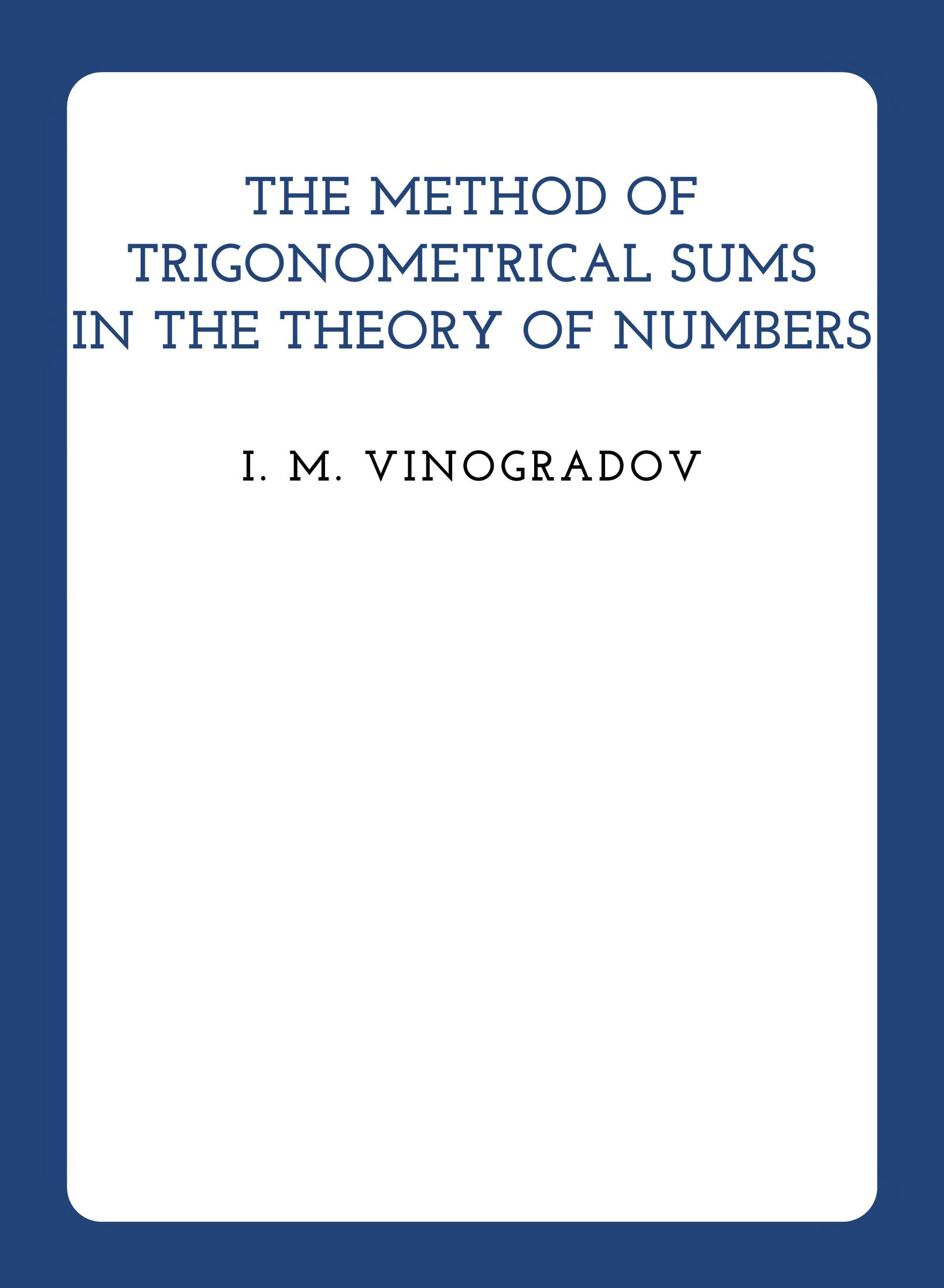
In this post, we will see the book The Method Of Trigonometric Sums In The Theory Of Numbers by I. M. Vinogradov.

About the book

Since 1934 the analytic theory of numbers has been largely transformed by the work of Vinogradov. This work, which has led to remarkable new results, is characterized by its supreme ingenuity and great power.

Vinogradov has expounded his method and its applications in a series of papers and in two monographs, which appeared in 1937 and 1947. The present book is a translation of the second of these monographs, which incorporated the improvements effected by the author during the intervening ten years.

The text has been carefully revised and to some extent rewritten. The more difficult arguments have been set out in greater detail.

Notes have been added, in which we mention the more im­portant changes made and comment on the subject-matter; we hope these will be of assistance or of interest to the reader.

The book was translated from Russian by K. F. Roth and Anne Davenport and was published in 1954.

Credits to the original uploader.

You can get the book here.

Follow us on The Internet Archive: https://archive.org/details/@mirtitles

Follow Us On Twitter: https://twitter.com/MirTitles

Write to us: mirtitles@gmail.com

Fork us at GitLab: https://gitlab.com/mirtitles/

Add new entries to the detailed book catalog here.

Contents

Preface by the Translators V
Notation ix

Introduction 1

Note on Vinogradov’s Method by the Translators 19

I. General Lemmas 21

Notes 42

II. The Investigation of the Singular Series in Waring’s Problem 45

Notes 54

III. The Contribution of the Basic Intervals in Waring’s Problem 55

Notes 61

IV. An Estimate for G(n) in Waring’s Problem 62

Notes 69

V. Approximation by the Fractional Parts of the Values of a Polynomial 71

Notes 81

VI. Estimates for Weyl Sums 82

Notes 113

VII. The Asymptotic Formula in Waring’s Problem 117

Notes 123

VIII. The Distribution of the Fractional Parts of the Values of a Polynomial 124

Notes 127

IX. Estimates for the Simplest Trigonometrical Sums with Primes 128

Notes 162

X. Goldbach’s Problem 163

Notes 175

XI. The Distribution of the Fractional Parts of the Values of the Function 𝛼𝓅 177

Notes 180

Posted in mathematics, soviet | Tagged , , , , , , , , | 1 Comment

How They Live – Charushin

In this post, we will see the book How They Live by Y. Charushin.

About the book

This little picture book describes how various animals live in their natural habitats. The animals described include hares, wolves, lions, tigers, elephants, zebras, bears, squirrels, and camels.

The book was translated from Russian by Irina Zheleznova and was published in 1979 by Progress Publishers (Third printing). The fantastic drawings are by the author. There is a Bengali version also.

Credits to the original uploaders.

You can get the book here (cleaned) and here.

Link to the Bengali version here and here.

Follow us on The Internet Archive: https://archive.org/details/@mirtitles

Follow Us On Twitter: https://twitter.com/MirTitles

Write to us: mirtitles@gmail.com

Fork us at GitLab: https://gitlab.com/mirtitles/

Add new entries to the detailed book catalog here.

Posted in books, children's books, children's stories, picture books, progress publishers, soviet | Tagged , , , , , , , , , , , , , , , , | Leave a comment

The Brave Ant – Makarova

In this post, we will see the book The Brave Ant by Tatiana Makarova.

About the book

The book describes a story of ant and his family whose home is swept away by water.

The book was translated from Russian by Fainna Glagoleva. The fantastic drawings are by  Gennadi Pavlishin. The book was published in in 1976 by Progress Publishers.

All credits to Guptaji.

You can get the book here (cleaned version) and here.

Follow us on The Internet Archive: https://archive.org/details/@mirtitles

Follow Us On Twitter: https://twitter.com/MirTitles

Write to us: mirtitles@gmail.com

Fork us at GitLab: https://gitlab.com/mirtitles/

Add new entries to the detailed book catalog here.

Posted in books, children's books, children's stories, progress publishers, soviet | Tagged , , , , , , , , , , | 4 Comments

Red Hill – Bianki

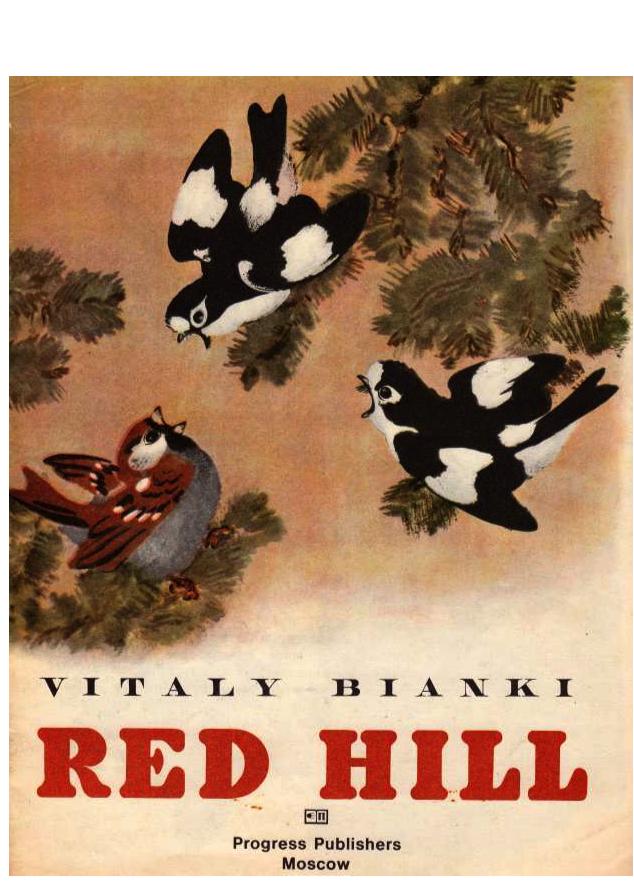
In this post, we will see the book Red Hill by Vitaly Bianki.

About the book

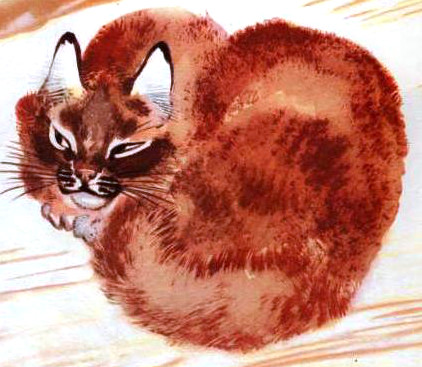
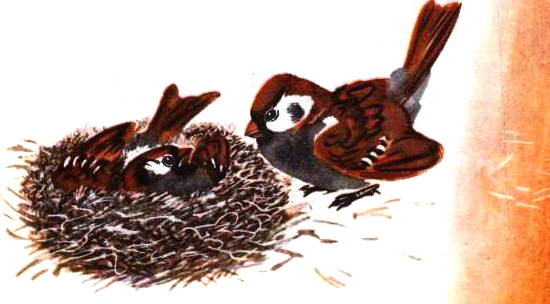
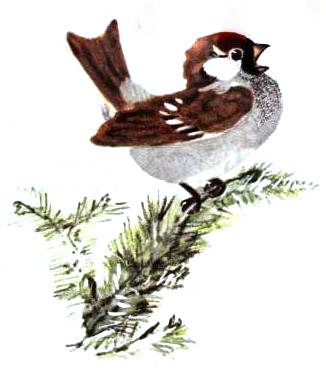
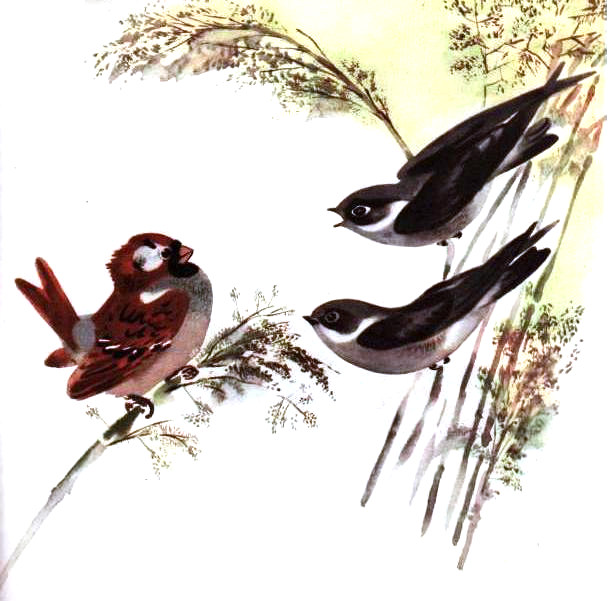
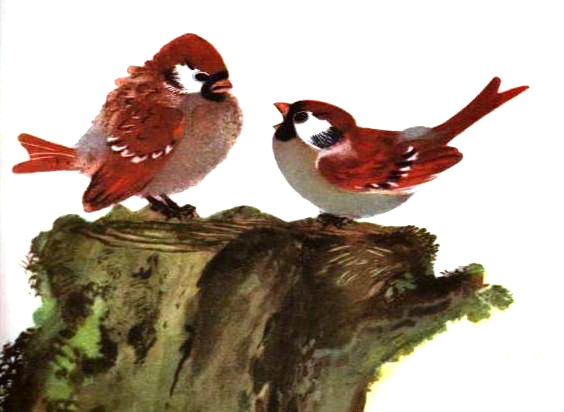
The book tells us the story of two sparrows Chirp and Chirpie. Chirp is always fighting with other birds. Will Chirp and Chirpie be able to get help from other birds to defend their nest from a cat attack? To find out read the book!

The book was translated from Russian by Olga Shartse. The drawings are by Yevgeny Charushin. The book was published in 1975 by Progress.

All credits to Guptaji.

You can get the book here and here.


Follow us on The Internet Archive: https://archive.org/details/@mirtitles

Follow Us On Twitter: https://twitter.com/MirTitles

Write to us: mirtitles@gmail.com

Fork us at GitLab: https://gitlab.com/mirtitles/

Add new entries to the detailed book catalog here.

Posted in books, children's books, children's stories, progress publishers, soviet | Tagged , , , , , , , , , , | Leave a comment

Builders Without Tools – Bianki

In this post, we will see the book Builders Without Tools by Vitaly Bianki.

About the book

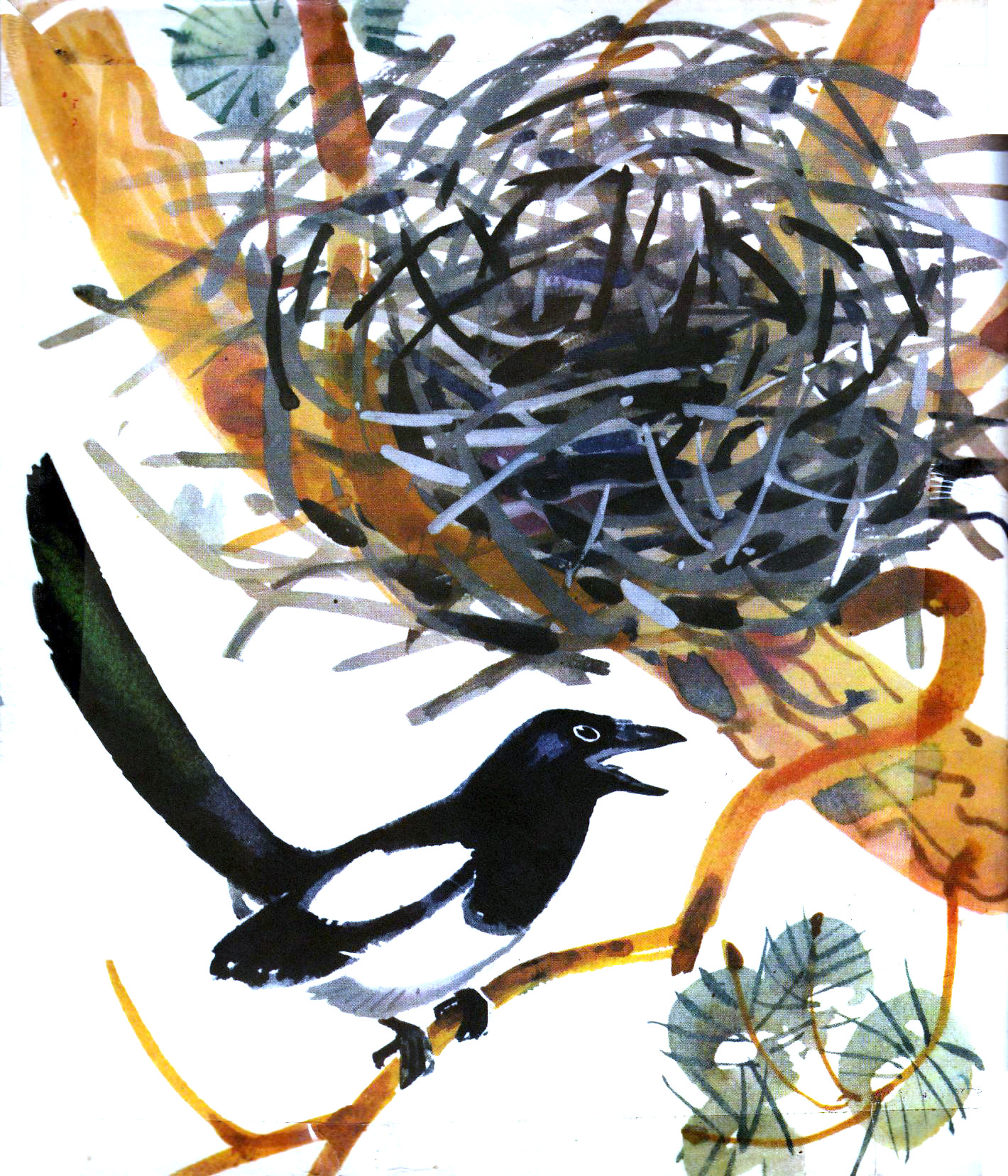
This little book describes how different birds like magpies, night-jars, willow tits, swallows, thrush, woodpecker and eagle build their amazing nests without using any tools.

The book was translated from Russian by Tom Botting and was illustrated by V. Fedotov. The book was published in 1980 by Malysh.

All credits to Guptaji.

You can get the book here (cleaned version) and here.

Follow us on The Internet Archive: https://archive.org/details/@mirtitles

Follow Us On Twitter: https://twitter.com/MirTitles

Write to us: mirtitles@gmail.com

Fork us at GitLab: https://gitlab.com/mirtitles/

Add new entries to the detailed book catalog here.

Posted in books, children's books, children's stories, malysh publishers | Tagged , , , , , , | Leave a comment

Why Tuppy Doesn’t Chase Birds – Charushin

In this post, we will see the book Why Tuppy Doesn’t Chase Birds by Y. Charushin.

About the book

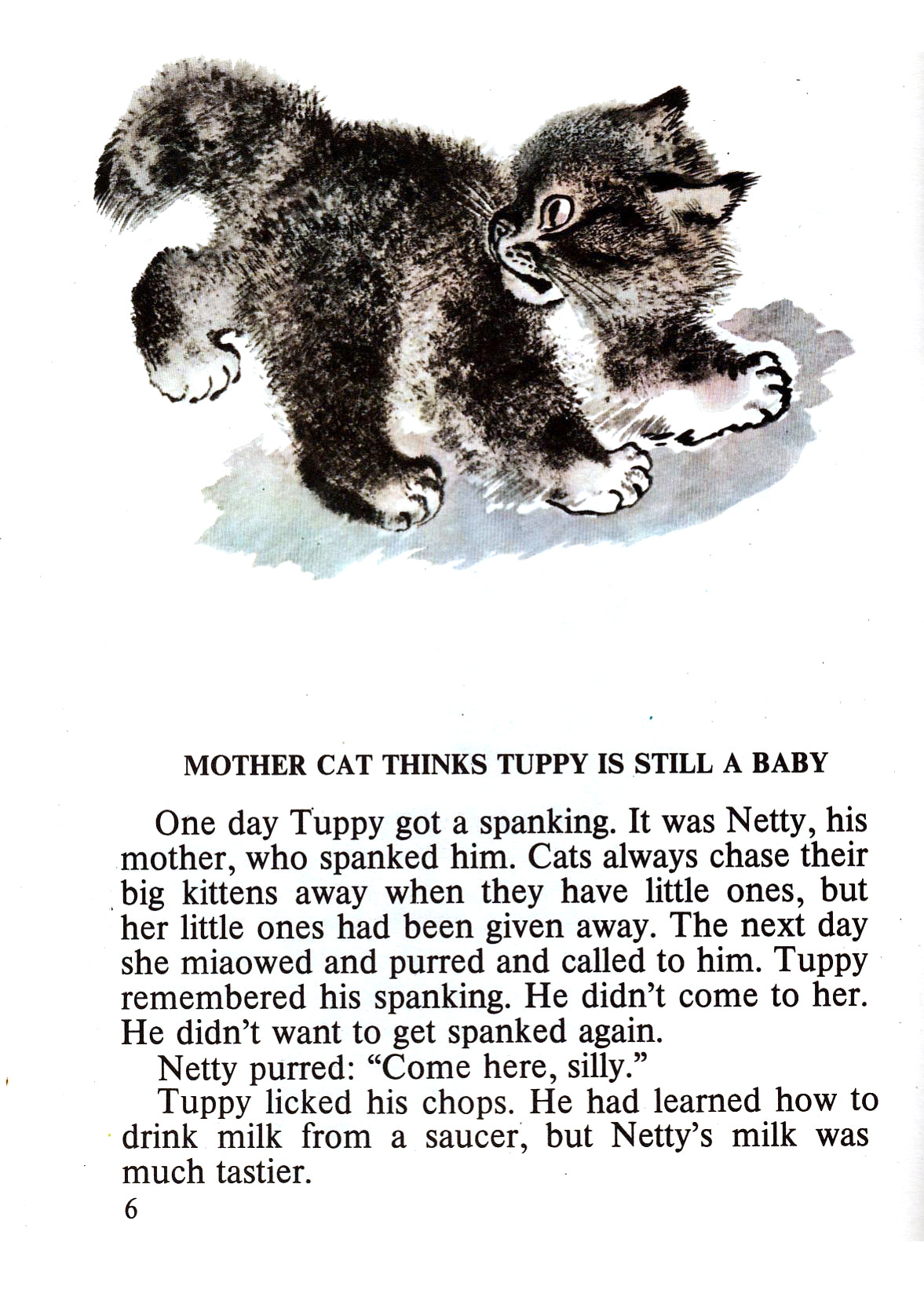
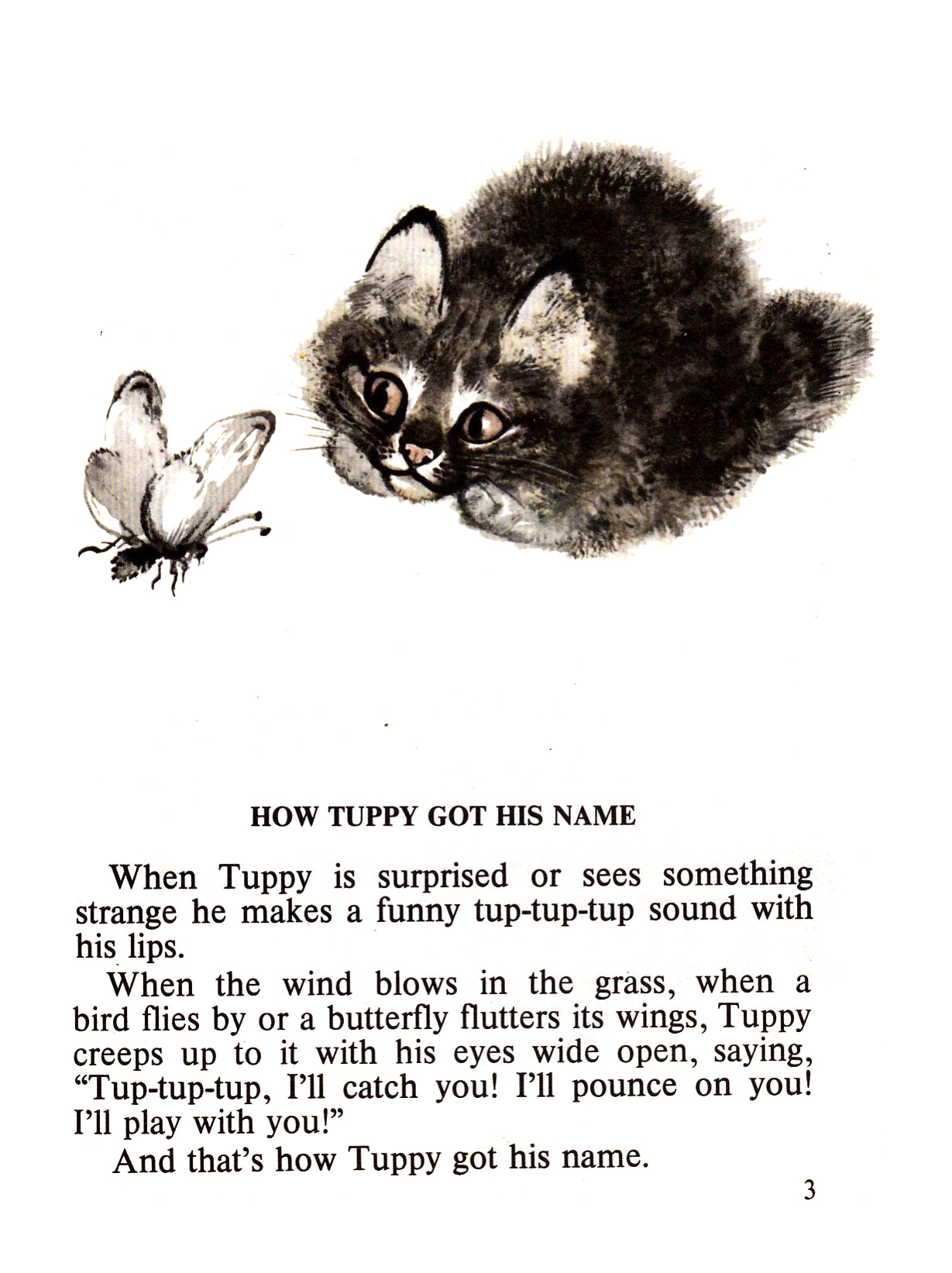
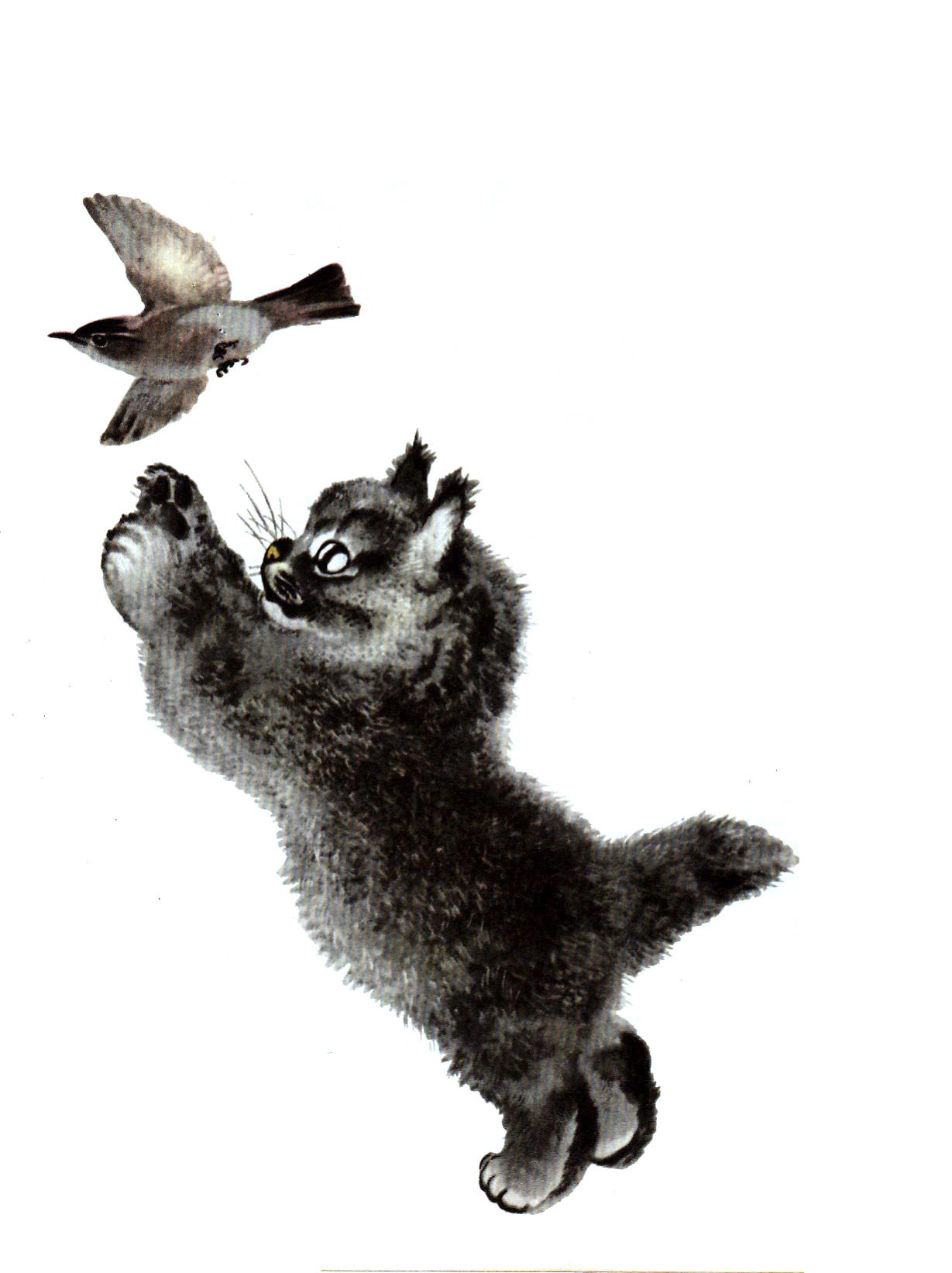
In this book you will know about a little mischievous cat named Tuppy and her adventures. Read the book to know why this little cat does not chase any birds!

The book was translated from Russian by Fainna Glagoleva and illustrated by the author. The book was published in 1976 by Progress Publishers. Note: title pages are missing.

All credits to Guptaji.

You can get the book here (cleaned version) an here.

Follow us on The Internet Archive: https://archive.org/details/@mirtitles

Follow Us On Twitter: https://twitter.com/MirTitles

Write to us: mirtitles@gmail.com

Fork us at GitLab: https://gitlab.com/mirtitles/

Add new entries to the detailed book catalog here.

Contents


Posted in books, children's books, children's stories, picture books, progress publishers, soviet | Tagged , , , , , , , | Leave a comment

Lectures in Geometry – Semester 5 Lie Groups and Lie Algebras – Postnikov

In this post, we will see the book Lectures in Geometry – Semester 5 Lie Groups and Lie Algebras by M. Postnikov. This book is the first one of a five part Lectures in Geometry series. So far we have volumes 1, 2 and 5, volumes 3 and 4 are missing. If anyone has access to volumes 3 and 4 please consider posting them.

About the book

This textbook like the rest of the series is compiled from lectures delivered by the author to students at Moscow State University. The audience was made up of final year students and postgraduates, and as a consequence, a certain level of knowledge (for example, the properties of manifolds) is assumed. The lectures fall into five parts. The first covers the basic concepts of Lie groups, Lie algebras, and the Lie algebra of a given Lie group. The second part deals with “ locality theory”, the third generalizes these ideas. The first three sections could be used as a foundation course in Lie algebras for beginners. The fourth part considers Lie subgroups and Lie factor groups. The final part has a purely algebraic character, and is practically independent of the preceding four parts; it considers a proof of Ado’s theorem, which is interesting in itself. This book will be useful for mathematics students taking courses in Lie algebras, because it contains all the major results and proofs in compact and accessible form.

The book was translated from Russian by by Vladimir Shokurov and was published in 1986 by Mir.

Credits to the original uploader.

You can get the book here.

Follow us on The Internet Archive: https://archive.org/details/@mirtitles

Follow Us On Twitter: https://twitter.com/MirTitles

Write to us: mirtitles@gmail.com

Fork us at GitLab: https://gitlab.com/mirtitles/

Add new entries to the detailed book catalog here.

Contents

Preface 10

Lecture 1 15


Smooth and topological groups. Relaxing the conditions defining Lie groups. Examples of Lie groups. Cayley transformation. Further examples of Lie groups. Connected and arcwise connected spaces and groups. Reduction of any smooth groups to connected groups. Examples of connected Lie groups


Lecture 2 33

Left-invariant vector fields. Parallelizability of Lie groups. Integral curves of left-invariant vector fields and one-parameter subgroups. Lie functor. An example: a group of invertible elements of an associative algebra. Functions with values in an associative algebra. One-parameter subgroups of the group G (𝓐)


Lecture 3 51

Matrix Lie groups admitting the Cayley construction. A generalization of the Cayley construction. Groups possessing ln-images. Lie algebras. Examples of Lie algebras. Lie algebras of vector fields. The Lie algebra of a Lie group. An example: the Lie algebra of a group of invertible elements of an associative algebra. Locally isomorphic Lie groups. Local Lie groups. Lie functor on the category of local Lie groups

Lecture 4 71

The exponent of a linear differential operator. A formula for the values of smooth functions in the normal neighbourhood of the identity of a Lie group. A formula for the values of smooth functions on the product of two elements. The Campbell-Hausdorff series and Dynkin polynomials. The convergence of a Campbell-Hausdorff series. The reconstruction of a local Lie group from its Lie algebra. Operations in the Lie algebra of a Lie group and one-parameter subgroups. Differentials of internal automorphisms. The differential of an exponential mapping. Canonical coordinates. The uniqueness of the structure of a Lie group. Groups without small subgroups and Hilbert’s fifth problem


Lecture 5 98

Free associative algebras. Free Lie algebras. The basic lemma. The universal enveloping algebra. The embedding of a Lie algebra into its universal enveloping algebra. Proof of the fact that the algebra I <X> is free. The Poincaré-Birkhoff-Witt theorem. Tensor products of vector spaces and of algebras. Hopf algebras

Lecture 6 116

The Friedrichs theorem. The proof of Statement B of Lecture 4. The Dynkin theorem. The linear part of a Campbell-Hausdorff series. The convergence of a Campbell-Hausdorff series. Lie group algebras. The equivalence of the categories of local Lie groups and of Lie group algebras. Isomorphism of the categories of Lie group algebras and of Lie algebras. Lie’s third theorem


Lecture 7 134

Local subgroups and sub-algebras. Invariant local subgroups and ideals. Local factor groups and quotient algebras. Reducing smooth local groups to analytic ones. Pfaffian systems. Sub-fiberings of tangent bundles. Integrable sub-fiberings. Graphs of a Pfaffian system. Involutory sub-fiberings. The complete univalence of a Lie functor. The involutedness of integrable sub-fiberings. Completely integrable sub-fiberings


Lecture 8 159

Coverings. Sections of coverings. Pointed coverings. Coamalgams. Simply connected spaces. Morphisms of coverings. The relation of quasi-order in the category of pointed coverings. The existence of simply connected coverings. Questions of substantiation. The functorial property of a universal covering


Lecture 9 183

Smooth coverings. Isomorphism of the categories of smooth and topological coverings. The existence of universal smooth coverings. The coverings of smooth and topological groups. Universal coverings of Lie groups. Lemmas on topological groups. Local isomorphisms and coverings. The description of locally isomorphic Lie groups


Lecture 10 197


Local isomorphisms and isomorphisms of localizations. The Cartan theorem. A final diagram of categories and functors. Reduction of the Cartan theorem. The globalizability of embeddable localigroups. Reducing the Cartan theorem to the Ado theorem


Lecture 11 208

Sub-manifolds of smooth manifolds. Subgroups of Lie groups.
Integral manifolds of integrable sub-fiberings. Maximal integral manifolds. The idea of the proof of Theorem 14. The local structure of sub-manifolds. The uniqueness of the structure of a locally rectifiable sub-manifold with a countable base. Sub-manifolds of manifolds with a countable base. Connected Lie groups have a countable base. The local rectifiability of maximal integral manifolds. The proof of Theorem 1


Lecture 12 228


Alternative definitions of a subgroup of a Lie group. Topological subgroups of Lie groups. Closed subgroups of Lie groups. Algebraic groups. Groups of automorphisms of algebras. Groups of automorphisms of Lie groups. Ideals and invariant subgroups. Quotient manifolds of Lie groups. Quotient groups of Lie groups. The calculation of fundamental groups. The simple-connectedness of groups SU (n) and Sp (n). The fundamental group of a group U(n)


Lecture 13 247

The Clifford algebra of a quadratic functional. ℤ_2-graduation of a Clifford algebra. More about tensor multiplication of vector spaces and algebras. Decomposition of Clifford algebras into a skew tensor product. The basis of a Clifford algebra. Conjugation in a Clifford algebra. The centre of a Clifford algebra. A Lie group Spin(n). The fundamental group of a group SO(n). Groups Spin(n) with n < 4. Homomorphism 𝜒. The group Spin(6). The group Spin(5). Matrix representations of Clifford algebras. Matrix representations of groups Spin(n). Matrix groups in which groups Spin(n) are represented. Reduced representations of groups Spin(n). Additional facts from linear algebra


Lecture 14 286


Doubling of algebras. Metric algebras. Normed algebras. Automorphisms and differentiations of metric algebras. Differentiations of a doubled algebra. Differentiations and automorphisms of the algebra ℍ. The algebra of octaves. The Lie algebra g_2ℂ. Structural constants of the Lie algebra g_2ℂ. Representation of the Lie algebra g_2ℂ, by generators and relations


Lecture 15 306

Identities in the octave algebra ℂ_a. Sub-algebras of the octave algebra ℂa. The Lie group G_2. The SH teat principle for the group Spin(8). The analogue of the triplicity principle for the group Spin(9). The Albert algebra 𝔸l. The octave projection plane

Lecture 16 327

Scalar products in the algebra 𝔸l. Automorphisms and differentiations of the algebra 𝔸l. Adjoint differentiations of the algebra 𝔸l. The Freudenthal theorem. Consequences of the Freudenthal theorem. The Lie group F_4. The Lie algebra f_4. The structure of the Lie algebra fℂ_4


Lecture 17 346

Solvable Lie algebras. The radical of a Lie algebra. Abelian Lie algebras. The centre of a Lie algebra. Nilpotent Lie algebras. The nil-radical of a Lie algebra. Linear Lie nil-algebras. The Engel theorem. Criteria of nil-potency. Linear irreducible Lie algebras. Reductive Lie algebras. Linear solvable Lie algebras. The nilpotent radical of a Lie algebra


Lecture 18 360

Trace functional. Killing’s functional. The trace functional of a representation. The Jordan decomposition of a linear operator. The Jordan decomposition of the adjoint operator. The Cartan theorem on linear Lie algebras. Proving Cartan’s criterion for the solvability of a Lie algebra. Linear Lie algebras with a nonsingular trace functional. Semisimple Lie algebras. Cartan’s criterion for semisimplicity. Casimir operators


Lecture 19 377

Cohomologies of Lie algebras. The Whitehead theorem. The Fitting decomposition. The generalized Whitehead theorem. The Whitehead lemmas. The Weyl complete reducibility theorem. Extensions of Abelian Lie algebras

Lecture 20 391

The Levi theorem. Simple Lie algebras and simple Lie groups. Cain and unimodular groups. Schur’s lemma. The centre of a simple matrix Lie group. An example of a non-matrix cats Lie group. De Rham cohomologies. Cohomologies of the Lie algebras of vector fields. Comparison between the cohomologies of a Lie group and its Lie algebra

Lecture 21 404

Killing’s functional of an ideal. Some properties of differentiations. The radical and nilradical of an ideal. Extension of differentiations to a universal enveloping algebra. Ideals of finite co-dimension of an enveloping algebra. The radical of an associative algebra. Justification of the inductive step of the construction. The proof of the Ado theorem. Conclusion


Supplement to the English Translation. (Proof of the Cartan theorem by V.V. Gorbatsevich) 418

Bibliography 431
Subject Index 433


Posted in books, mathematics, mir books, mir publishers, soviet | Tagged , , , , , , , , , , , , , , , , , , , , , , , , , , , , , , , , , , , , , , , | 1 Comment

Lectures in Geometry – Semester 2 Linear Algebra and Differential Geometry – Postnikov

In this post, we will see the book Lectures in Geometry – Semester 2 Linear Algebra and Differential Geometry by M. Postnikov. This book is the first one of a five part Lectures in Geometry series. So far we have volumes 1, 2 and 5, volumes 3 and 4 are missing. If anyone has access to volumes 3 and 4 please consider posting them.

About the book

This textbook directly continues the first volume of a course of geometry (M. M. Postnikov. Lectures in Geometry: Semester 1. Analytic Geometry. Moscow, Mir Publishers, 1981) based on lectures read by the author at Moscow University for students specializing in mathematics. lt contains 27 lectures, each a nearly exact reproduction of an original lecture. It treats linear algebra, with elementary differential geometry of curves and surfaces in three-dimensional space added to pave the way for further discussions.

The book was translated from Russian by by Vladimir Shokurov and was published in 1982 by Mir.

Credits to the original uploader.

You can get the book here.

Follow us on The Internet Archive: https://archive.org/details/@mirtitles

Follow Us On Twitter: https://twitter.com/MirTitles

Write to us: mirtitles@gmail.com

Fork us at GitLab: https://gitlab.com/mirtitles/

Add new entries to the detailed book catalog here.

Contents

Preface 5

Lecture 1 11

Vector spaces. Subspaces. Intersection of subspaces. Linear spans. A sum of subspaces. The dimension of a subspace. The dimension of a sum of subspaces. The dimension of a linear span

Lecture 2 19

Matrix rank theorem. The rank of a matrix product. The Kronecker-Capelli theorem. Solution of systems of linear equations

Lecture 3 28

Direct sums of subspaces. Decomposition of a space as a direct sum of subspaces. Factor spaces. Homomorphisms of vector spaces. Direct sums of spaces

Lecture 4 36

The conjugate space. Dual spaces. A second conjugate space. The transformation of a conjugate basis and of the coordinates of covectors. Annulets. The space of solutions of a system of homogeneous linear equations

Lecture 5 47

An annulet of an annulet and annulets of direct summands. Bilinear functionals and bilinear forms. Bilinear functionals in a conjugate space. Mixed bilinear functionals. Tensors

Lecture 6 58

Multiplication of tensors. The basis of a space of tensors. Contraction of tensors. The rank space of a multilinear functionals

Lecture 7 64

The rank of a multilinear functional. Functionals and permutations. Alternation

Lecture 8 72

Skew-symmetric multilinear functionals. External multiplication. Grassman algebra. External sums of covectors. Expansion of skew-symmetric functionals with respect to the external products of covectors of a basis

Lecture 9 82

The basis of a space of skew-symmetric functionals. Formulas for the transformation of the basis of that space. Multivectors. The external rank of a skew-symmetric functional. Multivector rank theorem. Conditions for the equality of multivectors

Lecture 10 92

Cartan’s divisibility theorem. Plücker relations. The Plücker coordinates of subspaces. Planes in an affine space. Planes in a projective space and their coordinates

Lecture 11 106

Symmetric and skew-symmetric bilinear functionals. A matrix of symmetric bilinear functionals. The rank of a bilinear functional. Quadratic functionals and quadratic forms. Lagrange theorem

Lecture 12 118

Jacobi theorem. Quadratic forms over the fields of complex and real numbers. The law of inertia. Positively definite quadratic functionals and forms

Lecture 13 127

Second degree hypersurfaces of an n-dimensional projective space. Second degree hypersurfaces in a complex and a real-complex projective space. Second degree hypersurfaces of an n-dimensional affine space. Second degree hypersurfaces in a complex and a real-complex affine space

Lecture 14 140

The algebra of linear operators. Operators and mixed bilinear functionals. Linear operators and matrices. Invertible operators. The adjoint operator. The Fredholm alternative. Invariant subspaces and induced operators

Lecture 15 151

Eigenvalues. Characteristic roots. Diagonalizable operators. Operators with simple spectrum. The existence of a basis in which the matrix of an operator is triangular. Nilpotent operators

Lecture 16 160

Decomposition of a nilpotent operator as a direct sum of cyclic operators. Root subspaces. Normal Jordan form. The Hamilton-Cayley theorem

Lecture 17 170

Complexification of a linear operator. Proper subspaces belonging te characteristic roots. Operators whose complexification is diagonalizable

Lecture 18 179

Euclidean and unitary spaces. Orthogonal complements. The identification of vectors and covectors. Annulets and orthogonal complements. Bilinear functionals and linear operators. Elimination of arbitrariness in the identification of tensors of different types. The metric tensor. Lowering and raising of indices

Lecture 19 191

Adjoint operators. Self-adjoint operators. Skew-symmetric and skew-Hermitian operators. Analogy between Hermitian operators and real numbers. Spectral properties of self-adjoint operators. The orthogonal diagonalizability of self-adjoint operators

Lecture 20 199

Bringing quadratic forms into canonical form by orthogonal transformation of variables. Second degree hypersurfaces in a Euclidean point space. The minimax property of eigenvalues of self-adjoint operators. Orthogonally diagonalizable operators

Lecture 21 208

Positive operators. Isometric operators. Unitary matrices. Polar factorization of invertible operators. A geometrical interpretation of polar factorization. Parallel translations and centroaffine transformations. Bringing a unitary operator into diagonal form. А rotation of an n-dimensional Euclidean space as a composition of rotations in two-dimensional planes

Lecture 22 221

Smooth functions. Smooth hypersurfaces. Gradient. Derivatives with respect to a vector. Vector fields. Singular points of a vector field. A module of vector fields. Potential and irrotational vector fields. The rotation of a vector field. The divergence of a vector field. Vector analysis. Hamilton’s symbolic vector. Formulas for products. Compositions of operators

Lecture 23 243

Continuous, smooth, and regular curves. Equivalent curves. Regular curves in the plane and graphs of functions. The tangential hyperplane of a hypersurface. The length of a curve. Curves in the plane. Curves in a three-dimensional space

Lecture 24 262

Projections of a curve onto the coordinate planes of the moving n-hedron. Frenet’s formulas for a curve in the n-dimensional space. Representation of a curve by its curvatures. Regular surfaces. Examples of surfaces

Lecture 25 276

Vectors tangential to a surface. The tangential plane. The first
quadratic form of a surface. Mensuration of lengths and angles on a surface. Diffeomorphisms of surfaces. Isometries and the intrinsic geometry of a surface. Examples. Developables

Lecture 26 291

The tangential plane and the normal vector. The curvature of a normal section. The second quadratic form of a surface. The indicatrix of Dupin. Principal curvatures. The second quadratic form of a graph. Ruled surfaces of zero curvature. Surfaces of revolution

Lecture 27 310

Weingarten’s derivation formulas. Coefficients of connection. The Gauss theorem. The necessary and sufficient conditions of isometry

Subject Index 346

Posted in books, mathematics, mir books, mir publishers, soviet | Tagged , , , , , , , , , , , , , , , , , , , , , , , , , , , , , , , , , , , , , , , , , , , , , , , , , , , , | 2 Comments

Lectures in Geometry – Semester 1 Analytic Geometry – Postnikov

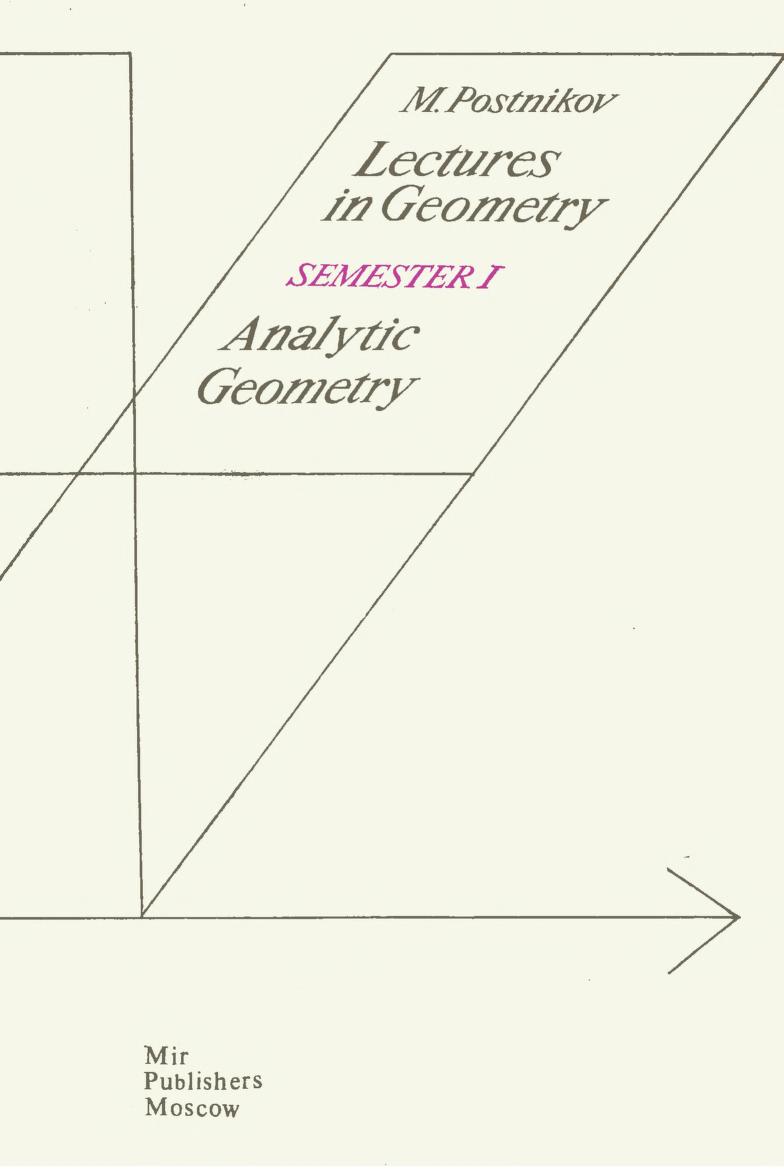
In this post, we will see the book Lectures in Geometry – Semester 1 Analytic Geometry by M. Postnikov. This book is the first one of a five part Lectures in Geometry series. So far we have volumes 1, 2 and 5, volumes 3 and 4 are missing.
About the book

This textbook comprises lectures read by the author to the first-year students of mathematics at Moscow State University. The book is divided into two parts containing the texts of lectures read in the first and second semesters, respectively. Part One contains 29 lectures and read in the first semester.
The subject matter is presented on the basis of vector axiomatics
of geometry with special emphasis on logical sequence in introduction of the basic geometrical concepts. Systematic exposition and application of bivectors and trivectors enables the author to successfully combine the above course of lectures with the lectures of the following semesters. The book is intended for university undergraduates majoring in mathematics.

The book was translated from Russian by by Vladimir Shokurov and was published in 1982 by Mir.

Credits to the original uploader.

You can get the book here.

Follow us on The Internet Archive: https://archive.org/details/@mirtitles

Follow Us On Twitter: https://twitter.com/MirTitles

Write to us: mirtitles@gmail.com

Fork us at GitLab: https://gitlab.com/mirtitles/

Add new entries to the detailed book catalog here.

Contents

Preface to the Russian edition 11
Preface to the English edition 13

Lecture 1 15

The subject-matter of analytic geometry. Vectors. Vector addition. Multiplication of a vector by a number. Vector spaces. Examples. Vector spaces over an arbitrary field

Lecture 2 23

The simplest consequences of the vector space axioms. Independence of the sum of any number of vectors on brackets arrangement. The concept of a family

Lecture 3 28

Linear dependence and linear independence. Linearly independent sets. The simplest properties of linear dependence. Linear-dependence theorem

Lecture 4 35

Collinear vectors. Coplanar vectors. The geometrical meaning of collinearity and coplanarity. Complete families of vectors, bases, dimensionality. Dimensionality axiom. Basis criterion. Coordinates of a vector. Coordinates of the sum of vectors and those of the product of a vector by a number

Lecture 5 43

Isomorphisms of vector spaces. Coordinate isomorphisms. The isomorphism of vector spaces of the same dimension. The method of coordinates. Affine spaces. The isomorphism of affine spaces of the same dimension. Affine coordinates, Straight lines in affine space. Segments –

Lecture 6 54

Parametric equations of a straight line. The equation of a straight line in a plane. The canonical equation of a straight line in a plane. The general equation of a straight line in a plane. Parallel lines. Relative position of two straight lines in a plane. Uniqueness theorem. Position of a straight line relative to coordinate axes. The half-planes into which a straight line divides a plane

Lecture 7 63

An intuitive notion of a bivector. A formal definition of the bivector. The coincidence of the two definitions. A zero bivector. Conditions for the equality of bivectors. Parallelism of the vector and the bivector. The role of the three-dimensionality condition. Addition of bivectors

Lecture 8 71

The correctness of the definition of a bivector sum. The product of a bivector by a number. Algebraic properties of external product. The vector space of bivectors. Bivectors in a plane and the theory of areas. Bivectors in space

Lecture 9 82

Planes in space. Parametric equations of a plane. The general equation of a plane. A plane passing through three noncollinear points

Lecture 10 87

The half-spaces into which a plane divides space. Relative positions of two planes in space. Straight lines in space. A plane containing a given straight line and passing through a given point. Relative positions of a straight line and a plane in space. Relative positions of two straight lines in space. Change from one basis for a vector space to another

Lecture 11 99

Formulas for the transformation of vector coordinates. Formulas for the transformation of the affine coordinates of points. Orientation. Induced orientation of a straight line. Orientation of a straight line given by an equation. Orientation of a plane in space

Lecture 12 112

Deformation of bases. Sameness of the sign bases. Equivalent bases and matrices. The coincidence of deformability with the sameness of sign. Equivalence of linearly independent systems of vectors. Trivectors. The product of a trivector by a number. The external product of three vectors

Lecture 13 123

Trivectors in three-dimensional vector space. Addition of trivectors. The formula for the volume of a parallelepiped. Scalar product. Axioms of scalar multiplication. Euclidean spaces. The length of a vector and the angle between vectors. The Cauchy-Buniakowski inequality. The triangle inequality. Theorem on the diagonals of a parallelogram. Orthogonal vectors and the Pythagorean theorem

Lecture 14 133

Metric form and metric coefficients. The condition of positive definiteness. Formulas for the transformation of metric coefficients when changing a basis. Orthonormal families of vectors and Fourier coefficients. Orthonormal bases and rectangular coordinates. Decomposition of positive definite matrices. The Gram-Schmidt orthogonalization process. Isomorphism of Euclidean spaces. Orthogonal matrices. Second-order orthogonal matrices. Formulas for the transformation of rectangular coordinates

Lecture 15 148

Trivectors in oriented Euclidean space. Triple product of three vectors. The area of a bivector in Euclidean space. A vector complementary to a bivector in oriented Euclidean space. Vector multiplication. Isomorphism of spaces of vectors and bivectors. Expressing a vector product in terms of coordinates. The normal equation of a straight line in the Euclidean plane and the distance between a point and a straight line. Angles between two straight lines in the Euclidean plane

Lecture 16 160

The plane in Euclidean space. The distance from a point to a plane. The angle between two planes, between a straight line and a plane, between two straight lines. The distance from a point to a straight line in space. The distance between two straight lines in space. The equations of the common perpendicular of two skew lines in space ‘

Lecture 17 166

The parabola. The ellipse. The focal and directorial properties of the ellipse. The hyperbola. The focal and directorial properties of the hyperbola

Lecture 18 176

The equations of ellipses, parabolas and hyperbolas referred to a vertex. Polar coordinates. The equations of ellipses, parabolas and hyperbolas in polar coordinates. Affine ellipses, parabolas, hyperbolas. Algebraic curves. Second-degree curves and associated difficulties. Complex affine geometry and its insufficiency

Lecture 19 187

Real-complex vector spaces. Their dimensionality. Isomorphism of real-complex vector spaces. Complexification. Real-complex affine spaces. The complexification of affine spaces. Real-complex Euclidean spaces. Real and imaginary curves of second degree.

Lecture 20 193

Introductory remarks. The centre of a second-degree curve. Centres of symmetry. Central and noncentral curves of second degree. Straight lines of non-asymptotic direction. Tangents. Straight lines of asymptotic direction

Lecture 21 203

Singular and nonsingular directions. Diameters. Diameters and centres. Conjugate directions and conjugate diameters. Simplification of the equation of the second-degree central curve. Necessary refinements. Simplification of the equation of the second-degree noncentral curve

Lecture 22 215

Second-degree curves in the complex aífine plane. Second-degree curves in the real-complex affine plane. The uniqueness of the equation of a second-degree curve. Second-degree curves in the Euclidean plane. Circles

Lecture 23 228

Ellipsoids. Imaginary ellipsoids. Second-de imaginary cones. Hyperboloids of two sheets. Hyperboloids of one sheet. Rectilinear generators of a hyperboloid of one sheet. Second-degree cones. Elliptical paraboloids. Hyperbolic paraboloids. Elliptical cylinders. Other second-degree surfaces. The statement of the classification theorem

Lecture 24 254

Coordinates of a straight line. Pencils of straight lines. Ordinary and ideal pencils. Extended planes. Models of projective-affine geometry

Lecture 25 264

Homogeneous affine coordinates. Equations of straight lines in homogeneous coordinates. Second-degree curves in the projective-affine plane. Circles in the projective-Euclidean real-complex plane. Projective planes. Homogeneous affine coordinates in the bundle of straight lines. Formulas for the transformation of homogeneous affine coordinates. Projective coordinates. Second-degree curves in the projective plane

Lecture 26 274

Coordinate isomorphisms of vector spaces. Coordinate isomorphisms of affine spaces. Projective-affine spaces. Projective spaces. Pencils of planes. Bundles of planes. Extending space with ideal elements. Orthogonal, affine and projective transformations

Lecture 27 288

Expressing an affine transformation in terms of coordinates. Examples of affine transformations. Factorization of affine transformations. Orthogonal transformations. Motions of a plane. Symmetries and glide symmetries. A motion of a plane as a composition of two symmetries. Rotations of a space

Lecture 28 302

The Desargues theorem. The Pappus-Pascal theorem. The Fano theorem. The duality principle. Models of the projective plane. Models of the projective straight line and of the projective space. The complex projective straight line

Lecture 29 315

Linear fractional transformations. Linear transformations. Inversion. Inversions and linear fractional transformations. Two properties of linear fractional transformations. Fixed points of linear fractional transformations. Parabolic, elliptical, hyperbolic and loxodromic linear fractional transformations. The three-point theorem. The multiplier of linear fractional nonparabolic transformation. Classiffcation of linear fractional transformations. Stereographic projection formulas. Rotations of a sphere as linear fractional transformations of a plane. Isometries of a cube

Subject index 341

Posted in books, mathematics, mir books, mir publishers, soviet | Tagged , , , , , , , , , , , , , , , , , , , , , , , , | 1 Comment
Firm-as-a-Rock Soft-as-Silk and Sweet-as-Honey

In this post, we will see the book Firm As Rock Soft As Silk Sweet As Honey edited by Zdravka Tasheva.

About the book

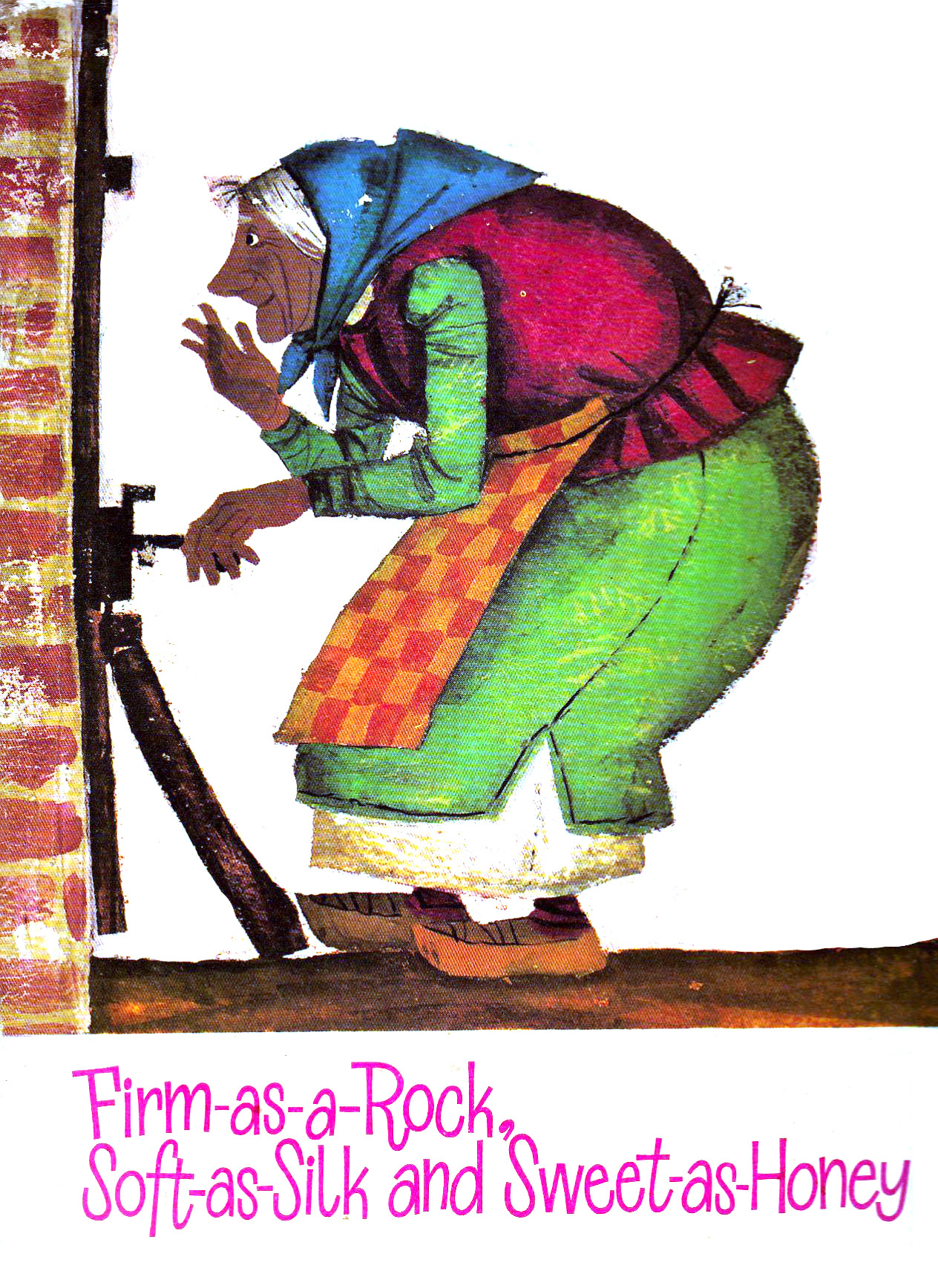
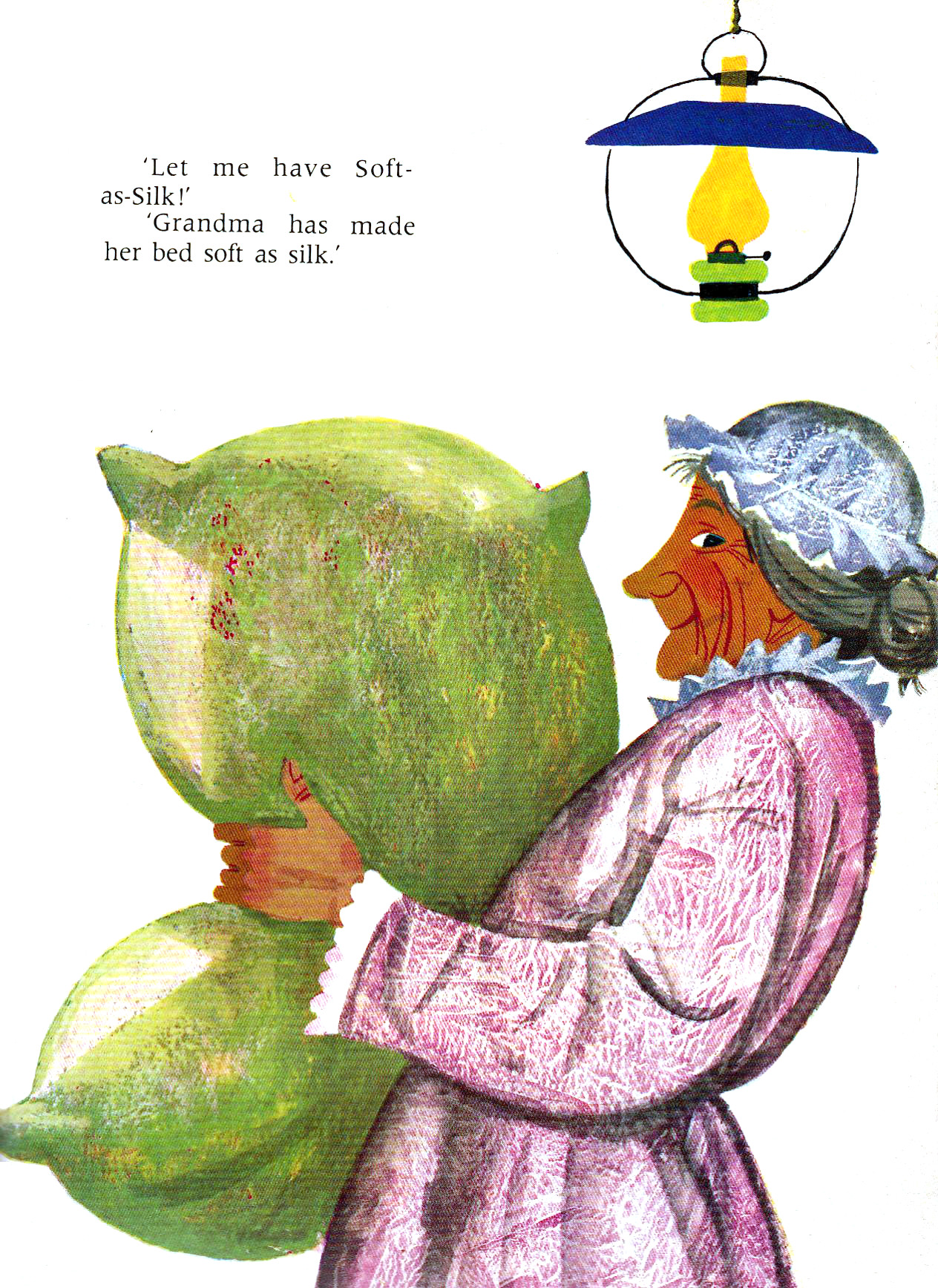
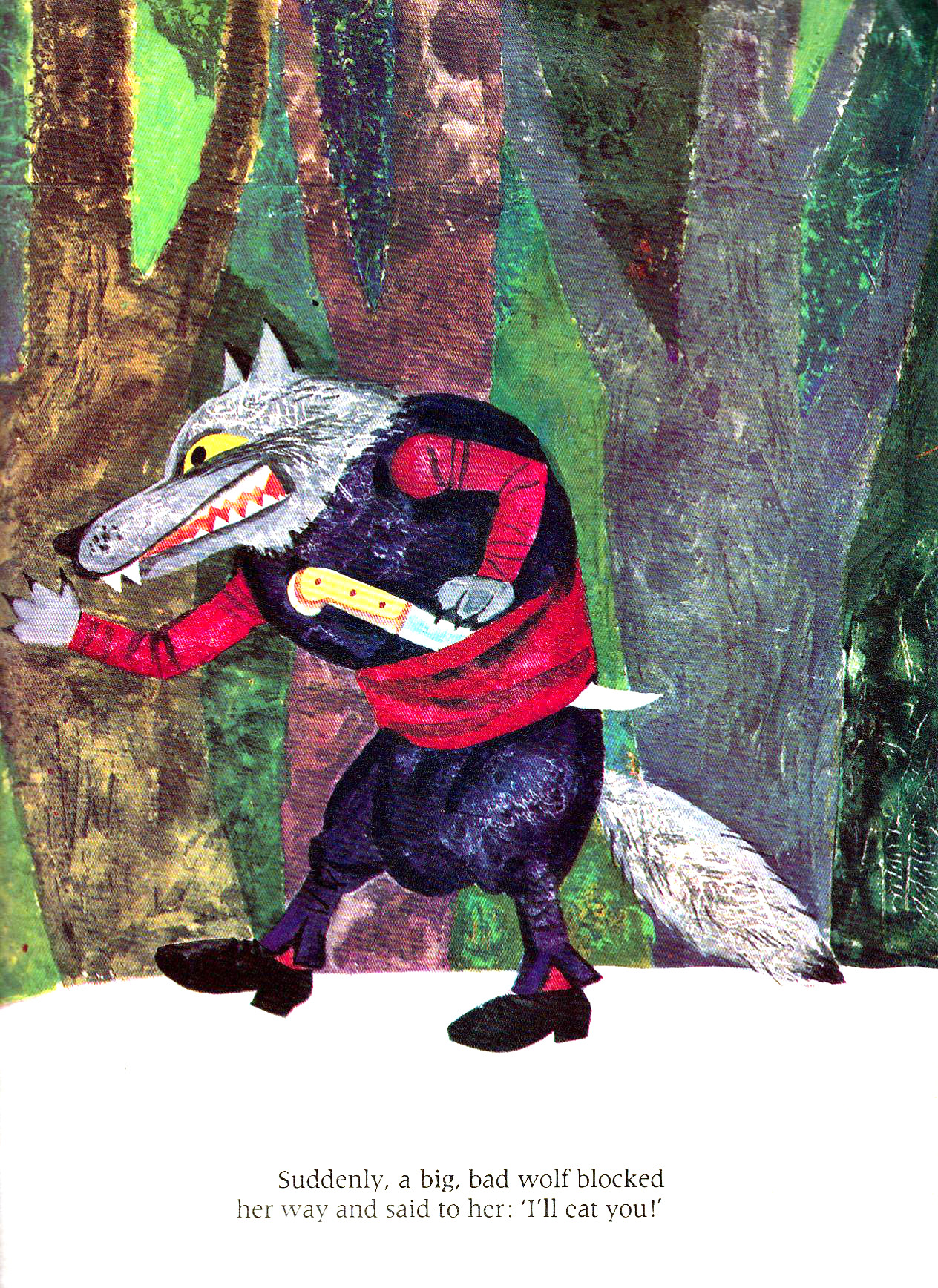
The book tells us story of a grandma who protects her grandchildren from a hungry, big bad wolf.

The book was translated from Bulgarian by and was published in Sofia press in Bulgaria. The book was illustrated by Gencho Denchev.

All credits to Guptaji.

You can get the book here.

Follow us on The Internet Archive: https://archive.org/details/@mirtitles

Follow Us On Twitter: https://twitter.com/MirTitles

Write to us: mirtitles@gmail.com

Fork us at GitLab: https://gitlab.com/mirtitles/

Add new entries to the detailed book catalog here.


Posted in books, children's books, children's stories, soviet | Tagged , , , | Leave a comment