Solid State Physics – Epifanov (LaTeX version)

In this post, we will see the completely electronic LaTeX version of the  book Solid State Physics by G. I. Epifanov.


Epifanov-Solid-State-Physics-Mir-1979.jpg

About the book

This is a classic book on the topic of solid state physics. and covers the various topics comprehensively. Starting from the structure of matter and various types of bonds in the first chapter the mechanical properties are treated in the second chapter. The second chapter also includes a discussion of Hooke’s Law, plastic flow, dislocations, elasticity etc. The third chapter deals with statistical mechanics and discusses degenerate and non-degenerate ensembles and various distribution functions. The fourth chapter looks at thermal properties of solids with reference to crystal lattice, heat capacity, heat conductivity etc. The fifth chapter discusses band theory of solids with reference to energy spectrum, effective mass and semiconductors. Some of the graphs in this chapter are revealing of the physical processes in the working of band structure. Sixth and seventh chapter deal with electrical and magnetic properties of solids. Sixth chapter also discusses deviations from Ohm’s Law (Section 58). Seventh chapter includes discssion on various types of magnetism their origins, and magnetic properties of solids and atoms along with magnetic resonance.  Eighth chapter discusses contact phenomenon, work functions between different of materials including p-n junctions. The last chapter discusses thermoelectric and galvanomagnetic phenomena including Seeback effect, Peltier effect, Thomson effect and some of their practical applications.

As in the first edition, the presentation of material has followed the aim of elucidating the physical nature of the phenomena dis­cussed. But, where possible, the qualitative relations are also pre­sented, often though without rigorous mathematics.

Some snapshots from the book – all the images have been redrawn meticulously!


The book was translated from the Russian by Mark Samokhvalov and was published by Mir in 1979.

Link for the new LaTeX version

All credits to Leandro Acquaroli | lnacquaroli 

Git repo for the book

Link to Original Scan


Contents

Preface 5


1 Bonding. The Internal Structure of Solids


§ 1 The van der Waals forces 11

§ 2 The ionic bond 15

§ 3 The covalent bond 16

§ 4 The metallic bond 21

§ 5 The hydrogen bond 22

§ 6 Comparison between bonds of various kinds 23

§ 7 Forces of repulsion 24

§ 8 Crystal lattice 25

§ 9 Notation used to describe sites, directions, and planes in a crystal 29

§10 Classification of solids based on the nature of bonds 32

§11 Polymorphism 38

§12 Imperfections and defects of the crystal lattice 42


2 Mechanical Properties of Solids


§ 13 Elastic and plastic deformations. Hooke’s law 46

§ 14 Principal laws governing plastic flow in crystals 51

§ 15 Mechanical twinning 55

§ 16 Theoretical and real shear strengths of crystals 56

§ 17 The dislocation concept. Principal types of dislocations 58

§ 18 Forces needed to move dislocations 64

§ 19 Sources of dislocations. Strengthening of crystals 66

§ 20 Brittle strength of solids 71

§ 21 Time dependence of the strength of solids 77

§ 22 Methods of increasing the strength of solids 81


3 Elements of Physical Statistics

§ 23 Methods used to describe the state of a macroscopic system 84

§ 24 Degenerate and nondegenerate ensembles 88

§ 25 The number of states for microscopic particles 91

§ 26 Distribution function for a nondegenerate gas 94

§ 27 Distribution function for a degenerate fermion gas 96

§ 28 Distribution function for a degenerate boson gas 103

§ 29 Rules for statistical averaging 105


4 Thermal Properties of Solids

§ 30 Normal modes of a lattice 107

§ 31 Normal modes spectrum of a lattice 110

§ 32 Phonons 112

§ 33 Heat capacity of solids 115

§ 34 Heat capacity of electron gas 120

§ 35 Thermal expansion of solids 122

§ 36 Heat conductivity of solids 126


5 The Band Theory of Solids


§ 37 Electron energy levels of a free atom 133

§ 38 Collectivization of electrons in a crystal 136

§ 39 Energy spectrum of electrons in a crystal 138

§ 40 Dependence of electron energy on the wave vector 142

§ 41 Effective mass of the electron 147

§ 42 Occupation of bands by electrons. Conductors,dielectrics, and semiconductors 151

§ 43 Intrinsic semiconductors. The concept of a hole 153

§ 44 Impurity semiconductors 156

§ 45 Position of the Fermi level and free carrier concentration in semiconductors 159

§ 46 Nonequilibrium carriers 166


6 Electrical Conductivity of Solids


§ 47 Equilibrium state of electron gas in a conductor in the absence of an electric field 169

§ 48 Electron drift in an electric field 170

§ 49 Relaxation time and mean free path 171

§ 50 Specific conductance of a conductor 173

§ 51 Electrical conductivity of nondegenerate and degenerate gases 174

§ 52 Wiedemann-Franz-Lorenz law 176

§ 53 Temperature dependence of carrier mobility 177

§ 54 Electrical conductivity of pure metals 183

§ 55 Electrical conductivity of metal alloys 184

§ 56 Intrinsic conductivity of semiconductors 188

§ 57 Impurity (extrinsic) conductivity of semiconductors 190

§ 58 Deviation from Ohm’s law. The effect ofa strong field 193

§ 59 The Gunn effect 195

§ 60 Photoconductivity of semiconductors 196

§ 61 Luminescence 203

§ 62 Fundamentals of superconductivity 207


7 Magnetic Properties of Solids


§ 63 Magnetic field in magnetic materials 224

§ 64 Magnetic properties of solids 225

§ 65 Magnetic properties of atoms 232

§ 66 Origin of diamagnetism 238

§ 67 Origin of paramagnetism 240

§ 68 Origin of ferromagnetism 247

§ 69 Antiferromagnetism 254

§ 70 Ferrimagnetism. Ferrites 255 § 71 Magnetic resonance 257

§ 72 Fundamentals of quantum electronics 259


8 Contact Phenomena


§ 73 Work function 265

§ 74 Contact of two metals 268

§ 75 The metal-semiconductor contact 271

§ 76 Contact between two semiconductors of different types of conductivity 278

§ 77 Physical principles of semiconductor p~n junction devices 288 § 78 Fundamentals of integrated circuit electronics (microelectron­

ics) 299


9 Thermoeleletric and Galvanomagnetic Phenomena


§ 79 The Seebeck effect 302.

§ 80 The Peltier effect 307

§ 81 The Thomson effect 310

§ 82 Galvanomagnetic phenomena 310

§ 83 Practical applications of thermoelectric and galvanomag­netic phenomena 315


Appendices


I Derivation of the Maxwell-Boltzmann distribution function 317

II Derivation of the Fermi-Dirac distribution function 318

III Derivation of the Bose-Einstein distribution function 320

IV Tables 321


Glossary of Symbols and Notations 322

Bibliography 326 Index 329
Posted in books, physics | Tagged , , , , , , , , , , , , , , , , , , , , , , , , , , , , , , , , , , , , | Leave a comment

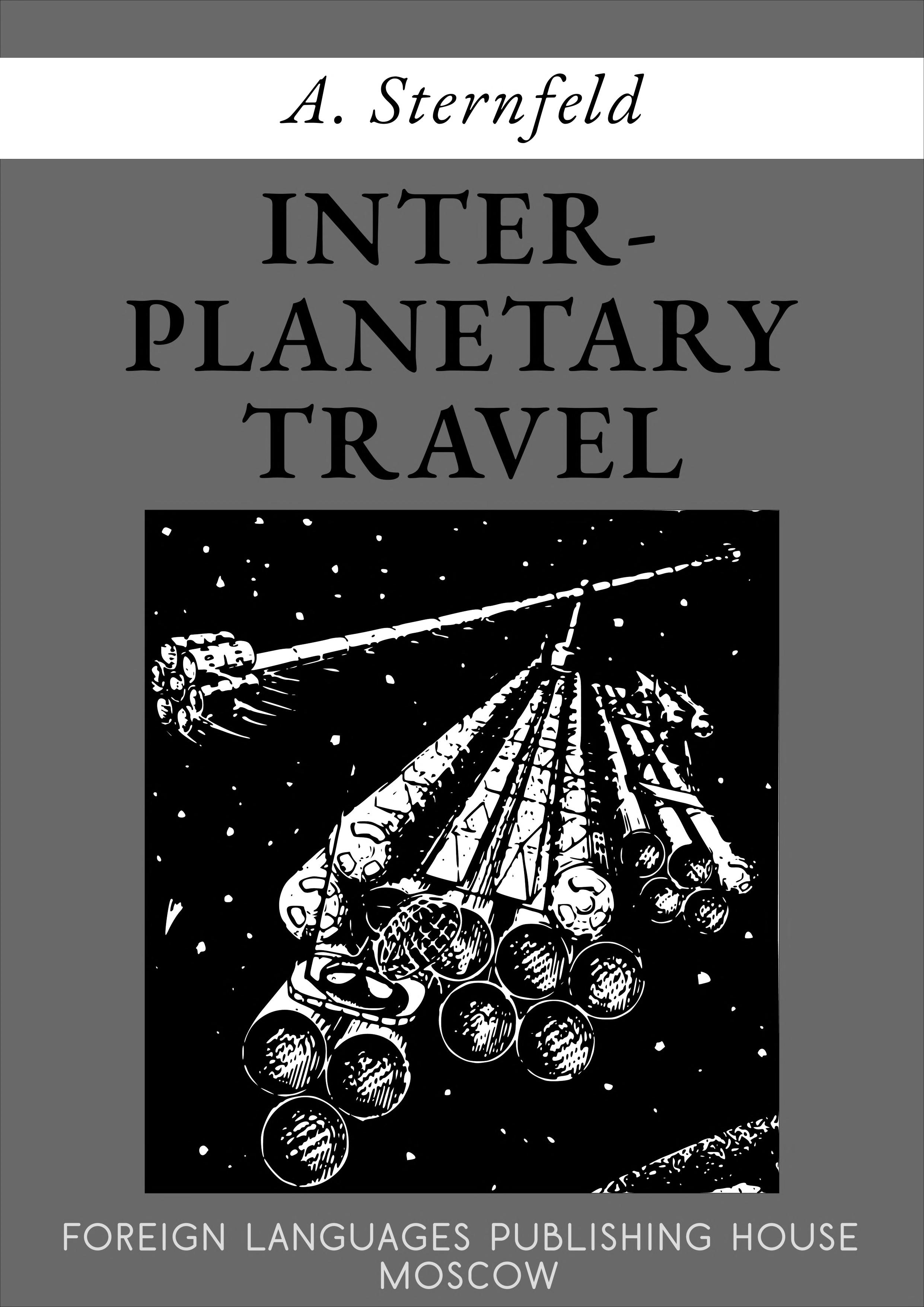
Interplanetary Travel – Sternfeld

In this post, we will see the book Interplanetary Travel by A. Sternfeld.

About the book

This hook is based mainly on materials published earlier by the writer, but emphasis is placed on problems connected with artificial satellites, the launching of which has marked the first step on mans way into interplanetary space. Investigation of the Earth and the space surrounding it by means of artificial satellites is an integral
part of the programme of the International Geophysical Year (July 1957-December 1958) a scientific undertaking of extraordinary scope. All nations of the world, whose representatives meet annually at international astronautical congresses, participate in observing these man-created moons. The International Astronautical Federation units the national astronautical societies of over twenty countries, and has a growing membership. It is up to the peoples to decide to what degree their efforts be creative and not destructive so that the next steps into the cosmos will be seven-league.

The book was translated from Russian by Geroge Yankovsky and was published in 1958 by Foreign Languages Publishing House .

Credits to original uploader.

You can get the book here.

Follow us on The Internet Archive: https://archive.org/details/@mirtitles

Follow Us On Twitter: https://twitter.com/MirTitles

Write to us: mirtitles@gmail.com

Fork us at GitLab: https://gitlab.com/mirtitles/

Add new entries to the detailed book catalog here.

Contents

Introduction 5
From Legend to Science in Space Flight 8

I. SPACE VEHICLES

1. Escape from the Earth 12
2. Rocket—Prototype of Spaceship 17
3. Artificial Satellites 21
4. Assembling the Satellite 32
5. Space Craft in Design 33

II. MAN IN OUTER SPACE

1. High Speeds Are Harmless 38
2. In the World of Overweight 39
3. Life in Conditions of Weightlessness 41
4. Artificial Gravity 48
5. Problems of Eating and Breathing 49
6. The Hazards of Space Flight 50
7. Preparing for a Flight into Space 55

III. ARTIFICIAL SATELLITES AND THEIR OBSERVATION

1. Orbiting Artificial Satellites 58
2. A Stationary Artificial Satellite 65
3. Observing Artificial Satellites 66
4. The Movements of Celestial Bodies Viewed from Artificial Satellites 79
5. Days, Nights and Seasons on Artificial Satellites 82

IV. ARTIFICIAL SATELLITES PUT TO USE

1. Flying Observatories and Laboratories 85
2. Artificial Satellites as Interplanetary Stations 95
3. The Problem of Natural cia savin Stations 99

V. ON BOARD THE SPACESHIP

1. Take-off 101
2. In Flight 103
3. Landing 106

VI. SPACE FLIGHT

1. A Trip to the Moon 108
2. Mission to Mars 111
3. A Voyage to Venus 116
4. Journeys to Other Worlds 120

Conclusion 124

Posted in Aerodynamics, books, engineering, foreign languages publishing, soviet, space, technology | Tagged , , , , , , , , , | Leave a comment

Epidemiology and Fundamentals of Infectious Diseases – Volovskaya

In this post, we will see the book Epidemiology And Fundamentals Of Infectious Diseases by M. L. Volovskaya.

About the book

This book discusses various infectious diseases and the subject matter of epidemiology. The diseases their method of spreading and treatments are provided. The diseases discussed include intestinal infections, respiratory infections, blood infections, malaria and haemorrhagic fevers , plague, skin infections and AIDS.

The book was translated from Russian by Alexander Rosinkin and was published in 1990 by Mir Publishers.

PS: This scan has the original text replaced by electronic text.

Credits to original uploader.

You can get the book here.

Follow us on The Internet Archive: https://archive.org/details/@mirtitles

Follow Us On Twitter: https://twitter.com/MirTitles

Write to us: mirtitles@gmail.com

Fork us at GitLab: https://gitlab.com/mirtitles/

Add new entries to the detailed book catalog here.

Contents


Part One. General Epidemiology 9

The Subject Matter of Epidemiology 9

The Concept of Infection 12

The Concept of Epidemic Process 13

Classification of Infectious Diseases 28

Prevention of Infectious Diseases and Measures to Control Them 34

Review Problems 44

Disinfection Measures 44

Disinfection (45). Disinsection (50). Rodent Control (54). Disinfec-
tion in Various Infectious Diseases (55). Quarantine Measures (60)
Review Problems 60

Part Two. The Concept of Infectious Process 62

The Course of Infectious Diseases 62

Infectious Department and Hospital 69

Care and Nutrition of Infectious Patients 71
Treatment of Infectious Patients 73

Review Problems 80

Part Three. Special Epidemiology 81

Intestinal Infections 81

Typhoid Fever (Typhus abdominalis) (81). Paratyphoid Fevers A
and B (90). Salmonellosis (91). Pseudotuberculosis (97). Yersiniosis
(100). Intestinal Infections due to Conventionally Pathogenic Microbes (102). Staphylococcal Toxaemia (104). Botulism (105). Dysentery
(109). Amoebiasis (118). Escherichia Coli Infections (121). Cholera
(124). Rotaviral Gastroenteritis (132). Viral Hepatitis (134). Poliomyelitis (143). Non-poliomyelitis Enteroviral Infections (Coxsackievirus
and Echovirus Infections) (149). Brucellosis (151). Leptospirosis (157)
Review Problems 162

Respiratory Infections 163

Influenza (163). Parainfluenza (169). Adenovirus Infections (170).
Smallpox (Variola) (172). Diphtheria (176). Scarlet Fever (184). Measles
(Rubeola) (189). Rubella (German Measles) (192). Whooping Cough
(Pertussis) (194). Parapertussis (197). Chickenpox (Varicella) (198).
Mumps (Epidemic Parotitis) (200). Meningococcal Infection (202).
Psittacosis (Ornithosis) (209). Legionellosis (213)
Review Problems 216

Blood Infections 217

Rickettsioses (217). Epidemic Typhus and Brill’s Disease (218). Ende-
mic (Murine) Typhus (225). Q Fever (226)

Borrelioses 229

Relapsing Fever (229). Endemic Relapsing Fever (231). Tick-Borne
Encephalitis (Encephalitis acarinarum) (233). Japanese Encephalitis
(236)

Malaria 238

Leishmaniasis 249
Visceral Leishmaniasis (249). Cutaneous Leishmaniasis (252).

Haemorrhagic Fevers 255

Crimean-Congo Haemorrhagic Fever (255). Omsk Haemorrhagic
Fever (257). Kyasanur Forest Disease (258). Yellow Fever (259).
Dengue Haemorrhagic Fever (262). Chikungunya Haemorrhagic Fe-
ver (263). Haemorrhagic Fever with Renal Syndrome (264). Lassa
Fever (267). Argentinian and Bolivian Haemorrhagic Fevers (269).
Ebola and Marburg Virus Haemorrhagic Fevers (270). Pappataci
Fever (272)

Plague 274

Tularaemia 281
Review Problems 287

Skin Infections 287

Anthrax (287). Rabies (Hydrophobia) (294). Tetanus (297). Erysipelas
(301)

Acquired Immune Deficiency Syndrome 303

Appendix I 309
Appendix II 311
Subject Index 314

Posted in books | Tagged , , , , , , , , , , , , , , , , , , , , , , , , | Leave a comment

इवान – बोगोमोलोव (Ivan – Bogomolov Marathi/Hindi)

In this post, we will see the Marathi book Ivan by V.  Bogolomov

इवान  व्लादिमीर बोगोमोलोव

About the book

A Soviet Novel in Marathi for children. Set during the Second World War. A nice summary is given here. The book was also adapted into a movie Ivan’s Childhood which was directed by great Russian director Andrei Tarkovsky.

The book was translated from Russian by Anil Havaldar and designed by S. A. Barabash. The illustrations are by Orest Veryesky. The book was published in 1987 by Lokwangmay Gruh, orginally Raduga 1987.


PS: There is a Hindi version too. Do post in the comments if you know of any other translations.

Credits to original uploader.

You can get the book here.

Follow us on The Internet Archive: https://archive.org/details/@mirtitles

Follow Us On Twitter: https://twitter.com/MirTitles

Write to us: mirtitles@gmail.com

Fork us at GitLab: https://gitlab.com/mirtitles/

Add new entries to the detailed book catalog here.

Posted in books, children's books, children's stories, literature, soviet | Tagged , , , , , , , | Leave a comment

Fun With Numbers – Stepnova

In this post, we will see the book Fun With Numbers by I. Stepnova.

About the book

This is a small book to teach children numbers and arithmetic operations on them. The book uses variety of contexts and situations to present exercises in numbers.

The book was translated from Russian by was published in 198? by Raduga Publishers. The illustrations are by B Rytman. The present scan is a reprint from Visalaandhra Publishing House in 2005. Unfortunately the illustrations are in black and white in VPH copy, so they are in the scan. If anyone has the original Raduga copy, please consider scanning it.

Credits to original uploader.

You can get the book here.

Follow us on The Internet Archive: https://archive.org/details/@mirtitles

Follow Us On Twitter: https://twitter.com/MirTitles

Write to us: mirtitles@gmail.com

Fork us at GitLab: https://gitlab.com/mirtitles/

Add new entries to the detailed book catalog here.


Posted in books, children's books, mathematics | Tagged , , , , , , , | Leave a comment

Commutative Normed Rings – Gelfand, Raikov, Shilov

In this post, we will see the book Commutative Normed Rings by I. Gelfand; D. Raikov; G. Shilov.

About the book

The present book gives an account of the theory of commu­tative normed rings with applications to analysis and topology. The paper by I. N. Gelfand and M. A. Naimark Normed Rings with an Involution and their Representations, which is presented here as Chapter VIII, may serve as an intro­duction to the theory of non-commutative normed rings with an involution.
The book is addressed to mathematicians—students in ad­vanced courses, research students, and scholars—who are interested in functional analysis and its applications.

The book was translated from Russian and  was published in 1964.

Credits to original uploader.

You can get the book here.

Follow us on The Internet Archive: https://archive.org/details/@mirtitles

Follow Us On Twitter: https://twitter.com/MirTitles

Write to us: mirtitles@gmail.com

Fork us at GitLab: https://gitlab.com/mirtitles/

Add new entries to the detailed book catalog here.

Contents

PART ONE

I. THE GENERAL THEORY OF COMMUTATIVE NORMED RINGS 15

§ 1. The Concept of a Normed Ring 15
§ 2. Maxiimal Ideals 20
§ 3. Abstract Analytic Functions 27
§ 4. Functions on Maximal Ideals. The Radical of a Ring 30
§ 5. The Space of Maximal Ideals 37
§ 6. Analytic Functions of an Element of a Ring 46
§ 7. The Ring R of Functions x(M) 51
§ 8. Rings with an Involution 56


II. THE GENERAL THEORY OF COMMUTATIVE NORMED RINGS (cont’d)66

§ 9. The Connection between Algebraic and Topological Isomorphisms 66
§ 10. Generalized Divisors of Zero 69
§ 11. The Boundary of the Space of Maximal Ideals 73
§ 12. Extension of Maximal Ideals 78
§ 13. Locally Analytic Operations on Certain Elements of a Ring 80
§ 14. Decomposition of a Normed Ring into a Direct Sum of Ideals 94
§ 15. The Normed Space Adjoint toa Normed Ring 97

PART TWO

III. THE RING OF ABSOLUTELY INTEGRABLE FUNCTIONS AND
THEIR DISCRETE ANALOGUES 100

§ 16. The Ring V of Absolutely Integrable Functions on the Line 100
§ 17. Maximal Ideals of the Rings V and V+ 106
§ 18. The Ring of Absolutely Integrable Functions With a Weight 113
§ 19. Discrete Analogues to the Rings of Absolutely Integrable
Functions 116

IV. HARMONIC ANALYSIS ON COMMUTATIVE LOCALLY COMPACT GROUPS 121

§ 20. The Group Ring of a Commutative Locally Compact Group 123
§ 21. Maximal Ideals of the Group Ring and the Characters of
a Group 129
§ 22. The Uniqueness Theorem for the Fourier Transform and the Abundance of the Set of Characters 135
$ 23. The Group of Characters 141
§ 24. The Invariant Integral on the Group of Characters 144
§ 25. Inversion Formulas for the Fourier Transform 151
§ 26. The Pontrjagin Duality Law 156
§ 27. Positive-Definite Functions 159

V. THE RING OF FUNCTIONS OF BOUNDED VARIATION ON A LINE 165

§ 28. Functions of Bounded Variation on a Line 165
§ 29. The Ring of Jump Functions 167
§ 30. Absolutely Continuous and Discrete Maximal Ideals of the Ring) 176
§ 31. Singular Maximal Ideals of the Ring V^(b) 180
§ 32. Perfect Sets with Linearly Independent Points. The Asymmetry of the Ring V^(b) 187
§ 33. The General Form of Maximal Ideals of the Ring V^(b) 192

PART THREE

VI. REGULAR RINGS 197

§ 34. Definitions, Examples, and Simplest Properties 197
§ 35: The Local Theorem 200
§ 36. Minimal Ideals 204
§ 37. Primary Ideals 205
§ 38. Locally Isomorphic Rings 207
§ 39. Connection between the Residue-Class Rings of Two Rings of Functions, One Embedded in the Other 210
§ 40. Wiener’s Tauberian Theorem 213
§ 41. Primary Ideals in Homogeneous Rings of Functions 214
§ 42. Remarks on Arbitrary Closed Ideals. An Example of L. Schwartz 219

VII. RINGS WITH UNIFORM CONVERGENCE 223

§ 43. Symmetric Subrings of C(S) and Compact Extensions of Space S 223
§ 44. The Problem of Arbitrary Closed Subrings of the Ring C(S) 227
§ 45. Ideals in Rings with Uniform Convergence 234

VII. NORMED RINGS WITH AN INVOLUTION AND THEIR REPRESENTATIONS 240

§ 46. Rings with an Involution and their Representations 241
§ 47. Positive Functionals and their Connection with Representations Of Rings 244
§ 48. Embedding of a Ring with an Involution in a Ring of Operators 251
§ 49. Indecomposable Functionals and Irreducible Representations 255
§ 50. The Case of Commutative Rings 259
§ 51. Group Rings 263
§ 52. Example of an Unsymmetric Group Ring 268

IX. THE DECOMPOSITION OF A COMMUTATIVE NORMED RING INTO A DIRECT SUM OF IDEALS 275

§ 53. Introduction 275
§ 54. Characterization of the Space of Maximal Ideals of a Commutative Normed Ring 277
§ 55. A Problem on Analytic Functions in a Finitely Generated Ring 278
§ 56. Construction of a Special Finitely Generated Subring 282
§ 57. Proof of the Theorem on the Decomposition of a Ring
into a Direct Sum of Ideals 285
S56. Some Corollaries 285

HISTORICO-BIBLIOGRAPHICAL NOTES 291
BIBLIOGRAPHY 295
INDEX 303

Posted in books, mathematics, soviet | Tagged , , , , , , , , , , | Leave a comment

Mathematical Analysis – Differentiation and Integration – Aramanovich et al

In this post, we will see the book Mathematical Analysis – Differentiation And Integration
by I. G. Aramanovich; R.S.Guter; L.A.Lyusternik; I.L. Raukhvarger; M. I. Skanavi; A. R.Yanpol’skii.


About the book

The present volume of the series in Pure and Applied Mathe­matics is devoted to two basic operations of mathematical analysis — differentiation and integration. It discusses the complex of problems directly connected with the operations of differentiation and integration of functions of one or several variables, in the classical sense, and also elementary generalizations of these operations. Further generalizations will be given in subsequent volumes of the series, volumes devoted to the theory of functions of real variables and to functional analysis.
Together with an earlier volume in the series, volume 69, L. A. Lyusternik and A. R. Yanpol’skii, Mathematical Analysis (Functions, Limits, Series, Continued Fractions), the present one includes material for a course of mathematical analysis, which is treated in a logically connected manner, briefly and without proofs, but with many examples worked in detail.

The book was translated from Russian by H. Moss and edited by I. N. Sneddon and was published in 1965.

Credits to original uploader.

You can get the book here.

Follow us on The Internet Archive: https://archive.org/details/@mirtitles

Follow Us On Twitter: https://twitter.com/MirTitles

Write to us: mirtitles@gmail.com

Fork us at GitLab: https://gitlab.com/mirtitles/

Add new entries to the detailed book catalog here.

Contents

CHAPTER I. DIFFERENTIATION OF FUNCTIONS OF ONE VARIABLE 1

CHAPTER II. DIFFERENTIATION OF FUNCTIONS OF n VARIABLES 46

CHAPTER III. COMPOSITE AND IMPLICIT FUNCTIONS OF n VARIABLES 76

CHAPTER IV. SYSTEMS OF FUNCTIONS AND CURVILINEAR COORDINATES IN A PLANE AND IN SPACE 99

CHAPTER V. INTEGRATION OF FUNCTIONS 135

CHAPTER VI. IMPROPER INTEGRALS. INTEGRALS DEPENDENT ON A PARAMETER. STIELTJES’ INTEGRAL 135

CHAPTER VII. THE TRANSFORMATION OF DIFFERENTIAL AND INTEGRAL EXPRESSIONS 226

APPENDICES 257

REFERENCES 309

INDEX 311

Posted in books, mathematics, soviet | Tagged , , , , , , , , , , | Leave a comment

Mathematical Analysis – A Brief Course For Engineering Students – Bermant, Aramanovich

In this post, we will see the book Mathematical Analysis – A Brief Course For Engineering Students by A.F . Bermant; I. G. Aramanovich.

About the book

This course is designed as a textbook for engineering students. It embraces the topics in mathematical analysis usually included into curricula of technical colleges. The course also contains some optional material which may be omitted in a first reading of the book; the corresponding items are marked with the asterisk.
There are a number of courses dealing with special divisions of mathematical analysis, such as equations of mathematical physics, functions of a complex argument and the like, and therefore, although these divisions are important for mathematical education of an engineer, they are not treated in this book. We also draw attention to the fact that only a few questions related to approximate calculations and programming (e.g. the applica­tion of the differential to approximate calculations, methods of approximate solution of equations, numerical integration and solution of differential equations, etc.) are discussed in this course. For a thorough study of this subject some other textbooks should be used.
In this course many examples are given which demonstrate the application of mathematical analysis to various divisions of mechanics and physics. The study of these examples is very impor­tant since the main interest of an engineer lies in solving concrete applied problems. At the end of each chapter we give a number of questions aimed at checking the understanding of the theore­tical material. In the presentation of the material the main emphasis has been laid upon practical aspects, and some purely mathematical facts are given without proof. On the other hand, in some cases detailed proofs of theorems are given, especially when this elucidates the meaning of the theorem and shows in which way it can be applied. Besides, the study of the proofs helps the student to acquire practice in logical argument and provides prerequisites for further mathematical self-education.

The book was translated from Russian by was published in 1986  by Mir Publishers.

Credits to original uploader.

You can get the book here.

Follow us on The Internet Archive: https://archive.org/details/@mirtitles

Follow Us On Twitter: https://twitter.com/MirTitles

Write to us: mirtitles@gmail.com

Fork us at GitLab: https://gitlab.com/mirtitles/

Add new entries to the detailed book catalog here.

Contents

(The starred items indicate the sections that may
be omitted in a first reading of the book)

Preface 5
Introduction 15

1. The Subject of Mathematical Analysis 15
2. Variables and Functions 15
3. The Role of Mathematics and Mathematical Analysis in Natural Sciences and Engineering 16

CHAPTER I. FUNCTION 19

§ 1. Real Numbers 19
§ 2. The Concept of Function 26
§ 3. Characteristics of Behaviour of Functions. Some Important Examples 38
§ 4. Inverse Function. Power, Exponential and Logarithmic Function 51
§ 5. Trigonometric, Inverse Trigonometric, Hyperbolic and Inverse
Hyperbolic Functions. 60

CHAPTER II. LIMIT. CONTINUITY 72

§ 1. Limit. Infinitely Large Magnitudes 72
§ 2. Continuous Functions 98
Oo. CONUIAUIN ai ads Sa aca & ee Ss ae ee eee ee :
§ 3. Comparison of Infinitesimals. Comparison of Infinitely Large
Magnitudes 109

CHAPTER III. DERIVATIVE AND DIFFERENTIAL. DIFFERENTIAL CALCULUS 118

§ 1. Derivative 118
§ 2. Differentiating Functions 126
§ 3. Some Geometrical Problems. Graphical Differentiation 148
§ 4. Differential 155
§ 5. Derivatives and Differentials of Higher Orders 167

CHAPTER IV. APPLICATION OF DIFFERENTIAL CALCULUS TO INVESTIGATION OF BEHAVIOUR OF FUNCTIONS 175

§ 1. Theorems of Fermat, Rolle, Lagrange and Cauchy 175
§ 2. Investigating Functions wita the Aid of First and Second Derivatives 181
§ 3. L’Hospital’s Rule. General Scheme for Investigating Functions 204
§ 4. Curvature 219
§ 5. Space Curves. Vector Function of a Scalar Argument 225
§ 6. Complex Functions of a Real Argument 237
§ 7. Solution of Equations 245
QUESTIONS 255

CHAPTER V. INTEGRAL CALCULUS 258

§ 1. Indefinite Integral 258
§ 2. Definite Integral 291
§ 3. Methods of Evaluating Definite Integrals. 318
§ 4. Improper Integrals 331

CHAPTER VI. APPLICATION OF INTEGRAL CALCULUS 345

§ 1. Some Problems of Geometry and Statics 345
§ 2. General Scheme of the Application of the Integral 358

CHAPTER VII. FUNCTIONS OF SEVERAL VARIABLES AND THEIR DIFFERENTIATION 365

§ 1. Functions of Several Variables 365
§ 2. Derivatives and Differentials. Differential Calculus 376
§ 3. Applications of Differential Calculus to Geometry 409
§ 4. Extrema of Functions of Two Variables 414
§ 5. Scalar Field 427

CHAPTER VIII. DOUBLE AND TRIPLE INTEGRAL 437

§ 1. Double Integrals 437
§ 2. Triple Integrals 459
§ 3. Integrals Dependent on Parameters 471

CHAPTER IX. LINE INTEGRALS AND SURFACE INTEGRALS. FIELD THEORY 482

§ 1. Line Integrals 482
§ 2. Surface Integrals 515
§ 3. Field Theory 533
Questions 561

CHAPTER X. DIFFERENTIAL EQUATIONS 564

§ 1. Differential Equations of the First Order 564
§ 2. Differential Equations of the Second and Higher Orders 592
§ 3. Linear Differential Equations 603
§ 4. Systems of Differential Equations 635
QUESTIONS 656

CHAPTER XI. SERIES 659

§ 1. Numerical Series 659
§ 2. Functional Series 678
§ 3. Power Series 684
§ 4. Expanding Functions into Power Series 691
§ 5. Some Applications of Taylor’s Series 706
§ 6*. Some Further Topics in the Theory of Power Series 716
Questions 721

CHAPTER XII. FOURIER SERIES AND FOURIER INTEGRAL. 724

§ 1. Fourier Series 724
§ 2. Some Further Topics in the Theory of Fourier Series 746
§ 3. Fourier-Integral 753
Questions 761

Table of Integrals 762

Bibliography 768

Name Index 770

Subject Index 772


Posted in books, engineering, mathematics, mir books, mir publishers, soviet | Tagged , , , , , , , , , , , , , , , , , | 7 Comments

An Introduction To The Theory Of Plasma Turbulence – Tsytovich

In this post, we will see the book An Introduction To The Theory Of Plasma Turbulence
by V. N. Tsytovich.

About the book

This book is based upon lectures given by Professor Tsytovich at Culham Laboratory. The preceding text can only represent the present state of the development of the theory of plasma turbulence. The author has tried to follow the logic, but not the history of this field and, therefore, the references are very fragmented and not by any means complete. The essential physical statements that the author wants to emphasise finally are:
  1. The plasma properties in the turbulent region are mostly non-linear. This raises the possibility of universal plasma properties like a universal spectrum that can be independent of the type of instability.

  2. Nevertheless, the turbulence is often weak: W/nT << 1, and when describing the properties of the turbulent oscillation interactions it is not possible to expand the non-linear interactions in terms of the turbulent energy. The elementary excitations such as plasmons and “dressed” particles have thus a finite lifetime which is connected with their non­-linear interactions.

  3. The small low-frequency perturbations in a turbulent plasma have quite a different nature because of the frequent turbulent collisions, and the dielectric constant that describes such perturbations cannot be expanded in terms of the turbulent energy.

  4. The development of a turbulent state is very probable for a plasma as a result of the fact that the energy applied has a tendency to disperse to the greatest possible degree of freedom. Innumerable numbers of different plasma instabilities can bring the plasma to a turbulent state. The plasmas in astrophysical conditions must, therefore, often be turbulent. This can lead to a way of explaining cosmic-ray origins with a universal power-type spectrum.

  5. The development of plasma turbulence can occur as a result of development, firstly, of one or a small number of collective modes, with a subsequent spread of the energy to other modes by non-linear inter­actions as well as by the excitation of many modes at the first stage. For the case of the excitation of one mode, the first stage is not turbulent and the turbulence develops as the energy is spread, if the system is ergodic. The plasma collective motions seem to be the best test for an investigation of the general problems of the development of the random­isation process, as well as of the general problems of the possibility of a statistical description of a system.

The book was translated from Russian and was published in  1972.

Credits to original uploader.

You can get the book here.

Follow us on The Internet Archive: https://archive.org/details/@mirtitles

Follow Us On Twitter: https://twitter.com/MirTitles

Write to us: mirtitles@gmail.com

Fork us at GitLab: https://gitlab.com/mirtitles/

Add new entries to the detailed book catalog here.

Contents


1. Comparison of plasma and liquid turbulence 1
2. General Problems of the Theory of Plasma Turbulence 14
3. The Balance Equation for a Turbulent Plasma 27
4. Turbulent Collisions and Resonance Broadening 44
5. The Spectrum and Correlation Functions of Ion-sound Turbulence 62
6. The Spectrum and Correlation Functions of Langmuir Turbulence 74
7. Electromagnetic Properties of a Turbulent Plasma 93
8. The Cosmic-ray Spectrum 105

Conclusions 128

References 130

Index 133

Posted in books, mathematics, physics, soviet | Tagged , , , , , , , , , , , | Leave a comment

Method Of Edge Waves In The Physical Theory Of Diffraction – Ufimtsev

In this post, we will see the book Method Of Edge Waves In The Physical Theory Of Diffraction by P. Ya. Ufimtsev.

About the book

The book is a monograph written as a result of research by the author. The diffraction of plane electromagnetic waves by ideally conducting bodies, the surface of which have discontinuities, is investigated in the book. The linear dimensions of the bodies are assumed to be large in comparison with the wavelength. The method developed in the book takes into account the perturbation of the field in the vicinity of the surface discontinuity and allows one to substantially refine the approximations of geometric and physical optics. Expressions are found for the fringing field in the distant zone. A numerical calculation is performed of the scattering characteristics, and a comparison is made with the results of rigorous theory and with experiments. The book is intended for physicists and radio engineers who are interested in diffraction phenomena, and also for students of advanced courses and aspirants who are specializing in antennas and the propagation of radio waves.

The book was translated from Russian and was published in 1962  by Foreign Technology Division of USA.

Credits to original uploader.

You can get the book here.

Follow us on The Internet Archive: https://archive.org/details/@mirtitles

Follow Us On Twitter: https://twitter.com/MirTitles

Write to us: mirtitles@gmail.com

Fork us at GitLab: https://gitlab.com/mirtitles/

Add new entries to the detailed book catalog here.

Contents

FOREWORD

INTRODUCTION

CHAPTER I. DIFFRACTION BY A WEDGE 1

§ 1. The Rigorous Solution 1
§ 2. Asymptotic Expressions 12
§ 3. The Physical Optics Approach 18
§ 4. The Field Radiated by the Nonuniform part of the Current 26
§ 5. The Oblique Incidence of a Plane Wave on a Wedge 32
§ 6. Diffraction by a Strip 35

CHAPTER II. DIFFRACTION BY A DISK 43

§ 7. The Physical Optics Approach 43
§ 8. The Field from the Uniform Part of the Current 48
§ 9. The Total Field Being Scattered by a Disk with Normal Irradiation 52
§ 10. The Physical Optics Approach 54
§ 11. The Field Radiated the Nonuniform Part of the Current 57
§ 12. The Scattering Characteristics: with an Arbitrary Irradiation66

CHAPTER III. DIFFRACTION BY A FINITE LENGTH CYLINDER 73

§ 13. The Physical Optics Approach 74
§ 14. The Field Created by the Nonuniform Part of the Current 80
§ 15. The Total Fringing Field 83

CHAPTER IV. DIFFRACTION OF A PLANE WAVE INCIDENT ALONG THE SYMMETRY AXIS OF FINITE BODIES OF ROTATION 90

§ 16. The Field Created by the Nonuniform Part of the Current 90
§ 17. A Cone 95
§ 18. A Paraboloid of Rotation 103
§ 19. A Spherical Surface 108

CHAPTER V. SECONDARY DIFFRACTION 114

§ 20. Secondary Diffraction by a Strip. Formulation of the Problem 115
§ 21. Secondary Diffraction by a Strip (H-Polarization) 118
§ 22. Secondary Diffraction by a Strip (E-Polarization) 126
§ 23. The Scattering Characteristics of a Plane Wave by a Strip 129
§ 24. Secondary Diffraction by a Disk 138
§ 25. A Brief Review of the Literature 154

CHAPTER VI. CERTAIN PHENOMENA CONNECTED WITH THE NONUNIFORM PART OF THE SURFACE CURRENT 163

§ 26. Measurement of the Field Radiated by the Nonuniform part of the Current 163
§ 27. Reflected Wave Depolarization 170

CHAPTER VII. DIFFRACTION BY A THIN CYLINDRICAL CONDUCTOR 175

§ 28. Current Waves in an Ideally Conducting Vibrator 176
§ 29. Radiation of a Transmitting Vibrator 183
§ 30. Primary and Secondary Diffraction by a Passive Vibrator 185
§ 31. Multiple Diffraction of Edge Waves 193
§ 32. Total Fringing Field 196
§ 33. A Vibrator Which is Short in Comparison with the Wavelength (a Passive Dipole) 204
§ 34. The Results of Numerical Calculations 208

CONCLUSION 217
REFERENCES 221


Posted in books | Tagged , , , , , , , , | Leave a comment