Diseases Of The Ear, Nose And Throat – Likhachev

In this post, we will see the book Diseases Of The Ear, Nose And Throat by A. Likhachev.

About the book

The present text-book of otorhinolaryngology is intended for secondary medical schools and gives the most essential theoretical and practical information needed by the junior medical personnel engaged in independent practice.
It is calculated to enable the junior medical personnel, employed as assistant physicians in medic”al institutions or working on their own, to diagnose typical diseases of the ear, nose and throat, prescribe and give correct treatment, and if need he, render first aid to the patient.
Before discussing the clinical aspects of diseases of the ear, nose and throat, we deem it necessary to give a concise description of the anatomy and physiology of these organs, which should considerably facilitate the clinical study.
Special attention is devoted to early diagnosis of ear, nose and throat diseases, which is very important for both treatment and prophylaxis.

The book was translated from Russian (translators name is not given) was published in 1955 by Foreign Languages Publishing House.

Original scan from Digital Library of India.

You can get the book here.

Follow us on The Internet Archive: https://archive.org/details/@mirtitles

Follow Us On Twitter: https://twitter.com/MirTitles

Write to us: mirtitles@gmail.com

Fork us at GitLab: https://gitlab.com/mirtitles/

Add new entries to the detailed book catalog here.

Contents

Preface 7

DISEASES OF THE EAR 11

Anatomy of the Ear 11
Physiology of the Ear 22
Examination of the Ear 27
General Methods of Nursing and Treatment of Ear diseases 37
Diseases of the External Ear 42
Inflammations of the Middle Ear
Intracranial Complications of Suppurative Otitis 83
Nonsuppurative Diseases of the Middle and Internal Ear 88
Deaf-Mutism 97
Traumatic Lesions of the Ear 99
Occupational Diseases of the Ear 102

DISEASES OF THE NOSE, PHARYNX AND LARYNX 106

Diseases of the Nose and Paranasal Sinuses 106

Anatomy of the Nose 106
Physiology of the Nose 111
General Methods of Treatment in Nasal Diseases 116
Diseases of the External Nose 120
Acute Inflammations of the Nose 133
Chronic Inflammations of the Nose (Chronic Rhinitis) 138
Vasomotor or Allergic Rhinitis 145
Disturbances of the Sense of Smell 147
Neoplasms in the Nose 148
Acute and Chronic Diseases of Paranasal Sinuses 150

Diseases of the Pharynx 161

Anatomy of the Pharynx 161
Physiology of the Pharynx 163
Methods of Examining the Pharynx 164
Acute Inflammations of the Pharynx 172
Chronic Inflammations of the Pharynx 194
Benign Tumours of the Pharynx 198
Malignant Tumours of the Pharynx 200

Diseases of the Larynx 202

Anatomy of the Larynx 202
Methods of Examining of the Larynx 205
General Methods of Treatment in Laryngeal Diseases 207
General Symptoms of Laryngeal Diseases 210
Acute Laryngitis 211
Chronic Laryngitis 213
Laryngeal Perichondritis 215
Benign Tumours of the Larynx 215
Malignant Tumours of the Larynx 217
Acute and Chronic Stenoses of the Larynx 218
Motor Disorders of the Larynx 221
Tuberculosis of the Upper Respiratory Tract 223
Syphilis of the Upper Respiratory Tract 227
Scleroma 232

Diseases of the Trachea 234

Anatomy of the Trachea 234
Tracheobronchoscopy 234
Intubation 237
Tracheotomy 238
Foreign Bodies in the Larynx, Trachea and Bronchi 245
Traumatic Lesions of the Upper Respiratory Tract 247
Occupational Diseases of the Upper Respiratory Tract 255

Diseases of the Esophagus 260

Anatomy of the Esophagus 260
Methods of Examining the Esophagus 260
Burns and Strictures of the Esophagus 261
Foreign Bodies of the Esophagus 262
Cancer of the Esophagus 263

Supplement: Health Education 265
Posted in books, foreign languages publishing, health, medical, soviet | Tagged , , , , , , , , , , , , | Leave a comment

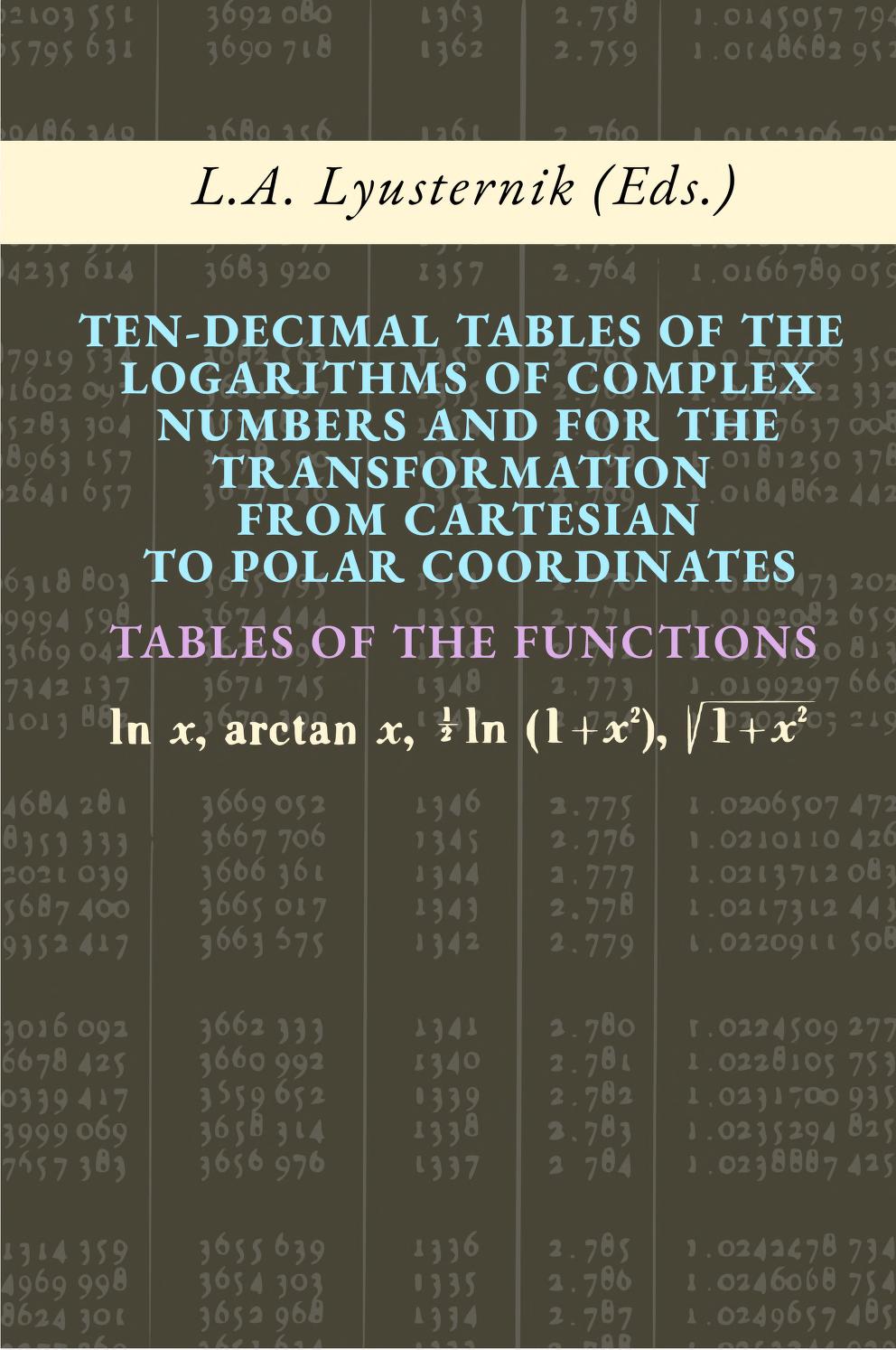
Ten Decimal Tables – Lyusternik (Ed.)

In this post, we will see the book Ten Decimal Tables Of The Logarithms Of Complex Numbers And For The Transformation From Cartesian To Polar Coordinates
edited by L. A. Lyusternik.

About the book

The present tables were compiled in the Department for Approximate Computations of the Institute of Exact Mechanics and Computational Methods of the U.S.S.R. Academy of Sciences. The computations were carried out by this department in conjunction with the Computational- Experimental Laboratory of the Institute.

The book was translated from Russian by D. E. Brown and was published in 1965.

Credits to original uploader.

You can get the book here.

Follow us on The Internet Archive: https://archive.org/details/@mirtitles

Follow Us On Twitter: https://twitter.com/MirTitles

Write to us: mirtitles@gmail.com

Fork us at GitLab: https://gitlab.com/mirtitles/

Add new entries to the detailed book catalog here.


Posted in books, mathematics | Tagged , , , , , , , | Leave a comment

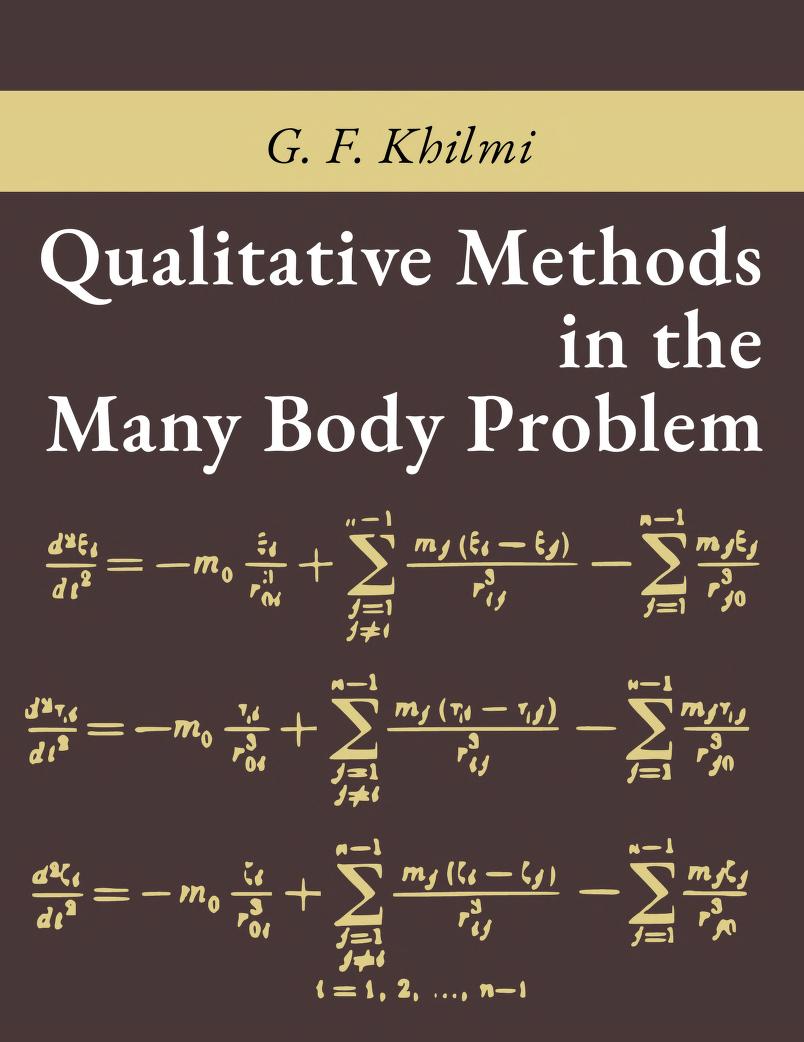
Qualitative Methods In The Many Body Problem – Khilmi

In this post, we will see the book Qualitative Methods In The Many Body Problem by G. F. Khilmi.

About the book

The n-body problem is the name usually given to the problem of the motion of a system of many particles attracting each other according to Newton’s law of gravitation. This is the classical problem of mathematical natural science, the significance of which goes far beyond the limits of its astronomical applications.

The n-body problem has been the main topic of celestial mechanics from the time of its inception as a science. Now that many of the problems of celestial mechanics have become part of geophysics, the central position of the w-body problem has been further strengthened.

The fundamental dynamical problem for a system of n gravitating bodies is the investigation and predetermina­tion of the changes in position and velocity that the particles undergo as the time varies. However, this is a very complex non-linear problem whose solution has not been possible under the present-day status of mathematical analysis.

In the first chapter, we give the equations and general integrals of the n-body problem, and we study the simplest theorems on the final motion due to Jacobi.

In the second chapter, we consider means of applying the method of dimensional analysis to the n-body problem. As far as we know, dimensional analysis has not been used before in the investigation of the final motion; though it does not yield definitive results in this area, it is very use­ ful in carrying out a preliminary analysis of the problem.

In the third chapter, we present our “method of continuous induction” and we consider some applications of it in which the final motion in the n-body problem is analyzed. This method allows us to obtain effective qualitative results, namely, it allows us to formulate suffi­cient conditions for the occurrence of certain types of final motions in the form of conditions on the initial state of the dynamical system.

The fourth chapter is devoted to the method of invariant measure. The application of this method to the many-body problem has necessitated working out a number of theorems on the measure theory of dynamical systems. These are presented at the beginning of the chapter. At the end of the chapter, we prove some very general theorems on the motion of a system of gravitating bodies using the method of invariant measure.

In the fifth chapter, an attempt is made to analyze some cases of the evolution of a system of n gravitating bodies on the basis of celestial mechanics. Here, we shall be concerned with the processes which are of cosmogonical interest, and which are accompanied by the conversion of mechanical energy into non-mechanical forms.

The book was translated from Russian by B. D. Seckler and was published in 1961.

Credits to original uploader.

You can get the book here.

Follow us on The Internet Archive: https://archive.org/details/@mirtitles

Follow Us On Twitter: https://twitter.com/MirTitles

Write to us: mirtitles@gmail.com

Fork us at GitLab: https://gitlab.com/mirtitles/

Add new entries to the detailed book catalog here.

Contents

CHAPTER 1. Equations and general integrals of the n-body problem. Simplest theorems on the final motion 1

CHAPTER 2. Method of dimensional analysis 15

CHAPTER 3. Method of continuous induction 27

CHAPTER 4. Method of invariant measure 61

CHAPTER 5. Analysis of some cases of the evolution of a system of gravitating bodies 97

Bibliography 113
Index 117

Posted in astronomy, books, mathematics, physics | Tagged , , , , , , , , , , | Leave a comment

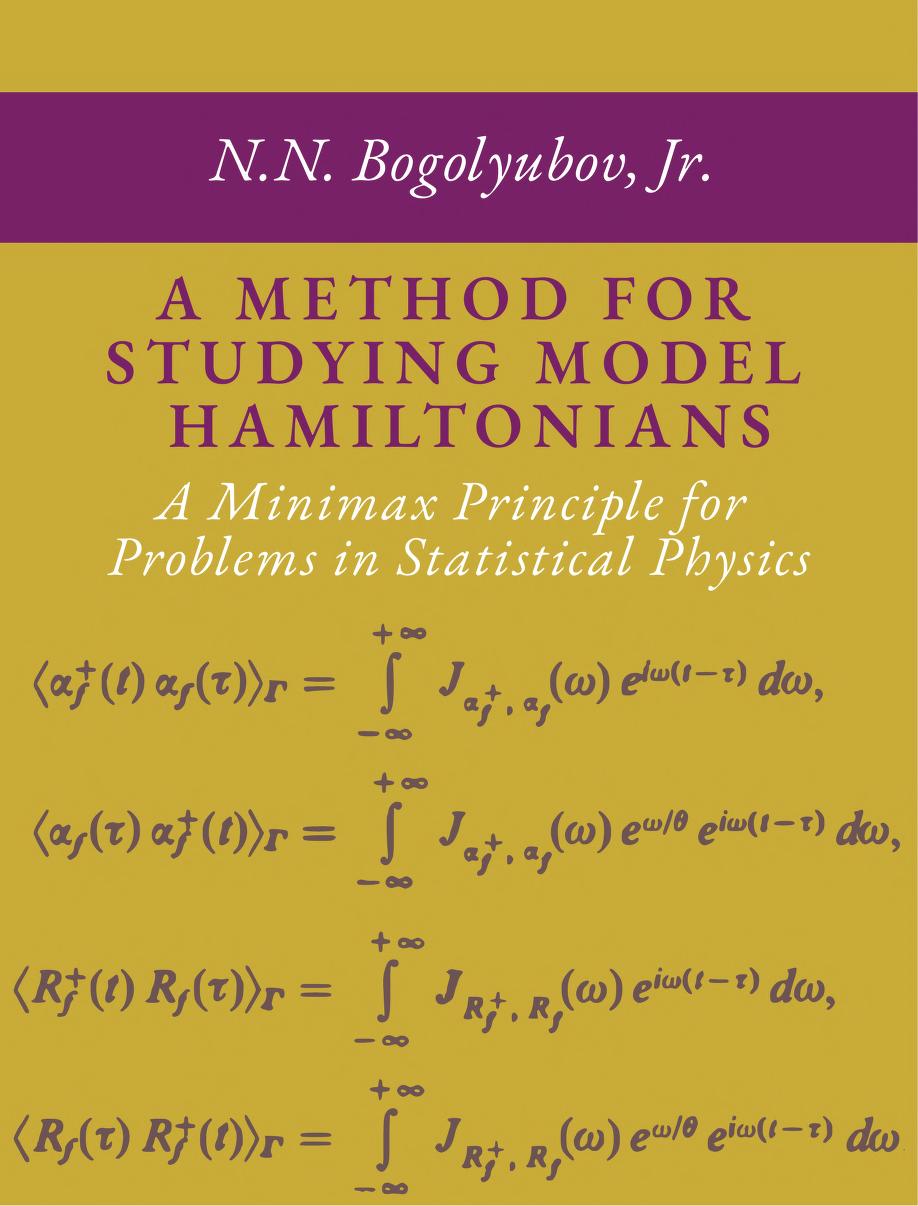
A Method For Studying Model Hamiltonians – A Minimax Principle For Problems In Statistical Physics – Bogolyubov Jr

In this post, we will see the book A Method For Studying Model Hamiltonians – A Minimax Principle For Problems In Statistical Physics by N. N. Bogolyubov Jr..

About the book

In this book methods are proposed for solving certain problems in statistical physics which contain four-fermion interaction.

It has been possible, by means of “approximating (trial) Hamiltonians”, to distinguish a whole class of exactly soluble model systems. An essential difference between the two types of problem with positive and negative four-fermion interaction is discovered and examined. The determination of exact solutions for the free energies, single-time and many-time correlation functions, T-products and Green’s functions is treated for each type of problem.

The more general problem for which the Hamiltonian contains some terms with positive and others with negative four-fermion interaction is also investigated. On the basis of analysing and general­izing the results of Chapters 1 to 3, it becomes possible to formulate and develop a new principle, the minimax principle, for problems in statistical physics (Chapter 4).

The book was translated from Russian by P. J. Shepherd and was published in 1972.

Credits to original uploader.

You can get the book here.

Follow us on The Internet Archive: https://archive.org/details/@mirtitles

Follow Us On Twitter: https://twitter.com/MirTitles

Write to us: mirtitles@gmail.com

Fork us at GitLab: https://gitlab.com/mirtitles/

Add new entries to the detailed book catalog here.

Contents

INTRODUCTION 1

§ I. GENERAL REMARKS 1
§ II. REMARKS ON QUASI AVERAGES 16

CHAPTER 1
PROOF OF THE ASYMPTOTIC RELATIONS FOR THE MANY-TIME CORRELATION FUNCTIONS

§ 1. GENERAL TREATMENT OF THE PROBLEM. SOME PRELIMINARY RESULTS AND FORMULATION OF THE PROBLEM 25

§ 2. EQUATIONS OF MOTION AND AUXILIARY OPERATOR INEQUALITIES 33

§ 3. ADDITIONAL INEQUALITIES 37

§ 4. BOUNDS FOR THE DIFFERENCE OF THE SINGLE-TIME AVERAGES 40

§ 5. REMARK (1) 47

§ 6. PROOF OF THE CLOSENESS OF AVERAGES CONSTRUCTED ON THE BASIS OF MODEL AND TRIAL HAMILTONIANS FOR “NORMAL” ORDERING OF THE OPERATORS IN THE AVERAGES 50

§ 7. PROOF OF THE CLOSENESS OF THE AVERAGES FOR ARBITRARY ORDERING OF THE OPERATORS IN THE AVERAGES 54

§ 8. ESTIMATES OF THE ASYMPTOTIC CLOSENESS OF THE MANY-TIME CORRELATION AVERAGES 57

CHAPTER 2
CONSTRUCTION OF A PROOF OF THE GENERALIZED ASYMPTOTIC RELATIONS FOR THE MANY-TIME CORRELATION AVERAGES 65

§ 1. SELECTION RULES AND CALCULATION OF THE AVERAGES 65

§ 2. GENERALIZED CONVERGENCE 70

§ 3. REMARK 74

§ 4. PROOF OF THE ASYMPTOTIC RELATIONS 76

§ 5. REMARK ON THE CONSTRUCTION OF UNIFORM BOUNDS 79

§ 6. GENERALIZED ASYMPTOTIC RELATIONS FOR THE GREEN’S FUNCTIONS 82

§ 7. THE EXISTENCE OF GENERALIZED LIMITS 85

CHAPTER 3
CORRELATION FUNCTIONS FOR SYSTEMS WITH FOUR-FERMION NEGATIVE INTERACTION 90

§ 1. CALCULATION OF THE FREE ENERGY FOR MODEL SYSTEMS WITH ATTRACTION 90

§ 2. FURTHER PROPERTIES OF THE EXPRESSIONS FOR THE FREE ENERGY 101

§ 3. CONSTRUCTION OF ASYMPTOTIC RELATIONS FOR THE FREE ENERGY 105

§ 4. ON THE UNIFORM CONVERGENCE WITH RESPECT TO 𝛳 OF THE FREE ENERGY FUNCTION AND ON BOUNDS FOR THE QUANTITIES 𝛿_{V} 111

§ 5. PROPERTIES OF PARTIAL DERIVATIVES OF THE FREE ENERGY FUNCTION. THEOREM 3.III 114

§ 6. RIDER TO THEOREM 3.III AND CONSTRUCTION OF AN AUXILIARY INEQUALITY 117

§ 7. ON THE DIFFICULTIES OF INTRODUCING QUASI-AVERAGES 120

§ 8. A NEW METHOD OF INTRODUCING QUASI-AVERAGES 124

§ 9. THE QUESTION OF THE CHOICE OF SIGN FOR THE SOURCE-TERMS 30

§ 10. THE CONSTRUCTION OF UPPER-BOUND INEQUALITIES IN THE CASE WHEN C = 0 131

CHAPTER 4
MODEL SYSTEMS WITH POSITIVE AND NEGATIVE INTERACTION COMPONENTS 137

§ 1. HAMILTONIAN WITH NEGATIVE COUPLING CONSTANTS (REPULSIVE INTERACTION) 137

§ 2. FEATURES OF THE ASYMPTOTIC RELATIONS FOR THE FREE ENERGIES IN THE CASE OF SYSTEMS WITH POSITIVE INTERACTION 141

§ 3. BOUNDS FOR THE FREE ENERGIES AND CORRELATION FUNCTIONS 143

§ 4. EXAMINATION OF AN AUXILIARY PROBLEM 146

§ 5. SOLUTION OF THE QUESTION OF UNIQUENESS 150

§ 6. HAMILTONIANS WITH COUPLING CONSTANTS OF DIFFERENT SIGNS. THE MINIMAX PRINCIPLE 154

REFERENCES 164

INDEX 169


Posted in books, physics | Tagged , , , , , , | Leave a comment

Calculus Of Variations – Gelfand, Fomin

In this post, we will see the book Calculus Of Variations by I.M. Gelfand; S.V. Fomin.

About the book

This book is a modern introduction to the calculus of variations and certain of its ramifications, and I trust that its fresh and lively point of view will serve to make it a welcome addition to the English-language literature on the subject. The present edition is rather different from the Russian original. With the authors’ consent, I have given free rein to the tendency of any mathematically educated translator to assume the functions of annotator and stylist.

The problems appearing at the end of each of the eight chapters and two appendices were made specifically for the English edition, and many of them comment further on the corresponding parts of the text.

The book was translated from Russian by Richard Silverman and was published in 1963.

Credits to original uploader.

You can get the book here.

Follow us on The Internet Archive: https://archive.org/details/@mirtitles

Follow Us On Twitter: https://twitter.com/MirTitles

Write to us: mirtitles@gmail.com

Fork us at GitLab: https://gitlab.com/mirtitles/

Add new entries to the detailed book catalog here.

Contents

1. ELEMENTS OF THE THEORY 1.

1: Functionals. Some Simple Variational Problems, 1.
2: Function Spaces, 4.
3: The Variation of a Functional. A Necessary Condition for an Extremum, 8.
4: The Simplest Variational Problem. Euler’s Equation, 14.
5: The Case of Several Variables, 22.
6: A Simple Variable End Point Problem, 25.
7: The Variational Derivative, 27.
8: Invariance of Euler’s Equation, 29. Problems, 31.

2. FURTHER GENERALIZATIONS 34.

9: The Fixed End Point Problem for n Unknown Functions, 34.
10. Variational Problems in Parametric Form, 38.
11: Functionals Depending on Higher-Order Derivatives, 40.
12: Variational Problems with Subsidiary Conditions, 42.
Problems, 50.

3. THE GENERAL VARIATION OF A FUNCTIONAL 54.

13: Derivation of the Basic Formula, 54.
14: End Points Lying on Two Given Curves or Surfaces, 59.
15: Broken Extremals. The Weierstrass-Erdmann Conditions, 61.
Problems, 63.

4. THE CANONICAL FORM OF THE EULER EQUATIONS AND RELATED TOPICS 67.

16: The Canonical Form of the Euler Equations, 67.
17: First Integrals of the Euler Equations, 70.
18: The Legendre Transformation, 71.
19: Canonical Transformations, 77. 20: Noether’s Theorem, 79.
21: The Principle of Least Action, 83.
22: Conservation Laws, 85.
23: The Hamilton-Jacobi Equation. Jacobi’s Theorem, 88.
Problems, 94,

5. THE SECOND VARIATION. SUFFICIENT CONDITIONS FOR A WEAK EXTREMUM 97.

24: Quadratic Functionals. The Second Variation of a Func-tional, 97.
25: The Formula for the Second Variation. Legendre’s Condition, 101. 26: Analysis of the Quadratic Functional | (Ph’? + Qh?) dx, 105.
27: Jacobi’s Necessary Condition. More on Conjugate Points, 111.
28: Sufficient Conditions for a Weak Extremum, 115.
29: Generalization to n Unknown Functions, 117.
30: Connection Between Jacobi’s Condition and the Theory of Quadratic Forms, 125.
Problems, 129.

6. FIELDS. SUFFICIENT CONDITIONS FOR A STRONG EXTREMUM 131.

31: Consistent Boundary Conditions. General Definition of a Field, 131.
32: The Field of a Functional, 137.
33: Hilbert’s Invariant Integral, 145.
34: The Weierstrass E-Function. Sufficient Conditions for a Strong Extremum, 146.
Problems, 150.

7. VARIATIONAL PROBLEMS INVOLVING MULTIPLE INTEGRALS 152.

35: Variation of a Functional Defined on a Fixed Region, 152.
36: Variational Derivation of the Equations of Motion of Continuous Mechanical Systems, 154.
37: Variation of a Functional
Defined on a Variable Region, 168.
38: Applications to Field Theory, 180.
Problems, 190.

8. DIRECT METHODS IN THE CALCULUS OF VARIATIONS 192.

39: Minimizing Sequences, 193.
40: The Ritz Method and the Method of Finite Differences, 195.
41: The Sturm-Liouville Problem, 198.
Problems, 206.

APPENDIX I PROPAGATION OF DISTURBANCES AND THE CANONICAL EQUATIONS 208.

APPENDIX II VARIATIONAL METHODS IN PROBLEMS OF OPTIMAL CONTROL 218.

BIBLIOGRAPHY 227.

INDEX 228.

Posted in books, mathematics, soviet | Tagged , , , , , , , , , , | 1 Comment

Forging Practice – Kamenshchikov, Koltun, Naumov, Chernobrovkin

In this post, we will see the book Forging Practice by G. Kamenshchikov; S. Koltun; V. Naumov; B. Chernobrovkin.

About the book

All machines are built up of parts made of different materials and by various manufacturing processes. Some parts are cast from metals; some are forged, while others are produced by machining on different kinds of machine tools. Castings and forgings have to be machined before they acquire their proper shape, exact dimensions and surface finish. Forged parts, whether they are to be machined or not, are called forgings. This book describes various technologies used in the forgings.

The book was translated from Russian (translator’s name is not mentioned) was published  by Peace Publishers in 1960.

Credits to original uploader.

You can get the book here.

Follow us on The Internet Archive: https://archive.org/details/@mirtitles

Follow Us On Twitter: https://twitter.com/MirTitles

Write to us: mirtitles@gmail.com

Fork us at GitLab: https://gitlab.com/mirtitles/

Add new entries to the detailed book catalog here.

Contents

Introduction 7
The Importance of Forging in Machine Building7

Chapter I. Bench Operations 8
Chapter II. Introduction to Forging Practice 18
Chapter III. Fuel and Its Combustion 36
Chapter IV. Heating Devices. 60
Chapter V. Heating Steel for Forging 101
Chapter VI. Chief Hand-Forging Operations 115
Chapter VII. The Influence of Deformation on Forgings and the Calculation of Forgings 161
Chapter VIII. Hammers for Hammer Forging 190
Chapter IX. Forging Operations and Hammer Forging Tools 232
Chapter X. The Technological Process and Examples of Hammer Forging 259
Chapter XI. Forging presses and Their Operation 278
Chapter XII. Automatic Forging and Stamping Machines 313
Chapter XIII. Drop-Forging (Hot Stamping) 322
Chapter XIV. Special Features of Forging Non-Ferrous Metals and Their Alloys 366
Chapter XV. Heat Treatment, Defects and Inspection of Forgings 368
Chapter XVI. Organisation of Work and of the Working Place 376
Chapter XVII. Safety Engineering 398

Posted in books, engineering, metals, soviet, technology | Tagged , , , , , , , , , , , , , , | 1 Comment

Quantum Mechanics – Davydov

In this post, we will see the book Quantum Mechanics by A. S. Davydov.

About the book

The present book is an extended exposition of a course of lectures in quantum mechanics given by the author over several years to students of the Physics Depart­ment of Moscow University. This course is given after the sections on atomic and nuclear physics of the general course in physics. In those sections of the course a historical outline of the development of contemporary ideas about the structure of atoms and of atomic nuclei is given, as well as the experimental data on which quantum mechanics is based. The present book therefore does not touch at all upon the historical development of quantum theory.
The main emphasis in the present book is upon the physical ideas and the mathematical formalism of the quantum theory of the non-relativistic and quasi-relativistic (up to terms of order v2lc2) motion of a single particle in an external field. In particular, we show the inapplicability of the concept of an essentially relativistic motion of a single particle. We put great emphasis upon representation theory, the theory of canonical transformations, scattering theory, and quantum transitions. A relatively detailed exposition is given of the theory of systems consisting of identical bosons or fermions. We also devote several sections to the theory of molecules, the theory of chemical binding, and solid state theory.
An important role is played in this book by the theory of second quantisation as a method to study systems consisting of a large number of identical particles. In parti­cular, we give the basic ideas of the theories of superconductivity and of superfluidity. The basic ideas are given of the methods for quantising the meson field, the electro­magnetic field (without charges) and the electron-positron field, neglecting diver­gencies and renormalisation, as these topics are dealt with in special books which are studied after quantum mechanics.
The present book can be used as an introduction to a study of quantum elctrodynamics, nuclear theory, or solid state theory. To read it, it is necessary to be fami­liar with the usual contents of university courses in mathematics, classical mechanics, and electrodynamics. For reference purposes we give at the end of the book some mathematical appendices about special functions, matrices, and group theory.
In this book we mainly refer to review or original papers when we want to indicate where the reader can study a more detailed discussion of a topic. These references do not pretend to be complete.
Although we do not consider in this book special methodological problems, the exposition is based upon dialectic materialism, that is, we start from the idea that the regularities of atomic and nuclear physics which are studied in quantum mechanics are objective regularities of nature.

The book is intended for students of physics, studying quantum mechanics. It can also be used as a reference book for teachers and other scientists.

The book was translated from Russian by D. Ter Haar was published in 1965.

Credits to original uploader.

You can get the book here.

Follow us on The Internet Archive: https://archive.org/details/@mirtitles

Follow Us On Twitter: https://twitter.com/MirTitles

Write to us: mirtitles@gmail.com

Fork us at GitLab: https://gitlab.com/mirtitles/

Add new entries to the detailed book catalog here.

Contents

PREFACE

PREFACE TO THE ENGLISH EDITION

CHAPTER I. THE BASIC CONCEPTS OF QUANTUM MECHANICS 1
CHAPTER II. CHANGE OF QUANTUM STATES IN TIME 45
CHAPTER III. THE CONNEXION BETWEEN QUANTUM MECHANICS AND CLASSICAL MECHANICS 69
CHAPTER IV. ELEMENTARY REPRESENTATION THEORY 85
CHAPTER V. THE SIMPLEST APPLICATIONS OF QUANTUM MECHANICS 106
CHAPTER VI. THE MOTION OF A PARTICLE IN A CENTRAL FIELD OF FORCE 123
CHAPTER VII. APPROXIMATE METHODs FOR EVALUATING EIGENVALUES AND EIGENFUNCTIONS 169
CHAPTER VIII. THE FOUNDATIONS OF A QUASI-RELATIVISTIC QUANTUM THEORY OF THE MOTION OF A PARTICLE IN AN EXTERNAL FIELD 189
CHAPTER IX. THE THEORY OF QUANTUM TRANSITIONS UNDER THE INFLUENCE OF AN EXTERNAL PERTURBATION 285
CHAPTER X. QUANTUM THEORY OF SYSTEMS CONSISTING OF IDENTICAL PARTICLES 336
CHAPTER XI. QUANTUM THEORY OF SCATTERING 374
CHAPTER XII. ELEMENTARY THEORY OF MOLECULES AND CHEMICAL BONDS 472
CHAPTER XIII. Basic IDEAS OF THE QUANTUM THEORY OF THE SOLID STATE 526
CHAPTER XIV. SECOND QUANTISATION OF SYSTEMS OF IDENTICAL BOSONS 553
CHAPTER XV. SECOND QUANTISATION OF SYSTEMS OF IDENTICAL FERMIONS 617

MATHEMATICAL APPENDICES
A. Some properties of the Dirac delta-function 654
B. The angular momentum operators in spherical coordinates 657
C. Linear operators in a vector space; matrices 658
D. Confluent hypergeometric functions; Bessel functions 664
E. Group theory 670

INDEX 675

Posted in books, physics | Tagged , , , , , , , , , , , , , , , , , | Leave a comment

Diseases Of The Thyroid Gland – Khavin, Nikolayev

In this post, we will see the book Diseases Of The Thyroid Gland by I. Khavin and O. Nikolayev.

About the book

A book about various diseases of the thyroid gland and their treatments. For each disease the pathogenesis, pathohistology and aetiology along with clinical picture is provided. Finally the ways of treating these diseases are discussed.

The book was translated from Russian (translators name is not mentioned) and was published in 1955 by Foreign Languages Publishing House.

Credits to original uploader.

You can get the book here.

Follow us on The Internet Archive: https://archive.org/details/@mirtitles

Follow Us On Twitter: https://twitter.com/MirTitles

Write to us: mirtitles@gmail.com

Fork us at GitLab: https://gitlab.com/mirtitles/

Add new entries to the detailed book catalog here.

Contents


Chapter I. Structure and Function of the Thyroid Gland 5

Chapter II. Thyrotoxicosis 15

Pathogenesis and Aetiology 15
Clinical Picture 28
Treatment 68

Chapter III. Hypothyroidism and Myxoedema 107

Pathogenesis and Aetiology 107
Clinical Picture 110
Treatment 119
Dysthyroidism 122

Chapter IV. Thyroiditis (Strumitis) 125

Pathogenesis and Aetiology 125
Clinical Picture 126
Treatment 130

Chapter V. Endemic Goitre 132

Definition 132
History 134
Distribution of Endemic Goitre in the World and Pathohistology 136
Aetiology and Pathogenesis 141
Clinical Picture 176
Prophylaxis and Treatment 191

Chapter VI. Malignant Neoplasms of the Thyroid 204

Chapter VII. Surgical Treatment of Thyroid Diseases 220

History 220
Surgical Treatment of Endemic Goitre 224
Surgical Treatment of Basedow’s Disease (Thyrotoxicosis) 238


Posted in books, health, life sciences, medicine, soviet | Tagged , , , , , , , , , , , , | Leave a comment

A World We Do Not See – Lev Potkov

In this post, we will see the book A World We Do Not See by Lev Potkov.

About the book

The reading public has always been keenly interested in the world of microscopic beings. And it is not difficult to explain why this is so, for the organisms which can
be seen only through the microscope play an exceeding­ly important role in Nature and in the life of man. It is micro-organisms that are responsible for the rotation of various substances in soil and to a great extent de­termine its productivity. Therefore, it is only natural that microbes occupy such a prominent place in the works of the great Russian soil scientists V. Dokuchayev, P. Kostychev and V. Williams.
The activity of microbes in water reservoirs is also very important as they are the direct producers of fodder for aquatic fauna. Today we know that a number of geological formations owe their existence to microbes, which, consequent­ly, are a potent geological factor. Microbiological methods are now widely used in geological survey, par­ticularly, in petroleum prospecting. Many industries, especially those dealing with fermen­tation and food processing, are based on the action of micro-organisms. Further development of such industries is wholly dependent on the progress of microbiology. The readers hardly need being reminded of the fact that micro-organisms are the cause of various diseases of man, animals and plants. Mankind cannot success­fully control disease without a thorough study of its agents.

Recently, microbes have been discovered which produce therapeutic substances—antibiotics—whose prac­tical application has proved highly effective, so that a
number of diseases formerlv considered incurable no longer constitute a threat to humanity. Antibiotics can be used for the treatment not only of humans, but also of animals and plants. The production of antibiotics is an extensive branch of industry.
We could give many more examples illustrating the importance of microbes, but even the few already mentioned are sufficient to draw attention to this group of organisms and make them the object of thorough study. Russian scientists have made a valuable contribution to microbiology, and the history of the science shall preserve for ever the names of I. Mechnikov, N. Gama- leya, I). Zabolotny, S. Vinogradsky, V. Omelyansky, B. Isachenko, and many other workers. Soviet microbiologists are today further developing the achievements of their teachers on the basis of up-to-date techniques.
It is not easy to describe in popular form the develop­ment and successes of microbiology. The book by L. Potkov is an attempt to solve this task. The author had worked long and assiduously, and we hope his effort will not prove in vain and that the book will meet the requirements of the readers.

The book was translated from Russian by W. Perelman and was published in 1953 by Foreign Languages Publishing House.

Credits to original uploader.

You can get the book here.

Follow us on The Internet Archive: https://archive.org/details/@mirtitles

Follow Us On Twitter: https://twitter.com/MirTitles

Write to us: mirtitles@gmail.com

Fork us at GitLab: https://gitlab.com/mirtitles/

Add new entries to the detailed book catalog here.

Contents

EDITOR’S NOTE 5

INTRODUCTION 7

CHAPTER I. AN HISTORICAL ESSAY 10
CHAPTER IT. MICROBES 56
CHAPTER II. SOIL, PLANTS AND MICRO-ORGANISMS 81
CHAPTER IV. THE EARHVS HISTORY AND MICRO-ORGANISMS 103
CHAPTER V. MICROBES IN FOOD AND FODDER 117

Wine-Making 117
Production of Alcohol 119
Brewing 121
Kvass 122
Production of Vinegar 123
Bacteria in Milk and Dairy Desine 125
Cheese 128
Bread-Making 131
Sauerkraut and Pickled Cucumbers 133
Silage 134

CHAPTER VI. FOODSTUFFS AND FODDER SPOILT BY MICROORGANISMS 136

Bread 136
Spontaneous Heating in Grain, Flour, Silage and Hay 138
Spoilage Organisms in Milk and Dairy Produce 139
Putrefactive Microbes 141
Diseases of Wine 144

CHAPTER VII. PROTECTION OF FOODSTUFFS FROM SPOILAGE MICRO-ORGANISMS 146

Pickling 148
Canning 148
Cold Storage 149

CHAPTER VIIT. MICROBES IN CHEMICAL INDUSTRY 152

Butyric Acid 152
Citric Acid 152
Lactic Acid 153
Glycerine 153
Acetone and Butyl Alcohol 154
Microbes and the Textile Industry 154
Finishing Textiles 155
Tanning Leather 156
Fermentation of Cellulose 157

CHAPTER IX. MICROBES HARMFUL. TO FUEL, METAL 159

CHAPTER X. MICROBES CAUSING INFECTIOUS DISEASES IN MAN AND ANIMALS AND WOOD 163

Intestinal Diseases (Typhoid Fever and Dysentery) 166
Asiatic Cholera 168
Brucellosis 170
Botulism 172
Smallpox or Variola 173
Diphtheria 175
Typhus 177
Recurrent (Relapsing) Fever 178
Injections by Pyogenic Micro-Organisms 179
Porest-Spring Encephalitis 181
Plague 184
Anthrax 187
Tetanus 192
Rabies (Hydophobia) 194
Tuberculosis 196
Leprosy 199

CHAPTER XI. FIGHT AGAINST PATHOGENIC MICROBES 201

CHAPTER XII. DIRECTED VARIABILITY IN MICROBES 212

EPILOGUA 127

Posted in books, foreign languages publishing, life sciences, popular science, soviet | Tagged , , , , , , , , | Leave a comment

Computational Methods Of Linear Algebra – Faddeeva

In this post, we will see the book Computational Methods Of Linear Algebra by V. N. Faddeeva.

About the book

English-speaking physicists, mathematicians, and engineers will welcome this first English translation of a unique and valuable Russian work. Translated especially for this edition by Curtis D. Benster, it is a basic work in English that presents a systematic exposition of computational methods of linear algebra— the classical ones, as well as those developed quite recently in Russia and elsewhere, by A. N. Krylov, A. M. Danilevsky, D. K. Faddeev, and others.

This unusual computer’s guide shows in detail how to derive numerical solutions of problems in mathematical physics which are frequently connected with the numerical solution of basic problems of linear algebra. Theory as well as individual practices are given.

The book is divided into three long chapters, with numerous sub-chapters. The first chapter provides the basic material from linear algebra (matrices, linear transformations, the Jordan canonical form, etc.) that is indispensable to what follows. The second chapter describes methods of numerical solution of systems of linear equations. The third chapter provides methods of computing the proper numbers and proper vectors of a matrix.

One of the outstanding and valuable features of this work is the care which has been taken in the preparation of the twenty-three tables which accompany chapters II and III. These tables have been specially rechecked and corrected by the translator, and carefully set (with uniform double-spacing) so as to allow the user to follow the computations throughout with case.

The book was translated from Russian by Curtis D. Benster and was published in 1959.

Credits to original uploader.

You can get the book here.

Follow us on The Internet Archive: https://archive.org/details/@mirtitles

Follow Us On Twitter: https://twitter.com/MirTitles

Write to us: mirtitles@gmail.com

Fork us at GitLab: https://gitlab.com/mirtitles/

Add new entries to the detailed book catalog here.

Contents

Chapter 1. Basic material from linear algebra 1

§1. Matrices 1
§2. n-Dimensional vector space 23
§3. Linear transformations 33
§4. The Jordan canonical form 49
§5. The concept of limit for vectors and matrices 54

Chapter 2. Systems of linear equations 63

§6. Gauss’s method 65
§7. The evaluation of determinants 72
§8. Compact arrangements for the solution of sacteenogeneyaes linear systems 75
§9. The connection of Gauss’s method with the decomposition of a matrix into factors 79
§10. The square-root method 81
§11. The inversion of a matrix 85
§12. The problem of elimination 90
§13. Correction of the elements of the inverse matrix 99
§14. The inversion of a matrix by partitioning 102
§15. The bordering method 105
§16. The escalator method 111
§17. The method of iteration 117
§18. The preparatory conversion of a system of linear equations into form suitable for the method of iteration 127
§19. Scidel’s method 131
§20. Comparison of the methods 142

Chapter 3. The proper numbers and proper vectors of a matrix 147

§2l. The method of A. N. Krylov 149
§22. The determination of proper vectors by the method of A. N. Krylov 159
§23. Samuelson’s method 161
§24. The method of A. M. Danthcsky 166
§25. Leverrier’s method in D. K. Faddeev’s modification 177
§26. ‘The escalator method 183
§27. ‘The method of interpolation 192
§28. Comparison of the methods 201
§29. Determination of the first proper number of a matrix, First case 202
§30. Improving the convergence of the iterative process 211
§31. Finding the proper numbers next in line 219
§32. Determination of the proper numbers next in line and their proper vectors as well 222
§ 33. Determination of the first proper number 234
§ 34. The case of a matrix with nonlinear elementary divisors 235
§ 35. Improving the convergence of the iterative process for solving
systems of linear equations 239

Bibliography 243
Index 247

Posted in books, mathematics, soviet | Tagged , , , , , , , , , | 1 Comment