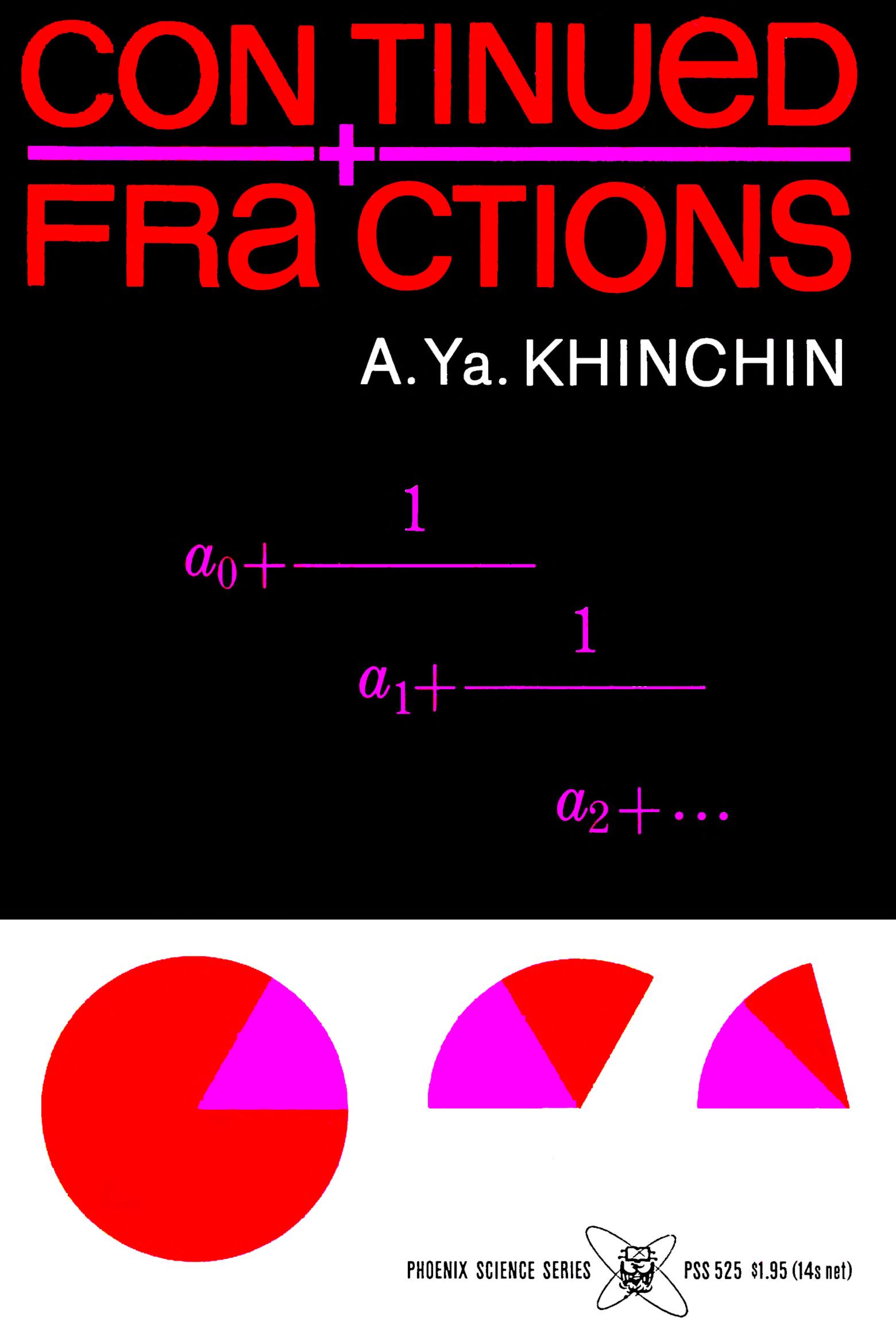
Continued Fractions – Khinchin

In this post, we will see the book Continued Fractions by A. Ya. Khinchin.

About the book

The late Alexander J. Khinchin was born in Russia in 1894. One of the founders of the Soviet school of probability theory, Khinchin was made a full professor at Moscow University in 1922 and held that position until his death. His teaching skill is discernible in the clear and straightforward presentation of his subject. Designed for use as an expository text in the university curriculum, the book is basically of an elementary nature, the author confining his attention to continued fractions with positive-integral elements. The essentials needed for applications in probability theory, mechanics, and, especially, number theory are given and the real number system is constructed from continued fractions. The last chapter is somewhat more advanced and deals with the metric, or probability, theory of continued fractions. This first English translation is based on the third edition of the text which was issued in 1961.

The book was translated from Russian by Scripta Technica and was published in 1964.

Credits to original uploader.

You can get the book here.

Follow us on The Internet Archive: https://archive.org/details/@mirtitles

Follow Us On Twitter: https://twitter.com/MirTitles

Write to us: mirtitles@gmail.com

Fork us at GitLab: https://gitlab.com/mirtitles/

Add new entries to the detailed book catalog here.

Contents

Chapter I. Properties of the Apparatus 1

1. Introduction 1
2. Convergents 3
3. Infinite continued fractions 8
4. Continued fractions with natural elements 12

Chapter II. The Representation of Numbers by Continued Fractions 16

5. Continued fractions as an apparatus for representing real numbers 16
6. Convergents as best approximations 20
7. The order of approximation 28
8. General approximation theorems 34
9. The approximation of algebraic irrational numbers and Liouville’s transcendental numbers 45
10. Quadratic irrational numbers and periodic continued fractions 47

Chapter III. The Measure Theory of Continued Fractions 51

11. Introduction 51
12. The elements as functions of the number represented 52
13. Measure-theoretic evaluation of the increase in the elements 60
14. Measure-theoretic evaluation of the increase in the denominators of the convergents. The fundamental theorem of the measure theory of approximation 65
15. Gauss’s problem and Kuz’min’s theorem 71
16. Average values 86
95 Index


Posted in books, mathematics, soviet | Tagged , , , , , , , , , | 1 Comment

The Fox Plays The Bear A Trick – Creanga

In this post, we will see the book The Fox Plays The Bear A Trick by Ion Creanga.

The Angry Bear

The Sly Fox


About the book

This little book will tell you the story of a sly fox who tricks a big angry bear!

The book was translated from Moldovian by D. Melenchuk and was illustrated by W. Brinzey. The book was published by Kishinev Literatura Artistica, Moldova in 1983. A detailed review can be found here.

All credits to Guptaji.

You can get the book here (cleaned) and here.

Follow us on The Internet Archive: https://archive.org/details/@mirtitles

Follow Us On Twitter: https://twitter.com/MirTitles

Write to us: mirtitles@gmail.com

Fork us at GitLab: https://gitlab.com/mirtitles/

Add new entries to the detailed book catalog here.

Posted in books, children's books, children's stories, picture books, soviet | Tagged , , , , , , , , , | Leave a comment

Please do help if you can!

Internet Archive Needs Your Help!

Posted in books | Leave a comment

Melasia And The Bear by Marko Vovchok

In this post, we will see the book Melasia And The Bear by Marko Vovchok.

About the book

This little book tells us the story of a little brave girl Melasia who faces a bear alone!

The book was translated from Russian by Mary Skrypnyk and was illustrated by Valentine Ulyanova. The book was published  by Veselka Publishers, Kiev in 1980.

All credits to Guptaji.

You can get the book here (cleaned) and here.

Follow us on The Internet Archive: https://archive.org/details/@mirtitles

Follow Us On Twitter: https://twitter.com/MirTitles

Write to us: mirtitles@gmail.com

Fork us at GitLab: https://gitlab.com/mirtitles/

Add new entries to the detailed book catalog here.


Posted in books, children's books, children's stories, picture books, soviet | Tagged , , , , , , , , , , | Leave a comment

The Three Bears – Tolstoy

In this post, we will see the book The Three Bears by Leo Tolstoy.

About the book

In this little book a family of bears, father bear, mother bear and little bear Misha, find a little girl in their home. The little girl has drank their soup, broken their chair and sleeping in their beds. What will the bear family do?

This is Tolstoy’s version for “Goldilocks and the Three Bears”.The girl intruder is not named, and has been interpreted as a Napoleon figure, invading and wrecking the home of the good Russian bears, but ultimately being beaten back as Napoleon was in 1812. The story was also popular in Soviet times where mistrust of outsiders was encouraged. Source

The book was translated from Russian by Iyv Litvinov and was illustrated by Yuri Vasnetsov. The book was printed several times, the current scan is for the 1989 print by Raduga Publishers.

All credits to Guptaji.

You can get the book here (cleaned) and here.

Follow us on The Internet Archive: https://archive.org/details/@mirtitles

Follow Us On Twitter: https://twitter.com/MirTitles

Write to us: mirtitles@gmail.com

Fork us at GitLab: https://gitlab.com/mirtitles/

Add new entries to the detailed book catalog here.


Posted in books, children's books, children's stories, folk tales, raduga publishers, soviet | Tagged , , , , , , , , , | Leave a comment

Mathematical Foundations of Information Theory – Khinchin

In this post, we will see the book Mathematical foundations of Information Theory by A. I. Khinchin.

About the book

The book is a translation of two papers written by the Russian mathematician, A. I. Khinchin, for the expository journal Uspekhi. These papers present the mathematical foundations of information theory. While completely rigorous, the flavour of the engineering applications which led to the theory runs throughout and very much helps the intuition. Khinchin has here reformulated basic concepts and presents for the first time rigorous proofs of certain fundamental theorems in the subject.

The first paper discusses the concept of entropy and gives one major application to coding. The only stochastic processes used are Markov chains. This paper would serve as a valuable supplement to an introductory probability course.

The second and longer paper uses more advanced topics from probability theory, for example, stationary processes and martingales. However, the treatment is quite complete and the non specialist would not suffer thanks to Khinchin’s amazing expository ability. It is a tribute to Shannon’s theory that a rigorous treatment only enhances the elegance of the basic theorems.

The book was translated from Russian by R. A. Silverman  and M. D. Friedman was published in  1957.

Credits to original uploader.

You can get the book here.

Follow us on The Internet Archive: https://archive.org/details/@mirtitles

Follow Us On Twitter: https://twitter.com/MirTitles

Write to us: mirtitles@gmail.com

Fork us at GitLab: https://gitlab.com/mirtitles/

Add new entries to the detailed book catalog here.

Contents


The Entropy Concept in Probability Theory

# 1. Entropy of Finite Schemes 2

# 2. The Uniqueness Theorem 9

# 3. Entropy of Markov chains 13

# 4. Fundamental Theorems 16

#5. Application to Coding Theory 23

On the Fundamental Theorems of Information Theory

INTRODUCTION: 30

CHAPTER I. Elementary Inequalities 34

# 1. Two generalizations of Shannon’s inequality 34

# 2. Three inequalities of Feinstein 39

CHAPTER II. Ergodic Sources 44

# 3. Concept of a source. Stationarity. Entropy. 44

# 4. Ergodic Sources 49

#5. The E property. McMillan’s theorem. 54

# 6. The martingale concept. Doob’s theorem. 58

% 7. Auxiliary propositions 64

# 8. Proof of McMillan’s theorem 70

CHAPTER III. Channels and the sources driving them 75

# 9. Concept of channel. Noise. Stationarity. Anticipation 75

#10. Connection of the channel to the source 78

#11. The ergodic case 85

CHAPTER IV. Feinstein’s Fundamental Lemma 90

#12. Formulation of the problem 90

#13. Proof of the lemma 93

CHAPTER V. Shannon’s Theorems 102

# 14. Coding 102

# 15. The first Shannon theorem 104

#16. The second Shannon theorem 109

CONCLUSION 111

REFERENCES 120


Posted in books, engineering, mathematics, physics, statistics, technology | Tagged , , , , , , , , , , , , , | 1 Comment

Mathematical Foundations of Statistical Mechanics – Khinchin

In this post, we will see the book Mathematical Foundations of Statistical Mechanics by A. I. Khinchin.

About the book

The present book considers as its main task to make the reader familiar with the mathematical treatment of statistical mechanics on the basis of modern concepts of the theory of probability and a maximum utilization of its analytic apparatus. The book is written, above all, for the mathematician, and its purpose is to introduce him to the problems of statistical mechanics in an atmosphere of logical precision, outside of which he cannot assimilate and work, and which, unfortunately, is lacking in the existing physical expositions.
The only essentially new material in this book consists in the systematic use of limit theorems of the theory of probability for rigorous proofs of asymptotic formulas without any special analytic apparatus. The few existing expositions which intended to give a rigorous proof to these formulas, were forced to use for this purpose special, rather cumbersome, mathematical machinery. We hope, however, that our exposition of several other questions (the ergodic problem, properties of entropy, intramolecular correlation, etc.) can claim to be new to a certain extent, at least in some of its parts.

The book was translated from Russian by George Gamow was first published in 1949.

Credits to original uploader.

You can get the book here.

Follow us on The Internet Archive: https://archive.org/details/@mirtitles

Follow Us On Twitter: https://twitter.com/MirTitles

Write to us: mirtitles@gmail.com

Fork us at GitLab: https://gitlab.com/mirtitles/

Add new entries to the detailed book catalog here.

Contents

Preface vii

Chapter I. Introduction

1. A brief historical sketch 1
2. Methodological characterization 7

Chapter II. Geometry and Kinematics of the Phase Space

3. The phase space of a mechanical system 13
4. Theorem of Liouville 15
5. Theorem of Birkhoff 19
6. Case of metric indecomposability 28
7. Structure functions 32
8. Components of mechanical systems 38

Chapter III. Ergodic Problem

9. Interpretation of physical quantities in statistical mechanics 44
10. Fixed and free integrals 47
11. Brief historical sketch 52
12. On metric indecomposability of reduced manifolds 55
13. The possibility of a formulation without the use of metric indecomposability 62

Chapter IV. Reduction to the Problem of the Theory of
Probability

14. Fundamental distribution law 70
15. The distribution law of a component and its energy 71
16. Generating functions 76
17. Conjugate distribution functions 79
18. Systems consisting of a large number of components 81

Chapter V. Application of the Central Limit Theorem

19. Approximate expressions of structure functions 84
20. The small component and its energy. Boltzmann’s law 88
21. Mean values of the sum functions 93
22. Energy distribution law of the large component 99
23. Example of monatomic ideal gas 100
24. The theorem of equipartition of energy 104
25. A system in thermal equilibrium. Canonical distribution of Gibbs 110

Chapter VI. Ideal Monatomic Gas

26. Velocity distribution. Maxwell’s law 115
27. The gas pressure 116
28. Physical interpretation of the parameter 121
29. Gas pressure in an arbitrary field of force 123

Chapter VII. The Foundation of Thermodynamics

30. External parameters and the mean values of external forces 129
31. The volume of the gas as an external parameter 131
32. The second law of thermodynamics 132
33. The properties of entropy 137
34. Other thermodynamical functions 145

Chapter VIII. Dispersion and the Distributions of Sum Functions

35. The inter molecular correlation 148
36. Dispersion and distribution laws of the sum functions 156

Appendix

The proof of the central limit theorem of the theory of probability 166

Notations 176

Index 178

Posted in books, mathematics, physics | Tagged , , , , , , , , , , , , , , , , | 1 Comment

Mining of Mineral Deposits – Shevyakov

In this post, we will see the book Mining of Mineral Deposits by L. Shevyakov.

About the book

A textbook on mining technology and processes. The book is a treatise on various aspects of mining. The first part covers open mining. The chapters 2 and 3 discuss opening up of coal and ore deposits. Chapters 4-6 discusses shafts, plants and structures required for open mining. underground and open cut mines. The second part is about the underground aspects of mining. It discusses various methods and modes of extraction of coal and ores. The final part talks about open cut mining with discussions about open pits.

The book was translated from the Russian by V. Schiffer and edited by G. Ivanov-Mumjiev. The book was published Foreign Languages Publishing House in 1963.

Credits to original uploader.

Note: Some pages have slightly unreadable parts due to bad scans.

You can get the book here.

Follow us on The Internet Archive: https://archive.org/details/@mirtitles

Follow Us On Twitter: https://twitter.com/MirTitles

Write to us: mirtitles@gmail.com

Fork us at GitLab: https://gitlab.com/mirtitles/

Add new entries to the detailed book catalog here.

Contents

PART ONE
OPENING UP OF MINERAL DEPOSITS

Chapter I. Basic Concepts and Terminology 15

Chapter II. Opening Up of Coal and Other Stratified Deposit 30

Chapter III. Opening up of Ore Deposits 96

Chapter IV. Choice of site for shafts 109
Chapter V. Surface Plants and Structures of a Mine 125

Chapter VI. Shaft Stations. 136

PART II
UNDERGROUND MINING OF MINERAL DEPOSITS

Chapter VII. Basic Concepts and Terminology 155

Chapter VIII. Filling 161

Chapter IX. Choice of mining methods and modes of extraction 187

Chapter X. General Surveyor Coal Seam Mining Methods 217

Chapter XI. Stoping in a Continuous Face 223

Chapter XII. Continuous Methods of Mining 312

Chapter XIII. Pillar Methods of Alining 337

Chapter XV. Mining of Thick Seams 364

Chapter XVI Underground Gasification of Coal 426

Chapter XVII. Hydraulic Mining of Coni 430

Chapter XVIII. Methods of Mining Rock and Potash Sails 437

Chapter XIX. Choice of Methods for Mining Ore Deposits 408

Chapter XX. Mining of Thin and Medium-Thick Ore Deposits 470

Chapter XXI. Methods of Mining Thick Ore Deposits 506

Chapter XXII. Mining of Contiguous Beds 560

Chapter XXIII. Effects of Underground Excavations on the Ground Surface 572

Chapter XXIV. Classification and Choice of Mining Methods 584

PART THREE
OPEN-CUT MINING

Chapter XXV. Basic Definitions and Terminology 593

Chapter XXVI Equipment and Layouts of Open Pits 609

Subject Index 677

Posted in books, engineering, foreign languages publishing, soviet, technology | Tagged , , , , , , , , , , , , , , , , , , , , , | Leave a comment

Mathematical Foundations of Quantum Statistics – Khinchin

In this post, we will see the book Mathematical Foundations of Quantum Statistics by A. I. Khinchin.

About the book

In the area of quantum statistics, I show that a rigorous and systematic mathematical basis of the computational formulas of statistical physics does not require a special unwieldy analytical apparatus (the method of Darwin-Fowler), but may be obtained from an elementary application of the well-developed limit theorems of the theory of probability. Apart from its purely scientific value, which is evident and requires no comment, the possibility of such an application is particularly satisfying to Soviet scientists, since the study of these limit theorems was founded by P. L. Chebyshev and was developed fur­ther by other Russian and Soviet mathematicians. The fact that these theorems can form the analytical basis for all the computational formulas of statistical physics once again demonstrates their value for applications.
This monograph, like my first book, is devoted entirely to the mathematical method of the theory and is in no way a complete physical treatise. In fact, no concrete physical problem is considered. The book is directed primarily towards the mathematical reader. However, I hope that the physicist who is concerned with the mathematical apparatus of his science will find something in it to interest him.

The book was translated from Russian by Irwin Shapiro and was published in  1960.

Credits to original uploader.

You can get the book here.

Follow us on The Internet Archive: https://archive.org/details/@mirtitles

Follow Us On Twitter: https://twitter.com/MirTitles

Write to us: mirtitles@gmail.com

Fork us at GitLab: https://gitlab.com/mirtitles/

Add new entries to the detailed book catalog here.

Contents

INTRODUCTION

1. The most important characteristics of the mathematical apparatus
of quantum statistics 1
2. Contents of the book 4

CHAPTER I
PRELIMINARY CONCEPTS OF THE THEORY OF PROBABILITY

1. Integral-valued random variables 12
2. Limit theorems 16
3. The method of characteristic functions 21
4. The one-dimensional limit theorem 29
5. The two-dimensional limit theorem 35

CHAPTER II
PRELIMINARY CONCEPTS OF QUANTUM MECHANICS

1. Description of the state of a physical system in quantum mechanics 45
2. Physical quantities and self-adjoint linear operators 49
3. Possible values of physical quantities00 54
4. Evolution of the state of a system in time 61
5. Stationary states. The law of conservation of energy 65


CHAPTER III
GENERAL PRINCIPLES OF QUANTUM STATISTICS

1. Basic concepts of statistical methods in physics 71
2. Microcanonical averages 75
3. Complete, symmetric and antisymmetric statistics 80
4. Construction of the fundamental linear basis 85
5. Occupation numbers. Basic expressions for the structure functions 91
6. On the suitability of microcanonical averages 96

CHAPTER IV
THE FOUNDATIONS OF THE STATISTICS OF PHOTONS

1. Distinctive characteristics of the statistics of photons 102
2. Occupation numbers and their mean values 103
3. Reduction to a problem of the theory of probability 106
4. Application of a limit theorem of the theory of probability 110
5. The Planck formula 113
6. On the suitability of microcanonical averages 118

CHAPTER V
FOUNDATIONS OF THE STATISTICS OF MATERIAL PARTICLES

1. Review of fundamental concepts 123
2. Mean values of the occupation numbers 124
3. Reduction to a problem of the theory of probability 130
4. Choice of values for the parameters 𝛼 and 𝛽 135
5. Application of a limit theorem of the theory of probability 139
6. Mean values of sum functions 142
7. Correlation between occupation numbers 144
8. Dispersion of sum functions and the suitability of microcanonical
averages 147
9. Determination of the numbers g_{k} for structureless particles in the absence of external forces 149

CHAPTER VI
THERMODYNAMIC CONCLUSIONS

1. The problems of statistical thermodynamics 153
2. External parameters, external forces and their mean values 154
3. Determination of the entropy and the deduction of the second law of thermodynamics 158

Supplement I. The Statistics or Heterogeneous Systems 162
Supplement II. The Distribution of a Component and its Energy 168
Supplement III. The Principle of Canonical Averaging 172
Supplement IV. The Reduction to One-dimensional Problem in the Case of Complete Statistics 178
Supplement V. Some General Theorems of Statistical Physics. 180
Supplement VI. Symmetric Functions on Multi-dimensional Surfaces 198

1. Introduction 198
2. Preliminary formulas 199
3. Distribution of the energy of a particle. Gibbs’ theorem 203
4. Derivation of the fundamental formula 207
5. Distribution of the maximum and minimum energy of a particle 210
6. The basic limit theorem 215
7. Probability that the energy of a particle lies in a given interval 219
8. A functional limit theorem 221
9. Continuous symmetric functions004 224
10. Generalizations of Gibbs’ theorem. 226

References 231

Index 232

Posted in books, mathematics, physics | Tagged , , , , , , , , , , , , , , , , | 1 Comment

The White Deer: A Latvian Folk Tale by Fainna Solasko

In this post, we will see the book The White Deer: A Latvian Folk Tale by Fainna Solasko.

About the book

This little book tells us the Latvian folk tale of two brothers who are in search of an enchanted white deer. Antelopes, wolves and hares help the brothers. But will they succeed in finding the magical white deer?

The book was translated from Russian by Fainna Solasko and was illustrated by Nikolay Kochergin. The book was published in by Publishers in 1973 with a reprint in 1979.

All credits to Guptaji.

You can get the book here (cleaned) and here.

Follow us on The Internet Archive: https://archive.org/details/@mirtitles

Follow Us On Twitter: https://twitter.com/MirTitles

Write to us: mirtitles@gmail.com

Fork us at GitLab: https://gitlab.com/mirtitles/

Add new entries to the detailed book catalog here.


Posted in books, children's books, children's stories, folk tales, progress publishers, soviet | Tagged , , , , , , , , , , , | Leave a comment