Industrial Wiring – Polyakov, Kovarsky

In this post, we will see the book Industrial WiringManual for Trainee Electricians by G. Polyakov and A. Kovarsky.

About the book

The book is a how to do wiring for high power requirements. The book is divided into six parts. The first part deals with fundamentals of electric power supplies till 500 volts. This includes generation of electric power, and various installations used for setting up systems with 500 volt threshold. The second part considers setting up of consumer electrical circuits upto 500 volts. The third part gives an overview of cables and aerial lines. Part four deals with high voltage substations and has discussions on the equipments used, protective relays and signal circuits and switchgears for these substations. Part five discusses power equipments in form of high powered motors both AC and DC and their control mechanisms. Final sixth part discusses maintenance and safety issues.

The book was translated from Russian by J. A. Feinberg and was published in 1961 by  Progress Publishers.

Credits to original uploaders.

You can get the book here.

Follow us on The Internet Archive: https://archive.org/details/@mirtitles

Follow Us On Twitter: https://twitter.com/MirTitles

Write to us: mirtitles@gmail.com

Fork us at GitLab: https://gitlab.com/mirtitles/

Add new entries to the detailed book catalog here.

Contents

Part One ELECTRIC POWER SUPPLY

Chapter I The Generation and Use of Electric Power 7

Chapter II Electrical Installations Rated for Voltages up to 500 V 21

Part Two INSTALLATION OF WIRING AND DUSWAYS FOR CONSUMER ELECTRIC
CIRCUITS WITH VOLTAGES UP TO 500 VOLTS

Chapter III Installation of wiring 68

Chapter IV Busways 137

Part Three CABLE AND AERIAL LINES

Chapter V Arrangement and Installation of Cable Lincs 142

Chapter VI Features of Overhead Power Line Erection for Voltages up to 1,000 Volts 180

Part Four HIGH-VOLTAGE SUBSTATIONS

Chapter VII Features and Equipment of Transformer Substations in Industrial Undertakings 188

Chapter VIII Main Features of Protective Relaying, Signal Circuit and Interlocking Arrangements 212

Chapter IX Erection of Switchgear Installations for Voltages over 1,000 Volts 232

Part Five POWER ELECTRICAL EQUIPMENT

Chapter X Types and Forms of Electrical Motors and Their Manual Control 259

Chapter XI Elements of Automatic Electric Motor Control
Automatic Control of Asynchronous (Induction) Motors 269

Chapter XII Mounting of Low-Power Electric Motors

Part Six OPERATION AND MAINTENANCE OF ELECTRICAL EQUIPMENT

Chapter XIII Operation and Maintenance of Electric Circuits and Equipment 285


Posted in books, engineering, soviet, technology | Tagged , , , , , , , , , , , , , , , , , , , | Leave a comment

Switchgear Installation – Kireyev, Kovarsky

In this post, we will see the book Switchgear Installation – A Manual for Installers of Electrical Switchgears and Powerlines by M. Kireyev; A. Kovarsky.

About the book

The book provides a comprehensive treatment of installation of power system equipments in Part 1. This covers fundamentals of installation work, substation switchgear, various mountings, power transformers, and control circuits. The second part of the book covers operation and maintenance and trouble-shooting of the station and line equipments. There is also a chapter on accident prevention and safety during maintenance.  The book is profusely illustrated with drawings of  various equipments, instruments, photographs and technical drawings almost on every page.

The book was translated from Russian by J. Fainberg and translation was edited by B. Kuznetsov. The book was published in  by Progress Publishers in 1964.

Note: The information is may be dated and is in particular about Soviet electrical equipments.

Credits to original uploader.

You can get the book here.

Follow us on The Internet Archive: https://archive.org/details/@mirtitles

Follow Us On Twitter: https://twitter.com/MirTitles

Write to us: mirtitles@gmail.com

Fork us at GitLab: https://gitlab.com/mirtitles/

Add new entries to the detailed book catalog here.

Content

PART ONE
Installation of Power System Equipment

Chapter 1. INSTALLATION WORK 7

1. Plans and Drawings 0 7
2. Tools and Mechanisms Employed in Installation Work 8

Chapter 2. SUBSTATION SWITCHGEAR 15

3. Types of Substations 15
4. Main Connections and Diagrams 20

Chapter 3. INSTALLATION OF 6-10-KV INDOOR PRIMARY CIRCUIT EQUIPMENT 31

5. General oer 31
6. Marking-out of Positions DN 32
7. Placement of Fastenings and Supporting Metalwork 35
8. Mounting of Support (Post) Insulators 38
9. Mounting of Bushings 44
10. Mounting of Isolators (Disconnecting Switches) 47
11. Mounting of Load-breaking Isolators 51
12. Mounting of BГ-10 Hard-gas Circuit Breakers 61
13. Mounting of BMБ-10 Oil Circuit Breakers 65
14. Mounting of BMГ-133 Minimum-oil Circuit Breakers 68
15. Mounting of MГГ-10 Oil Circuit Breakers 79
16. Mounting of МГГ-229 Oil Circuit Breakers 90
17. Mounting of Instrument Current Transformers 98
18. Mounting of Voltage Transformers 105
19. Mounting of High-voltage Fuses 112
20. Mounting of Cast-in-concrete Reactors 116
21. Mounting of Valve-type Lightning Arresters 121
22. Installation of Busbars 123
23. Installation of KPY and KCO Factory-assembled and Prefabricated Switchgear 144

Chapter 4. INSTALLATION OF OUTDOOR PRIMARY CIRCUIT SWITCHGEAR 149

24. General 149
25. Marking-out Positions (ог Supporting Structures and Foundations 150
26. Mounting of Support Insulators and Entrance Bushings 150
21. Mounting of Isolators 2 2. 155
28. Mounting of Type BM-35 and BMД-35 Oil Circuit Breakers 163
29. Mounting of an MKП-35 Oil Circuit Breaker
30. Mounting of ап MГ-35 Oil Circuit Breaker 180
31. Mounting of an MГ-110 Oil Circuit Breaker 187
32. Mounting of an MKП-110 Oil Circuit Breaker 195
33. Mounting of a BBH-110 Air-blast Circuit Breaker 205
34. Mounting of T𝛷H Instrument Current Transformers 212
35. Mounting of HOM-35 and НК𝛷-110 Instrument Voltage Transformers 216
36. Mounting of Reactors and Lightning Arresters 218
37. Installation of Outdoor Buses 222

Chapter 5. INSTALLATION OF POWER TRANSFORMERS 229

38. Delivery of Transformers to the Site 229
39, Mounting of Transformer Parts 230
40. Filling of Transformer with Oil and Putting into Operation 234

Chapter 6. INSTALLATION OF CONTROL CIRCUITS 237

41. General 237
42. Installation of Control Boards 237
43. Installation of Control Wiring 239
44. Fanning and Connection of Wires and Cables at Terminal Blocks 246
45. Mounting of Storage Batleries 250

Chapter 7. INSTALLATION OF PROTECTIVE EARTHING SYSTEMS 254

46. Protective Earthing of Indoor Substations 254
47. Protective Earthing of Outdoor Substations 257

Chapter 8. ACCIDENT PREVENTION IN SWITCHGEAR INSTALLATION 258

48. General 258
49. Safety Rules for Use of Hand Тоої5 259
50. Safety Rules for Hoisting 259
51. Safety Rules for the Installation of Main Electrical Equipment 260

Chapter 9. ERECTION OF OVERHEAD POWER LINES 261

92. Elements of Overhead Lines and Erection Procedure 261
53. Support Erection 263
54. Installation of Conductors and Earth-wires 269
55. Safety Rules Гог Installation of Conductors and Earth-wires 283
56. Lightning Protection of Overhead Lines 283

PART TWO
Operation and Maintenance of Station, Substation and Line Equipment

Chapter 10. ORGANISATION OF OPERATION AND MAINTENANCE 285

57. Scope and Principles 285
58. The Electrical Maintenance Department of an Electric Power Station and Its Functions 287
59. Training of Operating and Maintenance Personnel 289

Chapter 11. SWITCHING OPERATIONS .291

60. General 291
61. Operation of Isolators 292
62. Examples of Simple Switchings 294
63. Examples of Multiple Switchings 297

Chapter 12. SWITCHGEAR MAINTENANCE 300

64. Switchgear Inspection 300
65. Preventive Maintenance 301
66. Notes on Switchgear Repair 307
67. Overhaul of a Type BM𝚪-133 Minimum-oil Circuit Breaker 308
68. Overhaul of а Type M𝚪-229 Oil Circuit Breaker 313
69. Overhaul of Type BM-35 and BMД-35 Oil Circuit Breakers 316
70. Overhaul of an MK𝚷-35 Oil Circuit Breaker 317
71. Overhaul of an M𝚪-110 Oil Circuit Breaker 318
72. Overhaul of an MKII-110 Oil Circuit Breaker 322
73. Maintenance of Air-blast Circuit Breakers 325
74. Possible Troubles in the Main Types of Circuit Breakers
and Their Remedy. 321

Chapter 13. POWER TRANSFORMER OPERATION AND MAINTENANCE 328

15. Transformer Oil Maintenance 328
76. Transformer Overloads 330
77. Transformer [Inspection 331
78. Maintenance of the Buchholz Relay 333
79. Transformer Repair 334

Chapter 14. OPERATION AND MAINTENANCE OF ALTERNATORS 336

80. General 336
81. Abnormal Operating Conditions and Troubles of Generators 341
82. Generator Preventive. Maintenance 343
83. Generator Repair 344

Chapter 15. MAINTENANCE OF OVERHEAD LINES 346

84. General 346
85. Inspection of Overhead Lines 346
86. Maintenance Tests on Overhead Lines 350
87. Line Repair 356
88. Repair of Hot Overhead Lines 357

Chapter 16. ACCIDENT PREVENTION IN OPERATION AND MAINTENANCE OF POWER SYSTEM EQUIPMENT 372

89. General 372
90. Technical and Organisational Measures for Ensuring Safety 372
91. Protective Aids Used in Electrical Installations 379
92. First Aid in Cases of Electric Shock 390

Appendix: List of Russian-English Transliterations 395

Posted in books, engineering, progress publishers, soviet, technology | Tagged , , , , , , , , , , , , , , , | Leave a comment

Textbook of Physiology – Bykov (Ed.)

In this post, we will see the book  by K.M. Bykov; G.Y. Vladimirov; V.V. Delov; G.P. Konradi; A.D. Slonim; K. M. Bykov (Ed.).

About the book

The first edition of this text-book of physiology appeared in 1939. It was reprinted in the difficult war years, while in 1951-53 much of it was rewritten. For the present edition some parts have been abridged and a number of changes and additions made.
In preparing this text-book, the authors sought to reflect as fully as possible all the fundamentally new ideas introduced into physiology by I. P. Pavlov, our teacher and renowned naturalist. Pavlov paved the way for an understanding of the physiological processes in an integral, normal organism that is in natural contact with Ihc external environment. This was achieved by Pavlov not only by introducing and systematically applying his absolutely novel methods of research. Of still greater importance in the creation of a new physiology—the physiology of an integral organism—was Pavlov’s new principle of investigation: this required that all phenomena in an organism be studied in their dependence on the nervous system which through reflexes establishes all the connections of the animal organism with surrounding nature. Precisely this principle underlies Pavlov’s great teaching on conditioned reflexes, which extended ihe principle of scientific determinism to a comprehension of the most intricate phenomena in the world—a knowledge of all forms of activity of the higher parts of the brain, including consciousness.
From this it follows (and we have endeavoured to show il) that the integrating activity of the nervous system, in the true sense of the word, can be understood only if we examine the nervous activity in its entirety as based on the reflex mechanism, in the new, Pavlovian concept. Normally each reflex act is an indissoluble union of conditioned .and unconditioned reflexes; these reflex acts determine the character and course of all physiological processes which depend on the concrete conditions of the existence of animals and of man’s activity.
Such are the fundamental principles which we have tried, within the limits of available factual material, to reflect in this book. The authors realize that; so far they have not fully coped with their task. However, their attempt is justified if only by the fact that even an outline oT the significance of the principles underlying Pavlov’s teaching may in a certain measure help to disseminate them.

The book was translated from Russian by S. Belsky and D. Myshne  and translation was edited by D. Myshne. The book was published in  by Foreign Languages Publishing House in 1958.

Note: The scan is not of a good resolution but is readable most of the times. The book was scanned under Digital Library of India project. Some of the figures (especially the plates in grayscale and portraits) are not readable due to black and white nature of the original scan.We have cleaned and optimised the original scan as much as possible.

Credits to original uploaders.

You can get the book here.

Follow us on The Internet Archive: https://archive.org/details/@mirtitles

Follow Us On Twitter: https://twitter.com/MirTitles

Write to us: mirtitles@gmail.com

Fork us at GitLab: https://gitlab.com/mirtitles/

Add new entries to the detailed book catalog here.

Contents

Preface

PART I Fundamental Concepts of Physiology (K. Bykor and G. Konradi)

Chapter 1. The Subject and Brief History of Physiology 1

Chapter 2. General Characteristics of Principal Vital Phenomena 29

Chapter 3. Regulation of Physiological Functions 43

PART II Blood and Lymph (G. Vladimirov)

Chapter 4. General Characteristics of the Blood 46

Chapter 5. Blood Plasma 50

Chapter 6. The Blood Corpuscles 59

Chapter 7. Regulation of the Blood System 70

Chapter 8. The Lymph 74

PART III Circulation (G. Konradi)

Chapter 9. General Information on Circulation 78

Chapter 10. Pumping Function of the Heart 82

Chapter 11. Physical Phenomena Connected with Cardiac Activity. Cardiac Sounds 91

Chapter 12. Origin and Propagation of Excitation in the Heart. Force of Cardiac Contractions 97

Chapter 13. Regulation of Cardiac Activity 110

Chapter 14. Work of the Heart Under Various Conditions ss the mene Vital Activity 126

Chapter 15. Movement of the Blood Antes the Vessels 130

Chapter 16. Mechanisms Regulating the Vascular Tone 149

Chapter 17. Reflex Regulation of Circulation 160

Chapter 18. Circulatory Changes in Various States of the Body 174

Chapter 19. Peculiarities of Circulation in Certain Vascular Regions 175

PART IV Respiration (G. Konradi)

Chapter 20. Pulmonary Respiration 182

Chapter 21. Respiratory Function of the Blood and Tissue Respiration (G. Vladimirov and G. Konradi) 194

Chapter 22. Regulation of Respiration 210

Chapter 23. Hypoxia and Effect of Altered Atmospheric Pressure on the Body 223

PART V Digestion (K. Bykov)

Chapter 24. Characteristics of Digestion and Foods 234

Chapter 25. Digestion in the Oral Cavity 239

Chapter 26. Digestion in the Stomach 254

Chapter 27. Function of the Pancreas 274

Chapter 28. Secretion and Excretion of Bile 282

Chapter 29. Digestion in the Small and Large Intestines 287

PART VI Absorption (K. Bykov)

Chapter 30. Absorption 301

PART VII Metabolism and Vitamins (G. Vladimiror)

Chapter 31. Metabolism 311

Chapter 32. Vitamins 324

Chapter 33. Mineral and Water Metabolism 333

PART VIII Energy Exchange (A. Slonim)

Chapter 34. Energy Exchange in the Organism 341

Chapter 35. Heat Exchange and Regulation of the Body Temperature
Heat Exchange Between the Body and the External Environment 370

PART IX Excretory Processes (G. Konradi)

Chapter 36. Excretory Function of Kidneys 388

Chapter 37. Rate of Urine production and regulation of Renal Activity 404

PART X Physiology of the Endocrine Glands (G. Vladimirov)

Chapter 39. Methods of Investigating the Functions of the Endocrine Glands 416

Chapter 40. Internal Secretion of the Thyroid and the Parathyroids
Hypothyroidism and Hyperthyroidism 418

Chapter 41. Internal Secretion of the Pancreas 423

Chapter 42. Internal Secretion of the Adrenals 426

Chapter 43. Internal Secretion of the Hypophysis, Epiphysis and Other Glands 429

Chapter 44. Regulation of Endocrine Activity

PART XI Functions of the Sex Glands and Reproduction (A. Slonim)

Chapter 45. Functions of the Sex Glands 436

Chapter 46. Physiological Processes of Reproduction 450

PART XII Physiology of the Muscles and Nerves (V. Delov)

Chapter 47. Physiology of the Muscles 460

Chapter 48. Physiology of the Nerve 482

Chapter 49. Excitability of Nerves and Muscles 487

Chapter 50. The Excitatory Process 501

PART XIII Activity of the Nervous System (G. Konradi)

A. General Characteristics of the Central Nervous System and Theory of Reflexes 516

Chapter 51. Development of the Physiology of the Central Nervous System. 516

Chapter 52. General Characteristics of Reflex Activity 523

Chapter 53. Characteristics of the Excitatory Processes in the
Central Nervous System 536

Chapter 54. Coordination of Reflex Actvity and Phenomena of Central Inhibition 543

Chapter 55. Connections of Nervous Centres with Receptors and Effectors 555

Chapter 56. Vegetative Nervous System 558

Chapter 57. Functions of the Spinal Cord 567

Chapter 58. Functions of Medulla Oblongata 584

Chapter 59. Functions of Midbrain, Cerebellum and Diencephalon 588

Chapter 60. General Characteristics of Conditioned Reflexes and Coupling 605

Chapter 61. Inhibitory Processes in Cerebral Cortex 628

Chapter 62. Interrelations Between Excitatory and Inhibitory Processes in Cerebral Cortex. Analysing and Synthesizing Activity 640

Chapter 63. Types of Nervous System and Functional Pathology of
Cortical Activity 646

Chapter 64. Functions of Various Regions of Cerebral Cortex 651

Chapter 65. Characteristic Features of Higher Nervous Activity in Man 666

PART XIV Analysers (Sense Organs) (V. Delov)

Chapter 66. General Characteristics of Analysers 671

Chapter 67. Cutaneous Reception 678

Chapter 68. Olfaction and Taste 684

Chapter 69. Internal Analysers 690

Chapter 70. Vision 697

Chapter 71. Audition 724

PARTXV Voice and Speech (V. Delov)

Chapter 72. Voice 740
Chapter 73. Speech 744

Subject index 748

Posted in books, life sciences, science, soviet | Tagged , , , , , , , , , , , , , , , , , , , , , , , , , , | Leave a comment

An Elementary Introduction to The Theory of Probability – Gnedenko, Khinchin

In this post, we will see the book An Elementary Introduction To The Theory Of Probability by B. V. Gnedenko and A. Ya. Khinchin

About the book

This compact volume equips the reader with all the facts and principles essential to a fundamental understanding of the theory of probability. It is an introduction, no more: throughout the book the authors discuss the theory of probability for situations having only a finite number of possibilities, and the mathematics employed is held to the elementary level. But within its purpose is  restricted range it is extremely thorough, well organized, and absolutely authoritative. It is the only English translation of the latest revised Russian edition; and it is the only current translation on the market that has been checked and approved by Gnedenko himself.
After explaining in simple terms the meaning of the concept of probability and the means by which an event is declared to be in practice, impossible, the authors take up the processes involved in the calculation of probabilities. They survey the rules for addition and multiplication of probabilities, the concept of conditional probability, the formula for total probability, Bayes’s formula, Bernoulli’s scheme and theorem, the concepts of random variables, insuffciency of the mean value for the characterization of a random variable, methods of measuring the variance of a random variable, theorems on the standard deviation, the Chebyshev inequality, normal laws of distribution, distribution curves, properties of normal distribution curves, and related topics.
The book is unique in that, while there are several high school and college textbooks available on this subject, there is no other popular treatment for the layman that contains quite the same material presented with the same degree of clarity and authenticity. The reader who shies away from oversimplified popularizations may be sure that in this book he is getting a perfectly reliable scientific treatment. Anyone who desires a fundamental grasp of this increasingly important subject cannot do better than to start with this book.

The book was translated from Russian by Leo F. Boron an edited by Sidney F. Mack and was published in 1962.

Credits to original uploader.

You can get the book here.

Follow us on The Internet Archive: https://archive.org/details/@mirtitles

Follow Us On Twitter: https://twitter.com/MirTitles

Write to us: mirtitles@gmail.com

Fork us at GitLab: https://gitlab.com/mirtitles/

Add new entries to the detailed book catalog here.

Contents

PART I. PROBABILITIES

CHAPTER 1. THE PROBABILITY OF AN EVENT 3

1. The concept of probability 3
2. Impossible and certain events 8
3. Problem 9

CHAPTER 2. RULE FOR THE ADDITION OF PROBABILITIES 11

4. Derivation of the rule for the addition of probabilities 11
5. Complete system of events 13
6. Examples 16

CHAPTER 3. CONDITIONAL PROBABILITIES AND THE MULTIPLICATION RULE 18

7. The concept of conditional probability 18
8. Derivation of the rule for the multiplication of probabilities 20
9. Independent events 21

CHAPTER 4. CONSEQUENCES OF THE ADDITION AND MULTIPLICATION RULES 27

10. Derivation of certain inequalities 27
11. Formula for total probability 29
12. Bayes’s formula 32

CHAPTER 5. BERNOULLI’s SCHEME 38

13. Examples 38
14. The Bernoulli formulas 40
15. The most probable number of occurrences of an event 43

CHAPTER 6. BERNOULLI’S THEOREM 49

16. Content of Bernoulli’s theorem 49
17. Proof of Bernoulli’s theorem 50

PART II. RANDOM VARIABLES

CHAPTER 7. RANDOM VARIABLES AND DISTRIBUTION LAWS 59

18. The concept of random variable 59
19. The concept of law of distribution 61

CHAPTER 8. MEAN VALUES 65

20. Determination of the mean value of a random variable 65

CHAPTER 9. MEAN VALUE OF A SUM AND OF A PRODUCT 74

21. Theorem on the mean value of a sum 74
22. Theorem on the mean value of a product 77

CHAPTER 10. DISPERSION AND MEAN DEVIATIONS 80

23. Insufficiency of the mean value for the characterization of a random variable 80
24. Various methods of measuring the dissension of a random variable 81
25. Theorems on the standard deviation 87

CHAPTER 11. LAW OF LARGE NUMBERS 93

26. Chebyshev’s inequality 93
27. Law of large numbers 94
28. Proof of the law of large numbers 97

CHAPTER 12. NORMAL LAWS 100

29. Formulation of the problem 100
30. Concept of a distribution curve 102
31. Properties of normal distribution curves 105
32. Solution of problems 111

CONCLUSION 118

APPENDIX. Table of values of the function 𝛷(a) 123

BIBLIOGRAPHY 125

INDEX 129


Posted in books, mathematics, soviet, statistics | Tagged , , , , , , , , , , , , , , , | 1 Comment

The Hydrodynamics of The Hydrofoil


In this post, we will see the book The Hydrodynamics Of The Hydrofoil by A. N. Panchenkov.

About the book

The results of the investigation in the area of the hydrofoil theory are systematized in this monograph. A great deal of attention is given to the mechanical-mathematical aspects of the hydrofoil theory and to the development of the effective methods for solving the basic equations in the hydrofoil theory.

The book considers the theory of steady motion of a wing with an arbitrary profile in a plane-parallel flow; the linear theory of thin hydrofoils in the two-dimensional and three-dimensional flows; the theory of a hydrofoil in an unsteady flow; problems of the interaction of hydrofoils and motion of hydrofoils near the interface of fluids with different densities.

The monograph is intended for scientists and engineer­ing personnel at scientific research and design organizations specializing in the area of hydrodynamics of the submerged hydrofoil, aerodynamics, and aerohydrodynamics.

The book was translated from Russian was published in 1970 by Defense Technical Information Center.

Credits to original uploaders.

You can get the book here (cleaned) and here.

Follow us on The Internet Archive: https://archive.org/details/@mirtitles

Follow Us On Twitter: https://twitter.com/MirTitles

Write to us: mirtitles@gmail.com

Fork us at GitLab: https://gitlab.com/mirtitles/

Add new entries to the detailed book catalog here.

Contents

Abstract
Preface
Introduction
Table of Contents

PART I: THE THEORY OF THE SUBMERGED HYDROFOIL IN A PLANE- PARALLEL FLOW 1

CHAPTER I. LINEAR THEORY OF A THIN HYDROFOIL IN A PLANE-PARALLEL FLOW 1

CHAPTER II. THE THEORY OF THE SUBMERGED HYDROFOIL OF AN ARBITRARY PROFILE IN A PLANE-PARALLEL FLOW 31

CHAPTER III. THEORY OF THE HYDROFOIL IN A PLANE-PARALLEL FLOW OF FLUID OF FINITE DEPTH 61

CHAPTER IV. INTERACTION OF HYDROFOILS IN A PLANE PARALLEL FLOW 95

CHAPTER V. THEORY OF THE SUBMERGED HYDROFOIL IN A PLANE-PARALLEL UNSTEADY FLOW 147

CHAPTER VI. THE THEORY OF HYDROFOIL IN A PLANE-PARALLEL FLOW OF FLUIDS OF VARIOUS DENSITIES 175

PART TWO: THE THEORY OF THE SUBMERGED HYDROFOIL IN A THREE-DIMENSIONAL FLOW 210

CHAPTER VII. BASIC CONSIDERATIONS IN THE THEORY OF THE THEORY OF THE HYDROFOILS WITH FINITE SPAN 210

CHAPTER VIII. THE THEORY OF THE SUBMERGED HYDROFOIL IN THE THREE-DIMENSIONAL FLUID FLOW OF INFINITE DEPTH 232

CHAPTER IX. THE THEORY OF THE SUBMERGED HYDROFOIL IN A THREE-DIMENSIONAL FLUID FLOW OF FINITE DEPTH 368

CHAPTER X. INTERACTION OF SUBMERGED HYDROFOILS IN A THREE-DIMENSIONAL FLOW 392

CHAPTER XI. THE THEORY OF THE SUBMERGED HYDROFOIL
IN A THREE-DIMENSIONAL UNSTEADY STATE 414

CHAPTER XII. MOTION OF LIFTING SYSTEMS NEAR THE INTERFACE OF FLUIDS WITH DIFFERENT DENSITIES 464

REFERENCES 519


Posted in Aerodynamics, books, engineering, mathematics, physics, soviet, technology | Tagged , , , , , , , , , , , , , , , , , , , , , | 2 Comments

Higher Mathematics – Suvorov

In this post, we will see the book Higher Mathematics: Textbook for Technical Schools by I. Suvorov.

About the book

The book is divided into three parts. The first part deals with basic analytic geometry in the plane. The straight line and quadratic curves (conic sections) are treated in a condensed manner. The second part is on differential calculus in which limits and continuity, differentials and derivatives of elementary functions are treated with examples (mostly from physics). Problems of extrema are also treated in a separate chapter. The final part covers integral calculus – both indefinite and definite integrals are covered. The supplementary section covers differentiation of functions with several variables, expansion of functions using power series and problems and exercises.

The book was translated from Russian by M. V. Oak  and was edited by George Yankovsky. The book was published in 1965 by Peace Publishers.

Credits to original uploader.

You can get the book here.

Follow us on The Internet Archive: https://archive.org/details/@mirtitles

Follow Us On Twitter: https://twitter.com/MirTitles

Write to us: mirtitles@gmail.com

Fork us at GitLab: https://gitlab.com/mirtitles/

Add new entries to the detailed book catalog here.

Contents

A. BASIC ANALYTIC GEOMETRY IN THE PLANE

Chapter I. Method of Coordinates 11

Chapter II. The Straight Line 22

Chapter III. Quadric Curves 39

B. ELEMENTS OF DIFFERENTIAL CALCULUS

Chapter IV. Theory of Limits 73

Chapter V. Function and Its Continuity 95

Chapter VI. Derivative Function 115

Chapter VII. Derivatives of Elementary Functions 128

Chapter VIII. Studying Functions with the Aid of Their Derivatives 154

Chapter IX. Differential 176

C. ELEMENTS OF INTEGRAL CALCULUS

Chapter X. Indefinite Integral 185

Chapter XI. The Definite Integral and Its Applications 205

D. SUPPLEMENT

Chapter XII. Differentiation of Functions of Several Variables 233

Chapter XIII. Expansion of a Function in a Power Series 240

E. PROBLEMS AND EXERCISES 258

F. A SHORT HISTORICAL NOTE 314

Index 317

Posted in books, mathematics, physics, soviet | Tagged , , , , , , , , , , , , , , , , , , , , | 2 Comments

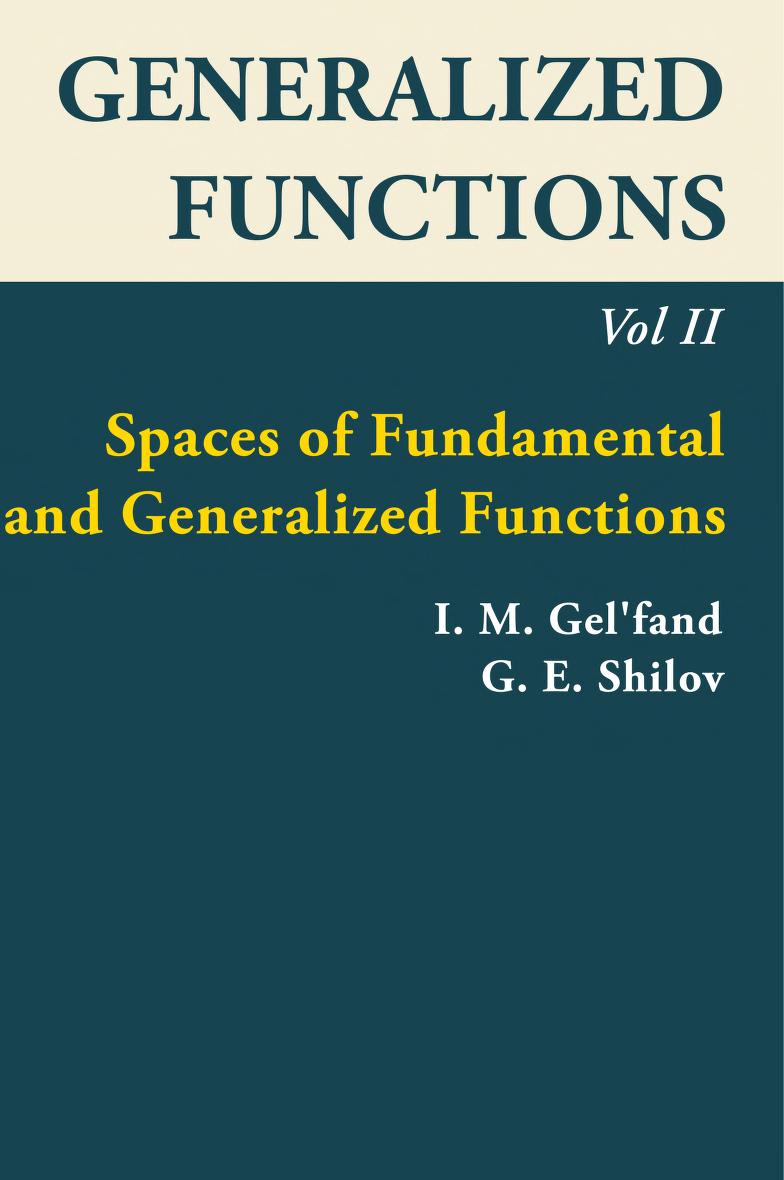
Generalized Functions (Vols. 1-6) – Gelfand, Shilov, Graev, Vilenkin, Pyatetskii-Shapiro

In this post we will see the six volume set of Generalized Functions by I. M. Gelfand, G. E. Shilov, M. I. Graev, N. Ya. Vilenkin, I. I. Pyatetskii-Shapiro.

About the books

The first systematic theory of generalized functions (also known as distributions) was created in the early 1950s, although some aspects were developed much earlier, most notably in the definition of the Green’s function in mathematics and in the work of Paul Dirac on quantum electrodynamics in physics. The six-volume collection, Generalized Functions, written by I. M. Gel′fand and co-authors and published in Russian between 1958 and 1966, gives an introduction to generalized functions and presents various applications to analysis, PDE, stochastic processes, and representation theory.

Volume 1 Properties And Operations is devoted to basics of the theory of generalized functions. The first chapter contains main definitions and most important properties of generalized functions as functional on the space of smooth functions with compact support. The second chapter talks about the Fourier transform of generalized functions. In Chapter 3, definitions and properties of some important classes of generalized functions are discussed; in particular, generalized functions supported on submanifolds of lower dimension, generalized functions associated with quadratic forms, and homogeneous generalized functions are studied in detail. Many simple basic examples make this book an excellent place for a novice to get acquainted with the theory of generalized functions. A long appendix presents basics of generalized functions of complex variables.

Volume 2 Spaces Of Fundamental And Generalized Functions is devoted to detailed study of generalized functions as linear functionals on appropriate spaces of smooth test functions. In Chapter 1, the authors introduce and study countable-normed linear topological spaces, laying out a general theoretical foundation for the analysis of spaces of generalized functions. The two most important classes of spaces of test functions are spaces of compactly supported functions and Schwartz spaces of rapidly decreasing functions. In Chapters 2 and 3 of the book, the authors transfer many results presented in Volume 1 to generalized functions corresponding to these more general spaces. Finally, Chapter 4 is devoted to the study of the Fourier transform; in particular, it includes appropriate versions of the Paley–Wiener theorem.

In Volume 3 Theory Of Differential Equations, applications of generalized functions to the Cauchy problem for systems of partial differential equations with constant coefficients are considered. The book includes the study of uniqueness classes of solutions of the Cauchy problem and the study of classes of functions where the Cauchy problem is well posed. The last chapter of this volume presents results related to spectral decomposition of differential operators related to generalized eigenfunctions.

The main goal of Volume 4  Applications Of Harmonic Analysis is to develop the functional analysis setup for the universe of generalized functions. The main notion introduced in this volume is the notion of rigged Hilbert space (also known as the equipped Hilbert space, or Gelfand triple). Such space is, in fact, a triple of topological vector spaces E⊂H⊂E′, where H is a Hilbert space, E′ is dual to E, and inclusions E⊂H and H⊂E′ are nuclear operators. The book is devoted to various applications of this notion, such as the theory of positive definite generalized functions, the theory of generalized stochastic processes, and the study of measures on linear topological spaces.

The unifying idea of Volume 5 Integral Geometry And Representation Theory in the series is the application of the theory of generalized functions developed in earlier volumes to problems of integral geometry, to representations of Lie groups, specifically of the Lorentz group, and to harmonic analysis on corresponding homogeneous spaces. The book is written with great clarity and requires little in the way of special previous knowledge of either group representation theory or integral geometry; it is also independent of the earlier volumes in the series. The exposition starts with the definition, properties, and main results related to the classical Radon transform, passing to integral geometry in complex space, representations of the group of complex unimodular matrices of second order, and harmonic analysis on this group and on most important homogeneous spaces related to this group. The volume ends with the study of representations of the group of real unimodular matrices of order two.

The unifying theme of Volume 6 Representation Theory And Automorphic Forms is the study of representations of the general linear group of order two over various fields and rings of number-theoretic nature, most importantly over local fields (p-adic fields and fields of power series over finite fields) and over the ring of adeles. Representation theory of the latter group naturally leads to the study of automorphic functions and related number-theoretic problems. The book contains a wealth of information about discrete subgroups and automorphic representations, and can be used both as a very good introduction to the subject and as a valuable reference.


The books were translated by Eugene Saletan (Vol. 1), Morris Friedman, Amiel Feinstein, Christian Peltzer (Vol. 2), Meinhard Meyet (Vol. 3), Amiel Feinstein (Vol. 4), Eugene Saletan (Vol. 5), K. A. Hirsch (Vol. 6). The series was published between 1964-1969.  Vol 1 (1964) 1968 (Vol 2) 1967 (Vol 3), 1964 (Vol 4), 1966 (Vol 5), 1969 (Vol 6).

Credits to the original uploaders.

Volume 1 here.

Volume 2 here.

Volume 3 here.

Volume 4 here.

Volume 5 here.

Volume 6 here.

PS: I am not posting contents as it would make the post very long. If you want please post them in comments so that others can benefit.

Posted in books, mathematics, soviet | Tagged , , , , , , , , , , , , , , , , , , , , , , , , , , , , , , , , , , , , , , , , , , , , , , , , | 1 Comment

A Course on Mathematical Analysis – Khinchin

In this post, we will see the book A Course on Mathematical Analysis by  A. Ya. Khinchin.

About the book

This course of mathematical analysis is a text-book for students of mechanico-mathematicaland physico-mathematical faculties of our universities (and to some extent of pedagogical institutes as well) ; it is intended as the main text-book in the study of a science which appears in the curriculum under the heading of mathematical analysis and which deals with the theory of limits, infinite series and differential calculus with simple applications of these subjects.

The book was translated from Russian was published in 1957.

Credits to original uploader.

You can get the book here.

Follow us on The Internet Archive: https://archive.org/details/@mirtitles

Follow Us On Twitter: https://twitter.com/MirTitles

Write to us: mirtitles@gmail.com

Fork us at GitLab: https://gitlab.com/mirtitles/

Add new entries to the detailed book catalog here.

Contents

Chapter 1. FUNCTIONS 1

§ 1. Variables 1
§ 2. Functions 3
§ 3. The region of definition of a function 6
§ 4. Functions and formulae 7
§ 5. The geometrical representation of functions 11
§ 6. Elementary functions 13

Chapter 2. ELEMENTARY THEORY OF LIMITS 18

§ 7. Infinitesimal quantities 18
§ 8. Operations with infinitesimal quantities 23
§ 9. Infinitely large quantities 26
§ 10. Quantities which tend to limits 29
§ 11. Operations with quantities which tend to limits 33
§ 12. Infinitesimal and infinitely large quantities of different orders 39

Chapter 3. THE DEVELOPMENT OF THE ACCURATE THEORY OF LIMIT TRANSITION 45

§ 13. The mathematical definition of a process 45
§ 14. The accurate concept of limits 47
§ 15. The development of the concept of limit transitions 52

Chapter 4. REAL NUMBERS 56

§ 16. Necessity of producing a general theory of real numbers 56
§ 17. Construction of a continuum 59
§ 18. Fundamental lemmas 69
§ 19. Final points in connection with the theory of limits 74

Chapter 5. CONTINUOUS FUNCTIONS 79

§ 20. Definition of continuity 79
§ 21. Operations with continuous functions 84
§ 22. Continuity of a composite function 85
§ 23. Fundamental properties of continuous functions 87
§ 24. Continuity of elementary functions 94

Chapter 6. DERIVATIVES 98

§ 25. Uniform and non-uniform variation of functions 98
§ 26. Instantaneous velocity of non-uniform movement 101
§ 27. Local density of a heterogeneous rod 106
§ 28. Definition of a derivative 108
§ 29. Laws of differentiation 110
§ 30. The existence of functions and their geometrical illustration 123

Chapter 7. DIFFERENTIALS 128

§ 31. Definition and relationship with derivatives 128
§ 32. Geometrical illustration and laws for evaluation 132
§ 33. Invariant character of the relationship between a derivative and a differential 134

Chapter 8. DERIVATIVES AND DIFFERENTIALS OF HIGHER ORDERS 136

§ 34. Derivatives of higher orders 136
§ 35. Differentials of higher orders and their relationship with derivatives 139

Chapter 9. MEAN VALUE THEOREMS 142

§ 36. Theorem on finite increments 142
§ 37. Evaluation of limits of ratios of infinitely small and infinitely large quantities 147
§ 38. Taylor’s formula 154
§ 39. The last term in Taylor’s formula 158

Chapter 10. APPLICATION OF DIFFERENTIAL CALCULUS TO ANALYSIS OF FUNCTIONS 164

§ 40. Increasing and decreasing of functions 164
§ 4l. Extrema 167

Chapter 11. INVERSE OF DIFFERENTIATION 175

§ 42. Concept of primitives 175
§ 43. Simple general methods of integration 182

Chapter 12. INTEGRAL 193

§ 44. Area of a curvilinear trapezium 193
§ 45. Work of a variable force 198
§ 46. General concept of an integral 201
§ 47. Upper and lower sums 204
§ 48. Integreability of functions 207

Chapter 13. RELATIONSHIP BETWEEN AN INTEGRAL AND A PRIMITIVE 213

§ 49. Simple properties of integrals 213
§ 50. Relationship between an integral and a primitive 218
§ 51. Further properties of integrals 223

Chapter 14. THE GEOMETRICAL AND MECHANICAL APPLICATIONS OF INTEGRALS 230

§ 52. Length of an arc of a plane curve 230
§ 53. Lengths of arcs of curves in space 241
§ 54. Mass, centre of gravity and moments of inertia of a material plane curve 242
§ 55. Capacities of geometrical bodies 247

Chapter 15. APPROXIMATE EVALUATION OF INTEGRALS 254

§ 56. Problematic set up 254
§ 57. Method of trapeziums 257
§ 58. Method of parabolas 262

Chapter 16. INTEGRATION OF RATIONAL FUNCTIONS 265

§ 59. Algebraical introduction 265
§ 60. Integration of simple fractions 274
§ 61. Ostrogradskij’s method 277

Chapter 17. INTEGRATION OF THE SIMPLE RATIONAL AND TRANSCENDENTAL FUNCTIONS 282

§ 62. Integration of functions of the type R(x,\sqrt[n]{\frac{ax+b}{cx+d}}) 282
§ 63. Integration of functions of the type R (x, \sqrt{ax^{2}+ bx +c}) 284
§ 64. Primitives of binomial differentials 287
§ 65. Integration of trigonometrical differentials 289
§ 66. Integration of differentials containing exponential
functions 294

Chapter 18. NUMERICAL INFINITE SERIES 297

§ 67. Fundamental concepts 297
§ 68. Series with constant signs 305
§ 69. Series with variable signs 316
§ 70. Operations with series 320
§ 71. Infinite products 326

Chapter 19. INFINITE SERIES OF FUNCTIONS 333

§ 72. Region of convergence of a series of functions 333
§ 73. Uniform convergence 335
§ 74. The continuity of the sum of a functional series 340
§ 75. Term-by-term integration and differentiation of series 344

Chapter 20 POWER SERIES AND SERIES OF POLYNOMIALS 351

§ 76. Region of convergence of a power series 351
§ 77. Uniform convergence and its consequences 357
§ 78. Expansion of functions into power series 361
§ 79. Series of polynomials 369
§ 80. Theorem of Weierstrass 372

Chapter 21. TRIGONOMETRICAL SERIES 377

§ 81. Fourier coefficients 377
§ 82. Average approximation 383
§ 83. Dirichlet-Liapunov theorem on closed trigonometrical systems 388
§ 84. Convergence of Fourier series 394
§ 85. Generalised trigonometrical series 396

Chapter 22. DIFFERENTIATION OF FUNCTIONS OF SEVERAL VARIABLES 400

§ 86. Continuity of functions of several independent variables 400
§ 87. Two-dimensional continuum 403
§ 88. Properties of continuous functions 408
§ 89. Partial derivatives 410
§ 90. Differentials 413
§ 91. Derivatives in arbitrary directions 419
§ 92. Differentiation of composite and implicit functions 422
§ 93. Homogeneous functions and Euler theorem 427
§ 94. Partial derivatives of higher orders 429
§ 95. Taylor’s formula for functions of two variables 433
§ 96. Extrema 438

Chapter 23. SOME SIMPLE GEOMETRICAL APPLICATIONS OF DIFFERENTIAL CALCULUS 443

§ 97. Equations of tangent and normal to a plane curve 443
§ 98. Tangential line and normal plane to a curve in space 446
§ 99. Tangential and normal planes to a surface 448
§ 100. Direction of convexity and concavity of a curve 451
§ 101. Curvature of a plane curve 453
§ 102. Tangential circle 458

Chapter 24. IMPLICIT FUNCTIONS 462

§ 103. The simplest problem 462
§ 104. The general problem 469
§ 105. Ostrogradskij’s determinant 475
§ 106. Conditional extremum 483

Chapter 25. GENERALISED INTEGRALS 491

§ 107. Integrals with infinite limits 491
§ 108. Integrals of unbounded functions 504

Chapter 26. INTEGRALS OF PARAMETRIC FUNCTIONS 514

§ 109. Integrals with finite limits 514
§ 110. Integrals with infinite limits 526
§ 111. Examples 535
§ 112. Euler’s integrals 541
§ 113. Stirling’s formula 548

Chapter 27. DOUBLE AND TRIPLE INTEGRALS 557

§ 114. Measurable plane figures 557
§ 115. Volumes of cylindrical bodies 567
§ 116. Double integral 571
§ 117. Evaluation of double integrals by means of two simple integrations 576
§ 118. Substitution of variables in double integrals 584
§ 119. Triple integrals 590
§ 120. Applications 593

Chapter 28. CURVILINEAR INTEGRALS 602

§ 121. Definition of a plane curvilinear integral 602
§ 122. Wark of a plane field of force 610
§ 123. Green’s formula 612
§ 124, Application to differentials of functions of two variables 617
§ 125. Curvilinear integrals in space 622

Chapter 29. SURFACE INTEGRALS 626

§ 126. The simplest case 626
§ 127. General definition of surface integrals 630
§ 128. Ostrogradskij’s formula 637
§ 129. Stoke’s formula 642
§ 130. Elements of the field theory 647

CONCLUSION – Short historical sketch 653

INDEX 665

Posted in books, mathematics, soviet | Tagged , , , , , , , , , , , , , , , , , , , | 1 Comment

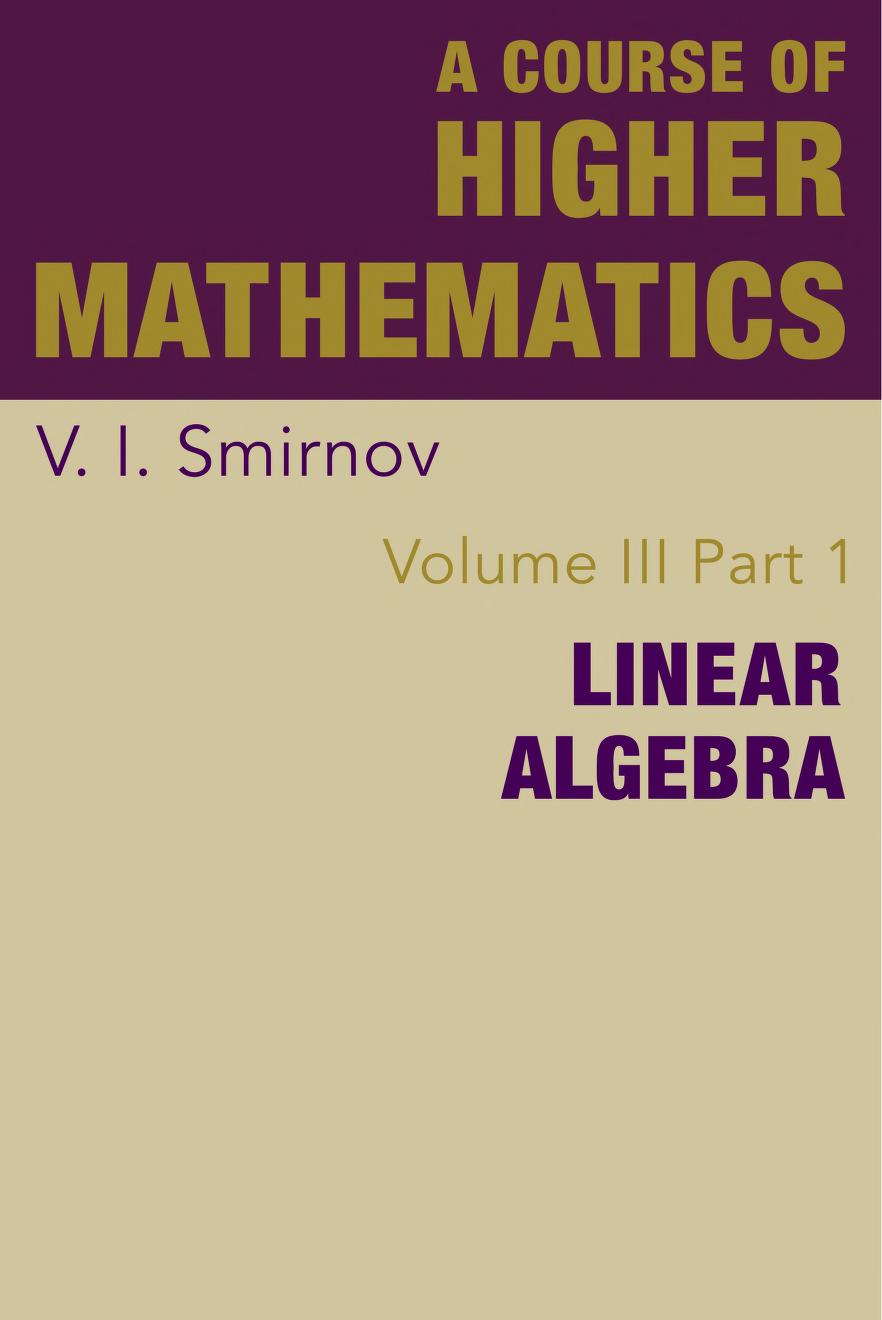
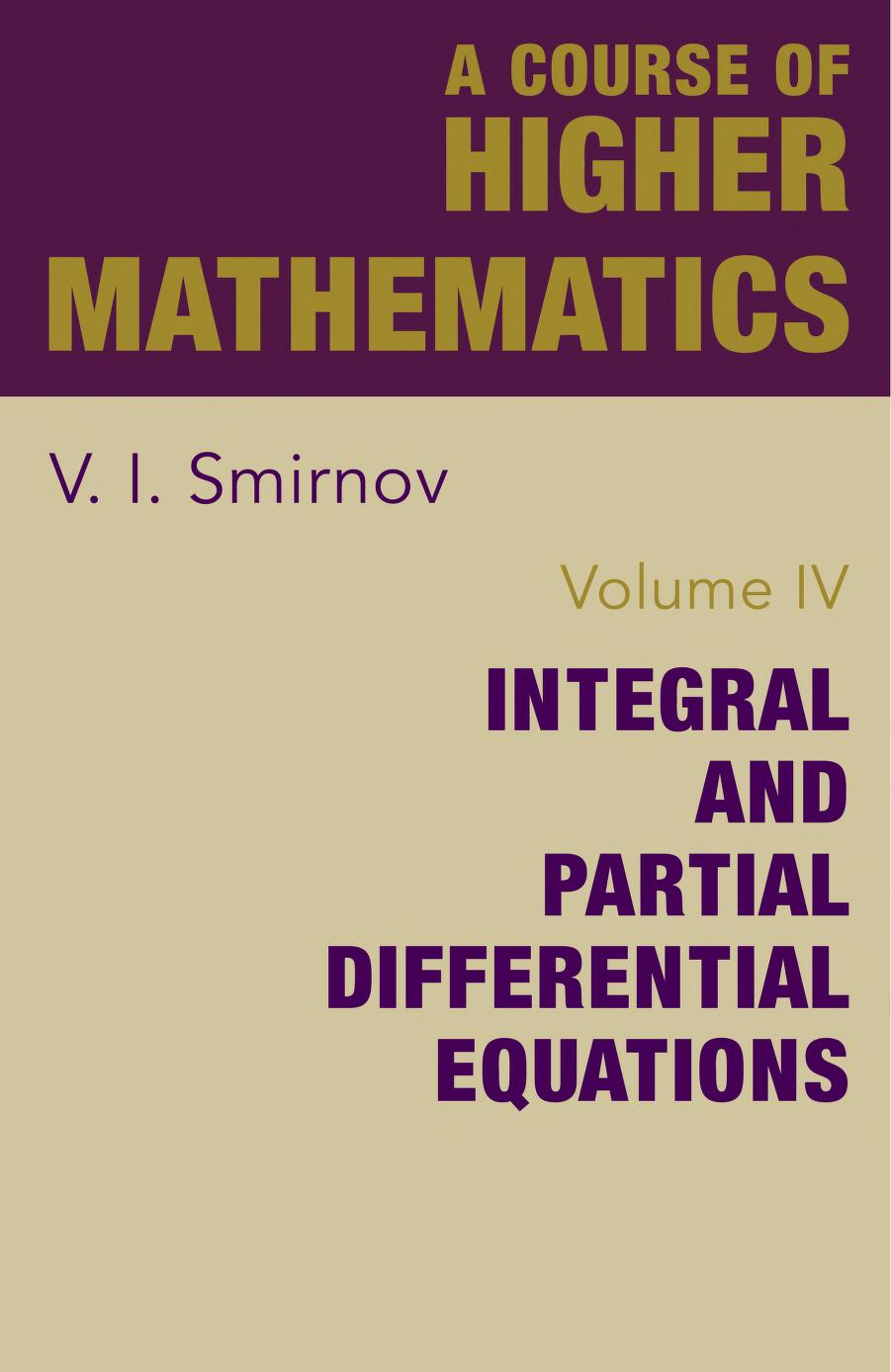
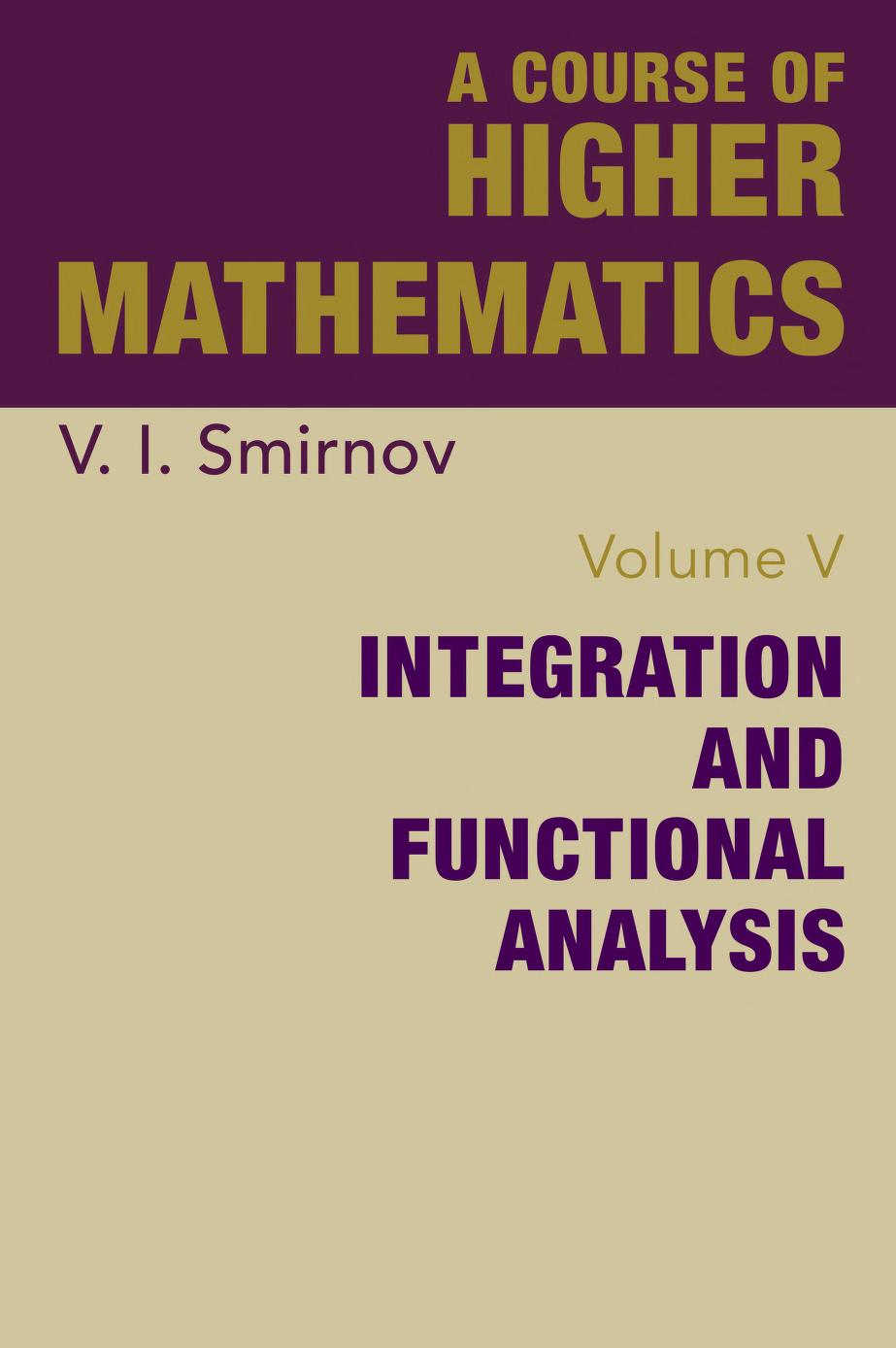
A Course of Higher Mathematics (Vols. 1 – 5) – Smirnov

In this post, we will see the six volume A Course of Higher Mathematics by V. I. Smirnov.

About the Course

Volume I Elementary Calculus is primarily concerned with differential and integral calculus. Particular emphasis is given to functional relationships in the theory of limits. The book also treats series, functions of several variables and complex numbers.

Volume 2 Advanced Calculus: This volume is primarily concerned with advanced calculus. Covered are ordinary differential equations, linear differential equations, multiple and line integrals, vector analysis and field theory, and the mathematics necessary for the discussion of problems in classical field theory.

Volume 3, Part 1 Linear Algebra: The first part of Volume III gives a full account of the two branches of modern algebra — linear algebra and the theory of groups —which are most frequently used in theoretical physics.

Volume 3, Part II Complex Variables – Special Functions: The second part of Volume III is primarily concerned with the theory of complex variables. It presents a complete picture of the aspects of the theory which are of most direct interest to applied mathematicians.

Volume 4 Integral and Partial Differential Equations: This volume begins with full accounts of the theory of integral equations and with the calculus of variations. Included are the fundamental theory of partial differential equations and systems of equations in which characteristics plays a central role.

Volume 5 Integration and Functional Analysis: The final volume presents the theory of integration and elements of functional analysis. Although functional analysis has become a very abstract discipline, its general results can be used to derive the solution of particular problems in classical analysis and in applied mathematics.

The course was translated by D. E. Brown and edited by I. N. Sneddon and was first published in 1964.

Credits to the Original uploaders.

Volume 1 here.

Volume 2 here.

Volume 3 Part 1 here.

Volume 3 Part 2 here.

Volume 4 here.

Volume 5 here.


Posted in books, mathematics, physics, soviet | Tagged , , , , , , , , , , , , , , , , , , , , , , , , , , , , , , , , , , , , | 14 Comments

Happy New Year and 2021 in Review

Happy New Year to All!

Hope this year is better than the last,

The last one went on very very fast..

Thank you for being with us over the years!

Here are some stats from the last year and resolutions for the next..

Views and Visitors

We had a little over 300,000 views this year with about 64 k unique visitors.

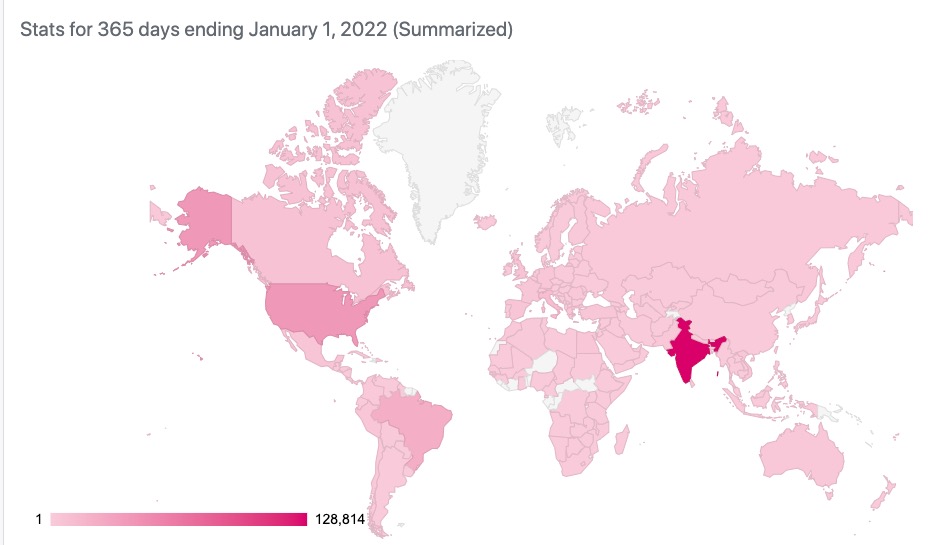
Places

As for the reach except for a few countries mostly from central-western Africa, we have covered almost all the globe. Of course most of our visitors are from India, but I am happy that we reached out to these many places and people!


Posts

For almost last three months or so, we have made at least one post a day – hope we are able to continue this next year too.

Resolutions

  1. to try to post at least one post a day for every day of the new year – we do have enough books to do this!
  2. There are about 250 books to be scanned, will try to finish in a workshop mode with some friends – will keep you posted.
  3. Get the printing of books done – I am guilty for this to happen, we had made the post  regarding printing last April and its still in production hell (as they call it). We hope to sort this one out before this April (Keep fingers crossed).
  4. Create LaTeX versions of more books ( a few are in pipeline) will keep you posted.
  5. Purchase new physical copies (getting rarer by the day). We might need your help in this – will post updates later.

Anyways hoping that this year is good for all of us!

Posted in books, meta | Tagged , , , | 1 Comment