Generalized Analytic Functions – Vekua

In this post, we will see the book Generalized Analytic Functions by I. Vekua.

About the book

THIS book is concerned with foundations of the general theory of generalized analytic functions and some applications to problems of differential geometry and theory of shells.
The book is intended for students of advanced courses of the mechanico-mathematical faculties, postgraduates, and likewise for research workers.

The book was translated from Russian by Ian N. Sneddon and was published in 1962.

Credits to original uploader.

You can get the book here.

Follow us on The Internet Archive: https://archive.org/details/@mirtitles

Follow Us On Twitter: https://twitter.com/MirTitles

Write to us: mirtitles@gmail.com

Fork us at GitLab: https://gitlab.com/mirtitles/

Add new entries to the detailed book catalog here.

Contents

PART ONE

FOUNDATIONS OF THE GENERAL THEORY
OF GENERALIZED ANALYTIC FUNCTIONS
AND BOUNDARY VALUE PROBLEMS 1

Chapter 1. Some classes of functions and operators 5
Chapter 2. Reduction of a positive differential quadratic form to the canonical form. Beltrami’s equation. Geometric applications 76
Chapter 3. Foundations of General Theory of Generalized Analytic Functions 132
Chapter 4. Boundary Value Problems 221

Appendix to Chapter 4 366

PART TWO

SOME APPLICATIONS TO PROBLEMS OF THE THEORY OF SURFACES AND THE MEMBRANE THEORY OF SHELLS 390

Chapter 5. Foundations of the General Theory of Infinitesimal Bendings of Surfaces 391
Chapter 6. Problems of the membrane theory of shells 563

References 646

Subject Index 660


Posted in books, mathematics, soviet | Tagged , , , , , , , , , | 1 Comment

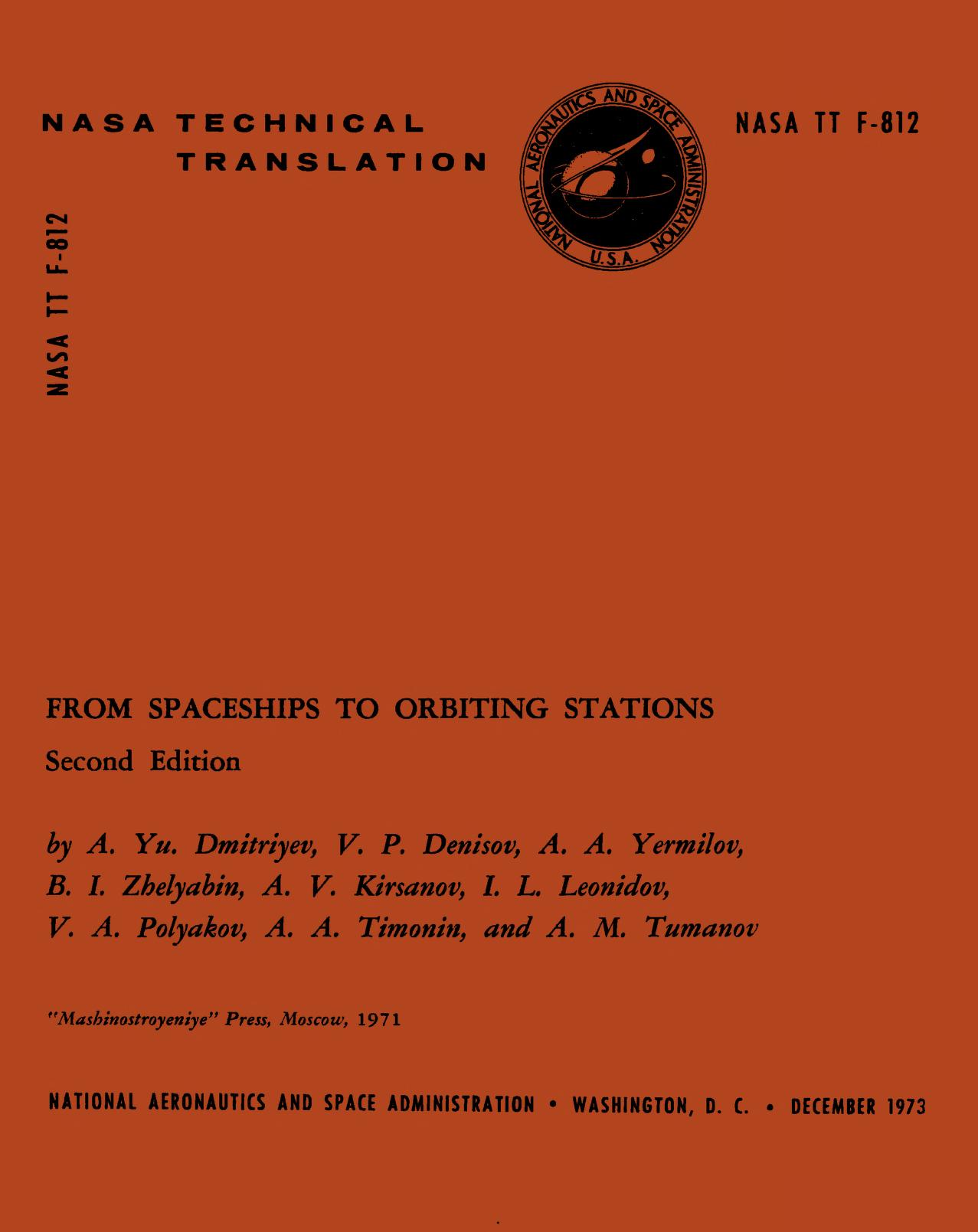
From Spaceships to Orbiting Stations – Dmitriyev et al

In this post, we will see the book From Spaceships to Orbiting Stations  by A. Yu. Dmitriyev; V. P. Denisov; A. A. Yermil’ov; V. A. Polyakov; B. I. Zhelyabin; A. V. Kirsanov; I. L. Leonidov; A. A. Timonin; A. M. Tumano

About the book

Book discusses the Soviet manned space program. The main stages of development-of Soviet cosmonautics are considered, as well .as the programs for the manned spacecraft “Vostok”,”Voskhod”and “Soyuz”,
and the orbital research station “Salyut”. The construction and equipment of the spacecraft, and their use on the earth and in flight are described. A description is given of the first orbital space station of the “Soyuz” spacecraft, as well as its operation and the experiments performed when the crew changed from one spacecraft to another in open space. The development of methods for assembling a station and performing scientific studies, and also the scientific station “Salyut”, on which the Soviet cosmonauts lived for several days are described. The book also discusses the future prospects for cosmonautics.

The book was translated from Russian under NASA Technical Translation series F-812 was published by NASA in 1973.

Originally uploaded by NASA Technical Documents.

You can get the book here (cleaned) and here.

Follow us on The Internet Archive: https://archive.org/details/@mirtitles

Follow Us On Twitter: https://twitter.com/MirTitles

Write to us: mirtitles@gmail.com

Fork us at GitLab: https://gitlab.com/mirtitles/

Add new entries to the detailed book catalog here.


Contents

Annotation
Foreword vii

1. The Main Stages of Soviet Cosmonautics 1

2 Programs of the “Vostok” and “Voskhod” Manned Spacecraft 8

Preparation for Human Flight into Space 8
The “Vostok” Program 10
The “Vostok,” The World’s First Spacecraft 12
The “Voskhod” Program 15
The First Man in Open Space 17

3. The Program of the Manned “Soyuz” Spacecraft 21

The Tasks of the Program 21
Design Characteristics of the “Soyuz” Spacecraft 23
The Main Systems of the “Soyuz” Spacecraft 27
Fabrication and Ground Testing of the Spacecraft 30
Fabrication of the Spacecraft 30
Ground Testing of Systems 21
Flight Tests of the Spacecraft Systems 35
Training the Cosmonauts for Space Flights 39

4. The Main Stages of Flight of the “Soyuz” Spacecraft 44

Orbit Injection 44
Orbital Flight 47
Gyroscopic Orientation (“Warping”) of the Spacecraft toward the Sun 47
Celestial Orientation of the Spacecraft 48
Orbital Correction 49
Reentry and Descent in the Atmosphere 51

5. The World’s First Experimental Space Station 55

The Experimental Orbital Station of the “Soyuz” Complex 55
Docking of Two Spacecraft 56
Space Walk of the Cosmonauts 63
Scientific Investigations and Experiments 67

6. When There Are Three Spacecraft in Orbit 72

Maneuvering of Spacecraft 72
Scientific and Technical Experiments and Observations 75
Welding of Metals in Orbit 77

7. “Soyuz-9” Working in Orbit 78

Medical and Biological Investigations During 78
Prolonged Space Flight 83
Maneuvering and Navigation Measurements 88
Investigations of Importance to the National Economy

8. The First Orbital Station of Long Duration Is in Space 89

“Salyut” Is in Orbit 89
Call Signs are “Granit” 90
Into Space Toward the Station 92
A Tour of the “Salyut” 93
Watch in Space 96

9. The Principal Methods of Developing Orbital Stations 101

Automatic or Manned Stations? 101
Design Characteristics of Future Space Stations 105
The Problem of Servicing Space Stations 111
Space Stations in the Service of Man 114
The Bridge to the Future is Being Erected Today 118


Posted in books, NASA Technical Translations, soviet, space, technology | 3 Comments

Criteria For Divisibility (Popular Lectures in Mathematics Vol 16) – Vorob’ev

In this post, we will see the book Criteria For Divisibility by N. N. Vorob’ev. This book is Volume 16 of Popular Lectures in Mathematics series.

About the book

N. N. Vorob’ev’s Criteria for Divisibility introduces the high school or early college student to a specific number-theoretic topic and explains the general mathematical structures which underlie the particular concepts discussed. Vorob’ev discusses the ideas of well-ordered sets, partial and linear orderings, equivalence relations, equivalence classes, algorithms, and the relationship between the determinability of algorithms defined on the integers and the well-ordering principle.

The book was translated from Russian by Daniel Levine and Timothy McLarnan  was published in 1980.

Credits to original uploader.

You can get the book here.

Follow us on The Internet Archive: https://archive.org/details/@mirtitles

Follow Us On Twitter: https://twitter.com/MirTitles

Write to us: mirtitles@gmail.com

Fork us at GitLab: https://gitlab.com/mirtitles/

Add new entries to the detailed book catalog here.

Contents

Preface vii

1. Divisibility of Numbers 1
2. The Divisibility of Sums and Products 17
3. Criteria for Congruence and Criteria for Divisibility 22
4. Divisibility of Powers 36
5. Proofs of Theorems 41
6. Solutions to Problems 50


Posted in books, mathematics, popular lectures in mathematics, soviet | Tagged , , , , , , , , , , , , , , | 1 Comment

Stories About Sets – Vilenkin

In this post, we will see the book Stories About Sets N. Ya. Vilenkin.

About the book

I want to tell the reader about the theory of sets in the same way, in which I learned it, by following the “corridor” course of study. Thus, our attention will be focused mainly on giving clear presentations of problems, discussing unexpected or surprising examples, quite often giving contradictory “naive” discussions. We shall find that the theory of functions of a real variable is richly endowed with all these. And if, after he has read this book, a high-school or college student wants to study the theory of sets or the theory of functions of a real variable more deeply, the author will feel that his book has been a success.

Professor Vilenkin has produced a small masterpiece that can be read with profit and delight by students of mathematics and laymen with an interest in mathematics. Slightly more than half the book explores the notion of cardinality of sets and the remainder traces the evolution of some of the most important concepts of m athem atics such as function, curve, surface and dimension.

The exposition combines informality with integrity of presentation and there is a wealth of unusual examples illustrating the paradoxical properties of curves and surfaces. Professor Vilenkin’s essay provides a royal road to the important concepts with which it is concerned.

Professor Vilenkin has produced a small masterpiece
which can be read with profit and delight by anybody,
beginning with high school juniors and seniors. Slightly
more than half of the book explores the notion of cardinality
of sets and the remainder traces the evolution of some of
the most important concepts of mathematics such as func-
tion, curve, surface, and dimension. The exposition combines
informality with integrity of presentation and there is a
wealth of unusual examples illustrating the paradoxical
properties of curves and surfaces. It is safe to say that
Professor Vilenkin’s essay provides a royal road to the
important concepts with which it is concerned.

The book was translated from Russian by Scripta Technica was published in 1968.

Credits to original uploader.

You can get the book here.

Follow us on The Internet Archive: https://archive.org/details/@mirtitles

Follow Us On Twitter: https://twitter.com/MirTitles

Write to us: mirtitles@gmail.com

Fork us at GitLab: https://gitlab.com/mirtitles/

Add new entries to the detailed book catalog here.

Contents

Foreword v
Preface vii

1. Some Extraordinary Properties of Infinite Sets

The Extraordinary Hotel, or the Thousand and First Journey of Ion the Quiet 4
From the Author 14

2. Sets and Operations on Sets

What Do We Mean by a Set? 16
How We Specify a Set 18
To Shave or Not to Shave? 21
The Empty Set 24
The Theory of Sets and Elementary Mathematics 26
Subsets 27
The Universal Set 29
The Intersection of Sets 29
Union of Sets 31
Partitioning of Sets 35
Subtraction of Sets 37
The Algebra of Sets 39
Boolean Algebras 41

3. The Cardinality of Sets

Equality between Sets 43
On the Dance Floor 44
For Every Flow There Is an Ebb 46
Can a Part Be Equal to the Whole? 47
Countable Sets 49
Algebraic Numbers 51
Unequal Sets 53
The Countable Set—The Smallest of the Infinite Sets 56
Uncountable Sets 57
The Census That Never Took Place 58
The Uncountability of the Continuum 61
The Existence of Transcendental Numbers 63
Long and Short Line Segments Have Equally Many Points 64
Segment and Square 66
Somehow One Problem Does Not Work Out 69
Is There a Set of Largest Cardinality ? 71
The Arithmetic of the Infinite 73
Infinite Exponents 76
On the Ordering of Numbers 78
Completely Ordered Sets 80
The Enigmatic Axiom 82
Two Apples from One 84

4. Remarkable Functions and Curves, or a Stroll through a Mathematical Art Museum

How the Notion of Function Developed 86
The Genie Escapes from the Bottle 91
Wet Points 93
The Devil’s Staircase 97
A Prickly Curve 99
A Closed Curve of Infinite Length 104
A Mathematical Carpet 107
Euclid Does Not Rely on Euclid 111
Are Rigorous Definitions Needed ? 112
A Curve Is the Path of a Moving Point 114
The Theorem Is Obvious, but the Proof Is Not 118
A Curve Passing through All the Points of a Square 120
Everything Had Come Unstrung 122
How to Make a Statue 124
Continua 126
Cantor Curves 128
Can the Area of a Curve Be Different from Zero ? 129
Domains without Area 133
Some Surprising Examples 135
Domains and Boundaries 137
The Great Irrigation Project 139
A “Nondissertable’’ Subject 141
The Inductive Definition of Dimension 144
The Article Is to Be Printed, Not Reviewed! 146
Conclusion 149
Exercises and Examples 150

Posted in books, mathematics, soviet | Tagged , , , , , , , , , , , , , , , , , , , , | Leave a comment

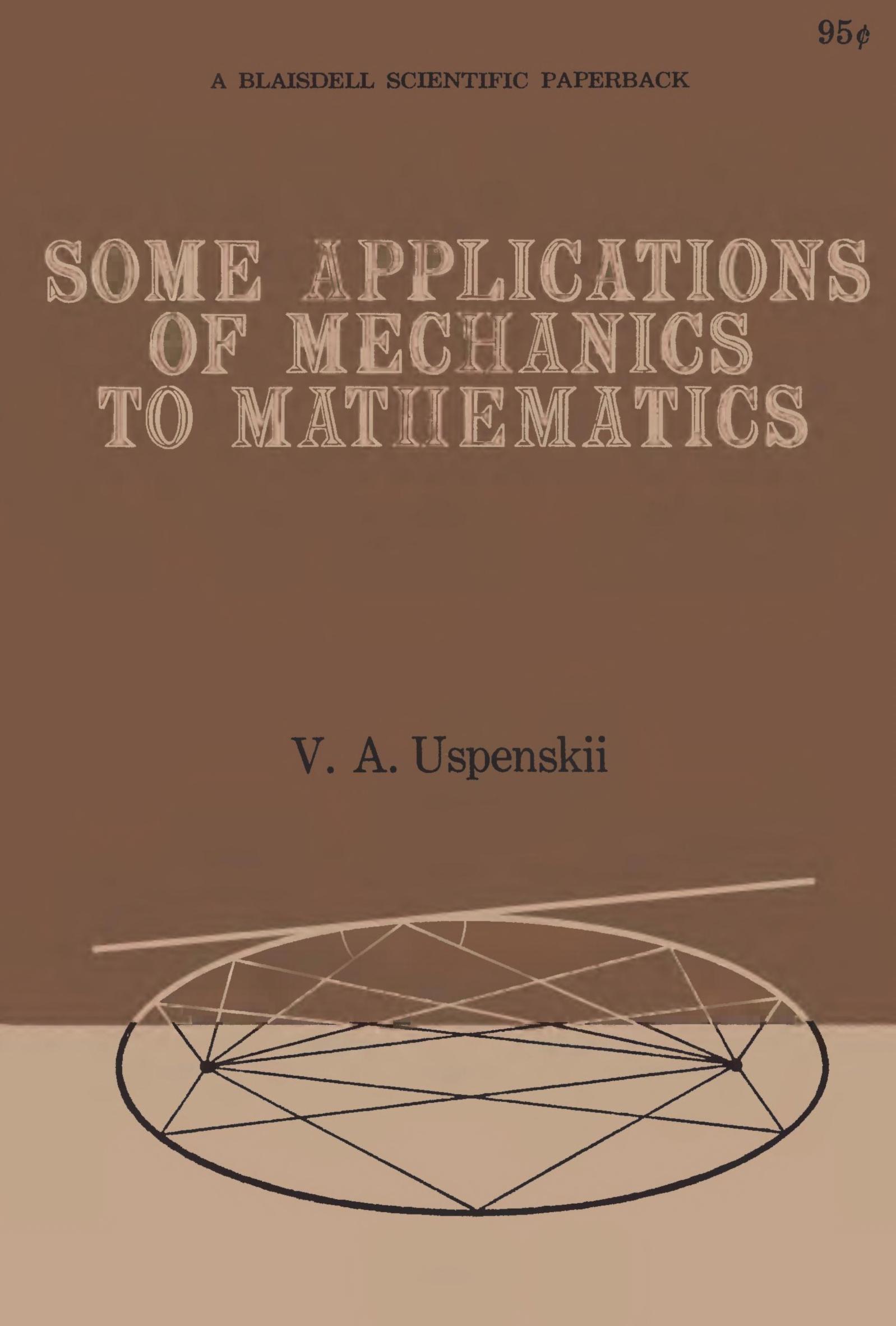
Some Applications Of Mechanics To Mathematics (Popular Lectures in Mathematics Vol 3) – Uspenskii

In this post, we will see the book Some Applications Of Mechanics To Mathematics by V. A. Uspenskii. This book is Volume 3 of the Popular Lectures in Mathematics series.

About the book

The applications of mathematics to physics (in particular, to mechanics) are well-known. We need only open a school text-book to find examples. The higher branches of mecha­nics demand a complex and refined mathematical apparatus.
There are, however, mathematical problems for whose solution we can successfully use the ideas and laws of physics. A number of problems of this kind soluble by methods drawn from mechanics (namely, by using the laws of equilibrium) were given by the author in his lecture “The solving of mathematical problems by the methods of mechanics”, which
was read to pupils in their seventh year of secondary school at the Moscow State University on 19 February 1956, this lecture, with very minor additions, makes up the contents of this article.

The book was translated from Russian by Halina Moss and edited by Ian N. Sneddon. was published in 1960.

Credits to original uploader.

You can get the book here.

Follow us on The Internet Archive: https://archive.org/details/@mirtitles

Follow Us On Twitter: https://twitter.com/MirTitles

Write to us: mirtitles@gmail.com

Fork us at GitLab: https://gitlab.com/mirtitles/

Add new entries to the detailed book catalog here.

Contents

Foreword vii


1. Problem on a tangent to a circle 1

2. Problem on a tangent to an ellipse 5

3. Problems on tangents to parabolas and hyperbolas 11

4. Principle of least potential energy 18

5. Material points and the centre of gravity 23

6. The centre of gravity and a system of two material points 28

7. Theorems about the intersection of straight lines 30

8. The centre of gravity of a rod with many loads 35

9. A problem in the theory of numbers (formulation) 39

10. A problem in the theory of numbers (solution) 43

11. The impossibility of perpetual motion 49


Conclusion 51

Posted in mathematics, physics, popular lectures in mathematics, soviet | Tagged , , , , , , , , , , | 4 Comments

Electric Slag Welding – Paton

In this post, we will see the book Electric Slag Welding by B. Paton.

About the book

Electric slag welding is a fundamentally new method of permanently joining metals. It has been developed and put to practical use by the Paton Electric Welding Institute of the Ukrainian Academy of Sciences in collaboration with the Engineering Works at Novo-Kramatorsk and the Krasny Kotelshchik Boiler- Making Factory at Taganrog, both of which are leading plants in the field.
As distinct from other fusion welding methods, the electric slag process depends on the lioaL generated by the passage of an electric current from the welding rod (electrode) to the workpiece through the molten pool of a high-resistance conductive flux, or slag. Hence its name—electric slag process.
Submerged arc welding has proved less efficient on thicknesses over 50 or 60 mm than on lighter sections. This is because of the difficulty and, at limes, impossibility of making well-shaped welds with strong arcs in the downhand position in a single pass. Therefore, heavy-gauge plate has to be bevelled prior to welding and welded in many passes—which is out of pace with modern heavy engineering practice.
Electric slag welding is a big step forward, as this process, coupled with weld moulding, has rendered possible the single-pass welding of plate of practically unlimited thickness.
The obvious advantages, both technical and economic, that the electric slag process possesses in comparison with other methods and processes of fusion welding of heavy sections have appealed to welding people in some Western countries. In 1959, equipment for electric slag welding went into production in Britain and West Germany.
In this book, the authors have sought to cover all the latest achievements in the science and art of electric slag welding.

The book was translated from Russian was published in  by Publishers.

Original scan by Digital Library of India project. Credits to original uploader.

You can get the book here.

Follow us on The Internet Archive: https://archive.org/details/@mirtitles

Follow Us On Twitter: https://twitter.com/MirTitles

Write to us: mirtitles@gmail.com

Fork us at GitLab: https://gitlab.com/mirtitles/

Add new entries to the detailed book catalog here.

Contents


FOREWORD? 5

Chapter I. ELECTRIC SLAG WELDING 1

1. Definitions 7
2. Classification 12
3. Features 17
4. Applications 19

Chapter II. WELD FORMATION IN ELECTRIC SLAG WELDING 22

1. Heat Input and Distribution 22
2. Propagation of Heat in the Parent Metal 26
3. Welding Procedures and Their Effect on Weld Shape and Dimensions 29
4. Structure of Weld Metal in Electric Slag Welding 48

Chapter III. METALLURGY OF ELECTRIC SLAG WELDING 63

1. Reactions of Manganese and Silicon 64
2. Reactions of Chromium 71
3. Oxidation of Carbon 71
4. Reactions of Phosphorus and Sulphur 72
5. Effect of Welding Conditions on the Rate of Metallurgical Reactions 74
6. Effect of Type of Current aud Polarity on Metallurgical Reactions 77
7. Behaviour of Gases in Electric Slag Welding 81
8. Fluxes for Electric Slag Welding 83
9. Electrodes for Electric Slag Welding 87

Chapter IV. TECHNIQUE OF ELECTRIC SLAG WELDING AND HARDFACING 90

1. Types of Joints and Welds 90
2. Edge Preparation and Fit-up 95
3. Technique for Straight Seams 100
4. Technique for Circumferential Seams 107
5. Consumable Electrode-guide Technique 111
6. Welding Technique with Large-size Flectrodes 116
7. Hard-facing by the Electric Slag Process 118
8. Electric Slag Welding in Repair of Thick-walled Articles and Machine Parts 124
9, Defects in Electric Slag Welds 128
10. Weld Inspection and Testing 139

Chapter V. DISTORTIONS AND THE!R CONTROL IN ELECTRIC SLAG WELDING 142

1. Distortions in Flat-plate Structures Joined by Straigh Seams 142
2. Distortions in Corner Joints 146
3. Distortions in Welded Frames lens 146
4. Distortions In Slag-welded High-pressure High-temperature Boilers 148
5. Distortions in Circumferential Seams 150

Chapter VI. EQUIPMENT FOR ELECTRIC SLAG WELDING 153

1. Features of Design 153
3. Track-riding Electric Slag Welding 155
3. Trackless Electric Slag Welding Equipment 170
4. Walking Magnet Welding Sets 175
5. Sets for Electric Slag Circumferential Seams 117
6. Equipment for Electric Slag Welding with Plate and Rod Electrodes 181
7. Sets for Welding with Consumable Electrode Guides 184
8. Electric Slag Welding Outfits 185

Chapter VII. POWER SOURCES AND AUTOMATIC CONTROL IN ELECTRIC SLAG WELDING 200

1. Power Sources for Electric Slag Welding 200
2. Automatic Control of Electric Slag Welding 205

Chapter VIII. WELDING PROCEDURES FOR CARBON AND ALLOY STRUCTURAL STEELS 217

1. Killed Carbon Steels 217
2. Rimmed Low-carbon Steels 234
3. Boiler Carbon Steels 231
4. Medium-alloy Steels 247
5. Austenitic Steels and Heat-resistant Alloys 267
6. Titanium 282
T. Cast Iron 287
8. Hard Facing by the Electric Slag Process 289

Chapter IX. ELECTRIC SLAG WELDING OF HIGII-PRESSURE VESSELS 299

1. Types of Welded Vessels 299
2. Slag-welded Vessels from Roll-formed Plate 303
3. Slag-welded Vessels from Pressed Plate 307
4. Heat Treatment of Thick-walled Boiler Drums and High-pressure Vessels 313
5 Distortions of Boilers Due to Heat Treatment in Gas-fired Furnaces and Their Control 315
6. Economic Gain and Technical Advantages 317

Chapter X. TYPICAL APPLICATIONS OF ELECTRIC SLAG WELDING 320

1. Rolled-welded Structures 321
2. Cast-welded Structures 332
3. Forged-welded Structures 344
4. Composite Structures from Plate, Forgings and Castings 351
5. Electric Slag Welding of Heavy-gauge Reinforcing Bars 359

Posted in engineering, foreign languages publishing, metals, soviet, technology | Tagged , , , , , , , , , , , , , , , , | Leave a comment

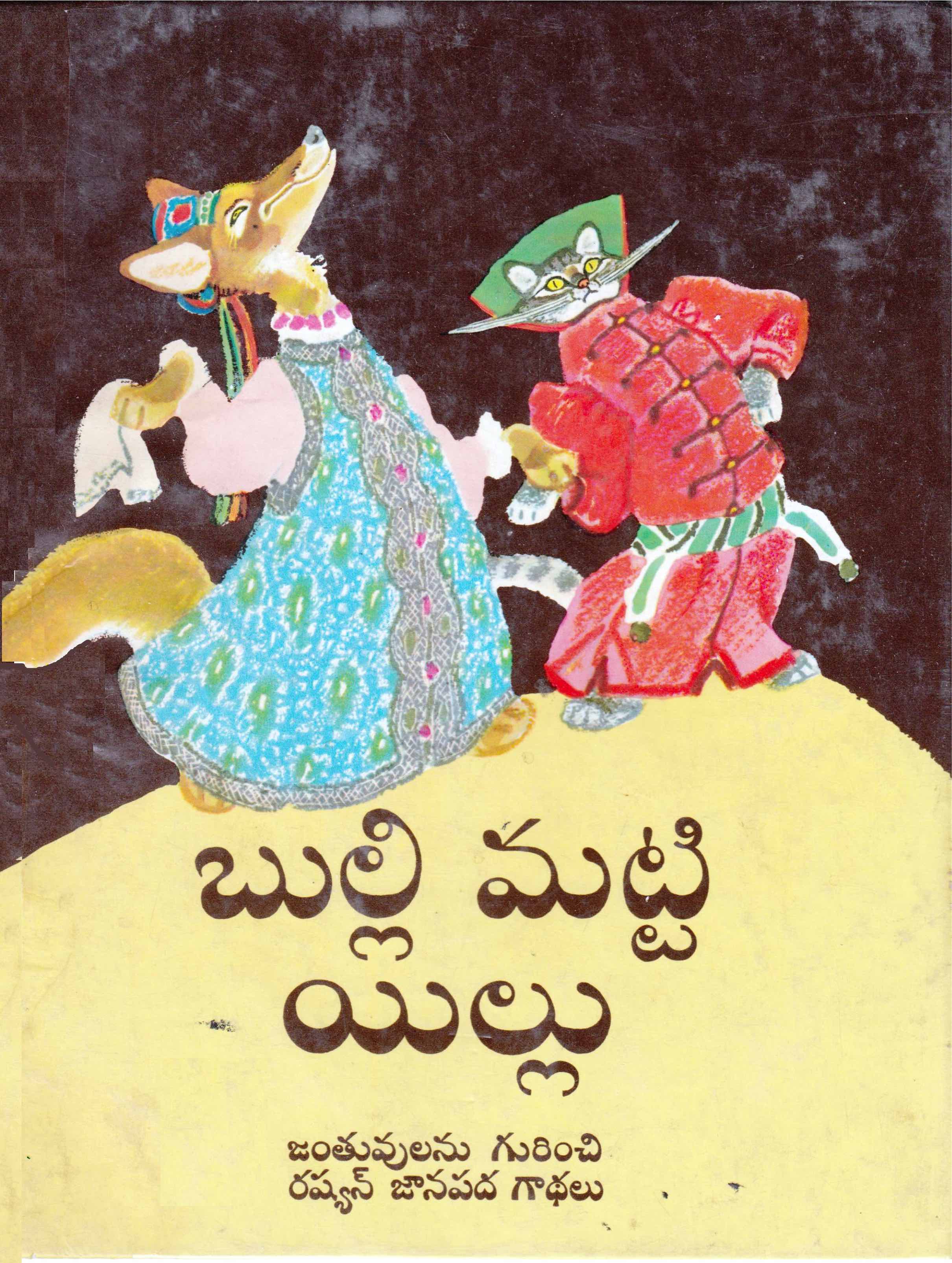
The Little Clay Hut

In this post, we will see the book The Little Clay Hut – Russian Folk Tales.

About the book

Collected in this book are Russian folk tales about animals. They are quaint and intriguing, and though meant for the tiny tots, will endear themselves to all. The birds and animals in them speak like human beings and they think and act like human beings. Some of them are good and others bad, some are brave and others cowardly, some are foolish and others clever.

Different sections of the book were translated from Russian by  Irina Zheleznova, George Hanna, and Bernard Isaacs. The Telugu translation is attributed to RVR. The splendid drawings of Yevgeny Rachev whose brush takes us into a world of magic are a joy in themselves. The book was published  by Raduga Publishers in 1987 reprint, the Telugu version is from 1982.

Do let us know if there are any other translations that you are aware of.

All credits to Guptaji.

You can get the English version of the book here.

Telugu Version here (cleaned) and here.

Follow us on The Internet Archive: https://archive.org/details/@mirtitles

Follow Us On Twitter: https://twitter.com/MirTitles

Write to us: mirtitles@gmail.com

Fork us at GitLab: https://gitlab.com/mirtitles/

Add new entries to the detailed book catalog here.

Contents

THE TURNIP  8
Translated by Irina Zheleznova

THE LITTLE CLAY HUT  12
Translated by Irina Zheleznova

THE WOLF AND THE LITTLE WHITE KIDS  24
Translated by Irina Zheleznova

THE FOX AND THE THRUSH    32
Translated by George Hanna

THE MUZHIK AND THE BEAR   42
Translated by Bernard Isaacs

THE FOX AND THE CRANE     46
Translated by Bernard Isaacs

RABBIT TALK BIG  50
Translated by Irina Zheleznova

THE BEAR AND THE FOX  54
Translated by George Hanna

THE GOAT, THE RAM AND THE CAT  60
Translated by Irina Zheleznova

LITTLE GIRL AND THE SWAN-GEESE  68
Translated by Bernard Isaacs


Posted in books, children's books, children's stories, folk tales, literature, raduga publishers, soviet | Tagged , , , , , , , , , , | Leave a comment

Happiness – Pyotr Pavlenko

In this post, we will see the book Happiness by Pyotr Pavlenko.

About the book

The novel Happiness (1947; State Prize of the USSR) was inspired by author’s experience during the restoration of the Crimea’s economy. The hero, the Communist Voropaev, is depicted comprehensively and in depth.

> A novel about postwar reconstruction in the Crimea; considered a Cult of Stalin novel: “a crude contribution to the Party’s campaign against Cosmopolitanism”

The book was translated from Russian by J. Fineberg, and was designed by A. Radishchev . The book was published in 1950 by Foreign Languages Publishing House.

Original scan from Digital Library of India project. Credits to original uploader.

You can get the book here.

Follow us on The Internet Archive: https://archive.org/details/@mirtitles

Follow Us On Twitter: https://twitter.com/MirTitles

Write to us: mirtitles@gmail.com

Fork us at GitLab: https://gitlab.com/mirtitles/

Add new entries to the detailed book catalog here.

Contents

PART ONE

CHAPTER ONE 13
CHAPTER TWO 105
CHAPTER THREE 134
CHAPTER FOUR 178
CHAPTER FIVE 220
CHAPTER SIX 263

Part TWO

CHAPTER SEVEN 333
CHAPTER EIGHT  370
CHAPTER NINE 445
CHAPTER TEN 494
CHAPTER ELEVEN 524
CHAPTER TWELVE  586

Posted in books, foreign languages publishing, literature, soviet | Tagged , , , | Leave a comment

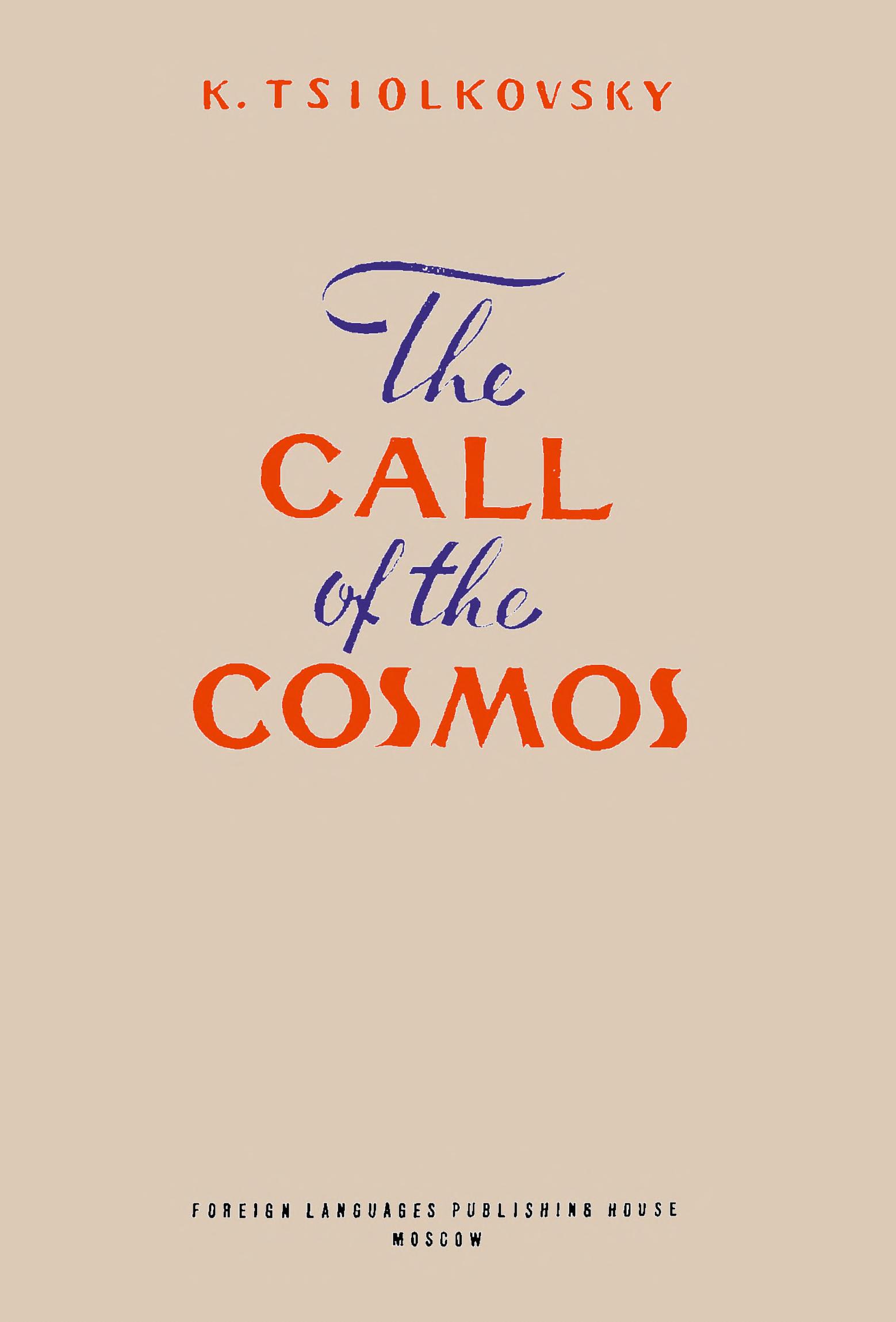
The Call of The Cosmos – Tsiolkovsky

In this post, we will see the book The Call Of The Cosmos by K. Tsiolkovsky.

About the book

Taken as a whole, this book makes interesting, even fascinating reading. Tsiolkovsky’s stories are of tremendous interest and urge us to ponder over the many purely specific problems of space travel. They will, undoubtedly, increase the number of enthusiasts in this branch of science and technology. His “On the Moon”, “Outside the Earth” and other stories afford hours of entertainment and leave a lasting impression.
Illustrated here is the world outlook of Konstantin Tsiolkovsky, original thinker, self-taught scientist, founder and keen enthusiast of space travel. Though man is bound by every fibre to his home-planet, Tsiolkovsky argues that he stands to gain immeasurably by gradually conquering space. Life in space, where there is no acceleration of gravity in relation to manned spacecraft, or even on such objects as the Moon or the asteroids, where the gravity is negligible compared with the Earth’s, presents tremendous advantages, Tsiolkovsky claims, since with the same effort it is possible there to accomplish an in­ comparably greater amount of work. In addition, in the absence of disease-producing germs and drawing on the Sun’s continuous radiation, it will be possible to cultivate
in artificial hothouses with temperature control and air-conditioning, various kinds of plants, which provide food for a human population and also consume the excreta of animal organisms.

The various sections in the book were translated from Russian by A. Shkarovsky, V. Talmy, X. Danko, and D. Myshne. The translation was edited by V. Dutt. The book was published in 1960 by Foreign Language Publishing House.

Original scan from Digital Library of India project.

You can get the book here.

Follow us on The Internet Archive: https://archive.org/details/@mirtitles

Follow Us On Twitter: https://twitter.com/MirTitles

Write to us: mirtitles@gmail.com

Fork us at GitLab: https://gitlab.com/mirtitles/

Add new entries to the detailed book catalog here.

Contents

FOREWORD. Translated by A. Shkarovsky 5

ON THE MOON. Translated by A. Shkarovsky 10
DREAMS OF EARTH AND SKY. Translated by D. Myshne 52
ON VESTA. Translated by A. Shkarovsky 155
OUTSIDE THE EARTH. Translated by V. Talmy 261
THE AIMS OF ASTRONAUTICS. Translated by X. Danko 333
CHANGES IN RELATIVE WEIGHT. Translated by A. Shkarovsky 373
LIVING BEINGS IN THE COSMOS. Translated by X. Danko 400
BIOLOGY OF DWARFS AND GIANTS. Translated by A. Shkarovsky 420
ISLAND OF ETHER. Translated by A. Shkarovsky 428
BEYOND THE EARTH’S ATMOSPHERE. Translated by A. Shkarovsky 441
B. N. VOROBYOV. SCIENCE FICTION IN TSIOLKOVSKY’S WRITINGS. Translated by A. Shkarovsky 451

Supplements

I. To Inventors of Reaction-Propelled Machines. 467
II. Is This Mere Fantasy? 469
III. Pages from a Young.Man’s Notebook. 471


Posted in Aerodynamics, books, literature, science fiction, soviet, technology | Tagged , , , , , , , , , , , , , , , , , , , , , | Leave a comment

Infectious Disease – Bunin

In this post, we will see the book Infectious Diseases by K. Bunin.

About the book

The first edition of the textbook was given a positive appraisal in the periodic press and in discussions by numerous teaching staffs of secondary medical schools.

In preparing this edition the author took into account the critical remarks made by reviewers.

The author deemed it necessary to include in this textbook the latest scientific information and results of the practical achievements of Soviet medicine. The author extended those parts of the textbook in which science has lately become enriched with new facts which are of particular practical value. The parts of the textbook dealing with methods of diagnosing infectious diseases, the principles of their treatment with antibiotics were written anew. The book also contains new descriptions of the complications of drug therapy, use of therapeutic serums, and a new chapter on Economo’s lethargic encephalitis.

New illustrations have been added and the old ones improved: the book also contains a number of original, including coloured, pictures and photographs.

In view of the existence of a special textbook on disinfection the author found it possible to limit himself to the most essential information on this subject, thereby shortening the corresponding chapter compared with the first edition of the textbook. The parts of the textbook printed in small type are aimed at giving the students deeper insight into the material.

To help the students to master the materials presented in the textbook, the latter includes tables of differential diagnostic signs of the main types of diseases. The supplements contain information which is of practical interest.

The author hopes that the present edition of the textbook will be helpful to the students and will be favourably received by teachers.

The book was translated from Russian by David A. Myshne was published in 1965 by  Mir Publishers.


Note: The original scan is from Digital Library of India project, and as mentioned earlier, the quality of scans is very poor.  The scan is barely readable at times, and in patches it is white washed (see below). So OCR is of little value for much of the text. The colour figures mentioned in the preface, are in black and white mode rendering them of no use. Only in a few cases they are legible as grayscale. We have cleaned as much as possible but we definitely need a better scan for this.
PS: With the current pandemic it is fun to read about other deadly diseases which can/have wreck/wrecked havoc on humans.

Credits to original uploaders.

You can get the book here.

Follow us on The Internet Archive: https://archive.org/details/@mirtitles

Follow Us On Twitter: https://twitter.com/MirTitles

Write to us: mirtitles@gmail.com

Fork us at GitLab: https://gitlab.com/mirtitles/

Add new entries to the detailed book catalog here.

Contents


Foreword

Introduction

GENERAL INFORMATION

History of Theories of Infectious Diseases 12
General Pathology of Infectious Diseases 26
Classification of Infectious Diseases 35
Principal Methods of Diagnosing Infectious Diseases 42
Organization of and Regimen in Contagious Hospitals and Departments 49
Purpose of Contagious Hospitals (Departments) 49
General Organization and layout of Hospitals (Departments) 49
Work of the Admission Department 51
Work of a Contagious Department 55
Rules Governing the Work of the Personnel of Contagious Departments 59
Prevention of Nosocomial (Intrahospital) Infections 59
Care and Diet of Infectious Patients 61
Principal Methods of Treating Infectious Patients 66
Disinfection, Disinsection and Deratization 77
Fundamentals of Infectious Disease Prevention 78

CLINICAL INFORMATION


I. INTESTINAL INFECTIONS 91

Typhoid Fever 91
Paratyphoid Fever A and Paratyphoid Fever B (Paratyphus Abdominalis A and B) 108
Food Poisoning 110
Botulism 115
Dysentery 120
Amoebiasis 132
Asiatic Cholera 138
Botkin’s Disease (Morbus Botkini) 145
Helminthiases 158

II. TRANSMISSIVE (BLOOD) INFECTIONS

Classic Epidemic (Louse-Borne) Typhus 175
Tick-Borne Typhus or North-Asian Ixodorickettsiosis 191
Endemic or Murine Rickettsiosis 194
Q-Fever (Q Rickettsiosis) 196
Relapsing Fever (Typhus, Sive Febris Recurrens) 200
Tick-Borne Relapsing Fever (Spirochaetosis Acarina) 210
Malaria 213
Cutaneous Leishmaniasis 231
Visceral (General) Leishmaniasis (Kala-azar) 235
Pappataci Fever (Febris Pappatasii) 241
Haemorrhagic Fevers 245

Epidemic Encephalitides 250

III. ZOONOTIC INFECTIONS 256

Rabies (Hydrophobia, Lyssa) 256
Brucellosis 263
Icterohaemorrhagic Leptospirosis or Weil-Vasilyev’s Disease 274
Marsh Fever or Anicteric Leptospirosis 281
Glanders (Malleus) 284
Anthrax 287
Tularaemia 297
Plague (Pestis) 306
Foot and Mouth Disease (Aphthae Epizooticae) 315

IV. AIR BORNE DROPLET INFECTIONS 318

Chickenpox (Varicella) 318
Influenza 322
Diptheria 334
Infectious Mononucleosis 350
Whooping Cough (Pertussis) 351
Rubeola Morbiollosa 361
Lethargic Encephalitis (Economo’s Disease) 362
Small Pox (Variola Vera) 364
Orniteosis 379
Acute Anterior Poliomyelitis 379
Scarlet Fever 390
Mumps (Epidemic Parotitis) 407

V. INTEGUMENTARY INFECTIONS 410

Erysipelas 410
Tetanus 415
Complications of Drug Therapy and Methods of Preventing Them 420


Supplements

Supplement 1. Incubation Periods of Various Infectious Diseases 429
Supplement 2. Methods of Taking Material for Laboratory Examination 431
Supplement 3. M. A. Morozov’s Method of Silvering for Viroscopy 437
Supplement 4. Staining Smears and Thick Drops for the Purpose of Revealing Malarial Plasmodia and Relapsing Fever Spirochaetes 437
Supplement 5. Liver Function Tests in Botkin’s Disease 439
Supplement 6. Rules Governing Discharge of Convalescents from Hospital after Treatment with Drugs and Antibiotics 439
Supplement 7. Prescriptions 441


Posted in books, life sciences, mir books, mir publishers, soviet, technology | Tagged , , , , , , , , , , , , , , , , , , , , , , , , , , , , , , , , , , , , , , , , , , | Leave a comment