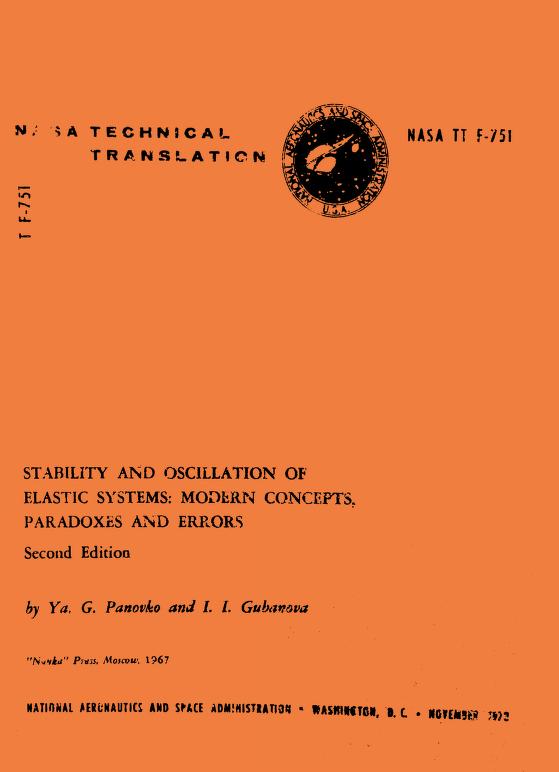
This book discusses contemporary problems such as “jumps” in elastic systems, problems of aeroelasticity, problems of frictional self-oscillations, and self-synchronization, providing only the elementary data on these topics.
The first part examines the stability of equilibrium shapes in elastic systems. It addresses stability loss in cases of similar equilibrium shapes, the disappearance of stable equilibrium forms, and the absence of any equilibrium states. The error made by Euler in analysing stability loss is highlighted, and Mises’ truss is used as an example of stability loss in cases of similar equilibrium shapes.
The second part focuses on problems related to oscillations of linear systems, including systems with a fractional number of degrees of freedom, as well as the free oscillations of a cantilever in the field of centrifugal forces. Four methods for solving the problem of the action of periodic instantaneous impulses are presented. The Tacoma catastrophe is analysed as an example of aeroelastic oscillations.
Finally, the book explores problems of nonlinear system oscillations, including the vibration maintenance of rotation, the Sommerfeld effect, and self-oscillations of a quasi-system with dry friction.
You can get the book here and here
Follow us on
Twitter https://x.com/MirTitles
Mastadon https://mastodon.social/@mirtitles
Bluesky https://bsky.app/profile/mirtitles.bsky.social
Tumblr https://www.tumblr.com/mirtitles
Internet Archive https://archive.org/details/mir-titles
Fork us on gitlab https://gitlab.com/mirtitles
Table of Contents
Foreword
Foreword to the First Edition …………………………………………….. v
Foreword to the Second Edition ……………………………………………. vi
Part 1: The Stability of Equilibrium Shapes of Elastic Systems
Introduction ………………………………………………………………….. 1
Chapter I: The Loss of Stability Upon the Appearance of Similar Equilibrium Shapes
§1. Euler’s Error ……………………………………………………………………. 5
§2. The Effect of Subcritical Compression of a Bar on the Critical Value of the Compressive Force …. 11
§3. One Version of the Application of the Energy Method ………………………. 17
§4. Loads Whose Values Depend on the Displacements ………………………….. 22
Chapter II: Loss of Stability Upon the Appearance of Non-Similar Equilibrium Shapes
§5. The Mises’ Truss ………………………………………………………………… 43
§6. The Stability of a Fluted Strip ………………………………………………….. 51
§7. More Examples of Systems with Jumps; Discussion of the Results …………. 58
Chapter III: Stability Loss Upon the Disappearance of Stable Equilibrium Shapes
§8. Tracking Loads: Static Statement of the Problem …………………………. 70
§9. Tracking Loads: Dynamic Statement of the Problem …………………….. 80
§10. Tracking Loads: A System with Two Degrees of Freedom ………………… 87
§11. The History of the Problem …………………………………………………… 91
Chapter IV: Stability Losses When Any Forms of Equilibrium Disappear
§12. General Stability of High Buildings ………………………………………… 97
§13. Characteristics of “Deformation Calculations” …………………………….. 104
§14. Two Discussions (Solutions of R. Lorenz and V. E. Vlasov) ……………….. 113
§15. Stability Losses of a Rod Under Tension …………………………………. 125
§16. Critical Internal Pressure for a Spherical Shell ……………………………. 136
§17. Rotation of a Flexible Shaft in a Rigid Tube-Shell ………………………… 140
Chapter V: Buckling of Not Fully Elastic Rods
§18. Elastic-Plastic Buckling: Classical Concept ……………………………….. 153
§19. Elastic-Plastic Buckling: Present-Day Concept ……………………………. 160
§20. Buckling of a Rod in a Statically Indeterminate System …………………. 167
§21. Stability Loss in the Case of Material Creep ……………………………….. 175
Part 2: Oscillations of Elastic Systems
Introduction …………………………………………………………………… 184
Chapter VI: Certain Problems of Oscillations of Linear Systems
§22. System with a Fractional Number of Degrees of Freedom ………………. 187
§23. Free Oscillations of a Cantilever in the Field of Centrifugal Forces ………. 192
§24. Equal-Frequency Shock Absorber ……………………………………………. 197
§25. Comments on the Formulas of Rayleigh and Grammel ……………………… 201
§26. Lagrange Errors ………………………………………………………………. 214
§27. Formula of A. N. Krylov ………………………………………………………. 224
§28. Four Methods of Solving the Problem of the Action of Periodic Instantaneous Impulses …….. 233
§29. Superpositions: Variations of Using It in Problems of Forced Oscillations … 244
§30. The “Inverse” Form of Differential Equations of Oscillations ……………. 252
§31. Terminology Information: Impedance, Receptance, Admittance, Response, Anti-Resonance …. 259
§32. Parametric Excitation of Oscillations ……………………………………… 269
§33. Destabilizing Action of the Forces of Viscous Friction …………………….. 285
§34. Linear Realisations of Dry Friction Forces …………………………………. 292
§35. Paradox Connected with Damping Coverings ……………………………… 302
§36. Damping of Pipeline Oscillations by Coriolis Forces ………………………. 309
Chapter VII: Dynamic Action of a Moving Load
§37. Brief Historical Sketch ……………………………………………………… 314
§38. Bresse Error ……………………………………………………………………… 322
§39. A Travelling Bending Wave …………………………………………………….. 327
§40. Action of an Infinite Strip of a Moving Load ………………………………. 332
Chapter VIII: Aeroelastic Oscillations
§41. Dynamic Problems of Aeroelasticity Theory ……………………………….. 338
§42. “Classical” Flutter ………………………………………………………………. 341
§43. Tacoma Catastrophe: Separation Flutter …………………………………… 351
Chapter IX: Problems of Nonlinear System Oscillations
§44. Vibration Maintenance of Rotation …………………………………………. 358
§45. Dynamics of the Boisse-Sarda Regulator …………………………………… 365
§46. Sommerfeld Effect ………………………………………………………………… 372
§47. Self-Oscillations: Method of Slowly Changing Amplitudes ……………….. 383
§48. Self-Oscillations of a Quasi-System with Dry Friction …………………… 393
§49. Discontinuous Self-Oscillations in the Case of Dry Friction ……………. 400
§50. Delta Method ……………………………………………………………………… 406





 Mir Books