Updates…

The link for All About The Telescope has been updated. This is a major revision from the earlier link, in terms of quality. The download size is about ~118 MB.

Update 2: gnv64 has made a (much) smaller version of the above file ~ 7 MB. Check out the new link for that.

Continue reading

Posted in astronomy, books, progress publishers | Tagged , , | Leave a comment

Little Mathematics Library – Images of Geometric Solids

We now come to another title in the Little Mathematics Library, this one is titled Images of Geometric Solids by N. M. Beskin

Drawing a plane figure is not geometrically difficult because the image drawn is either an exact copy of the original or a similar figure, e.g. the drawing of a circle looks like the original circle. Drawing geometric solids is quite a different matter. Unfortunately, there are no “spatial pencils” which can trace an object in the air. Such a pencil would “draw” a cube by tracing along its edges. Hence, we have to sketch a cube on paper with an ordinary pencil. A plane image will never be an exact copy of a solid and, therefore, a certain routine ought to be followed in drawing a solid that would create an image of the original in the best way.

What is the book about. Descriptive geometry embraces so
many methods that even a brief account would make up a rather thick volume. Therefore, we shall discuss just one of these methods, so as to enable the reader to make stereometric drawings and solve the respective problems…

This book presents a geometric theory of constructing
stereometric drawings. Having mastered this theory, a reader will be able to make the drawings himself rather than have to stick to the few sample ones.

The first chapter presents the theory, the second one is devoted
to its applications (drawing of a cube, a cone, a cylinder, etc.),
and the third one describes a method of plotting the points of an
image if their coordinates are known.

It is these strategies and routine that this book discusses. Though many things are possible with modern computer programs, but the logic may not be known to people who are using them.

The book was translated from the Russian by Valery Barvashov and was first published by Mir in 1985.  All credits to the original uploader.

Update 26 May 2018

The Internet Archive link.

and here

Continue reading

Posted in books, little mathematics library, mathematics, mir books, mir publishers | Tagged , , , , , , , , , | 7 Comments

Little Mathematics Library – Differentiation Explained

We begin with the Little Mathematics Library series once again, after a long break.  We first see the book titled Differentiation Explained by V. G. Boltyansky (Boltyanskii).

The author in the Preface says:

High school students, especially those interested in mathematics, physics and engineering, often ask, ‘What is “higher” mathematics?’ Sometimes they discuss this and similar questions at mathematics clubs at schools.

In this book I have tried to explain, in a way a high school pupil would understand, certain concepts of higher mathematics  such as the derivative, differential equation, the number e, and natural logarithm (pupils are more apt to be aware of and interested in the latter two concepts). Wherever possible, I have tried to illustrate the concepts with problems taken from physics. In addition, I have tried to show that the concepts of “higher mathematics” are mathematical reflections of actual processes, that mathematics and life are connected, not separated, and that mathematics is a growing, not an unchanging, completed science. Not all proofs and arguments are presented with complete mathematical rigour. Some arguments are presented for illustration. This method seems to me more appropriate for a general book.

The book can be used by mathematics and physics clubs at school. Part of the material is taken from lectures the author gave at the request of the advisers of school mathematics clubs at the Moscow State University.

The book was translated from Russian by M. Samokhvalov and was first published by Mir in 1977.  All credits to the original uploader.

The Internet Archive Link

and here

Continue reading

Posted in books, little mathematics library, mathematics, mir books, mir publishers, physics, science | Tagged , , , , , , , | 5 Comments

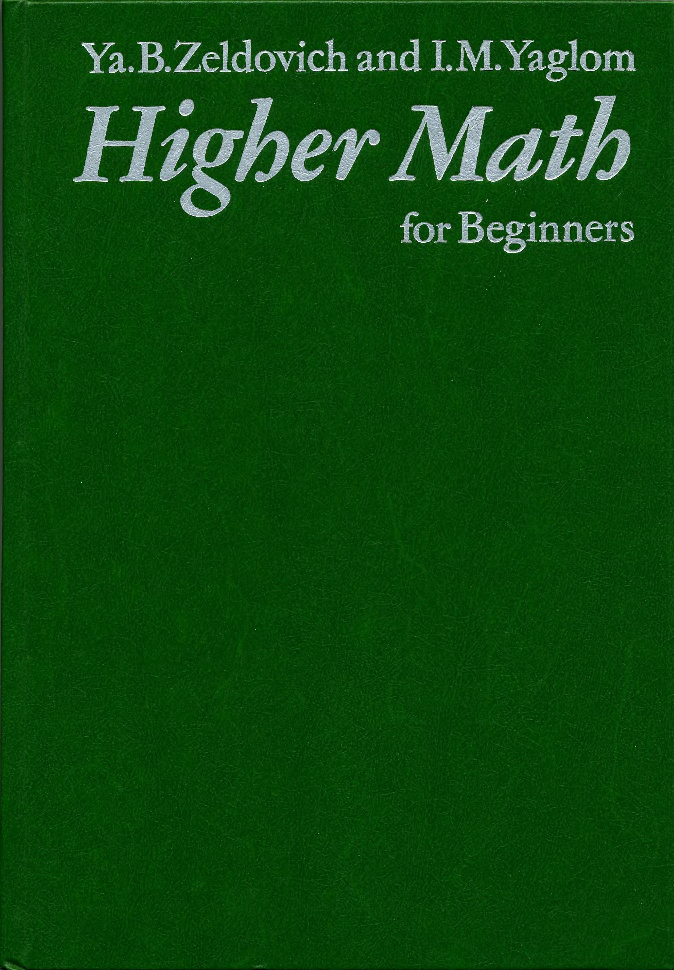
Higher Maths for Beginners – Zeldovich, Yaglom

The book in this post is one of the best introductory books for Higher Mathematics and it has been written by two exceptionally talented people, namely, Yakov B. Zeldovich and Issak M. Yaglom. Just visit the wikipedia pages to see their achievements. If only all the outstanding people in their fields wrote books at popular level, we would be living in a different world. The complete title of the book reads Higher Maths for Beginners (Mostly Engineers and Scientists).

This book is a joint attempt of a physicist and a mathematician to write an entirely new type of book for future scientists and engineers.

The purpose of this book is to enable the future physicist (chemist, engineer etc.) to use higher mathematics in his or her work by mastering its methods without going into full logical substantiation of them, allowing the student to view mathematics as a section of natural sciences and to solve as many concrete  problems as possible.

This book is intended for beginners, that is, for high-school students in the upper grades, students of trade schools and vocational schools, and students in the first years of college. We also have in mind anyone who by himself wishes to become better acquainted with higher mathematics, say, people who finished school some years ago

The book was translated from the Russian by Eugene Yankovsky and was first published by Mir in 1987.

You can get the book here and here.

All credits to the original uploader.

Update: Posted Internet Archive Link 03 December 2015

Continue reading

Posted in books, mathematics, mir books, mir publishers, physics, science | Tagged , , , , , , | 37 Comments

Did You Say Mathematics?

We have seen one book by Yakov Khurgin previously in the Science for Everyone series named Yes, No  Or Maybe . Now we come to another book by him with the title Did You Say Mathematics?

The back cover of the book says about the author:

Dr. Yakov Khurgin is professor of mathematics at the Chair of Applied Mathematics at the Gubkin Institute of the Petrolium and Gas Industry. He has written over a hundred scientific papers in pure and applied mathematics and has been particularly productive in the fields of  radioengineering, radiophysics, cybernetics, neurophysiology and psychiatry. At the present time, Professor Khurgin heads the laboratory of applied mathematics. He is also a  member of the USSR National Committee of Automatic Control.

His extensive knowledge and wide range of activities have helped to make his popular-science book a great success.

And the book itself is described by the author in a section titled One last word to the reader:

In the chapters that follow I will attempt to tell the story of mathematics and weave into an integral whole the various discussions I have had with my non-mathematical friends.

This will be a story of mathematics in popular language so that the non-mathematician will see what it is all about. This is not a course in mathematics but merely a series of sketches concerning ideas and
methods. There will be no proofs to carry out and no need for paper and pencil. What I want to do is sketch a picture of the development of mathematics and show what mathematicians are presently engaged
in—to some extent.

This book is true indeed a popular exposition of many concepts in mathematics. The book was translated from the Russian by George Yankovsky and was first published by Mir in 1974 and republished in 1984. Thanks to gnv64 for this one!

The Internet Archive Link

and here

Continue reading

Posted in books, mathematics, mir books, mir publishers, psychology, science, statistics | Tagged , , , , , , , , | 8 Comments

Updates…

The links for following books have been reloaded:

Lobachevskian Geometry

Method of Successive Approximations

Post’s Machine

Proof In Geometry

Stereographic Projection

The Method of Mathematical Induction

Pascal’s Triangle

Let’s Play Geometry

Let me know if they are working okay.

Password, if needed: mirtitles

PS: Also updated links for

The Monte Carlo Method

Posted in books | Leave a comment

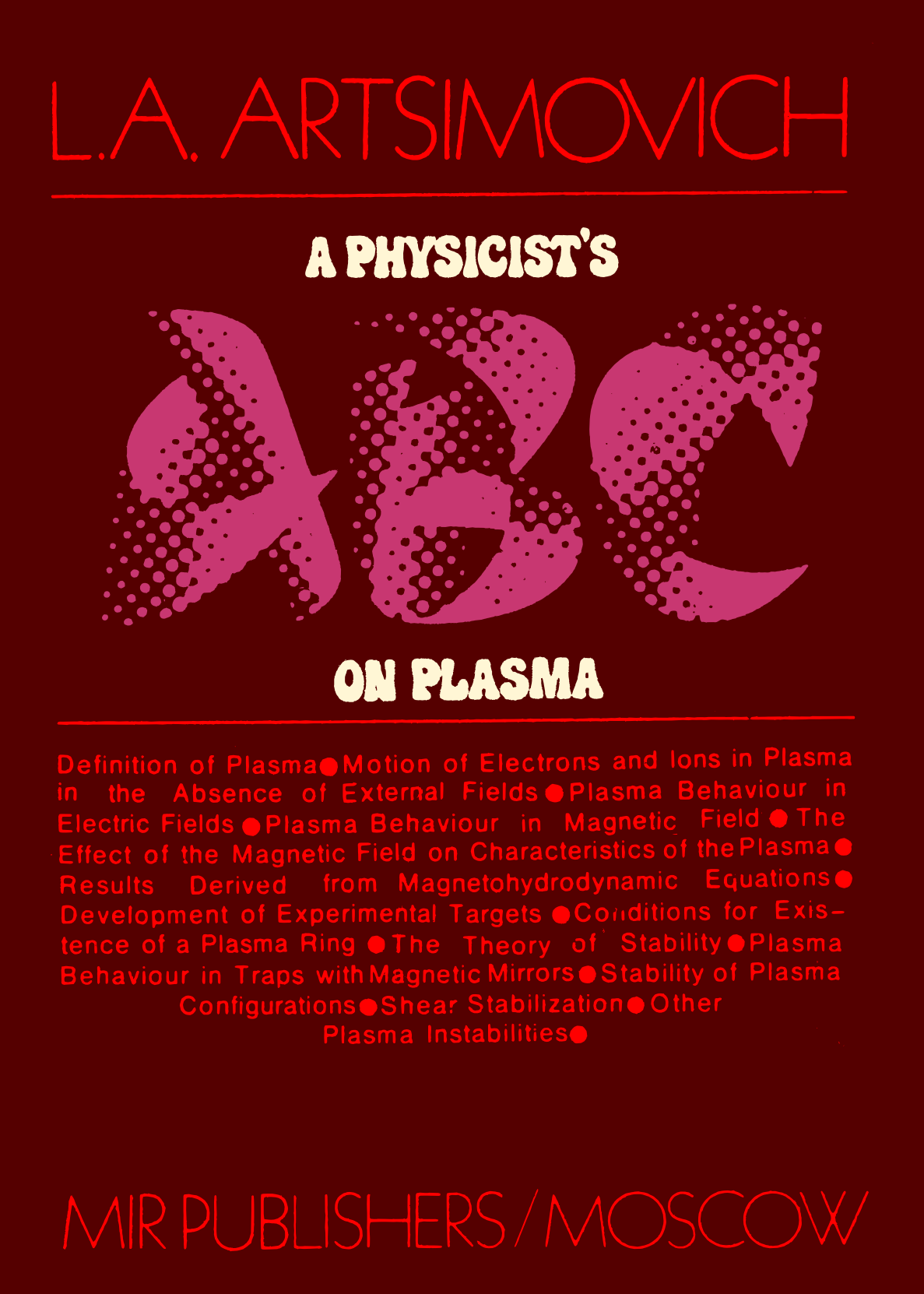
ABC of Plasma Physics

We now come to another series of books the ABC of … series. One of the first books that I had read of this series was ABC of Quantum Mechanics, which is lost somewhere. In this post we see A Physicist’s ABC of Plasma Physics by L. A. Artsimovich.

The Preface of the book written by Prof. B. B. Kadomtsev says:

This small book written by the late Lev Artsimovich, a Full Member of the USSR Academy of Sciences, is the lecture course he delivered for the physicists interested in plasma physics. The book presents the fundamental information on the high-temperature plasma physics. These, at present largely well established results, comprise, in effect, the sum of knowledge indispensable for any physicist with a wide enough sphere of interests.

By now, some material in the book has become somewhat dated; for instance, plasmas generated in Tokamaks and adiabatic traps have now more impressive parameters and we have now a markedly better understanding of the processes in them. However, since the general conceptual system has not undergone any major changes we have deemed it unwise to alter the original author’s presentation of ideas and, therefore, no significant changes have been made in the original text. Hence, the material presented in the book comprises, in the opinion of L. Artsimovich, the fundamental results obtained through many years of experimental and theoretical research in the high temperature plasma physics.

The book was translated from the Russian by Oleg Glebov and was first published by Mir in 1978.

The Internet Archive Link

and here

This post is dedicated to Mubs, hope you also write a similar book in the future.

Continue reading

Posted in books, mir publishers, physics, science | Tagged , , , , | 3 Comments

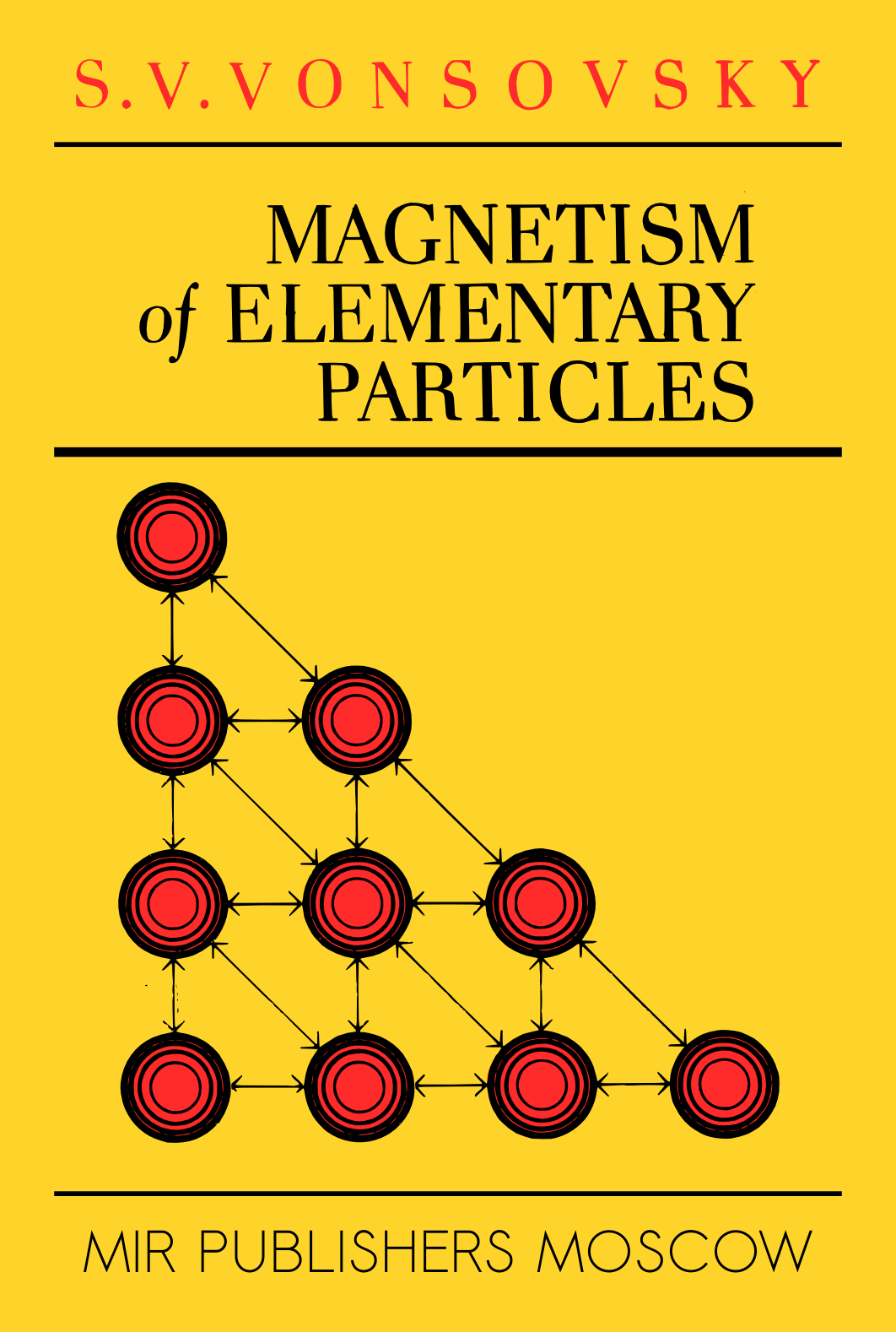
Magnetism of Elementary Particles – S. V. Vonsovsky

After last book, we come to another book on the topic of magnetism. But this is not of the popular science kind as most of the books that we have seen so far, this is for the experts in the field.

From the Preface

The book contains a fairly detailed though, of course, incomplete reference list, which may help to satisfy the reader who wishes to investigate anyone question in its entirity.

The book opens with a review of the well-known aspects of magnetism of the elementary particle that was discovered first, the electron (Chapter 1). This is followed by a brief summary of data concerning the magnetic properties of atomic electron shells (Chapter 2). Chapter 3 is devoted to the magnetic properties of atomic nuclei and their constituent nucleons-the proton and the neutron. It also contains a description of the most important experimental techniques of determining the magnetic moments of nuclei and nucleons (detailed tables of measured magnetic moments are given in the Appendix at the end of the book). Chapter 4 deals with the problem of the anomalous magnetic moment of an elementary particle and with the relation of this problem to the quarks hypothesis. Chapter 5 offers a fairly detailed description of the situation arising from the Dirac
hypothesis concerning the magnetic monopole. Finally, Chapter 6 gives a very brief presentation of non-linear magnetic effects in strong fields.

As has been noted, the author did not pursue the goal of giving a rigorous mathematical elaboration of theory or a comprehensive review of experimental facts. He confined himself to outlining the general situation, stressing the physical essence of the described phenomena. It is the author’s hope that this book will find many readers among physicists and specialists in related branches of the natural sciences and will help them in their practical research.

Also impressive is the list of References which has a total of 998 entries!

The book was translated from Russian by O. A. Germogenova, and was first published by Mir in 1975.

The Internet Archive Link

and here

Continue reading

Posted in books, mir books, physics, science | Tagged , , , , , , , , | 13 Comments

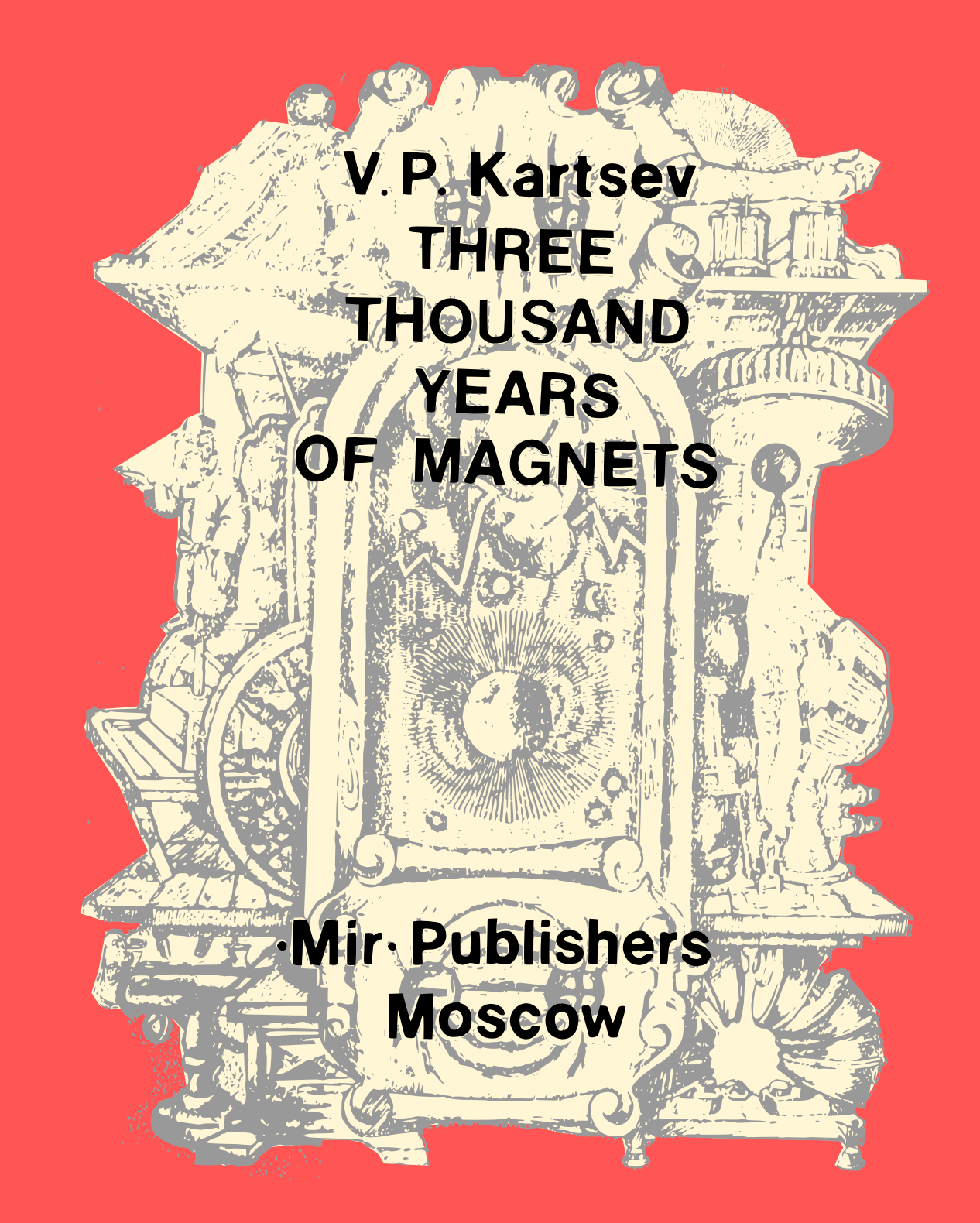
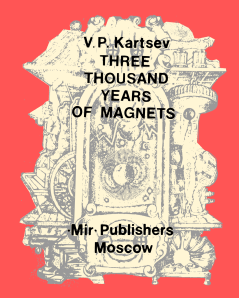
Three Thousand Years of Magnets – V. P. Kartsev

We now come to a wonderful book titled Three Thousand Years of Magnets by V. P. Kartsev.

The introduction of the book says:

The universe is magnetic, from its vast, distant nebulae right down to elementary particles, and man is permeated through and through with myriads of magnetic fields from all sorts of sources.

We now take the magnet for granted and have a rather supercilious attitude toward it as an old-fashioned part of school physics lessons, with no idea, at times, of the number of magnets around us. I counted up one day; in my flat there are dozens-in my electric razor, in the radio  loudspeaker, in the tape-recorder, and in a jar of nails. And I myself am a magnet; the biological currents in me give rise to a fantastic pattern of magnetic lines of force. Our Earth, too, is a gigantic blue magnet; and the Sun,a great, yellow sphere of plasma, is an even more powerful one. Galaxies and nebulae hardly visible even by means of radio telescopes are magnets of unfathomable size.

Nobody has ever been able to say (and probably never will): ‘I know everything there is to know about magnets.’ The question ‘Why does a magnet attract?’ will always fill us with a sense of Nature’s inexhaustible variety and encourage to thirst after new knowledge and new discoveries. And, because of the immensity of the problem of magnets, this book will not provide a complete answer either.
Nevertheless we do know a great deal about magnets – in any event enough to exploit their power to our own advantage.

New materials, new magnets, amazing new equipment, and the most complex and sophisticated machines all became possible when scientists began to understand the mysterious manifestations of magnetism. The magnet, it seems, which not so long ago was incomprehensible and uncontrollable, is beginning without demur to obey the orders of man, who is penetrating its secrets. And here we
would do well to recall the words of the] poet Velimir Khlebnikov: ‘No one could fulfil an order more exactly than the Sun if he were told to rise in the morning in the east. ‘

The book was translated from the Russian by Ann Feltham and was first published by Mir in 1975.

The Internet Archive Link

and here

Continue reading

Posted in books, history, mir books, mir publishers, physics, science | Tagged , , , , , | 11 Comments

Updates…

Have upped Tarasov’s Calculus. The link in the original post has also been updated.

Also Landau and Rumer’s What is The Theory of Relativity has been re-upped.


Posted in books, mathematics, mir books, mir publishers, science | 8 Comments