Relativity and Man – V. Smilga

Our task is to comprehend the purely physical essence 
of the theory, without going into problems which cannot
be explained here with sufficient clarity.

After seeing three books (RTG and STG) on General Relativity (GR) and one Special Theory of Relativity (STR), we come to yet another book on STR. In this post we will see a popular science book on STR titled Relativity and Man by V. Smilga. In other words this can be your first book on relativity, as opposed to the earlier three books 🙂
This book is about the special theory of relativity. A secondary schooling is adequate to understand it, but reading it calls for some mental concentration as well as an ability for mental abstraction. The unsophisticated reader may, therefore, find it difficult and boring. Nevertheless, since the discourse is abundantly interspersed with general statements and sundry examples and analogies, and insofar as most statements of fact are declared but not proved, the book can probably be classified as popular science reading.

The book in the first few chapters the classical concepts of Newtonian mechanics of length and time, so as to give the reader a comprehensive understanding of the paradoxes and “astonishing” results that we arrive at in STR. In my opinion the strangeness of results of STR (and for that matter of Quantum Mechanics also) paradoxes many times appears not so strange (they are just some theoretical results) to students, as they do not have much substantial understanding of the classical concepts themselves. So when something unexpected happens, the students are not in a position to appreciate that result well. Also discussed at length is the rise and fall of the stationary ether, and hence in this connection how the theories regarding light developed historically. The postulates of STR with their possible implications for observables (time, length) are discussed in details in the later chapters. The book has some really nice illustrations, ones that fit in a popular science book perfectly.

The book was translated from the Russian by V. Talmy and was designed by B. Zhutovsky. The book was published by Progress Publishers in 1964.

You can get the book here. and here

Update: 11 December 2015 | Added Internet Archive Link

PDF | OCR | 600 dpi| Bookmarked| Paginated| Covers | 356 pages| 20.4 MB

Get the magnet link/torrent here. Continue reading

Posted in astronomy, books, physics, progress publishers, science, soviet | Tagged , , , , , , , , , , | 9 Comments

Special Theory of Relativity – Ugarov

After the two books on General Relativity (GR) viz. STG and RTG, we come to a great textbook on Special Theory of Relativity (STR). This one is by V. A. Ugarov titled Special Theory of Relativity. This book is a very comprehensive treatment of the Special Theory of Relativity with all advanced topics treated well. Also interesting is the article by V. L. Ginzburg (whose book Key Problems of Physics and Astrophysics we saw recently) which is  Who Developed Special theory of relativity and how? This may be of special importance to those who wish to know historical roots of development of relativity.

It is in this book that I first read about the superluminal speeds which are possible and are indeed result of STR. Section 8.1 deals with these phenomena and there are 5 of them discussed here. These are for real and are indeed observed in nature. For example the hot-spot in case of radio jets appeared to move at faster-than-speed-of-light. The easiest one which you can indeed do is to take a torch and make a spot on the wall, there is no limit on how fast the spot can travel. Let us see what Ugarov has to say on this topic:

Let us place a searchlight at the origin of coordinates and start rotating it at the angular velocity \Omega. Let us circumscribe a stationary sphere of radius c around the origin. Then the light spot will run along the surface of this sphere at the linear velocity v = \Omega c. This velocity can exceed the velocity of light. The example of such a beam is provided by a rotating pulsar. The light spot of the Crab Nebula pulsar runs along the Earth surface at the velocity equal approximately to 10^{22} m/s. But as in the previous cases no signal is transmitted at such a velocity. As a matter of fact, every point of a screen (the Earth) receives a new portion of light energy from a searchlight (pulsar), but not from a neighbouring point of the screen. Therefore, it is impossible to transmit information from one point of the screen to another.

The 4-forms, electrodynamics, transformations are discussed with substantial emphasis on the physical meaning. These kind of discussions make this book a wonderful resource to learn.

The book was translated from the Russian by Yuri Atanov and was first published by Mir in 1979.

All credits to the original uploader, thanks to atisundar for providing this link.

You can get the book here. 

and

French version here

and here

Update: 11 December 2015 | Added Internet Archive Link

Get the magnet link/torrent here.


Continue reading

Posted in astronomy, books, history, mathematics, mir books, mir publishers, physics | Tagged , , , , , , , , , , , , , | 1 Comment

Space Time Gravitation – Vladimirov, Mitskiévich, Horský

However, the main difference between this and other popularizations
is the third chapter, in which the authors try get to grips with
subjects such as cosmological singularities, generalizations of 
Einstein's gravitational theory, the quantization of gravitational 
fields, and the dimensionality of space-time.

After seeing some heavy stuff on Relativistic Theory of Gravitation (RTG) in the last post, we come to yet another book on General Relativity (GR) which is titled Space Time Gravitation by Yu. Vladimirov, N. Mitskiévich, J. Horský.

This book is basically divided into three sections which are aptly titled Yesterday, Today and Tomorrow and they discuss the historical aspects, current situation and future advances respectively regarding GR. The back cover of the book says:

An historical survey of our ideas about space, time and gravitation. In three chapters, the authors consider how space and time were perceived from ancient times to the present (as marked by the publication of Einstein’s theory of relativity) how they are now perceived, and finally how this field of mathematics and physics might develop in the future. Although there are many presentations of our current understanding of this subject on the market, the topics covered in the second chapter of the book are not those usually examined. However, the main difference between this and other
popularizations is the third chapter, in which the authors try get to grips with subjects such as cosmological singularities, generalizations of Einstein’s gravitational theory, the quantization of gravitational fields, and the dimensionality of space-time.

Written for students and professionals specializing in
physics or related sciences.

The book was translated from the Russian by A. G. Zilberman and edited by F. I. Fedorov. This book was first published by Mir in 1987.

You can get the book here. and here

PDF | OCR | 600 dpi | Cover | Bookmarked| Paginated | 220 pages | 19.5 MB

Continue reading

Posted in astronomy, books, history, mathematics, mir books, mir publishers, physics, science | Tagged , , , , , , , , , , , | 6 Comments

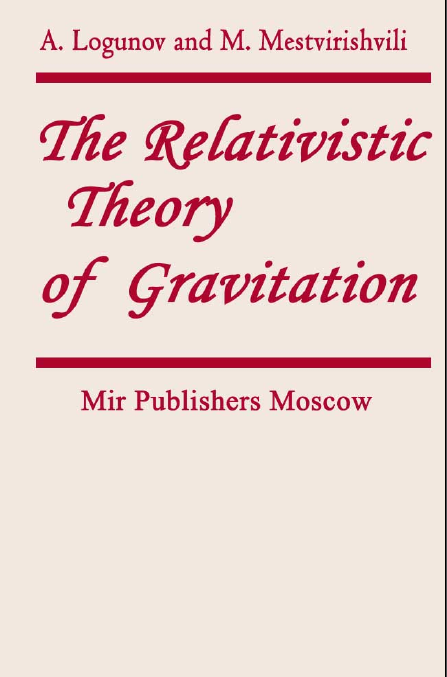
The Relativistic Theory of Gravitation – Logunov, Mestvirishvili

The gravitational field is constructed as a physical field in the 
spirit of Faraday and Maxwell, and this field has energy, momentum, 
and spins 2 and 0.

In this post we see book titled The Relativistic Theory of Gravitation by A. A. Logunov and M. A. Mestvirishvili.If you think the title is a bit scary, then it is. Without a proper background in General Relativity (GR) and associated subjects (tensor calculus, etc.) this book is not readable. The topics are mostly at advanced level and already assumes that the reader is familiar and well acquainted with the subject. In other words this is not the first  book to be  read on the subject. It is a rigorous presentation of a gravitational theory which differs from results of the Einstein’s version of General Relativity.

This book presents the authors’ Relativistic Theory of Gravitation

In this book we give a detailed exposition of the relativistic theory of gravitation or RTG, developed in Logunov, 1986, Logunov and Mestvirishvili 1984 , 1985a , 1985b, 1986b , Vlasov and Logunov, 1984, an d Vlasov , Logunov, and Mestvirishvili, 1984 . In these works RTG bas been built unambiguously, using as a basis the relativity principle, the gauge principle, and the geometrization principle.The gravitational field is constructed as a physically in the spirit of Faraday and Maxwell, and this field has energy, momentum, and spins 2 and 0. RTG revives the concept of a classical gravitational field that no choice of reference frame can destroy since it is a material substratum. The gauge principle is formulated on the basis of the local infinite dimensional non-commutative group of super-coordinate transformation.

The theory considered here rigorously obeys the laws of conservation of energy momentum and angular momentum for matter and gravitational field taken together. It also describes the entire body of gravitational experiments. We show that Einstein’s formula for gravitational waves, (15.56 ),  follows directly from the theory. In analysing the evolution of the universe, RTG concludes that the universe is infinite and “flat” and predicts a large “latent” mass in it. This “latent” mass exceeds the observable mass of the universe by a factor of 40.

We also show that in general relativity, GR, there are no fundamental laws of conservation of energy -momentum and angular momentum of matter and gravitational field taken together, with the result that the inertial mass defined in GR is not equal to the active gravitational mass. We have established that GR gives no definite predictions concerning gravitational effects. Finally, in GR the gravitational field is not a physical field possessing an energy-momentum density. Consequently, Einstein’s formula (15.56) for gravitational waves does not follow from GR.

The book was translated from the Russian by Eugene Yankovsky and was first published by Mir in 1989.

You can get the book here. and here

All credits to the original uploader.

For magnet links/ torrents go here.

PDF | OCR | Cover (Front Only) | 37 MB | Pagination | Bookmarks| 235 Pages

Page: 103 missing

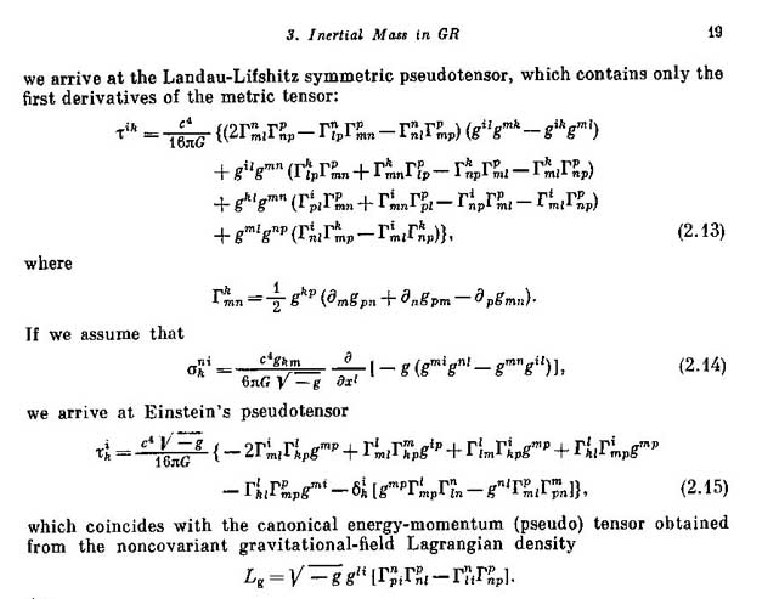
Note: The scan quality is poor (though file size is large) maybe 100 dpi or less. OCR is not reliable and the text is barely readable at times. This is especially true when there is a lot of tensor notation. See sample below. Maybe we should LaTeX it! If anyone has access to a better link please post the link.

Continue reading

Posted in astronomy, books, mathematics, mir books, mir publishers, physics, science | Tagged , , , , , , , | 6 Comments

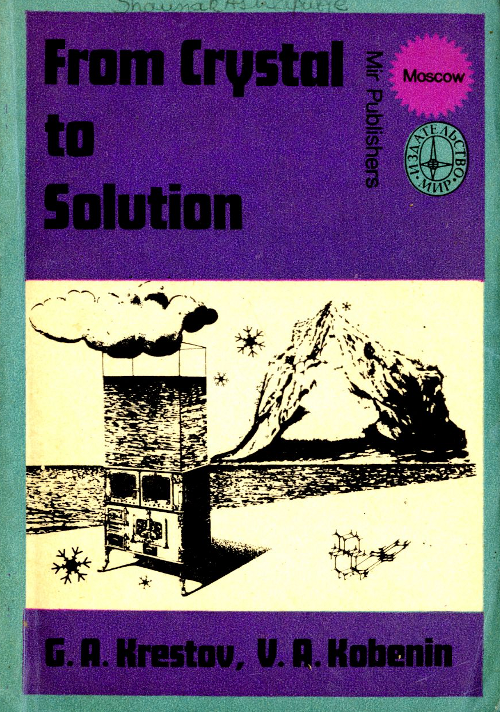
From Crystal to Solution – Krestov, Kobenin

Crystal and solution. The two words often go together. Crystals of 
salts dissolve in water, and saturated solutions of mineral salts 
precipitate crystals ...

We now come to a wonderful little book titled From Crystal to Solution by G. A. Krestov, V. A. Kobenin and edited by P. B. Dobrotin.

The editor says in the Preface:

Fascinated as we are with the perfect beauty of a snow flake, we must remember that when it melts on the palm to turn into water, its inner structure is not fully destroyed but only becomes invisible to the eye. The structure persists in the mutual arrangement of molecules, in the intricate ice-like structure of liquid water …

As substances dissolve in water, they occupy their own “apartments” in this invisible but orderly “molecular building” partly destroying its separate sections and partly introducing their own new order around the ions and molecules.

So it is not for nothing that crystal and solution are put together in the title of this book. They are related and the modern scientist believes that the study of the close connections between them will give him the clue to understanding the nature of solution, which is perhaps the most important state of matter.

The book was translated from the Russian by A. Rosinkin and was first published by Mir Publishers in 1980.

You can get the book here.

and here

PDF | OCR | 600 dpi | Paginated | Bookmarked | Cover (Front Only) | 145 Pages |8.3 MB

Update: Added Internet Archive Link | 04 December 2015

For magnet link/ torrent go here.

Continue reading

Posted in books, chemistry, mir publishers, science | Tagged , , , , , , , , | 1 Comment

Trigonometric Functions – Problem Solving Approach

We now come to another Problems and solutions book titled Trigonometric Functions (Problem Solving Approach) by A. Panchishkin and E. Shavgulidze.

The  back cover says:

This study aid is to help the student to master the basic techniques of solving difficult problems in trigonometry. The book contains theoretical material, many worked competition problems, and some problems to be solved independently (the answers being at end of the book.) Intended for high-school and precollege students.

The book has some interesting things, for example it introduces the trigonometric functions as a feature of a trigonometric circle instead of a right-angled triangle as many books do. Also the second chapter (Identical Transformations of Trigonometric Expressions) will help you understand many combination formulae (which we learn by heart in many cases without understanding). Chapter 4 (Investigating Trigonometric Functions) treats the trigonometric functions graphically and analyzes the meaning of graphs, also with help of their derivatives.

The book was translated from the Russian by Leonid Levant and was first published by Mir in 1988. This book also has an ISBN Number 5030002227.

You can get the book here. and here

PDF | OCR | Bookmarked | Paginated | 300 dpi | Cover | 9 MB

Update: 11 December 2015 | Added Internet Archive Link

For magnet link / torrent go here.


Continue reading

Posted in books, mathematics, mir books, mir publishers | Tagged , , , , , , , , | 4 Comments

Key Problems of Physics and Astrophysics – Vitaly L. Ginzburg

This unusual book is a rare personal exploration of a wide range 
of current physics and astrophysics by a distinguished scientist; 
it was planned to educate budding scientists on important new
topics. 

The book is excellent reading for intelligent undergraduates and 
for graduates facing a decision on the field in which they will 
work. It should prove an education for specialized research 
scientists, teachers and Federal-agency decision-makers and
planners.

The discovery of Higg’s Boson was done today (04 July 2012), we would see a book whose title resonates with the meaning of this discovery. In this post have a book by Vitaly L. Ginzburg titled Key Problems of Physics and Astrophysics.

About the book author says:

 “I came to the decision to write this book having in mind that there was so much interesting in various areas of physics and astrophysics and yet many budding physicists and students were not aware of this and could hardly find out for themselves. So I decided to do something constructive in this way, to describe briefly some urgent problems of physics and astrophysics.”

One of the reviewers of the book in Physics Today (July 1977) says following about the author:

Ginzburg is a generalist whose encyclopedic reading and depth permit coverage of a variety of such novel, specialized material. He uses order-of-magnitude (nearly dimensional) formulas, sufficient to provide quantitative estimates. He appreciates the experimenter’s contribution. The book provides a model of how non-theorists can judge what realms of theory may be illuminated by work in a new range of photon and particle energy, how new technologies may be used to good effect.

The book has three sections dealing with Macrophysics, Microphysics and Astrophysics and in the end is full of references for each of the fields.

This book was translated from the Russian by Oleg Glebov and was first published by Mir in 1976 with a revised and enlarged edition in 1978. Link below is for 1978 print.

You can get the book here. and here

Update: 06 December 2015 | Added Internet Archive Link


For torrent/magnet link go here.

Please seed, share the torrent.

Continue reading

Posted in astronomy, books, mir books, mir publishers, physics, science | Tagged , , , , , , , , , , | 6 Comments

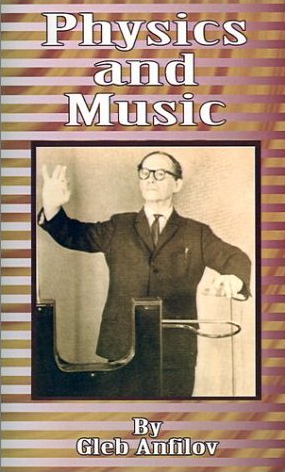
Physics and Music – Gleb Anfilov

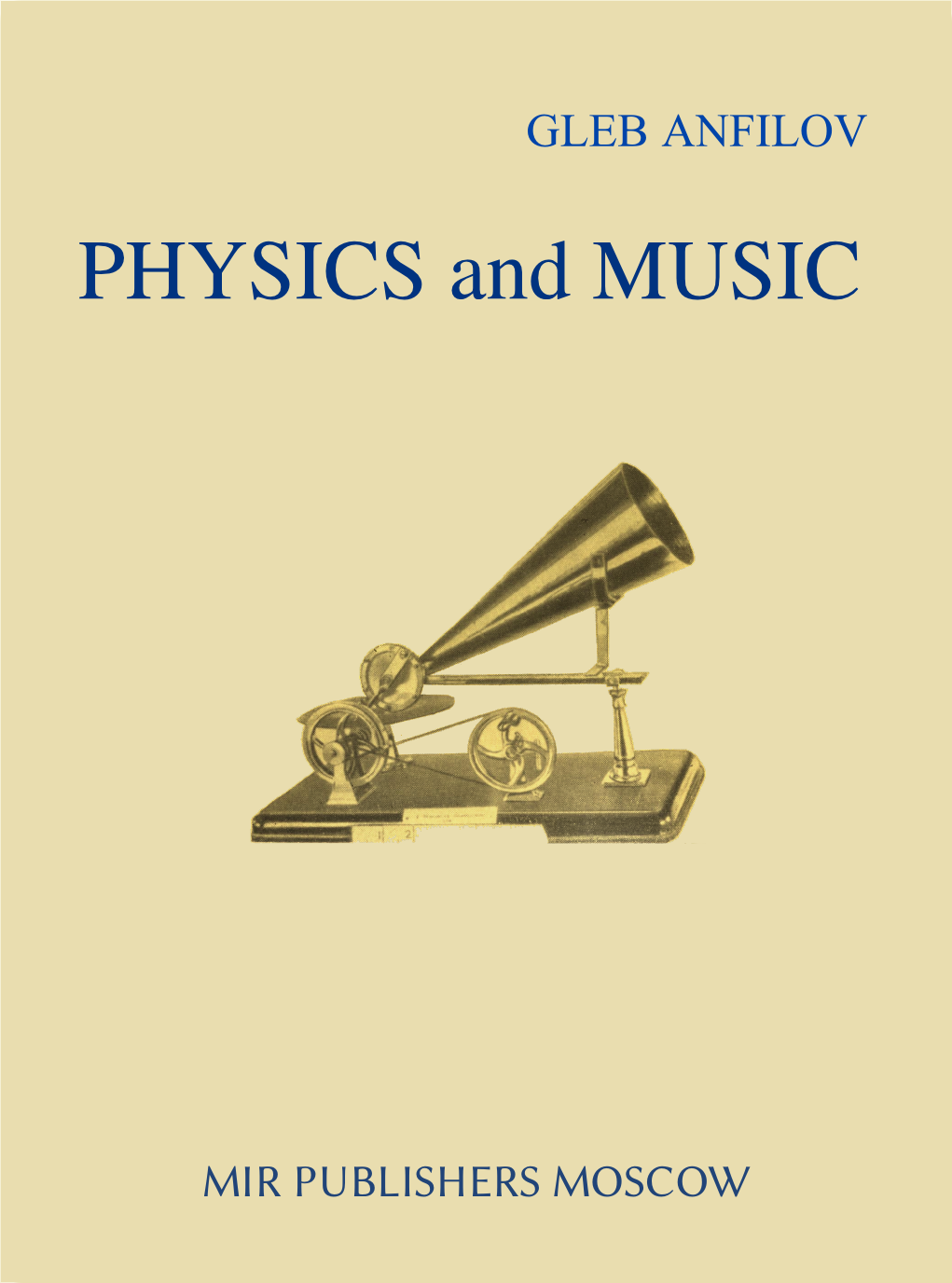
We now come to Physics and Music by Gleb Anfilov. This is a book that I had seen as an advertisement in back of many books, but failed to get a look at the book itself. But finally got the book. Since there was no original cover left (only cloth bound), I designed this cover which you see below. The image is from inside the book (page 110) and is the  Berliner’s Gramophone from 1894.

The book takes us through the history of music, and the science behind it. Anfilov tells about development of various musical instruments, and also what possible future developments might take place. For example he says (p. 265):

So, sooner or later musical instruments will come which are controllable, probably, even by the subconscious desire of the artist. Man will inject his will and thoughts into the responsive machine which will “be an extension of his fingers and nerves.” Isn’t that fantastic? Instead of being a slave of the machine, man is becoming its almighty master.
Looking further ahead, we can see with our mind’s eye machines which reproduce musical thoughts, that internal music which every person hears when his or her “very soul is singing”. We can imagine thought-controlled computers composing all sorts of music.

Though many of the contents may seem ‘dated’ to some people, the book remains a very good read for a refreshing view on the subject of music.

From the primitive reed pipe to modern music “written” by computers is quite a journey. Here, in informal text and about a score of plates, is a story that takes the teenage layman on this interesting trip.

The younger reader, like a good musicologist, follows the steps in the evolution of the most important instruments that make up today’s symphony orchestra, and the development of music itself (scales, modes, keys, and temperaments).

Physics and music is also a source, although, of necessity a modest one, of information about the music research that has been underway in the Soviet Union, especially in the scientific manufacture of the violin, and in electrophonic and synthetic music. This why the foreign reader might think of a degree of “bias” on the part of the author. Yet, it gives him an insight into what is going on in a country that has given the world quite a number of great composers.

The book was translated from the Russian by  Boris Kuznetsov and was first published by Mir in 1966. There is a new edition published by University Press of the Pacific in 2001.

You can get the book here. and here

Continue reading

Posted in books, history, mir books, mir publishers, physics, psychology, science, soviet, technology | Tagged , , , , , , , , , , | 7 Comments

Probability Theory (first steps)

We now come to a small booklet by E. S. Wentzel titled Probability Theory (first steps).

The back cover of the book says:

The author of this booklet describes in popular language how probability theory was developed and found wide application in all fields of modern science. This book can be considered as an introduction towards a more thorough study of probability theory and is intended for a wide circle of readers.

This book has a translation in Tamil titled நிகழ் தகவுக் கோட்பாடு
(தொடக்கப் படிகள்) thanks to Senthil for helping with this. I do not know about translations in other Indian languages

Many thanks to Al-Kap-Ro (\alpha \kappa \rho) for making this book available.

The book was translated from the Russian by N. Deineko and was first published by Mir in 1982, followed by a second print in 1986.

You can get the book here. and here

Tamil translated version here and here

Contents are as under

Contents
Probability Theory and Its Problems 6
Probability and Frequency 24
Basic Rules of Probability Theory 40
Random Variables 57
Literature 87

Posted in books, mathematics, mir books, mir publishers, science, soviet, statistics | Tagged , , , , , , , | 8 Comments

Physics for Everyone via magnet links

The 5 books of the Physics for Everyone series have been uploaded to magnet links.

The link has following files:

Physics for Everyone: Motion, Heat- L. D. Landau, A. I. Kitaigorodsky (1978) pp. 478
Physics for Everyone – Book 1 – Physical Bodies – L. D. Landau, A. I. Kitaigorodsky (1980) pp. 248
Physics for Everyone – Book 2 – Molecules – L. D. Landau, A. I. Kitaigorodsky (1980) pp. 244
Physics for Everyone – Book 3 – Electrons – A. I. Kitaigorodsky (1981) pp. 248
Physics for Everyone – Book 4 – Photon and Nuclei – A. I. Kitaigorodsky (1981) pp. 235

Please find the magnet link here, share it and seed it.


Posted in books, mir books, mir publishers, physics, physics for everyone | Tagged , , | 3 Comments