This book by a prominent Soviet astronomer and imaginative interpreter of the history and latest knowledge of astronomy, an age-old science that has come through two shattering decades of exciting discovery and research, can be dubbed a popular encyclopaedia of astronomy. It is a vivid and fascinating account of almost all the celestial bodies with which astronomy is concerned: planets, comets, meteors, the Sun and stars, gaseous and dust nebulae, quasars, black hole., etc. The tome is lavishly illustrated throughout with a mixture of photographs and specially commissioned artwork in full colour. The book will appeal to the general reader with no astronomical and mathematical background, fascinated by the wonders of the Space Age.
The book has two major sections, the first deals with Solid matter, that is the planets (minor and major), comets and meteors. The second part deals with the gaseous state which includes stars, nebulae, galaxies, interstellar matter. Mathematics is avoided as much as possible with the main emphasis on explaining the physical meaning of the concepts and their implications to the reader. The book covers an impressively wide range of topics in astronomy starting from the basics to topics of cutting-edge research.
The book was translated from the Russian by Alexander Repyev and was published by Mir 1985.
Note: The book is large in size (~ 190 MB). It took some time to scan it, as I had to scan individual pages because of their large size almost A4 in size. Unfortunately, before the optimisation of the images could be completed, I lost all the raw images to a disk crash. Hence I have uploaded the pdf that could be salvaged. You might notice some inconsistencies in the pages here and there. There are some amazing full-page illustrations, one of my favourites is one explaining the meteor path for different observers.
Introduction 7
The Starry Skies
A Heavenly Menagerie 7.
Brightness and Names of Stars 10.
Addresses of Stars in the Sky 11.
Eyes, Ears and Hands of Astronomers 14.
General Survey of an Observatory 14.
Optical Telescopes-Astronomer’s Eyes 16.
Telescope’s Auxiliaries 21.
Spectroscopy and Spectra 22.
Spectral Language 24.
Astronomers’ “Ears”-Radio Telescopes 28.
Astronomers’ “Fingers”: Radar and Laser or… Is It Possible to Feel Planets and Illuminate the Moon? 32.
The Hunt for High- Energy Cosmic Rays 33.
Through Soviet Observatories 34.
“Smart” Satellites 34.
You Yourself Can Observe and Study the Universe 35.
How Astronomical Discoveries Are and Aren’t Done 36.
The World of Solid Matter 39
1. The Main Members of the Solar System 40
Distant Worlds-Satellites of the Sun 40.
Kepler’s Laws 40.
Orbital Elements 42.
Space Near Our Home Planet 42.
Planetary and Lunar Studies 43.
The Old and New About Our Eternal Satellite 45.
Lunokhods and First Astronauts on the Moon 52.
Two More Earth’s Moons, but Made of Dust 57.
The Moon’s Twin-Mercury 58.
Mysteries of Beautiful Venus 60.
Mars from Far and Near 65.
Once More About Life on Mars 69.
Are the Martian Satellites Artificial? 71.
Is There Life on Earth? 74.
The Giants Jupiter and Saturn 74.
At the Far Reaches of the Solar System 79.
The Ringed Planets 81.
Are There Any Other Planetary Systems? 85.
2. The Little Planets 87
The Planet Hunters 87.
A Chain of Discoveries 88.
The Farther into the Forest, the More Firewood There Is 91.
Our Nearest Neighbours 93.
Travels To and On Hermes 96
3. Visible Nothing 100
Heralds of Terror 100.
Celestial Chameleons 103.
Halley’s Discovery 105.
Short-Period Comets 107.
Members of the Family or Aliens? 109.
Discovery of Comets 110.
Lost Comets 112.
Visible Nothing 115.
The Cause of Luminescence of Comets and Their Chemical Composition 117.
What Occurs Within Comets 118.
A Collision Between the Earth and a Cornet 121.
Where Were Comets Born? Are They Born Now? 122.
4. Shooting Stars and Meteoric Storms 124
Shooting Stars and Stones from the Skies 124.
Meteor Portraits and Passports 127.
Meteor Storms and Streams 128.
More About Meteors 129.
A Census of Meteors 132.
Meteoric Swarms 133.
Cometary Dust 136.
Meteors in the Atmosphere 138.
New Techniques in Meteoric Studies 143.
5. Heavenly Rocks and Dust 146
The Stones in Figures 148.
Structure and Age of Meteorites 150.
The Chemical Composition of Earth and Meteorites 152.
In Search of Ancestry 154.
Canyon Diablo 156.
Other Meteorite Craters 157.
The Tunguska Object 159.
Sikhote-Alin Meteorite 161.
Bombardments from the Heavens 162.
Zodiacal Light and the Gas Tail of the Earth 164.
Light and Dark Nebulae 167.
Interstellar Wastes 170.
Contents (Part 2)
The World of Gas 175
1. The Sun-the Closest of the Stars 176
Introduction 176.
The Sphere of Light 177.
Even the Sun Is Not Without Spots 179.
Observation of the Invisible and the Sun’s Anatomy 182.
The Envelopes of the Sun 184.
The Highest Fountains in the Universe 185.
The Solar Corona and Its Mysteries 186.
How Three Astronomers Deceived Nature 188.
Solar Chemistry 190.
A History of Two Strangers 191.
Active Regions, Chromospheric Flares, X-Ray and Radio Emission of the Sun 194.
Magnetic Phenomena on the Sun 195.
The Solar Wind and Polar Aurorae 198.
2. The Stars Are Distant Suns 203
Comprehending the Incomprehensible 203.
Stellar Luminosity 203.
Spectra – Stellar Credentials 204.
What Do Stars Consist of and Why Are Their Spectra Different? 206.
Thermometers for Stars 207.
Stellar Spectrum – Distance Indicator 208.
Sounding Rod in the Depths of Space 209.
Motion of Fixed Stars 211.
“Traffic Control” for Stars 213.
Where Are We Going? 213.
Taking a Star’s Measure 214.
Star Pairs 215.
“Devil” Stars 217.
Portrait Gallery of Coloured Stars 218.
Portraits of White Stars and Their History 220.
Anatomy of Stellar Atmospheres 222.
Stars Are Like Tops 224.
In the Neighbourhood of the Sun 224.
Neighbours of the Sun 227.
Distribution of Stellar Luminosities 229.
Census of the Star Population on the Hertzsprung-Russell Diagram 230.
3. Stellar Pulsations and Explosions
Cepheids – the Lighthouses of the Universe 231.
Other Physical Variable and Flare Stars 231.
Swollen Atmospheres 234.
Stars with Escaping Gas 235.
Stars That Cast Off Their Envelopes 236.
Supernova Explosions 240.
Stellar Tops – Pulsars and Black Holes 245.
4. The World of Star Clusters and Diffuse Gases 247
Open and Globular Star Clusters and Associations 247.
Clearer About the Nebulous World 250.
Nebular Gas 250.
Luminescence and Nature of Gaseous Nebulare 251.
Diffuse Gaseous Nebulae 253.
Planetary Nebulae 257.
Expansion of Planetary Nebulae 259.
Evolution of Planetary Nebulae and Their Nuclei 261.
Interstellar Gas 264.
5. Islands of the Universe
Milestones and the Structure of Our Galaxy 269.
Structure of Our Stellar Home 272.
Galaxies – Islands of the Universe 275.
More About Galaxies 279.
Galactic Groups and Clusters 285.
Your Address in the Infinite Universe 286.
From Atomic Nucleus to Meta-galaxy 287.
Interaction of Galaxies 287.
Radio Galaxies and Enigmatic Quasars 288.
Explosions in Island Universes 292.
Is There a Boundary of the World and What Is Beyond? 295.
Is Any Communication Possible with Extraterrestrial Civilizations ? 295.
6. Birth, Life and Death of Stars 231
How Old Are the Stars and the Milky Way? 300.
Where Does Stellar Energy Come From? 303.
Nuclei and Nuclear Reactions 305.
“Feed Cycle” of Stars 309.
Internal Structure of Stars 312.
The Origin of Diffuse Matter 314.
The Origins of Stars 316.
The Life and Death of Stars 317.
7. The History of the Earth and Planets 323




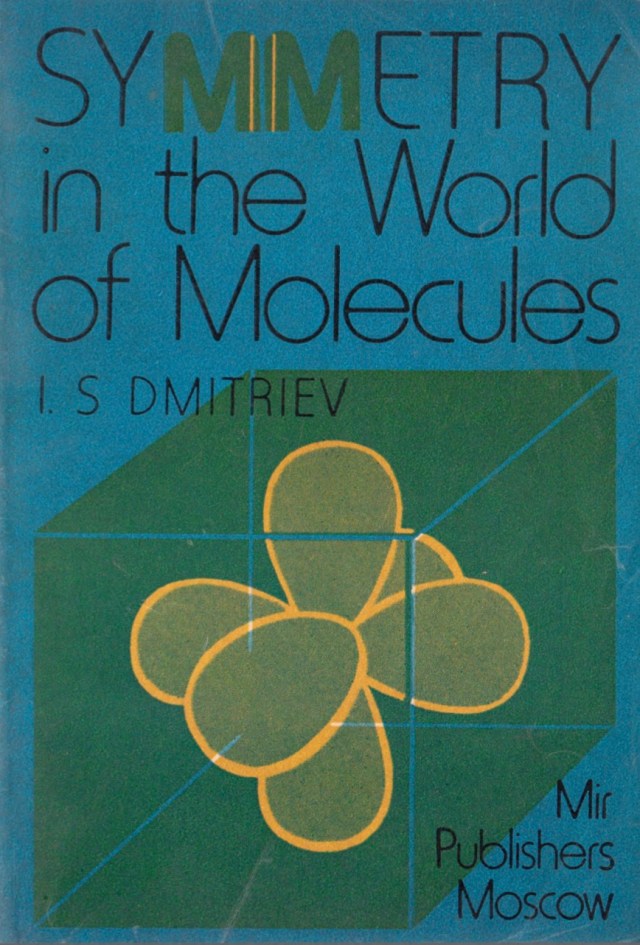 In this post, we will see the book Symmetry in the World of Molecules by I. S. Dmitriev.