Wheaten Loaf by Angel Karalichev

In this post, we will see the book Wheaten Loaf by Angel Karalichev.

About the book

A small, illustrated story book for children.

Illustrations by Gencho Denchev, Editor Zdravka Tasheva, Art Editor Vesselin Tsakov, Technical Editor Snezhana Pipeva, Proof-Reader Pravda Pesseva. The book was published by Sofia Press in 1974.

All credits to Guptaji.

You can get the book here and here.

Follow us on The Internet Archive: https://archive.org/details/@mirtitles

Follow Us On Twitter: https://twitter.com/MirTitles

Write to us: mirtitles@gmail.com

Fork us at GitLab: https://gitlab.com/mirtitles/

Add new entries to the detailed book catalog here.

Contents

Posted in books, children's books, children's stories | Tagged , , , , | Leave a comment

The Hermit And The Rose – Boris Zakhoder

In this post, we will see the book The Hermit And The Rose by Boris Zakhoder.

About the book

A beautifully illustrated collection of stories for children.

Drawings by Gennady Kalinovsky

The book was translated from Russian by was published in 1988  by Raduga Publishers.

All credits to Guptaji.

You can get the book here and here.

Follow us on The Internet Archive: https://archive.org/details/@mirtitles

Follow Us On Twitter: https://twitter.com/MirTitles

Write to us: mirtitles@gmail.com

Fork us at GitLab: https://gitlab.com/mirtitles/

Add new entries to the detailed book catalog here.

Contents

The Hermit and the Rose 3

Little Grey Star 31

Little Grey Hare 47

Why the Cock Crows Thrice 63

The Fox’s Ruling 69

The Wolf Who Sang Songs 75

Posted in books, children's books, children's stories, picture books, raduga publishers | Tagged , , , , , , | Leave a comment

Higher Mathematics For Beginners And Its Application To Physics – Zeldovich

In this post, we will see the book Higher Mathematics For Beginners And Its Application To Physics by Ya. B. Zeldovich.

About the book

The title of this book gives the clue to our main aim, which is to initiate the reader into the realm of differential and integral calculus and, by applying these methods to the more important divisions of physics, to demonstrate the significance and power of higher mathe­matics.
In this book, the student is regarded as a friend and ally who puts his faith in the teacher and the textbook and wishes ardently to make use of and apply to nature and technology the mathematical techni­ques offered to him. Comprehension of the subject expands as the result of analyzing examples and applications. In the strictly logical approach, the question of the significance and usefulness of the theo­rems studied remains in the background. In the present text, by con­trast, we bring to the fore the mathematical ideas and their relation­ship with the study of nature.
The notorious pitting of poets against physicists (mathematicians too) is a figment of the imagination of the poet B. Slutsky. In mathe­matics there is more poetry than any poet ever imagined. The history of science is proof that good mathematics is prophetic: mathematical analysis of the known opens up the path into the realm of the unknown and leads to new physical notions.
In “Higher Mathematics for Beginners” I strove towards a const­ructive approach, to the eliciting of the meaning and aims of mathe­matical concepts and attempted, at least in part, to convey the spirit of the heroic period when these notions were born.
The last two chapters (Dirac’s Remarkable Delta Function and What Next) are entirely different from the remainder of the book. The style too is quite changed. The aim there is to give the reader a feeling (of necessity, very superficial) of what complicated things lie ahead.

Translated from the Russian by George Yankovsky. First published 1973, revised from the 1972 Russian edition by Mir Publishers..

PS: This is a previous version of the book by Zeldovich and Msykis we had seen earlier.

You can get the book here.

Follow us on The Internet Archive: https://archive.org/details/@mirtitles

Follow Us On Twitter: https://twitter.com/MirTitles

Write to us: mirtitles@gmail.com

Fork us at GitLab: https://gitlab.com/mirtitles/

Add new entries to the detailed book catalog here.

Contents

PREFACE TO THE FIFTH RUSSIAN EDITION 9

CHAPTER 1 FUNCTIONS AND GRAPHS 13

The functional relationship
Coordinates
Geometric quantities expressed in terms of coordinates
Graphical representation of functions. The equation of the straight line
The parabola
The cubic parabola, hyperbola, and circle
Altering the scale of a curve
Parametric representation of a curve

CHAPTER 2 THE CONCEPTS OF A DERIVATIVE AND AN INTEGRAL 45

Motion, distance and velocity
The derivative of a function as the limit of a ratio of increments
Notation of derivatives. The derivative of a power function
Approximating the values of a function by means of a derivative
A tangent to a curve
Increase and decrease of functions. Maximum and minimum
The area under a curve and determining distance from the rate of motion
The definite integral
The relationship between the integral and the derivative (Newton-Leibniz theorem)
The integral of a derivative
The indefinite integral
Properties of integrals
Mean values
Examples of derivatives and integrals
Summary

CHAPTER 3 COMPUTATION OF DERIVATIVES AND INTEGRALS 106

The differential sign. The derivative of a sum of functions
The derivative of an inverse function
The composite function
The derivative of a product of functions
The power function
The derivatives of algebraic functions with constant exponents
The exponential function
The number e
Logarithms
Trigonometric functions
Inverse trigonometric functions
The derivative of an implicit function
Integrals. Statement of the problem
Elementary integrals
General properties of integrals
Change of the variable in a definite integral
Series
Computing the values of functions by means of series
Condition for applicability .of series. The geometric progression
The binomial theorem for integral and fractional exponents
The order of increase and decrease of functions

CHAPTER 4 THE APPLICATION OF DIFFERENTIAL AND INTEGRAL CALCULUS TO GEOMETRY AND THE INVESTIGATION OF FUNCTIONS 174

Investigating maxima and minima of functions with the aid of the second derivative
Other types of maxima and minima. Salient points and discontinuities
Computing areas
Mean values
Arc length and curvature
Approximation of are length
Computing volumes, The volume and surface area of a solid of revolution
Curve sketching

CHAPTER 5 WATER FLOW. RADIOACTIVE DECAY AND NUCLEAR FISSION. ABSORPTION OF LIGHT 211

Water flow from a vessel, Statement of the problem
The solution of an equation when the derivative depends on the desired function
Radioactive decay
Measuring the mean lifetime of radioactive atoms
Series disintegration (radioactive family)
Investigating the solution for a radioactive family (series)
The chain reaction in the fission of uranium
Multiplication of neutrons in a large system
Escape of neutrons
Critical mass
Subcritical and supercritical mass for a constant source of neutrons
The critical mass
Absorption of light. Statement of the problem and a rough estimate
The absorption equation and its solution
Relationship between exact and approximate calculations
Effective cross-section
Attenuation of a charged-particle flux of alpha and beta rays

CHAPTER 6 MECHANICS 258

Force, work and power
Energy
Equilibrium and stability
Newton’s second law
Impulse
Kinetic energy
Motion under the action of a force dependent solely on the velocity
Motion under the action of an elastic force
Oscillations
Oscillation energy. Damped oscillations
Forced oscillations and resonance
On exact and approximate solutions of physical problems
Jet propulsion and Tsiolkovsky’s formula
The path of a projectile
The mass, centre of gravity and moment of inertia of a rod
The oscillations of a suspended rod

CHAPTER 7 THE THERMAL MOTION OF MOLECULES AND THE DISTRIBUTION OF AIR DENSITY IN THE ATMOSPHERE 344

The condition for equilibrium in the atmosphere
The relationship between density and pressure
Density distribution
The molecular kinetic theory of density distribution
The Brownian movement and kinetic-energy distribution of molecules
Rates of chemical reactions
Evaporation. The emission current of a cathode

CHAPTER 8 ELECTRIC CIRCUITS AND OSCILLATORY PHENOMENA IN THEM 361

Basic concepts and units of measurement
Discharge of a capacitor through a resistor
Oscillations in a capacitance circuit with spark gap
The energy of a capacitor
Inductance circuit
Breaking an inductance circuit
The energy of inductance
The oscillatory circuit
Damped oscillations
The_case of a large resistance
Alternating current
Mean quantities, power and phase shift
An alternating-current oscillatory circuit. Series resonance
Inductance and capacitance in parallel. Parallel resonance
Displacement current and the electromagnetic theory of light
Nonlinear resistance and the tunnel diode

CHAPTER 9 DIRAC’S REMARKABLE DELTA FUNCTION 422

Various ways of defining a function
Dirac and his function
Discontinuous functions and their derivatives
Representing the delta function by formulas
Application of the delta function

CONCLUSION. WHAT NEXT? 440
ANSWERS AND SOLUTIONS 445
APPENDIX 474
INDEX 481

Posted in books, mathematics, mir books, mir publishers, physics | Tagged , , , , , , , , , , , , , | Leave a comment

Puntos Fijos (Lecciones Populares De Matemáticas) – Shashkin (Español)

En este post, veremos el libro Puntos Fijos (Lecciones Populares De Matemáticas)- por Yu. Shashkin. (Fixed Points)

Sobre el libro

La teoría de los puntos fijos encuentra sus raíces en el trabajo de Poincaré, Brouwer y Sperner y hace un uso extensivo de nociones topológicas como la continuidad, la compacidad, la homotopía y el grado de mapeo. Los teoremas de punto fijo tienen numerosas aplicaciones en matemáticas; la mayoría de los teoremas que aseguran la existencia de soluciones para ecuaciones diferenciales, integrales, de operador u otras ecuaciones se pueden reducir a teoremas de punto fijo. Además, estos teoremas se utilizan en áreas tales como la economía matemática y la teoría de juegos. Este libro presenta una exposición legible de la teoría de puntos fijos. El autor se centra en el problema de si un intervalo cerrado, cuadrado, disco o esfera tiene la propiedad de punto fijo.Otro objetivo del libro es mostrar cómo la teoría de puntos fijos utiliza ideas combinatorias relacionadas con la descomposición (triangulación) de figuras en partes distintas llamadas caras (símplexes), que se unen entre sí de manera regular. Se explican todos los conceptos básicos necesarios, como la continuidad, la compacidad, el grado de un mapa, etc., lo que hace que el libro sea accesible incluso para los estudiantes de secundaria. Además, el libro contiene ejercicios y descripciones de aplicaciones. Los lectores apreciarán este libro por su presentación lúcida de este tema matemático fundamental.

El libro fue traducido del ruso por ingeniero Antonio Molina García.

El libro fue publicado por la editorial Mir en 1991.

Créditos al cargador original.

Puedes conseguir el libro aquí.

(Disculpas por cualquier error, estoy usando la traducción automática)

Continue reading

Posted in books, Editorial Mir, mathematics, popular lectures in mathematics, soviet | Tagged , , , , , , , , , , | Leave a comment

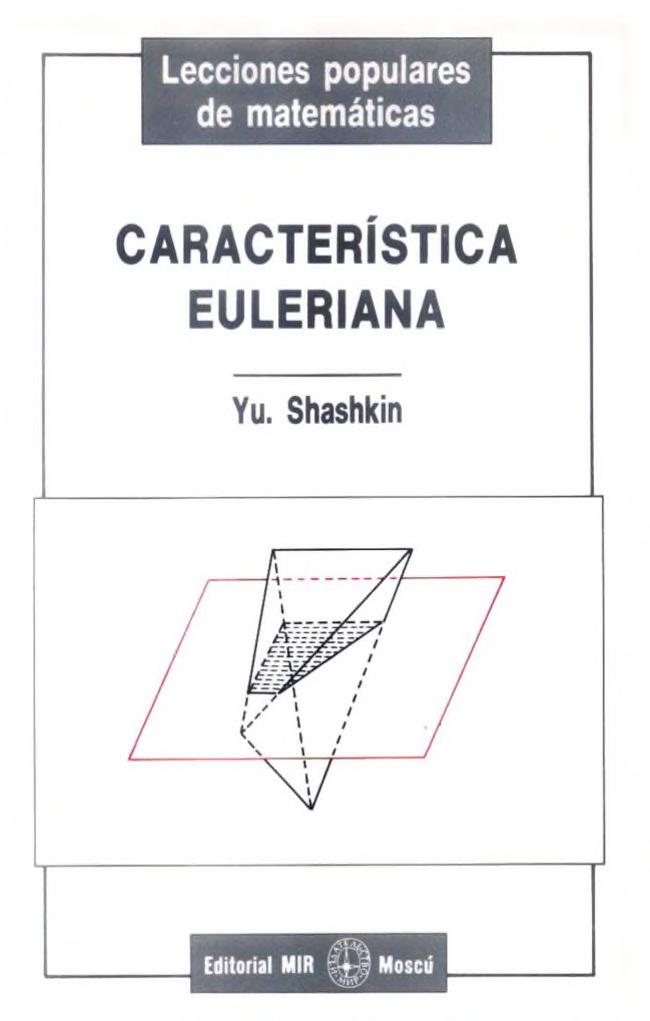
Característica Euleriana (Lecciones Populares De Matemáticas) – Yu. Shashkin (Español)

En este post, veremos el libro Característica Euleriana (Lecciones Populares De Matemáticas) por Yu. Shashkin. (Euler Characteristic)

Sobre el libro

Este folleto da pruebas de la famosa fórmula de Euler para politopos convexos y de sus análogos para otras figuras (planos, espacios y polígonos). Las fórmulas llevan al lector de forma natural a la noción de característica de Euler. Se dan dos definiciones de la noción y se demuestra su equivalencia. Se discute el papel desempeñado por la característica de Euler en diferentes problemas geométricos, es decir, en la descomposición de planos y espacios, en el cálculo de áreas, en el recubrimiento de esferas.
El libro está dirigido a alumnos de último año, estudiantes universitarios y universitarios y a todos los amantes de las matemáticas.

El libro fue traducido del ruso por B. Mirchevski.

El libro fue publicado por la editorial Mir en 1989.

Créditos al cargador original.

Puedes conseguir el libro aquí.

(Disculpas por cualquier error, estoy usando la traducción automática)

Continue reading

Posted in books, Editorial Mir, Lecciones Populares De Matemáticas, popular lectures in mathematics | Tagged , , , , , , | Leave a comment

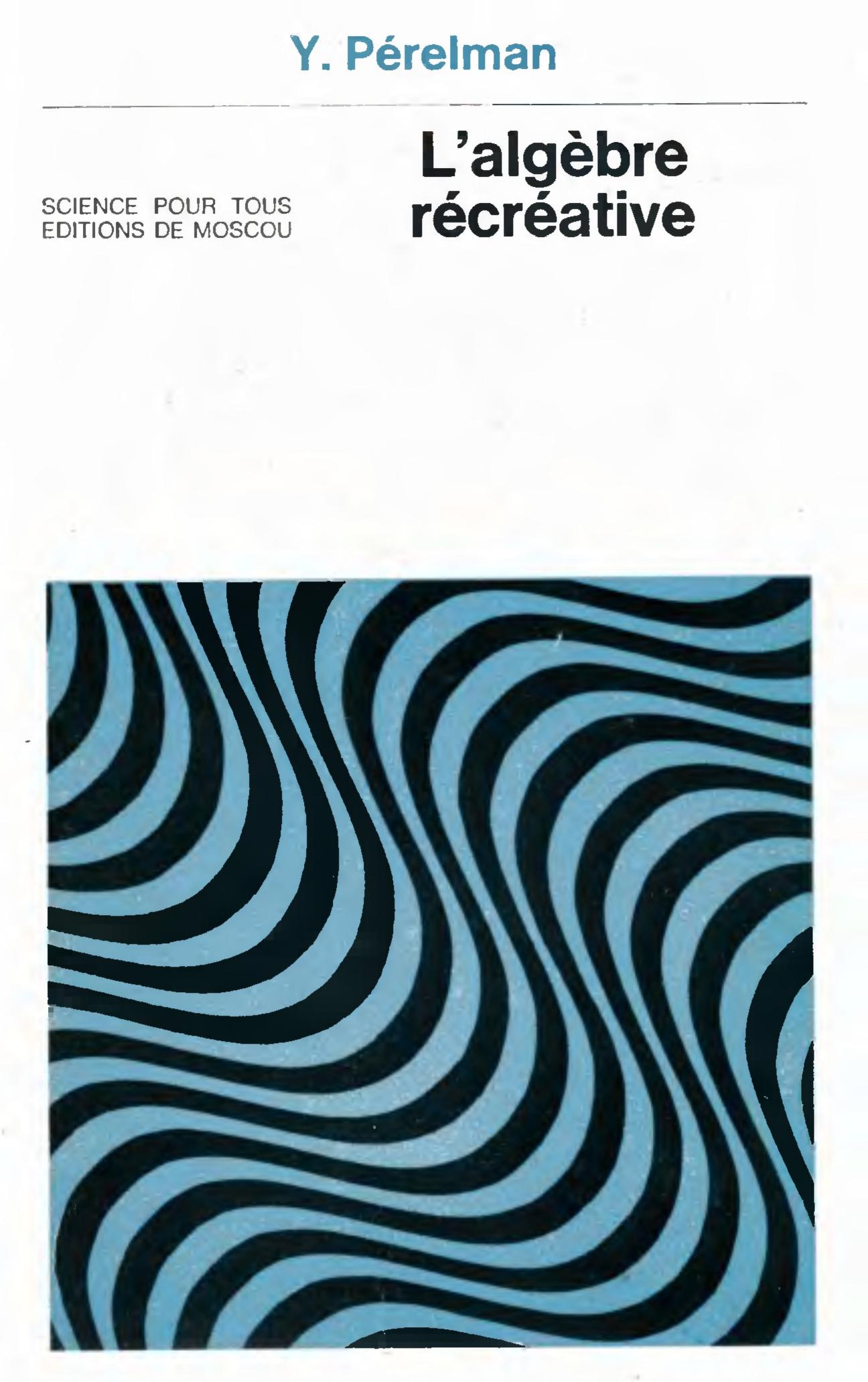
L’algèbre Récréative (Science Pour Tous) – Yakov Pérelman (Perelman)

Dans cet article, nous verrons le livre L’algèbre Récréative par Yakov Pérelman.

À propos du livre

II ne faut pas considérer ce livre comme un manuel d’ « algèbre facile >> pour débutants. Comme mes autres ouvrages de la même collection, L’algèbre récréative n’est pas un livre d’études, mais un livre à lire pour se distraire. Le lecteur auquel il est destiné doit avoir certaines connaissances d’algèbre, même si elles sont vagues ou à moitié oubliées. L’algèbre récréative a pour but de rendre plus précises, de rafraîchir et d’approfondir ces connaissances éparses et peu solides, mais surtout de former chez le lecteur le goût pour l’étude de l’algèbre et le désir de combler lui même, à l’aide des livres appropriés, ses lacunes éventuelles. Sous ce rapport, L’algèbre récréative n’a pas le même but qu’un livre comme Les nombres et les figures de Rademacher et Toeplitz, par exemple, qui ne demande pas au lecteur de  «se rappeler les mathématiques que nous avons étudiées dans notre jeunesse». Mon livre, au contraire, cherche à consolider les connaissances acquises à l’école.
Pour donner plus d’attrait et d’intérêt au sujet, j’ai utilisé différents moyens ; on trouvera  ici des problèmes peu courants ou curieux, des incursions dans l’histoire des mathématiques, des applications inattendues de l’algèbre dans la vie pratique, etc.
Par les matières étudiées, ce livre ne dépasse pas le programme d’algèbre de l’enseignement secondaire, abordant presque toutes les parties de celui ci, mais évitant les questions théoriques difficiles.

Le livre a été traduit du russe par Ch. Bir.

L’édition française a été publiée en 1984 par les éditions Mir.

Crédits à l’uploader d’origine.

Vous pouvez obtenir le livre ici et ici.

(J’ai utilisé la traduction automatique, toutes mes excuses pour les erreurs.)

Suivez-nous sur Internet Archive: https://archive.org/details/@mirtitles

Suivez-Nous Sur Twitter: https://twitter.com/MirTitles

Écrivez-nous: mirtitles@gmail.com

Rejoignez-nous sur GitLab: https://gitlab.com/mirtitles/

Ajoutez de nouvelles entrées au catalogue de livres détaillé ici.

Contenu

Extrait de la préface de l’auteur à Ia troisième édition 5

Chapitre premier. La cinquième opération mathématique 7

Qu’est-ce que la cinquième opération? 7
Chiffres astronomiques 8
Combien pèse l’air entier ? 10
Combustion « sans flamme et sans chaleur » 11
La diversité du temps 13
La serrure à secret 14
Un cycliste superstitieux 16
Résultats de doublements répétés 17
100 mille fois plus vite 19
10 mille opérations par seconde 23
Le nombre de parties d’échecs possibles 27
Le secret de l’automate joueur d’échecs 28
A l’aide de trois 2 32
A l’aide de trois 3 33
A l’aide de trois 4 33
A l’aide de trois chiffres identiques 34
A l’aide de quatre unités 35
A l’aide de quatre 2 36

Chapitre II. Le langage de l’algèbre 38

L’art de poser des équations 38
La vie de Diophante 40
Le cheval et le mulet 41
Les quatre frères 43
Des oiseaux sur les rives du fleuve 44
Une promenade 46
L’équipe de faucheurs 47
Les vaches dans le pré 51
Le problème de Newton 54
Permutation des aiguilles d’une montre 56
Coïncidence des aiguilles d’une montre 60
Les sept joueurs 61
rs absurdité apparente 63
ie pense pour nous 64
Quelques cas curieux 64
Dans un salon de coiffure 68
Le tramway et le piéton 69
Le vapeur et le radeau 70
Les deux boîtes de café 72
Une soirée dansante 73
Une reconnaissance navale 74
Au vélodrome 76
Une compétition de motocyclistes 77
La vitesse moyenne d’une automobile 79
Machines mathématiques 81

Chapitre III. Au secours de l’arithmétique

Multiplication instantanée 94
Les chiffres 1, 5 et 6 97
Les nombres 25 et 76 98
« Nombres » infinis 98
Le supplément 102
Divisibilité par 11 104
Le numéro de la voiture 106
Divisibilité par 108
Le théorème de Sophie Germain 109
Nombres divisibles 110
Nombre des nombres premiers 112
Le plus grand nombre premier connu 113
Un calcul sérieux 113
L’algèbre ne simplifie pas toujours 117

Chapitre IV. Les équations de Diophante 119

Achat d’une tente 119
Vérification des comptes d’un magasin 124
Achat de timbres-poste 126
Achat de fruits 127
Deviner la date de naissance 129
La vente des poulets 131
Deux nombres et quatre opérations 133
Les côtés d’un rectangle 135
Deux nombres de deux chiffres 136
Les nombres de Pythagore 137
Equation indéterminée du troisième degré 142
Cent mille marks pour la démonstration d’un théorème 146

Chapitre V. La sixième opération mathématique 149

Quel est plus grand ? 151
Résoudre en un seul Coup d’œil 152
Paradoxes algébriques 153

Chapitre VI. Equations du second degré 157

Les poignées de main 157
Un essaim d’abeilles 158
La bande de singes 159
La prévoyance des équations 160
Le problème d’Euler 162
Les haut-parleurs 164
L’algèbre d’un voyage sur la Lune 166
« Un problème difficile » 169
Quels sont ces nombres? 172

Chapitre VIII. Maximums et minimums 173

Les deux trains 173
Où faut-il placer l’arrêt du train? 175
Comment tracer la route? 178
Maximum d’un produit 180
Minimum d’une somme 185
Une poutre de volume maximum 185
Les deux champs 186
Le cerf-volant 187
La construction d’une maison 189
Ün terrain pour une maison de campagne 191
Auge de section maximum 192
La capacité maximum d’un entonnoir 195
Le plus fort éclairage 196

Chapitre VIII. Progressions 199

Une progression très ancienne 199
L’algèbre sur le papier quadrillé 201
L’arrosage d’un jardin potager 202
La nourriture des poules 203
Une équipe de terrassiers 205
Les pommes 206
L’achat d’un cheval 207
La pension d’un soldat 208

Chapitre IX. La septième opération mathématique 210

Les concurrents des logarithmes 212
L’évolution des tables de logarithmes 213
Curiosités logarithmiques 214
Les logarithmes sur la scène 216
Les logarithmes à la ferme 219
Les logarithmes dans la musique 220
Les étoiles, le bruit et les logarithmes 222
Les logarithmes dans l’éclairage électrique 225
Testament pour des centaines d’années 226
Accroissement continu d’un capital 229
Le nombre « e » 230
Une astuce logarithmique 232
Ecrire un nombre quelconque à l’aide de trois 2 233

Posted in books, Editorial Mir, french, l’arithmétique, mathematics, mir books, popular science, Science Pour Tous | Tagged , , , , , , , , , , , , , | Leave a comment

The Price Of Truth: The Story of Rare-Earth Elements – Trifonov

In this post, we will see the book The Price Of Truth: The Story of Rare-Earth Elements by D. N. Trifonov.

About the book

This book is about a fascinating family of chemical elements.

Popular science writers generally tend to overuse the word “fascinating” but in this case it gives a very apt description. Indeed, everything about these dozen and a half elements is fascinating-the histories of their discoveries, their properties and their applications.

Take Mendeleev’s periodic table of elements. The row under the table describes 14 elements from cerium to lutetium. When we add to them lanthanum, yttrium and scandium which are found in the third group of the table we have 17 elements comprising this fascinating family.

Seventeen? Was not it a dozen and a half just a few lines above? What is i t – a slip or carelessness?

Not at all. There is yet no complete agreement on which elements can be called the rare-earth elements. We shall discuss this problem below.

At last we gave the name to this family-the rare- earth elements belong to it. This rather interestingly sounding name contains two substantial errors.

Indeed, these elements are not all that rare.

Further studies demonstrated that the properties of these elements differed from those of the classic “earth” elements. Then their oxides should not be called earths.

We see that the name “rare earths” is just a relic of the past still used owing to a tradition. Sometimes it is better to keep an old familiar name, even if it has lost its former meaning, than invent a new one. Though this family of elements never lacked for names as we shall see in this story.

A prominent French chemist Georges Urbain once gave a very imaginative description of the history of rare-earth elements saying: “It was a sea of errors and the truth sank in it.”

But when the truth had been finally uncovered, when all intricacies of rare-earth elements had been studied it became clear that they were priceless, indeed. Rare earths make their contribution to the progress in practically all branches of modem technology.

Here we end this short but necessary introduction and begin our story.

About the author

Dmitri TRIFONOV is a Soviet chemist working on the history of chemistry. D. Trifonov was born in 1932. He graduated from the chemical de­partment of Moscow University where he later was awarded the degree of doctor of science. Cur­rently he is the head of a research group at the Institute of History of Natural Sciences and Tech­nology of the USSR Academy of Sciences in Moscow .His research concerns mainly the theory and history of the periodic system of elements. He has written several books on the subject some of which have been translated into foreign languages. D. Trifonov is a well-known writer on science. He has written ten popular science books and a few dozen papers

The book was translated from Russian by O. Glebov and I. Poluyan and was published in 1987  by Mir Publishers.

You can get the book here.

Follow us on The Internet Archive: https://archive.org/details/@mirtitles

Follow Us On Twitter: https://twitter.com/MirTitles

Write to us: mirtitles@gmail.com

Fork us at GitLab: https://gitlab.com/mirtitles/

Add new entries to the detailed book catalog here.

Contents

Short Introduction 6
The Thorny Path of Discoveries 9
The Birth of Truth 36
The Element from the “Sealed Envelope” 85
A Coming Age of Rare-Earth Elements? 111
In Conclusion: Are There “Relatives” of Rare-Earth Elements? 126

Posted in books, chemistry, discovery, history, mir books, mir publishers, popular science, science, soviet | Tagged , , , , , , , , , , , , | 1 Comment

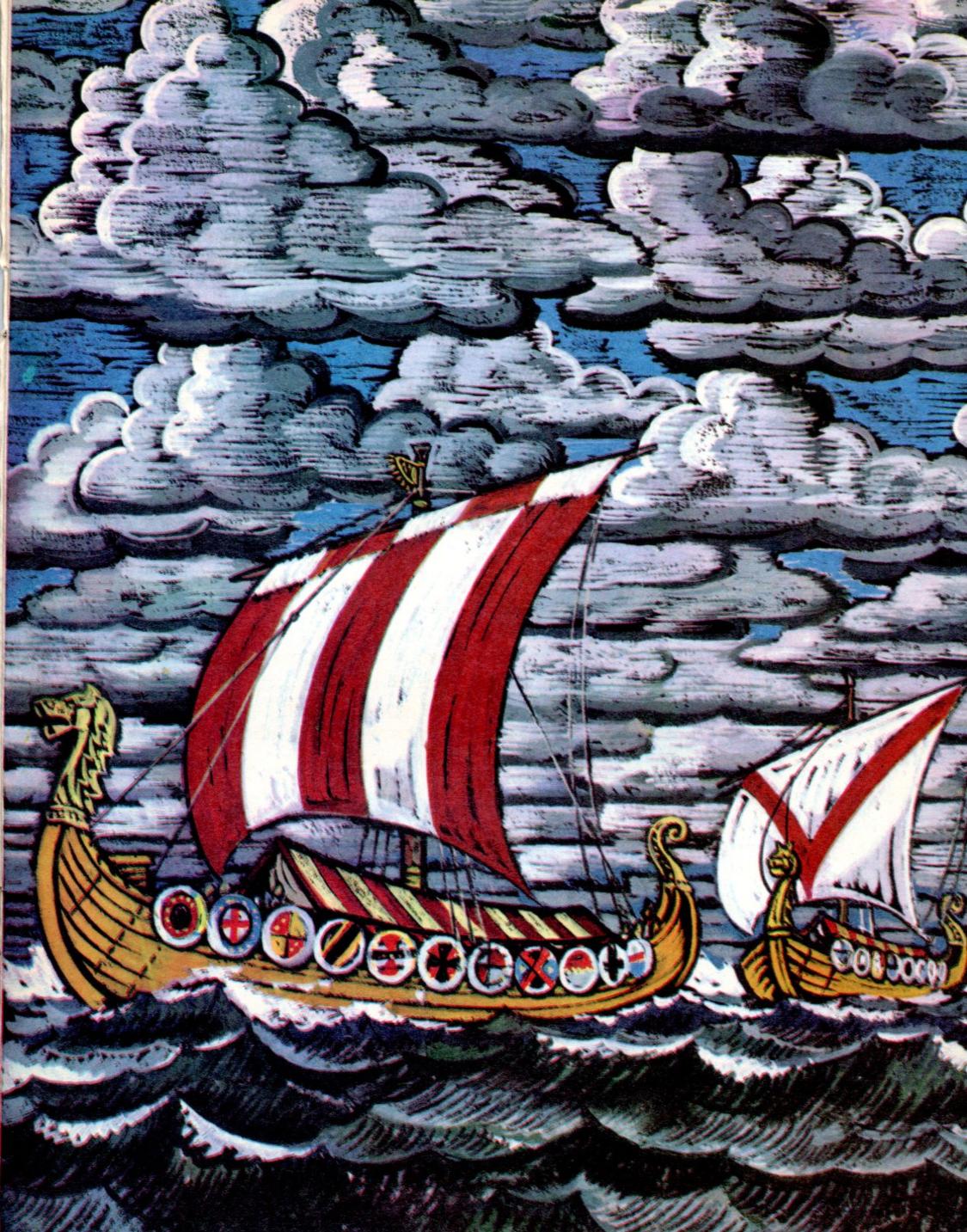
Wondrous Ships – Sakharnov

In this post, we will see the book Wondrous Ships by Svyatoslav Sakharnov.

About the book

Ships ply the seven sea. They puff and chug, and the waves slap against their sides as they
hurry on their different ways. One has a tall smokestack, another has a squat one. Some can pull three barges along easily, while others can barely get themselves moving. Each one is different.

Their stories are different, too. Ships are like people, each one wondrous and like no other.

Translated from the Russian by Fainna Solasko and Fantastic drawings by Vladimir Surikov.

Published in 1981 by Progress Publishers.

All credits to Guptaji

You can get the book here.

PS: I have nostalgic memories of the drawings in this book. It is the second Soviet era book that I had read, the first being All About the Telescope. The images of this book fueled my childhood imagination…

Follow us on The Internet Archive: https://archive.org/details/@mirtitles

Follow Us On Twitter: https://twitter.com/MirTitles

Write to us: mirtitles@gmail.com

Fork us at GitLab: https://gitlab.com/mirtitles/

Add new entries to the detailed book catalog here.

Contents

Dragon Heads

The Caravels

The Ship that only sailed a day

The Victory’s Last Battle

A Clipper Ship

An Impossible Collision

The Blue Destroyer

The Ship of The Revolution

Posted in books, children's books, children's stories, progress publishers, soviet | Tagged , , , , , , , , | 1 Comment

An Introduction To Computers – Sergeev, Vashkevich

In this post, we will see the book An Introduction To Computers by N. Sergeev and N. Vashkevich.

About the book

Because of the rapid growth and wide use of computers, in practically all fields of man’s activity, there is a need for students in all specialities to have a concise, yet thorough presentation of computer theory, design and operation.

This book is an attempt to fill this need. It covers the circuitry and operating principles of analog and digital computers, special-purpose com­puting devices, machines and systems. Ample space is devoted to a basic theory of similitude and simulation, and a fairly detailed description is given of basic functional elements, assemblies and units which make up typical analog and digital computers, in conjunction with an introduction to the mathematical and logical basis of electronic digital computers.

Separate sections deal with block-diagram synthesis of analog compu­ters to solve algebraic, transcendental, ordinary and partial differential equations and their systems. The reader will find a survey of methods used to program problem solving on analog and digital computers, analog with a brief outline of digital differential analyzers and hybrid systems.
Written by leading authorities in the field of Soviet computer enginee­ring with a wealth of teaching and research experience at colleges, the book is student-oriented in the presentation of the subject-matter.
The book will be of primary value to college students and faculty mem­bers and also to researchers and engineers concerned with the develop­ment and application of computers.

The late PROFESSOR SERGEEV N.P., Doctor of Technical Sciences, was Head of the Chair (automatic informa­tion retrieval systems), rector of the Penza Polytechnic Institute. Lectured on computers (both digital and analog) and engineering and business applications of computers. Read lectures on automatic informa­tion retrieval systems. Has penned a total of 250 papers of which 200 have been published, including three monographs and 23 study aids on computer engineering and data processing.

PROFESSOR VASHKEVICH N.P., Doctor of Technical Sciences, Head of the Chair (computer engineering) at the Penza Polytechnic Institute.
Is a prominent authority in the Soviet Union on computation and computer engineering, especially in the field of product quality control.
Has penned 200 publications, inclu­ding several study aids and a mono­graph.

Translated from the Russian by Boris Kuznetsov. First published 1976, revised from the 1973 Russian edition. Second printing in 1981 and third printing 1987

You can get the book here.

Follow us on The Internet Archive: https://archive.org/details/@mirtitles

Follow Us On Twitter: https://twitter.com/MirTitles

Write to us: mirtitles@gmail.com

Fork us at GitLab: https://gitlab.com/mirtitles/

Add new entries to the detailed book catalog here.

Contents

Preface 8
Introduction 9

PART ONE. ANALOG COMPUTERS 11

Chapter I. Basic Theory of Similitude and Electric Modelling 11

1.1. Basic Conce pe of Similitude Theory 11
1.2. Synthesis of Electric Models for Physical Systems 18
1.3. Electric Modelling of Physical Fields 23

Chapter II. Computing Elements 34

2.1. General 34
2.2. Basic Elements of Computing Circuits 35
2.3. Summing Networks 54
2.4. Differentiators and Integrators 58
2.5. Function Generators 66
2.6. Function Multipliers-Dividers 85

Chapter III. Synthesis of Analog Differential Analyzers 97

3.1. Development of a Block Diagram for a Differential Analyzer 97
3.2. Main Units of Differential Analyzers 102
3.3. Problem Preparation for a Differential Analyzer 106
3.4. Problem Solving on an Electronic Differential Analyzer 113

Chapter IV. Algebraic and Transcendental Equation Solvers 118

Special-purpose purpose Algebraic Equation Solvers 118
Techniques for Solving Linear Algebraic Equations on Electronic Analog Computers 123

PART TWO. ELECTRONIC DIGITAL COMPUTERS

Chapter V. Mathematical Basis of Digital Computers 127

5.1. General 127
5.2. Arithmetic Principles 130
5.3. Switching Circuits and Boolean Algebra 142

Chapter VI. Basic Functional Elements of Electronic Digital Computers 156

6.1. Computer Elements 156
6.2. Logical Design 177
6.3 Logic Assemblies of Electronic Digital Computers 186

Chapter VII. Principal Units of an Electronic Digital Computer 200

7.1. Arithmetic Unit 200
7.2. Storage 204
7.3. Input/Output Equipment 227
7.4. Control Equipment 245

Chapter VIII. Principles of Programming 252

8.1. Basic Definitions. Hypothetical computer 252
8.2. Direct Programming 256
8.3. An Outline of FORTRAN Language 269

Chapter IX. Special-purpose Computers 287

9.1. Control Computers 287
9.2. Digital Differential Analyzers 289
9.3. Analog-Digital Computers 295
9.4. Prospects in the Development and Use of Electronic Computers 296

Bibliography 299
Index 300

Posted in books, computers, engineering, mir books, mir publishers, soviet, technology | Tagged , , , , , , , , , , , , , , | Leave a comment

Handbook Of Physics – Yavorsky, Detlaf

In this post, we will see the book Handbook Of Physics by B. Yavorsky and A. Detlaf. We had earlier seen an abridged version of the handbook titled A Modern Handbook of Physics by the same authors.

About the book

A handbook covering fundamental branches of physics in detail.

This handbook is designed primarily for engineering students, as well as college and university students studying, but not majoring in physics. It can be used to advantage by engineers and graduate students, as well as by instructors and lecturers of intermediate schools and colleges.

Mathematical knowledge required in using the handbook is within the scope of the ordinary mathematics courses of engineering institutes. The detailed index and the numerous cross references, indicating the chapter, section and subsection, are of aid in finding any required information.

Translated from the Russian by Nicholas Weinstein

First published 1972 Revised from the 1968 Russian edition

You can get the book here.

Follow us on The Internet Archive: https://archive.org/details/@mirtitles

Follow Us On Twitter: https://twitter.com/MirTitles

Write to us: mirtitles@gmail.com

Fork us at GitLab: https://gitlab.com/mirtitles/

Add new entries to the detailed book catalog here.

Contents

PART ONE THE PHYSICAL BASIS OF CLASSICAL MECHANICS

CHAPTER 1 Kinematics of Particles and Rigid Bodies 15

CHAPTER 2 Dynamics of Translatory Motion 34

CHAPTER 3 Work and Mechanical Energy 59

CHAPTER 4. Dynamics of Rotary Motion 72

CHAPTER 5. Fundamentals of Analytical Mechanics 92

CHAPTER 6. Mechanical Vibrations 112

PART TWO THE FUNDAMENTALS OF THERMODYNAMICS AND MOLECULAR PHYSICS

CHAPTER 7. Introduction 147

CHAPTER 8. Ideal Gas Laws 153

CHAPTER 9. First Law of Thermodynamics 157

CHAPTER 10. Second and Third Laws of Thermodynamics 169

CHAPTER 11. Kinetic Theory of Gases 207

CHAPTER 12. Elements of Statistical Physics 221

CHAPTER 13. Real Gases and Vapours

CHAPTER 14. Liquids 259

CHAPTER 15. Crystalline Solids 272

CHAPTER 16. Amorphous Substances 293

CHAPTER 17. Polymers 298

PART THREE THE FUNDAMENTALS OF FLUID MECHANICS

CHAPTER 18. Fluid Statics 316

CHAPTER 19. Fluid Dynamics 321

PART FOUR ELECTRICITY AND MAGNETISM

CHAPTER 20. Electrostatics 348

CHAPTER 21. Direct Electric Current in Metals 383

CHAPTER 22. Electric Current in Liquids and Gases 395

CHAPTER 23. Electric Current in Semiconductors 409

CHAPTER 24. Junction, Thermoelectric and Emission Effects 415

CHAPTER 25. Magnetic Field of Direct Current 434

CHAPTER 26. Motion of Charged Particles in Electric and Magnetic Fields 453

CHAPTER 27. Electromagnetic Induction 465

CHAPTER 28. Magnetic Properties of Matter 477

CHAPTER 29. Electromagnetic Oscillations 497

CHAPTER 30. Fundamentals of Electrodynamics of Stationary Media 511

CHAPTER 31. Fundamentals of Magnetohydrodynamics 525

CHAPTER 32. Fundamentals of the Special Theory of Relativity 534

PART FIVE WAVE PHENOMENA

CHAPTER 33 Fundamentals of Acoustics 549

CHAPTER 34. Electromagnetic Waves

CHAPTER 35. Light Travelling Through the Boundary Between Two Media 602

CHAPTER 36. Interference of Light 614

CHAPTER 37. Diffraction of Light 623

CHAPTER 38. Geometrical Optics 644

CHAPTER 39. Polarization of Light 672

CHAPTER 40. Molecular Optics 694

CHAPTER 41. Thermal Radiation 710

CHAPTER 42. Light Quanta 719

CHAPTER 43. Luminescence 730

PART SIX ATOMIC AND NUCLEAR PHYSICS

CHAPTER 44. Elements of Nonrelativistic Quantum Mechanics 736

CHAPTER 45. The Atom

CHAPTER 46. The Molecule 801

CHAPTER 47. The Atomic Nucleus 827

CHAPTER 48. Nuclear Reactions 887

CHAPTER 49. Elementary Particles 887

Appendices

APPENDIX I Units of Physical Quantities and Their Dimensions in Various Systems

I.1 Units of Mechanical Quantities 912
I. 2Units of Heat Quantities 918
I.3 Units of Electric and Magnetic Quantities 918
I.4 Units of Sound Pressure Level 927
I.5 Units of Light Quantities 927
I.6 Certain Units of Atomic and Nuclear Physics 928

APPENDIX II Universal Physical Constants 929

Index 935


Posted in books, mir books, mir publishers, physics, science, soviet | Tagged , , , , , , , , , | 2 Comments