Chemistry – Definitions Notions Terminology – Busev, Efimov

In this post, we will see the book Chemistry – Definitions Notions Terminology by A. I. Busev; I. P. Efimov.

About the book

An excellent up-to-date guide to the terminology of chemistry and the allied sciences written in the simplest language consistent with accuracy and fullness.

The book contains the most important information pertaining to inorganic, organic and analytical chemistry. the reader will also find reliable definitions and clear explanations of the basic terms used in radiochemistry, polymer science, chemistry of scattered elements, biochemistry, and geochemistry. A compact, authoritative reference book indispensible for secondary school pupils interested in chemistry and related disciplines.

Translated from the Russian by V.A. Sipachev. First published 1984, Revised from the 1981 Russian edition Second printing 1987 by Mir Publishers.

You can get the book here.

Continue reading

Posted in books, chemistry, mir books, mir publishers, science, soviet | Tagged , , , , , , , , , , , , , , , , | Leave a comment

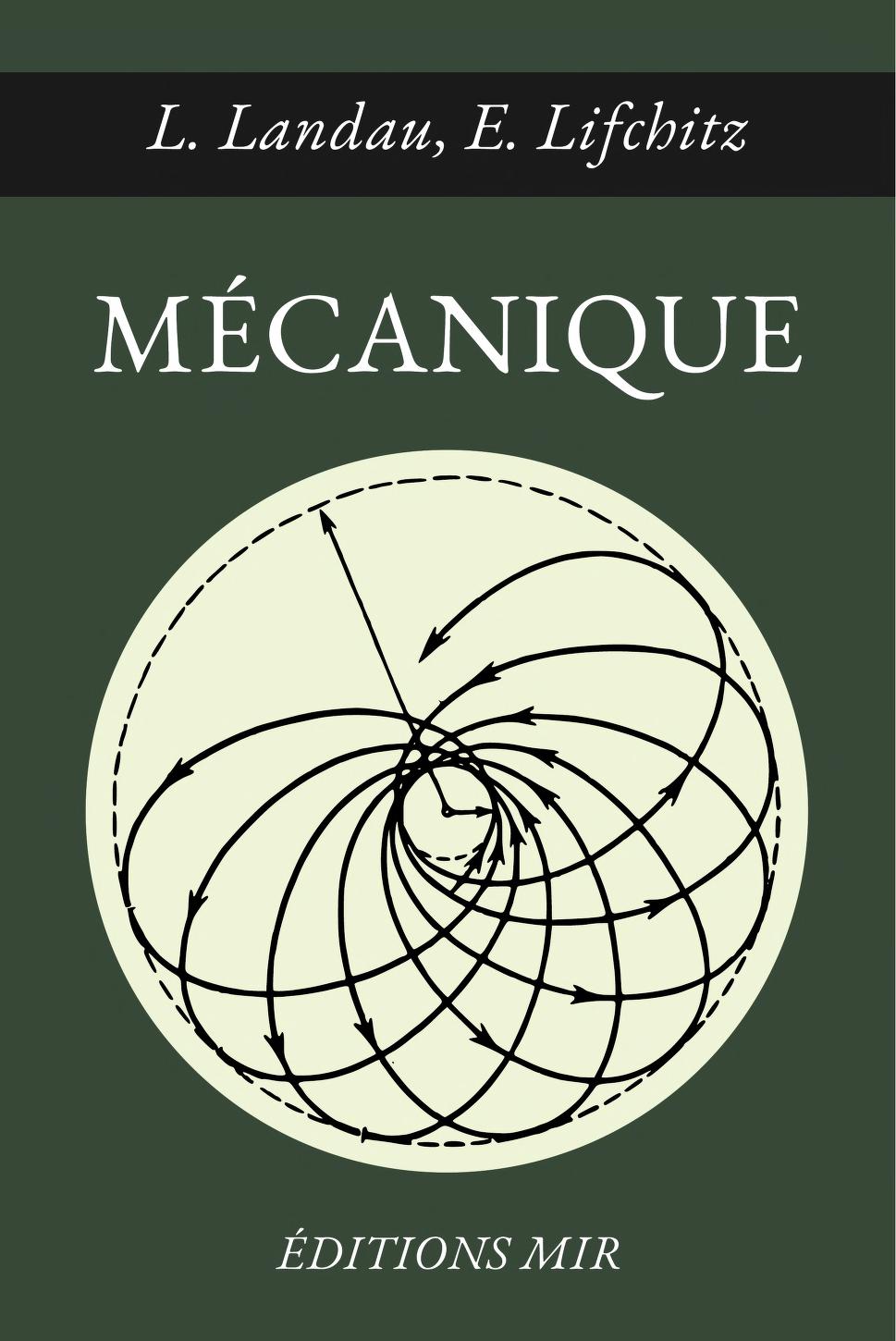
Mécanique – Landau, Lifchitz

Dans cet article, nous verrons le livre Mécanique de L. Landau et E. Lifchitz.

À propos du livre

Le présent livre est la traduction du 1er volume du Cours de physique théorique de L. Landau, de l’Académie des Sciences, et de E. Lifchitz, membre correspondant de l’Académie des Sciences de l’U.R.S.S.

Consacré aux fondements de la mécanique, à savoir la mécanique newtonienne classique, le sujet est basé principalement sur le principe de relativité de Galilée et le principe de moindre action de Hamilton. L’exposition est simple et conduit au moyen direct le plus complet de résoudre des problèmes en mécanique.


Le livre a été traduit du russe par Claude Ligny.

L’édition française a été publiée en 1969 par les éditions Mir.

Crédits à l’uploader d’origine.

Vous pouvez obtenir le livre ici.

(J’ai utilisé la traduction automatique, toutes mes excuses pour les erreurs.)

Continue reading

Posted in books | Tagged , , , , , , , , , , , , , , , | Leave a comment

Electronic Structure Of Metals – Brandt, Chudinov

In this post, we will see the book Electronic Structure Of Metals by N. B. Brandt and S. M. Chudinov.

About the book

“ Electronic Structure of Metals” is a textbook on the physics of metals. It opens with an exposition of the connection between the various properties of metals and the energy spectrum of their electrons. Employs the method of the structure of the Fermi surface. Devotes much space to describing the behaviour of the electron system in metals in the presence of a quantizing magnetic field, and gives a detailed exposition of various quasi-classical and quantum methods of investigating the Fermi sur­face. This textbook is for university students. Suitable also for col­leges of education and other higher teacher-training courses.

About the Authors

 Nikolai Brandt, Dr. Sc. (Phys.-math.), Professor, heads the department of solid-state physics and is the chair of low-temperature physics at the Moscow State University. The field of his scientific interests is solid-state physics. His scientific activities are mainly directed to the study of matter under the com­bined action of super-strong magnetic and electric fields, super-high pressures, strong anisotropic deformations, and strong alloying at low and ultra-low temperatures.
The most important results of Brandt’s scientific research are the discovery and study of phase electron transitions of 2.5 kind under the action of pressure which have been predicted by Acad. Lifshits; the discovery of electron phase transitions of the type metal-dielectric and dielectric-metal in strong magne­tic fields; the discovery and study of new types of gapless state of substances appearing under the action of pressure and magnetic field; the discovery and study of the stationary phase-exciton insulator; the dis­covery of superconductivity at high pressures for a number of new modifications cf phosphorus, antimony, arsenic, bismuth, and indium antimonide.
Nikolai Brandt is the author of more than 50 published Works.
Sergei Chudinov, Cand. Sc. (Phys,-math.), is an assistant professor at the chair of low- temperature physics at the Moscow State University.
The main direction of his scientific activities is the study of electron energy spectra of sub­stances.
The most important results of Chudinov’s scientific research are the establishment of zonal structure of bismuth-antimony alloys in the region of antimony concentrations up to 20 at. per cent and determination of the nature of its variation under the action of pressure and a strong magnetic field; the discovery of new types of gapless state of substances appearing under the action of pressure and magnetic field. Sergei Chudinov is the author of about 40 published Works.

The book was translated from Russian by V. Afanasyev was published in 1975 by Mir Publishers.

You can get the book here.

Follow us on The Internet Archive: https://archive.org/details/@mirtitles

Follow Us On Twitter: https://twitter.com/MirTitles

Write to us: mirtitles@gmail.com

Fork us at GitLab: https://gitlab.com/mirtitles/

Add new entries to the detailed book catalog here.

Contents

Introduction 7

Chapter One. THE CRYSTAL LATTICE 13

1-1. Metal Formation through Condensation of “Neutral Atoms. The Metallic Bond 13
1-2. The Metallic Bond and Crystal Lattice 17
1-3. The Nature of Oscillations of Atoms in a Crystal Lattice 18
1-4. The Natural-frequency Spectrum of a One-dimensional Lattice 23
1-5. Phonons. Thermal Oscillations in a One-dimensional Lattice 34
1-6. Specific Heat of a Lattice. Einstein’s Model 39
1-7. Specific Heat of a Lattice at Temperatures below 𝛩_{D} 41
1-8. The Spectral Density of Phonons 50
1-9. Interaction of Phonons 57

Chapter Two. THE SYSTEM OF VALENCE ELECTRONS 61

2-1. The Behaviour of the Electron System in a Metal 61
2-2. The Concept of Fermi Surface 62
2-3. The Effect of Crystal Lattice on the Motion of an Electron 67
2-4. The Dynamics of an Electron in the Crystal Lattice 79
2-5. Dependence of the Energy of an Electron in the Lattice on Quasi-momentum 89
2-6. Construction of Brillouin Zones 97
2-7. The Reciprocal Lattice. The Wigner-Seitz Method for Constructing the First Brillouin Zone 106
2-8. Filling the Brillouin Zone with Electrons 111
2-9. Fermi Surfaces of the Elements of Group I of the Periodic Table 115
2-10. Harrison’s Method for Constructing Fermi Surfaces 120
2-11. The Modern Scheme of Constructing Fermi Surfaces. Topological Classification of Fermi Surfaces 138
2-12. Motion of Quasi-particles in a Constant Magnetic Field 148
2-13. The Density of States 165
2-14. Quantization of the Energy of an Electron in a Magnetic Field. 169
2-15. Distribution of Electrons in p-space in the Presence of a Quantizing Magnetic Field 177
2-16. The Density of States in a Magnetic Field 183
2-17. A Two-zone Metal in a Magnetic Field 197

Chapter Three. ELECTRIC CONDUCTIVITY OF METALS 219

3-1. Phenomenological Description of Electric Conductivity 219
3-2. Electric Conductivity and Energy Spectrum of Electrons in a Metal 220
3-3. Temperature Dependence of Electric Conductivity 282
3-4. Electric Conductivity of Metals in a Magnetic Field. General Considerations 240
3-5. Weak Magnetic Fields 241
3-6. Weak Magnetic Fields. Hole-type Fermi Surfaces 248
3-7. Strong Magnetic Fields 250

Chapter Four. EXPERIMENTAL METHODS FOR STUDYING THE ENERGY SPECTRUM OF ELECTRONS IN METALS 268

4-1. General Remarks 268
4-2. Galvano-magnetic Methods for Studying the Energy Spectrum 269
4-3. The Azbel-Kaner Cyclotron Resonance 276
4-4. Gantmacher’s Radio-frequency Size Effect 289
4-5. Pippard’s Magneto-acoustic Resonance 300
4-6. Quantum-mechanical Magneto-acoustic Resonance 307
4-7. Oscillational Quantum Effects 314

Bibliography 331
Index 334

Posted in books, metals, mir books, mir publishers, physics | Tagged , , , , , , , , , , , , , , , | Leave a comment

La physique à la portée de tous – Livre 4 – Photons et noyaux (Science Pour Tous) – Kitaïgorodski

Dans cet article, nous verrons le livre La physique à la portée de tous – Livre 4 – Photons et noyaux (Science Pour Tous) par A. Kitaïgorodski.

À propos du livre

Le livre “Photons et noyaux” a pour objet d’illustrer la mise en œuvre des lois du champ électromagnétique et de la physique quantique pour une étude du comportement des ondes électromagnétiques de différents longueurs d’onde.
Une initiation préalable à la mécanique ondulatoire et à la théorie de la relativité restreinte permettra d’aborder la question du noyau atomique. A la suite d’un exposé des principaux résultats concernant la structure du noyau atomique, on s’attachera à une discussion de la question cruciale des wurces d’énergie dont pourrait disposer l’Humanité. Un aperçu sur la physique de l’Univers termine cet ouvrage.
Le volume restreint de l’ouvrage nous a obligés à sacrifier certains thèmes traditionnels, afin de ménager la place pour un exposé de nouveaux développements.

Le livre a été traduit du russe par S. Medvédev. L’édition française a été publiée en 1984 par les éditions Mir.

Crédits à l’uploader d’origine.

Vous pouvez obtenir le livre 4 ici.

Livre 1.

Livre 2.

Livre 3.

(J’ai utilisé la traduction automatique, toutes mes excuses pour les erreurs.)

Continue reading

Posted in books, french, mir books, mir publishers, physics, physics for everyone, popular science, science for everyone | Tagged , , , , , , , , , , , , , , , , , | Leave a comment

La physique à la portée de tous – Livre 3 – Les électrons (Science Pour Tous) – Kitaïgorodski

Dans cet article, nous verrons le livre La physique à la portée de tous – Livre 3 – Les électrons (Science Pour Tous) par A. Kitaïgorodski.

À propos du livre

Dans ce troisième livre, nous examinons la structure électrique de la matière, les forces électriques et le champ électromagnétique.

Quelques mots maintenant sur le livre «Les électrons». Utilisant d’une façon assez particulière la nécessité de rappeler les définitions les plus simples au moyen desquelles sont décrits les phénomènes électriques, j’ai tenté de donner une idée de l’approche phénoménologique de la physique.
Deux chapitres sur six sont consacrés à la physique appliquée. L’électrotechnique est donnée sous la forme d’un résumé. Une description détaillée aurait obligé à recourir à des dessins et schémas techniques. Aussi avons-nous estimé possible de nous en tenir aux principes fondamentaux de l’électrotechnique et aux faits importants que nul ne doit ignorer.
Nous avons procédé de même au chapitre consacré à la radio. Faute de place, nous nous sommes bornés à faire l’historique de la question et à énoncer brièvement les principes de la radio- technique.

Le livre a été traduit du russe par Igor Sokolov. L’édition française a été publiée en 1984 par les éditions Mir.

Crédits à l’uploader d’origine.

Vous pouvez obtenir le livre 3 ici.

Livre 1.

Livre 2.

(J’ai utilisé la traduction automatique, toutes mes excuses pour les erreurs.)

Continue reading

Posted in books, french, mir books, mir publishers, physics, physics for everyone, popular science, science for everyone | Tagged , , , , , , , , , , , , , , , , , , , | Leave a comment

La physique à la portée de tous – Livre 2 – Molécules (Science Pour Tous) – Landau, Kitaigorodski

Dans cet article, nous verrons le livre La physique à la portée de tous – Livre 2 – Molécules (Science Pour Tous) par Lev Landau et A. Kitaïgorodski.

À propos du livre

Ce livre, intitulé « Molécules» , reprend sans modification maints chapitres de la deuxième moitié de la précédente édition du livre Physique pour tous de Lev Landau et Alexandre Kitaïgorodski.

Pour l’essentiel, il est consacré aux divers aspects de la science traitant de la structure de la matière. Toutefois,  l’atomey demeure provisoirement ce qu’il était encore pour Démocrite, soit une particule indivisible. Il n’empêche, bien entendu, qu’il y sera question aussi des problèmes soulevés par le mouvement des molécules. Ceux qui sont au fondement de l’interprétation moderne des phénomènes thermiques. Et surtout, on y accorde toute l’attention nécessaire aux questions qui ont trait aux transformations de phase.
Depuis la parution des précédentes éditions de la Physique pour tous, nos connaissances sur la structure des molécules et leurs interactions se sont fortement étoffées. De nombreux ponts ont été jetés entre les problèmes de la structure moléculaire de la matière et’ ses propriétés. Ceci nous a incités à ajouter à ce livre des chapitres nouveaux, assez considérables.
Je pense que le moment est venu depuis longtemps d’introduire dans les livres scolaires courants des renseignements généraux sur des molécules plus complexes que celles de l’oxygène, de l’azote et du gaz carbonique. Jusqu’à présent, les auteurs de la plupart des cours de physique n’estiment pas indispensable de parler de combinaisons atomiques plus compliquées. Et pourtant, les macromolécules occupent d’ores et déjà une grande place dans notre vie quotidienne, sous l’aspect des matières synthétiques les plus variées. On a constitué une biologie moléculaire qui explique les phénomènes vitaux dans le langage des molécules des protéines et des acides nucléi-ques.

De même, on omet d’ordinaire et de la façon la plus injuste les questions touchant aux réactions chimiques. C’est pourtant là le processus physique de la collision des molécules et qui s’accompagne de leur restructuration. On imagine comme il devient plus facile d’expliquer aux élèves ou aux lecteurs la nature des réactions nucléaires, dès lors qu’ils ont initiés au comportement des molécules, en tout point analogue.

Au cours du remaniement de ce livre, il s’est avéré nécessaire de transférer plusieurs chapitres de l’ancienne Physique pour tous dans les volumes suivants.
Pour le son en particulier, nous avons cru bon de nous en tenir ici à quelques mots dans le chapitre qui traite de la mécanique moléculaire.

Le livre a été traduit du russe par Ch. Bir et A Karvovski. L’édition française a été publiée en 1984 par les éditions Mir.

Crédits à l’uploader d’origine.

Vous pouvez obtenir le livre 2 ici.

Livre 1.

(J’ai utilisé la traduction automatique, toutes mes excuses pour les erreurs.)

Continue reading

Posted in books, french, mir books, mir publishers, physics, physics for everyone, popular science, science for everyone | Tagged , , , , , , , | Leave a comment

La physique à la portée de tous – Livre 1 – Corps physiques (Science Pour Tous) – Landau, Kitaigorodski

Dans cet article, nous verrons le livre La physique à la portée de tous – Livre 1 – Corps physiques (Science Pour Tous) par Lev Landau et A. Kitaigorodski.

À propos du livre

Puisque l’entretien sur la physique débute par les phénomènes qui n’exigent pas de connaissances particulières sur la structure de la matière, il m’a paru naturel d’intituler le premier livre Corps physiques. Certes, j’aurais pu aussi bien opter, comme on le fait généralement, pour Mécanique, qui est la science du mouvement. Toutefois, la théorie de la chaleur dont il sera question dans le volume suivant est aussi une science du mouvement, mais concernant cette fois des corps invisibles à l’œil nu, les molécules et les atomes. Ce qui fait que le titre choisi me semble plus approprié.
Pour l’essentiel, ce premier livre se consacre à l’enseignement des lois du mouvement et de l’attraction universelle, lois destinées à rester à jamais le fondement de la physique et donc de toute science naturelle.

Le livre a été traduit du russe par Ch. Bir et A Karvovski. L’édition française a été publiée en 1984 par les éditions Mir.

Crédits à l’uploader d’origine.

Vous pouvez obtenir le livre ici.

(J’ai utilisé la traduction automatique, toutes mes excuses pour les erreurs.)

Suivez-nous sur Internet Archive: https://archive.org/details/@mirtitles

Suivez-Nous Sur Twitter: https://twitter.com/MirTitles

Écrivez-nous: mirtitles@gmail.com

Rejoignez-nous sur GitLab: https://gitlab.com/mirtitles/

Ajoutez de nouvelles entrées au catalogue de livres détaillé ici.

Contenu

TABLE DES MATIÈRES

PRÉFACE 5

CHAPITRE PREMIER. NOTIONS FONDAMENTALES 7

Le centimètre et la seconde 7
Poids et masse 12
Système SI et étalons 16
Densité 22
Loi de conservation de la masse 24
Action et réaction 26
Composition des vitesses 28
Force considérée comme un vecteur 33
Plan incliné 38

CHAPITRE 2. LOIS DU MOUVEMENT 41

Divers postes d’observation 41
Principe de l’inertie 43
Le mouvement est relatif 47
Point de vue d’un observateur stellaire 49
Accélération et force 52
Mouvement rectiligne uniformément accéléré 61
Trajectoire d’une balle 64
Mouvement circulaire 68
La vie en impondérabilité 72
Le mouvement considéré d’un point de vue « non rationnel » 78
Systèmes tournants 83
Force de Coriolis 90

CHAPITRE 3. LOIS DE CONSERVATION 100

Recul 100
Loi de conservation de l’impulsion 102
Mouvement à réaction 106
Le mouvement sous l’action de la pesanteur 110
Loi de conservation de l’énergie mécanique 116
Travail 119
Unités de mesure du travail et de l’énergie 123
Puissance et rendement d’une machine 124
Déperdition d’énergie 126
Perpetuum mobile 128
Collisions 131

CHAPITRE 4. OSCILLATIONS 135

Equilibre 135
Oscillations simples 137
Développement des oscillations 142
Force et énergie potentielle lors des oscillations 147
Oscillations des ressorts 150
Oscillations plus complexes 154
Résonance 155

CHAPITRE 5. MOUVEMENT DES SOLIDES 159

Moment d’une force 159
Levier 163
Gains et pertes 166
Autres machines simples 169
Comment composer des forces parallèles agissant sur un solide 171
Centre de gravité 176
Centre d’inertie 181
Moment de rotation 184
Loi de conservation du moment de rotation 185
Le moment de rotation considéré comme un vecteur 188
Toupies gyroscopiques 190
Arbre flexible 192

CHAPITRE 6. GRAVITATION 197

Sur quoi tient la Terre? 197
Loi de la gravitation universelle 198
Pesée de la Terre 201
Les mesures de g au service de la prospection 204
La pesanteur à l’intérieur de la Terre 209
Energie gravifique 212
Comment se déplacent les planètes 217
Voyages interplanétaires 224
Si la Lune n’existait pas 227

CHAPITRE 7. PRESSION 235

Presse hydraulique 235
Pression hydrostatique 237
Pression de l’atmosphère 240
Comment on apprit l’existence de la pression atmosphérique 244
La pression atmosphérique et le temps 246
Variation de la pression avec l’altitude 250
Principe d’Archimède 252
Pressions de l’ordre de plusieurs millions d’atmosphère 258
SDDOES OR D re dr

APPENDICE 260

Posted in books, french, mir books, mir publishers, physics, physics for everyone, popular science, science for everyone | Tagged , , , , , , , , , , , , , , , , , , | Leave a comment

The Theory Of Electromagnetic Field – Polivanov

In this post, we will see the book The Theory Of Electromagnetic Field by K. Polivanov.

About the book

The theory of an electromagnetic field is a concluding subject in the curriculum of the theoretical training of electrical engineers. The field theory course usually follows the course in the basic theory of electric circuits.
The author covers the basic aspects of the theory of an electromagnetic field within the restricted space so that the text can fit the interest of students and answer the practical engineering needs. The emphasis therefore is on the behavior of fer­romagnetic bodies in an electromagnetic field and on the processes in real imperfect dielectrics and poor conductors. The text also gives strict definitions of the basic vec­tors and shows the differences between them.
Many of the aspects discussed in the book focus on the problems one has to deal with in electrical engineering practice. This is one of the factors that influenced the organization of the book and the manner of presentation of the material. A similar treatment of the field theory was also given in the book by A. Netushil and K. Polivanov The Theory o f Electromagnetic Field. Theoretical Principles o f Elec­trical Engineering. Part 3 (Gosenergoizdat, in Russian). No effort has been made to cite a great number of contributors in this area. In the author’s opinion, of many valuable texts, the following books will be very helpful to students in the study of the theory of electrical engineering: Analysis and Synthesis o f Electric Circuits (Mir Publishers) by G. Zeveke, P. Ionkin, A. Netushil, and S. Strakhov, The Feynman Lectures on Physics (Addison-Wesley) by R. Feynman, R. Leighton, and M. Sands, Electricity and Magnetism (McGraw-Hill) by E. Purcell that treats the effects of moving bodies in an electromagnetic Field, and Fundamentals of the Theory of Elec­tricity (Mir Publishers) by I. Tamm. Special mention should be made of Maxwell’s Treatise on Electricity and Magnetism which forms the basis of the course in the field theory.
In preparing the book for its publication in English, the author revised the text and added some useful information.

The book was translated from Russian by P. Ivanov was published in 1983 by Mir Publishers.

PS: This book was in my collection for a very long time, digitised recently.

You can get the book here.

Follow us on The Internet Archive: https://archive.org/details/@mirtitles

Follow Us On Twitter: https://twitter.com/MirTitles

Write to us: mirtitles@gmail.com

Fork us at GitLab: https://gitlab.com/mirtitles/

Add new entries to the detailed book catalog here.

Contents

Chapter 1. Maxwell’s Equations 9

1.1. Classical Electrodynamics 9
1.2. Maxwell’s Equations in Integral Form 10
1.3. Principal Electric Field Vector 12
1.4, Principal Magnetic Field Vector 14
1.5. Principle of Superposition 16
1.6. Field Calculation by Equations in Integral Form 17

Chapter 2. Differential Field Equations 21

2.1. Differential Operators 21
2.2. Examples of Operations on Various Fields 24
2.3. Displacement Current in Vacuum 26
2.4. Corollaries to Maxwell’s Equations 29
2.5. Scalar and Vector Potentials 33
2.6. Electric Field Expressed in Terms of Two Potentials 39

Chapter 3. Electromagnetic Field in Polarizable Bodies and Conductors. Static and Quasistatic Conditions 45

3.1. Stationary (Quasistatic) Field in the Presence of Polarized 45
3.2. A Dielectric in a Time-Varying Field 55
3.3. Stationary Magnetic Fields in Magnetized Media 64
3.4. Ferromagnet in a Time-Varying Field 76
3.5. Notes on Sections 3.1 t0 3.4 80
3.6. Electric Field in a Conducting Medium. Quasistatic Conditions 80

Chapter 4. Simple Solutions of Field Equations and Their Applications in Circuit Theory 81

4.1. Electric Field and Electric Parameters of Parallel Wires 81
4.2. Self-Inductance and Mutual Inductance 89
4.3. Equations of Field Lines 97
4.4. Approximate Methods of Calculation of Potential Fields 98
4.5. Simple Approximate Calculations of Capacitance and Inductance 103
4.6. Potential Field Modeling. Electrolytic Tanks 105
4.7. The Reciprocity Principle for a DC Circuit 109
4.8. Theorems of a Magnetic Flux and Induced Electric Charge 110

Chapter 5 Potential Electric Fields 119

5.1. General Features of Calculation Methods 119
5.2. Solution to Partial Differential Equations by the Fourier-Euler Method 122
5.3. Simple Problems Solvable in the Cylindrical and Spherical Coordinate Systems 123
5.4. Polarized Ellipsoid. Coefficients of Depolarization 131
5.5. Polarizable Bodies in an AC Field 133
5.6. Transients in Quasistatic Fields. Relaxation 133
5.7. Method of Images 135
5.8. Method of Complex Functions. Conformal Mapping 139
5.9. Van-der-Pauw’s Theorem 143

Chapter 6. Magnetic Fields. Quasistatic and Quasistationary Conditions 146

6.1. Solution of Magnetostatic Field Equations 146
6.2. Demagnetization Factors 146
6.3. Method of Images for a Magnetic Field 153
6.4. Magnetic Field in Electrical Machines 155
6.5. Vector Potential for the Magnetic Field in an Electrical Machine 158

Chapter 7. Energy and Force 162

7.1. General 162
7.2. Field Energy and its Flow 172
7.3. Energy Transfer in Electrical Machines 180
7.4. Energy Converters 183
7.5. Lifting Force of a Magnet 183
7.6. Determining Forces from Reluctance 185

Chapter 8. Varying Electromagnetic Field in a Conducting Medium. Skin Effect 186

8.1 General 186
8.2. Varying Magnetic Field in a Thin Plate 198
8.3. The Skin Effect in a Coaxial Cable 206
8.4. Electromagnetic Field in Conductors of a Two-Wire Line 212
8.5. Conductors in the Slot of an Electrical Machine 213
8.6. Study of the Skin Effect on Models 217
8.7. Additional Remarks 218

Chapter 9. Propagation and Reflection of Electromagnetic Waves 221

9.1. Plane Wave Propagation 221
9.2. Cavity Resonators and Waveguides 233
9.3. Waves in a Nonlinear Medium 244

Chapter 10. Electromagnetic Wave Radiation

10.1. Introductory Remarks 246
10.2. Delayed Potentials 248
10.3. Electric Dipole Radiation 252
10.4. Half-Wave Antenna 256
10.5. Directional Radiation 257
10.6. Summary 259

Appendices 266
Index 270

Posted in books, mir books, mir publishers, physics, soviet | Tagged , , , , , , , , , , , , , , , , , , | Leave a comment

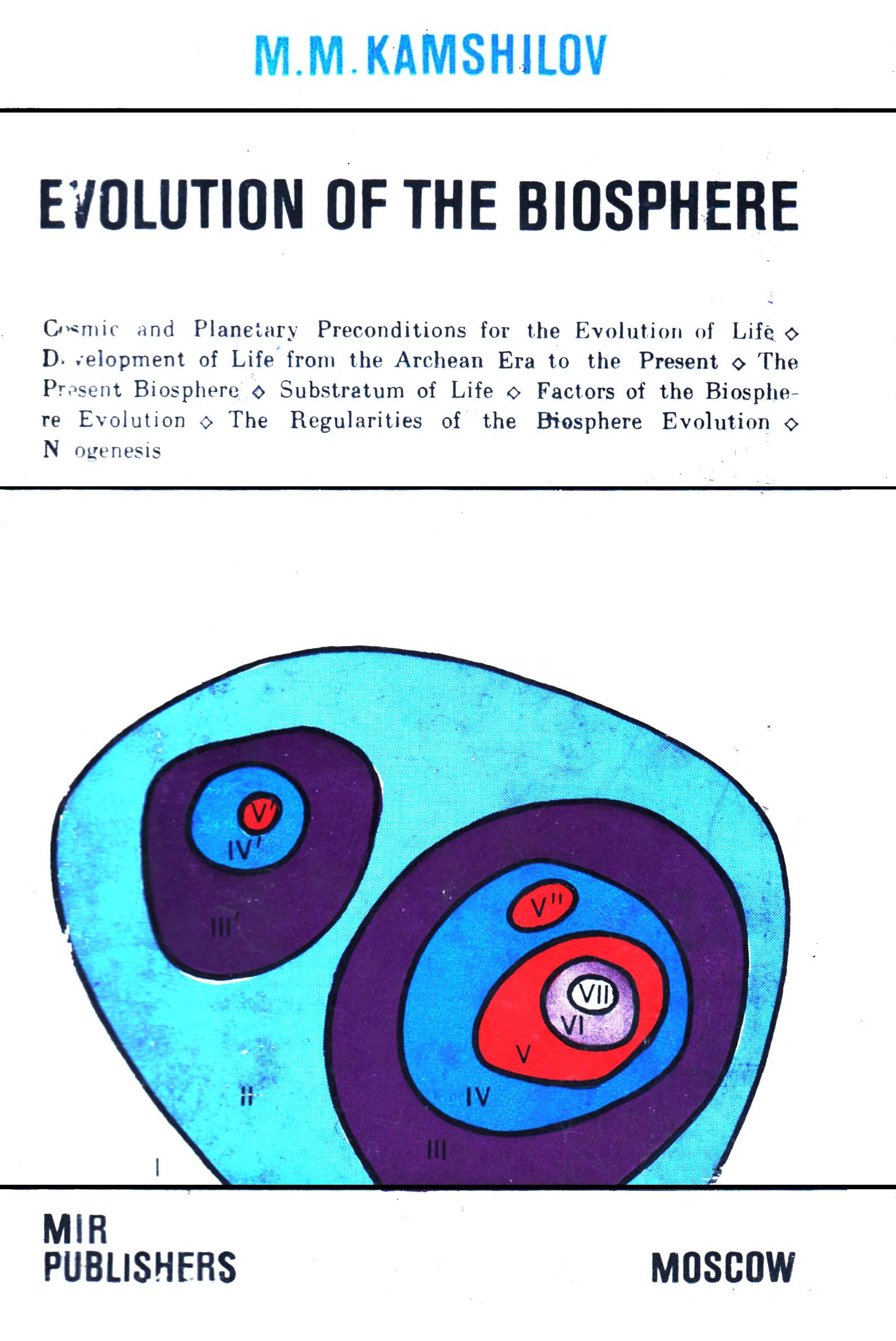
Evolution Of The Biosphere – Kamshilov

In this post, we will see the book Evolution Of The Biosphere by M. M. Kamshilov.

About the book

A book for the general reader with an interest in science and defence of the environment. Deals with problems of the evolution of the biosphere, its origin and feature organization of the substratum of life, factors and patterns in the evolution of the biosphere, and the interrelations of the biosphere and human society. The first two chapters are concerned with the origin of the biosphere and its stages of development; the third and fourth chapters describe its modern features and parts. The fifth and sixth chapters are devoted to the problems ot the main laws and patterns of the evolution of the biosphere. And the last chapter deals with the problems of the interaction of man and the biosphere.
 Prof. Mikhail KAMSHILOV, D.Sc., heads the laboratory of lower orga­nisms biology of the Institute of Biology of Inland Waters of the Academy of Sciences of the USSR.
 He is a specialist in animal genetics and hydrobiology, author of more than 150 published works, among them The Significance of Interrelation­ship of Organisms in Evolution, The Biological Circulation, and many others.

The book was translated from Russian by Minna Brodskaya and was published in 1976 by Mir Publishers.

Many thanks to GN for the book.

You can get the book here.

Follow us on The Internet Archive: https://archive.org/details/@mirtitles

Follow Us On Twitter: https://twitter.com/MirTitles

Write to us: mirtitles@gmail.com

Fork us at GitLab: https://gitlab.com/mirtitles/

Add new entries to the detailed book catalog here.

Contents

Cosmic and Planetary Preconditions for the Evolution of Life | Development of Life from the Archean Era to the Present | The Present Biosphere | Substratum of Life | Factors of the Biosphere Evolution | The Regularities of the Biosphere Evolution Neogenesis

Preface

Chapter 1. COSMIC AND PLANETARY PRECONDITIONS FOR THE EVOLUTION OF LIFE 13

From dogma on the spontaneous generation of life to a scientific theory of its origin 13
Formation of the chemical elements 15
Chaos, organization, information 17
Planetary preconditions for the development of life 25
From heavy atoms to molecules of the organic substance 33
The origin of the biotic circulation 36
Prebiological systems — coacervates 44

Chapter 2. DEVELOPMENT OF LIFE FROM THE ARCHEAN ERA TO THE PRESENT 49

Initial steps of life 49
Life accumulates strength Shekels 50
First results 73
Life as a form of differentiation of matter 75

Chapter 3. THE PRESENT BIOSPHERE 78

The number of species 78
Biomass 81
The biotic circulation 82
Organization of the biosphere 88

Chapter 4. SUBSTRATUM OF LIFE 98

Cell 100
Preformed epigenesis 118
Nucleus or cytoplasm 121
Epigenesis of preformed entities 124
Phenotype and genotype 129
Paradox of individual development 135

Chapter 5. FACTORS OF THE BIOSPHERE EVOLUTION 140

Categories of intraspecific variability 142
Microevolution 143
The phenotypic form of hereditary variation 148

Chapter 6. THE REGULARITIES OF THE BIOSPHERE EVOLUTION 191

The structure of life 191
Non-uniformity of the evolution 195
The unity of the life substratum 197
The motive forces and the adaptive form of the evolutionary process 19
Conditions of formbuilding 205
Life and the second principle of thermodynamics 218

Chapter 7. NOOGENESIS 227

Food 227
Water 228
Air 229
Minerals 231
Plants and animals 232
Man 233
Where is the way out? 235
From biogenesis to noogenesis 239
Noogenics 242

Conclusion 252
Bibliography 256
Name Index 264
Subject Index 267

Posted in books, geology, history, life sciences, mir books, mir publishers, science, soviet | Tagged , , , , , , , , , , , , , , , , , , , , , , | Leave a comment

The Physics Of Rocks – Rzhevsky, Novik

In this post, we will see the book The Physics Of Rocks by V. Rzhevsky and G. Novik.

About the book

This book treats the fundamentals of a new branch of mining sci­ence — rock physics. It defines the subject, the basic trends in rese­arch, and concepts of the physical properties of rock. The mechani­cal, acoustic, thermal, electrical, magnetic, and radiation proper­ties of rocks are discussed in detail, and the effect dn them of external fields (viz. temperature, pressure, moisture, etc.) is ana­lysed. Fundamental problems of the utilization of these properties in mining are also discussed. The concluding chapter attempts to establish the inter-relationships between the physical properties of rocks, and the principles for a classification and certification of rocks according to their physical properties.
The book is designed as a text­ book for mining students but it may be found useful by all who are working or interested in the field of rock physics.

About the Authors

Vladimir Rzhevsky, Corr. Mem. USSR Academy of Sciences, D. Tech. Sc., is Rector of the Moscow Mining Institute and a specialist in the technology mechanization, and automation ot mining and in the physics of rocks. He is the author or editor of many textbooks and other publications in these fields, including works on ultrasonic control and research in mining, and the classification and certification of rocks by their physical properties.
Gottfried Novik, Cand. Tech. Sc., is reader in rock physics at the Moscow Mining Institute. Apart from the investigation of the physical properties of rocks, the main line of his work is the breaking and melting of rock by means of high-frequency currents. He has published around 50 pa­pers on his research.

The book was translated from Russian by A.K. Chatterjee and translation edited by A.A. Beknazarov, revised from the 1967 Russian edition and was published in 1971 by Mir Publishers.

PS: I got this book c. 2001-2 and almost after twenty years the book was scanned!

You can get the book here.

Follow us on The Internet Archive: https://archive.org/details/@mirtitles

Follow Us On Twitter: https://twitter.com/MirTitles

Write to us: mirtitles@gmail.com

Fork us at GitLab: https://gitlab.com/mirtitles/

Add new entries to the detailed book catalog here.

Contents

Preface 5
Introduction 11

CHAPTER I MINERALOGICAL AND PETROGRAPHICAL PRINCIPLES OF ROCK PHYSICS. PHYSICAL PROPERTIES OF ROCKS

1. Minerals and Rocks 15
2. Classification of Physical Properties of Rocks and Factors Determining Them 22
3. Effect of Internal and External Factors on the Properties of Rocks 28
4. General Considerations for Studying the Mineral Composition, Structure, and Properties of Rocks 32
5. Significance of the Physical Properties of Rocks for Mining 37

Questions and Problems 42

CHAPTER II MECHANICAL PROPERTIES OF ROCKS

1. Density Properties of Rocks 44
2. Characteristics of Loosened Rock 49
3. Stress and Strain in Rocks 52
4. Elastic Properties of Rocks 56
5. Strength of Rocks 67
6. Plastic and Rheological Properties of Rocks 82
7. Hydrodynamics and Gas-Dynamics of Rocks 90
8. Special Technological Indices of Rocks 100

Questions and Problems 105

CHAPTER III ACOUSTICS OF ROCKS

1. Propagation of Elastic Waves in Rocks 107
2. Acoustic Properties of Rocks 110
3. Employment of Acoustics in Mining 121

Questions and Problems 131

CHAPTER IV THERMODYNAMICS OF ROCKS

1. Laws of Propagation and Accumulation of Heat in Rocks 132
2. Thermal Parameters of Rocks 137
3. Application of Thermodynamics in Mining 153

Questions and Problems 167

CHAPTER V ELECTROMAGNETIC PROPERTIES OF ROCKS

1. Basic Concepts of the Theory of Electric Field 168
2. Polarization 171
3. Relative Permittivity and Dielectric Losses 176
4, Electrical Conductivity of Rocks 188
5. Magnetic Properties of Rocks 200
6. Propagation of Electromagnetic Waves in Rocks 205
Questions and Problems 212

CHAPTER VI UTILIZATION OF ROCK ELECTRODYNAMICS IN MINING. RADIATION PROPERTIES OF ROCKS

1. Use of Electrodynamics to Obtain Information About Rocks 213
2. Breakdown of Rocks 222
3. Application of Electrodynamics in Breaking Rocks 227
4. Radiation Properties of Rocks 239

Questions and Problems 245

CHAPTER VII INTERRELATION BETWEEN PROPERTIES AND PHYSICAL PHENOMENA IN ROCKS

1. General Interdependence of Rock Properties 247
2. Classification of Rocks by Physical Properties 258
3. Problems for Further Research in Rock Physics 266

Questions and Problems 269

Appendix 304
Literature 308
Index 308

Posted in geology, mathematics, mir books, mir publishers, physics, soviet | Tagged , , , , , , , , , , , | 1 Comment