

सोडा कैन कार में नजानू का रोमांच
अनुवादक सरस्वती हैदर
चित्रकार बोरीस कलऊशिन
You can get the book here and here.
Twitter: @MirTitles
Mastodon: @mirtitles@mastodon.world
Mastodon: @mirtitles@mastodon.social
Bluesky: mirtitles.bsky.social
सोडा कैन कार में नजानू का रोमांच
अनुवादक सरस्वती हैदर
चित्रकार बोरीस कलऊशिन
You can get the book here and here.
Twitter: @MirTitles
Mastodon: @mirtitles@mastodon.world
Mastodon: @mirtitles@mastodon.social
Bluesky: mirtitles.bsky.social

नाना के घर पर नजानु के शरारती रोमांच
अनुवाद योगेन्द्र नागपाल
You can get the book here and here.
Twitter: @MirTitles
Mastodon: @mirtitles@mastodon.world
Mastodon: @mirtitles@mastodon.social
Bluesky: mirtitles.bsky.social

This publication is concerned with a series of questions in computer engineering: the power supply system of the high-speed electronic computer of the Academy of Sciences of the U.S.S.R.; new elements and units for computers; a method of control of the arithmetic unit; a method of selecting the required word from the dictionary in machine translation; and present-day computer terminology. The publication was drawn up by specialists in the design and working of electronic computers. Besides papers from the Institute of Precision Mechanics and Computer Engineering, this publication contains articles by authors from other organizations concerned with computer engineering.
Translated From the Russian by JANE STUART
Translation edited by J.P. CLEAVE and E.A. SOWAN
You can get the book here and here.
Twitter: @MirTitles
Mastodon: @mirtitles@mastodon.world
Mastodon: @mirtitles@mastodon.social
Bluesky: mirtitles.bsky.social
CONTENTS
Editorial Note vii
O. K. Shcherbakov The Lower Supply System of BESM (the high-speed electronic computer of the Academy of Sciences of the U.S.S.R.) 1
F. V. Maiorov Digital Integrating Machines (Differential Analyzers) 22
P. P. Golovistikov Dynamic Flip-Flops and Their Use in Parallel Action Computers 96
E. A. Voikov A Method of Automatic Monitoring of a Serial Arithmetic Unit 134
L. N. Korolev Methods of Selecting the Required Word from a Dictionary 139
K. Ya. Matyukhin and O. V. Rosnitskii The Role of the Ferrite Core in a Matrix Storage Unit 143
Yu. N. Glukhov and O. V. Rosnitskii Reliability of a Matrix-Type Magnetic Store with Linear Selection 158
E. I. Limonov Basic Nomenclature and Definitions in Automatic Digital Computer Engineering 170
In this post, we will see the book from the series Little Mathematics Library titled The Euler Characteristic by Yu. A. Shashkin.
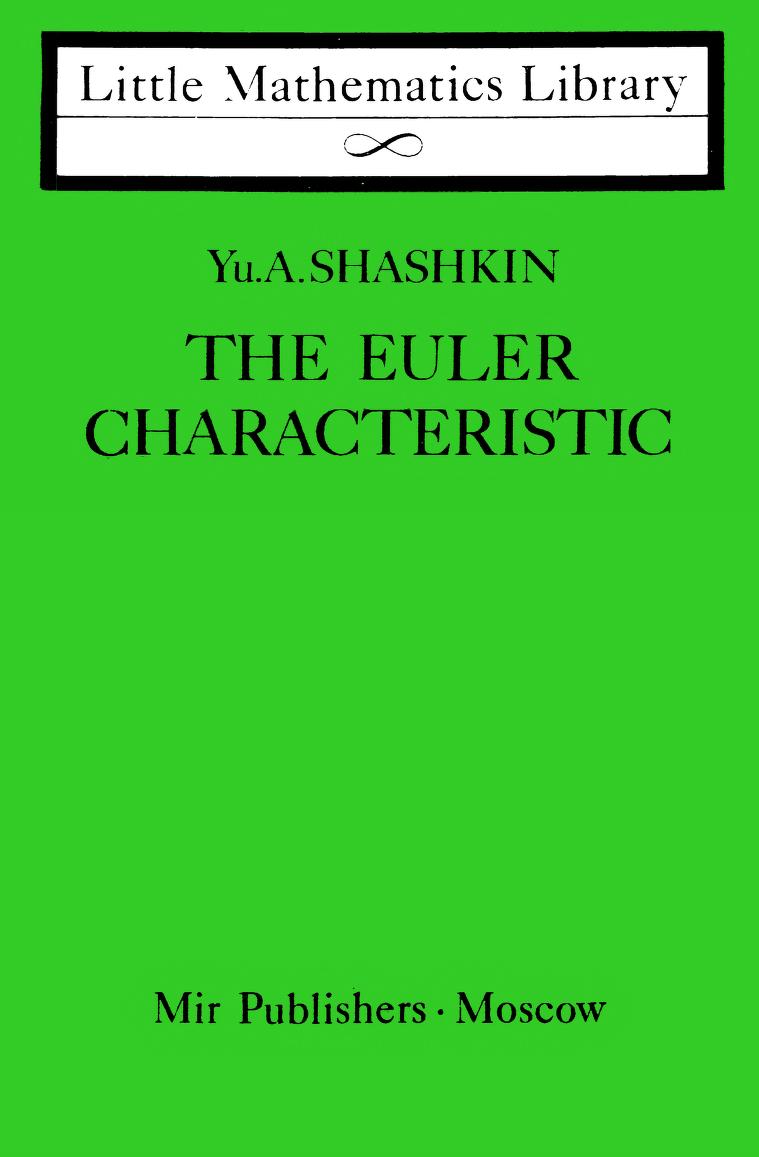
This booklet gives proofs of Euler’s famous formula for convex polytopes and of its analogues for other figures (planes, spaces and polygons). The formulas bring the reader naturally to the notion of Euler’s characteristic. Two definitions of the notion are given and their equivalence is proved. The part played by the Euler characteristic in different geometrical problems, i.e. in the decomposition of planes and spaces, in calculating areas, in coverings of spheres, is discussed.
The book is intended for senior pupils, junior college and university students and all lovers of mathematics.
Translated from the Russian
by Vladimir Shokurov
First published 1989
Revised from the 1984 Ruasian edition
Many, many thanks to the Anonymous uploader who commented on the Mirtitles blog!
This is a cleaned/optimised version from the original scan.
You can get the book here and here
Versión en español aqui and aqui
This was the last remaining volume of the Little Mathematics Library, it is now complete!
Twitter: @MirTitles
Mastodon: @mirtitles@mastodon.world
Mastodon: @mirtitles@mastodon.social
Bluesky: mirtitles.bsky.social
GitLab: https://gitlab.com/mirtitles
Internet Archive: https://archive.org/details/mir-titles
Contents
Preface 6
1. Euler’s Formulas for a Straight Line and a Plane 8
2. What is the Euler Characteristic? 14
3. The Euler Characteristic for Polygons 21
4. The Euler Characteristic and the Sum of the Exterior Angles of a Polygon 31
5. Applying the Euler Characteristic to Calculation of Areas 36
6. Euler’s Formula for Space 42
7. Euler’s Formula for Convex Polytopes and Its Consequences 47
8. Axioms of the Euler Characteristic 55
9. Proof of the Existence of the Euler Characteristic 62
10. The Equivalence of the Two Definitions of the Euler Characteristic 68
11. Elementary Figures on the Sphere and Their Euler Characteristics 78
12. Further Applications of the Euler Characteristic 82
Solutions, Hints and Answers 89
References 96
Follow us on The Internet Archive: https://archive.org/details/@mirtitles
Follow Us On Twitter: https://twitter.com/MirTitles
Write to us: mirtitles@gmail.com
Fork us at GitLab: https://gitlab.com/mirtitles/
Add new entries to the detailed book catalog here.
Preface 6
1. Systems of Linear Equations and Their Solutions 7
2. Matrices and Their Elementary Transformations 11
3. A Method for Solving Systems of Linear Equations 22
4. The Rank of a Matrix 31
5. The Theorem on Principal Unknowns 39
6. Fundamental Systems of Solutions 48
Answers 56
Solutions 60

बच्चों के लिए एक सचित्र कहानी ।
एन चारुशिन द्वारा चित्रित
You can get the book here and here.
Twitter: @MirTitles
Mastodon: @mirtitles@mastodon.world
Mastodon: @mirtitles@mastodon.social
Bluesky: mirtitles.bsky.social

The purpose of this book was to generalize the essential facts and ideas
about biogeochemical cycles and the mass distribution of chemical elements in the world’s land biosphere. The reason for this endeavour is undoubtedly because the predominant mass of the Earth’s living organisms is confined to land. The land is also the habitat of humanity, and it is the land that has had to sustain the onus and odium of humanity’s productive activities. The study of biogeochemical processes that occur on land is therefore an important issue.
The land, to a first approximation, is one of the two general blocks of the
biosphere (the other is the ocean). For this reason, the overall estimated mass of the elements in biogeochemical cycles on land provides a basis for estimating the material balance on a planetary scale. A more detailed approach show that the rate of biogeochemical processes and the migrating mass is strongly susceptible to hydrothermal conditions on the Earth’s surface and several other factors. In view of this, the emphasis is on the features of biogeochemical cycles in the major natural zones and, particularly, at the land-ocean interface where the cyclic mass exchange processes are subject to the enormous power of the ocean.
This book is to a certain extent a summary of the author’s experience and experimental biogeochemical material collected in the tundra, taiga, steppes and deserts of Eurasia, in the tropics of Africa and on islands in the Indian and Arctic oceans.
Translated from the Russian by B.V. Rassadin
Translation edited by Hansford T. Shacklette
You can get the book here and here.
Twitter: @MirTitles
Mastodon: @mirtitles@mastodon.world
Mastodon: @mirtitles@mastodon.social
Bluesky: mirtitles.bsky.social
Preface 9
Introduction 10
1. Terrestrial Living Matter: Composition and Biogeochemical Dynamics 23
1.1. Composition of Living Matter 23
1.2. Minor, or Trace, Elements 29
1.3. Biological Cycle of Chemical Elements 33
1.4. Extent of Biological Uptake 36
1.5. Natural Biogeochemical Anomalies 40
2. Earth’s Crust as a Factor in the Chemical Composition of Living Matter 47
2.1. Earth’s Crust Composition: Conceptual Survey 47
2.2. Relative Abundance of Chemical Elements in the Earth’s Crust 49
2.3. Forms for Occurrence of Chemical Elements in the Earth’s Crust 53
2.4. Characterization of Chemical Element Distributions in the Earth’s Crust 56
3. Biogeochemistry of Atmosphere and Natural Waters of Land 61
3.1. Biogeochemical Evolution of Atmospheric Composition and the Gas Mass Exchange 61
3.2. Geochemistry and Biogeochemistry of Aerosols 70
3.3. Wash-out and Transfer of Water-Soluble Forms of Chemical Elements in Troposphere 82
3.4. Composition of Terrestrial Surface Waters in Relation to Biogeochemical Processes 89
4. Biogeochemistry of Pedosphere 105
4.1. Soil and Pedosphere 105
4.2. Pedosphere as a Regulator of Carbon-Oxygen Metabolism in Biosphere 108
4.3. Organic Matter of the Pedosphere 114
4.4. Mineral Matter of Soil and Its Biogeochemical Transformation 127
4.5. Distribution of Trace Elements in Pedosphere 132
4.6. Epochal Relicts of Ancient Soil Formation 142
4.7. Equilibria in Biolatent Soil System 145
5. Global Biogeochemical Cycles and Distribution of Chemical Elements in the Biosphere of the World’s Land 153
5.1. Global Mass Exchange Cycles for Sodium and Chlorine 156
5.2. Cycles and Mass Distribution for Elements Supplied to the Biosphere Through Outgassing. Global Carbon Cycle 160
5.3. Global Sulfur Cycle 175
5.4. Global Nitrogen Cycle 184
5.5. General Characterization of Cycles and Mass Distribution of Outgassed Elements 192
6. Biospheric Cycles of Elements Mobilized from the Earth’s Crust 195
6.1. Global Calcium Cycle 195
6.2. Global Potassium Cycle 197
6.3. Global Silicon Cycle 199
6.4. Global Phosphorus Cycle 200
6.5. Global Cycles for Heavy Metals 206
6.6. Global Lead Cycle 206
6.7. Global Zinc Cycle 211
6.8. General Characterization of Cycles and Metal Distribution 216
7. Problems in the Organization of the World’s Land Biosphere 221
7.1. Geochemical Inhomogeneity of the World’s Land Biosphere 221
7.2. Intensity of Biogeochemical Processes on the World’s Land 226
7.3. Elementary Landscape (Elementary Ecogeosystem) as a Basic Chorologic Unit of the World’s Land Biosphere 229
8. Biogeochemistry of Polar Zone 235
8.1. Biogeochemistry of Arctic Landscapes 235
8.2. Biogeochemistry of Boreal and Subboreal Forests 249
8.3. Biological Cycle of Elements in Forest Communities 249
8.4. Biogeochemical Characterization of the Soils of Boreal Forest Zone 263
9. Biogeochemistry of Extratropical Steppes and Deserts 273
9.1. Biological Cycle of Elements in Arid Vegetable Communities 273
9.2. Biological Cycle in Extra-arid Deserts 280
9.3. Specificity of Soil Biogeochemistry in Arid Landscapes 286
9.4. Biogeochemical Processes in Relation to Aqueous and Atmospheric Migration of Elements 289
10. Biogeochemistry of Tropical Land 293
10.1. Biological Cycle of Chemical Elements in the Tropics 293
10.2. Biogeochemical Characterization of Tropical Soils 301
10.3. The Mangrove Biogeochemistry 305
11. Specific Features in the Biogeochemistry of Sea Islands 311
11.1. Salt Mass Transfer and Role of Bird Colonies 311
11.2. Atmospheric Delivery of Heavy Metals to the Ecogeosystems of Islands 317
12. Anthropogenic Deformation of Natural Biogeochemical Cycles 325
12.1. Human Society as a Factor in the Transformation of the Biosphere 325
12.2. Global and Regional Biogeochemical Problems 326
12.3. Local Anthropogenic Biogeochemical Anomalies of Heavy Metals 334
Literature Sources 345
Index 357
Today marks the 2000th post on the blog! Many thanks to all the collaborators, supporters and well wishers, without all of you this would not have been possible.
Hopefully, many more to come!
2000 posts

कहानी कैसे नजानू एक कवि बन गया
अनुवादक सरस्वती हैदर
चित्रकार बोरीस कलऊशिन
You can get the book here and here.
Twitter: @MirTitles
Mastodon: @mirtitles@mastodon.world
Mastodon: @mirtitles@mastodon.social
Bluesky: mirtitles.bsky.social

This book provides an overview of the mysteries and explorations of Mars. The Red Planet has fascinated humanity since antiquity. The invention of the telescope only deepened its enigmas, particularly with the discovery of the so-called ‘canals.’ This led to the idea of Martians living on the planet in science fiction. But is there really life on Mars? Do Martians exist? What are the canals? To answer questions like these space probes from the USSR and USA started the exploration of Mars in the 1960s. Going to Mars is not straightforward and reaching Mars is an engineering and technological feat. Ever since then we have continued our explorations of the Red Planet. We now have sophisticated rovers on the surface of Mars and orbiters in orbit around Mars. In the last few decades our knowledge of Mars has improved in leaps and bounds with new discoveries shedding more and more light on the mysterious planets past and future. This volume presents an outline of these explorations, a journey that continues to advance the bounds of human knowledge with hopes that one day humans will inhabit Mars.
Drawings by V. Korolkov
Translated from the Spanish and Typset in Scribus by Damitr Mazanav
Released on the web by The Mir Titles Project in 2025
This work is an Open Educational Resource (OER)
Creative Commons BY Share Alike 4.0 License
You can get the book here and here
Twitter: @MirTitles
Mastodon: @mirtitles@mastodon.world
Mastodon: @mirtitles@mastodon.social
Bluesky: mirtitles.bsky.social
GitLab: https://gitlab.com/mirtitles
Internet Archive: https://archive.org/details/mir-titles
One of the first books that I remember reading was All About the Telescope by Pavel Klushantsev translated to Marathi. The book got me fascinated about science in general and astronomy in particular.
So, when I saw this book by Klushantsev on Mars only available in Spanish, I could not resist from translating it. Though I started the work on this some years back, it was never completed for various reasons. One of them being the complex nature of typsetting in the book. So for this book I have used Scribus for typsetting and the results have been pleasing.
Since the book was written, our knowledge about Mars has increased by leaps and bounds. I have added an additional chapter in the book that summarises the various spacecraft since the 1990s that have taken our knowledge of Mars to the next level. The Martian surface has been revelead unprecendented detail with numerous rovers and orbiters around it. The attribution of images in the last section is provided with the images.
We now have active rovers on the surface of Mars and orbiters around it sending us vital information about the Red Planet. All this with hopes that humans would one day land there. It is to those future astronauts this translation and additional sections are dedicated.
Some screenshots

Screenshot

Screenshot

Screenshot

Screenshot

Screenshot
TRANSLATOR’S NOTE
THAT LITTLE STAR IS MARS! 1
THE MYSTERIES OF MARS 14
WHERE CAN YOU LIVE 22
UNEXPLAINED PHENOMENA OF MARS 32
WE MUST SOLVE THE MYSTERY OF “CANALS” 41
DO MARTIANS EXIST? 46
TRACES OF MARTIANS 56
ARE THE MARTIANS OUR ENEMIES 67
ARE MARTIANS OUR FRIENDS? 77
WE MUST FLY TO MARS 87
IS IT DIFFICULT TO REACH MARS 97
WHAT DID THE SPACE PROBES SEE FROM THEIR ORBIT 117
WATER! 129
THE SEARCH FOR LIFE ON MARS 136
IN THE FUTURE 152
FROM UNCERTAINTY TO DISCOVERY: MARS SINCE THE 1990s – Damitr Mazanav 163

A collection of short stories by great Soviet author Maxim Gorky.
You can get the book here and here.
Twitter: @MirTitles
Mastodon: @mirtitles@mastodon.world
Mastodon: @mirtitles@mastodon.social
Bluesky: mirtitles.bsky.social
CONTENTS
Preface 7
Chelkash 11
Comrades 70
One Autumn Night 94
In the Steppe 108
Twenty-six of U s and One Other 130
T he Green Kitten 154
A Rolling Stone 167
Her Lover 227
Chums 236
 Mir Books