Nikolsky A Course of Mathematical Analysis Vol. 2

In this post we will see the second part of Course in Mathematical
Analysis by S. M. Nikolsky.

p0001

The major part of this two-volume textbook stems from the
course in mathematical analysis given by the author for many
years at the Moscow Physico-technical Institute.

The first volume consisting of eleven chapters includes an
introduction (Chapter 1)which treats offundamental notions of
mathematical analysis using an intuitive concept ofa limit. With
the aid of visual interpretation and some considerations of a
physical character it establishes the relationship between the
derivative and the integral and gives some elements of differentiation
and integration techniques necessary to those readers
who are simultaneously studying physics.

The notion of a real number is interpreted in the first volume
(Chapter 2) on the basis of its representation as an infinite decimal.
Chapters 3-11 contain the following topics: Limit of Sequence,
Limit of Function, Functions of One Variable, Functions
of Several Variables, Indefinite Integral, Definite Integral,
Some Applications of Integrals, Series.

This book was translated from the Russian by V. M. Volosov. The
book was published by first Mir Publishers in 1977 with reprints in
1981, 1985 and 1987. The copy below is from the 1987 print.

All credits to the original uploader.

Update 18 December 2021: New post with new links to both volumes here.

Continue reading →

Posted in books, mathematics, mir books, mir publishers, soviet | Tagged , , , , , | 21 Comments

Theory of Probability – Gnedenko

We will now see Theory of Probability by B. V. Gnedenko.

the theory of probability

This book aims to give an exposition of the fundamentals of the
theory of probability, a mathematical science that treats of the
regularities of random phenomena.

This book was translated from the Russian by George Yankovsky. The
book was published by first Mir Publishers in 1969, with reprints in
1973, 1976 and 1978. The book below is from the 1978 reprint.

All credits to the original uploader.

DJVU | OCR | 15.1 MB | Pages: 390 |
You can get the book here

and here
For magnet / torrent links go here.

Continue reading →

Posted in books, mathematics, mir books, mir publishers | Tagged , , , , , , | 6 Comments

Fock – Fundamentals of Quantum Mechanics

We now come to Fundamental of Quantum Mechanics by V. A. Fock.

Fock-FCVladimir Aleksandrovich Fock was one of the group of brilliant physics theoreticians whose work built the magnificent edifice of the quantum theory.

From the vast subject of the quantum theory the author has chosen material limited in two respects. First, the book considers none but the main principles and simplest applications of quantum mechanics, It concerns itself exclusively with the one-body problem. It does not deal with the many-body problem or the Pauli exclusion principle, basic to that problem. Second, the author has sought to confine himself to that part of the theory that is’ considered proved, that is, quantum mechanics proper. He has not examined quantum electrodynamics since this theory has yet to be fully elaborated.

The author’s main purpose is to introduce the reader to a new set of ideas differing greatly from the classical theory. He has endeavoured to avoid using images from the classical theory as being inapplicable to quantum physics. Rather, he has attempted to familiarize the reader with the basic concepts underlying a quantum description of the states of atomic systems.

The second edition of this book, unlike the first, devotes a separate chapter to the nonrelativistic theory of the electron spin (Pauli’s theory of the electron) and contains a chapter on the many-electron problem of quantum mechanics. In addition, some of the author’s findings have been incorporated as separate sections. Otherwise, the subject matter of the book (both the mathematical theory and its physical interpretation) remains the same, except for certain new formulations of an epistemological character (the concepts of relativity with respect to the means of observation and of potential possibility), which has necessitated changing the expression “the statistical interpretation of quantum mechanics” to “the probabilistic interpretation”. The new formulations are more precise than the previous ones.

The title of the book speaks for itself. The word “fundamentals” can be understood as “basic principles” or as “introductory facts”.

About the author:
Vladimir Aleksandrovich Fock was one of the group of brilliant physics theoreticians whose work built the magnificent edifice of the quantum theory. A contemporary of Niels Bohr, Lev landau, Werner Heisenberg, and Paul Dirac, he contributed much to practically all fields of theoretical and mathematical physics. His books The Theory of Space, Time and Gravitation, and Electromagnetic Diffraction and Propagation Problems have been translated into English (Pergamon Press). In 1936 Vladimir Fock merited the Mendeleev prize for his work in quantum theory of atoms, in 1946 the State prize for his work in the propagation of radio waves, and in 1960 the Lenin prize for his work in quantum field theory. In 1932 Vladimir Fock became a Corresponding Member of the USSR Academy of Sciences and in 1939 a Full Member.

The book was translated from the Russian by Eugene Yankovsky and was published by Mir in 1978, 1982 and 1986. The present scan is from the 1986 print.

PDF | Cover | OCR | Bookmarked | 600 dpi

The Internet Archive Link

and here

Edit: Removed, old, dead links. Added a link to a fresh scan and a new cover. 19 September 2018.

Contents

Foreword 5
Preface to the Second Russian Edition 7
Preface to the First Russian Edition 8

PART I BASIC CONCEPTS OF QUANTUM MECHANICS

Chapter I. The physical and epistemological bases of quantum mechanics 13

I. The need for new methods and concepts in describing atomic phenomena 13
2. The classical description of phenomena 13
3. Range of application of the classical way of describing phenomena
Heisenberg’s and Bohr’s uncertainty relations 15
4. Relativity with respect to the means of observation as the basis for the quantum way of describing phenomena 17
5. Potential possibility in quantum mechanics 19
Chapter II. The mathematical apparatus of quantum mechanics 22
1. Quantum mechanics and the linear-operator problems 22
2. The operator concept and examples 23
3. Hermitian conjugate. Hermiticity 24
4. Operator and matrix multiplication 27
5. Eigenvalues and eigenfunctions 30
6. The Stieltjes integral and the operator corresponding to multiplication into the independent variable 32
7. Orthogonality of eigenfunctions and normalization 34
8. Expansion in eigenfunctions. Completeness property of eigenfunctions 37

Chapter III. Quantum mechanical operators 41

1. Interpretation of the eigenvalues of an operator 41
2. Poisson brackets 42
3. Position and momentum operators 45
4. Eigenfunctions and eigenvalues of the momentum operator 48
5. Quantum description of systems 51
6. Commutativity of operators 52
7. Angular momentum 54
8. The energy operator 57
9. Canonical transformation 59
10. An example of canonical transformation 63
11. Canonical. transformation as an operator 64
12. Unitary invariants 66
13. Time evolution of systems. Time dependence of operators 69
14. Heisenberg’s matrices 73
15. Semiclassical approximation 75
16. Relation between canonical transformation and the contact transformation of classical mechanics 80

Chapter IV. The probabilistic interpretation of quantum mechanics 85

1. Mathematical expectation in the probability theory 85
2. Mathematical expectation in quantum mechanics 86
3. The probability formula 88
4. Time dependence of mathematical expectation 90
5. Correspondence between the theory of linear operators and the quantum theory 92
6. The concept of statistical, ensemble in quantum mechanics 93
PART II SCHRODINGER’S THEORY

Chapter I. The Schrodinger equation. The harmonic oscillator 96

I. Equations of motion and the wave equation 96
2. Constants of the motion 98
3. The Schrodinger equation for the harmonic oscillator 99
4. The one-dimensional harmonic oscillator 100
5. Hermite polynomials 103
6. Canonical transformation a; illustrated by the harmonic-oscillator problem 106
7. Heisenberg’s uncertainty relations 110
8. The time dependence of matrices. A comparison with the classical theory 112
9. An elementary criterion for the applicability of the formulas of classical mechanics I15

Chapter II. Perturbation theory 119
1. Statement of the problem 119
2. Solution of the nonhomogeneous equation 120
3. Nondegenerate eigenvalues 123
4. Degenerate eigenvalues. Expansion in powers of the smallness parameter 125
5. The eigenfunctions in the zeroth-order approximation 126
6. The first and higher approximations 129
7. The case of adjacent eigenvalues 131
8. The anharmonic oscillator 133

Chapter III. Radiation, the theory of dispersion, and the law of decay 137

1. Classical formulas 137
2. Charge density and current density 139
3. Frequencies and intensities 143
4. Intensities in a continuous spectrum 146
5. Perturbation of an atom by a light wave 148
6. The dispersion formula 150
7. Penetration of a potential barrier by a particle 153
8. The law of decay of a quasi-stationary state 156

Chapter IV. An electron In a central field 160

1. General remarks 160
2. Conservation of angular momentum 161
3. Operators in spherical coordinates. Separation of variables 164
4. Solution of the differential equation for spherical harmonics 166
5. Some properties of spherical harmonics 170
6. Normalized spherical harmonics 173
7. The radial functions. A general survey 175
8. Description of the states of a valence electron. Quantum numbers 179
9. The selection rule 181

Chapter V. The Coulomb field 188

1. General remarks 188
2. The radial equation for the hydrogen atom. Atomic units 188
3. Solution of an auxiliary problem 190
4. Some properties of generalized Laguerre polynomials 193
5. Eigenvalues and eigenfunctions of the auxiliary problem 197
6. Energy levels and radial functions for the discrete hydrogen spectrum 198
7. Solution of the differential equation for the continuous spectrum in the form of a definite integral 201
8. Derivation of the asymptotic expression 204
9. Radial functions for the continuous hydrogen spectrum 207
10. Intensities in the hydrogen spectrum 211
11. The Stark effect. General remarks 215
12. The Schrodinger equation in parabolic coordinates 216
13. Splitting of energy levels in an electric field 219
14. Scattering of a.-particles. Statement of the problem 221
15. Solution of equations 223
16. The Rutherford scattering law 225
17. The virial theorem in classical and in quantum mechanics 226
18. Some remarks concerning the superposition principle and the probabilistic interpretation of the wave function 229
PART III PAULl’S THEORY OF THE ELECTRON
1. The electron angular momentum 232
2. The operators of total angular momentum in spherical coordinates 236
3. Spherical harmonics with spin 239
4. Some properties of spherical harmonics with spin 243
5. The Pauli wave equation 245
6. Operator P in spherical and cylindrical coordinates and its relation to .A 248
7. An electron in a magnetic field 254
PART IV THE MANY-ELECTRON PROBLEM OF QUANTUM MECHANICS
AND THE STRUCTURE OF ATOMS
1. Symmetry properties of the wave function 257
2. The Hamiltonian and its symmetry 262
3. The self-consistent field method 263
4. The equation for the valence electron and the operator of quantum
exchange 269
5. The self-consistent field method in the theory of atoms 271
6. The symmetry of the Hamiltonian of a hydrogen like atom 276

PART V DIRAC’S THEORY OF THE ELECTRON

Chapter I. The Dirac equation 281
1. Quantum mechanics and the theory of relativity 281
2. Classical equations of motion 281
3. Derivation of the wave equation 283
4. The Dirac matrices 284
5. The Dirac equation for a free electron 288
6. Lorentz transformations 291
7. Form of matrix S for spatial rotations of axes and for Lorentz transformations 293
8. Current density 297
9. The Dirac equation in the case of a field. Equations of motion 298
10. Angular momentum and the spin vector in Dirac’s theory 301
11. The kinetic energy of an electron 304
12. The second intrinsic degree of freedom of the electron 305
13. Second-order equations 308

Chapter II. The use of the Dirac equation In physical problems 312

1. The free electron 312
2. An electron in a homogeneous magnetic field 316
3. Constants of the motion in the problem with spherical symmetry 320
4. Generalized spherical harmonics 322
5. The radial equation 325
6. Comparison with the Schrodinger equation 327
7. General investigation of the radial equations 329
8. Quantum numbers 334
9. Heisenberg’s matrices and the selection rule 336
10. Alternative derivation of the selection rule 340
11. The hydrogen atom. Radial functions 343
12. Fine-structure levels of hydrogen 347
13. The Zeeman effect. Statement of the problem 350
14. Calculation of the perturbation matrix 352
15. Splitting of energy levels in a magnetic field 355
Chapter III. On the theory of positrons 359

1. Charge conjugation 359
2. Basic ideas of positron theory 360
3. Positrons as unfilled states 361
Index 362

Posted in books, mathematics, mir books, mir publishers, physics, soviet | Tagged , , , , , , | 9 Comments

Prilepko – Problem Book In High School Mathematics

We now come to Problem Book In High School Mathematics edited by A. I. Prilepko.

PRILEPKO

The present problem book is meant for high-school students
who intend to enter technical colleges. I t contains more than
two thousand problems and examples covering all divisions
of high-school mathematics.

The main aim of the book is to help students to revise their
school knowledge of mathematics and develop a technique
in solving a variety of problems.

The book consists of nine chapters divided into sections,
each of which deals with a certain theme. The problems on
a definite theme are arranged in the order of increasing
difficulty, which makes it possible for a student to gradually
acquire the necessary techniques and experience in problem
solving. Thus, the problems are classified as far as possible.
Most of the problems were given at the entrance examinations
in various colleges to the USSR in recent years. All the
problems are supplied with answers, and some of them with
solutions or instructions. The words “Solution” and “Hint”
are replaced by the signs A and. respectively. The list of
designations makes the use of the book more convenient.
All the contributors to the book have a long experience
as lecturers at preparatory courses of colleges, as teachers
at high schools specializing in physics and mathematics and
as examiners in mathematics.

This book was translated from the Russian by I. A. Aleksanova. The
book was published by first Mir Publishers in 1985.

All credits to the original uploader.

DJVU | 4 MB | Pages: 280 | Cover

You can get the book here

and here
For magnet / torrent links go here.
Continue reading →

Posted in books, mir books, mir publishers, soviet | Tagged , , , , , | 20 Comments

300,000 + and Counting!

On the last day on 2012, we have crossed 300,000 mark for views.

Thanks to all those who made it possible, and special thanks to Desperadomar for making the posts in the end.

We may have some long awaited releases in the next year, till then

Have a great new year in 2013!


Posted in books | Tagged , , | 9 Comments

Computational Mathematics – Demidovich, Maron

We now come to Computational Mathematics by B. P. Demidovich,
  I. A. Maron.

computational mathematics

The basic aim of this book is to give as far as possible a
systematic and modern presentation of the most important methods and  techniques of computational mathematics on the basis of the general  course of higher mathematics taught in higher technical schools. The  book has been arranged so that the basic portion constitutes a  manual for the first cycle of studies in approximate computations  for higher technical colleges. The text contains supplementary  material which goes beyond the scope of the ordinary college course,  but the reader can select those sections which interest him and omit  any extra material without loss of continuity. The chapters and  sections which may be dropped out in a first reading are marked with an asterisk.

For a full comprehension of the contents of this book, the reader
should have a background of linear algebra and the theory of linear
vector spaces. With the aim of making the text as self-contained as
possible, the authors have included all the necessary starting
material in these subjects. The appropriate chapter are completely
independent of the basic text and can be omitted by readers who have  already studied these sections.

A few words about the contents of the book. In the main it is
devoted to the following problems: operations involving approximate  numbers, computation of functions by means of series and iterative  processes, approximate and numerical solution of algebraic and  transcendental equations, computational methods of linear algebra,  interpolation of functions, numerical differentiation and  integration of functions, and the Monte Carlo method.

This book was translated from the Russian by George Yankovsky. The book was  published by first Mir Publishers in 1973, with reprints in 1976,
and 1981. The book below is from the 1981 reprint.

All credits to the original uploader.

DJVU | OCR | 17.1 MB | Pages: 688 |
You can get the book here and here
For magnet / torrent links go here.
Password if needed: mirtitles


Table of Contents
PREFACE

INTRODUCTION.

GENERAL RULES OF COMPUTATIONAL WORK

CHAPTER 1
APPROXIMATE  NUMBERS 19

1.1 Absolute and relative errors 19
1.2 Basic sources of errors  22
1.3 Scientific notation. Significant digits, The number of correct
digits 23
1.4 Rounding of numbers  26
1.5 relationship between the relative error of an approximate number
and the number of correct digits  27
1.6 Tables for determining the limiting relative error from the number
of correct digits and vice versa 30
1.7 The error of a sum 33
1.8 The error of a difference 35
1.9 The error of a product 37
1.10 The number of correct digits in a product 39
1.11 The error of a quotient 40
1.12 The number of correct digits in a quotient 41
1.13 The relative error of a power 41
1.14 The relative error of a root 41
1.15 Computations in which errors are not taken into exact account 42
1.16 General formula for errors 42
1.17 The inverse problem of the theory of errors 44
1.18 Accuracy in the determination of arguments from a tabulated
function 48
1.19 The method of bounds 50
1.20 The notion of a probability error estimate 52
References for Chapter 1 54

CHAPTER 2
SOME FACTS FROM THE THEORY OF CONTINUOUS FRACTIONS 55

2.1 The definition of a continued fraction 55
2.2 Converting a continued fraction to a simple fraction and vice
versa 56
2.3 Convergents 58
2.4 Nonterminating continued fractions 66
2.5 Expanding functions into continued fractions 72
References for Chapter 2 76

CHAPTER 3
COMPUTING THE VALUES OF FUNCTIONS 77

3.1 Computing the values of a polynomial. Horner’s scheme  77
3.2 The generalized Horner scheme 80
3.3 Computing the values of rational fractions 82
3.4 Approximating the sums of numerical series 83
3.5 Computing the values of an analytic function 89
3.6 Computing the values of exponential functions 91
3.7 Computing the values of a logarithmic function 95
3.8 Computing the values of trigonometric functions 98
3.9 Computing the values of hyperbolic functions 101
3.10 Using the method of iteration for approximating the values of
function 103
3.11 Computing reciprocals 104
3.12 Computing square roots 107
3.13 Computing the reciprocal of a square root 111
3.14 Computing cube roots 112
References for Chapter 3 114

CHAPTER 4
APPROXIMATE SOLUTIONS OF ALGEBRAIC AND TRANSCENDENTAL EQUATIONS 115

4.1 Isolation of roots 115
4.2 Graphical solution of equations 119
4.3 The halving method 121
4.4 The method of proportional parts (method of chords) 122
4.5 Newton’s method {method of tangents) 127
4.6 Modified Newton method 135
4.7 Combination method 136
4.8 The method of iteration 138
4.9 The method of iteration for a system of two equations 152
4.10 Newton’s method for a’system of two equations 156
4.11 Newton’s method for the case of complex roots 157
References for Chapter 5 161

CHAPTER 5
SPECIAL TECHNIQUES FOR APPROXIMATE SOLUTION OF EQUATIONS 162

5.1 General properties of algebraic equations 162
5.2 The bounds of real roots of algebraic equations 167
5.3 The method of alternating sums 169
5.4 Newton’s method 171
5.5 The number of real roots of a polynomial 173
5.6 The theorem of Budan-Fourier 175
5.7 The underlying principle of the method of Lobachevsky-Graeife 179
5.8 The root-squaring process 182
5.9 The Lobachevsky-Graeffe method for the case of real and distinct
roots 184
5.10 The Lobachevsky-Graeife method for the case of complex roots 187
5.11 The case of a pair of complex roots 190
5.12 The case of two pairs of complex roots 194
5.13 Bernoulli’s method 198
References for Chapter 5 202

CHAPTER 6
ACCELERATING THE CONVERGENCE OF SERIES 203

6.1 Accelerating the convergence of numerical series 203
6.2 Accelerating the convergence of power series by the Euler-Abel
method 209
6.3 Estimates of Fourier coefficient 213
6.4 Accelerating the convergence of Fourier trigonometric series by
the method of A, N. Krylov 217
6.5 Trigonometric approximation 225
References for Chapter 6 228

CHAPTER 7
MATRIX ALGEBRA 229

7.1 Basic definitions 229
7.2 Operations involving matrices 230
7.3 The transpose of a matrix 234
7.4 The inverse matrix 236
7.5 Powers of a matrix 240
7.6 Rational functions of a matrix 241
7.7 The absolute value and norm of a matrix 242
7.8 The rank of a matrix 248
7.9 The limit of a matrix 249
7.10 Series of matrices 251
7.11 Partitioned matrices 256
7.12 Matrix inversion by partitioning 260
7.13 Triangular matrices 265
7.14 Elementary transformations of matrices 268
7.15 Computation of determinants 269
References for Chapter 7 272

CHAPTER 8
SOLVING  SYSTEMS OF LINEAR EQUATIONS 273

8.1 A general description of methods of solving systems of linear
equations 273
8.2 Solution by inversion of matrices. Cramer’s rule 273
8.3 The Gaussian method 277
8.4 Improving roots  284
8.5 The method of principal elements 287
8.6 Use of the Gaussian method in computing determinants 288
8.7 Inversion of matrices by the Gaussian method 290
8.8 Square-root method 293
8.9 The scheme of Khaletsky 296
8.10 The method of iteration 300
8.11 Reducing a linear system to a form convenient for iteration 307
8.12 The Seidel method 309
8.13 The case of a normal system 311
8.14 The method of relaxation 313
8.15 Correcting elements of an approximate inverse matrix 316
References for Chapter 8 321

CHAPTER 9
THE CONVERGENCE OF ITERATION PROCESSES FOR SYSTEMS OF LINEAR EQUATIONS 322

9.1 Sufficient conditions for the convergence of the iteration process 322
9.2 An estimate of the error of approximations in the iteration
process 324
9.3 First sufficient condition for convergence of the Seidel process 327
9.4 Estimating the error of approximations in the Seidel process by the m-norm 330
9.5 Second sufficient condition for convergence of the Seidel process 330
9.6 Estimating the error of approximations in the Seidei process by
the l-norm 332
9.7 Third sufficient condition for convergence of the Seidel process 333
References for Chapter 9 335

CHAPTER 10
ESSENTIALS OF THEORY OF LINEAR VECTOR SPACES 336

10.1 The concept of a linear vector space 336
10.2 The linear dependence of vectors 337
10.3 The scalar product of vectors 343
10.4 Orthogonal systems of vectors 345
10.5 Transformations of the coordinates of a vector the basis 348
10.6 Orthogonal matrices 350
10.7 Orthogonalization of matrices 351
10.8 Applying orthogonalixation methods to the solutions of linear
equations 358
10.9 The solution space of a homogeneous system 364
10.10 Linear transformations of variables 367
10.11 Inverse transformation 373
10.12 Eigenvectors and eigenvalues of a matrix 375
10.13 Similar matrices 380
10.14 Bilinear form of a matrix 384
10.15 Properties of symmetric matrices 384
10.16 Properties of matrices with real elements 389
References for Chapter 10 393

CHAPTER 11
ADDITIONAL FACTS ABOUT THE CONVERGENCE OF ITERATION PROCESSES FOR
SYSTEMS OF LINEAR EQUATIQHS 394

11.1 The convergence of matrix power series 394
11.2 The Cayley-Hamilton theorem 397
11.3 Necessary and sufficient conditions for the convergence of the
process of iteration for a system of linear equations 398
11.4 Necessary and sufficient conditions for the convergence of the
Seidel process for a system of linear equations 400
11.5 Convergence of the Seidel process for a normal system 403
11.6 Methods for effectively checking the conditions of convergence 405
References for Chapter 11 409

CHAPTER 12
FINDING THE EIGENVALUES AND EIGENVECTORS OF A MATRIX 410

12.1 Introductory remarks 410
12.2 Expansion of secular determinants 410
12.3 The method of Danilevsky 412
12.4 Exceptional cases in the Danilevsky method 418
12.5 Computation of eigenvectors by the Danilevsky method 420
12.6 The method of Krylov 421
12.7 Computation of eigenvectors by the Krylov method 424
12.8 Leverrier’s method 426
12.9 On the method of undetermined coefficients 428
12.10 A comparison of different methods of expanding a secular
determinant 429
12.11 Finding the numerically largest eigenvalue of a matrix and the
corresponding eigenvector 430
12.12 The method of scalar products for finding the first eigenvalue
of a real matrix 436
12.13 Finding the second eigenvalue of a matrix and the second
eigenvector 439
12.14 The method of exhaustion 443
12.15 Finding the eigenvalues and eigenvectors of a positive definite
symmetric matrix 445
12.16 Using the coefficients of the characteristic polynomial of a
matrix for matrix inversion 450
12.17 The method of Lyusternik for accelerating the convergence of the
iteration process in the solution of a system of linear equation 453
References for Chapter 12  458

CHAPTER 13
APPROXIMATE SOLUTION OF SYSTEMS OF NOHLINEAR EQUATIONS  459

13.1 Newton’s method 459
13.2 General remarks on the convergence of the Newton process 465
13.3 The existence of roots of a system and the convergence of the
Newton process 469
13.4 The rapidity of convergence of the Newton process 474
13.5 Uniqueness of solution 475
13.6 Stability of convergence of the Newton process under variations
of the initial approximation 478
13.7 The modified Newton method 481
13.8 The method of iteration 484
13.9 The notion of a contraction mapping 487
13.10 First sufficient condition for the convergence of the process of
iteration 491
13.11 Second sufficient condition for the convergence of the process
of iteration 493
13.12 The method of steepest descent (gradient method) 496
13.13 The method of steepest descent for the case of a system of
linear equations 501
13.14 The method of power series 504
References for Chapter 13 506

CHAPTER 14
THE INTERPOLATION OF FUNCTIONS 507

14.1 Finite differences of various orders 507
14.2 Difference table 510
14.3 Generalized power 517
14.4 Statement of the problem of interpolation 518
14.5 Newton’s first interpolation formula 519
14.6 Newton’s second interpolation formula 526
14.7 Table of central differences 530
14.8 Gaussian interpolation formulas 531
14.9 Stirling’s interpolation formula 533
14.10 Bessel’s interpolation formula 534
14.11 General description of interpolation formulas with constant
interval 536
14.12 Lagrange’s interpolation formula 539
14.13 Computing Lagrangian coefficients 543
14.14 Error estimate of Lagrange’s interpolation formula 547
14.15 Error estimates of Newton’s interpolation formulas 550
14.16 Error estimates of the central interpolation formulas 552
14.17 On the best choice of interpolation points 553
14.18 Divided differences 554
14.19 Newton’s interpolation formula for unequally spaced values of
the argument 556
14.20 Inverse interpolation for the case of equally spaced points 559
14.21 Inverse interpolation for the case of unequally spaced points 562
14.22 Finding the roots of an equation by inverse interpolation 564
14.23 The interpolation method for expanding a secular determinant 565
14.24 Interpolation of functions of two variables 567
14.25 Double differences of higher order 570
14.26 Newton’s interpolation formula for a function of two variables 571
References for Chapter 14 573

CHAPTER 15
APPROXIMATE DIFFERENTIATION 574

15.1 Statement of the problem 574
15.2 Formulas of approximate differentiation based on Newton’s first
interpolation formula 575
15.3 Formulas of approximate differentiation based on Stirling’s
formula 580
15.4 Formulas of numerical differentiation for equally spaced points 583
15.5 Graphical differentiation 586
15.6 On the approximate calculation of partial derivatives 588
References for Chapter 15  589

CHAPTER 16
APPROXIMATE INTEGRATION OF FUNCTIONS 590

16.1 General remarks 590
16.2 Newton-Cotes quadrature formulas 593
16.3 The trapezoidal formula and its remainder term 595
16.4 Simpson’s formula and its remainder term 596
16.5 Newton-Cotes formulas of higher orders 599
16.6 General trapezoidal formula (trapezoidal rule) 601
16.7 Simpson’s general formula (parabolic rule) 603
16.8 On Chebyshev’s quadrature formula 607
16.9 Gaussian quadrature formula 611
16.10 Some remarks on the accuracy of quadrature formulas 618
16.11 Richardson extrapolation 622
16.12 Bernoulli numbers 625
16.13 Euler-Maclaurin formula 628
16.14 Approximation of improper integrals 633
16.15 The method of Kantorovich for isolating singularities 635
16.16 Graphical integration 639
16.17 On cubature formulas 641
16.18 A cubature formula of Simpson type 644
References for Chapter 16 648

CHAPTER 17
THE MONTE CARLO METHOD 649

17.1 The idea of the Monte Carlo method 649
17.2 Random numbers 650
17.3 Ways of generating random numbers 653
17.4 Monte Carlo evaluation of multiple integrals 656
17.5 Solving systems of linear algebraic equations method by the Monte
Carlo method 666
References for Chapter 17 674

COMPLETE LIST OF REFERENCES 675

INDEX 679 

Posted in books, mathematics, mir books, mir publishers | Tagged , , , , | 14 Comments

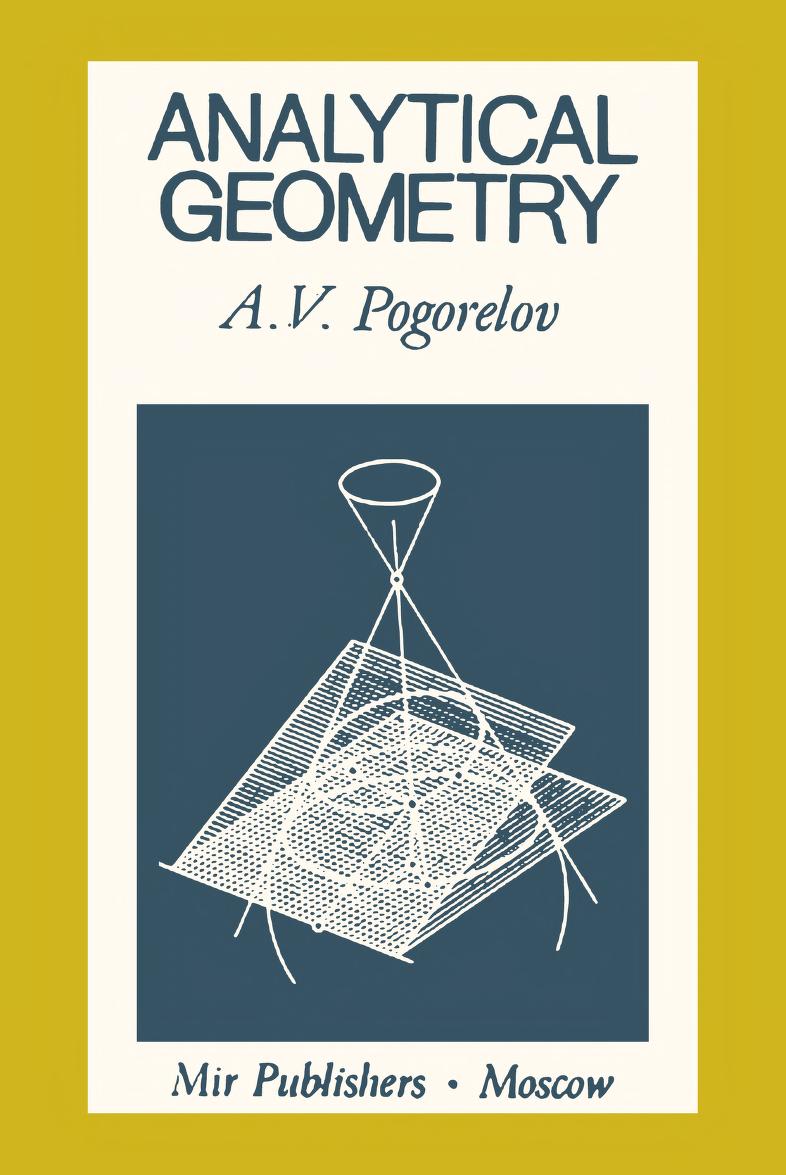
Pogorelov – Analytical Geometry

We now come to Analytical Geometry by A. V. Pogorelov.

  Analytical geometry has no strictly defined contents. It is the   method but not the subject under investigation, that constitutes the   leading feature of this branch of geometry.   The essence of this method consists in that geometric objects are   associated in some standard way with equations (or systems of   equations) so that geometric relations of figures are expressed   through properties of their equations.   For instance, in case of Cartesian coordinates any straight line in   the plane is uniquely associated with a linear equation ax+by+ c =   0.   The intersection of three straight, lines at one point is     expressed by the condition of compatibility of a system of three     equations which specify these lines.

Due to a multi purpose approach to solving various problems, the     method of analytic geometry has become the leading method in     geometric investigations and is widely applied in other fields of     exact natural sciences, such as mechanics and physics.     Analytical geometry joined geometry with algebra and analysis –     the fact which has told fruitfully on further development of     these three subject of mathematics.     The principal ideas of analytical geometry are traced back to the     French mathematician, Rene Descartes (1595-1650), who in 1637     described the fundamentals of its method in his famous work     “Geometric”.

The present book, which is a course of lectures, treats the
fundamentals of the method of analytic geometry as applied to the
simplest geometric objects. It is designed for the university
students majoring in physics and mathematics,

This book was translated from the Russian by Leonid Levant and
was first published by Mir Publishers in 1980.

You can get the book  here. and here

Thanks 0kelvin for providing this earler link. The current copy is a cleaned version from the earlier one with cover added.

Update: 01 Sep 2020 added internet archive link Continue reading →

Posted in books, mathematics, mir books, mir publishers, soviet | Tagged , , , , , , | 5 Comments

Travel To Distant Worlds – Gilzin

We now come to Travel to Distant Worlds by Karl Gilzin. This is a   very optimistic book about future, written at just the beginning of   space age.

travel to distant worlds

The youth throughout the world have been manifesting a great   interest in the problem of space travel. This interest has long   since ceased to be a question of idle curiosity: “Is space travel   possible?” Every pupil now knows the answer to this question. The   interest of our young people in the problem of space travel has   assumed quite concrete form. They want to know what interplanetary   flights are possible today, at the present level of scientific and   technical develop- ment, they want to know what achievements have   been attained in the de- velopment of remarkable reaction engines,   which will be the vital part of any interplanetary vessel. These   young people question the astronomers about the routes of future   cosmic flights. They question the doctors about the specific effects   of space travel on the human organism. They are interest- ed in the   possibility of a collision between a space ship and meteors, in the   possibility of using artificial satellites of the Earth and in many   other things.

In a few words, our youth are keenly interested in   all the problems covered by the science of space travel. This   science has already developed to such an extent, especially during   the past decade, that it is impossible even to attempt any detailed   account of its achievements in any one book.  If this publication   succeeds in replying to some of the questions put by our young   readers, if it arouses their greater interest and curiosity, its aim   will have been achieved.

This book was translated from the Russian by Pauline Rose and   illustrated by N. Kolchitsky and designed by G. Dauman. The book was   published by Foreign Languages Publishing House in 1957.


A completely new and clean scan here. and here

Continue reading →

Posted in astronomy, books, foreign languages publishing | Tagged , , | 11 Comments

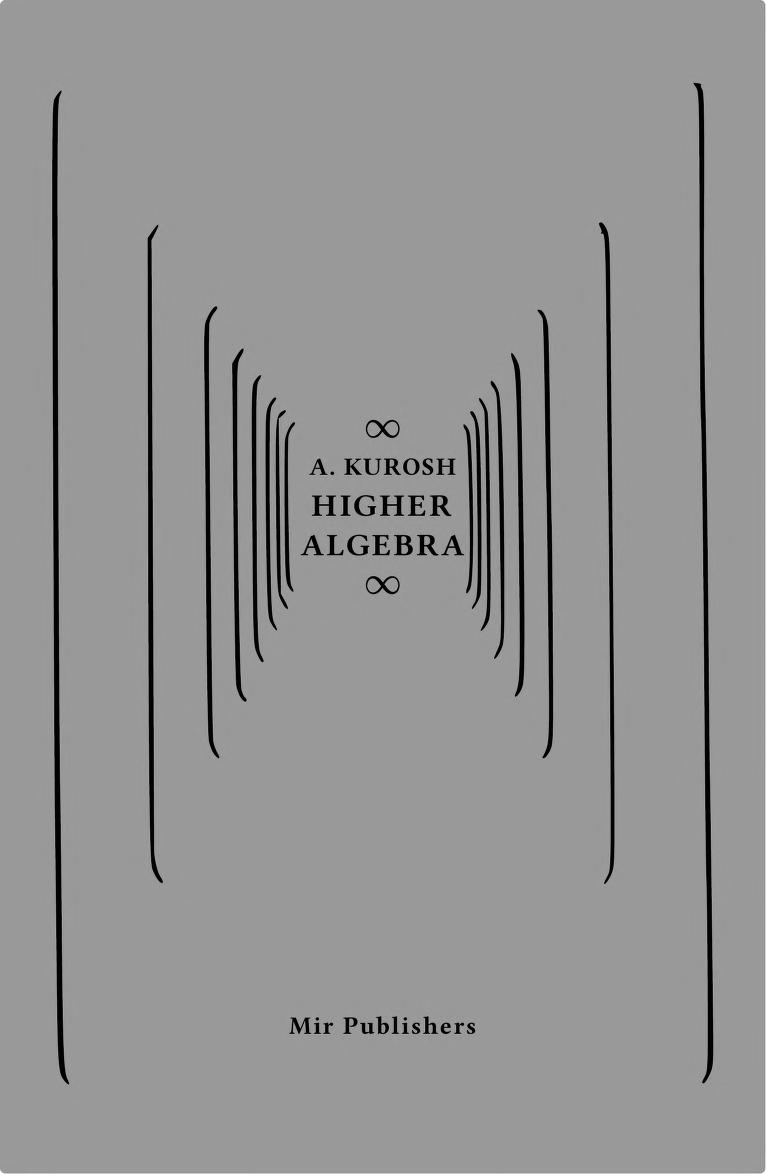
Higher Algebra – Kurosh

In this post we see Higher Algebra by A. Kurosh.

Higher algebra—the subject of this text—is a far-reaching and natural generalization of the basic school course of elementary algebra. Central to elementary algebra is without doubt the problem of solving equations. The study of equations begins with the very simple case of one equation of the first degree in one unknown. From there on, the development proceeds in two directions: to systems of two and three equations of the first degree in two and, respectively, three unknowns, and to a single quadratic equation in one unknown and also to a few special types of higher-degree equations which readily reduce to quadratic equations (quartic equations, for example).

The second half of the course of higher algebra, called the algebra of polynomials, is devoted to the study of a single equation in one unknown but of arbitrary degree. Since there is a formula for solving quadratic equations, it was natural to seek similar formulas for higher-degree equations. That is precisely how this division of algebra developed historically. Formulas for solving equations of third and fourth degree were found in the sixteenth century. The search was then on for formulas capable of expressing the roots of equations of fifth and higher degree in terms of the coefficients of the equations by means of radicals, even radicals within radicals. It was futile, though it continued up to the beginning of the nine­ teenth century, when it was proved that no such formulas exist and that for all degrees beyond the fourth there even exist specific examples of equations with integral coefficients whose roots cannot be written down by means of radicals.

This book was translated from the Russian by George Yankovsky. The  book was published by first Mir Publishers in 1972, with reprints in  1975, 1980 and 1984. The book below is from the 1984 reprint.

Update 2024-12-19 New Hi-res scan added

You can get it here and here


Continue reading →

Posted in books, mathematics, mir books, mir publishers, problem books | Tagged , , , , , | 15 Comments

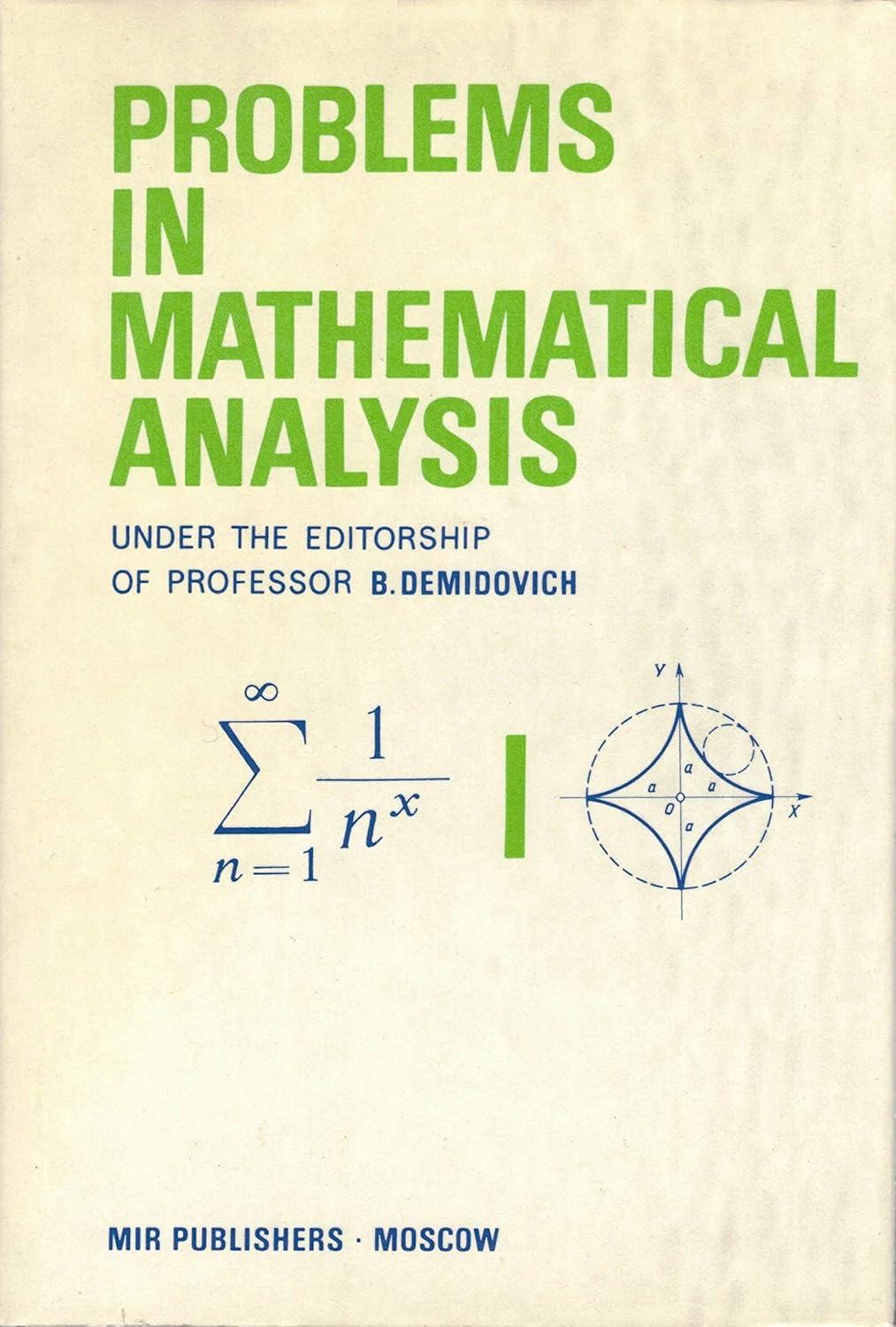
Problems in Mathematical Analysis – Demidovich (Ed.)

We now come to Problems in Mathematical Analysis edited by B. P. Demidovich. The list of authors is G. Baranenkov, B. Demidovich, V. Efimenko, S. Kogan, G. Lunts, E. Porshneva, E. Sychera, S. Frolov, R. Shostak and A.  Yanpolsky.

This collection of problems and exercises in mathematical analysis covers the maximum requirements of general courses in higher mathematics for higher technical schools. It contains over 3,000 problems sequentially arranged in Chapters I to X covering branches of higher mathematics (with the exception of analytical geometry) given in college courses. Particular attention is given to the most important sections of the course that require established skills (the finding of limits, differentiation techniques, the graphing of functions, integration techniques, the applications all of definite integrals, series, the solution of differential equations).

Since some institutes have extended courses of mathematics, the
authors have included problems on field theory, method, and the
Fourier approximate calculations. Experience shows that problems given in this book not only fully satisfies the number of the requirements of the student, as far as practical mastering of the various sections of the course goes, but also enables the instructor to supply a varied choice of problems in each section to select problems for tests and examinations.

Each chapter begins with a brief theoretical introduction that
covers the basic definitions and formulas of that section of the
course. Here the most important typical problems are worked out in full. We believe that this will greatly simplify the work of the student. Answers are given to all computational problems; one asterisk indicates that hints to the solution are given in the
answers, two asterisks, that the solution is given. The are
frequently illustrated by drawings.

This collection of problems is the result of many years of teaching higher mathematics in the technical schools of the Soviet Union. It includes, in addition to original problems and examples, a large number of commonly used problems.

This book was translated from the Russian by George Yankovsky. The  book was published by first Mir Publishers in 1970.

All credits to the original uploader.

Thanks Siddharth for providing the link.

PDF | OCR | 15.2 MB | Pages: 511 |

Update 13 May 2018: The Internet Archive link

and here

You can get the book here
For magnet / torrent links go here.
Password if needed: mirtitles

4-shared link here

Password, if required, for 4shared files:

www.mirtitles.org

Facing problems while extracting? See FAQs
Continue reading →

Posted in books, mathematics, mir books, mir publishers, soviet | Tagged , , , , , , , , , , , , , , , | 9 Comments