The gravitational field is constructed as a physical field in the
spirit of Faraday and Maxwell, and this field has energy, momentum,
and spins 2 and 0.
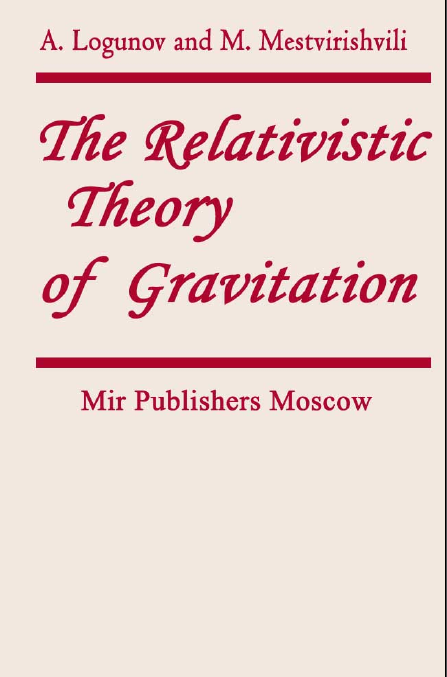
In this post we see book titled The Relativistic Theory of Gravitation by A. A. Logunov and M. A. Mestvirishvili.If you think the title is a bit scary, then it is. Without a proper background in General Relativity (GR) and associated subjects (tensor calculus, etc.) this book is not readable. The topics are mostly at advanced level and already assumes that the reader is familiar and well acquainted with the subject. In other words this is not the first book to be read on the subject. It is a rigorous presentation of a gravitational theory which differs from results of the Einstein’s version of General Relativity.
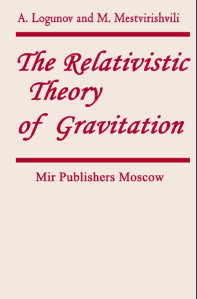
This book presents the authors’ Relativistic Theory of Gravitation
In this book we give a detailed exposition of the relativistic theory of gravitation or RTG, developed in Logunov, 1986, Logunov and Mestvirishvili 1984 , 1985a , 1985b, 1986b , Vlasov and Logunov, 1984, an d Vlasov , Logunov, and Mestvirishvili, 1984 . In these works RTG bas been built unambiguously, using as a basis the relativity principle, the gauge principle, and the geometrization principle.The gravitational field is constructed as a physically in the spirit of Faraday and Maxwell, and this field has energy, momentum, and spins 2 and 0. RTG revives the concept of a classical gravitational field that no choice of reference frame can destroy since it is a material substratum. The gauge principle is formulated on the basis of the local infinite dimensional non-commutative group of super-coordinate transformation.
The theory considered here rigorously obeys the laws of conservation of energy momentum and angular momentum for matter and gravitational field taken together. It also describes the entire body of gravitational experiments. We show that Einstein’s formula for gravitational waves, (15.56 ), follows directly from the theory. In analysing the evolution of the universe, RTG concludes that the universe is infinite and “flat” and predicts a large “latent” mass in it. This “latent” mass exceeds the observable mass of the universe by a factor of 40.
We also show that in general relativity, GR, there are no fundamental laws of conservation of energy -momentum and angular momentum of matter and gravitational field taken together, with the result that the inertial mass defined in GR is not equal to the active gravitational mass. We have established that GR gives no definite predictions concerning gravitational effects. Finally, in GR the gravitational field is not a physical field possessing an energy-momentum density. Consequently, Einstein’s formula (15.56) for gravitational waves does not follow from GR.
The book was translated from the Russian by Eugene Yankovsky and was first published by Mir in 1989.
You can get the book here. and here
All credits to the original uploader.
For magnet links/ torrents go here.
PDF | OCR | Cover (Front Only) | 37 MB | Pagination | Bookmarks| 235 Pages
Page: 103 missing
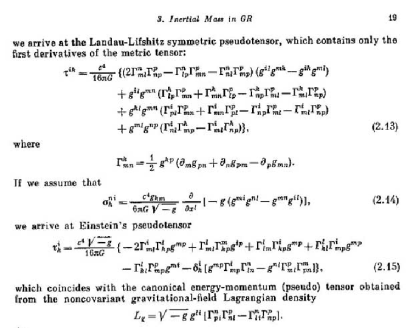
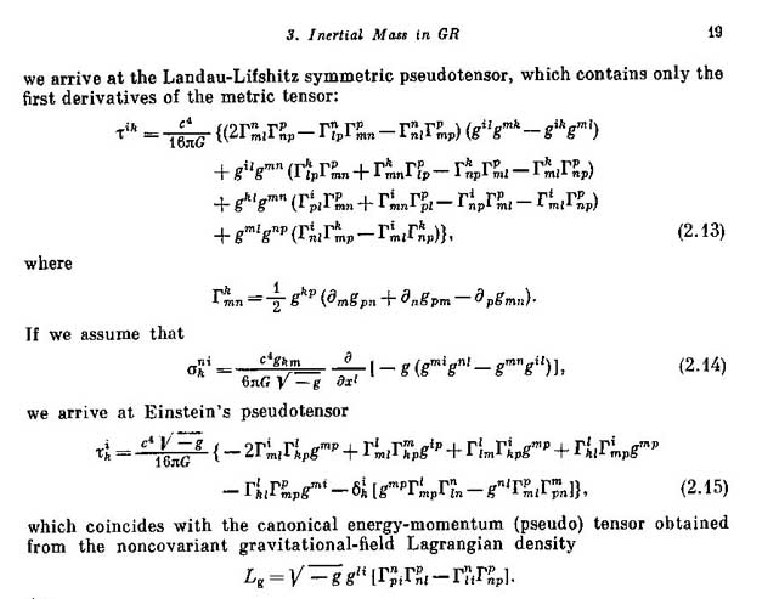
Note: The scan quality is poor (though file size is large) maybe 100 dpi or less. OCR is not reliable and the text is barely readable at times. This is especially true when there is a lot of tensor notation. See sample below. Maybe we should LaTeX it! If anyone has access to a better link please post the link.
 Continue reading →


 . Let us circumscribe a stationary sphere of radius
  around the origin. Then the light spot will run along the surface of this sphere at the linear velocity
  . This velocity can exceed the velocity of light. The example of such a beam is provided by a rotating pulsar. The light spot of the Crab Nebula pulsar runs along the Earth surface at the velocity equal approximately to
  . But as in the previous cases no signal is transmitted at such a velocity. As a matter of fact, every point of a screen (the Earth) receives a new portion of light energy from a searchlight (pulsar), but not from a neighbouring point of the screen. Therefore, it is impossible to transmit information from one point of the screen to another.




 ) for making this book available.
 Mir Books