

कहानी कैसे नजानू एक कवि बन गया
अनुवादक सरस्वती हैदर
चित्रकार बोरीस कलऊशिन
You can get the book here and here.
Twitter: @MirTitles
Mastodon: @mirtitles@mastodon.world
Mastodon: @mirtitles@mastodon.social
Bluesky: mirtitles.bsky.social
कहानी कैसे नजानू एक कवि बन गया
अनुवादक सरस्वती हैदर
चित्रकार बोरीस कलऊशिन
You can get the book here and here.
Twitter: @MirTitles
Mastodon: @mirtitles@mastodon.world
Mastodon: @mirtitles@mastodon.social
Bluesky: mirtitles.bsky.social

This book provides an overview of the mysteries and explorations of Mars. The Red Planet has fascinated humanity since antiquity. The invention of the telescope only deepened its enigmas, particularly with the discovery of the so-called ‘canals.’ This led to the idea of Martians living on the planet in science fiction. But is there really life on Mars? Do Martians exist? What are the canals? To answer questions like these space probes from the USSR and USA started the exploration of Mars in the 1960s. Going to Mars is not straightforward and reaching Mars is an engineering and technological feat. Ever since then we have continued our explorations of the Red Planet. We now have sophisticated rovers on the surface of Mars and orbiters in orbit around Mars. In the last few decades our knowledge of Mars has improved in leaps and bounds with new discoveries shedding more and more light on the mysterious planets past and future. This volume presents an outline of these explorations, a journey that continues to advance the bounds of human knowledge with hopes that one day humans will inhabit Mars.
Drawings by V. Korolkov
Translated from the Spanish and Typset in Scribus by Damitr Mazanav
Released on the web by The Mir Titles Project in 2025
This work is an Open Educational Resource (OER)
Creative Commons BY Share Alike 4.0 License
You can get the book here and here
Twitter: @MirTitles
Mastodon: @mirtitles@mastodon.world
Mastodon: @mirtitles@mastodon.social
Bluesky: mirtitles.bsky.social
GitLab: https://gitlab.com/mirtitles
Internet Archive: https://archive.org/details/mir-titles
One of the first books that I remember reading was All About the Telescope by Pavel Klushantsev translated to Marathi. The book got me fascinated about science in general and astronomy in particular.
So, when I saw this book by Klushantsev on Mars only available in Spanish, I could not resist from translating it. Though I started the work on this some years back, it was never completed for various reasons. One of them being the complex nature of typsetting in the book. So for this book I have used Scribus for typsetting and the results have been pleasing.
Since the book was written, our knowledge about Mars has increased by leaps and bounds. I have added an additional chapter in the book that summarises the various spacecraft since the 1990s that have taken our knowledge of Mars to the next level. The Martian surface has been revelead unprecendented detail with numerous rovers and orbiters around it. The attribution of images in the last section is provided with the images.
We now have active rovers on the surface of Mars and orbiters around it sending us vital information about the Red Planet. All this with hopes that humans would one day land there. It is to those future astronauts this translation and additional sections are dedicated.
Some screenshots

Screenshot

Screenshot

Screenshot

Screenshot

Screenshot
TRANSLATOR’S NOTE
THAT LITTLE STAR IS MARS! 1
THE MYSTERIES OF MARS 14
WHERE CAN YOU LIVE 22
UNEXPLAINED PHENOMENA OF MARS 32
WE MUST SOLVE THE MYSTERY OF “CANALS” 41
DO MARTIANS EXIST? 46
TRACES OF MARTIANS 56
ARE THE MARTIANS OUR ENEMIES 67
ARE MARTIANS OUR FRIENDS? 77
WE MUST FLY TO MARS 87
IS IT DIFFICULT TO REACH MARS 97
WHAT DID THE SPACE PROBES SEE FROM THEIR ORBIT 117
WATER! 129
THE SEARCH FOR LIFE ON MARS 136
IN THE FUTURE 152
FROM UNCERTAINTY TO DISCOVERY: MARS SINCE THE 1990s – Damitr Mazanav 163

A collection of short stories by great Soviet author Maxim Gorky.
You can get the book here and here.
Twitter: @MirTitles
Mastodon: @mirtitles@mastodon.world
Mastodon: @mirtitles@mastodon.social
Bluesky: mirtitles.bsky.social
CONTENTS
Preface 7
Chelkash 11
Comrades 70
One Autumn Night 94
In the Steppe 108
Twenty-six of U s and One Other 130
T he Green Kitten 154
A Rolling Stone 167
Her Lover 227
Chums 236

A collection of Essays, Sketches, Speeches, Papers by great Soviet writer and Nobel prize winner Mikhail Sholokhov
Translated from the Russian by Olga Shartse
Compiled by Y. Lukin
Designed by S. Danilov
You can get the book here and here.
Twitter: @MirTitles
Mastodon: @mirtitles@mastodon.world
Mastodon: @mirtitles@mastodon.social
Bluesky: mirtitles.bsky.social
Contents
Life—The Writer—Young People. By Y. Lukin 7
PART I. LIFE
From An Address to the Constituency of the Novocherkassk Election District 33
On the Don
Cossack Collective Farms 39
Vileness
On the Way to the Front 44
First Encounters 49
Red Army Men 53
Prisoners-of-War 59
A Letter to Leningraders 64
The Science of Hatred 65
A Letter to American Friends 80
A Victory Such As History Has Never Known (Excerpt from an article) 82
A Speech Addressed to the Electorate of Veshenskaya 83
From A Word About Motherland 84
From A Speech Addressed to the All-Union Conference of Peace Champions 106
From The Firstborn of Our Great Construction Projects 108
Long Live, My Party! 115
To Our Ukrainian Brothers 117
Admiration and Pride (On the flight of the world’s first cosmonaut Yuri Gagarin) 118
The Beacon for Mankind 119
The Greatest Feat (On the spaceflight of the second cosmonaut Herman Titov) 119
The Whole Nation Salutes You, Pravda! 119
I Embrace You with Fatherly Affection (On the spaceflight of Valentina Tereshkova and Valery Bykovsky) 119
To the Shock Workers of Communist Labour 120
I Gladly Accepted the Invitation 120
Communists of the Quiet Don Collective Farm Set Their Targets (From a speech addressed to a collective farm Party meeting) 121
Hands Off Glezos! 123
Greatness of the Soul 123
PART II. THE WRITER
The Writer and the Critic Must Do an Honest Job 129
To the English Readers (Foreword to the English publication of “And Quiet Flows the Don”) 134
Literature Is Part of the General Proletarian Cause (From a speech addressed to a meeting of shock workers of the Lenzavod Factory and the Rostov Railway Junction) 135
He Will Be a Model of Courage for Millions 141
About the Soviet Writer 142
A Spokesman for the People 144
A Bolshevik Writer 144
From A Speech Made at the 18th Party Congress 145
A Mighty Artist 149
From A Speech at the Funeral of Alexei Tolstoi 150
A Great Friend of Literature 151
Twenty-Five Years in Literature (Speech at the gathering held in honour of this occasion) 154
A Radio Address 155
I Wish You Happiness, Ukrainian People! 156
Speech at the Second All-Union Congress of Soviet Writers 158
Passionate and Truthful 166
From the Bottom by My Heart 170
A Letter to the Editors of Inostrannaya Literatura 167
New Year Wishes 170
From A Speech Addressed to the 20th Party Congress 170
The Ukraine’s Great Son 181
To Hungarian Writers 182
Keep in Step with the Party, with the People 182
The Treasure-Store of Folk Wisdom 183
A Letter to the Navy 184
From A Speech Addressed to the Electorate of Taganrog 185
Readers Want New Books About the Present Day 187
To the Editors of Pravda 188
Interview Given to a Correspondent of Literaturnaya Gazeta 188
About Semyon Davidov (From a talk addressed to the workers of the Kirov Plant in Leningrad) 190
Consolidation, and Once Again Consolidation! 191
Fidelity to the Ideals of Communism 191
A Letter to Charles Percy Snow 193
Speech at a Session of the European Committee of Writers 194
When Writers Are Friends with Their Heroes 195
Books About the Glory of the Working Class Are Needed 196
For a Stronger Alliance Between Industry and Art 197
Opening Speech at the Second Congress of Writers of the Russian Federation 199
A Word of Thanks (To the Swedish Royal Academy) 202
To Pravda 203
An Interview Given to a Pravda Correspondent 203
The Vital Strength of Realism 204
New Year Wishes 207
Speech in Acknowledgement of the Diploma of Honorary Doctor of Philosophy Conferred by the Karl Marx University in Leipzig 207
Speech at the 23rd Party Congress 208
From A Humanist Is the Man Who Fights 216
Preface to the Book History of the Kirov Plant 218
Speech Made at the Polish Embassy in Moscow 218
A Telegram to the International Literary Symposium 219
Speech at the 24th Party Congress 220
PART III. YOUNG PEOPLE
From A Speech About Maxim Gorky 229
The First Anniversary of the Theatre of Collective Farm Cossack Youth in Veshenskaya 229
We Are with You with All Our Hearts 230
The Second Anniversary of the Theatre of Collective Farm Cossack Youth in Veshenskaya 231
Your Faithful Companion 232
From A Speech Made at the Third Congress of Kazakh Writers 233
It Is a Great Honour to Write for the People (Speech addressed to a seminar of young writers of Rostov and Kamensk regions) 235
Speech at the Third All-Union Conference of Young Writers 236
Never Forget Friendship 238
A Letter to Lvov Students 238
The Pride of My Country 239
A Letter to Two Pupils of School No. 2 in Belaya Tserkov, a Village in Kiev Region 239
To My Don Countrymen 240
Heartfelt Thanks (From the answering speech made at the Kremlin during the presentation of the Lenin Prize for “Virgin Soil Upturned”) 240
From A Speech Made at the 22nd Congress of the CPSU 242
To the Young Pioneers 251
To the Young Farmers 251
To the Youth of Veshenskaya 251
To the Youth of the Don Country 252
Entry Made in the Young Guard Publishers Visitors’ Book 252
The Land Needs Young Hands (From a talk addressed to the youth) 253
Be Patriotic Always (From a conversation with Daghestan schoolgirls) 256
From A Speech at the Fourth Congress of Soviet Writers 258
What Happiness to Live Among Such Splendid People! (Speech at the Third All-Union Congress of Collective Farmers) 263
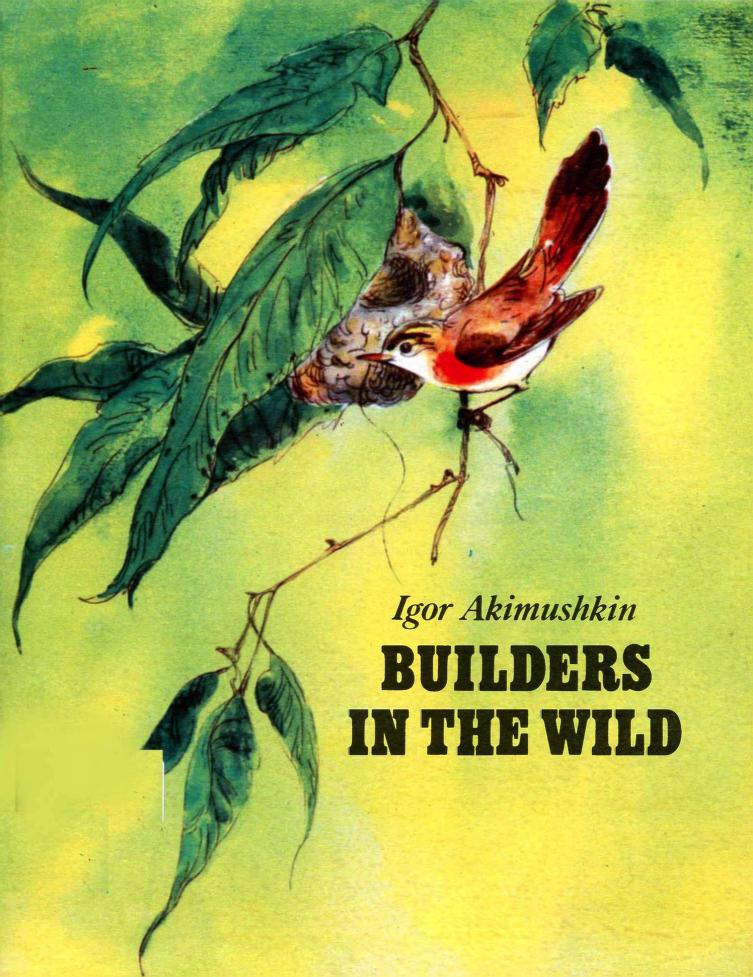
A little book describing various fantastic constructions made by different animals in the wild.
Drawings byA.Keleinikov
Translated by Eleanor Yankowskaya
You can get the book here and here.
Twitter: @MirTitlesMastodon: @mirtitles@mastodon.worldMastodon: @mirtitles@mastodon.socialBluesky: mirtitles.bsky.social

A little book describing four insects and how they destroy other harmful insects.
चार कीड़ों का वर्णन करने वाली एक छोटी सी किताब और वे अन्य हानिकारक कीड़ों को कैसे नष्ट करते हैं ।
शब्दांकन : लिन सुङइङ
चित्रांकन : छो रुइछङ च्वाङलिङ
You can get the book here and here.
Twitter: @MirTitles
Mastodon: @mirtitles@mastodon.world
Mastodon: @mirtitles@mastodon.social
Bluesky: mirtitles.bsky.social

कैसे नजानू एक चित्रकार बन गया
अनुवादक सरस्वती हैदर
चित्रकार बोरीस कलऊशिन
You can get the book here and here.
Twitter: @MirTitles
Mastodon: @mirtitles@mastodon.world
Mastodon: @mirtitles@mastodon.social
Bluesky: mirtitles.bsky.social

A book describing space adventures of boy named Grishka
Drawings by Yuri Molokanov
Translated from the Russian by Ronald Vroon
You can get the book here and here.
Twitter: @MirTitles
Mastodon: @mirtitles@mastodon.world
Mastodon: @mirtitles@mastodon.social
Bluesky: mirtitles.bsky.social

గ్రిష్కా అనే బాలుడి అంతరిక్ష సాహసాలను వివరించే పుస్తకం
చిత్రాలు: యూ. మలకానొవ్
అనువాదం: ఆర్వియార్
You can get the book here and here.
Twitter: @MirTitles
Mastodon: @mirtitles@mastodon.world
Mastodon: @mirtitles@mastodon.social
Bluesky: mirtitles.bsky.social

Anatoly Ivanov (b. 1928), State Prize winner and editor-in-chief of Molodaya Gvardia magazine, has been writing for over twenty years. Alka’s Songs, his first collection of short stories, was published in Novosibirsk in 1956. This was followed by three novels: Morning Glory (1958), Shadows Disappear at Noon (1964), and The Eternal Call (1969), which have won acclaim both in the Soviet Union and abroad.
Anatoly Ivanov writes of Siberia, its past and present. Most of his books have been filmed and serialized.
The action of The Eternal Call covers nearly fifty years, from the turn of the century to the Great Patriotic War against fascism. The book’s characters are peasants, workers, revolutionaries, Party functionaries, and Red Army men and officers. As one of the main characters says: “Sooner or later the man’ll begin thinking about the meaning of life…. And what forces him to do this is a powerful, compelling eternal call to life, an eternal desire to find his own place in life….” These words provide the key to all of Anatoly Ivanov’s work.
Translated from the Russian by Fainna Glagoleva
Illustrated by Peter Pinkisevich
You can get the book here and here.
Twitter: @MirTitles
Mastodon: @mirtitles@mastodon.world
Mastodon: @mirtitles@mastodon.social
Bluesky: mirtitles.bsky.social
FOREWORD. 7
PROLOGUE. 15
Part one. THE BROTHERS 93
Part two. A RIP IN TIME BECOMES A HOLE. 241
Part three.THE GREAT OPPOSITION.507
 Mir Books