History Of The Ancient World – Korovkin

In this post, we will see the book History Of The Ancient World by F. Korovkin

About the book

 Fyodor Korovkin is a Doctor of History. His textbook, History of the Ancient World, was awarded the USSR State Prize in 1973 and has run into over twenty editions. It provides information on the history of the ancient states in Me­sopotamia, Egypt, India, and China. The book includes the history of ancient Greece and Rome up to the fall of the Western Roman Empire in the 5th century AD. Several chapters deal with reli­gious views, art, and culture of the peoples of the ancient world.

The book was translated from Russian by Serger Sossinsky and designed by Leonid Shkanov. The book was published in 1985 by Progress Publishers.

Credits to the original uploaders

You can get the book here (cleaned and optimised) and here (original scan).

There is a Swahili and Bangla version available. I was aware of translations of Soviet books to African languages but this is the first time I am seeing one.

Swahili version here (cleaned and optimised) and here (original scan).

Bangla version here (DLI copy)

And we have a Hindi version as well, which is not yet digitised. This book might have other translations as well, please do comment if you know of any.

Follow us on The Internet Archive: https://archive.org/details/@mirtitles

Follow Us On Twitter: https://twitter.com/MirTitles

Write to us: mirtitles@gmail.com

Fork us at GitLab: https://gitlab.com/mirtitles/

Add new entries to the detailed book catalog here.


Contents

About the History of the Ancient World 7
How to Work with the Textbook 10

THE LIFE OF PRIMITIVE PEOPLE

CHAPTER I. PRIMEVAL GATHERERS AND HUNTERS 12

§ 1. What Ancient People Were Like and How They Lived 12
§ 2. Communities of Hunters 14
§ 3. The Rise of Art and Religious Beliefs 18

CHAPTER II. PRIMITIVE LAND TILLERS AND LIVESTOCK BREEDERS 21

§ 4. The Beginning of Livestock age and Land Tillage 21
§ 5. The Rise of Inequality among People 24

CHRONOLOGY IN HISTORY 30

THE ANCIENT EAST

CHAPTER III. ANCIENT EGYPT

§ 6. The Nature of Ancient Egypt and the Activities of Its Inhabitants
§ 7. The Emergence of Classes in Egypt
§ 8. The Rise of the State in Ancient Egypt
§ 9. Government and the Struggle of Classes in Egypt
§ 10. The Peak and Decline of the Egyptian State
§ 11. Religion in Ancient Egypt
§ 12. Incipient Scientific Knowledge and the Appearance of Writing in Ancient Egypt
§ 13. The Arts in Ancient Egypt

CHAPTER IV. ASIA MINOR IN ANCIENT TIMES 62

§ 14. The Emergence of Classes in Mesopotamia 62
§ 15. The Earliest States in Mesopotamia and the Babylon Kingdom 66
§ 16. Asia Minor in the First Half of the 1st Millennium BC 69
§ 17. The Culture of the Peoples Inhabiting Asia Minor in Ancient Times 73

CHAPTER V. ANCIENT INDIA 79

§ 18. India in the 3rd-Early Ist Millennium BC 79
§ 19. The Rise and Development of Slave-Owning States in India in the 1st Millennium BC 82
§ 20.Culture in Ancient India 84
§ 21. Sri Lanka in Ancient Times 88

CHAPTER VII. ANCIENT CHINA 92


§ 22. The Formation of the Chinese State 92
§ 23. Popular Uprisings in China 95
§ 24. Culture in Ancient China 99

ANCIENT GREECE

CHAPTER VIII. GREECE IN THE EARLIEST TIMES 106

§ 25. The Nature and Population of Ancient Greece 106
§ 26. The Myths of Ancient Greece 108
§ 27. Homer’s Iliad and Odyssey 112
§ 28. The Occupations of the Greeks and the Emergence of Classes in the 11th-9th Century BC 117
§ 29. Religion of the Ancient Greeks 120

CHAPTER VIII. THE ESTABLISHMENT OF THE SLAVE-OWNING SYSTEM AND THE RISE OF THE CITY-STATES IN THE 8TH-6TH CENTURY BC 126

§ 31-32.Formation of the Athens Slave-Owning State 126
Athens Under the Aristocrats’ Rule in the 8th-7th Century BC 126
The Victory of the Demos and the Strengthening of the State in Athens 130
§ 32. The Spartan Slave-Owning State in the 8th-6th Century BC
§ 33. The Rise of the City-States in Greece and on the Shores of the Mediterranean and Black Seas

CHAPTER IX. THE DEVELOPMENT OF SLAVERY IN GREECE AND THE RISE OF ATHENS IN THE 5TH CENTURY BC 141

§ 34. The Greco-Persian Wars 141
§ 35. Slavery in Greece in the 5th Century BC 147
§ 36. The Power and Wealth of Athens in the Middle of the 5th Century BC 151
§ 37. The Athenian Slave-Owning Democracy 153

CHAPTER X. THE FLOURISHING OF CULTURE IN GREECE IN THE 5th-4th CENTURY BC 157

§ 38. Writing and the School. The Olympic Games 157
§ 39. Ancient Greek Theatre 160
§ 40. Architecture, Sculpture and Painting in Ancient Greece in the 5th Century BC 164
§ 41. Science in Ancient Greece 170

CHAPTER XI. THE RISE OF GRECO-MACEDONIAN STATES IN THE EASTERN MEDITERRANEAN 173

§ 42. The Decline of Greece and Its Subjection by Macedonia in the 4th Century BC 173
§ 43. The Rise and Fall of the Empire of Alexander the Great 176
§ 44. The Economy and Culture in he Eastern Mediterranean at the End of the 4th-2nd Century BC 179


ANCIENT ROME

CHAPTER XII. THE EMERGENCE OF THE ROMAN REPUBLIC AND ITS CONQUEST OF ITALY 188

§ 45. The Earliest Rome and the Establishment of a Republic in It 188
§ 46. The Roman Aristocratic Republic in the Middle of the 3rd Century BC 192

CHAPTER XIII. THE ROMAN REPUBLIC BECOMES THE STRONGEST SLAVE-OWNING POWER IN THE MEDITERRANEAN 196

§ 47. The Struggle Between Rome and Carthage for Domination in the Western Mediterranean 196
§ 48. Roman Conquests of Second Century BC 200
§ 49. Slave-Owning in Rome in the 2nd-1st Century BC 204
§ 50. The Ruining of the Peasants in Italy and Their Struggle for land 207
§ 51. The Slave uprising Headed by Spartacus 210

CHAPTER XIV. THE FALL OF THE REPUBLIC IN ROME. THE ROMAN EMPIRE AT THE PEAK OF ITS POWER 214

§ 52. Caesar Seizes Power in Rome 214
§ 53. The Roman Empire Under Octavian Augustus and His Successors 217


CHAPTER XV. CULTURE AND DAILY LIFE IN ROME AT THE END OF THE
REPUBLIC AND THE BEGINNING OF THE EMPIRE 222

§ 54. The arts in Ancient Rome 222
§ 55. The City of Rome ne the Empire 225

CHAPTER XVI. THE DECLINE AND FALL OF THE ROMAN EMPIRE 231

§ 56. The Beginning of the Decline of the Slave-Owning Economy at the End of the 2nd-3rd Century AD 231
§ 57. The Weakening of the Empire in the 3rd Century and Its Strengthening Under Emperor Diocletian 233
§ 58. The Rise of Christianity 236
§ 59. Further Deterioration of the Situation in the Empire in the 4th Century 237
§ 60. The Fall of the Western Roman Empire 240

Check How You Have Learned the Most Important Things in the History of the Ancient World 245

CONCLUSION 247

Posted in books, history, progress publishers | Tagged , , , , , , , , , , , , , , | 1 Comment

The Wold Chess Crown Challenge Kasparov V. Kaprov Seville 87 – Bronstein

In this post, we will see the book The Wold Chess Crown Challenge Kasparov V. Kaprov Seville 87 by David Bronstein.

About the book

The games of Kasparov-Karpov match are annotated by International Grandmaster David Bronstein who was challenger for the World title in 1950s; he reached a draw with Mikhail Botvinnik in the match for the world chess crown. Over recent years Bronstein has rarely appeared in tournaments but has established himself as an outstanding chess commentator and analyst. He is the author of many original books on the subject of chess and his annotations are easy to follow for chess fans of all levels.

The book was translated from Russian by Oleg Zilbert was published in 1988 by Raduga Publishers.

All credits to our old friend gnv64

You can get the book here and here.

Follow us on The Internet Archive: https://archive.org/details/@mirtitles

Follow Us On Twitter: https://twitter.com/MirTitles

Write to us: mirtitles@gmail.com

Fork us at GitLab: https://gitlab.com/mirtitles/

Add new entries to the detailed book catalog here.

Contents

GAME ONE. Gruenfeld Defence 7
GAME TWO. English Opening 10
GAME THREE. Gruenfeld Defence 18
GAME FOUR. English Opening. 21
GAME FIVE. Gruenfeld Defence 26
GAME S1X. English Opening. 31
GAME SEVEN. Gruenfeld Defence 35
GAME EIGHT. English Opening 44
GAME NINE. Gruenfeld Defence 50
GAME TEN. Caro-Kann Defence 56
GAME ELEVEN. Gruenfeld Defence 59
GAME TWELVE. Queen’s Gambit Declined 64
GAME THIRTEEN. Gruenfeld Defence. 67
GAME FOURTEEN. Caro-Kann Defence 89
GAME FIFTEEN. Gruenfeld Defence 92
GAME SIXTEEN. English Opening O7
GAME SEVENTEEN. King’s Indian Defence 105
GAME EIGHTEEN. Queen’s Gambit Declined 110
GAME NINETEEN. Queen’s Gambit Declined 115
GAME TWENTY. Queen’s Gambit Declined. 122
GAME TWENTY-ONE. Gruenfeld Defence 127
GAME TWENTY-TWO. Queen’s Gambit 132
GAME TWENTY-THREE. Gruenfeld Defence 136
GAME TWENTY-FOUR. RetI Opening 145

David Bronstein. Points Scored and Moves Played 155

Posted in books, chess | Leave a comment

Domination In 2,545 Endgame Studies – Kasparyan

In this post, we will see the book Domination In 2,545 Endgame Studies by Ghenrikh M. Kasparyan.

About the book

This worldwide anthology of endgame studies is divided into thematic sections in which White wins by trapping pieces. The stud­ies were selected with a view to presenting a clear picture of the rise and development of different ideas and enabling the reader to appraise the past and present of endgame composition in the sphere of piece-trapping.
Problems relating to the creative development of endgame com­ position are examined her;’). Naturally, when generalising the crea­tive chess process of the past century, one must consider, in addition to outstanding works, others that are far from the best. Only a com­parison of endgame studies of dh-erse genres, styles, scale and qual­ity can reveal the many different ways in which ideas have arisen and developed. This is the only means of tracing the progress of endgame composition and forecasting its future roads.
Composers will find the book helpful in coping with some specific difficulties, such as the search for precedents. It may also prove useful in the eternal quest for new ideas.
Rank-and-file players will find the analyf’.is of endgames helpful in improving their chess skills. They will see beautiful examples of creativity by endgame composers of all times. On the \vhole, the book may be of interest to a broad range of skilled chess players.
The systematisation and classification aim at tracing the develop­ment of ideas. Accurate data on the initial publication of endgames (time and source) are not always available, especially in the case of very old ones, and whenever the authenticity of such information is doubtful it has not been given.
The sequence of the endgames presented here was determined by the chronology and kinship of separate branches. It easily guides the reader through the vast material presented.
Work on the book entailed the inevitable difficulties connected with the examination of a tremendous amount of material. It is up to the reader to judge how successfully the author has coped with his main task, that of demonstrating the rise and development of positions and ideas in the sphere of trapping pieces.

The book was translated from Russian by A. Krivoviaz  and designed by M. Melik-Pashayeva and T. Rudenke. The book was published in 1980 by Progress Publishers.

All credits to our old friend gnv64.

You can get the book here and here.

Follow us on The Internet Archive: https://archive.org/details/@mirtitles

Follow Us On Twitter: https://twitter.com/MirTitles

Write to us: mirtitles@gmail.com

Fork us at GitLab: https://gitlab.com/mirtitles/

Add new entries to the detailed book catalog here.

Contents

Preface? 5
Introduction 7

Part One. Trapping Minor Pieces. 9

(Numbers in bracket indicate the Endgame Nos.)

Chapter 1. Minor Piece Traps Minor Piece 9 (1-61)
Chapter 2. Two Minor Pieces Trap One 28 (62-268)
Chapter 3. Two Minor Pieces Versus Two. 70 (269-309 )
Chapter 4. Three Minor Pieces Versus One or Two 78 (310-349 )
Chapter 5. Rook (with Pawns) Versus Minor Pieces 86 (350-432)
Chapter 6. Rook with Minor Piece (or Queen) Versus Two Minor Pieces 105 (433-677)

Part Two. Trapping the Rook 451

Chapter 1. Minor Piece Traps Rook 152 (678-728)
Chapter 2. Two Minor Pieces Trap Rook 162 (729-840)
Chapter 3. Two Knights and Bishop Trap Rook 185 (841-902)
Chapter 4. Rook Traps Rook 195 (903-1005)
Chapter 5. Trapping the Rook with Other Forces 215 (1006-1076)

Part Three. Trapping the Queen 230

Chapter 1. Minor Pieces Trap Queen 230 (1077-1436)
Chapter 2. Rooks Trap Queen 300 (1437-1508)
Chapter 3. Rook and Minor Piece Trap Queen 344 (1509-1724)
Chapter 4. Rook and Two Minor Pieces or Two Rooks and Minor Piece Trap Queen 356 (1725-1877)
Chapter 5. Queen Traps Queen 387 (1878-1998)
Chapter 6. Queen and Minor Piece Trap Queen 412 (1999-2395)

Part Four. Trapping Pieces with Other Forces 498

Chapter 1. Two Rooks Trap Rook and Minor Piece 498 (2396-2440)
Chapter 2. Rook and Two Minor Pieces (or One) Trap Rook and Minor Piece (2441-2476)
Chapter 3. Two Rooks and Minor Piece Trap Two Rooks and Minor Piece 514 (2477-2481)
Chapter 4. Queen Traps Rook and Minor Piece 516 (2482-2505)
Chapter 5. Queen and Rook Trap Queen and Rook (or Bishop) (2506-2519)
Chapter 6. Checkers Combinations 524 (2520-2539)
Chapter 7. Mauling Black’s Forces 528 (2540-2545)
Concluding Remarks 534
Index of Composers 533
Bibliography 540


Posted in books, chess, progress publishers | Tagged , , , , , , , , , | Leave a comment

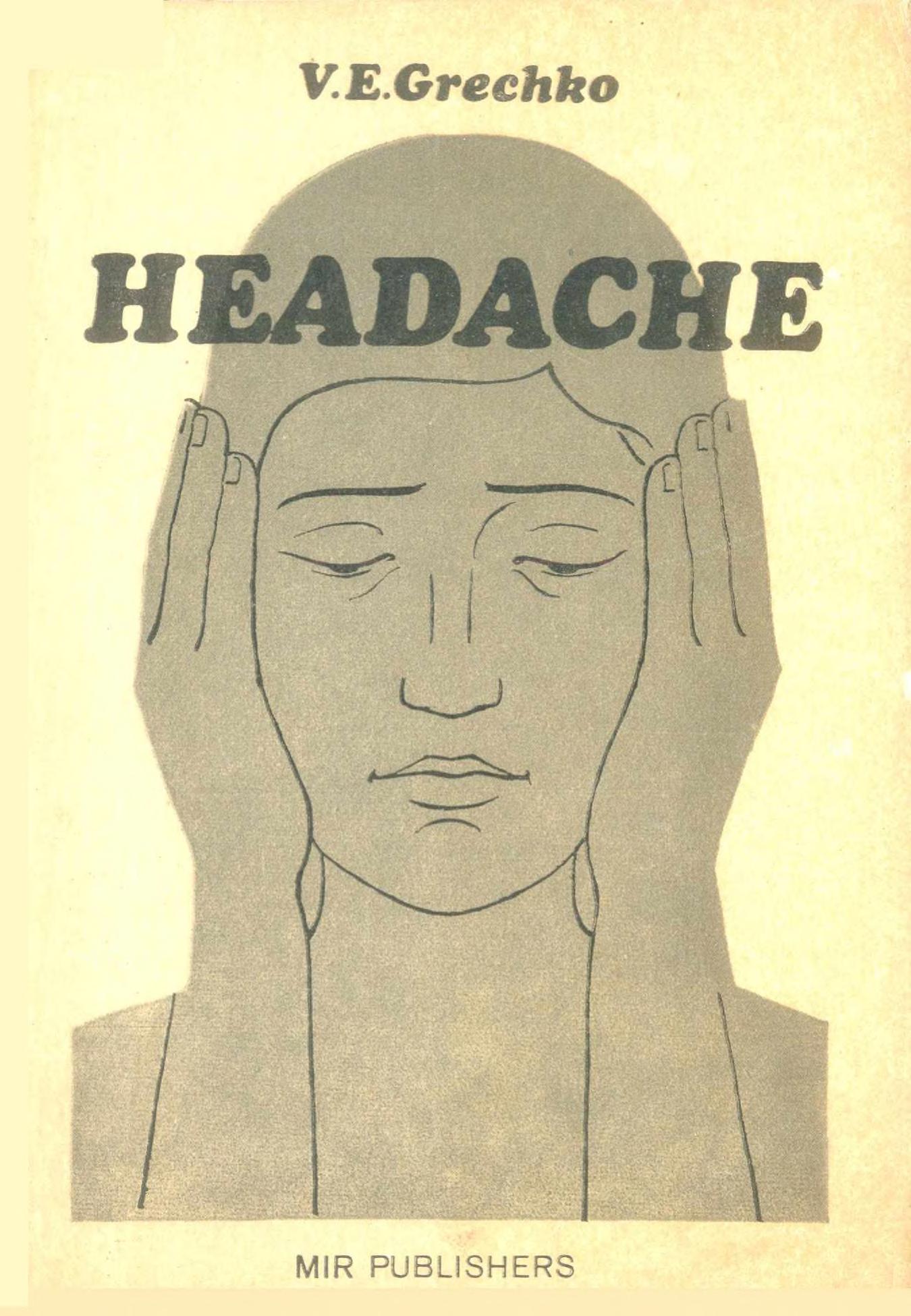
Headache – Grechko

In this post, we will see the book Headache by V. E. Grechko.

About the book

The booklet discusses the headache which is among the most prevalent symptoms marking different pathological conditions of the body. It shows how headaches may develop in healthy subjects and in those afflicted with different diseases.
The causes for headaches, the mechanisms by which they de­velop, the features of the var­ious types of headaches, and the basic principles of headache prophylaxis and elimination are reviewed. Medical recommendations for patients suffering from headache are given. The booklet is intended for a wide spectrum of general read­ers.

The book was translated from Russian by Nina Abdurakhmanova and was published in 1986 by Mir Publishers.

All credits to our old friend gnv64.

You can get the book here and here.

Follow us on The Internet Archive: https://archive.org/details/@mirtitles

Follow Us On Twitter: https://twitter.com/MirTitles

Write to us: mirtitles@gmail.com

Fork us at GitLab: https://gitlab.com/mirtitles/

Add new entries to the detailed book catalog here.

Contents

Introduction 6
Some Data About Pain in General and Sensitivity to Pain in the Head 10
When Does a Headache Afflict Healthy People? 27
Headache as a Symptom of Different Diseases 48
Cardiovascular Diseases 49
Abnormality in the Functions of the Endocrine Glands 76
Brain Injuries 78
Inflammatory Diseases 83
Poisoning 100
Visual Abnormalities and Eye Diseases 104
Brain Tumours 103
Cervical Osteochondrosis 104
Neuroses 116
Conclusion 120


Posted in books | Tagged , , , , , , | Leave a comment

Survival in Space Gagarin, Lebedev

In this post, we will see the book Survival in Space by Yu. Gagarin, V. Lebedev.

About the book

This unique document includes vivid descriptions of the space capsule, the various psycho­logical and physical disorientations that afflict astronauts during flights, the grueling ground training and testing of astronauts, the problems of group interaction among crews and how it can affect the success of flights, the emotional reac­tions of astronauts and their own personal ac­counts of sensations felt during training and actual flights, the problems of prolonged isolation
—and much more…

The book was translated from Russian by Gabriella Azrael and was published in  1969.

Credits to original uploader.

You can get the book here.

Follow us on The Internet Archive: https://archive.org/details/@mirtitles

Follow Us On Twitter: https://twitter.com/MirTitles

Write to us: mirtitles@gmail.com

Fork us at GitLab: https://gitlab.com/mirtitles/

Add new entries to the detailed book catalog here.

Contents

Soviet Space Flights vii

First Flights in Space 1
The Cosmonaut and the Robot 34
Without Ever Getting off the Ground 60
The Team on an Interplanetary Craft 75
Emotions in Space 91
In a Weightless World 122
Secrets of Silence 141

Posted in books, psychology, soviet, space, technology | Tagged , , , , , , | Leave a comment

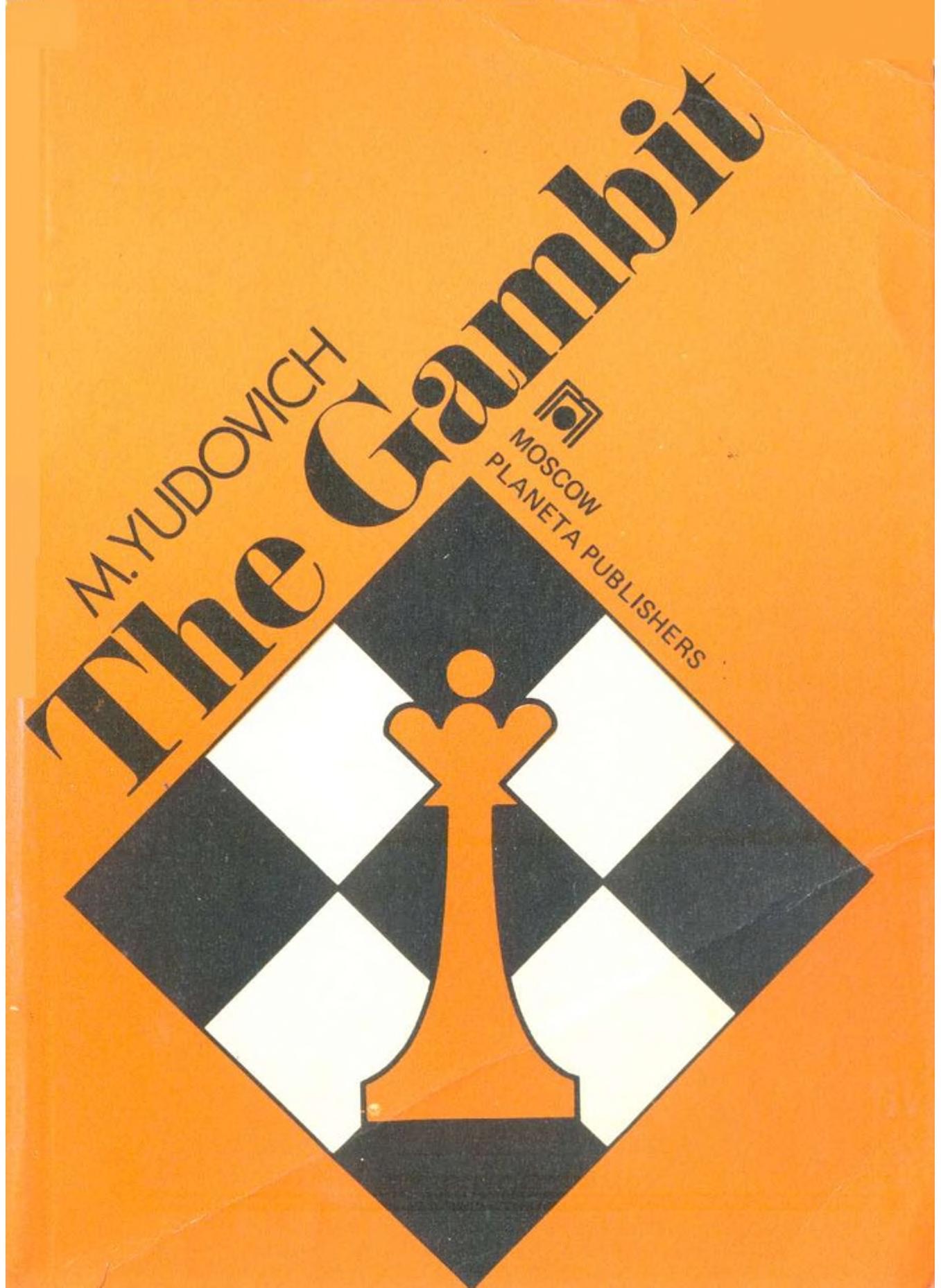
The Gambit – Yudovich

In this post, we will see the book The Gambit by M. Yudovich.

About the book

Mikhail Yudovich (1911-1987), International Master and International Correspondence Grandmaster, is the author of a number of books on chess theory and practice, which have been published in the USSR and abroad. He devoted this book to the complicated and sharp openings—gambits. The author gives an insight into the history of gambits, and this as well as what follows (the selection of 23 games taken from both classical and modern practice of great chess-masters) should interest those who already know how to play. The gambit tactics can be picked up by studying the examples given in the book, which are chosen for the pleasure they give as well as for their instructive value. The reader will also get useful information about such notions as space and gain of time, harmonious development of pieces and preparation of an attack. The book is intended for amateurs of chess.

The book was translated from Russian by Oleg Zilbert was published in 1989 by Planeta Publishers.

All credits to our old friend gnv64!

You can get the book here and here.

Follow us on The Internet Archive: https://archive.org/details/@mirtitles

Follow Us On Twitter: https://twitter.com/MirTitles

Write to us: mirtitles@gmail.com

Fork us at GitLab: https://gitlab.com/mirtitles/

Add new entries to the detailed book catalog here.

Contents

An Old but Formidable Weapon 4

The Immortal Gambit 15

Blow in the Centre 79

Captain Evans’s Secret 93

In the Heat of Combat 111

Modern Ideas 139

From the Golden Treasury 163

The Hidden and the Obvious (Questions Answered) 180


Posted in books | Tagged , , , , , , , , , | Leave a comment

Nonequilibrium Statistical Thermodynamics – Zubarev

In this post, we will see the book Nonequilibrium Statistical Thermodynamics by D. N. Zubarev.

About the book

In this book an attempt is made to give a unified account of the present state of nonequilibrium statistical thermodynamics as a natural generalization of the equilibrium theory.
From a logical point of view, it would be desirable to develop the statistical theory of nonequilibrium processes first, and treat the theory of statistical equilibrium as its limiting case. Such an approach, however, is scarcely worthwhile at the present time, since nonequilibrium and equilibrium statistical thermodynamics are at very different stages of development. In Chapters I and II, therefore, we give a brief account of the basic ideas of the classi­cal and quantum statistical mechanics of equilibrium systems, to the extent that this is necessary for the derivation of the basic thermodynamic relations for the case of statistical equilibrium.
The purpose of these introductory chapters is to recall the general method of Gibbsian statistical ensembles, since later, in Chapters in and IV, attempts are made to take over the ideas of statistical ensembles to nonequilibrium statistical thermody­namics.

The book was translated from Russian by was published in  by Publishers.

Credits to original uploader.

You can get the book here.

Follow us on The Internet Archive: https://archive.org/details/@mirtitles

Follow Us On Twitter: https://twitter.com/MirTitles

Write to us: mirtitles@gmail.com

Fork us at GitLab: https://gitlab.com/mirtitles/

Add new entries to the detailed book catalog here.

Contents

PREFACE. V

INTRODUCTION IX

Chapter 1 Equilibrium Statistical Thermodynamics of Classical Systems 1

§1. Distribution functions 1
§2. Liouville’s equation 5
§3. Gibbsian statistical ensembles 18
§4. The connection between the Gibbsian distributions and the maximum of the information entropy 38
§5. Thermodynamic equalities 46
§6 Fluctuation 55

Chapter 2 Equilibrium Statistical Thermodynamics of Quantum Systems 65

§7. The statistical operator 65
§8. The quantum Liouville equation 73
§9. Gibbsian statistical ensembles in the quantum case 82
§10. The connection between Gibbsian distributions and the maximum of information entropy (quantum case) 100
§11. Thermodynamic equalities 105
§12. Fluctuations in Quantum Systems 115
§13. Thermodynamic equivalence of the Gibbsian statistical ensembles 119
§14. Passage to the classical limit of quantum 129

Chapter 3 Irreversible Processes Induced by Mechanical Perturbations 141

§15. Response of a system to external mechanical perturbations 141
§16. Two-time Green functions 174
§17. Fluctuation-dissipation theorems and dispersion relations 196
§18. Systems of charged particles in an alternating electromagnetic field 220

Chapter 4 The Nonequilibrium Statistical Operator 237

§19. Conservation Laws 242
§20. The local-equilibrium distribution 266
§21. Statistical operator for nonequilibrium systems 301
§22. Tensor, vector and scalar processes 317
§23. Relaxation Processes 360
§24. The statistical operator for relativistic systems and relativistic hydrodynamics 395
§25. Kinetic equations 411
§26. The Kramers—Fokker—Planck equations 424
§27. Extremal properties of the nonequilibrium statistical operator 435

Appendix I Formal Scattering Theory in Quantum Mechanics 453
Appendix II MacLennan’s Statistical Theory of Transport Processes 461
Appendix III Boundary Conditions for the Statistical Operators in the Theory of Nonequilibrium Processes and the Method of Quasi-Averages 465

References 471

Posted in books, mathematics, physics | Tagged , , , , , , , , , , | Leave a comment

A Brief Course In Analytic Geometry – Yefimov

In this post, we will see the book A Brief Course In Analytic Geometry by N. Yefimov.

About the book

Written by Professor N. Yefimov, Dr. Phys. Math. Sc., this book presents, in concise form, the theoretical foundations of plane and solid analytic geometry. Also, an elementary outline of the theory of determinants is given in the Appendix.

The textbook is intended for students of higher educational institutions and for engineers engaged in the field of quadric surface design.

The book is illustrated with 122 drawings.

The book was translated from Russian by O. Soroka and was published in 1962 by Peace Publishers.

Credits to original uploader.

You can get the book here.

Follow us on The Internet Archive: https://archive.org/details/@mirtitles

Follow Us On Twitter: https://twitter.com/MirTitles

Write to us: mirtitles@gmail.com

Fork us at GitLab: https://gitlab.com/mirtitles/

Add new entries to the detailed book catalog here.

Contents

PART ONE
PLANE ANALYTIC GEOMETRY

Chapter 1. Coordinates on a Straight Line and in a Plane 11
Chapter 2. Elementary Problems of Plane Analytic Geometry 23
Chapter 3. The Equation of a Curve 41
Chapter 4. Curves of the First Order 55
Chapter 5. Geometric Properties of Curves of the Second Order 75
Chapter 6. Transformation of Equations by Change of Coordinates 116

PART TWO
SOLID ANALYTIC GEOMETRY

Chapter 7. Some Elementary Problems of Solid Analytic Geometry 131
Chapter 8. Linear Operations on Vectors 143
Chapter 9. The Scalar Product of Vectors 157
Chapter 10. The Vector and Triple Scalar Products of Vectors 163
Chapter 11. The Equation of a Surface and the Equalions of a Curve 178
Chapter 12. The Plane as the Surface of the First Order. the Equations of a Straight Line 185
Chapter 13. Quadric Surfaces 207

Appendix. The Elements of the Theory of Determinants. 225


Posted in books, mathematics, peace publishers, soviet | Tagged , , , , , , , , | 1 Comment

Probability And Information – Yaglom, Yaglom

In this post, we will see the book Probability And Information by A. M. Yaglom; I. M. Yaglom.

About the book

The present book, designed for a wide circle of readers (familiarity with mathematics up to high school level suffices for comprehension of all of its contents), makes, of course, no claim to serve even as an elementary introduction to the scientific information theory. We can give here only a preliminary idea of important practical applications of this theory. Similarly, it shall not be possible to deal here with the deeper purely mathematical problems connected with the in­ formation theory. The main aim of the authors is much simpler : it consists of acquainting the reader with certain, though not complex but highly important, new mathematical ideas, and leading him through these ideas to an understanding of one of the possible means of employing mathematical methods of modern engineering.

The book was translated from Russian by V. K. Jain and was published in 1983.

Credits to original uploader.

You can get the book here.

Follow us on The Internet Archive: https://archive.org/details/@mirtitles

Follow Us On Twitter: https://twitter.com/MirTitles

Write to us: mirtitles@gmail.com

Fork us at GitLab: https://gitlab.com/mirtitles/

Add new entries to the detailed book catalog here.

Contents

CHAPTER 1 Probability

1.1 Definition of Probability. Random Events and Random
Variables 1
1.2 Properties of Probability. Addition and Multiplication of
Events. Incompatible and Independent Events 7
1.3 Conditional Probability 20
1.4 The Variance of a Random Variable. Chebyshev’s Inequality and the Law of Large Numbers 26
1.5 Algebra of Events and General Definition of Probability 36

CHAPTER 2 Entropy and Information

2.1 Entropy as a Measure of the Amount of Uncertainty 44
2.2 The Entropy of Compound Events. Conditional Entropy 59
2.3 The Concept of Information 73
2.4 Entropy (revisited). The Determination of Entropy from its Properties 93

CHAPTER 3 The Solution of Certain Logical Problems by Calculating
Information

3.1 Simple Examples 101
3.2 The Counterfeit Coin Problem 108
3.3 Discussion 121

CHAPTER 4 Application of Information Theory to the Problem of the
Information Transmission Through Communication Channels

4.1 Basic Concepts. Efficiency of a Code 137
4.2 Shannon-Fano and Huffman Codes. Fundamental Coding Theorem 147
4.3 Entropy and Information of Various Messages Encountered in Practice 177
4.4 Transmission of Information over Noisy Channels 258
4.5 Error-Detecting and Error-Correcting Codes 304

Appendix 1. Properties of Convex Functions 347
Appendix 2. Some Algebraic Concepts 364
Appendix 3. Table of Values of — p log p 392
Appendix 4. Short Table of the Function h(p) = —p log p — (1 — p) log (1 — p) 395

References 397
Name Index 409
Subject Index 413

Posted in books, mathematics | Tagged , , , , , , , , , | Leave a comment

Physics Of The Solar System – Vyazanitsyn et al

In this post, we will see the book Physics Of The Solar System (Vol 3 of A Course in Astrophysics and Stellar Astronomy) by V.P. Vyazanitsyn, M.N. Gnevyshev, O.V. Dobrovol’skii, V.A. Krat, A.V. Markov, A.P. Molchanov, V.M. Sobolev, V.V. Sharonov and edited by  A.A. Mikhailov.

About the book

This third volume of “A Course in Astrophysics and Stellar Astronomy” deals with observational results and their interpretation. It is not the aim of this book either to present all existing astrophysical theories and hypotheses or to discuss systematically general problems in the modern theories of cosmogony and cosmology. Such subjects have been treated in special textbooks and monographs. However, in all the astronomical literature so far there has been no book which gives a systematic presentation of observational results together with methods for their interpretation. This fact has determined the nature and the scope of this text. It mainly presents facts, and the principal theoretical studies related to an interpretation of the observational data are given only briefly (they are often just mentioned in the references). As far as possible, we have tried to avoid controversial theoretical questions for which no definite answers have yet been found, since this book does not represent a survey of astrophysics and stellar astronomy in the sense of the volumes edited by Kuiper on the sun and the solar system. Rather, it constitutes a textbook for young astronomers,
both graduates and undergraduates. For this reason, it was impossible to include a systematic discussion of general and complex problems related to cosmology and cosmogony, the proper place for which is in more specialized monographs.
For the teaching of astrophysics in a university, this book should be used in parallel with a course in theoretical astrophysics. Consequently, in our presentation it is assumed that the reader is already familiar with the rudiments of theory.
This volume, Volume III, is divided into two parts: 1) The Sun, and 2) The Planetary System (planets, comets, and meteors).
Part I mainly stresses so-called solar activity, that is, the processes occurring on the surface of the sun. These processes are inevitably interrelated, since they represent different stages in the development of large-scale motions on the solar surface. These motions produce so-called active regions, which in a certain sense may be compared with terrestrial cyclones and anticyclones.

The book was translated from Russian by the Israel Program for Scientific Translations
and was published in 1966 by NASA.

Credits to original uploader.

You can get the book here.

Follow us on The Internet Archive: https://archive.org/details/@mirtitles

Follow Us On Twitter: https://twitter.com/MirTitles

Write to us: mirtitles@gmail.com

Fork us at GitLab: https://gitlab.com/mirtitles/

Add new entries to the detailed book catalog here.

Contents

Part One
THE SUN

CHAPTER I. INTRODUCTION
(V.P. Vyazanitsyn.) 3

§ 1. General data 3
§ 2. The total solar radiation 5
§ 3. Fluctuations in solar radiation 6
§ 4. The energy distribution in the solar spectrum 9
§ 5. Limb darkening 13
§ 6. Solar rotation 16

CHAPTER II. THE SOLAR LINE SPECTRUM
(V.P. Vyazanitsyn.) 19

§ 7. The Normal solar spectrum. Spectrum atlases and line catalogs 19
§ 8. The identification of Fraunhofer lines 22
§ 9. Equivalent Fraunhofer-line widths. Growth curves 25
§ 10. The quantitative composition of the solar atmosphere 32

CHAPTER III. THE STRUCTURE OF THE PHOTOSPHERE: GRANULATION, SUNSPOTS AND FACULAE
(V.A. Krat) 37

§ 11. The general appearance of the solar surface, Granulation 37
§ 12. Sunspots 43
§ 13. Solar rotation, as determined from spots and faculae 46
§ 14. Special features of the line spectra of spots and faculae 49
§ 15. Magnetic fields of spots. The general magnetic field of the sun 53
§ 16. Gas motion in sunspots. The Evershed effect 57
§ 17. The nature of sunspots 59
§ 18. The cyclic variation of photospheric phenomena 61
§ 19. The cyclic nature of sunspot formation 66

Chapter IV. THE CHROMOSPHERE
(V. P. Vyazanitsyn and V.M. Sobolev.) 68

§ 20. The flash spectrum, General properties of the chromosphere 68
§ 21. Spectrophotometric measurements and ee profiles 72
§ 22. The chemical composition of the chromosphere 77
§ 23. The density distribution with height in the chromosphere 79
§ 24. Self-absorption in the chromosphere 84
§ 25. The temperature and the electron concentration. Chromospheric models 89
§ 26. Chromospheric spicules 98
§ 27. The ultraviolet radiation of the chromosphere 101
§ 28. The theory of chromospheric heating 103
§ 29. Bright flocculi 107

Chapter V. PROMINENCES
(V.P. Vyazanitsyn and V.M.Sobolev.) 111

§ 30. Historical remarks 111
§ 31. Statistical data 112
§ 32. Filaments 114
§ 33. The classification of prominences 116
§ 34. The dynamics of prominences 123
§ 35. Prominence spectra. Spectrophotometric measurements 125
§ 36. Excitation and ionization 130

Chapter VI. CHROMOSPHERIC FLARES
(V.A. Krat.) 134

§ 37. Classification. Frequency of flares 134
§ 38. The formation of surges 136
§ 39. The spectra of chromospheric flares and their interpretation 137
§ 40. Emission cores 141
§ 41. Geoactivity and the nature of lane 144

Chapter VII. THE SOLAR CORONA
(V.A. Krat) 148

§ 42. The continuous spectrum of the corona 148
§ 43. The line spectrum of the corona 151
§ 44. The brightness and polarization of the corona 153
§ 45. Structural features of the corona in “white” light 155
§ 46. The ionization and excitation of atoms in the corona 156
§ 47. Profiles of coronal lines. The structure of the corona in monochromatic emission of spectral lines 158
§ 48. Coronal motions. The development of coronal condensations 162
§ 49. The corona and the chromosphere 163

Chapter VII. THE SOLAR SURVEY
(M.N. Gnevyshev.) 169

§ 50. A definition of the term “Solar Survey” 169
§ 51. Photospheric solar-activity indexes 171
§ 52. Chromospheric solar-activity indexes 175
§ 53. Coronal solar-activity indexes 178
§ 54. Solar radio-emission indexes 179

Chapter IX. SOLAR RADIO EMISSION
(A.P. Molchanov.) 182

§ 55. Methods of observation 182
§ 56. A general description of solar radio emission 185
§ 57. The undisturbed component of the solar radio emission 186
§ 58. The slowly varying disturbed component of the solar radio emission 208
§ 59. The rapidly varying disturbed component (radio bursts) 228

PART TWO
THE PLANETARY SYSTEM

Chapter X. THE MOON
(A.V.Markov.) 238

§ 60. The moon as a celestial body 238
§ 61. Photometric and polarization properties of the lunar surface 241
§ 62. Studies of the temperature of the lunar crust using heat receivers and radio methods 246
§ 63. Endogenous and exogenous hypotheses of lunar-relief formation 255
§ 64. Maps of the other side of the moon 259

Chapter XII. PHYSICS OF THE PLANETS
(V.V.Sharonov.) 264

§ 65. Introduction 264
§ 66. The planetary disk 265
§ 67. Methods of observing planetary features 266
§ 68. Methods of disk measurement 267
§ 69. Phases 269
§ 70. Planetographic coordinates of surface points 270
§ 71. The rotation elements and their observational determination 272
§ 72. Spectroscopic studies of rotation 274
§ 73. The disk of a considerably flattened planet 277
§ 74. Planetary characteristics related to the mass 279
§ 75. The brightness, magnitude, and color of a planet 281
§ 76. Reflectivity 283
§ 77. Albedo 285
§ 78. The application of surface photometry to disks of planets and satellites 288
§ 79. Structures of planetary atmospheres 289
§ 80. Optical phenomena in planetary atmospheres 292
§ 81. Temperature conditions 294
§ 82. Planetary radio astronomy 296


Chapter XII. A DESCRIPTION OF INDIVIDUAL PLANETS
(V.V.Sharonov.) 299

§ 83. Mercury 299
§ 84. Venus 300
§ 85. The earth 306
§ 86. Mars 308
§ 87. Jupiter 314
§ 88. Saturn and its rings 318
§ 89. Uranus, Neptune, and Pluto 321
§ 90. Planetary satellites 324


Chapter XIII. PHYSICAL PROPERTIES OF THE MINOR PLANETS
(A.V. Markov.) 328

§ 91. Orbits of the minor planets we 328
§ 92. Physical properties of the minor planets 329
§ 93. The origin of the minor planets 333

Chapter XIV. COMETS, METEORS, AND THE ZODIACAL LIGHT
(O.V. Dobrovol’skii.) 336

§ 94. General data on comets 336
§ 95. Cometary nuclei 342
§ 96. Cometary spectra 347
§ 97. The apparent brightness a a comet. Masses and densities of cometary atmospheres 358
§ 98. Differentiation of matter in a cometary atmosphere under the influence of solar heat 361
§ 99. Type-1 tails 363
§ 100. The origin of comets 369
§ 101. Some unsolved problems in the physics of comets 369
§ 102. General data on meteors 370
§ 103. Elements of the physical theory of meteors 373
§ 104. The results of photographic observations of meteors 375
§ 105. Spectra of meteors 379
§ 106. Radar observations of meteors 381
§ 107. The latest research techniques 386
§ 108. General data on the zodiacal 387
§ 109. The nature of the zodiacal light 389

INDEX 393


Posted in astronomy, books, NASA Technical Translations, physics, soviet | Tagged , , , , , , , , , , , , | 1 Comment