Descriptive Geometry – Chahly

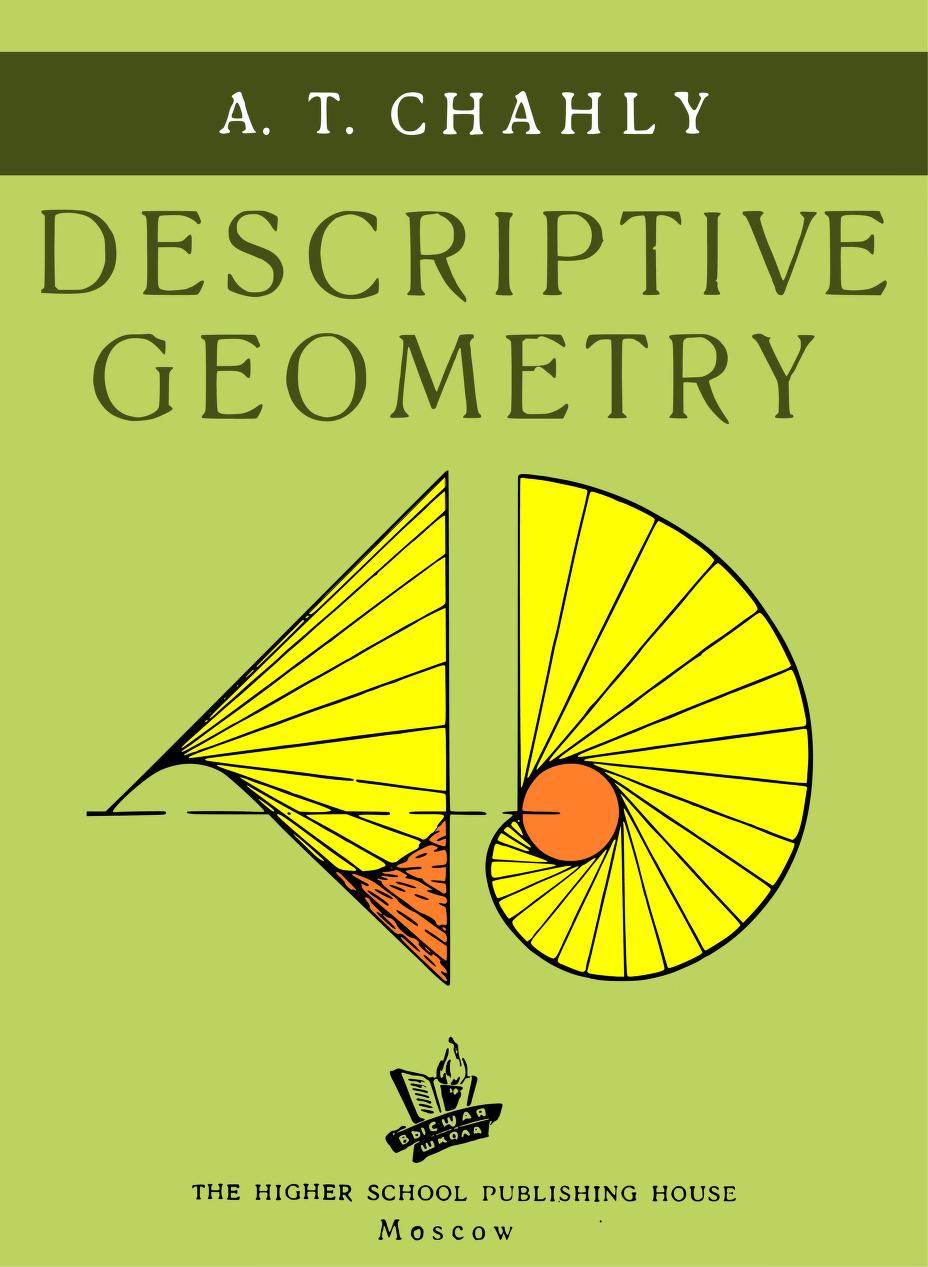
In this post, we will see the book Descriptive Geometry by A. T. Chahly.

About the book

Descriptive Geometry and Engineering Drawing are among the first engineering subjects taught at institutions of higher education. These subjects are essential if the students are to obtain a fundamental knowledge of the design and construction of machines and mechanisms.
Descriptive geometry, as a specific field of knowledge, like many others, arose and developed as a direct result of man’s creative labour.
Descriptive geometry is the theoretical foundation of engineering drawing which, in turn, is the preparatory graphical course required for studying all general engineering and special subjects.
Descriptive geometry develops the capacity for imagining objects in space which is essential for reading drawings.
Every engineer must have a good knowledge of the techniques used to represent objects by drawings. He must, so to say, be able to think in three dimensions. Creative engineering without this ability is quite impossible.
In this book descriptive geometry is dealt with step by step. Numerous examples are given to illustrate all theoretical aspects outlined and the methods of constructing projections.

Translated from the Russian by A. E. Tchernukhin and Th. Botting

The book was published by The Higher School Publishing House in 1968.

You can get the book here.

Follow us on The Internet Archive: https://archive.org/details/@mirtitles

Follow Us On Twitter: https://twitter.com/MirTitles

Write to us: mirtitles@gmail.com

Fork us at GitLab: https://gitlab.com/mirtitles/

Add new entries to the detailed book catalog here.


Posted in books, mathematics, soviet | Tagged , , , , , , , , , , , , | Leave a comment

Bridge And Potentiometer Methods Of Electrical Measurements – Karandeyev

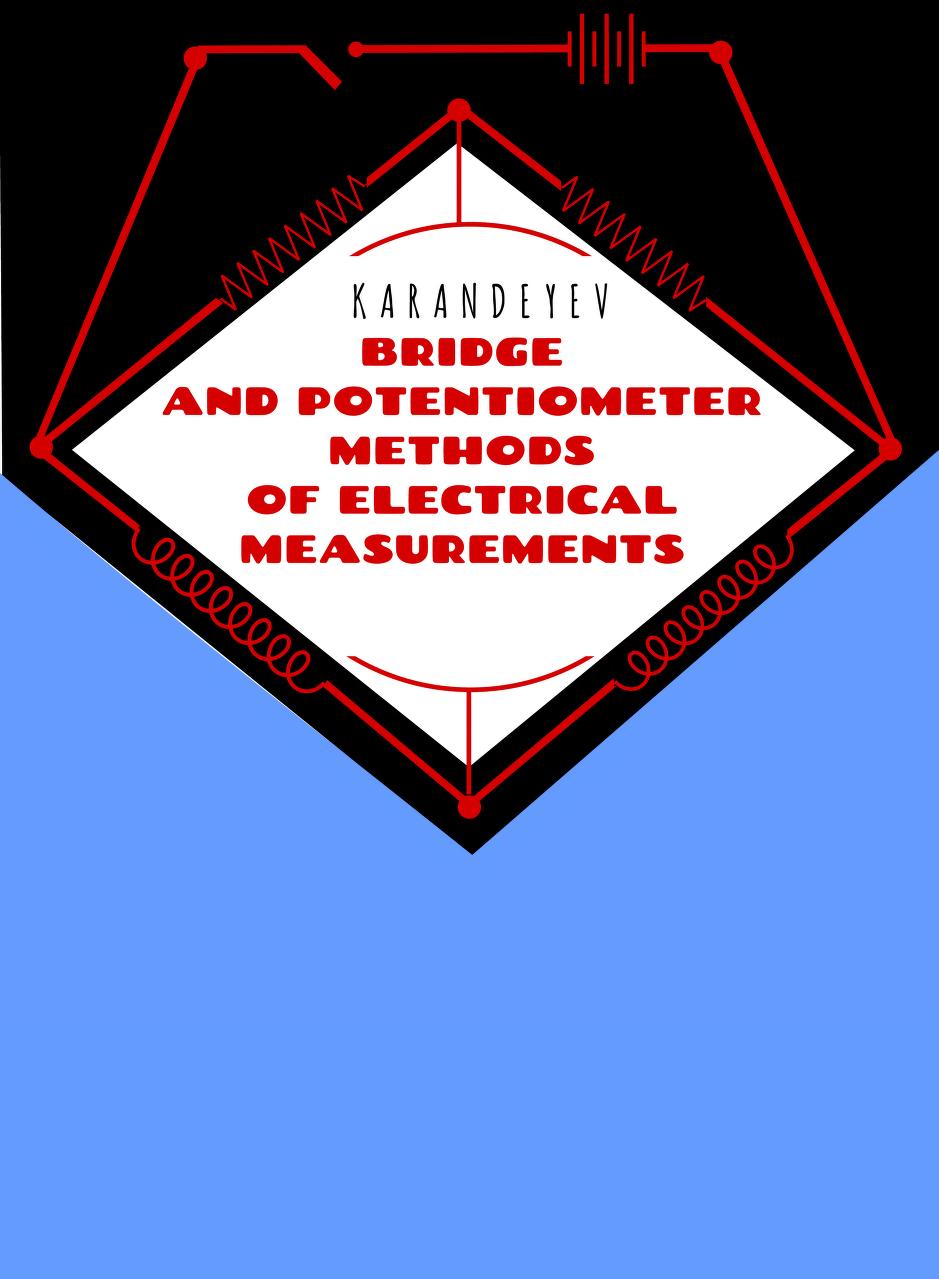
In this post, we will see the book Bridge And Potentiometer Methods Of Electrical Measurements by K. Karandeyev.

About the book

To sum up, our terms of reference will include the operating principles, basic features and techniques (including auxiliary apparatus) of the two important electrical methods of measurement: the bridge method and the potentiometer method, assuming that the measuring circuit is balanced by hand.

The book was translated from Russian by Boris Kuznetsov and was published in 1967 by Peace Publishers.

You can get the book here.

Follow us on The Internet Archive: https://archive.org/details/@mirtitles

Follow Us On Twitter: https://twitter.com/MirTitles

Write to us: mirtitles@gmail.com

Fork us at GitLab: https://gitlab.com/mirtitles/

Add new entries to the detailed book catalog here.

Contents

Introduction 7

Chapter One. BASIC DEFINITIONS AND CONCEPTS 11

1-1. Classification of Methods of Measurement 11
1-2. General Remarks on Sensitivity 15

Chapter Two. PRIMARY AND SECONDARY STANDARDS OF ELECTRI­ CAL UNITS 20

2-1. General 20
2-2. Standards of Resistance 22
2-3. Standards of Capacitance 25
2-4. Standards of Inductance 27
2-5. Standards of E.M.F. 29

Chapter Three. DIRECT-CURRENT AND ALTERNATING-CURRENT NULL DETECTORS 31

3-1. Types of Null Detectors 31
3-2. The Moving-coil Galvanometer 34
3-3. Valve-type A. C. Null Detectors 39

Chapter Four. AUXILIARY EQUIPMENT 53

4-1. Types of Auxiliary Equipment. Requirements 53
4-2. D. C. Power Supplies  54
4-3. Voltage Stabilizers 56
4-4. A. C. Supplies 62
4-5. Auxiliary Amplifiers 67

Chapter Five. THE D.C. BRIDGE METHOD 70

5-1. The Bridge Circuit. Definition of the Bridge Method 70
5-2. The Four-arm (Wheatstone) Bridge 71
5-3. The Kelvin Double Bridge 78
5-4. The Sensitivity of D.C. Bridges 86
5-5. Unbalanced Bridges. Comparison Sets 94
5-6. Construction of D. C. Bridges 110

Chapter Six. ALTERNATING-CURRENT BRIDGE MEASUREMENTS 114

6-1. Properties and Classification of A. C. Bridges 114
6-2. The Sensitivity of A. C. Bridges 123
6-3. Balancing and Circle Diagrams of A.C. Bridges 134
6-4. Balance Convergence of A. C. Bridges 142
6-5. Independence of Adjustments and Measurement 151
6-6. Basic Types of A. C. Bridges 156
6-7. Quasi-balanced A. C. Bridges 180
6-8. A. C. Percentage Bridges 187

Chapter Seven. THE D. C. POTENTIOMETER METHOD193

7-1. Basic Principles and Development of the Potentiometer Method 193
7-2. Practical D. C. Potentiometers 210
7-3. The Sensitivity of D. C. Potentiometers 221
7-4. Applications of D. C. Potentiometers 227

Chapter Eight. THE ALTERNATING-CURRENT POTENTIOMETER METHOD 232

8-1. Special Features of the A.C. Potentiometer Method  232
8-2. Principles of Construction and Practical A.C. Potentiometers 236
8-3. Applications of A. C. Potentiometers 244

Chapter Nine. CONTROL OF STRAY EFFECTS 247

9-1. Principal Sources of Stray Effects 247
9-2. Control of Stray Effects in D. C. MeasuringCircuits 250
9-3. Control of Stray Effects in A.C. Measuring Circuits 252
Index 263
Posted in books, electronics, engineering, peace publishers, physics, soviet, technology | Tagged , , , , , , , , , , , | Leave a comment

Instrumentation Manual – Weinberg

In this post, we will see the book Instrumentation Manual (Petroleum Processing and Petro Chemical Industries) by I. Weinberg.

About the book

Continuous progress in petroleum processing and petrochemical industries in the USSR calls for new plants to be put into service and those in operation to be enlarged. The automation of industrial processes is to be raised to new heights in the near future. Particular attention will be given to the improvement of the final product quality.

Each year the instrument-making industry and plants of specialized analytical instrumentation turn out in increasing numbers new instruments and analyzers, and redesign the models series-produced at present with a view to making the process control instrumentation more comprehensive and improving process-stream analysis and control. Every effort is being made by the research laboratories and institutes of the industries that the latest developments in science and technology be in no time put to use. Characteristic of the present stage of automation progress in the petroleum processing and petro-chemical industries is the complete automation of the industrial processes, the use of the commercial on-stream quality analyzers, the automation of the laboratory analysis on the basis of semiautomatic analyzers and means for data acquisition and reduction, and transmission of information to the process operator’s desk or computer.

Besides the scheduled maintenance of the equipment, the instrumentation and control personnel carry out substantial work for the development and introduction of new automatic measurement and control schemes for process units and installations. This is why, along with the specifications of instruments, analyzers, regulators, transducers, etc., used in petroleum processing and petro-chemical industries, the manual covers some concepts relating to metrology, reliability parameters, gives a guide to selecting the appropriate control elements and discusses the characteristics of a unified system of commercial pneumonics. It presents information about the explosion protection of instruments and gives recommendations on the repair and mounting of some instruments and analyzers.

Translated from, the Russian by N. Komissarova
First published 1978
Revised from the 1975 Russian edition

You can get the book here.

Follow us on The Internet Archive: https://archive.org/details/@mirtitles

Follow Us On Twitter: https://twitter.com/MirTitles

Write to us: mirtitles@gmail.com

Fork us at GitLab: https://gitlab.com/mirtitles/

Add new entries to the detailed book catalog here.

Posted in books, chemistry, engineering, soviet, technology | Tagged , , , , , , , , , , , , , , , , , , | Leave a comment

Biophysics – Volkenshtein

In this post, we will see the book Biophysics by M. V. Volkenshtein.

About the book

This book is intended for students and post-graduates—biologists mid physicists—who study biophysics. The book has emerged from the lectures given by the author for many years at the Moscow Physico-Technical Institute and from two monographs published earlier. The first of these monographs, Molecular Biophysics, was published in Russian in 1975 and in English by Academic Press in 1977. The second, General Biophysics, was issued in Russian in 1978 and is being prepared for publication by Academic Press. A considerable part of the book has been written anew. At the same time the above two monographs are recommended to the reader for a more thorough study of the subject. They are provided with extensive bibliography. In my opinion, biophysics is not a subsidiary branch of biology — but a legitimate part of the physical sciences. Biophysics is the physics of living things. Accordingly, an attempt has been made to divorce biophysics from physiology, though these fields overlap to a considerable extent. Though the book is devoted mainly to the theoretical problems of biophysics, it also deals with the most important experimental findings.

Translated from the Russian by Artavaz Beknazarov

First published 1983
Revised from the 1981 Russian edition

You can get the book here.

Follow us on The Internet Archive: https://archive.org/details/@mirtitles

Follow Us On Twitter: https://twitter.com/MirTitles

Write to us: mirtitles@gmail.com

Fork us at GitLab: https://gitlab.com/mirtitles/

Add new entries to the detailed book catalog here.

Contents

Preface 5

Chapter 1. Goals and Methods off Biophysics 11

1.1. The Place of Biophysics in Natural Sciences 11

1.2. Physics and Biology 13

1.3. Living and Inanimate Nature 15

1.4. Biological Individuality 17

1.5. Finalism and Causality 18

1.6. The Properties of Open Systems 19

1.7. Scope and Methods of Biophysics 22

Chapter 2. Chemical Foundations off Biophysics 25

2.1. Chemistry and Biology 25

2.2. Amino Acids 27

2.3. Electrolytes  29

2.4. The Composition and Primary Structure of Proteins 34

2.5. Nucleic Acids 36

2.6. Adenylates 43

2.7. The Chirality of Biological Molecules 45

2.8. Carbohydrates and Lipids 49

2.9. Cofactors, Vitamins, and Hormones 51

2.10. The Main Biochemical Processes 55

2.11. Strong and Weak Interactions 58

Chapter 3. Physics off Macromolecules 63

3.1. Macromolecules and Rubber Elasticity 63

3.2. Internal Rotation and Rotational Isomerism 66

3.3. The Rotational-Isomeric Theory of Macromolecules 71

3.4. The Macromolecule as a Cooperative System 78

3.5. The Coil and the Globule 82

3.6. Methods of Investigation of Macromolecules 85

3.7. Polyelectrolytes 91

Chapter 4. Physics of Proteins 95

4.1. The Goals of Protein Physics 95

4.2. Conformations of the Polypeptide C h a in 97

4.3. The Hydrogen Bond and the Structure of W ater 103

4.4. Helix-Coil Transitions 108

4.5. The Protein Globule and Hydrophobic Interactions 114

4.6. Relationship Between the Primary and the Three-Dimensional Structure of Proteins 119

4.7. The Structure and Stability of the Globule 125

4.8. Antibodies and Antigens 132

4.9. Fibrous Proteins 138

Chapter 5. Methods of Investigation of the Structure of Biopolymers 142

5.1. X-Ray Diffraction Analysis 142

5.2. Diffuse Scattering of X-Rays by Solutions of Biopolymers 148

5.3. Methods of Nuclear Physics 150 5.4. Electronic Absorption Spectra 153

5.5. Luminescence 157

5.6. Optical Activity 161

5.7. Optical Activity of Biopolymers 169

5.8. Magnetic Optical Activity 174

5.9. Vibrational Spectra 178

5.10. Nuclear Magnetic Resonance and ElectronParamagnetic Resonance 182

Chapter 6. Physics of Enzymes 188

6.1. Chemical Kinetics and Catalysis 188

6.2. Kinetics of Simple EnzymaticReactions 193

6.3. Chemical Aspects of Enzyme Action 198

6.4. Conformational Properties of Enzymes 205

6.5. Physics of Enzyme-Substrate Interactions 209

6.6. Electronic-Conformational Interactions 212

6.7. Cooperative Properties of Enzymes 217

6.8. Myoglobin and Hemoglobin 224

Chapter 7. Physics of Nucleic Acids 236

7.1. Molecular Biology and Physics 236

7.2. The Structure of Nucleic Acids 239

7.3. Intramolecular Interactions in the Double Helix 247

7.4. Thermodynamics of Melting of the Double Helix 250

7.5. Kinetics of Unwinding of the Double Helix 260

7.6. Interaction of the Double Helix with Small Molecules and Ions 265

7.7. Replication of DNA 268

Chapter 8. Physics of Protein Biosynthesis 275

8.1. The Problem of the Genetic Code 275

8.2. Protein Biosynthesis 280

8.3. Transcription and Reverse Transcription 284

8.4. Transfer RNA  286

8.5. Translation 289

8.6. Deciphering of the Genetic Code and Its Meaning 294

8.7. Mutations 301

8.8. Regulation of Genes 306

Chapter 9. Nonequilibrium Thermodynamics in Biology 313

9.1. Information and Entropy 313

9.2. Nonequilibrium Processes 319

9.3. Coupling of Fluxes 322

9.4. Coupling of Chemical Reactions 325

9.5. Steady States of Linear Systems 329

9.6. Coupling of Chemical Reactions to Transport of Matter 335

9.7. Far-from-Equilibrium Processes 339

Chapter 10. Physics of Membranes 346

10.1. Cell Membranes 346

10.2. The Structure of Membranes 348

10.3. Conformational Properties of Membranes 351

10.4. Passive Membrane Transport 355

10.5. Active Membrane Transport 361

10.6. Transport of Charged Particles Through Membranes 368

10.7. Molecular Reception 372

Chapter 11. Physics of the Nerve Impulse 377

11.1. The Axon and the Nerve Impulse 377

11.2. Propagation of the Nerve Impulse 388

11.3. Generation of the Nerve Impulse 394

11.4. Ionic Channels 399

11.5. Synaptic Transmission 402

Chapter 12. Mechanochemical Processes 406

12.1. Thermodynamics of Mechanochemical Processes 406

12.2. The Structure of the Muscle and Muscle Proteins 411

12.3. The Chemistry and Physics of the Muscle 417

12.4. The Theory of Muscular Contraction 423

12.5. The Kinetic Properties of the Muscle 431

12.6. Mechanochemical Systems 433

12.7. Biomechanics 437

Chapter 13. Bioenergetics of the Respiratory Chain 440

13.1. Biological Oxidation 440

13.2. The Structure and Properties of Mitochondria 446

13.3. Chemiosmotic Coupling 449

13.4. Electronic-Conformational Interactions 457

13.5. Cytochrome c 463

Chapter 14. Photobiological Processes 466

14.1. Photosynthesis 466

14.2. Two Photochemical Systems 472

14.3. Chloroplasts 477

14.4. The Mechanism of Photosynthesis 481

14.5. Vision 485

14.6. The Molecular Mechanism of Photoreception 489

14.7. Bacteriorhodopsin 497

Chapter 15. Modelling of Dynamic BiologicalProcesses 501

15.1. Dynamic Order 501

15.2. Physico-Mathematical Foundations of the Dynamics of Nonlinear Processes 504

15.3. Lotka-Volterra Models 515

15.4. Autocatalytic Systems 521

15.5. Phase Transitions 527

15.6. Stochastic Processes 532

15.7. Dynamics and Regulation 535

Chapter 16. Periodic Chemical and Biological Processes .538

16.1. Introduction 538

16.2. Belousov-Zhabotinsky Reactions 539

16.3. Auto-oscillations in Glycolysis 547

16.4. Auto-oscillations in Photosynthesis 551

16.5. Nonlinear Dynamics of Membranes 554

16.6. Autowave Processes in the Cardiac Muscle 559

Chapter 17. Problems of Biological Evolution and Development 564

17.1 The Origin of Life 564

17.2. Modelling of Prebiotic Evolution 568

17.3. Game Models and Informational Aspects of Self-Organization 572

17.4. Hypercycles 575

17.5. Other Models of Prebiological Evolution 579

17.6. Biological Evolution 585

17.7. Ontogenesis 589

17.8. Immunity 596

17.9. Biological Evolution and Information Theory 602

17.10. Complexity and Evolution 611

Recommended Literature 619

Name Index  624

Subject Index  627

Posted in chemistry, mir books, mir publishers, physics, science, technology | Tagged , , , , , , , , , , , , | Leave a comment

A Laboratory Manual For Trainees In Heat Treatment – Zuyev

In this post, we will see the book A Laboratory Manual For Trainees In Heat Treatment by V. M. Zuyev.

About the book

A lab manual with a series of experiments for determining effect of various types of processes on properties of materials.

Translated from the Russian by Boris V. Kuznetsov
First published 1985
Revised from the 1982 Russian edition

Many thanks to Anish M. for making this book available.

You can get the book here.

Follow us on The Internet Archive: https://archive.org/details/@mirtitles

Follow Us On Twitter: https://twitter.com/MirTitles

Write to us: mirtitles@gmail.com

Fork us at GitLab: https://gitlab.com/mirtitles/

Add new entries to the detailed book catalog here.

Contents


Posted in books, engineering, mir publishers, soviet, technology | Tagged , , , , , , , , , , , , , , , , | 1 Comment

Gravitation And Elementary Particle Physics (Advances In Science And Technology In The USSR – Physics Series) – Logunov ( Ed.)

In this post, we will see the book Gravitation And Elementary Particle Physics edited by A. A. Logunov. This book is a part of the – Advances In Science And Technology In The USSR – Physics Series.

About the book

A collection of papers by Soviet scientists on current issues of gravitation and elementary particles.. New gravitation theory is presented that, unlike Einstein’s theory of general relativity, satisfies the correspondence principle and conservation laws for energy-momentum for matter and gravitational field. The book also highlights the physical aspects of the multiple production of particles at high energies and scale invariance in strong interactions of elementary particles. Also the hypothesis is presented of coloured quarks and strongly inelastic processes in quantum chromodynamics, and theories are discussed describing spontaneous violation of colour symmetry. Intended for researchers interested in modern theory of gravitation and physics of elementary particles.

Translated from the Russian by Valerii Ilyushchenko, Cand. Sc. (Phys.-Math.)

First published 1983 by Mir Publishers

You can get the book here.

Follow us on The Internet Archive: https://archive.org/details/@mirtitles

Follow Us On Twitter: https://twitter.com/MirTitles

Write to us: mirtitles@gmail.com

Fork us at GitLab: https://gitlab.com/mirtitles/

Add new entries to the detailed book catalog here.

Contents

Introduction by A. A. Logunov

1. The Theory of Space-Time and Gravitation by V. I. Denisov and A. A. Logunov

2. Inclusive Processes and Strong Interaction Dynamics by A. A. Logunov, M. A. Mestvirishvili, and V. A. Petrov

3. Colored Quarks by N. N. Bogolyubov , V. A. Matveev, and A. N. Tavkhelidze

Posted in astrophysics, books, mathematics, mir publishers, physics | Tagged , , , , , , , , | 1 Comment

General Chemical Engineering – Furmer, Zaitsev

In this post, we will see the book General Chemical Engineering by I. Furmer; V. Zaitsev.

About the book

At the present time, there are tens of thousands of products
manufactured by chemical and related industries. It
is not feasible to acquaint students with the manufacture
of each product. It is essential therefore that every student
should be provided with information on the regularities
inherent in chemical processes and on the use of these
regularities to apply these processes in practice.
Due to this fact, the course in general chemical engineering
is acquiring a special importance in the training of
industrial workers. The authors of this book deal with the
theoretical fundamentals of chemical processes in a form
-comprehensible to students of vocational training schools,;
and show their application by giving specific examples in
Ahe manufacture of major chemical products.

Many Thanks to Anish M. for making this book available.

Translated from the Russian by Yu. N. Vereshchagin

First published 1985

Revised from the 1984 Russian edition

You can get the book here.

Follow us on The Internet Archive: https://archive.org/details/@mirtitles

Follow Us On Twitter: https://twitter.com/MirTitles

Write to us: mirtitles@gmail.com

Fork us at GitLab: https://gitlab.com/mirtitles/

Add new entries to the detailed book catalog here.

Posted in books | Tagged , , , , , , , , , , , , , , , , , , , , , , , , , , , , , , , , , | Leave a comment

A Course In Descriptive Geometry – Gordon, Sementsov-Ogievskii

In this post, we will see the book A Course In Descriptive Geometry by V. O. Gordon; M. A. Sementsov-Ogievskii.

About the book

This celebrated textbook was written as a course in descriptive geometry for students of machine building and mechanical engineering institutes. It contains sections on systems of orthogonal projections and axonometric projections. It also includes a systematic account of topics like formation of projections, point and straight line, planes and their mutual positions, formation of a drawing
by varying projection planes and rotation, construction of polygons and their intersection by a plane and
a straight line, intersection of one polygonal surface by another, curved lines and curved surfaces,
intersection of curved surfaces by a plane and a straight line, intersection of one curved surface
by another, involution of curved surfaces. Each chapter contains a large number of test questions to make the subject matter more readily comprehensible. The book also contains a short account of the development of descriptive geometry since XIX century as well as information about some scientists who have made significant contributions in the field of descriptive geometry both as a science and as a subject of study.

Edited by V. O. Gordon
Translated from the Russian by Leonid Levant
First published 1980
Revised from the 1977 Russian edition

You can get the book here.

Follow us on The Internet Archive: https://archive.org/details/@mirtitles

Follow Us On Twitter: https://twitter.com/MirTitles

Write to us: mirtitles@gmail.com

Fork us at GitLab: https://gitlab.com/mirtitles/

Add new entries to the detailed book catalog here.


Posted in books, mathematics, mir books, mir publishers | Tagged , , , , , , , , , , | Leave a comment

Aksel Berg A Man Of 20th Century – Radunskaya

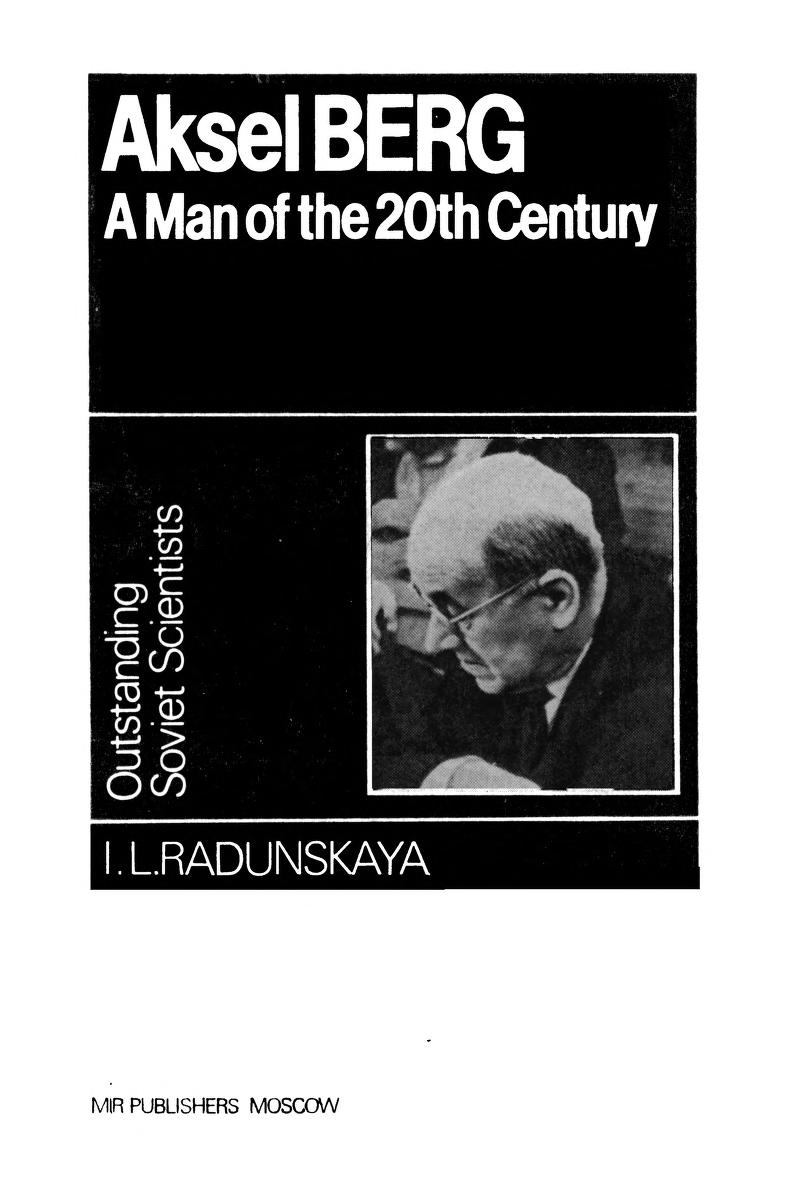
In this post, we will see the book Aksel Berg A Man Of 20th Century by I. L. Radunskaya. This books is a part of the Outstanding Soviet Scientists series

About the book

His life, in essence, consisted of several separate lives. or just the third of the lives, he would merit a biography all the same. Because each of his lives would be sufficient to make a full-blooded biography of an outstanding man.

In fact, the first life is the life of a nobleman, a czarist officer who sided with the Revolution and became one of the first Red navigators, first radio physicist and one of the fathers of cybernetics. A tragic event nearly killed him. But he was destined to know a new fate, to become an admiral, an Academician, a Deputy Minister of Defence, a Hero of Socialist Labour. He was instrumental in developing Soviet radar science, one of the wonders of the century. A myocardial infarction, several years taken away by diseases. But. . .A third life begins. The 66-year-old Berg again puts up a fight, a fight for cybernetics. It was not without good reason that his friends jokingly called the science cy-Berg-netics. A new life of the scientist. True, on the surface of it this life had no major upheavals, no exciting events — no battles and gales. If the earlier years is a novel of action, then this life is a novel of thought. It is a clash of ideas! Some excerpts from his note-books: “After the dust of centuries has settled down, we will be remembered not only for our victories and defeats in warfare or politics, but also for what we have accomplished for the future spiritual development of man.” “Nobody must be great or wise, but everybody must be honest…” “Admiration for outstanding people produces natural desire to emulate them.” It is in this hope that I begin my story.

Translated from the Russian by Alexander Repyeu
First published 1986
Revised from the 1971 Russian edition

You can get the book here.

Follow us on The Internet Archive: https://archive.org/details/@mirtitles

Follow Us On Twitter: https://twitter.com/MirTitles

Write to us: mirtitles@gmail.com

Fork us at GitLab: https://gitlab.com/mirtitles/

Add new entries to the detailed book catalog here.


Posted in books, computers, engineering, mir publishers, popular science, soviet, technology | Tagged , , , , , , | Leave a comment

Industrial Robots Handbook – Kozyrev

In this post, we will see the book Industrial Robots Handbook by Yu. Kozyrev.

About the book

Industrial robots are being used more and more in many fields of industry where they are replacing human operators engaged in onerous, repetitive, or potentially hazardous jobs. A particular point in favor of robots is that they can be taught to do jobs which are not amenable to automation or mechaniza­tion through conventional approaches. Robot systems are certainly only one of the many possible means of automating and simplifying the production process. They pave the way to a qualitatively new stage of automation, namely, the development of production systems which would require a minimum human attendance.
One of the main advantages of industrial robots is that they can be quickly reprogrammed to undertake tasks that differ in sequence and character of mani­pulation steps. Robots are therefore most cost-effective in conditions of frequent product changes and in automation of jobs requiring manual unskilled labor. A major share of the products of the metal-working and machine-building industries come in low-volume batches. It is essential to evolve automatic assembly machines suitable for short and medium production runs. Of no less importance is to ensure fast retooling of automatic lines and putting them on stream as fast as possible.

Industrial robots can be harnessed to handle not only the main tasks but also auxiliary ones, which explains why they are generating ever greater in­ terest.

From 1970 to 1980, the total world stock of machinery loosely called indu­strial robots increased 25-fold to number 25 000 units. The areas of application of robots extend with each passing year. Robots mostly service press-forging and foundry equipment, and also machine tools. The use of robots for welding, painting, and coating operations continues to extend. In the last few years the number of robots working at assembly jobs has increased.

One of the main causes of the intensive development of robotics is the need to increase productivity in manufacturing. In comparison with conventional automatic means, robots offer greater flexibility in solving technical and orga­nizational problems and shorten the time needed to complete and adjust auto­matic systems, and put them into service.

In deciding on whether to use robots, industrial safety and working conditions should be given prior consideration. This is particularly the case where condi­tions are harmful or hazardous to the health of workers.

To sum up, industrial robots will most likely be used more and more to achieve the following:
— raise the quality and volume of products, with a minimum of labor force employed, owing to a decrease in the production time and reproducible perfor­mance of robots which are not subject to fatigue; increase the life of the equip­ ment; improve the current production processes and create innovative high­ speed production processes and equipment; — improve working conditions by relieving people of stultifying, repetitive, tedious, hazardous tasks; increase the safety of industrial labor; decrease the loss in man-hours due to occupational trauma and industrial diseases;
— decrease labour requirements.

Translated from the Russian by P. S. Ivanov
First published 1985
Revised from the 1983 Russian edition

You can get the book here.

Follow us on The Internet Archive: https://archive.org/details/@mirtitles

Follow Us On Twitter: https://twitter.com/MirTitles

Write to us: mirtitles@gmail.com

Fork us at GitLab: https://gitlab.com/mirtitles/

Add new entries to the detailed book catalog here.

Posted in books, computers, electronics, engineering, mir publishers, soviet, technology | Tagged , , , , , , , , , , | Leave a comment