A picture story book for children.
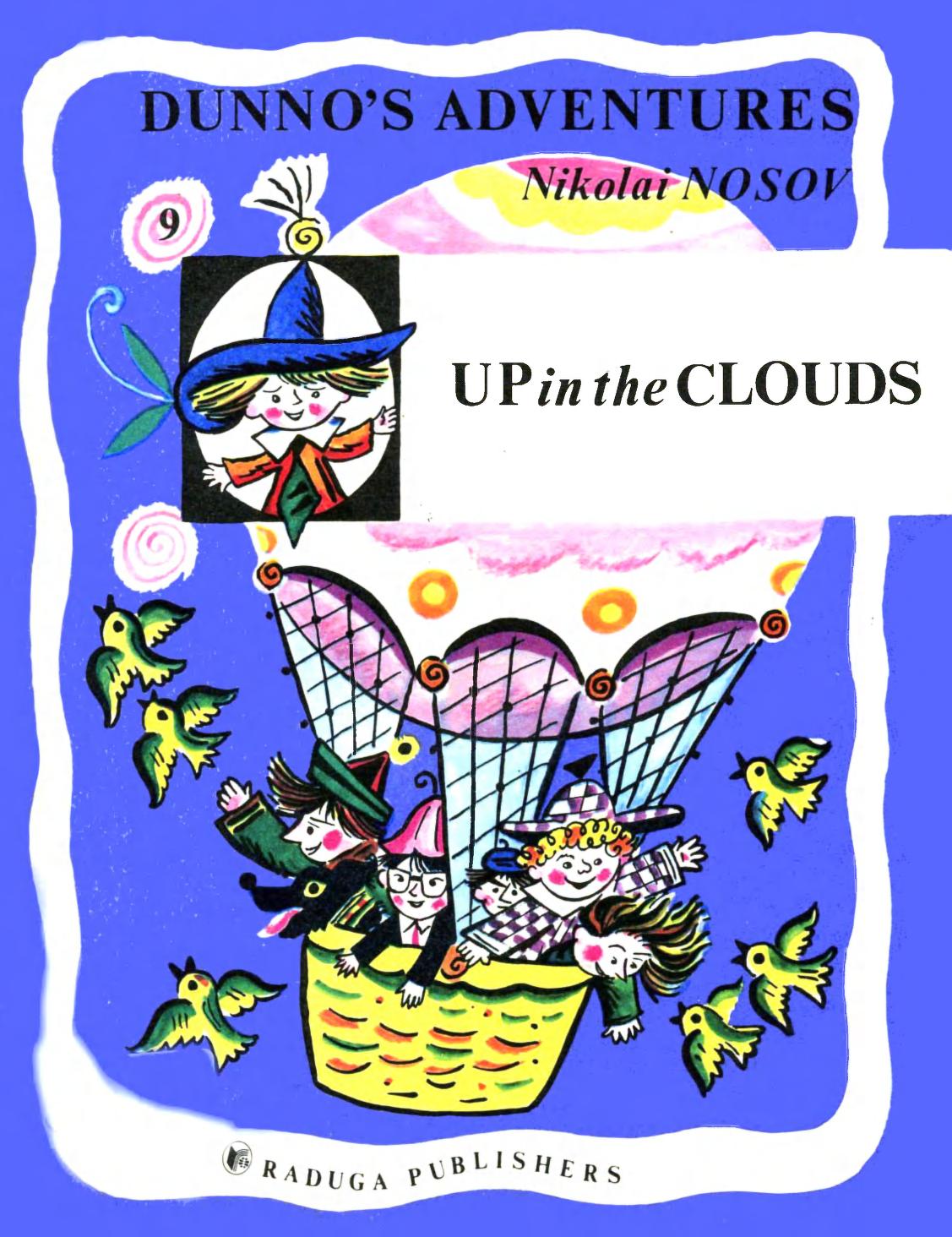
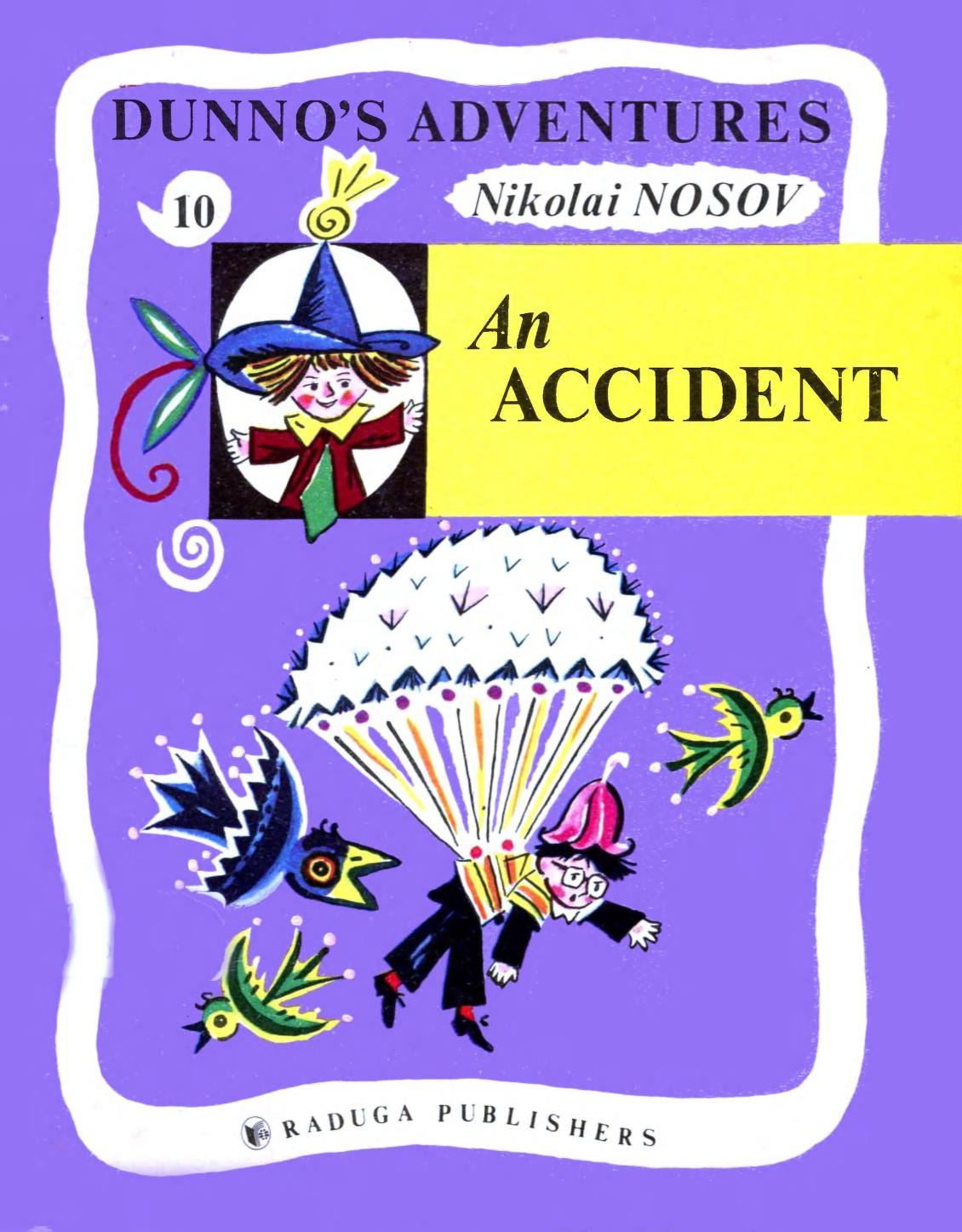
Dunno’s adventures with a hot air balloon and its accident
Drawings by Boris Kalaushin
Translated from the Russian by Margaret Wettlin
A picture story book for children.
Dunno’s adventures with a hot air balloon and its accident
Drawings by Boris Kalaushin
Translated from the Russian by Margaret Wettlin
Following the rapid development of anthropogenic changes in the environment in recent years there emerged a heightened interest in problems of global ecology. This is why it was important to write a book devoted entirely to the problems of that science, even though this has presented some difficulties.
Global ecology as a distinct scientific discipline is still in a state of development,rand its boundaries are not yet clearly defined. While not seeking to encompass all branches of that science, the author has found it appropriate to emphasize the central problem of world ecology, namely, the [circulation of energy and of different types of matter within the biosphere. Wide use has been made of the author’s own earlier studies, including relevant sections of Thermal Balance of the Earth’s Surface (1956), Climate and Life (1971), and Climatic Changes (1974).
These studies are fneeded to solve current problems of global ecology, as well as to explain the patterns of the biosphere’s evolution in the past and to forecast its possible changes in the future.
Particular emphasis has been given to the geophysical aspects of global ecology, since the author possessed more data on that subject than on other aspects of that science.
Translated from the Russian
Designed by Mikhail Shevtsov
You can get the book here and here.
Preface 5
The Biosphere 6
1. The Problems and Tasks of Global Ecology 6
2. The Structure of the Biosphere 17
The Transformations of Solar Radiation 36
1. Components of the Biosphere’s Energy Balance 36
2. The Geographical Distribution of Energy Balance Components 50
III Climate 72
1. Climate and Life 72
2. The Theory of Climate 81
3. Changes in Climate 99
IV The Hydrological Cycle 114
1. The Water Balance 114
2. Relations Between Energy and Water Balances on Land 120
3. The Water Exchange in the Atmosphere 128
V Geographical Zones 136
1. Climatic Factors Determining Geographical Zonality 136
2. A Periodic Law of Geographical Zonality 142
VI The Circulation of Organic Matter 154
1. Activities of Autotrophic Plants 154
2. The Global Biological Cycle 175
VII The Ecological Mechanism of the Evolution of Organisms 191
1. The Stability of Ecological Systems 191
2. Critical Ages in the History of the Biosphere 202
VIII The Ecological Mechanism of the Evolution of Man 222
1. The Origin of Man 222
2. The Ecological Crisis of the Upper Paleolithic 233
IX Man and the Biosphere 249
1. The Current Ecological Situation 249
2. Man’s Influence on Global Processes 259
X The Future of the Biosphere 276
1. The Evolution of the Biosphere 276
2. The Biosphere in the Near Future 293
Conclusion 310
Bibliography 313
The problem of the gaseous composition of the atmosphere is one of the central questions of modern atmospheric physics. We need not consider in detail the fact that the gaseous composition, which varies considerably with height, has a vital influence on most phenomena occurring in the Earth’s atmosphere. In the upper layers of the atmosphere, there is no single problem (with the possible exception of the wind conditions) that can be solved accurately without a knowledge of the chemical nature of these layers.
As far as I know, this is the first book to appear in either Russian or foreign literature which attempts to collect and systematize the large amount of work devoted to the investigation of the composition of the Earth’s air cover. Hundreds of papers, not connected by any unifying idea—some of them old and undeservedly forgotten, others scattered throughout various journals—cannot give a complete impression of the gaseous composition of the atmosphere. The scattered nature of the material makes it necessary to spend a large amount of time and trouble just to become acquainted with the work that has been done.
The absence of a critical appraisal of the often somewhat contradictory results of various experiments has led to the inclusion of incorrect information in modern courses on atmospheric physics and in most reference books. This has happened even when dealing with the lower atmosphere, which has been most thoroughly investigated.
The recent use of rockets and artificial satellites has led to rapid progress in our exploration of the upper atmosphere. The large amount of very interesting material, which has accumulated within the short space of the last decade, needs analysis and detailed commentary. All these considerations have led me to write this monograph, in which I have tried to collect and critically discuss the existing experimental material on the chemical composition of the atmosphere.
This book deals with a series of problems connected with the investigation of the composition of the atmosphere, but it is by no means my intention to try to describe all sides of this subject. In order to avoid giving the reader a false impression of the volume of work discussed, I shall now clearly define the range covered.
You can get the book here and here.
PREFACE 1
CHAPTER I. INVESTIGATIONS OF THE LOWER ATMOSPHERE
Introduction
Early geophysical investigations 9
The discovery of new gases in air the present state of knowledge of the gaseous composition of the lower atmosphere 18
Conclusion 26
CHAPTER II. INVESTIGATIONS OF THE COMPOSITION OF THE MIDDLE ATMOSPHERE (up to a height of 30 km)
Introduction 27
Balloon ascents 28
Discovery of the stratosphere and the problem of the gravitational separation of gases 30
Early investigations of the composition of the atmosphere at high altitudes by indirect methods 32
Direct investigations in the stratosphere 33
Balloon ascents into the stratosphere 36
Sounding-balloon investigations with automatic equipment 41
Conclusion 49
CHAPTER III. INVESTIGATIONS OF THE COMPOSITION OF THE UPPER ATMOSPHERE USING ROCKETS (sampling method)
Introduction 51
Gaseous composition one of the central problems of the physics of the upper atmosphere 56
Sounding rockets 57
Characteristics of rocket investigations 63
Methods and results of investigations of gaseous composition 64
Conclusion 78
CHAPTER IV. SOVIET INVESTIGATIONS OF THE UPPER ATMOSPHERE USING ROCKETS (sampling method)
Introduction 80
Sampling 81
Storing the samples 91
Analysis of the samples 93
Spectroscopic microanalysis of gases 95
The vacuum apparatus 101
Experimental results 106
CHAPTER V. INVESTIGATIONS OF THE COMPOSITION OF THE UPPER ATMOSPHERE USING ROCKET-BORNE RADIO-FREQUENCY MASS SPECTROMETERS
Introduction 110
Characteristics of the composition of the upper atmosphere 110
The use of the radio-frequency mass spectrometer for investigating the upper atmosphere 113
American investigations on the neutral composition of the atmosphere 117
Investigations of the neutral composition of the atmosphere carried out in the Soviet Union 128
Discussion of results 133
Investigations of the ionic composition of the atmosphere carried out in the USA 136
Investigations of the ionic composition of the atmosphere carried out in the USSR 142
Conclusion 144
CHAPTER VI. INVESTIGATIONS OF THE IONIC COMPOSITION OF THE UPPER ATMOSPHERE USING RADIO-FREQUENCY MASS SPECTROMETERS MOUNTED IN ARTIFICIAL SATELLITES (SPUTNIKS)
The use of artificial satellites for the investigation of the Earth’s upper and outer atmosphere 146
Characteristics of the method of investigation 147
Investigations of the ionic composition of the upper atmosphere 157
Discussion of the results 163
Conclusion 165
BIBLIOGRAPHY 172
APPENDIX THE CONCENTRATION OF OZONE IN THE ATMOSPHERE
Introduction 179
The variation of the overall ozone content and the study of ozone in the lower atmosphere 180
Investigations on the vertical distribution of ozone at high altitudes 187
Photochemical theory 193
Conclusion 196
Bibliography 198
LIST OF ABBREVIATIONS 209
A collection of Russian fairy tales for children.
Compiled by A. Afanasiev
Illustrations by I. Bilibin
Translated from Russian by A. Zamchuk
Sister Alionushka and brother Ivanushka 1
Tale of Ivan-Tsarevich, the firebird and the grey wolf 9
Vasilisa the Beautiful 23
Tale of the Frog Tsarevna 35
Tale of the feather of Finist, the bright Falcon 43
Maria Morevna 53
Tale of the White Duck 66
You can get the book here and here.
नजानू की अस्पताल की फुलनगर की सैर
अनुवादक सरस्वती हैदर
चित्रकार बोरीस कलऊशिन
The theory of equations of mixed type originated in the fundamental researches of the Italian mathematician Francesco Tricomi, which were published in the twenties of this century. Owing to the importance of its applications, the discussion of problems concerned with equations of mixed type has become, in the last ten years, one of the central problems in the theory of partial differential equations.
The present work is not meant to be a summary of all results in this field, especially since the number of results increases with great speed; nevertheless, the reader of this monograph will obtain an idea of the present state of the theory of equations of mixed type.
This book was developed from a series of lectures dealing with certain fundamental questions in the theory of equations of mixed type, which the Author delivered in scientific establishments in the Chinese People’s Republic at the end of 1957 and the beginning of 1958.
Translated by P. Zador
Translation edited by I. N. Sneddon
You can get the book here and here.
CONTENTS
Foreword ix
Introduction xi
1. General remarks on linear partial differential equations of mixed type 1
1. Equation of the second order with two independent variables 1
2. The theory of Cibrario 3
3. Systems of two first order equations 12
4. Linear systems of partial differential equations of the second order with two independent variables 17
2. The study of the solutions of second order hyperbolic equations with initial conditions given along the lines of parabolicity 20
1. The Riemann function for a second order hyperbolic linear equation 20
2. A class of hyperbolic systems of second order linear equations 27
3. The Cauchy problem for hyperbolic equations with given initial conditions on the line of parabolic degeneracy 32
4. Generalizations 41
3. The study of the solutions of second order elliptic equations for a domain, the boundary of which includes a segment of the curve of parabolic degeneracy 44
1. The linear elliptic partial differential equation of the second order 44
2. Elliptic systems of second order 49
3. The Dirichlet problem for second order elliptic equations in a domain, the boundary of which includes a segment of the curve of parabolic degeneracy 58
4. Some other problems and generalizations 66
4. The problem of Tricomi 71
1. The statement of the problem of Tricomi 72
2. The extremal principle and the uniqueness of the solution of problem T 74
3. Solution of problem T by means of the method of integral equations 78
4. Continuation. The proof for the existence of a solution of the integral equations obtained in the preceding paragraph 90
5. Other methods for solving problem T 94
6. Examples and generalizations 103
5. Other mixed problems 112
1. The mixed problem M 112
2. The proof of the uniqueness of solution for problem M 113
3. Concerning the existence of the solution of problem M 117
4. The general mixed problem 124
5. The problem of Frankl 135
6. Short indication of some important generalizations and applications 141
References 151
Index 157
Dunno’s adventures with a soda-water can car
Drawingsby Boris Kalaushin
Translated from the Russian by Margaret Wettlin
Dunno’s adventures with learning music
Drawingsby Boris Kalaushin
Translated from the Russian by Margaret Wettlin
The Eternal Wind is a science-fiction story about people of the not-too-distant future. The setting is an island float in the Indian Ocean, a biostation and a scientific centre for the biological research of ocean life. The main characters are students spending the summer on field practice. They unriddle the secrets of the ocean and help in utilizing its countless riches. The book also tells of the dolphin, man’s closest friend, of killer whales and many strange denizens of the deeps. The book is full of thrills for the young reader—romance, adventure and danger accompanies the two student-heroes of this tale of the sea.
Translated from the Russian by Gladys Evans
A collection of short stories and novellas by Russian writer Anton Chekov (Chekhov)
Translated from the Russian by Ivy Litvinov
Designed by B. Trifonov
You can get the book here and here.
Twitter: @MirTitles
Mastodon: @mirtitles@mastodon.world
Mastodon: @mirtitles@mastodon.social
Bluesky: mirtitles.bsky.social
Fork us at: https://gitlab.com/mirtitles
Contents
DEATH OF A CLERK 9
CHAMELEON 13
THE MASK 18
WOE 25
VANKA 32
ANTAGONISTS 37
DULL STORY (From an Old Man’s Note-Book) 53
THE GRASSHOPPER 122
WARD No. 6 152
THE HOUSE WITH THE MANSARD, An Artist’s Story 218
YONICH 240
THE MAN WHO LIVED IN A SHELL 262
GOOSEBERRIES 278
THE LADY WITH THE DOG 291
IN THE GULLY 312
THE BRIDE 361