Multicoloured Fins – Datskevich

In this post, we will see the book Multicoloured Fins by V. Datskevich.

About the book

A little book describing various colourful fish and habits and habitats. It describes various tropical and non-tropical fish which are reared in aquariums.

The book was translated from Russian by was published in  by Publishers.

You can get the book here.

PS: This book brings back special memories for me. Till some years back I had two planted aquariums which hosted a variety of fish. One of the tanks had wild guppies and other fish collected from various streams and lakes. I used river sand as a substrate and plants would be very healthy. I have had vallisneria, hydrilla, ludwigia, amazon swords, cadomba, water ferns along with several other aquatic plants, though crown were water lilies which would continuously flower in the tanks. I have had almost all fish mentioned in the book at some point of time, so it was refreshing to know a bit more about them and their scientific names as well.

Follow us on The Internet Archive: https://archive.org/details/@mirtitles

Follow Us On Twitter: https://twitter.com/MirTitles

Write to us: mirtitles@gmail.com

Fork us at GitLab: https://gitlab.com/mirtitles/

Add new entries to the detailed book catalog here.

Contents


Posted in books | Leave a comment

Challenging Mathematical Problems With Elementary Solution (Vols. 1 & 2) – Yaglom, Yaglom

In this post, we will see the two volume set of Challenging Mathematical Problems With Elementary Solution by A. M. Yaglom; I. M. Yaglom .

Volume 1: Combinatorial Analysis and Probability Theory

Volume 2: Problems From Various Branches of Mathematics

About the books

This book is the first of a two-volume translation and adaptation of a well-known Russian problem book entitled Non-Elementary Problems in an Elementary Exposition The first part of the original, Problems on Combinatorial Analysis and Probability Theory, appears as Volume I, and the second part, Problems from Various Branches of Mathematics, as Volume II. The authors, Akiva and Isaak Yaglom, are twin brothers, prominent both as mathematicians and as expositors, whose many excellent books have been exercising considerable influence on mathematics education in the Soviet Union.

This adaptation is designed for mathematics enthusiasts in the upper grades of high school and the early years of college, for mathematics instructors or teachers and for students in teachers’ colleges, and for all lovers of the discipline; it can also be used in problem seminars and mathematics clubs. Some of the problems in the book were originally discussed in sections of the School Mathematics Circle (for secondary school students) at Moscow State University; others were given at Moscow Mathematical Olympiads, the mass problem-solving contests held annually for mathematically gifted secondary school students.
The chief aim of the book is to acquaint the reader with a variety of new mathematical facts, ideas, and methods. The form of a problem book has been chosen to stimulate active, creative work on the materials presented.

The first volume contains 100 problems and detailed solutions to them. Although the problems differ greatly in formulation and method of solution, they all deal with a single branch of mathematics: combinatorial analysis. While little or no work on this subject is done in American high schools, no knowledge of mathematics beyond what is imparted in a good high school course is required for this book. The authors have tried to outline the elementary methods of combinatorial analysis with some completeness, however. Occasionally, when needed, additional explanation is given before the statement of a problem.

Designed for advanced high school students, undergraduates, graduate students, mathematics teachers and any lover of mathematical challenges, this two-volume set offers a broad spectrum of challenging problems—ranging from relatively simple to extremely difficult. Indeed, some rank among the finest achievements of outstanding mathematicians.

Translated from a well-known Russian work entitled Non-Elementary Problems in an Elementary Exposition, the chief aim of the book is to acquaint the reader with a variety of new mathematical facts, ideas and methods. And while the majority of the problems represent questions in higher (“non-elementary”) mathematics, most can be solved with elementary mathematics. In fact, for the most part, no knowledge of mathematics beyond a good high school course is required.

Volume Two contains 74 problems from various branches of mathematics, dealing with such topics as points and lines, lattices of points in the plane, topology, convex polygons, distribution of objects, non-decimal counting, theory of primes and more. In both volumes the statements of the problems are given first, followed by a section giving complete solutions. Answers and hints are given at the end of the book

Ideal as a textbook, for self-study, or as a working resource for a mathematics club, this wide-ranging compilation offers 174 carefully chosen problems that will test the mathematical acuity and problem-solving skills of almost any student, teacher or mathematician.

Volume 1 was translated from Russian by James McCawley Jr. was published in 1964.

Volume 2 was translated from Russian by James McCawley Jr. was published 1967.

Credits to original uploader.

You can get Volume 1 here.

You can get Volume 2  here.

Follow us on The Internet Archive: https://archive.org/details/@mirtitles

Follow Us On Twitter: https://twitter.com/MirTitles

Write to us: mirtitles@gmail.com

Fork us at GitLab: https://gitlab.com/mirtitles/

Add new entries to the detailed book catalog here.

Contents

Volume 1

PROBLEMS

I. Introductory problems 4
II. The representation of integers as sums and products 5
III. Combinatorial problems on the chessboard 10
IV. Geometric problems on combinatorial analysis 12
V. Problems on the binomial coefficients 15
VI. Problems on computing probabilities 20
VII. Experiments with infinitely many possible outcomes 27
VIII. Experiments with a continuum of possible outcomes 30

SOLUTIONS

I. Introductory problems 39
II. The representation of integers as sums and products 52
III. Combinatorial problems on the chessboard 76
IV. Geometric problems on combinatorial analysis 102
V. Problems on the binomial coefficients 125
VI. Problems on computing probabilities 141
VII. Experiments with infinitely many possible outcomes 194
VIII. Experiments with a continuum of possible outcomes 211

Volume 2

Preface to the American Edition v

Suggestions for Using the Book vii

Problems 3
I. Points and Lines 3
II. Lattices of Points in the Plane 5
III. Topology 7
IV. A Property of the Reciprocals of Integers 11
V. Convex Polygons 11
VI. Some Properties of Sequences of Integers 12
VII. Distribution of Objects 13
VIII. Nondecimal Counting 13
IX. Polynomials with Minimum Deviation from Zero (Tchebychev Polynomials) 20
X. Four Formulas for 𝜋 22
XI. The Calculation of Areas of Regions Bounded by Curves 33
XII. Some Remarkable Limits 38
XIII. The Theory of Primes 45

Solutions 45

Hints and Answers 199

Bibliography 213

Posted in books, mathematics, problem books, soviet | Tagged , , , , , , , , , , , , , , , , , , , , | 1 Comment

Mechanics Of Gyroscopic Systems – Ishlinskii

In this post, we will see the book .

About the book

This book discusses a fairly wide range of problems in mechanics con­nected with the practical application of gyroscopes. The classical studies of A.N. Krylov and B. V. Bulgakov on the theory of gyroscopes are insufficient for solving the problems encountered in the development of new gyroscopic systems. Stricter standards of accuracy have made it necessary to take into account factors formerly neglected and to explain previously undetected experimental facts. New problems in kine­matics, the applied theory of elasticity, the theory of oscillations and sta­bility, and the theory of gyroscopes proper have thus arisen.

Several new papers on the theory of gyroscopic systems have been pub­lished by the author since this book was written (the present monograph is a second slightly revised edition of the book which was first printed in 1952 in a limited issue). Three of them are given here as appendixes.

The book was translated from Russian by Israel Program for Scientific Translations and was published in 1965.

Original scan by NASA TechDocs.

You can get the book here.

Follow us on The Internet Archive: https://archive.org/details/@mirtitles

Follow Us On Twitter: https://twitter.com/MirTitles

Write to us: mirtitles@gmail.com

Fork us at GitLab: https://gitlab.com/mirtitles/

Add new entries to the detailed book catalog here.

Contents


FOREWORD 1

Chapter I. GEOMETRY AND KINEMATICS OF GYROSCOPIC SYSTEMS 5

Chapter II. ORIENTATION OF GYRO-CONTROLLED OBJECTS 46

Chapter III. PHENOMENA CONNECTED WITH THE ELASTICITY OF GYRO-SYSTEM ELEMENTS 75

Chapter IV. LINEAR THEORY OF GYROSCOPIC SYSTEMS 105

Chapter V. NONLINEAR PROBLEMS IN THE THEORY OF GYROSCOPES 178

Chapter VI. VARIOUS PROBLEMS IN GYRO-SYSTEM MECHANICS 221

APPENDIX I. THEORY OF COMPLEX GYROSCOPIC STABILIZATION SYSTEMS
APPENDIX II. THEORY OF THE GYROHORIZONCOMPASS
APPENDIX III. DETERMINING THE POSITION OF A MOVING OBJECT BY GYROS AND ACCELEROMETERS

BIBLIOGRAPHY 311

Posted in books, physics, soviet, statistics | Tagged , , , , , , , , , | 1 Comment

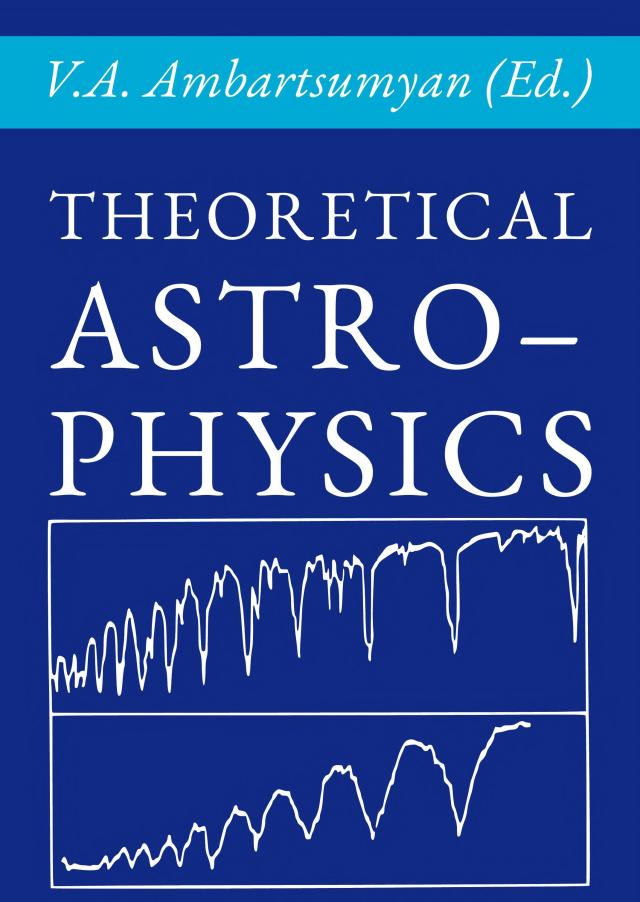
Theoretical Astrophysics – Ambartsumyan ( Ed.)

In this post, we will see the book Theoretical Astrophysics edited by V. A. Ambartsumyan.
About the book

Theoretical astrophysics is the science which studies and explains, using the laws of physics, the physical processes occurring in the heavenly bodies. In doing so, wide use is made of mathematical methods, but these play only a subsidiary part.
Although theoretical astrophysics is a young and very rapidly developing science, its results are already of great importance in all branches of astronomy and in many branches of physics. The subject has been developed particularly in the USSR.

Soviet scientists who work in the field of theoretical astrophysics are guided by the method of dialectical materialism, and always link their work to reality, using mathematical and physical methods as an important and powerful means of studying the heavenly bodies.

In the field of theoretical astrophysics, Soviet scientists now occupy the leading place in the world. The authors of this book have made by their investigations considerable contributions to the branches of theoretical astrophysics which they discuss. The treatment of many topics in the present work is therefore completely original, and sometimes differs sharply from anything that has been published in scientific literature. This fact should be kept in mind in studying the book.

The course is designed for university students, graduates, and scientific workers. In a new branch of science, errors are inevitable, but it is hoped that this book contains as few as possible.

The book was translated from Russian by J.B. Sykes was published in 1958.

Credits to original uploader.

You can get the book here.

Follow us on The Internet Archive: https://archive.org/details/@mirtitles

Follow Us On Twitter: https://twitter.com/MirTitles

Write to us: mirtitles@gmail.com

Fork us at GitLab: https://gitlab.com/mirtitles/

Add new entries to the detailed book catalog here.

Contents

Part I. The theory of the radiative equilibrium of stellar photospheres and the continuous spectrum of stars

Chapter 1. Introductory remarks 1

Chapter 2. Basic concepts of the theory of radiation. The equations of transfer 3

Chapter 3. Radiative equilibrium of the stellar photosphere. The solution of the equation of transfer 10

Chapter 4. The theory of radiative equilibrium for an absorption coefficient independent of the frequency 21

Chapter 5. The coefficients of continuous absorption 31

Chapter 6. The distribution of energy in the continuous spectra of stars for an absorption coefficient depending on the frequency 56

Chapter 7. The structure of stellar photospheres 76

Chapter 8. The application of the laws of thermodynamic equilibrium to stellar photospheres 86

Part II. The formation of absorption lines in the spectra of stars

Chapter 9. The mechanism of the formation of absorption lines in stellar atmospheres 107

Chapter 10. The solution of the equations of transfer for frequencies inside absorption lines 118

Chapter 11. The coefficients of selective absorption 127

Chapter 12. The relation between the absorption coefficients and the transition coefficients 147

Chapter 13. The interpretation of observed contours of absorption lines in stellar and solar spectra 170

Chapter 14. The variation of absorption-line contours from the centre to the limb of the solar disc. Non-coherent scattering. Central residual intensities 198

Chapter 15. Methods of studying the chemical composition of stars. 218

Chapter 16. The interpretation of the spectral sequence. The absolute-magnitude effect. The scale of effective temperatures 235

Part III. Physics of the Solar Envelopes

Chapter 17. The structure of the solar photosphere. Granulation. Convection 256

Chapter 18. The electrodynamies of the Sun’s atmosphere 265

Chapter 19. Sunspots and faculae 290

Chapter 20. Prominences 308

Chapter 21. The chromosphere. Flocculi. Chromospheric flares 341

Chapter 22. The corona and the radio emission of the Sun 378

Part IV. Planetary Nebulae

Chapter 23. The mechanism of the radiation of the nebulae. The temperatures of their nuclei 401

Chapter 24. The physical state of matter in the nebulae 413

Chapter 25. Radiative equilibrium in planetary nebulae 434

Part V. Novae

Chapter 26. Nova outbursts and their interpretation 448

Chapter 27. The part played by the ejected envelopes in the evolution of novae 466

Part VI. Stars with bright spectral lines

Chapter 28. The formation of emission lines 478

Chapter 29. Problems of the physics of stars with bright spectral lines 497

Part VII. The internal structure of stars

Chapter 30. Basic facts 520

Chapter 31. The physical conditions inside stars 526

Chapter 32. The internal structure of stars 541

Part VII. The scattering of light in planetary atmospheres

Chapter 33. The theory of radiative transfer in planetary atmospheres 550

Chapter 34. Comparison of theory and observation 565

Part IX. Interstellar matter

Chapter 35. The dust component of interstellar matter 573

Chapter 36. The gaseous component of interstellar matter 602

Appendices. 616
Bibliography 623
Indexes 633


Posted in astronomy, books, physics, soviet | Tagged , , , , , , , , , , , | 2 Comments

Introduction To Rocket Technology – Feodosiev, Siniarev

In this post, we will see the book Introduction To Rocket Technology by V. I. Feodosiev and G. B. Siniarev.

About the book

The authors have undertaken the task of introducing the reader to the general subject of rocket technology, without demanding of him serious preparation, especially in the specialized fields of aero-gas-dynamics and thermodynamics. To understand the material in this book a general back­ ground in the elements of physics, chemistry, and the fundamentals of higher mathematics is all that is needed. In this way, the book is designed for the reader who has the background equivalent to two semesters of a technical college.

The book was translated from Russian by S. N. Samburoff and was published in 1959.

Credits to original uploader.

You can get the book here.

Follow us on The Internet Archive: https://archive.org/details/@mirtitles

Follow Us On Twitter: https://twitter.com/MirTitles

Write to us: mirtitles@gmail.com

Fork us at GitLab: https://gitlab.com/mirtitles/

Add new entries to the detailed book catalog here.

Contents

Introduction 1

I. The Basic Relationships in the Theory of Reactive Motion 13

II. Types of Jet Propelled Aircraft and their Basic Construction 25

III. Types of Reaction Motors, Their Construction and Operational Characteristics 62

IV. Rocket Motor Fuels 91

V. The Processes in the Combustion Chamber of a Rocket Motor 127

VI. Flow of the Combustion Products through the Nozzle of a Rocket Motor 161

VII. Forces and Moments Acting on the Rocket in Flight 200

VIII. Rocket Flight Trajectory 249

IX. The Basic Principles of Stabilization and Steering 273

X. Ground Equipments nad Launching Devices 322

Index 341


Posted in Aerodynamics, books, soviet, space, technology | Tagged , , , , , , , , , , , , , , , , , , | 1 Comment

The Riddle Of The Origin Of Consciousness – Guryev

In this post, we will see the book The Riddle Of The Origin Of Consciousness by D. Guryev.

About the book

The book is devoted to one of the most complex phenomena on Earth – human consciousness. The author expounds in a popular form contemporary data on the origin of consciousness as the highest form of reflecting reality. He analyses the role of labour in the formation of thinking, the latter’s association with the biological prerequisites and the process of the origin of society. Revealed in the work is the specific quality of consciousness, its association with man’s speech, brain and social behaviour.

The book was translated from Russian  by Aini Lehto and
designed by Sergei Krasovsky. Th book was published in 1990 by Progress Publishers.

Credits to original uploader.

You can get the book here.

Follow us on The Internet Archive: https://archive.org/details/@mirtitles

Follow Us On Twitter: https://twitter.com/MirTitles

Write to us: mirtitles@gmail.com

Fork us at GitLab: https://gitlab.com/mirtitles/

Add new entries to the detailed book catalog here.

Contents

Introduction 5

Chapter One. What is Consciousness? 13

§ 1. Society As the Basis of Consciousness 14
§ 2. The Nature of Consciousness 22

Chapter Two. The Behaviour and Psyche of Higher Apes 39

§ 1. The Behaviour and Psyche of Higher Apes in Natural Conditions 39
§ 2. What Are Higher Apes Capable. of i in Experimental Conditions? 51
§ 3. Development of Chimpanzee Psyche by Means of Language 74

Chapter Three. The Life and Fact of Man’s Direct Ancestors

§ 1. Contemporary Science on the Life and Psyche of Man’s Ancestors 104
§ 2. The Australopithecines and Man 130

Chapter Four. The Emergence of Consciousness 149

§ 1. The Causes of the Conception of Consciousness 150
§ 2. The Emergence of Consciousness 182


Name Index 219


Posted in books, philosophy, progress publishers, psychology | Tagged , , , , , , , , , , , , | Leave a comment

Lev Vygotsky (Outstanding Soviet Psychologists) – Yaroshevsky

In this post, we will see the book Lev Vygotsky by Mikhail Yaroshevsky. The book is a part of Outstanding Soviet Psychologists series.

About the book

Lev Vygotsky, known as the “Mozart of Psychology”, was one of the most influential psychologists from Soviet Russia. Vygotsky’s genius swept a wide range of problems in psychology and education in his brilliant but short career. Vygotsky provided deep and unique insights to a variety of problems in both pedagogy and psychology. His theories have influenced a variety of fields and given a socio-cultural lens to researchers. This book traces the thought process of building of his system of psychology: the ideas and authors who influenced him along with newly formed Soviet society on his work and worldview. Each of the chapters thematically discusses various dimensions of his wide ranging work and is a scientific biographical overview of his life and work.

The book was translated from Russian by Sergei Syrovatkin was published in 1989  by Progress Publishers.

This is a completely electronic version typeset using LaTeX from a 1989 scan. The original scan though readable was in pretty low resolution.  I am pretty happy with the design and typesetting of the book and hope that this would be useful version for future pedagogues and psychologists.

You can get the book here.

You can find the source LaTeX files here.

Follow us on The Internet Archive: https://archive.org/details/@mirtitles

Follow Us On Twitter: https://twitter.com/MirTitles

Write to us: mirtitles@gmail.com

Fork us at GitLab: https://gitlab.com/mirtitles/

Add new entries to the detailed book catalog here.

Contents


Introduction 7

Family and School 25

University Years. The Riddle of Hamlet 29

Teacher in Gomel 41

From Reflexology To Psychology 49

The Abnormal Child In The World Of Culture 67

Art: A Social Technique For The Emotions 91

The Crisis In Psychology And Its Historical Meaning 111

In Search Of Traps For The Psyche 133

Psychology In Terms Of Drama 141

The Discovery Of The Mechanism Of The Higher Forms Of Behaviour 155

The Path To Concept 171

The Fate Of The Word In The Life Of Individual Thought 187

Integral Schema Of The Structure Of Consciousness 199


Posted in books, philosophy, progress publishers, psychology | Tagged , , , , , , , , , , , , , , , , , , , , , , , , , , | Leave a comment

Foundations of the Theory of Probability – Kolmogorov

In this post, we will see the book Foundations of the Theory of Probability by A. N. Kolmogorov.

About the book

The purpose of this monograph is to give an axiomatic foundation for the theory of probability. The author set himself the task of putting in their natural place, among the general notions of modern mathematics, the basic concepts of probability theory—concepts which until recently were considered to be quite peculiar.

This task would have been a rather hopeless one before the introduction of Lebesgue’s theories of measure and integration. However, after Lebesgue’s publication of his investigations, the analogies between measure of a set and probability of an event, and between integral of a function and mathematical expectation of a random variable, became apparent. These analogies allowed of further extensions; thus, for example, various properties of independent random variables were seen to be in complete analogy with the corresponding properties of orthogonal functions. But if probability theory was to be based on the above analogies, it still was necessary to make the theories of measure and integration independent of the geometric elements which were in the foreground with Lebesgue. This has been done by Frechet.

While a conception of probability theory based on the above general viewpoints has been current for some time among certain mathematicians, there was lacking a complete exposition of the whole system, free of extraneous complications.

I wish to call attention to those points of the present exposition which are outside the above-mentioned range of ideas familiar to the specialist. They are the following: Probability distributions in infinite-dimensional spaces (Chapter III, § 4) ; differentiation and integration of mathematical expectations with respect to a parameter (Chapter IV, § 5) ; and especially the theory of condi­ tional probabilities and conditional expectations (Chapter V). It should be emphasized that these new problems arose, of neces­sity, from some perfectly concrete physical problems.

The sixth chapter contains a survey, without proofs, of some results of A. Khinchine and the author of the limitations on the applicability of the ordinary and of the strong law of large numbers. The bibliography contains some recent works which should be of interest from the point of view of the foundations of the subject.

The book was translated from Russian by Nathan Morrison and was published in 1950.

Credits to original uploader.

You can get the book here.

Follow us on The Internet Archive: https://archive.org/details/@mirtitles

Follow Us On Twitter: https://twitter.com/MirTitles

Write to us: mirtitles@gmail.com

Fork us at GitLab: https://gitlab.com/mirtitles/

Add new entries to the detailed book catalog here.

Contents

EDITOR’S NOTE iii
PREFACE v

I. ELEMENTARY THEORY OF PROBABILITY

§ 1. Axioms 2
§ 2. The relation to experimental data 3
§ 3. Notes on terminology 5
§ 4. Immediate corollaries of the axioms; conditional probabilities; Theorem of Bayes 6
§5. Independence 8
§6. Conditional probabilities as random variables; Markov Chains 12

II. INFINITE PROBABILITY FIELDS

§ 1. Axiom of Continuity 14
§ 2. Borel fields of probability 16
§ 3. Examples of infinite fields of probability 18

III. RANDOM VARIABLES

§ 1. Probability functions 21
§ 2. Definition of random variables and of distribution functions 22
§ 3. Multi-dimensional distribution functions 24
§ 4. Probabilities in infinite-dimensional spaces 27
§ 5. Equivalent random variables; various kinds of convergence 33

IV. MATHEMATICAL EXPECTATIONS

§1. Abstract Lebesgue integrals 37
§ 2. Absolute and conditional mathematical expectations 39
§ 3. The Tchebycheff inequality 42
§ 4. Some criteria for convergence 43
§ 5. Differentiation and integration of mathematical expectations with respect to a parameter 44

V. CONDITIONAL PROBABILITIES AND MATHEMATICAL EXPECTATIONS

§ 1. Conditional probabilities 47
§ 2. Explanation of a Borel paradox 50
§ 8. Conditional probabilities with respect to a random variables 51
§ 4. Conditional mathematical expectations 52

VI. INDEPENDENCE THE LAW OF LARGE NUMBERS

§ 1. Independence 57
§ 2. Independent random variables 58
§ 3. The Law of Large Numbers 61
§ 4. Notes on the concept of mathematical expectation 64
§ 5. The Strong Law of Large Numbers; convergence of a series 66
APPENDIX Zero-or-one law in the theory of probability 69

BIBLIOGRAPHY 71


Posted in books, mathematics, soviet, statistics | Tagged , , , , , , , , , , , , , , , , | 1 Comment

The Philosophy Of Quantum Mechanics – Blokhintsev

In this post, we will see the book The Philosophy Of Quantum Mechanics by D. I. Blokhintsev.

About the book

The present monograph is devoted to the principal problems of quantum mechanics and is based on the conception first stated in my course on ‘Fundamentals of Quantum Mechanics’. The scope and purpose of the above course did not allow some principal questions to be brought out as fully as they deserved, and besides, some important points were only very recently developed to a sufficient extent. This refers especially to the analysis of the action of the measuring instrument, whose dual role as an analyser of a quantum ensemble and as a detector of individual events was insufficiently elucidated.

The reader will find that the present monograph is concerned more with theoretical physics than with philosophy. However, I have never separated Weltanschauung from science (and particularly theoretical physics) so that the philosophical implications are also discussed, justifying publication in the philosophical series.

The book was translated from Russian by Express Translation Service and was published in 1968.

Credits to original uploader.

You can get the book here.

Follow us on The Internet Archive: https://archive.org/details/@mirtitles

Follow Us On Twitter: https://twitter.com/MirTitles

Write to us: mirtitles@gmail.com

Fork us at GitLab: https://gitlab.com/mirtitles/

Add new entries to the detailed book catalog here.

Contents

PREFACE V

I. THE ILLUSION OF DETERMINISM 1

II. CLASSICAL MECHANICS AND CAUSALITY 3

A. Effects of Initial Data 5
B. Random Forces 7
C. Boundary Conditions 10
D. Some Remarks on Fields 11
E. Conclusions 14

III. A GIBBS ENSEMBLE 15

IV. A QUANTUM ENSEMBLE 19

V. THE DENSITY MATRIX 26

VI. CAUSALITY IN QUANTUM MECHANICS 33

A. Equations of Motion for a Mixed Ensemble, Density Matrix p(q, q’) 37
B. Explicit Form of the Equation for the Density Matrix p(q, q’) 39

VII. IS THE WAVE FUNCTION AVOIDABLE? 41

VIII. IS THE WAVE FUNCTION MEASURABLE? 45

IX. DEDUCTION OF THE STRUCTURE OF A MICRO-OBJECT FROM PARTICLE SCATTERING 53

X. THE INVERSE PROBLEM IN QUANTUM MECHANICS 58

XI. A MEASURING INSTRUMENT IS A MACROSCOPIC DEVICE 64

XII. SCHEME OF A MACROSCOPIC INSTRUMENT 70

A. Analysis of a Polarized Beam 71
B. Momentum Measurement 72
C. Determination of the Quantum State of an Atom 75

XIII. THE THEORY OF MEASUREMENT 81

A. Determination of the Internal State of an Atom 82
B. Momentum of a Microparticle determined by Interaction with a Macroscopic Body 85
C. Thermodynamically Unstable Detector 91

XIV. THE WAVE FUNCTION AS THE OBSERVER’S NOTEBOOK 99

XV. IS QUANTUM MECHANICS A COMPLETE THEORY? 104

XVI. LATENT PARAMETERS 109

A. Observable Latent Parameters 110
B. Unobservable Latent Parameters 114

XVII. CAN A PARTICLE HAVE AN INDIVIDUAL HISTORY? 123

SELECTED BIBLIOGRAPHY 132


Posted in books, physics, soviet | Tagged , , , , , , , , , , , , , , , , , , | Leave a comment

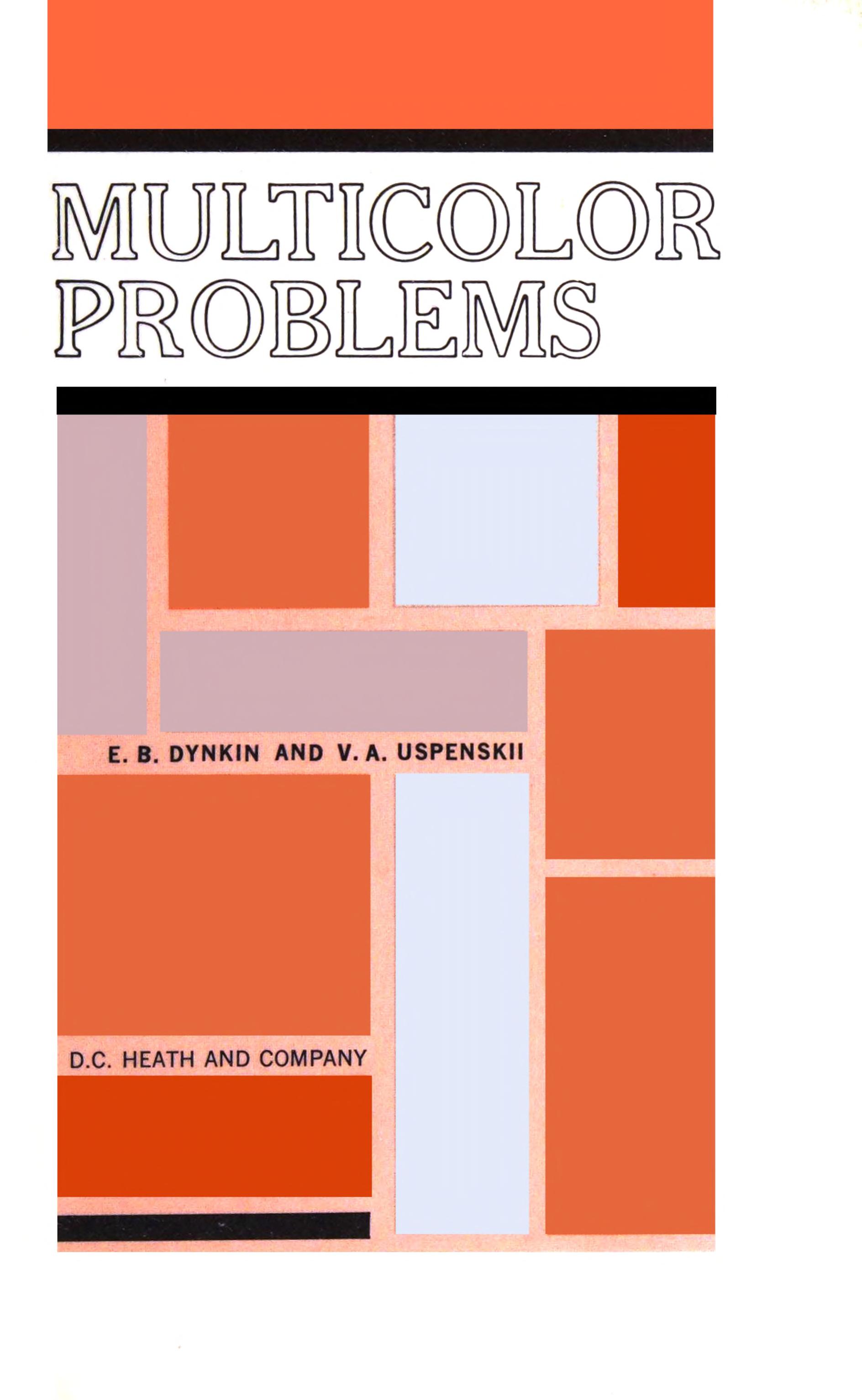
Multicolor Problems ( Mathematical Conversations Part 1) – Dynkin, Uspenskii

In this post, we will see the book Multicolor Problems ( Mathematical Conversations Part 1) by E. B. Dynkin and V. A. Uspenskii.

About the book

Multicolor Problems is a translation of Part One of Mathe­matical Conversations by E. B. Dynkin and V. A. Uspenskii, which was published in the Russian series. Library of the Mathematics Circle. The originality of the exposition and the variety of the problems presented here make this booklet especially useful in stimulating an inventive approach to mathematics.
This booklet deals with several of the classical map-coloring problems. The technique is one of developing an ordered presentation of problems and extensive solutions to them. A discussion of the famous four-color problem, which has puz­zled mathematicians for nearly a century, is included.
The booklet is designed for the reader’s active participation, as the problems are carefully integrated with the text and should be solved in sequence. The reader should have a back­ ground of high school algebra and should also be acquainted with the method of mathematical induction.
E. B. DYNKIN, a Professor at Moscow State University, is an eminent mathematician and author, whose specialties are higher algebra, topology, and probability theory. V. A. USPENSKII, a Lecturer at Moscow State University, spe­ cializes in mathematical logic.

The book was translated from Russian by was published in 1962. There is a recent volume by Dover which has all three parts in one book.

Credits to original uploader.

You can get the book here.

Follow us on The Internet Archive: https://archive.org/details/@mirtitles

Follow Us On Twitter: https://twitter.com/MirTitles

Write to us: mirtitles@gmail.com

Fork us at GitLab: https://gitlab.com/mirtitles/

Add new entries to the detailed book catalog here.

Contents

Introduction 1

CHAPTER 1. Coloring with Two Colors 3

1. Simple two-color problems 3
2. Problems on square boards 5
3. Problems involving even and odd numbers 6
4. Networks and maps 7
5. General two-color problems 9

CHAPTER 2. Coloring with Three Colors 12

6. A simple three-color problem 12
7. Problems on hexagonal boards 12
8. Dual diagrams 14
9. Triangulation 16
10. Dual maps 19
11. Normal maps in three colors 23

CHAPTER 3. The Four-Color Problem 24

12. Normal maps in four colors 24
13. Volynskii’s theorem 25

CHAPTER 4. The Five-Color Theorem 27

14. Euler’s theorem 27
15. The five-color theorem 32

Concluding Remarks 33

Appendix 34
Coloring a sphere with three colors 34

Solutions to Problems 40

Bibliography 66

Posted in books, mathematics, soviet | Tagged , , , , , , , , , , , , , | Leave a comment