https://archive.org/details/sedov-mecanique-des-milieux-continus-tome-2-mir-1975
https://archive.org/details/sedov-mecanique-des-milieux-continus-tome-1-mir-1975
https://archive.org/details/sedov-mecanique-des-milieux-continus-tome-2-mir-1975
https://archive.org/details/sedov-mecanique-des-milieux-continus-tome-1-mir-1975
En este post, veremos el libro Algebra y análisis defunciones elementales por M. Potápov; V. Alexándrov; S. Pasichenko.
Un libro de álgebra con análisis de funciones elementales,
Nota: La calidad del escaneo es deficiente.
Traducido del ruso por el ingeniero K. P. Medkov.
Publicado por Editorial Mir en 1986.
Créditos al cargador original.
Puedes conseguir el libro aquí.
(Disculpe los errores, he utilizado la traducción automática.)
Síguenos en el Archivo de Internet: https://archive.org/details/@mirtitles
Síguenos En Mastodon: https://mastodon.world/@mirtitles
Síguenos En Twitter: https://twitter.com/MirTitles
Escríbanos a: mirtitles@gmail.com
Únete a nosotros en GitLab: https://gitlab.com/mirtitles/
Agregue nuevas entradas al catálogo detallado de libros aquí.
Contenido
In this post, we will see the book Geometric Shell Stability Theory by A. V. Pogorelov.
Translation of Geometricheskaya Teoriya Ustoychivosti Obolochek, Izd-vo “Nauka”, Moscow, 1966, pages 296.Covers fundamental aspects of geometric shells and their stability under stress and strain conditions.
Credits to original uploader.
You can get the book here.
Follow us on The Internet Archive: https://archive.org/details/@mirtitles
Follow us on Mastodon: https://mastodon.world/@mirtitles
Follow Us On Twitter: https://twitter.com/MirTitles
Write to us: mirtitles@gmail.com
Fork us at GitLab: https://gitlab.com/mirtitles/
Add new entries to the detailed book catalog here.
This book is a revised and enlarged edition of B. A. Pavlov and A. P. Terentyev’s widely known textbook of organic chemistry. Several sections and subsections have been completely rewritten by Professor A. P. Terentyev, who has also edited the book as a whole. The theoretical sections have been supplemented with an exposition of the modern concepts of single, multiple, and conjugated bonds, benzene structure, orientation rules, catalysis, tagged atom techniques in organic chemistry, etc. Special attention in the presentation of the factual material is given to compounds with practical applications in the national economy. New information has been included concerning synthetic polymors, plastics, chemical fibres and dyes, as well as organosilicon, organoarsenic, and organophosphorus compounds.
BORIS PAVLOV, Candidate of Pedagogical Sciences, is a well-known lecturer in general, inorganic, and organic chemistry. He has written several valuable books on teaching methods is the author of the textbooks ORGANIC CHEMISTRY and INORGANIC CHEMISTRY for teachers’ colleges.
ALEXANDER TERENTYEV, Corresponding Member of the Academy of Sciences of the U.S.S.R., is Professor of Organic Chemistry at Moscow University. The founder of the Soviet school of organic analysis, he has considerably enriched this field of chemistry with new reactions, techniques, and apparatus. His work in the sulphonation of organic compounds has won him the National Prize.
Alexander Terentyev is a leading authority on the stereochemistry of organic compounds. He is the author f a special course in the stereochemistry of organic compounds, which has become part of the curriculum of the Department of Chemistry at Moscow University. His numerous books include THE STEREOCHEMISTRY OF ORGANIC COMPOUNDS, CHEMICAL LITERATURE AND HOW TO USE IT, and ORGANIC CHEMISTRY. He has written more than 400 scientific papers, which cover a wide range of subjects in the fields of heterocyclic compounds, physiologically active substances, and complex compounds.
The book was translated from Russian by Boris Belitsky and was published in 1969 by Mir Publishers.
Original scan by servants of knowledge.
Note: There is heavy warping on some of the pages.
You can get the book here.
Follow us on The Internet Archive: https://archive.org/details/@mirtitles
Follow us on Mastodon: https://mastodon.world/@mirtitles
Follow Us On Twitter: https://twitter.com/MirTitles
Write to us: mirtitles@gmail.com
Fork us at GitLab: https://gitlab.com/mirtitles/
Add new entries to the detailed book catalog here.
Contents
This Handbook of Analytical Chemistry is intended for scientific workers, and chemistry students in universities, polytechnics, and technical colleges. It can be used in solving various problems (both calculating and experimental) concerning general chemistry, analytical chemistry, chemical technology, and so forth.
The book was translated from Russian by Nicholas Bobrov and was published in 1978 by Mir Publishers.
Note: There is heavy warping on some pages
Original scan by servants of knowledge
You can get the book here.
Follow us on The Internet Archive: https://archive.org/details/@mirtitles
Follow us on Mastodon: https://mastodon.world/@mirtitles
Follow Us On Twitter: https://twitter.com/MirTitles
Write to us: mirtitles@gmail.com
Fork us at GitLab: https://gitlab.com/mirtitles/
Add new entries to the detailed book catalog here.
Contents
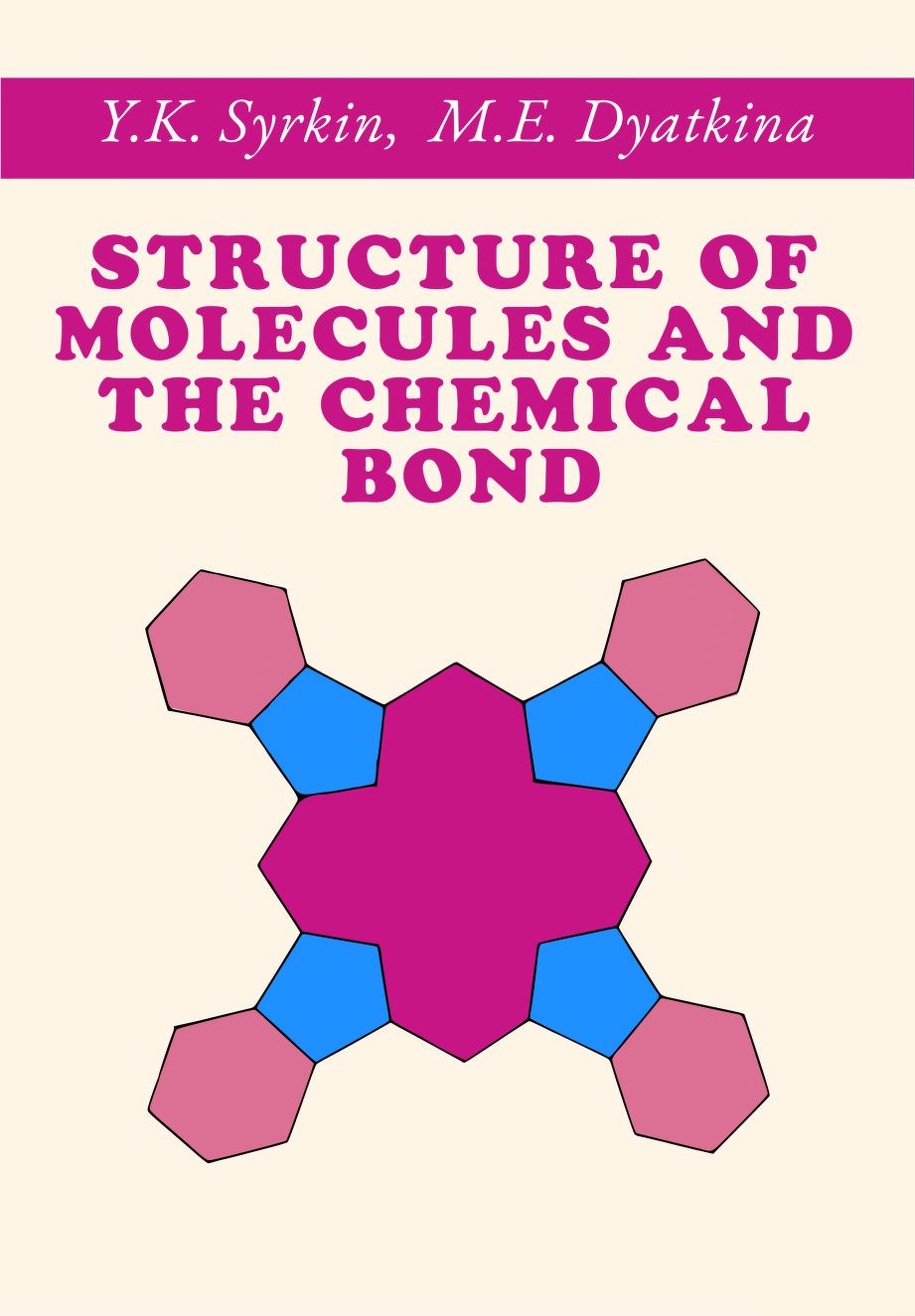
This book presents a coherent, comprehensive account of structural chemistry—a complex, but important area of modern chemistry. The authors, two outstanding Russian scientists, have furnished a well-balanced wave mechanical treatment of the field. Throughout the book, they have endeavored to link theoretical aspects with practical measurements so that the reader can properly grasp recent developments and problems.
The book begins with a general survey of atomic structure (covering the Rutherford- Bohr model, the developments of wave mechanics and its relation to periodic classi fication of the elements). The emergence of ideas on chemical binding is discussed, particularly in reference to covalency and resonance—using the Heitler-London atomic orbital method as a basis for the treatment. Chapters cover the homopolar bond (with an examination of the Pauli Principle), saturation and direction of valency bonds, resonance of valency structures, and resonance of covalent and ionic states.
The authors then take up the molecular orbital method and its application to diatomic and polyatomic molecules. They consider a number of highly significant topics: spec tral measurements, dipole moments, bond energies and intermolecular attraction; crystal structure and chemical binding; etc. An extensive account of complex com pounds follows. This chapter deals with metallic carbonyls, nitrosyl and nitro com pounds, cyanides, halogen compounds, and the like. Apart from the Heitler-London treatment of the homopolar bond, all mathematical derivations are postponed to three chapters at the end of the book. Thus, the non-mathematical reader with an average chemistry background can simply omit this final section and still be assured that he has a thoroughly sound introduction to the subject.
A great virtue of the book is that it brings together between the covers of a single volume a large amount of theoretical material and experimental data otherwise to be found only in scattered books and periodicals. And it presents this material in a form intelligible to a great many readers who would ordinarily be put off by the more advanced texts in which these topics are usually discussed. Practicing chemists and students will find this an exceptionally useful addition to their working libraries.
The book was translated from Russian by Translated and revised by M. A. Partridge and D. O. Jordan was published in 1964.
Credits to original uploader.
Original scan by DLI.
You can get the book here.
Follow us on The Internet Archive: https://archive.org/details/@mirtitles
Follow us on Mastodon: https://mastodon.world/@mirtitles
Follow Us On Twitter: https://twitter.com/MirTitles
Write to us: mirtitles@gmail.com
Fork us at GitLab: https://gitlab.com/mirtitles/
Add new entries to the detailed book catalog here.
Contents
A survey of the resolved and unresolved problems of planetary physics is presented. The contribution of worldwide research in the fields of astronomy, surface astronomy, space technology and other fields to planetary physics is reviewed. A list of physical constants for all planets and their satellites is given.
Translation of “Planety: Reshennyye i Nereshennyye Problemy.”
“Nauka” Press, Moscow, 1970
Credits to original uploader.
You can get the book here.
Follow us on The Internet Archive: https://archive.org/details/@mirtitles
Follow us on Mastodon: https://mastodon.world/@mirtitles
Follow Us On Twitter: https://twitter.com/MirTitles
Write to us: mirtitles@gmail.com
Fork us at GitLab: https://gitlab.com/mirtitles/
Add new entries to the detailed book catalog here.
In this post, we will see the book Outer Space And Man.
This book has appeared now for the very reason that it didn’t appear 20 centuries or half a century ago—because of speed. Jules Verne’s Around the World in Eighty Days required a speed of 500 kilometres a day. Outer Space and Man requires escape velocity at least.Before the reader embarks on this book we should like to give him a warning. It has several qualities which, if not mentioned in advance, may escape his attention, and he may not like the book so much—which would be a pity.We hope that this book will be easy to read. We should like the reader to smile occasionally and to stop and think occasionally, but never to wrinkle his brow trying to recall some for gotten textbook formula. We know that no one has tried to define cosmic humour, but we have
seen Gagarin’s smile and we make so bold as lo claim that if people didn’t know how to laugh they would never have entered outer space.But this is not a funny’ book. It has no formulas, but it does have numbers. It has words like “orbit”, “parsec”, and even “explo sive decompression”. When it was finished all the authors and editors reread it, and each one understood many things, and all together they understood everything. In any case, the reader will probably realize that outer space is not tobe trilled with.The book is far from comprehensive. Manythings have not been reflected, described or even mentioned. But why speak of omissions? If it contained everything about outer space it would be another kind of book which we should be unable to judge.When the authors got down to work they knew of only two Soviet cosmonauts. By the time they had finished there were eleven. The ink will dry on the printed pages, the reader will get to the last part and then how many will there be?We can only guess how many new cos monauts there will be and what new exploits they will have performed.Per aspera ad astra—through difficulties to the stars—the ancients used to say. They prayed humbly to their gods and dreamed meekly of heaven.
Note: Original scan had a lot of warping, some pages still have them after corrections.
Translated from the Russian by Vladimir Talmy
Original Scan by Servants of Knowledge
You can get the book here.
Follow us on The Internet Archive: https://archive.org/details/@mirtitles
Follow us on Mastodon: https://mastodon.world/@mirtitles
Follow Us On Twitter: https://twitter.com/MirTitles
Write to us: mirtitles@gmail.com
Fork us at GitLab: https://gitlab.com/mirtitles/
Add new entries to the detailed book catalog here.
List of contributors
M. Arlazorov
F. Arsky
V. Azernikov
S. Bakanov
I. Belousov
D. Bilenkin
N. Eidelman
A. Emme
V. Fedchenko
S. Gushchev
Y. Kalinin
G. Kazarnovskaya
V. Keler
B. Konovalov
Y. Kreindlin
L. Lebedev
M. Podgorodnikov
I. Rabinovich
L. Repin
G. Smolyan
V. Titarenko
T. Topilina
I. Vatel
L. Vladimirov
V. Yelagin
F. Yereshko
S. Zhurbina
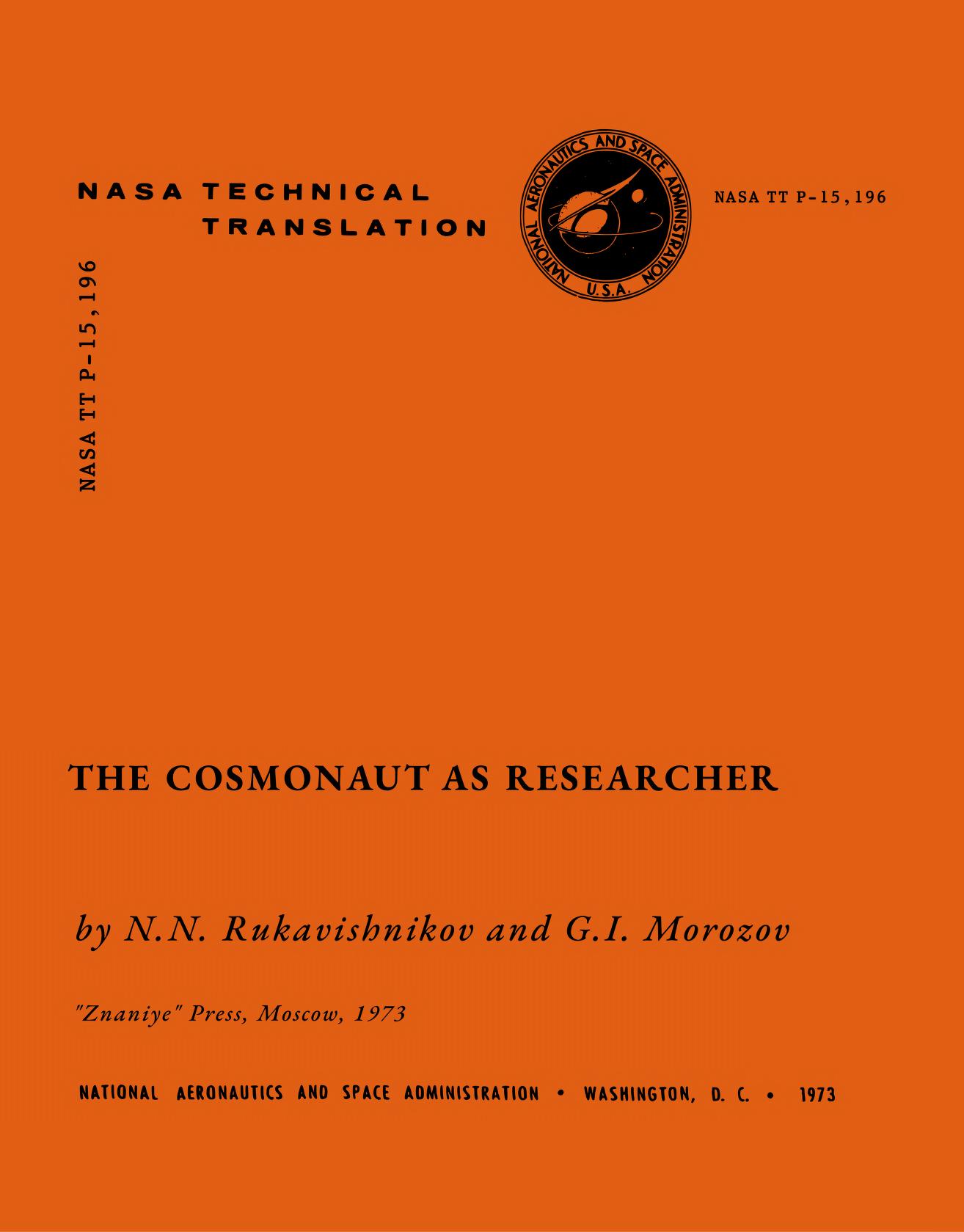
In this post, we will see the book The Cosmonaut As A Researcher by N. N. Rukavishnikov; G. I. Morozov.
This pamphlet discusses in popular form the studies performedby cosmonauts on spacecraft. The possibilities which have opened up for science due to experiments carried out directly in space are discussed, as well as certain interesting results already obtained from the flights of cosmonauts. The cosmonaut profession and flight training are examined in detail. Future trends in the development of manned space technology are briefly investigated. The pamphlet is designed for a wide circle of readers who are interested in the problems of human space flight.
Translation of: “Kosmonavt-issledovatel1”,
Novoye vZhizni, Nauke, Tekhnike, Seriya
“Kosmanavtika, Astronomiya”, No. 9, Moscow,
“Znaniye” Press, 1973- 64 pp.
You can get the book here.
Follow us on The Internet Archive: https://archive.org/details/@mirtitles
Follow us on Mastodon: https://mastodon.world/@mirtitles
Follow Us On Twitter: https://twitter.com/MirTitles
Write to us: mirtitles@gmail.com
Fork us at GitLab: https://gitlab.com/mirtitles/
Add new entries to the detailed book catalog here.
This study aid is based on many years’ experienceof lecturing on mathematical analysis at the firstcourse at the physics faculty of Moscow University. Itis intended for students as well as for teachers, especiallyyoung ones, who are starting their lecturing career.The hook covers the analysis of functions of one variable,including the concepts of Lebesgue measure andLebesgue integral. It is not a collection of problems inthe ordinary sense. As can be seen from its structure, itsaim is to help the student master the material both activelyand informally. As a rule, the material in each sectionis divided into four subsections.
The book was translated from Russian by Irene Aleksanova was published in 1988 by Mir Publishers.
You can get the book here.
Follow us on The Internet Archive: https://archive.org/details/@mirtitles
Follow us on Mastodon: https://mastodon.world/@mirtitles
Follow Us On Twitter: https://twitter.com/MirTitles
Write to us: mirtitles@gmail.com
Fork us at GitLab: https://gitlab.com/mirtitles/
Add new entries to the detailed book catalog here.
Contents