
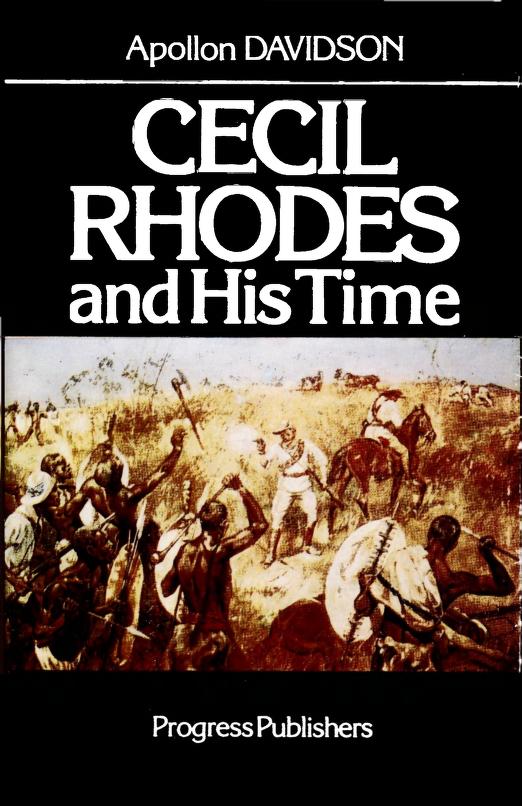
Cecil Rhodes…
He has been spoken and written about for a hundred years. Do we really need yet another book?
And does his time, the age when the world was divided up by the European countries using people like Rhodes, really need to be written about again? After all, the age of colonialism is past.
When undertaking this book, the author believed that only now that the political dominance of colonialism has ended can one truly grasp this phenomenon as a whole. And this must be done since the imprint of colonialism still remains on states, and even continents, and on the lives and characters of their inhabitants.
The figure of Rhodes helps one to understand a great deal about how colonialism functioned and about the psychology of people of that time. Why did Rhodes become a symbol of the largest empire in the history of mankind? Why was it Rhodes who became the idol of colonialism in the epoch of the division of the world? And what impression did his personality leave on the nature of colonialism?
These are some of the questions which the book tries to answer.
Translated from the Russian by Christopher English
Designed by Oleg Grebenyuk
Jacket: The battle of the Umguza (April 22, 1896). reproduced from Oliver Ransford’s book Bulawayo: Historic Battleground of Rhodesia, Cape Town, 1968.
Title page: A late nineteenth-century map of Southern Africa showing the countries conquered by Rhodes (from the book Rhodes by J. G. Lockhart and Hon. C. M. Woodhouse, London, 1963).
You can get the book here and here
This is a cleaned, optimised scan.
Follow us on
Twitter https://x.com/MirTitles
Mastadon https://mastodon.social/@mirtitles
Bluesky https://bsky.app/profile/mirtitles.bsky.social
Tumblr https://www.tumblr.com/mirtitles
Internet Archive https://archive.org/details/mir-titles
Fork us on gitlab https://gitlab.com/mirtitles
Contents
Page
6 Testament of a Young Man
The Gold and Diamond King
26 “How Cecil Rhodes Made His Fortune”
64 His Road to Politics
79 Battle of the Magnates
Hero of the Day
96 The Land of Ophir Between the Zambezi and the Limpopo
120 From the “White Queen” to Inkosi Lobengula
165 Setting Up His Own State
182 His First Military Campaign
214 And the First War
239 The Idol of His Day
Instigator of the Boer War
262 The Conspiracy Against the Afrikaners
286 Rhodesia Against Rhodes
314 Mere Setback or Utter Debacle?
338 “Terug na Die Ou Transvaal” (“Back to the Old Transvaal”)
370 Fading Away
393 Conclusion
400 Appendix
416 References
436 Name Index


