
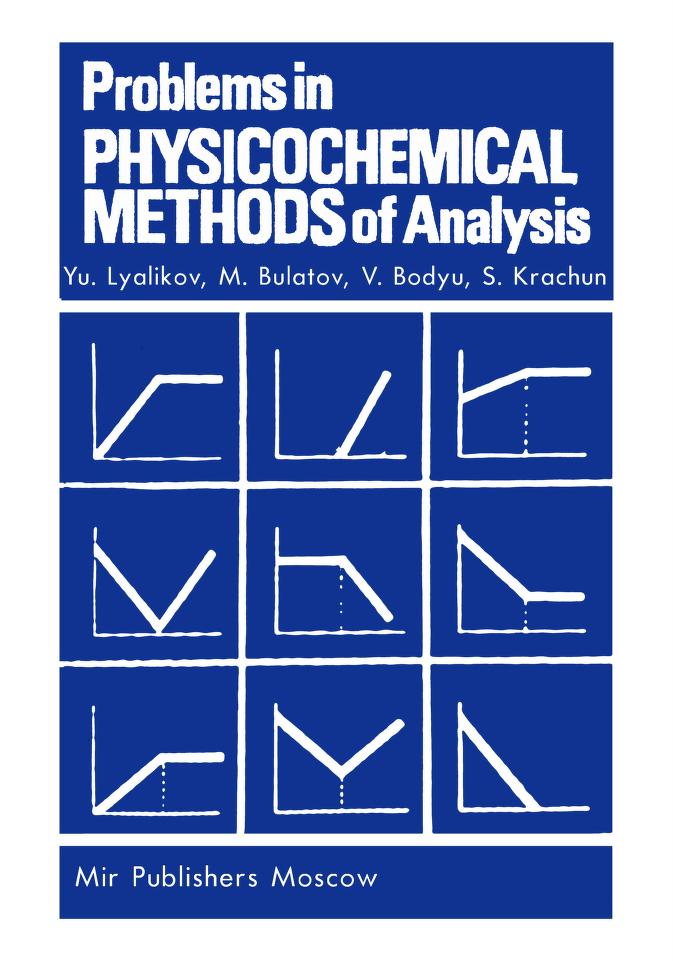
Our physico-chemical analysis methods are included in the curricula of many educational institutions. However, these topics are often given little emphasis in textbooks and manuals. The authors of this problem book aim to fill this gap by presenting problems in key physico-chemical analysis methods and substance separation techniques. Since programmed instruction methods have recently been introduced at higher education levels, each chapter includes assignments for programmed questioning.
Most chapters consist of the following sections:
- Examples of problem-solving.
- Multivariate problems: covering simple calculations based on specific formulas or laws.
- Problems of types A, B, and C:
- Type A problems are intended for college students and workers in laboratory settings.
- Type B problems are more complex, designed for university and higher education students.
- Type C problems require literature-based data, intended for advanced students in physico-chemical analysis.
In some Type B and C problems, physico-chemical methods are used to determine constants such as solubility products and complex formation constants.
- Programmed questioning assignments: These are structured based on multiple-choice, linear, variants, and detailed-answer principles, with the student selecting or pairing correct answers from given options. Some assignments involve machine learning components to aid skill development in using reference literature.
For certain problems, marked with an asterisk, some information (e.g., densities, oxidation-reduction potentials) is omitted intentionally. The recommended reference book for these problems is “Handbook of Chemistry” by N.A. Lange (McGraw-Hill, 1961).
For more advanced problems (marked with double asterisks), detailed solutions are provided at the end of the book, guiding students through complex problem-solving methods. Students should avoid relying on these solutions prematurely.
A list of recommended books for further study and theoretical foundations of physico-chemical methods is provided at the end of the book.
The authors express their deep gratitude to Professors K.N. Mochalov and Yu.A. Klyachko for their valuable suggestions and advice, which contributed to the improvement of the manuscript.
This problem book is the first attempt to compile a text of this kind, and the authors welcome any feedback and suggestions to further enhance the book.
Translated from the Russian by Artavaz Bek Nazarov.
You can get the book here and here
Follow us on
Twitter https://x.com/MirTitles
Mastadon https://mastodon.social/@mirtitles
Bluesky https://bsky.app/profile/mirtitles.bsky.social
Tumblr https://www.tumblr.com/mirtitles
Internet Archive https://archive.org/details/mir-titles
Fork us on gitlab https://gitlab.com/mirtitles


