
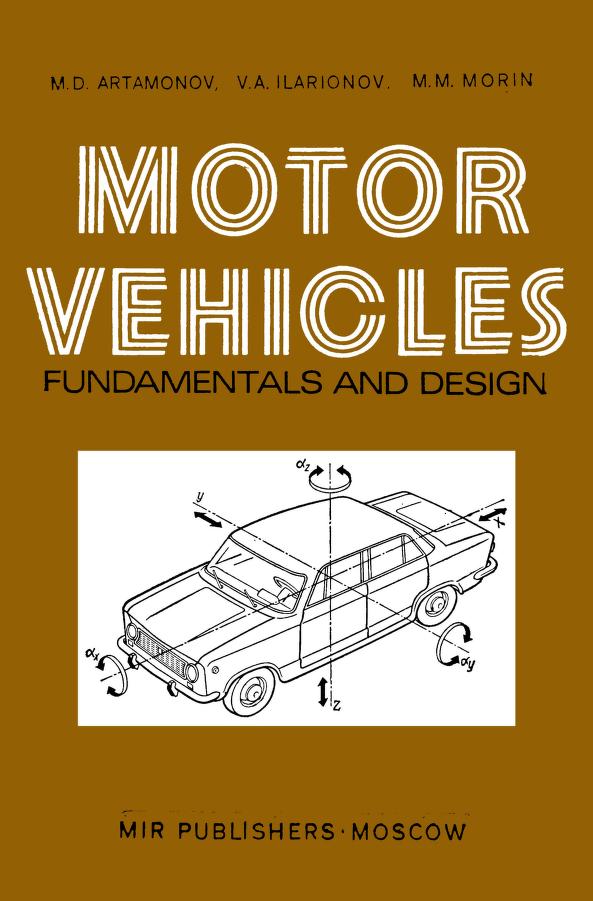
This book provides a systematic treatment of the theory of automobile engines and motor vehicles, beginning with the fundamental thermodynamic and combustion processes that govern internal-combustion engines. It examines theoretical and actual engine cycles, fuel combustion, engine efficiency, performance characteristics, fuel economy, and methods for increasing power and improving efficiency. The discussion also considers emerging engine technologies, including gas-turbine installations, supercharging, fuel injection, rotor-piston engines, multi-fuel engines, and electric motors.
The second part focuses on the theory and performance of motor vehicles. It covers the forces acting on vehicles, traction and braking dynamics, fuel economy, stability, steerability, cross-country ability, smoothness of run, and transmission systems. Particular attention is given to the relationships between vehicle design, operating conditions, road characteristics, and performance, making the book useful for understanding both the engineering principles underlying motor vehicles and their practical behaviour under different operating conditions.
Translated from the Russian by A. Troitsky
You can get the book here and here
Follow us on
Twitter https://x.com/MirTitles
Mastadon https://mastodon.social/@mirtitles
Bluesky https://bsky.app/profile/mirtitles.bsky.social
Tumblr https://www.tumblr.com/mirtitles
Internet Archive https://archive.org/details/mir-titles
Fork us on gitlab https://gitlab.com/mirtitles
CONTENTS
Introduction
PART ONE. THEORY OF AUTOMOBILE ENGINES
Chapter I. Theoretical Cycles of Internal-Combustion Engines
1.1. Constant-Volume Cycle
1.2. Compound Cycle
Chapter II. Combustion of Fuel
2.1. Reaction of Burning
2.2. Combustible Mixture and Products of Combustion
2.3. Heat of Combustion (Heating Value) of Fuel and Mixture
2.4. Heat Capacity of Charge and Combustion Products
Chapter III. Actual Cycles of Internal-Combustion Engines
3.1. Process of Admission
3.2. Process of Compression
3.3. Process of Combustion
3.4. Process of Expansion
3.5. Process of Exhaust
Chapter IV. Basic Parameters and Engine Efficiency
4.1. Mean Indicated Pressure, Indicated Power and Fuel Economy
4.2. Effective (Brake) Power and Engine Fuel Economy
4.3. Heat Balance of an Engine
4.4. Increasing the Power and Improving the Fuel Economy of the Engine
Chapter V. Characteristics of Engines
5.1. Speed Characteristics
5.2. Load Characteristics
5.3. Adjustment Characteristics
5.4. Detonation Characteristics
Chapter VI. Future Developments of Motor Vehicle Engines
6.1. Automobile Gas-Turbine Installations
6.2. Supercharging of Engines
6.3. Injection of Light Fuel
6.4. Fuel Spray Ignition
6.5. Rotor-Piston Engines
6.6. Multi-Fuel Engines
6.7. Electric Motors
PART TWO. THEORY OF MOTOR VEHICLES
Chapter VII. Forces Acting on a Motor Vehicle
7.1. Tractive Force on the Driving Wheels
7.2. Traction Characteristic of a Motor Vehicle
7.3. Road Resistance
7.4. Air Resistance
7.5. Equation of Motion of a Motor Vehicle
7.6. Tractive Force According to Conditions of Tyre-Road Grip
7.7. Normal Reactions of the Road
Chapter VIII. Traction Dynamics of a Motor Vehicle
8.1. Force Balance
8.2. Power Balance
Chapter IX. Dynamic Certificate of a Motor Vehicle
9.1. Dynamic Factor
9.2. Dynamic Certificate
9.3. Acceleration
9.4. Gradient Climbing
9.5. Coasting
9.6. Overtaking
Chapter X. Fuel Economy of a Motor Vehicle
10.1. Fuel Economy Characteristics
10.2. Fuel Consumption Equation
10.3. Effect of Operating Factors on Fuel Economy
10.4. Fuel Consumption Rate
Chapter XI. Braking Dynamics of a Motor Vehicle
11.1. General on Braking Dynamics
11.2. Experimental Estimation of the Braking Properties of a Motor Vehicle
11.3. Braking Force on Wheels
11.4. Equation of Motion of a Motor Vehicle during Braking
11.5. Characteristics of a Motor Vehicle Braking Dynamics
11.6. Braking Force Distribution Between the Wheels
11.7. Braking Methods
11.8. New Features in the Design of Brake Systems
11.9. Technical Examination of Traffic Accidents
Chapter XII. Trailer Trains
12.1. Dynamic Characteristics of a Trailer Train
12.2. Fuel Economy of a Trailer Train
Chapter XIII. Stability of a Motor Vehicle
13.1. Lateral Stability Characteristics
13.2. Body Lateral Rolling
13.3. Effect of Operating Factors on Lateral Stability
13.4. Longitudinal Stability
Chapter XIV. Steerability of a Motor Vehicle
14.1. Steerability Characteristics
14.2. Rolling of the Steerable Wheels Without Slipping
14.3. Wheel Lateral Slip and Ability of a Motor Vehicle to Turn
14.4. Relation Between Angles of Turn of Steerable Wheels
14.5. Oscillations of the Steerable Wheels
14.6. Stabilization of the Steerable Wheels
Chapter XV. Cross-Country Ability of a Motor Vehicle
15.1. General on Cross-Country Ability
15.2. Trafficability Test
15.3. Geometrical Characteristics of Trafficability
15.4. Supporting and Tractive Characteristics of Trafficability
15.5. Effect of a Motor Vehicle Design on Its Cross-Country Ability
15.6. Self-Recovery Devices
15.7. Special Types of Cross-Country Vehicles
Chapter XVI. Smoothness of Run of a Motor Vehicle
16.1. General
16.2. Testing for Smooth Running
16.3. Characteristics of the Smoothness of Run
16.4. Oscillations of a Motor Vehicle
16.5. Effect of Design Factors on Smooth Running
Chapter XVII. Types of Transmission
Chapter XVIII. Future Developments of Motor Vehicle Designs
Index


